ABS SKODA SUPERB 2007 1.G / (B5/3U) Owner's Manual
[x] Cancel search | Manufacturer: SKODA, Model Year: 2007, Model line: SUPERB, Model: SKODA SUPERB 2007 1.G / (B5/3U)Pages: 259, PDF Size: 14.71 MB
Page 5 of 259
Contents
4
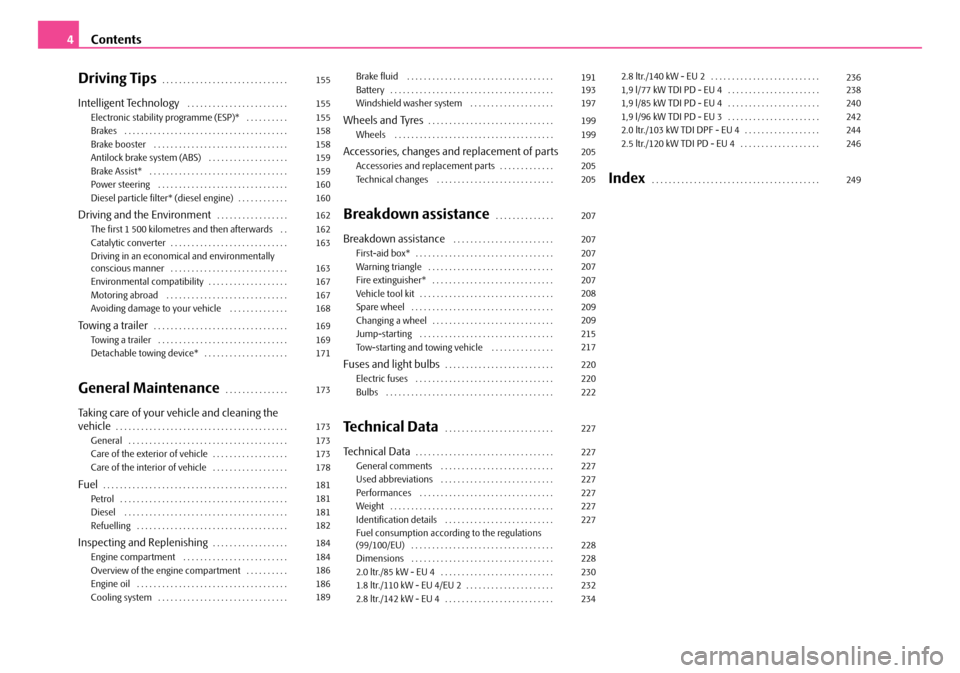
Driving Tips. . . . . . . . . . . . . . . . . . . . . . . . . . . . . .
Intelligent Technology . . . . . . . . . . . . . . . . . . . . . . . .
Electronic stability programme (ESP)* . . . . . . . . . .
Brakes . . . . . . . . . . . . . . . . . . . . . . . . . . . . . . . . . . . . . . .
Brake booster . . . . . . . . . . . . . . . . . . . . . . . . . . . . . . . .
Antilock brake system (ABS) . . . . . . . . . . . . . . . . . . .
Brake Assist* . . . . . . . . . . . . . . . . . . . . . . . . . . . . . . . . .
Power steering . . . . . . . . . . . . . . . . . . . . . . . . . . . . . . .
Diesel particle filter* (diesel engine) . . . . . . . . . . . .
Driving and the Environment. . . . . . . . . . . . . . . . .
The first 1 500 kilometres and then afterwards . .
Catalytic converter . . . . . . . . . . . . . . . . . . . . . . . . . . . .
Driving in an economical and environmentally
conscious manner . . . . . . . . . . . . . . . . . . . . . . . . . . . .
Environmental compatibility . . . . . . . . . . . . . . . . . . .
Motoring abroad . . . . . . . . . . . . . . . . . . . . . . . . . . . . .
Avoiding damage to your vehicle . . . . . . . . . . . . . .
To w i n g a t r a i l e r. . . . . . . . . . . . . . . . . . . . . . . . . . . . . . . .
Towing a trailer . . . . . . . . . . . . . . . . . . . . . . . . . . . . . . .
Detachable towing device* . . . . . . . . . . . . . . . . . . . .
General Maintenance. . . . . . . . . . . . . . .
Taking care of your ve hicle and cleaning the
vehicle. . . . . . . . . . . . . . . . . . . . . . . . . . . . . . . . . . . . . . . . .
General . . . . . . . . . . . . . . . . . . . . . . . . . . . . . . . . . . . . . .
Care of the exterior of vehicle . . . . . . . . . . . . . . . . . .
Care of the interior of vehicle . . . . . . . . . . . . . . . . . .
Fuel. . . . . . . . . . . . . . . . . . . . . . . . . . . . . . . . . . . . . . . . . . . .
Petrol . . . . . . . . . . . . . . . . . . . . . . . . . . . . . . . . . . . . . . . .
Diesel . . . . . . . . . . . . . . . . . . . . . . . . . . . . . . . . . . . . . . .
Refuelling . . . . . . . . . . . . . . . . . . . . . . . . . . . . . . . . . . . .
Inspecting and Replenishing. . . . . . . . . . . . . . . . . .
Engine compartment . . . . . . . . . . . . . . . . . . . . . . . . .
Overview of the engine compartment . . . . . . . . . .
Engine oil . . . . . . . . . . . . . . . . . . . . . . . . . . . . . . . . . . . .
Cooling system . . . . . . . . . . . . . . . . . . . . . . . . . . . . . . . Brake fluid . . . . . . . . . . . . . . . . . . . . . . . . . . . . . . . . . . .
Battery . . . . . . . . . . . . . . . . . . . . . . . . . . . . . . . . . . . . . . .
Windshield washer system . . . . . . . . . . . . . . . . . . . .
Wheels and Tyres. . . . . . . . . . . . . . . . . . . . . . . . . . . . . .
Wheels . . . . . . . . . . . . . . . . . . . . . . . . . . . . . . . . . . . . . .
Accessories, changes and replacement of partsAccessories and replacement parts . . . . . . . . . . . . .
Technical changes . . . . . . . . . . . . . . . . . . . . . . . . . . . .
Breakdown assistance. . . . . . . . . . . . . .
Breakdown assistance . . . . . . . . . . . . . . . . . . . . . . . .
First-aid box* . . . . . . . . . . . . . . . . . . . . . . . . . . . . . . . . .
Warning triangle . . . . . . . . . . . . . . . . . . . . . . . . . . . . . .
Fire extinguisher* . . . . . . . . . . . . . . . . . . . . . . . . . . . . .
Vehicle tool kit . . . . . . . . . . . . . . . . . . . . . . . . . . . . . . . .
Spare wheel . . . . . . . . . . . . . . . . . . . . . . . . . . . . . . . . . .
Changing a wheel . . . . . . . . . . . . . . . . . . . . . . . . . . . . .
Jump-starting . . . . . . . . . . . . . . . . . . . . . . . . . . . . . . . .
Tow-starting and towing vehicle . . . . . . . . . . . . . . .
Fuses and light bulbs. . . . . . . . . . . . . . . . . . . . . . . . . .
Electric fuses . . . . . . . . . . . . . . . . . . . . . . . . . . . . . . . . .
Bulbs . . . . . . . . . . . . . . . . . . . . . . . . . . . . . . . . . . . . . . . .
Technical Data. . . . . . . . . . . . . . . . . . . . . . . . . .
Te c h n i c a l D a t a. . . . . . . . . . . . . . . . . . . . . . . . . . . . . . . . .
General comments . . . . . . . . . . . . . . . . . . . . . . . . . . .
Used abbreviations . . . . . . . . . . . . . . . . . . . . . . . . . . .
Performances . . . . . . . . . . . . . . . . . . . . . . . . . . . . . . . .
Weight . . . . . . . . . . . . . . . . . . . . . . . . . . . . . . . . . . . . . . .
Identification details . . . . . . . . . . . . . . . . . . . . . . . . . .
Fuel consumption according to the regulations
(99/100/EU) . . . . . . . . . . . . . . . . . . . . . . . . . . . . . . . . . .
Dimensions . . . . . . . . . . . . . . . . . . . . . . . . . . . . . . . . . .
2.0 ltr./85 kW - EU 4 . . . . . . . . . . . . . . . . . . . . . . . . . . .
1.8 ltr./110 kW - EU 4/EU 2 . . . . . . . . . . . . . . . . . . . . .
2.8 ltr./142 kW - EU 4 . . . . . . . . . . . . . . . . . . . . . . . . . . 2.8 ltr./140 kW - EU 2 . . . . . . . . . . . . . . . . . . . . . . . . . .
1,9 l/77 kW TDI PD - EU 4 . . . . . . . . . . . . . . . . . . . . . .
1,9 l/85 kW TDI PD - EU 4 . . . . . . . . . . . . . . . . . . . . . .
1,9 l/96 kW TDI PD - EU 3 . . . . . . . . . . . . . . . . . . . . . .
2.0 ltr./103 kW TDI DPF - EU 4 . . . . . . . . . . . . . . . . . .
2.5 ltr./120 kW TDI PD - EU 4 . . . . . . . . . . . . . . . . . . .
Index . . . . . . . . . . . . . . . . . . . . . . . . . . . . . . . . . . . . . . . .
155
155
155
158
158
159
159
160
160
162
162
163
163
167
167
168
169
169
171
173
173
173
173
178
181
181
181
182
184
184
186
186
189 191
193
197
199
199
205
205
205
207
207
207
207
207
208
209
209
215
217
220
220
222
227
227
227
227
227
227
227
228
228
230
232
234236
238
240
242
244
246
249
NKO B5 20.book Page 4 Friday, March 2, 2007 1:46 PM
Page 7 of 259

Layout of this Owner's Manual (explanations)
6
Layout of this Owner's Manual (explanations)
The Owner's Manual has been systematically designed, in order to make it easy for
you to find and absorb the information you require.
Chapters, table of contents and subject index
The text of the manual are divided into re latively short sections which are combined
into easy-to-read chapters. The chapter you are reading at any particular moment
is highlighted at the bottom right of the page.
The Table of contents is arranged according to the chapters and the detailed
Subject index at the end of the Owner's Manual helps you to rapidly find the infor-
mation you are looking for.
Sections
The majority of Sections apply to all models.
Since there is a wide range of different equipment and options available it is clearly
unavoidable, despite dividing the contents into sections, that mention may be
made of equipment which is not fitted to your vehicle.
Equipment which is marked * is only standa rd on certain vehicle model versions or
only suppliable as optional equipment for certain models.
Brief information and instructions
Each section has a Heading.
This is followed by Brief information (in large italic lettering), which tells you the
subject which is dealt with in this section.
Most of the illustrations are accompanied by an Instruction (in relatively large
letters) which explains to you in a straig htforward way the action you have to take.
Work steps which have to be carried out are illustrated with a hyphen.
Notes
All four kinds of notes, which are used in the text, are always stated at the end of the
respective section.
WARNING
The most important notes are marked with the heading Warning. These
Warning notes draw your attention to a serious risk of accident or injury.
While reading the text you will frequently encounter a double arrow
followed by a small warning symbol. This symbol is intended to draw your
attention to a Warning note at the end of the section to which you must pay
careful attention.
Caution
A Caution note draws your attention to the po ssibility of damage to your vehicle
(e.g. damage to gearbox), or points out general risks of an accident.
For the sake of the environment
An Environmental note draws your attention to environmental protection aspects.
This is where you will, for example, find tips aimed at reducing your fuel consump-
tion.
Note
A normal Note draws your attention in a general way to important information.
Direction indications
All direction indications such as “left”, “right”, “front”, “rear” relate to the direction
of travel of the vehicle.
NKO B5 20.book Page 6 Friday, March 2, 2007 1:46 PM
Page 24 of 259
Instruments and Indicator/Warning Lights23
Using the systemSafetyDriving TipsGeneral MaintenanceBreakdown assistanceTechnical Data
WARNING
•If you do not pay attention to the warning lights coming on and the corre-
sponding descriptions and warning notes, this may result in severe body
injuries or major vehicle damage.
•The engine compartment of your car is a hazardous area. There is a risk
of injuries, scalding, accidents and fire when working in the engine
compartment, e.g. inspecting and replenis hing oil and other fluids. It is also
essential to observe all warnings ⇒page 185.
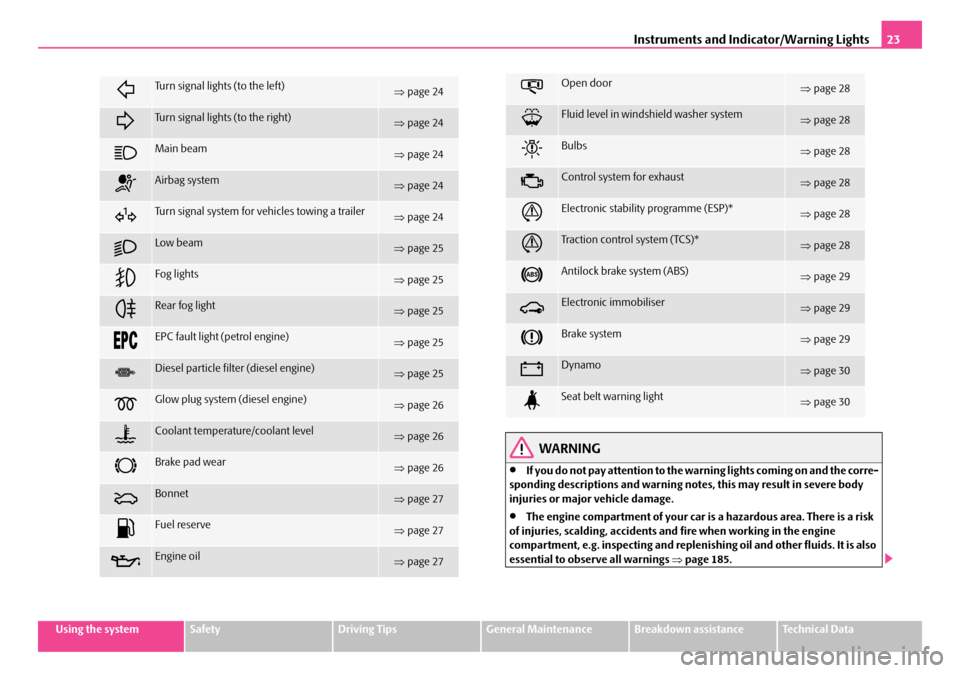
Turn signal lights (to the left)⇒ page 24
Turn signal lights (to the right)⇒page 24
Main beam⇒page 24
Airbag system⇒page 24
Turn signal system for vehicles towing a trailer⇒page 24
Low beam⇒page 25
Fog lights⇒page 25
Rear fog light⇒page 25
EPC fault light (petrol engine)⇒page 25
Diesel particle filter (diesel engine)⇒page 25
Glow plug system (diesel engine)⇒page 26
Coolant temperature/coolant level⇒page 26
Brake pad wear⇒page 26
Bonnet⇒page 27
Fuel reserve⇒page 27
Engine oil⇒page 27
Open door⇒page 28
Fluid level in windshield washer system⇒page 28
Bulbs⇒page 28
Control system for exhaust⇒page 28
Electronic stability programme (ESP)*⇒page 28
Tra c t i o n c o n t r o l s y s t e m ( TC S ) *⇒page 28
Antilock brake system (ABS)⇒page 29
Electronic immobiliser⇒page 29
Brake system⇒page 29
Dynamo⇒page 30
Seat belt warning light⇒page 30
NKO B5 20.book Page 23 Friday, March 2, 2007 1:46 PM
Page 29 of 259
Instruments and Indicator/Warning Lights
28
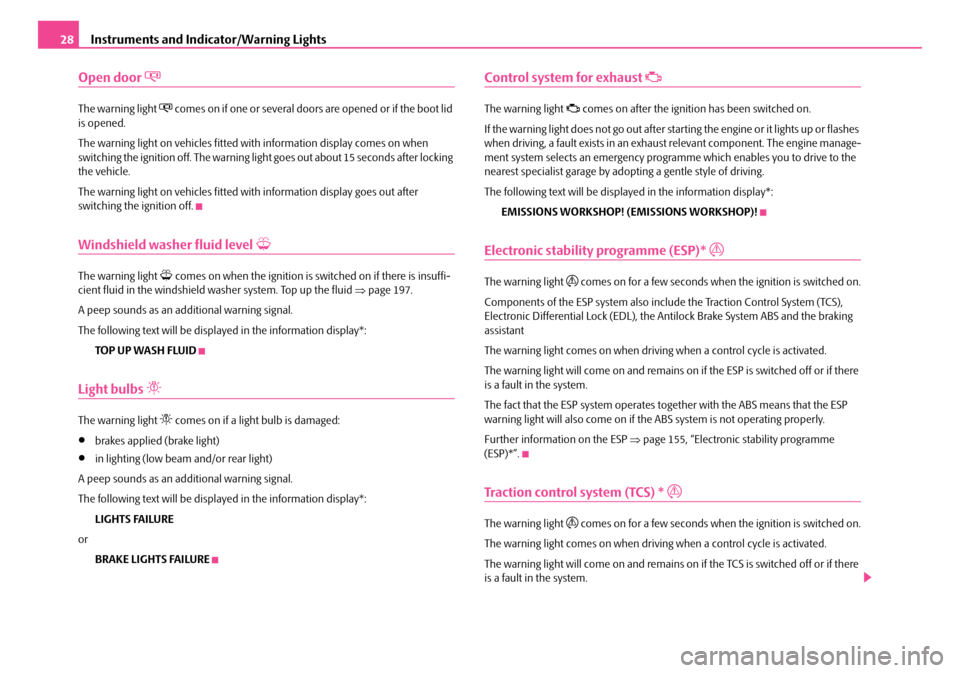
Open door
The warning light comes on if one or several doors are opened or if the boot lid
is opened.
The warning light on vehicles fitted wi th information display comes on when
switching the ignition off. The warning li ght goes out about 15 seconds after locking
the vehicle.
The warning light on vehicles fitted wi th information display goes out after
switching the ignition off.
Windshield washer fluid level
The warning light comes on when the ignition is switched on if there is insuffi-
cient fluid in the windshield washer system. Top up the fluid ⇒page 197.
A peep sounds as an additional warning signal.
The following text will be displayed in the information display*: TOP UP WASH FLUID
Light bulbs
The warning light comes on if a light bulb is damaged:
•brakes applied (brake light)
•in lighting (low beam and/or rear light)
A peep sounds as an additional warning signal.
The following text will be displayed in the information display*:
LIGHTS FAILURE
or BRAKE LIGHTS FAILURE
Control system for exhaust
The warning light comes on after the ignition has been switched on.
If the warning light does not go out after star ting the engine or it lights up or flashes
when driving, a fault exists in an exhaus t relevant component. The engine manage-
ment system selects an emergency programme which enables you to drive to the
nearest specialist garage by adopting a gentle style of driving.
The following text will be displayed in the information display*:
EMISSIONS WORKSHOP! (EMISSIONS WORKSHOP)!
Electronic stability programme (ESP)*
The warning light comes on for a few seconds when the ignition is switched on.
Components of the ESP system also include the Traction Control System (TCS),
Electronic Differential Lock (EDL), the Antilock Brake System ABS and the braking
assistant
The warning light comes on when drivin g when a control cycle is activated.
The warning light will come on and remains on if the ESP is switched off or if there
is a fault in the system.
The fact that the ESP system operates together with the ABS means that the ESP
warning light will also come on if the ABS system is not operating properly.
Further information on the ESP ⇒page 155, “Electronic stability programme
(ESP)*”.
Traction control system (TCS) *
The warning light comes on for a few seconds when the ignition is switched on.
The warning light comes on when drivin g when a control cycle is activated.
The warning light will come on and remains on if the TCS is switched off or if there
is a fault in the system.
NKO B5 20.book Page 28 Friday, March 2, 2007 1:46 PM
Page 30 of 259
Instruments and Indicator/Warning Lights29
Using the systemSafetyDriving TipsGeneral MaintenanceBreakdown assistanceTechnical Data
The fact that the TCS system operates together with the ABS means that the TCS
warning light will also come on if the
ABS system is not operating properly.
Further information about the TCS ⇒page 156, “Traction control system (TCS)*”.
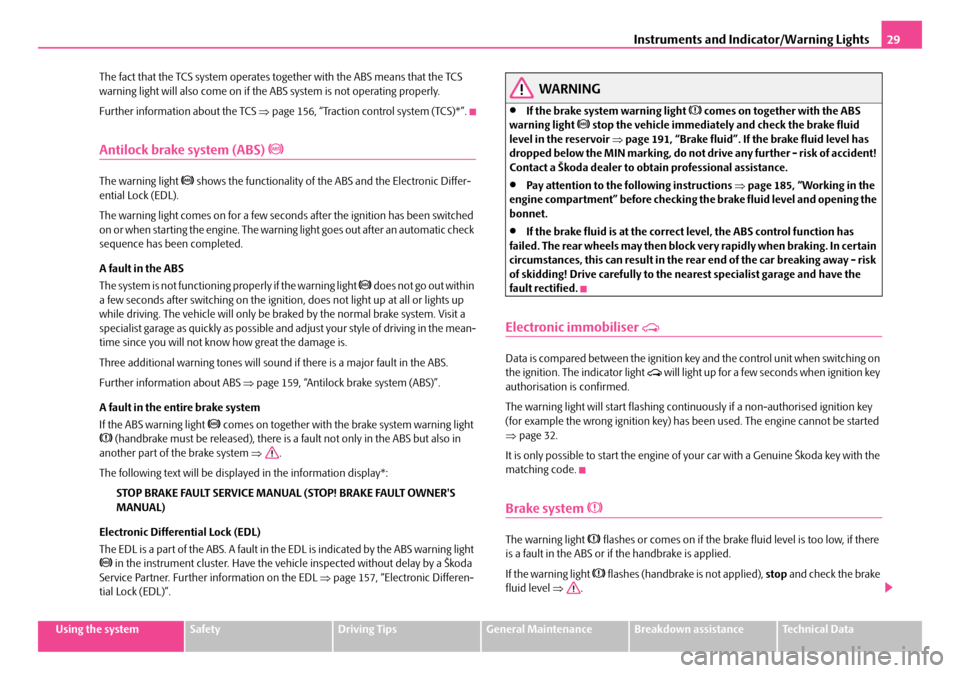
Antilock brake system (ABS)
The warning light shows the functionality of the ABS and the Electronic Differ-
ential Lock (EDL).
The warning light comes on for a few seconds after the ignition has been switched
on or when starting the engine. The warning light goes out after an automatic check
sequence has been completed.
A fault in the ABS
The system is not functioning properly if the warning light
does not go out within
a few seconds after switching on the ignition , does not light up at all or lights up
while driving. The vehicle will only be br aked by the normal brake system. Visit a
specialist garage as quickly as possible and adjust your style of driving in the mean-
time since you will not know how great the damage is.
Three additional warning tones will sound if there is a major fault in the ABS.
Further information about ABS ⇒page 159, “Antilock brake system (ABS)”.
A fault in the entire brake system
If the ABS warning light
comes on together with the brake system warning light (handbrake must be released), there is a fault not only in the ABS but also in
another part of the brake system ⇒.
The following text will be displayed in the information display*: STOP BRAKE FAULT SERVICE MANUAL (STOP! BRAKE FAULT OWNER'S
MANUAL)
Electronic Differential Lock (EDL)
The EDL is a part of the ABS. A fault in the EDL is indicated by the ABS warning light
in the instrument cluster. Have the ve hicle inspected without delay by a Škoda
Service Partner. Further information on the EDL ⇒page 157, “Electronic Differen-
tial Lock (EDL)”.
WARNING
•If the brake system warning light comes on together with the ABS
warning light stop the vehicle immediately and check the brake fluid
level in the reservoir ⇒page 191, “Brake fluid”. If the brake fluid level has
dropped below the MIN marking, do not drive any further - risk of accident!
Contact a Škoda dealer to obta in professional assistance.
•Pay attention to the following instructions ⇒ page 185, “Working in the
engine compartment” before checking the brake fluid level and opening the
bonnet.
•If the brake fluid is at the correct level, the ABS control function has
failed. The rear wheels may then block very rapidly when braking. In certain
circumstances, this can result in the rear end of the car breaking away - risk
of skidding! Drive carefully to the nearest specialist garage and have the
fault rectified.
Electronic immobiliser
Data is compared between the ignition ke y and the control unit when switching on
the ignition. The indicator light will light up for a few seconds when ignition key
authorisation is confirmed.
The warning light will start flashing conti nuously if a non-authorised ignition key
(for example the wrong ignition key) has been used. The engine cannot be started
⇒ page 32.
It is only possible to start the engine of your car with a Genuine Škoda key with the
matching code.
Brake system
The warning light flashes or comes on if the brake fluid level is too low, if there
is a fault in the ABS or if the handbrake is applied.
If the warning light
flashes (handbrake is not applied), stop and check the brake
fluid level ⇒ .
NKO B5 20.book Page 29 Friday, March 2, 2007 1:46 PM
Page 31 of 259
Instruments and Indicator/Warning Lights
30
The following text will be displayed in the information display*:
STOP BRAKE FLUID SERVICE MANUAL
If there is a fault in the ABS which also influences the function of the normal brake
system (e.g. distribution of brake pressure), the ABS warning light
comes on
together with the brake system warning light . Be aware that not only the ABS but
also another part of th brake system is defective ⇒.
3 peeps sound as an additional warning signal.
One should get used to high pedal forces, long braking distances and long free play
of the brake pedal when driving to the next specialist garage.
The following text will be displayed in the information display*: STOP BRAKE FAULT SERVICE MANUAL (STOP! BRAKE FAULT OWNER'S
MANUAL)
For further information on the brake system ⇒page 158, “Brakes”.
Handbrake applied
The warning light
also comes on if the handbrake is applied. An audible warning
is also given if you drive the vehicle for at least 3 seconds at a speed of more than 5
km/h.
The following text will be displayed in the information display*:
HANDBRAKE ON
WARNING
•Pay attention to the following instructions ⇒page 185, “Working in the
engine compartment” before checking the brake fluid level and opening the
bonnet.
•If the brake system warning light does not go out a few seconds after
switching on the ignition or comes on when driving, stop immediately and
check the brake fluid in the reservoir ⇒page 191, “Brake fluid”. If the fluid
level has dropped below the MIN marking, do not drive any further - risk of
accident! Contact a Škoda dealer to obtain professional assistance.
Alternator
The warning light comes on after the ignition has been switched on. It should go
out after the engine has started.
If the warning light
does not come on after the ignition is switched on, drive to
the nearest specialist garage.
If the warning light does not go out after the engine has started, or comes on when
driving, drive to the nearest specialist garage. The vehicle battery will be discharged
in this case so switch off all non-essential electrical components.
The following text will be displayed in the information display*:
ALTERNATOR WORKSHOP! (ALTERNATOR WORKSHOP!)
Caution
If the warning light comes on when driving and in addition the warning light
(cooling system fault) also comes on in display, you must then stop the car imme-
diately and switch the engine off - risk of engine damage!
Seat belt warning light
The warning light comes on for a few seconds after the ignition is switched on as
a reminder to fasten the seat belt.
If you do not fasten the seat belt, a long warning signal sounds for 6 seconds.
For further information on the seat belts ⇒page 130.
The following text will be displayed in the information display*: FASTEN SEATBELT
For further information on the seat belts ⇒page 130, “Seat belts”.
NKO B5 20.book Page 30 Friday, March 2, 2007 1:46 PM
Page 32 of 259
Unlocking and locking31
Using the systemSafetyDriving TipsGeneral MaintenanceBreakdown assistanceTechnical Data
Unlocking and locking
Key
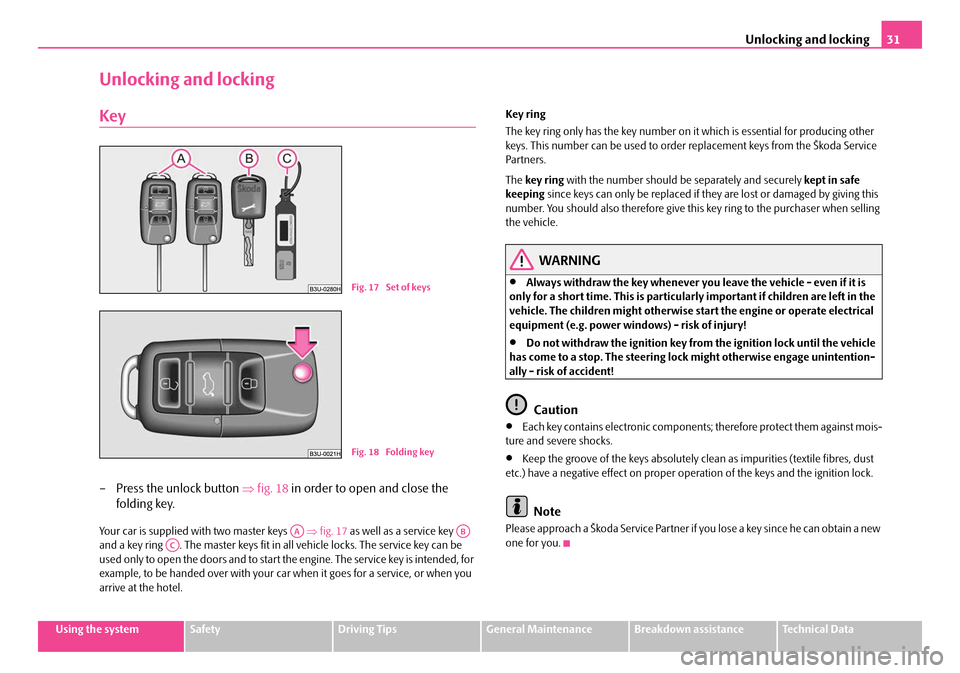
– Press the unlock button ⇒fig. 18 in order to open and close the
folding key.
Your car is supplied with two master keys ⇒fig. 17 as well as a service key
and a key ring . The master keys fit in all vehicle locks. The service key can be
used only to open the doors and to start the engine. The service key is intended, for
example, to be handed over with your car when it goes for a service, or when you
arrive at the hotel. Key ring
The key ring only has the key number on it
which is essential for producing other
keys. This number can be us ed to order replacement keys from the Škoda Service
Par tners.
The key ring with the number should be separately and securely kept in safe
keeping since keys can only be replaced if th ey are lost or damaged by giving this
number. You should also therefore give this key ring to the purchaser when selling
the vehicle.
WARNING
•Always withdraw the key whenever you leave the ve hicle - even if it is
only for a short time. This is particularly important if children are left in the
vehicle. The children migh t otherwise start the engine or operate electrical
equipment (e.g. power windows) - risk of injury!
•Do not withdraw the ignition key from the ignition lock until the vehicle
has come to a stop. The steering lock might otherwise engage unintention-
ally - risk of accident!
Caution
•Each key contains electronic components ; therefore protect them against mois-
ture and severe shocks.
•Keep the groove of the keys absolutely clean as impurities (textile fibres, dust
etc.) have a negative effect on proper op eration of the keys and the ignition lock.
Note
Please approach a Škoda Service Partner if you lose a key since he can obtain a new
one for you.
Fig. 17 Set of keys
Fig. 18 Folding key
AAABAC
NKO B5 20.book Page 31 Friday, March 2, 2007 1:46 PM
Page 79 of 259
Seats and Stowage
78
ments. It is therefore essential to pay a ttention to the fitting instructions supplied
with the roof luggage rack system.
•On models fitted with a power sliding/tilting roof, ensure that the opened
sliding/tilting roof does not strike any items of luggage transported on the roof.
For the sake of the environment
The increased aerodynamic drag results in a higher fuel consumption. One should
therefore take off the roof bar system after use.
Attachment points
Fitting
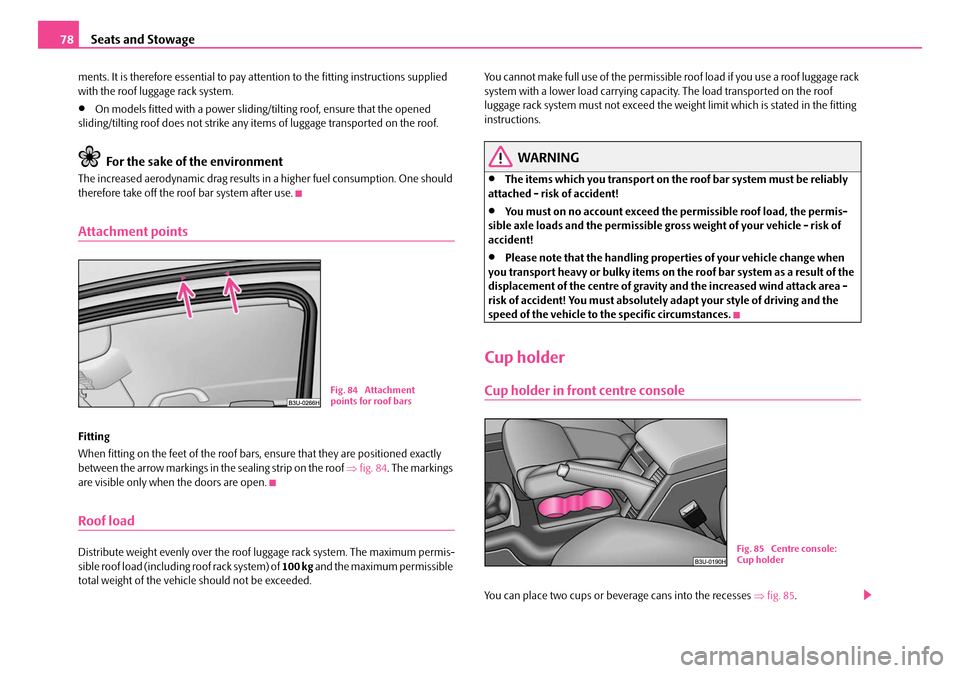
When fitting on the feet of the roof bars, ensure that they are positioned exactly
between the arrow markings in the sealing strip on the roof ⇒fig. 84 . The markings
are visible only when the doors are open.
Roof load
Distribute weight evenly over the roof luggage rack system. The maximum permis-
sible roof load (including roof rack system) of 100 kg and the maximum permissible
total weight of the vehicl e should not be exceeded. You cannot make full use of the permissible
roof load if you use a roof luggage rack
system with a lower load carrying capa city. The load transported on the roof
luggage rack system must not exceed the weight limit which is stated in the fitting
instructions.
WARNING
•The items which you transport on the roof bar system must be reliably
attached - risk of accident!
•You must on no account exceed the permissible roof load, the permis-
sible axle loads and the permissible gros s weight of your vehicle - risk of
accident!
•Please note that the handling prop erties of your vehicle change when
you transport heavy or bulky items on the roof bar system as a result of the
displacement of the centre of gravity and the increased wind attack area -
risk of accident! You must absolutely adapt your style of driving and the
speed of the vehicle to the specific circumstances.
Cup holder
Cup holder in front centre console
You can place two cups or beverage cans into the recesses ⇒fig. 85 .
Fig. 84 Attachment
points for roof bars
B1Z-0042HB1Z-0042HFig. 85 Centre console:
Cup holder
NKO B5 20.book Page 78 Friday, March 2, 2007 1:46 PM
Page 131 of 259
Seat belts
130
Seat belts
Why seat belts?
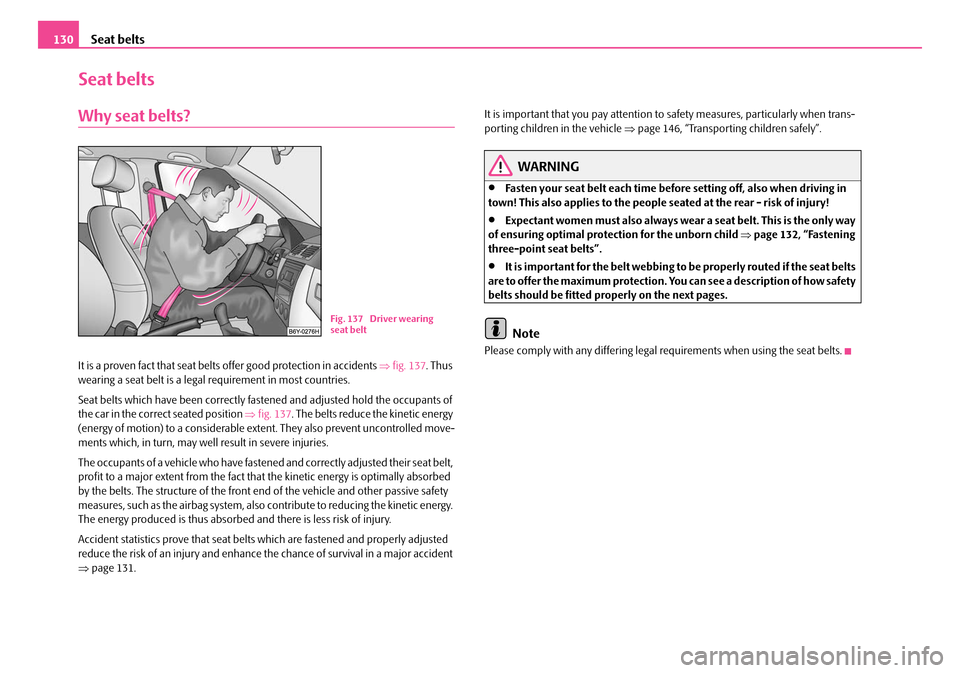
It is a proven fact that seat belt s offer good protection in accidents ⇒fig. 137 . Thus
wearing a seat belt is a legal requirement in most countries.
Seat belts which have been correctly fastened and adjusted hold the occupants of
the car in the correc t seated position ⇒fig. 137 . The belts reduce the kinetic energy
(energy of motion) to a considerable extent. They also prevent uncontrolled move-
ments which, in turn, may well result in severe injuries.
The occupants of a vehicle who have fastened and correctly adjusted their seat belt,
profit to a major extent from the fact that the kinetic energy is optimally absorbed
by the belts. The structure of the front end of the vehicle and other passive safety
measures, such as the airbag system, also contribute to reducing the kinetic energy.
The energy produced is thus absorbed and there is less risk of injury.
Accident statistics prove that seat belts which are fastened and properly adjusted
reduce the risk of an injury and enhance the chance of survival in a major accident
⇒ page 131. It is important that you pay attention to
safety measures, particularly when trans-
porting children in the vehicle ⇒ page 146, “Transporting children safely”.
WARNING
•Fasten your seat belt each time before setting off, also when driving in
town! This also applies to the people seated at the rear - risk of injury!
•Expectant women must also always wear a seat belt. This is the only way
of ensuring optimal protection for the unborn child ⇒page 132, “Fastening
three-point seat belts”.
•It is important for the belt webbing to be properly routed if the seat belts
are to offer the maximum protection. You can see a description of how safety
belts should be fitted pr operly on the next pages.
Note
Please comply with any differing legal requirements when using the seat belts.
Fig. 137 Driver wearing
seat belt
NKO B5 20.book Page 130 Friday, March 2, 2007 1:46 PM
Page 132 of 259

Seat belts131
Using the systemSafetyDriving TipsGeneral MaintenanceBreakdown assistanceTechnical Data
The physical principle of a frontal collision
The physical principle of a frontal a ccident can be explained quite simply:
Motion energy, so-called kinetic energy, is produced as soon as the vehicle is
moving, both for the vehicle and its occupants. The magnitude of this kinetic energy
depends essentially on the speed at which the vehicle is travelling and on the
weight of the vehicle and the occupants. The greater the speed and weight increase, the greater the amount of energy which has to be absorbed in the event of an acci-
dent.
The speed of the vehicle is, nevertheless,
the most important factor. Doubling the
speed of the vehicle from 25 km/h up to 50 km/h increases the kinetic energy four
times.
The common opinion that it is possible to support your body in a minor accident
with your hands, is incorrect. Even in a collision at only a low speed, the forces
acting on the body are such that it is no longer possible to support your body.
Even if you only drive at a speed within the range from 30 km/h to 50 km/h, the
forces which are produced on your body in the event of an accident can easily
exceed 10.000 N (Newton). This equals a weight of one tonne (1 000 kg).
In the event of a frontal collision, occupants of the car not wearing a seat belt, are
thrown forward and strike in an uncontrolle d way parts of the interior of the car,
such as steering wheel, dash panel, windscreen, ⇒fig. 138 . The occupants of a
vehicle who have not fastened their seat belts may even be thrown out of the
vehicle. This can resu lt in fatal injuries.
It is also important that rear seat occupants fasten their seat belts as they will other-
wise be thrown through the vehicle in an uncontrolled manner in the event of an
accident A rear seat passenger who has not fastened the seat belt is a danger not
only to himself but also fo r those seated at the front ⇒fig. 139 .
Important safety information regarding the use of
seat belts
The correct use of the seat belts considerably reduces the risk of
injury!
WARNING
•The belt webbing must not be jammed in-between at any point or
twisted, or chafe against any sharp edges.
•It is important that the belt webbing is properly routed if the seat belts
are to offer their maximum protection ⇒page 132, “How are seat belts
correctly fa stened?”.
Fig. 138 The driver is
thrown forward if not
wearing a belt
Fig. 139 The rear seat
occupant is thrown
forward if not wearing a
belt
NKO B5 20.book Page 131 Friday, March 2, 2007 1:46 PM