length SKODA SUPERB 2007 1.G / (B5/3U) Owner's Manual
[x] Cancel search | Manufacturer: SKODA, Model Year: 2007, Model line: SUPERB, Model: SKODA SUPERB 2007 1.G / (B5/3U)Pages: 259, PDF Size: 14.71 MB
Page 47 of 259
Lights and Visibility
46
Lights and Visibility
Lights
Switching lights on and off
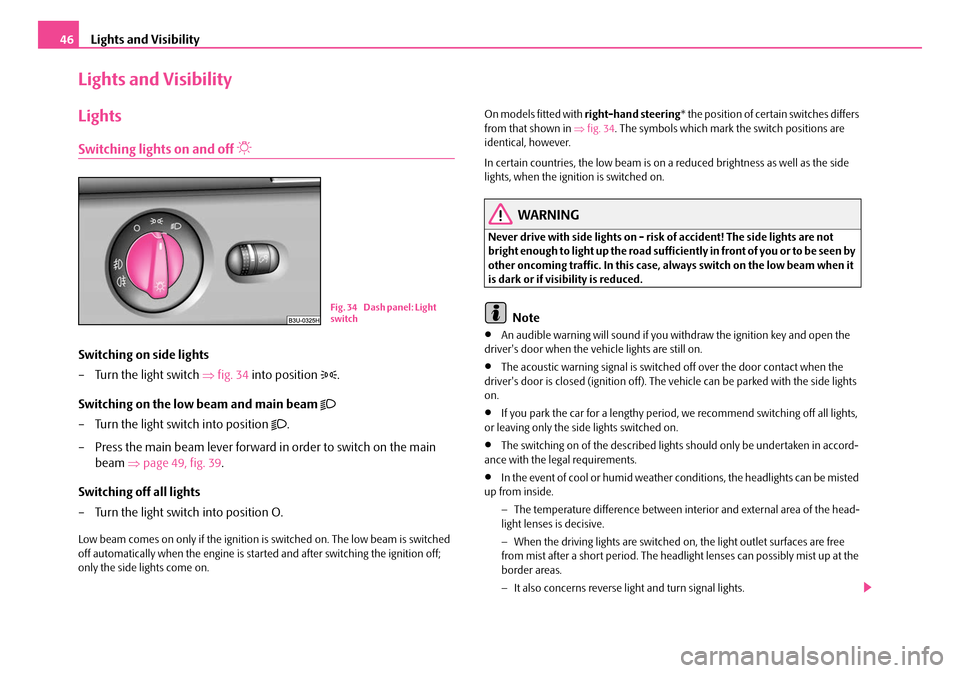
Switching on side lights
– Turn the light switch ⇒fig. 34 into position
.
Switching on the low beam and main beam
– Turn the light switch into position .
– Press the main beam lever forward in order to switch on the main beam ⇒page 49, fig. 39.
Switching off all lights
– Turn the light switch into position O.
Low beam comes on only if the ignition is switched on. The low beam is switched
off automatically when the engine is star ted and after switching the ignition off;
only the side lights come on. On models fitted with
right-hand steering* the position of certain switches differs
from that shown in ⇒fig. 34 . The symbols which mark the switch positions are
identical, however.
In certain countries, the low beam is on a reduced brightness as well as the side
lights, when the ignition is switched on.
WARNING
Never drive with side lights on - risk of accident! The side lights are not
bright enough to light up the road sufficiently in front of you or to be seen by
other oncoming traffic. In this case, always switch on the low beam when it
is dark or if visibility is reduced.
Note
•An audible warning will sound if you withdraw the ignition key and open the
driver's door when the vehicle lights are still on.
•The acoustic warning signal is switched off over the door contact when the
driver's door is closed (ignition off). The vehicle can be parked with the side lights
on.
•If you park the car for a lengthy period, we recommend switching off all lights,
or leaving only the side lights switched on.
•The switching on of the described lights should only be undertaken in accord-
ance with the legal requirements.
•In the event of cool or humid weather conditions, the headligh ts can be misted
up from inside.
−The temperature difference between interior and external area of the head-
light lenses is decisive.
− When the driving lights are switched on, the light outlet surfaces are free
from mist after a short period. The headli ght lenses can possibly mist up at the
border areas.
− It also concerns reverse light and turn signal lights.
B1Z-0042HB1Z-0042HFi g. 3 4 D ash pan el: Lig ht
switch
NKO B5 20.book Page 46 Friday, March 2, 2007 1:46 PM
Page 73 of 259
Seats and Stowage
72
Through-loading bag*
The through-loading bag enables you to conveniently transport long
objects (such as skis) without damaging the interior of the car.
Loading
– Fold down the armrest of the rear seats to the front.
– Press the unlock button for the cover of the through-loading bag in the
interior of the car and swivel it down.
– Pull the bag out and unfold it.
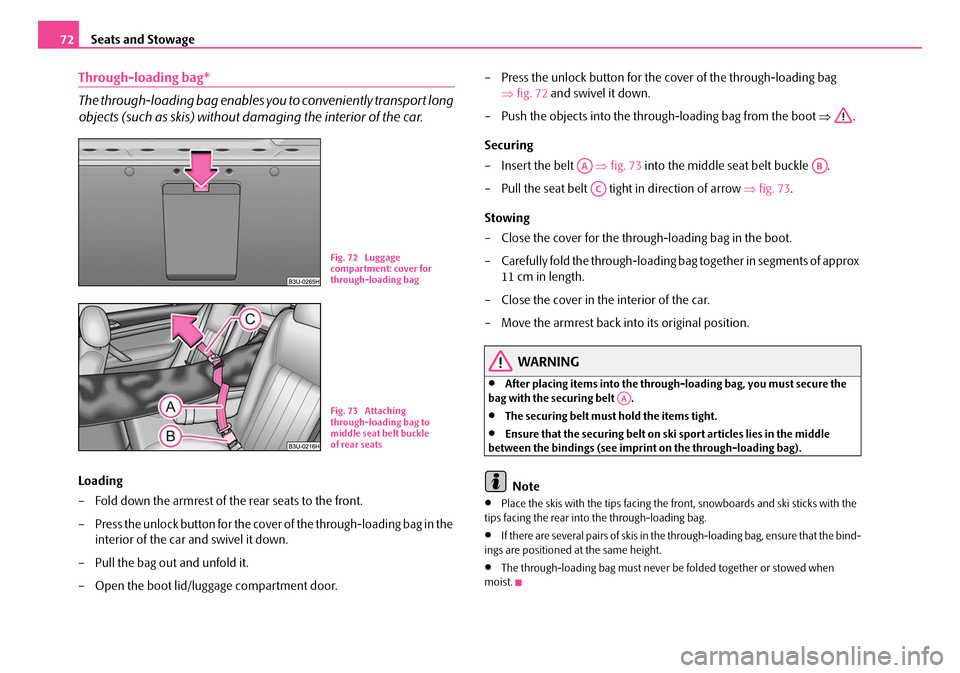
– Open the boot lid/luggage compartment door. – Press the unlock button for the cover of the through-loading bag
⇒fig. 72 and swivel it down.
– Push the objects into the through-loading bag from the boot ⇒.
Securing
– Insert the belt ⇒fig. 73 into the middle seat belt buckle .
– Pull the seat belt tight in direction of arrow ⇒fig. 73 .
Stowing
– Close the cover for the through-loading bag in the boot.
– Carefully fold the through-loading bag together in segments of approx 11 cm in length.
– Close the cover in the interior of the car.
– Move the armrest back into its original position.
WARNING
•After placing items into the through- loading bag, you must secure the
bag with the securing belt .
•The securing belt must hold the items tight.
•Ensure that the securing belt on ski sport articles lies in the middle
between the bindings (see imprin t on the through-loading bag).
Note
•Place the skis with the tips facing the fr ont, snowboards and ski sticks with the
tips facing the rear into the through-loading bag.
•If there are several pairs of skis in the through-loading bag, ensure that the bind-
ings are positioned at the same height.
•The through-loading bag must never be folded together or stowed when
moist.
Fig. 72 Luggage
compartment: cover for
through-loading bag
B1Z-0042HB1Z-0042H
Fig. 73 Attaching
through-loading bag to
middle seat belt buckle
of rear seats
AAAB
AC
AA
NKO B5 20.book Page 72 Friday, March 2, 2007 1:46 PM
Page 88 of 259

Seats and Stowage87
Using the systemSafetyDriving TipsGeneral MaintenanceBreakdown assistanceTechnical Data
Armrest with stowage compartment
You can use the cover of the compartment as an armrest. The
armrest is adjustable for height and length.
Opening stowage compartment
– Fold out the top cover of the arm rest ⇒fig. 102 .
Closing stowage compartment
– First of all fold the cover of the armrest in the direction of arrow fully to the top ⇒fig. 102 and then to the bottom. Opening cooling air inlet in stowage compartment
– Turn the rotary switch to the left as far as the end position
⇒fig. 103 .
Closing cooling air inlet in stowage compartment
– Turn the rotary switch to the right as far as the end position .
The cooling air flows into the stowage comp artment only when the air conditioning
is in the cooling mode. If the air conditioning is operating in the heating mode or if
you do not wish to use the cooling syst em of the stowage compartment, you can
close the cooling air inlet.
Note
If the armrest is pulled forward, ensure that it does not restrict you when steering
the car.
Rear seat armrest with storage compartment
– You can fold down the armrest to enhance occupant comfort.
The armrest includes a stowage compar tment. You open the compartment by
pressing the button on the front side of the armrest and raising the cover. A drinks
Fig. 102 Armrest
between driver and front
passenger seat
B1Z-0042HB1Z-0042H
Fig. 103 Storage
compartment: Using
cooling system
A1
A2
B1Z-0042HB1Z-0042HFig. 104 Armrest of rear
seats:
NKO B5 20.book Page 87 Friday, March 2, 2007 1:46 PM
Page 90 of 259

Heating and air conditioning system89
Using the systemSafetyDriving TipsGeneral MaintenanceBreakdown assistanceTechnical Data
Heating and air conditioning system
Air conditioning system
Description
The air conditioning system is a combined cooling and heating
system. It makes it possible to optimally control the air temperature
at any season of the year.
Description of the air conditioning system
It is important for your safety and for your driving comfort that the air conditioning
system is operating properly.
The air conditioning system operates when switch ⇒page 90, fig. 106 is
pressed and the following conditions are met:
•engine running,
•outside temperature above +5 °C,
•blower switch switched on (positions 1 to 4).
If the cooling system is switched on, the temperature and air humidity drops in the
vehicle. The wellbeing of the occupants of the car is enhanced as a result of this
particularly at high outs ide temperatures and a high air humidity. The system
prevents the windows misting up during the cold season of the year.
The heating effect is dependent upon th e coolant temperature, thus full heat
output only occurs when the engine has reached its operating temperature.
It is possible to briefly activate recirc ulated air mode in order to enhance the
cooling effect ⇒ .
Air at a temperature of about 5°C may flow out of the vents under certain circum-
stances when the cooling system is operating. Lengthy and uneven distribution of
the air flow out of the vents (in particular at the leg area) and large differences in
temperature, for example when getting out of the vehicle, can result in chills in
sensitive persons.
The air inlet in front of the windscreen must be free of ice, snow or leaves in order
to ensure that the heating and ventilation systems operate properly. After switching on the cooling
Condensation from the evaporator of the air condi-
tioning may drip down and form a puddle below the vehicle. This is quite normal
and not an indication of a leak!
Aeration of the vehicle when ignition is switched off*
On models fitted with power sliding/tilting roof with sollar cells, the fresh air blower
is automatically switched over to “solar mode ” if the sun ray's are sufficient after
switching off the ignition. The solar cells on the sliding/tilting roof deliver power for
the fresh air blower. This supplies the interior of the car with fresh air.
For an optimum ventilation, the air outlet vents 3 and 4 must be opened
⇒ page 92.
The ventilation functions only when the sliding/tilting roof is closed.
WARNING
•For your own safety and that of other road users, ensure that all the
windows are free of ice, snow and mistin g. Please familiarize yourself about
how to correctly operate th e heating and ventilation systems, how to demist
and defrost the windows, as well as with the cooling mode.
•You should not leave recirculated air mode on over a longer period of
time, as “stale” air may result in fatigue in the driver and occupants, divert
your attention and also cause the windows to mist up. The risk of having an
accident increases. Switch recirculated air mode off as soon as the windows
begin misting up.
Note
We recommend that you do not smoke in the vehicle when the recirculating air
mode is operating since the smoke which is drawn at the evaporator from the inte-
rior of the vehicle forms deposits in the ev aporator of the air conditioning system.
This produces a permanent odour when th e air conditioning system is operating
which can only be eliminated through co nsiderable effort and expense (replace-
ment of compressor).
ACAE
NKO B5 20.book Page 89 Friday, March 2, 2007 1:46 PM
Page 91 of 259

Heating and air conditioning system
90
Using the system
Setting temperature
– Turn the control dial ⇒fig. 106 to the right in order to increase the
temperature.
– Turn the control dial to the left in order to increase the tempera- ture.
Controlling blower
– Turn the blower switch into one of the positions, 1 to 4, in order to switch the blower on.
– Turn the blower switch into position 0 in order to switch the blower off.
– Pressing switch causes the recirculating air system ⇒page 91
to be switched on.
Control for air distribution
– You can adjust the direction of the inlet air flow ⇒page 92 using air
distribution regulator . switching cooling on and off
– Press the switch . The symbol
in the switch comes on.
– When you again press the switch , the cooling system is switched off. The symbol
in the button is no longer illuminated.
Note
•The whole heat output will be needed to unfrost the windscreen and side
windows. No warm air will be fed to the foot well. This can lead to restriction of the
heating comfort.
•If the cooling system has not been switched on for a lengthy period, odours may
be produced at the evaporator because of deposits. Switch the air conditioning
system on at least once a month for approximately 5 minutes at the highest blower
stage - also during the cold season of the year - in order to remove such odours.
Also open a window for a short time.
•Please refer to the information regarding recirculated air mode ⇒page 91.
Setting air conditioning system
Recommended settings of air conditioning controls:
Defrosting the windscreen and side windows
•Turn control dial ⇒fig. 106 to the right up to the stop,
•Blower switch in position 4,
•Turn the air distribution control into the position ,
•Close the air outlet vents 3,
•Open air outlet vents 4 ⇒ page 92, fig. 107 and point towards the side window.
Keeping winscreen demisted
We recommend that you use the following setting in cases where the windows are
misted up more than usual (e.g. when it is raining):
•Blower switch in position 2,
•Turn the air distribution control into the position between and ,
B1Z-0042HB1Z-0042H
Fig. 106 The air condi-
tioning system: Control
elements
AA
AA
AB
AB
AD
AC
ACAE
AC
AA
AB
AC
AB
AC
NKO B5 20.book Page 90 Friday, March 2, 2007 1:46 PM
Page 95 of 259

Heating and air conditioning system
94
An acoustic signal for depressed buttons
Simultaneous pressing of buttons and can be used to de-activate or
activate this function.
A higher tone is heard when switching on this function, when increasing the blower
speed or when increasing the temperature.
A lower tone is heard when switching off this function, when decreasing the blower
speed or when decreasing the temperature.
Aeration of the vehicle when ignition is switched off*
On models fitted with power sliding/tilting roof with sollar cells, the fresh air blower
is automatically switched over to “solar mode ” if the sun ray's are sufficient after
switching off the ignition. The solar cells on the sliding/tilting roof deliver power for
the fresh air blower. This supplies the interior of the car with fresh air.
For an optimum ventilation, the air outlet vents 3 and 4 must be opened
⇒ page 97.
The ventilation functions only when the sliding/tilting roof is closed.
WARNING
•For your own safety and that of other road users, ensure that all the
windows are free of ice, snow and mistin g. Please familiarize yourself about
how to correctly operate th e heating and ventilation systems, how to demist
and defrost the windows, as well as with the cooling mode.
•You should not leave recirculated air mode on over a longer period of
time, as “stale” air may result in fatigue in the driver and occupants, divert
your attention and also cause the windows to mist up. The risk of having an
accident increases. Switch recirculated air mode off as soon as the windows
begin misting up.
Note
•If the cooling system has not been switched on for a lengthy period, odours may
be produced at the evaporator because of deposits. Switch the air conditioning
system on at least once a month for appr oximately 5 minutes at the highest blower stage - also during the cold season of the year - in order to remove such odours.
Also open a window for a short time.
•We recommend that you do not smoke in the vehicle when the recirculating air
mode is operating since the smoke which is drawn at the evaporator from the inte-
rior of the vehicle forms deposits in the evaporator of the air conditioning system.
This produces a permanent odour when th e air conditioning system is operating
which can only be eliminated through co nsiderable effort and expense (replace-
ment of compressor).
•Using the air conditio ning economically ⇒page 93.
•Operational faults ⇒page 93.
Overview of the control elements
Fig. 109 Climatronic: Control elements
The buttons
Defrosting the windscreen
The displays Display of blower stages
Display of outside temperature, here: +11 °C
Defrosting the windscreen
ECON
A1
A2
A3
A4
NKO B5 20.book Page 94 Friday, March 2, 2007 1:46 PM
Page 97 of 259

Heating and air conditioning system
96
Please note that, in the ECON mode, the interior temperature cannot be lower than
the outside temperature. The interior is not cooled and the air is not dehumidified.
If you select the temperature below +18 °C (64 °F), LO appears in the display. If you
select a temperature higher than + 29 °C (86 °F), HI appears in the display. In the
position LO the recirculated air is not warmed up. In the HI position, the system
operates continuously with maximum heating capacity.
Please refer to the information regarding recirculated air mode ⇒page 96.
Recirculated air mode
In recirculated air mode air is sucked out of the interior of the vehicle
and then fed back into the interior.
Recirculated air mode prevents polluted air outside the vehicle from
getting into the vehicle, for example when driving through a tunnel or
when standing in a traffic jam.
Switching recirculated air mode on
– Press button , the symbol
lights up on the display.
Switching recirculated air mode off
– Once again press the button or the button , the symbol
goes out on the display.
WARNING
You should not leave recirculated air mode on over a longer period of time,
as “stale” air may result in fatigue in the driver and occupants, divert your
attention and also cause the windows to mist up. The risk of having an acci-
dent increases. Switch recirculated air mode off as soon as the windows
begin misting up.
Note
If the windscreen is misted up, first of all press the button and then the
button . After the windscreen has been demisted, once again press the button
.
Setting temperature
– Press the button or ⇒page 94, fig. 109 and continue pressing
until the desired temperature is set.
You can set the interior temperature betw een +18°C (64°F) and +29°C (86°F). The
interior temperature is regulated automatically within this range. If you select the
temperature below 18°C (64°F), “LO” appear s in the display. If you select the
temperature higher than 29 °C (86 °F), “HI” appears in the display. In both limit posi-
tions the Climatronic operates at maximu m cooling or heating capacity, respec-
tively. The temperature is no t controlled in this case.
Lengthy and uneven distribution of the air flow out of the vents (in particular at the
leg area) and large differences in temperature, for example when getting out of the
vehicle, can result in chills in sensitive persons.
Controlling blower
There are a total of seven blower stages available.
The Climatronic system controls the bl ower stages automatically in line
with the interior temperature. You can also, however, adapt the blower
stages manually to suit your particular needs.
Setting blower stages
– Press the button or the button to set the blower stage.
The number of dashes in the display ⇒page 94, fig. 109 indicates the blower
stage.
AUTO
AUTOAUTO
A15A16
A2
NKO B5 20.book Page 96 Friday, March 2, 2007 1:46 PM
Page 103 of 259
Starting-off and Driving
102
You should not switch on any major elec trical components during the heating
period otherwise the vehicle battery will be drained unnecessarily.
•You should start the engine immediately after the glow plug warning light
has gone out.
•The glow plug warning light will come on for about one second if the engine is
at a normal operating temperature or if the outside temperature is above +5°C. This
means that you can start the engine right away.
•Interrupt the attempt at starting after 10 seconds if the engine does not start
right awayand wait for about 30 seconds before repeating the attempt.
•It is possible that the fuse on the diesel preglow system is defect if the engine
still does not start. Check the fuse and replace it if necessary ⇒page 220.
•If the engine does not start, contact th e nearest specialist garage to obtain
professional assistance.
Starting the engine after fuel tank has run dry
It may take longer than normal to start the engine after refuelling if the fuel tank has
run completely dry - up to one minute. This is because the fuel system must first of
all be filled while the attempting to start the engine.
Switching the engine off
– Turn the ignition key into position ⇒page 100, fig. 114 .
WARNING
•Never switch off the engine before the vehicle is stationary - risk of acci-
dent!
•The brake booster only operates when the engine is running. Greater
physical effort for braking is required when engine is switched off. Because
if you do not stop as normal, this can cause an accident and severe injuries.
Caution
you should not switch the engine off right away at the end of your journey after the
engine has been operated for a lengthy peri od at high loads but should be allowed
it to run at idling speed for about 2 minut es. This prevents any accumulation of heat
when the engine is switched off.
Note
•The radiator fan may continue running for a further 10 minutes or so after the
engine and the ignition have been switched off. The coolant fan may, however, also
switch on again after some time if the coolant temperature rises because of an
accumulation of heat in the engine or if the engine is warm and the engine
compartment is additionally heated by strong sunlight.
•This is why particular care is required when carrying out any work in the engine
compartment ⇒ page 185, “Working in the engine compartment”.
A1
NKO B5 20.book Page 102 Friday, March 2, 2007 1:46 PM
Page 165 of 259

Driving and the Environment
164
The fuel consumption can naturally also be influenced by factors which are beyond
the driver's control. It is, for example, no rmal for the fuel consumption to increase
in winter and under worsened conditions such as poor road conditions, towing a
trailer, etc.
The technical requirements for low fuel usage and economic efficiency of the
vehicle have already been bu ilt into the vehicle at the works. Special attention has
been given to minimisi ng negative effects on the envi ronment. It is necessary to
take note of the guidelines given in this chapter in order to make best use of these
characteristics and to maintain their effectiveness.
Looking ahead when driving
A vehicle's highest fuel consumption occurs it accelerates.
Avoid accelerating and braking unnecessarily. If you drive with forsight you will not
need to brake so often and will also then not have to accelerate so much. Let your
vehicle coast to a stop, for example, if this is possible, when you see that the next
set of traffic lights is at red.
Shifting gears and saving energy
Shifting up early saves on fuel.
Manual gearbox
– Drive no more than about one length of your vehicle in first gear. Always shift up into the next higher gear at approx. 2 000 to 2 500 revs.
Automatic gearbox
– Depress the accelerator pedal slowly. Do not depress it beyond the
kickdown position, however.
An effective way of achieving good fuel economy is to shift up early. You will
consume more fuel if you drive at unnecess arily high revolutions in any given gear.
The ⇒fig. 166 shows the ratio of fuel consumption to the speed of your vehicle in
the relevant gears. Fuel cons umption in 1st gear is the highest, while that in 5th or
the 6th gear is the lowest.
Only depress the accelerator pedal slowly if your vehicle is fitted with an automatic
gearbox in order to automatically select an economic driving programme. You will
achieve good fuel economy by shifting up early and shifting down late. This applies
in particular if you make use of the ma nual mode (Tiptronic) for shifting gears.
Note
Also use the information supplied by the multi-functional indicator ⇒page 15.
Fig. 166 Fuel consump-
tion in litres/100 km. and
speed in km/h.
NKO B5 20.book Page 164 Friday, March 2, 2007 1:46 PM
Page 166 of 259

Driving and the Environment165
Using the systemSafetyDriving TipsGeneral MaintenanceBreakdown assistanceTechnical Data
Avoiding full throttle
Driving more slowly means saving fuel.
Sensitive use of the accelerator will not only significantly reduce fuel consumption
but also positively influence environmental pollution and wear of your vehicle.
You should avoid fully exploiting the top speed of your vehicle wherever possible.
Fuel consumption, pollutant emissions and vehicle noises increase disproportion-
ally at high speeds.
The ⇒fig. 167 shows the ratio of fuel consumptio n to the speed of your vehicle.
You will cut your fuel consumption by half if you only make use three-quarters of
the possible top speed of your vehicle.
Reducing idling
Idling also costs fuel.
It is worthwhile switching off the engine in a traffic jam or when waiting at a level
crossing or at traffic lights with a length y red phase. Even after just 30 - 40 seconds
you will have saved more fuel than that is needed when you start the engine up
again.
If an engine is only idling it takes much longer for it to reach its normal operating
temperature. Wear-and-tear and pollutant em issions, though, are particularly high in the warming-up phase. This is why you should drive off right after starting the
engine. Do avoid high engine re
volutions at this time, however.
Regular servicing
A poorly tuned engine consumes an unnecessarily high amount of
fuel.
Having your vehicle serviced regularly at a specialist garge enables you to satisfy
one of the requirements for economical motoring even before you set off on your
journey. Keeping your vehicle properly serviced not only has a positive effect on the
safety of your vehicle and maintaining its value, but also saves on fuel.
A poorly tuned engine can result in a fu el consumption which is 10% higher than
normal.
The foreseen maintenance work should be undertaken exactly according to the
Service schedule by a specialist garage.
Also check the oil level after refueling. Oil consumption is dependent to a consid-
erable extent on the load and speed of the engine. Oil consumption could be as
high as 0.5 litres/1 000 km depending on your style of driving.
It is quite normal that a new engine ha s a higher oil consumption at first, and
reaches its lowest level only after a certain running in time. It is therefore not
possible to correctly assess the oil cons umption of a new vehicle until after you
have driven about 5 000 km.
For the sake of the environment
•You can achieve additional improvements in your fuel economy by using high-
lubricity oils.
•Check the ground below your car at regula r intervals to detect any leakages in
good time. Please have your vehicle inspected by a specialist garge if you find any
stains caused by oil or other fluids on the floor.
Fig. 167 Fuel consump-
tion in litres/100 km. and
speed in km/h.
NKO B5 20.book Page 165 Friday, March 2, 2007 1:46 PM