check oil SKODA SUPERB 2008 2.G / (B6/3T) User Guide
[x] Cancel search | Manufacturer: SKODA, Model Year: 2008, Model line: SUPERB, Model: SKODA SUPERB 2008 2.G / (B6/3T)Pages: 272, PDF Size: 18.25 MB
Page 211 of 272
Inspecting and Replenishing
212
Oil level within range
–You must not top up the oil.
Oil level within range
–You may top up the oil. It is possible that the oil level may then be
within range after doing this.
Oil level within range
–You must top up the oil ⇒page 212. It is sufficient, once this is done,
to keep the oil level is within range .
It is normal for the engine to consume oil. The oil cons umption may be as much as
0.5 l/1 000 km depending on your style of driving and the conditions under which
you operate your vehicle. The oil consumpt ion may be slightly higher than this
during the first 5 000 kilometres.
One should therefore check the oil level at regular intervals, preferably every time
after the fuel tank is filled or after driving for long stretches.
We recommend maintaining the oil level within the range if the engine has been
operating at high loads, for example during a lengthy motorway trip during the
summer months, towing a trailer or negotiating a high mountain pass, but not
above this .
The warning light in the instrument cluster* will indicate ⇒page 35, “Engine oil
level* ” whether the oil level is too low. In this case, check the oil level as soon as
possible. Top up with an a ppropriate quantity of oil.
Caution
•The oil level must on no account ex tend beyond the range . Danger of
damaging the catalytic converter.
•Do not continue your journey if for some reason it is not possible under the
conditions prevailing to top up with oil. Switch of the engine and contact and
obtain professional assistance from a specialist garage.
Replenishing engine oil
– Inspecting the engine oil level ⇒page 211.
– Unscrew the cap of the engine oil filler opening.
– Pour in a suitable grade of oil in portions of 0.5 litres ⇒page 210.
– Inspect the oil level ⇒page 211, “Check engine oil level”.
– Carefully screw on the cap of the filler opening and push the dipstick in fully.
WARNING
•Avoid dripping oil onto hot parts of the engine when topping up will oil -
a risk of fire!
•Read and observe the warning notes ⇒page 209, “Working in the engine
compartment” before working in the engine compartment.
For the sake of the environment
The oil level must on no account be above the range ⇒page 211. Oil will other-
wise be drawn in through the crankcase ventilation and may pass through the
exhaust system to atmosphere. The oil ma y combust in the catalytic converter and
damage it.
Changing engine oil
The engine oil must be changed at the intervals stated in the Service schedule or
according to the service interval indicator ⇒page 12, “Service Interval Display”.
WARNING
•Only carry out the engine oil change, if you have the required profes-
sional knowledge!
Aa
Ab
Aa
Ac
Ab
Aa
Aa
Aa
NKO B6 20.book Page 212 Wednesday, March 26, 2008 3:15 PM
Page 213 of 272
Inspecting and Replenishing
214
Inspecting the coolant level
The coolant expansion bottle is loca ted in the engine compartment on
the right.
– Switch the engine off.
– Open the bonnet ⇒page 209, “Working in the engine compartment”.
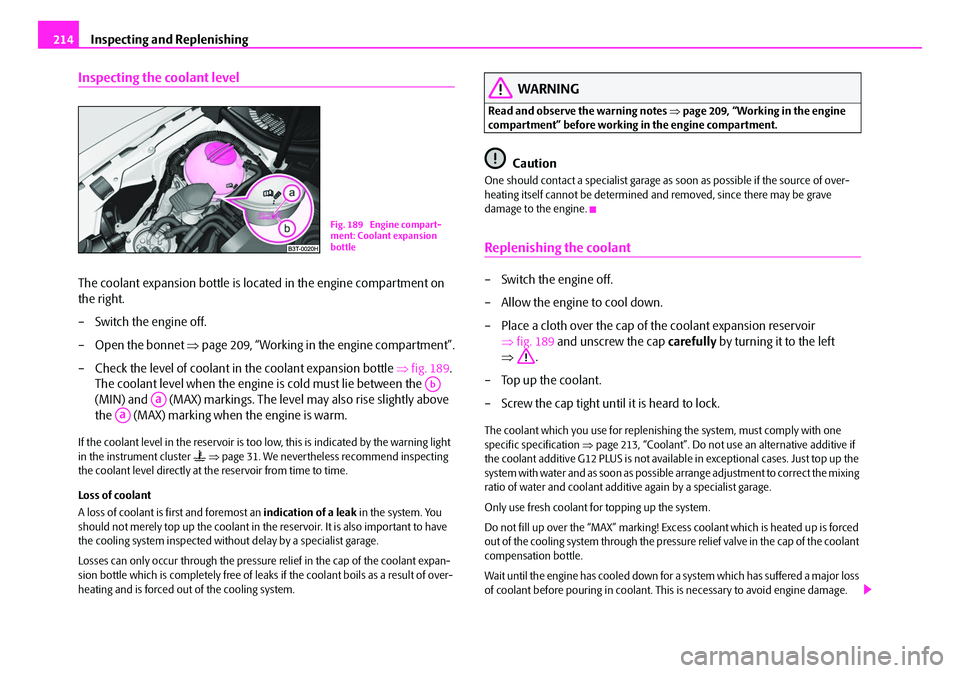
– Check the level of coolant in the coolant expansion bottle ⇒fig. 189 .
The coolant level when the engine is cold must lie between the
(MIN) and (MAX) markings. The level may also rise slightly above
the (MAX) marking when the engine is warm.
If the coolant level in the reservoir is too low, this is indicated by the warning light
in the instrument cluster ⇒ page 31. We nevertheless recommend inspecting
the coolant level directly at th e reservoir from time to time.
Loss of coolant
A loss of coolant is first and foremost an indication of a leak in the system. You
should not merely top up the coolant in the reservoir. It is also important to have
the cooling system inspected without delay by a specialist garage.
Losses can only occur through the pressure relief in the cap of the coolant expan-
sion bottle which is completely free of leak s if the coolant boils as a result of over-
heating and is forced out of the cooling system.
WARNING
Read and observe the warning notes ⇒page 209, “Working in the engine
compartment” before working in the engine compartment.
Caution
One should contact a specialist garage as soon as possible if the source of over-
heating itself cannot be determined and removed, since there may be grave
damage to the engine.
Replenishing the coolant
– Switch the engine off.
– Allow the engine to cool down.
– Place a cloth over the cap of the coolant expansion reservoir ⇒fig. 189 and unscrew the cap carefully by turning it to the left
⇒ .
– Top up the coolant.
– Screw the cap tight until it is heard to lock.
The coolant which you use for replenishing the system, must comply with one
specific specification ⇒page 213, “Coolant”. Do not use an alternative additive if
the coolant additive G12 PLUS is not available in exceptional cases. Just top up the
system with water and as soon as possible arrange adjustment to correct the mixing
ratio of water and coolant additive again by a specialist garage.
Only use fresh coolant for topping up the system.
Do not fill up over the “MAX” marking! Excess coolant which is heated up is forced
out of the cooling system through the pressure relief valve in the cap of the coolant
compensation bottle.
Wait until the engine has cooled down for a system which has suffered a major loss
of coolant before pouring in coolant. This is necessary to avoid engine damage.
Fig. 189 Engine compart-
ment: Coolant expansion
bottle
Ab
Aa
Aa
NKO B6 20.book Page 214 Wednesday, March 26, 2008 3:15 PM
Page 221 of 272
Wheels and Tyres
222
Wheels and Tyres
Wheels
General information
•New tyres do not offer optimal grip at first and should therefore be run in for
about 500 km at a moderate speed and an appropriately cautious style of driving.
You will also profit from longer tyre life.
•The tread depth of new tyres may differ because of design features and the
configuration of the tread (d epending on the type of tyre and the manufacturer).
•Drive over curbs on the side of the road and other such obstacles slowly and,
where possible, at a right angles in order to avoid damage to tyres and wheel trims.
•Inspect your tyres from time to time for damage (punctures, cuts, splits and
bulges). Remove foreign bodi es from the tyre profile.
•Damage to tyres and wheels is frequent ly not visible. Unusual vibrations or
pulling of the vehicle to one side could be a sign of tyre damage. Please reduce
your speed immediately and stop if you suspect that a wheel is damaged.
Inspect the tyres for signs of damage (bulges, splits, etc.) If no visible damage is
present, please drive at an appropriately slow speed and carefully to the nearest
specialist garage in order to have your vehicle inspected.
•Also protect your tyres from contact with oil, grease and fuel.
•Immediately replace any dust caps of the valves which have got lost.
•Mark wheels before removing them so th at their previous direction of running
can be maintained when mounted them again.
•Always store wheels or tyres which been removed in a cool, dry and, where
possible, dark place. Tyres which are not fixed to a wheel trim should be stored
upright.
Unidirectional tyres*
The direction of rotation of the tyres is marked by arrows on the wall of the tyre. This
indicates the direction of rotation of the tyre, and it is essential that the tyres are
fitted on to run in this direction. Only then are the tyres able to provide the optimal
properties in terms of grip, low no ise, wear-and-tear and aquaplaning. Further information concerning the use of unidirectional tyres
⇒page 226.
WARNING
•New tyres during the first 500 km do not offer optimal grip and should
therefore be run appropriately - risk of accident!
•Never drive with damaged tyres - risk of accident!
Note
Please observe the various differing legal requirements regarding tyres.
Tyre life
The life of your tyres very much depends on the following points:
Tyre pressure
The working life of tyres will be shortened co nsiderably if the tyres are insufficiently
or over-inflated and this will have an advers e effect on the handling of your vehicle.
Correctly inflated tyres are of partic ular importance when travelling at high speeds .
It is therefore good to check the pressure at least once a month and also before
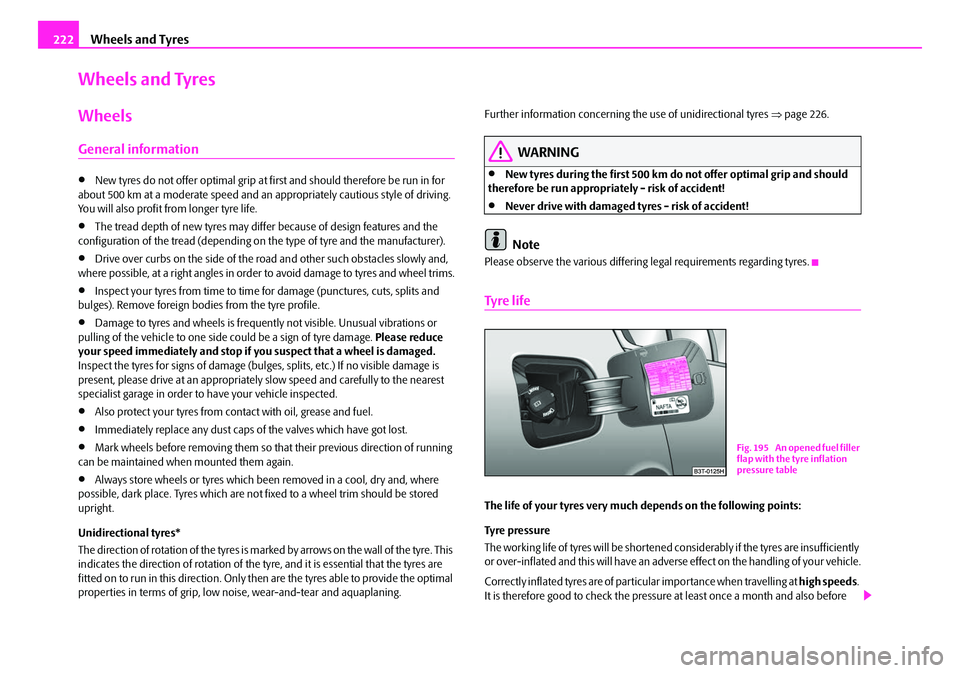
Fig. 195 An opened fuel filler
flap with the tyre inflation
pressure table
NKO B6 20.book Page 222 Wednesday, March 26, 2008 3:15 PM
Page 231 of 272
Breakdown assistance
232
•Never start the engine with the vehicle sitting on the raised jack - danger
of suffering injury!
Caution
If you have to change a wheel on a slope first block the opposite wheel with a stone
or similar object in order to secure th e vehicle from unexpectedly rolling away.
Note
Comply with the national legal regulations.
Changing a wheel
Always change a wheel on a level surface as far as possible.
– Take off the full wheel trim* ⇒page 233 or the caps ⇒page 233.
– In the case of light alloy wheels remove the wheel trim cap ⇒page 234.
– First of all slacken the theft-de terrent wheel bolt*, afterwards the
other wheel bolts ⇒page 234.
– Jack up the vehicle until the wheel to be changed is clear of the ground
⇒ page 235.
– Unscrew the wheel bolts and place them on a clean surface (cloth, paper etc.).
– Take off the wheel.
– Fit on the spare wheel and tighten the wheel bolts slightly.
–Lower the car. – Tighten the wheel bolts firmly, al
ternately and diagonally using the
wheel wrench (crosswise) and last the theft-deterrent wheel bolt*
⇒ page 234.
– Mount the full wheel trim/w heel trim cap or the caps.
Note
•All bolts must be clean and must turn easily.
•You must never grease or oil the wheel bolts!
•When fitting on unidirectional tyres, ensure that the tyres rotate in the correct
direction ⇒page 222.
Subsequent steps
After changing the wheel, you must perform the following steps.
– Stow and attach the replaced wheel in the spare wheel well using the
special screw ⇒page 231, fig. 201 .
– Stow the vehicle tool kit in the space provided.
– Check the tyre pressure on the spare wheel just mounted as soon as
possible.
– Have the tightening torque of the wheel bolts checked with a torque
wrench as soon as possible. Steel and light alloy wheels must be tight-
ened to a tightening torque of 120 Nm.
– Have the defective tyre repaired as soon as possible.
WARNING
It is necessary to observe the guidelines given on ⇒page 224 if the vehicle is
subsequently fitted with tyres which are different to those it was fitted with
at the works.
WARNING (continued)
NKO B6 20.book Page 232 Wednesday, March 26, 2008 3:15 PM
Page 258 of 272
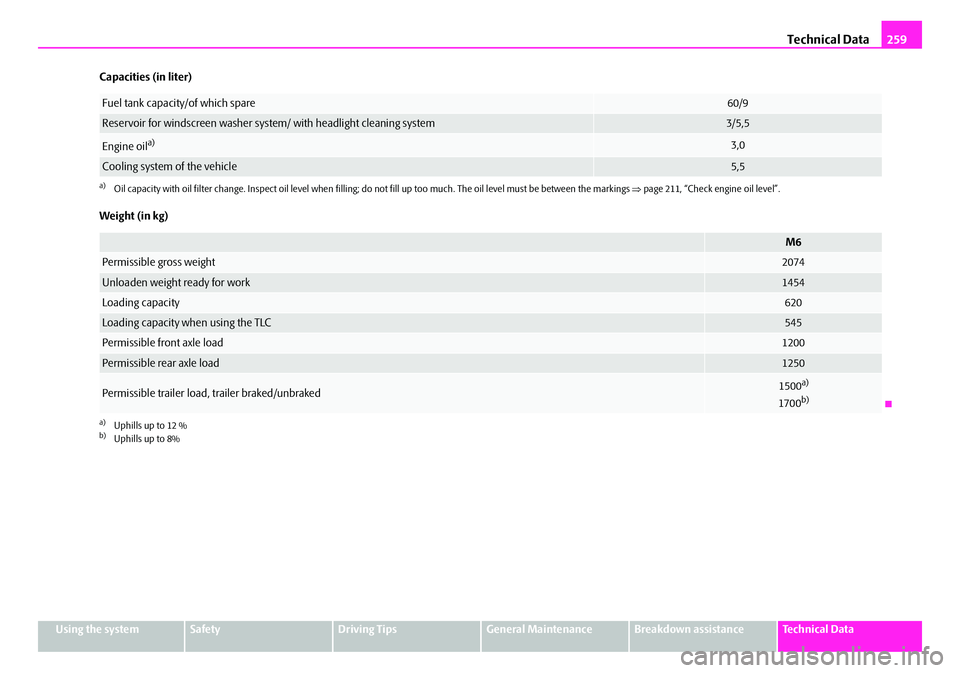
Technical Data259
Using the systemSafetyDriving TipsGeneral MaintenanceBreakdown assistanceTechnical Data
Capacities (in liter)
Weight (in kg)
Fuel tank capacity/of which spare60/9
Reservoir for windscreen washer system/ with headlight cleaning system3/5,5
Engine oila)
a)Oil capacity with oil filter change. Inspec
t oil level when filling; do not fill up too much. The oil level must be between the markings ⇒page 211, “Check engine oil level”.
3,0
Cooling system of the vehicle5,5
M6
Permissible gross weight2074
Unloaden weight ready for work1454
Loading capacity620
Loading capacity when using the TLC545
Permissible front axle load1200
Permissible rear axle load1250
Permissible trailer load, trailer braked/unbraked1500a)
1700b)
a)Uphills up to 12 %b)Uphills up to 8%
NKO B6 20.book Page 259 Wednesday, March 26, 2008 3:15 PM
Page 260 of 272
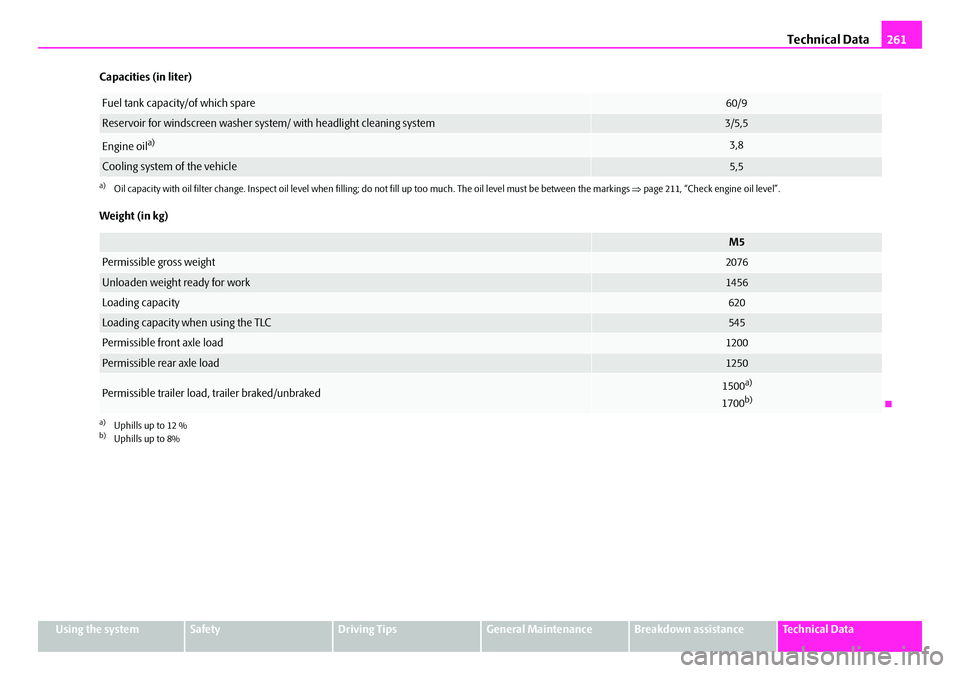
Technical Data261
Using the systemSafetyDriving TipsGeneral MaintenanceBreakdown assistanceTechnical Data
Capacities (in liter)
Weight (in kg)
Fuel tank capacity/of which spare60/9
Reservoir for windscreen washer system/ with headlight cleaning system3/5,5
Engine oila)
a)Oil capacity with oil filter change. Inspec
t oil level when filling; do not fill up too much. The oil level must be between the markings ⇒page 211, “Check engine oil level”.
3,8
Cooling system of the vehicle5,5
M5
Permissible gross weight2076
Unloaden weight ready for work1456
Loading capacity620
Loading capacity when using the TLC545
Permissible front axle load1200
Permissible rear axle load1250
Permissible trailer load, trailer braked/unbraked1500a)
1700b)
a)Uphills up to 12 %b)Uphills up to 8%
NKO B6 20.book Page 261 Wednesday, March 26, 2008 3:15 PM
Page 262 of 272
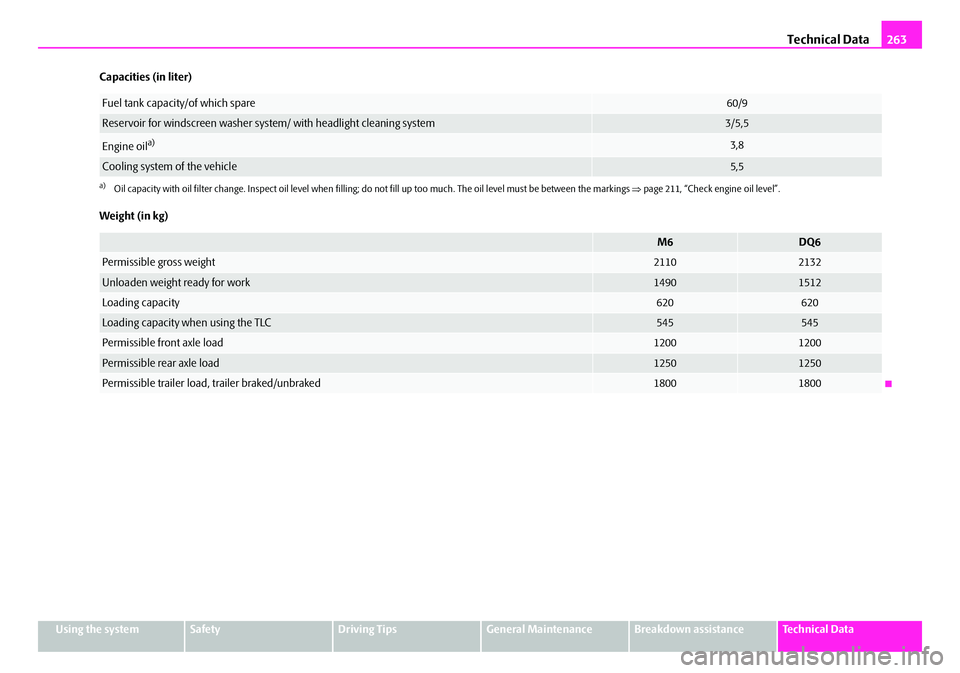
Technical Data263
Using the systemSafetyDriving TipsGeneral MaintenanceBreakdown assistanceTechnical Data
Capacities (in liter)
Weight (in kg)
Fuel tank capacity/of which spare60/9
Reservoir for windscreen washer system/ with headlight cleaning system3/5,5
Engine oila)
a)Oil capacity with oil filter change. Inspec
t oil level when filling; do not fill up too much. The oil level must be between the markings ⇒page 211, “Check engine oil level”.
3,8
Cooling system of the vehicle5,5
M6DQ6
Permissible gross weight21102132
Unloaden weight ready for work14901512
Loading capacity620620
Loading capacity when using the TLC545545
Permissible front axle load12001200
Permissible rear axle load12501250
Permissible trailer load, trailer braked/unbraked18001800
NKO B6 20.book Page 263 Wednesday, March 26, 2008 3:15 PM
Page 265 of 272
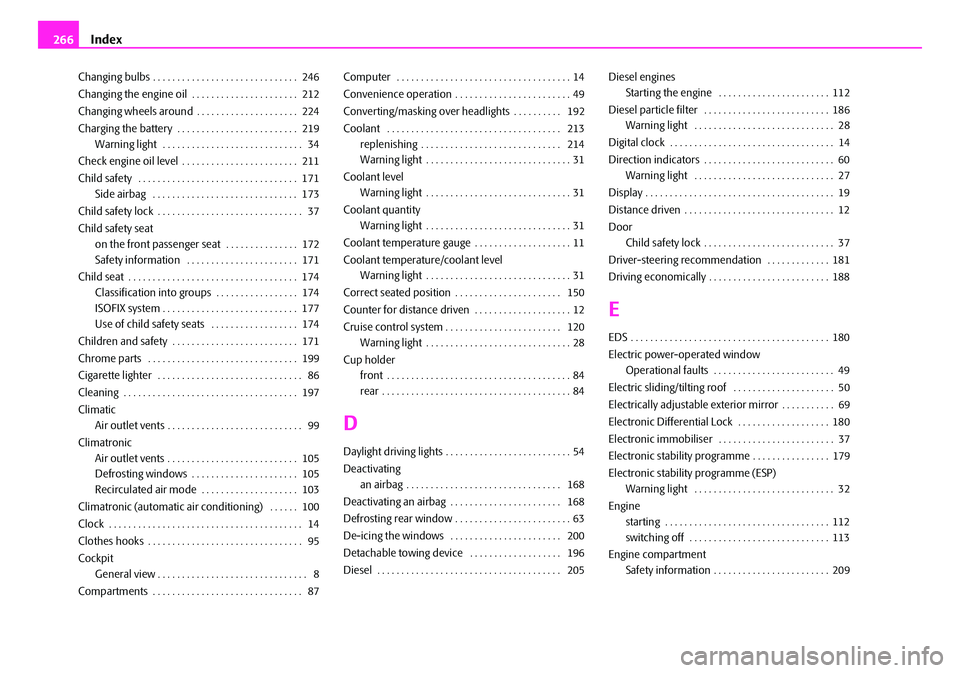
Index
266
Changing bulbs . . . . . . . . . . . . . . . . . . . . . . . . . . . . . . 246
Changing the engine oil . . . . . . . . . . . . . . . . . . . . . . 212
Changing wheels around . . . . . . . . . . . . . . . . . . . . . 224
Charging the battery . . . . . . . . . . . . . . . . . . . . . . . . . 219
Warning light . . . . . . . . . . . . . . . . . . . . . . . . . . . . . 34
Check engine oil level . . . . . . . . . . . . . . . . . . . . . . . . 211
Child safety . . . . . . . . . . . . . . . . . . . . . . . . . . . . . . . . . 171 Side airbag . . . . . . . . . . . . . . . . . . . . . . . . . . . . . . 173
Child safety lock . . . . . . . . . . . . . . . . . . . . . . . . . . . . . . 37
Child safety seat on the front passenger seat . . . . . . . . . . . . . . . 172
Safety information . . . . . . . . . . . . . . . . . . . . . . . 171
Child seat . . . . . . . . . . . . . . . . . . . . . . . . . . . . . . . . . . . 174 Classification into groups . . . . . . . . . . . . . . . . . 174
ISOFIX system . . . . . . . . . . . . . . . . . . . . . . . . . . . . 177
Use of child safety seats . . . . . . . . . . . . . . . . . . 174
Children and safety . . . . . . . . . . . . . . . . . . . . . . . . . . 171
Chrome parts . . . . . . . . . . . . . . . . . . . . . . . . . . . . . . . 199
Cigarette lighter . . . . . . . . . . . . . . . . . . . . . . . . . . . . . . 86
Cleaning . . . . . . . . . . . . . . . . . . . . . . . . . . . . . . . . . . . . 197
Climatic Air outlet vents . . . . . . . . . . . . . . . . . . . . . . . . . . . . 99
Climatronic Air outlet vents . . . . . . . . . . . . . . . . . . . . . . . . . . . 105
Defrosting windows . . . . . . . . . . . . . . . . . . . . . . 105
Recirculated air mode . . . . . . . . . . . . . . . . . . . . 103
Climatronic (automatic air conditioning) . . . . . . 100
Clock . . . . . . . . . . . . . . . . . . . . . . . . . . . . . . . . . . . . . . . . 14
Clothes hooks . . . . . . . . . . . . . . . . . . . . . . . . . . . . . . . . 95
Cockpit General view . . . . . . . . . . . . . . . . . . . . . . . . . . . . . . . 8
Compartments . . . . . . . . . . . . . . . . . . . . . . . . . . . . . . . 87 Computer . . . . . . . . . . . . . . . . . . . . . . . . . . . . . . . . . . . . 14
Convenience operation . . . . . . . . . . . . . . . . . . . . . . . . 49
Converting/masking over headlights . . . . . . . . . . 192
Coolant . . . . . . . . . . . . . . . . . . . . . . . . . . . . . . . . . . . . 213
replenishing . . . . . . . . . . . . . . . . . . . . . . . . . . . . . 214
Warning light . . . . . . . . . . . . . . . . . . . . . . . . . . . . . . 31
Coolant level Warning light . . . . . . . . . . . . . . . . . . . . . . . . . . . . . . 31
Coolant quantity Warning light . . . . . . . . . . . . . . . . . . . . . . . . . . . . . . 31
Coolant temperature gauge . . . . . . . . . . . . . . . . . . . . 11
Coolant temperatur e/coolant level
Warning light . . . . . . . . . . . . . . . . . . . . . . . . . . . . . . 31
Correct seated position . . . . . . . . . . . . . . . . . . . . . . 150
Counter for distance driven . . . . . . . . . . . . . . . . . . . . 12
Cruise control system . . . . . . . . . . . . . . . . . . . . . . . . 120 Warning light . . . . . . . . . . . . . . . . . . . . . . . . . . . . . . 28
Cup holder front . . . . . . . . . . . . . . . . . . . . . . . . . . . . . . . . . . . . . . 84
rear . . . . . . . . . . . . . . . . . . . . . . . . . . . . . . . . . . . . . . . 84
D
Daylight driving lights . . . . . . . . . . . . . . . . . . . . . . . . . . 54
Deactivatingan airbag . . . . . . . . . . . . . . . . . . . . . . . . . . . . . . . . 168
Deactivating an airbag . . . . . . . . . . . . . . . . . . . . . . . 168
Defrosting rear window . . . . . . . . . . . . . . . . . . . . . . . . 63
De-icing the windows . . . . . . . . . . . . . . . . . . . . . . . 200
Detachable towing device . . . . . . . . . . . . . . . . . . . 196
Diesel . . . . . . . . . . . . . . . . . . . . . . . . . . . . . . . . . . . . . . 205 Diesel engines
Starting the engine . . . . . . . . . . . . . . . . . . . . . . . 112
Diesel particle filter . . . . . . . . . . . . . . . . . . . . . . . . . . 186 Warning light . . . . . . . . . . . . . . . . . . . . . . . . . . . . . 28
Digital clock . . . . . . . . . . . . . . . . . . . . . . . . . . . . . . . . . . 14
Direction indicators . . . . . . . . . . . . . . . . . . . . . . . . . . . 60 Warning light . . . . . . . . . . . . . . . . . . . . . . . . . . . . . 27
Display . . . . . . . . . . . . . . . . . . . . . . . . . . . . . . . . . . . . . . . 19
Distance driven . . . . . . . . . . . . . . . . . . . . . . . . . . . . . . . 12
Door Child safety lock . . . . . . . . . . . . . . . . . . . . . . . . . . . 37
Driver-steering recommendation . . . . . . . . . . . . . 181
Driving economically . . . . . . . . . . . . . . . . . . . . . . . . . 188
E
EDS . . . . . . . . . . . . . . . . . . . . . . . . . . . . . . . . . . . . . . . . . 180
Electric power-operated window Operational faults . . . . . . . . . . . . . . . . . . . . . . . . . 49
Electric sliding/tilting roof . . . . . . . . . . . . . . . . . . . . . 50
Electrically adjustable exterior mirror . . . . . . . . . . . 69
Electronic Differential Lock . . . . . . . . . . . . . . . . . . . 180
Electronic immobiliser . . . . . . . . . . . . . . . . . . . . . . . . 37
Electronic stability programme . . . . . . . . . . . . . . . . 179
Electronic stability programme (ESP) Warning light . . . . . . . . . . . . . . . . . . . . . . . . . . . . . 32
Engine starting . . . . . . . . . . . . . . . . . . . . . . . . . . . . . . . . . . 112
switching off . . . . . . . . . . . . . . . . . . . . . . . . . . . . . 113
Engine compartment Safety information . . . . . . . . . . . . . . . . . . . . . . . . 209
NKO B6 20.book Page 266 Wednesday, March 26, 2008 3:15 PM
Page 266 of 272
Index267
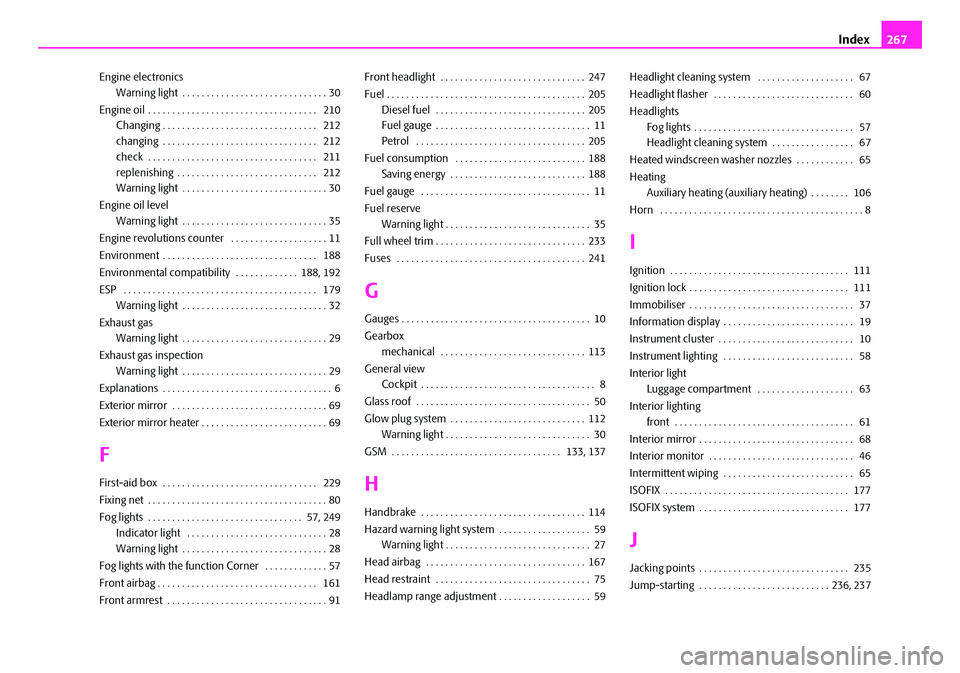
Engine electronics
Warning light . . . . . . . . . . . . . . . . . . . . . . . . . . . . . . 30
Engine oil . . . . . . . . . . . . . . . . . . . . . . . . . . . . . . . . . . . 210 Changing . . . . . . . . . . . . . . . . . . . . . . . . . . . . . . . . 212
changing . . . . . . . . . . . . . . . . . . . . . . . . . . . . . . . . 212
check . . . . . . . . . . . . . . . . . . . . . . . . . . . . . . . . . . . 211
replenishing . . . . . . . . . . . . . . . . . . . . . . . . . . . . . 212
Warning light . . . . . . . . . . . . . . . . . . . . . . . . . . . . . . 30
Engine oil level Warning light . . . . . . . . . . . . . . . . . . . . . . . . . . . . . . 35
Engine revolutions counter . . . . . . . . . . . . . . . . . . . . 11
Environment . . . . . . . . . . . . . . . . . . . . . . . . . . . . . . . . 188
Environmental compatibility . . . . . . . . . . . . . 188, 192
ESP . . . . . . . . . . . . . . . . . . . . . . . . . . . . . . . . . . . . . . . . 179 Warning light . . . . . . . . . . . . . . . . . . . . . . . . . . . . . . 32
Exhaust gas Warning light . . . . . . . . . . . . . . . . . . . . . . . . . . . . . . 29
Exhaust gas inspection Warning light . . . . . . . . . . . . . . . . . . . . . . . . . . . . . . 29
Explanations . . . . . . . . . . . . . . . . . . . . . . . . . . . . . . . . . . . 6
Exterior mirror . . . . . . . . . . . . . . . . . . . . . . . . . . . . . . . . 69
Exterior mirror heater . . . . . . . . . . . . . . . . . . . . . . . . . . 69
F
First-aid box . . . . . . . . . . . . . . . . . . . . . . . . . . . . . . . . 229
Fixing net . . . . . . . . . . . . . . . . . . . . . . . . . . . . . . . . . . . . . 80
Fog lights . . . . . . . . . . . . . . . . . . . . . . . . . . . . . . . . 57, 249 Indicator light . . . . . . . . . . . . . . . . . . . . . . . . . . . . . 28
Warning light . . . . . . . . . . . . . . . . . . . . . . . . . . . . . . 28
Fog lights with the function Corner . . . . . . . . . . . . . 57
Front airbag . . . . . . . . . . . . . . . . . . . . . . . . . . . . . . . . . 161
Front armrest . . . . . . . . . . . . . . . . . . . . . . . . . . . . . . . . . 91 Front headlight . . . . . . . . . . . . . . . . . . . . . . . . . . . . . . 247
Fuel . . . . . . . . . . . . . . . . . . . . . . . . . . . . . . . . . . . . . . . . . 205
Diesel fuel . . . . . . . . . . . . . . . . . . . . . . . . . . . . . . . 205
Fuel gauge . . . . . . . . . . . . . . . . . . . . . . . . . . . . . . . . 11
Petrol . . . . . . . . . . . . . . . . . . . . . . . . . . . . . . . . . . . 205
Fuel consumption . . . . . . . . . . . . . . . . . . . . . . . . . . . 188 Saving energy . . . . . . . . . . . . . . . . . . . . . . . . . . . . 188
Fuel gauge . . . . . . . . . . . . . . . . . . . . . . . . . . . . . . . . . . . 11
Fuel reserve Warning light . . . . . . . . . . . . . . . . . . . . . . . . . . . . . . 35
Full wheel trim . . . . . . . . . . . . . . . . . . . . . . . . . . . . . . . 233
Fuses . . . . . . . . . . . . . . . . . . . . . . . . . . . . . . . . . . . . . . . 241
G
Gauges . . . . . . . . . . . . . . . . . . . . . . . . . . . . . . . . . . . . . . . 10
Gearbox mechanical . . . . . . . . . . . . . . . . . . . . . . . . . . . . . . 113
General view Cockpit . . . . . . . . . . . . . . . . . . . . . . . . . . . . . . . . . . . . 8
Glass roof . . . . . . . . . . . . . . . . . . . . . . . . . . . . . . . . . . . . 50
Glow plug system . . . . . . . . . . . . . . . . . . . . . . . . . . . . 112 Warning light . . . . . . . . . . . . . . . . . . . . . . . . . . . . . . 30
GSM . . . . . . . . . . . . . . . . . . . . . . . . . . . . . . . . . . . 133, 137
H
Handbrake . . . . . . . . . . . . . . . . . . . . . . . . . . . . . . . . . . 114
Hazard warning light system . . . . . . . . . . . . . . . . . . . 59 Warning light . . . . . . . . . . . . . . . . . . . . . . . . . . . . . . 27
Head airbag . . . . . . . . . . . . . . . . . . . . . . . . . . . . . . . . . 167
Head restraint . . . . . . . . . . . . . . . . . . . . . . . . . . . . . . . . 75
Headlamp range adjustment . . . . . . . . . . . . . . . . . . . 59 Headlight cleaning system . . . . . . . . . . . . . . . . . . . . 67
Headlight flasher . . . . . . . . . . . . . . . . . . . . . . . . . . . . . 60
Headlights
Fog lights . . . . . . . . . . . . . . . . . . . . . . . . . . . . . . . . . 57
Headlight cleaning system . . . . . . . . . . . . . . . . . 67
Heated windscreen washer nozzles . . . . . . . . . . . . 65
Heating Auxiliary heating (auxiliary heating) . . . . . . . . 106
Horn . . . . . . . . . . . . . . . . . . . . . . . . . . . . . . . . . . . . . . . . . . 8
I
Ignition . . . . . . . . . . . . . . . . . . . . . . . . . . . . . . . . . . . . . 111
Ignition lock . . . . . . . . . . . . . . . . . . . . . . . . . . . . . . . . . 111
Immobiliser . . . . . . . . . . . . . . . . . . . . . . . . . . . . . . . . . . 37
Information display . . . . . . . . . . . . . . . . . . . . . . . . . . . 19
Instrument cluster . . . . . . . . . . . . . . . . . . . . . . . . . . . . 10
Instrument lighting . . . . . . . . . . . . . . . . . . . . . . . . . . . 58
Interior light Luggage compartment . . . . . . . . . . . . . . . . . . . . 63
Interior lighting front . . . . . . . . . . . . . . . . . . . . . . . . . . . . . . . . . . . . . 61
Interior mirror . . . . . . . . . . . . . . . . . . . . . . . . . . . . . . . . 68
Interior monitor . . . . . . . . . . . . . . . . . . . . . . . . . . . . . . 46
Intermittent wiping . . . . . . . . . . . . . . . . . . . . . . . . . . . 65
ISOFIX . . . . . . . . . . . . . . . . . . . . . . . . . . . . . . . . . . . . . . 177
ISOFIX system . . . . . . . . . . . . . . . . . . . . . . . . . . . . . . . 177
J
Jacking points . . . . . . . . . . . . . . . . . . . . . . . . . . . . . . . 235
Jump-starting . . . . . . . . . . . . . . . . . . . . . . . . . . . 236, 237
NKO B6 20.book Page 267 Wednesday, March 26, 2008 3:15 PM