child seat SKODA SUPERB 2008 2.G / (B6/3T) Owner's Guide
[x] Cancel search | Manufacturer: SKODA, Model Year: 2008, Model line: SUPERB, Model: SKODA SUPERB 2008 2.G / (B6/3T)Pages: 272, PDF Size: 18.25 MB
Page 173 of 272

Transporting children safely
174
This applies particularly to children if they are not transported in accordance
with legal requirements.
The child is protected when seated in a child safety seat matching its age. Adequate
room is available between th e child and the deployment area of the side airbag and
head airbag. The airbag offers optimal protection.
WARNING
•It is essential to always switch off ⇒page 168 the front passenger airbag
when attaching a child safety seat on the front passenger seat where the
child is seated with its back facing in direction of travel (in some countries
also when the child is facing the direction of travel). If this is not done, there
is a risk of the child suffering severe or even fatal injuries if the front
passenger airbag is deploy ed. In certain countries national legal provisions
also require that the si de and head airbags be deactivated. When trans-
porting a child on the front passenger seat, please comply with the appro-
priate national regulations regarding the use of child safety seats.
•When transporting a child on the fr ont passenger seat, please comply
with the appropriate national regulations regarding the use of child safety
seats.
•Children must never be seated with their head in the deployment area of
the side airbag - risk of injury!
•Do not place any objects within the deployment area of the side airbag -
risk of injury!
Child seat
Classification of child seats into groups
Only child safety seats which have an official approval and are suit-
able for the child, may be used.
ECE-R 44 standard applies to child safety seats. ECE means: Economic Commission
for Europe. Child safety seats which have been tested for conformity with ECE-R 44 have a non-
detachable test seal (a large E within
a circle and below this the test number)
attached to the seat.
Child safety seats are classified in 5 groups:
Children of more than 150 cm in height may use the seat belts fitted to the vehicle
without a seat bolster.
Use of child safety seats
An overview of the usefulness of child se ats on each of the seats according to the
ECE-R 44 standard:
Universal category - seat is suitable for all approved types of child safety seats.
The seat can be fitted with fixing eyes for the “ISOFIX*”system.
The divided rear seat - seat can be fi tted with fixing eyes for the system “To p
Te t h e r *” ⇒page 178, “Attaching child seat using the “Top Tether” system”.
GroupWeight
00 - 10 kg⇒page 175
0+up to 13 kg⇒page 175
19 - 18 kg⇒page 175
215 - 25 kg⇒page 176
322 - 36 kg⇒page 176
Child seat
groupsFront passenger seatRear seat outsideRear seat middle
0
0+
1
2 and 3
AUA+AUA+ATAU
AUA+AUA+ATAU
AUA+AUA+ATAU
AUAUAU
AU
A+
AT
NKO B6 20.book Page 174 Wednesday, March 26, 2008 3:15 PM
Page 174 of 272

Transporting children safely175
Using the systemSafetyDriving TipsGeneral MaintenanceBreakdown assistanceTechnical Data
Child seats of group 0/0+
The optimal solution for babies of up to about 9 months old weighing up to 10 kg
or babies up to about 18 mont hs old weighing up to 13 kg is a child safety seat
which can be adjusted into the reclining position ⇒fig. 168 .
In view of the fact that such child seats are installed that the child is seated with its
back facing the direction of travel, they must not be used on the front passenger
seat ⇒page 172, “Use of child safety seats on the front passenger seat”.
WARNING
•It is essential to always switch off the front passenger airbag (airbags)
when attaching in exceptional circumstances a child safety seat on the front
passenger seat where the child is seated with its back facing in direction of
travel (in some countries also when the child is facing the direction of travel),
−in a specialist garage
− or by using the switch for the front passenger airbag* ⇒page 169,
“Switch for the front passenger airbag*”.
•In certain countries national legal provisions require that besides the
front airbag also the side or head ai rbags are deactivated. Please comply
with any differing national legal regula tions regarding the use of child safety
seats.
•If this is not done, a child seated on the front passenger seat may suffer
severe or even fatal injuries if the front passenger airbag or airbags are
deployed.
•You should have the front passenger ai rbag (or airbags) reactivated just
as soon as you no longer use a child sa fety seat on the front passenger seat.
Child safety seats in Group 1
Child seats in Group 1 are for babies and sm all children up to 4 years of age with a
weight of between 9 and 18 kilograms. It is best for children in the lower range of
this group, to use a child seat which allows the child to sit with its back to the direc-
tion of travel. It is best for children in the upper range of the Group 0+, to use a child
seat which allows the child to sit ⇒fig. 169 in the direction of travel.
Child safety seats in which the child is seat ed with its back facing the direction of
travel, must not be used on the front passenger seat ⇒page 172, “Use of child
safety seats on the front passenger seat”.
WARNING
•It is essential to always switch of f the front passenger airbag (airbags)
when attaching in exceptional circumstances a child safety seat on the front
Fig. 168 Child seats of group
0/0+
WARNING (continued)
Fig. 169 Child seat with
padded table in Group 1
installed on rear seat bench
facing the direction of travel
NKO B6 20.book Page 175 Wednesday, March 26, 2008 3:15 PM
Page 175 of 272

Transporting children safely
176
passenger seat where the child is seated with its back facing in direction of
travel (in some countries also when the child is facing the direction of travel),
− in a specialist garage
− or by using the switch for the front passenger airbag* ⇒page 169,
“Switch for the front passenger airbag*”.
•In certain countries national legal provisions require that besides the
front airbag also the side or head ai rbags are deactivated. Please comply
with any differing national legal regula tions regarding the use of child safety
seats.
•If this is not done, a child seated on the front passenger seat may suffer
severe or even fatal injuries if the front passenger airbag or airbags are
deployed.
•You should have the front passenger ai rbag (or airbags) reactivated just
as soon as you no longer use a child sa fety seat on the front passenger seat.
Child safety seats in Group 2
For children up to about 7 years of age weighing between 15 and 25 kg the optimal
solution is a child safety seat in comb ination with the three-point seat belt
⇒ fig. 170 .
WARNING
•When transporting a child on the front passenger seat, please comply
with the appropriate national regulati ons regarding the use of child safety
seats. If required, the airbag has to be deactivated,
−in a specialist garage
− or by using the switch for the front passenger airbag* ⇒page 169,
“Switch for the front passenger airbag*”.
•The shoulder part of the seat belt must run approximately across the
middle of the shoulder and fit snugly agai nst the chest. It must on no account
run across the neck. The lap part of the seat belt must run across the pelvis
and fits snugly; it must not run over the belly. Tighten the belt webbing over
your hip if necessary.
•Please comply with any differing nati onal legal regulations regarding the
use of child safety seats.
Child safety seats in Group 3
For children of about 7 years of age weighi ng between 22 and 36 kg and of a height
of less than 150 cm, the optimal solution is a child safety seat (seat bolster) in
combination with the three-point seat belt ⇒fig. 171 .
WARNING (continued)
Fig. 170 Child seat in Group
2 installed on the rear seat
facing the direction of travelFig. 171 Child seat in Group
3 installed on the rear seat
facing the direction of travel
NKO B6 20.book Page 176 Wednesday, March 26, 2008 3:15 PM
Page 176 of 272

Transporting children safely177
Using the systemSafetyDriving TipsGeneral MaintenanceBreakdown assistanceTechnical Data
Children of more than 150 cm in height may use the seat belts fitted to the vehicle
without a seat bolster.
WARNING
•When transporting a child on the front passenger seat, please comply
with the appropriate national regulations regarding the use of child safety
seats. If required, the airb ag has to be deactivated,
− in a specialist garage
− or by using the switch for the front passenger airbag* ⇒page 169,
“Switch for the front passenger airbag*”.
•The shoulder part of the seat belt must run approximately across the
middle of the shoulder and fit snugly against the chest. It must on no account
run across the neck. The lap part of the seat belt must run across the pelvis
and fits snugly; it must not run over th e belly. Tighten the belt webbing over
your hip if necessary.
•Please comply with any differing nati onal legal regulations regarding the
use of child safety seats.
Attaching a child seat using the “ISOFIX” system
There are two fixing eyes* between the backrest and the seat of the front
passenger as well as on the rear exte rior seats for fixing the “ISOFIX”
system child seat in place. The places are marked with -ISOFIX-.
Install child seat
– Insert the mounting funnels onto the locking eyes between the backrest and seat cushion ⇒fig. 172 .
– Push the notched arms of the chil d seat over the mounting funnels
into the locking eyes, until it is heard to lock ⇒fig. 173 .
– Pull on both sides of the child seat!
One can mount a child safety seat using the “ISOFIX” system quickly, easily and reli-
ably. Please pay close attention to instru ctions from the manufacturer of the child
safety seat when installing and removing the seat.
Child seats fitted with the “ISOFIX” clampi ng system can only be mounted and fixed
in a vehicle fitted with an “ISOFIX system” when these child seats have been
released for this type of vehicle ac cording to the ECE-R 44 standard.
You can obtain child seats with the “ISOFIX” attachment system from specialist
garages who will also installed it as well.
Fig. 172 Locking eyes
(ISOFIX system)
Fig. 173 The ISOFIX child
seat is pushed into the
mounting funnels
AAAB
NKO B6 20.book Page 177 Wednesday, March 26, 2008 3:15 PM
Page 177 of 272

Transporting children safely
178
Complete installation instructions are enclosed with the child safety seat.
WARNING
•The locking eyes have just been developed for child safety seats which
use the “ISOFIX” system. You should therefore never attach other child
safety seats, seat belts or obje cts to the locking eyes - hazard!
•Ask a Škoda Service Partner whether a child seat which you bought for
another vehicle is recommended for use in a Škoda before using an “ISOFIX”
system.
•Certain child seats which use the “ISOFIX” system can be attached with
standard three-point seat belts. Please pay close attention to instructions
from the manufacturer of the child safety seat when installing and removing
the seat.
Note
•Child seats which use the “ISOFIX” system are currently available for children
weighing from 9 up to 18 kg. This correspo nds to an age range of from 9 months to
4 years.
•The child seats can also be fitted with the “Top Tether” system ⇒page 178.
Attaching child seat using the “Top Tether” system
IIn certain countries national legal provisions also require the equipment of the rear
seat with fixing eyes for child seat using the “Top Tether” system ⇒fig. 174 .
Always perform the installation and removal of the child seat using the “Top Tether”
system as stated in the instructions from the manufacturer of the child seat.
WARNING
•Attach the child seats with the “Top Tether” system only to the points
provided for this purpose ⇒fig. 174 .
•On no account should you equip your vehicle, e.g. mount screws or other
anchorage points.
•Pay attention to the important safety information regarding the use of
child seats.
Note
Store the remaining part of the belt for the “Top Tether” system in a textile pocket,
which is located at the child seat.
Fig. 174 Rear seat: Top
Te t h e r
NKO B6 20.book Page 178 Wednesday, March 26, 2008 3:15 PM
Page 227 of 272

Accessories, changes and replacement of parts
228
Accessories, changes and replacement of parts
Accessories and replacement parts
Škoda vehicles have been bu ilt according to the latest discoveries in safety engi-
neering. Thus one should not change the condition in which the vehicle was deliv-
ered from the manufacturer without some thought.
The following guidelines should be observed when a vehicle is to be retrofitted with
accessories, have technical chan ges made to it or a par t has to be replaced at some
time in the future.
•Advise should always be obtained from a Škoda Service Partner before buying
any accessories and before making any technical changes ⇒.
•This is particularly the case when accessories are bought in a foreign country.
•Škoda Genuine Accessories which have be en released for use and Skoda orig-
inal parts can be obtained from Škoda Service Partners. They will install them
professionally and correctly.
•All Škoda original accessory which is listed in the catalogue such as transport
systems, child seats, light alloy wheels etc., are homologized.
•Radios, aerials and other electrical accessories should only be installed by an
authorised workshop.
•The guidelines issued by Škoda Auto a.s. must be observed when making tech-
nical changes.
•This is to ensure that no technical damage occurs to the vehicl e, that travelling
and operating safety are maintained and that the chnages are permissible. Škoda
Service Partners undertake this work professionally or refer it to an specialist
company in special cases.
Any damage which is done caused by technical changes made without
consulting a Skoda a.s. dealer is excluded from the guarantee.
WARNING
•We advise you, in your own interest, to only use Škoda Genuine Accesso-
ries and Škoda original parts which have been expressly approved for use on your Škoda. Reliability, safety and suitabiliity have been established for
these Škoda original parts.
•We cannot guarantee suitability of installation into your vehicle of other
products despite keeping a constant ey e on market developments (also not
in the case where there is an attest ation or permission can be produced).
Technical changes
Interference on the electronic components and their software can lead to opera-
tional faults. This interference can also im pair not directly affected systems because
of the networking of the electronic co mponents. This means that the operating
safety of your vehicle can be considerably jeopardized, a greater wear of vehicle
parts can occur and finally the vehi cle registration documents expire.
We trust that you will understand that your Škoda Service Partner cannot be liable
for damage resulting from unprofessional work.
We therefore recommend that you have al l work carried out with Škoda original
parts at your authorised Škoda Service Partners.
WARNING
Work or modifications on your vehicle, which have been carried out unpro-
fessionally, can cause operational faults - risk of accident!
WARNING (continued)
NKO B6 20.book Page 228 Wednesday, March 26, 2008 3:15 PM
Page 265 of 272
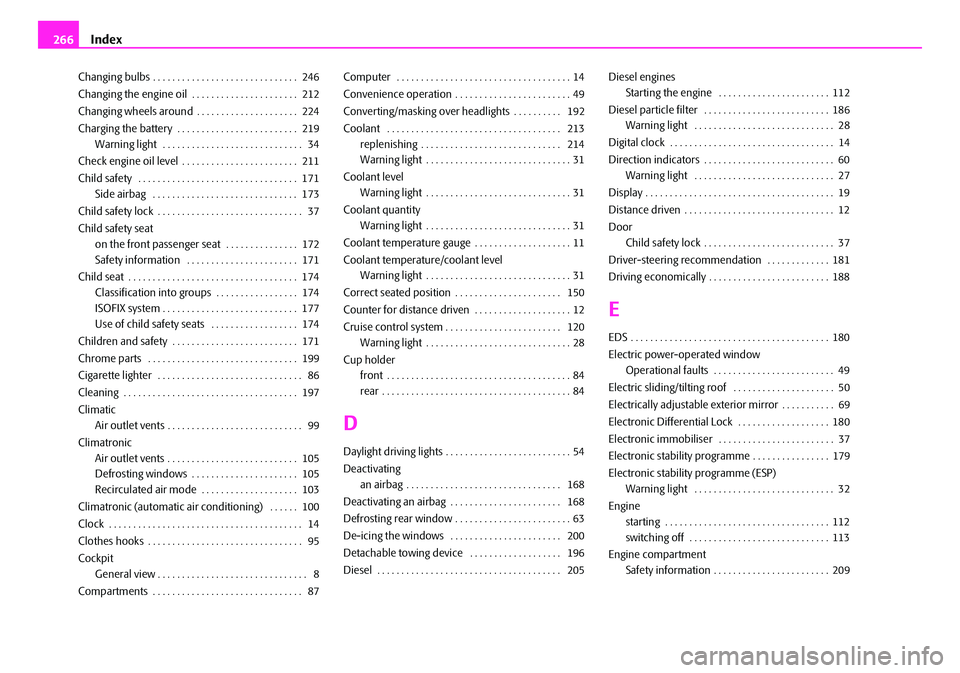
Index
266
Changing bulbs . . . . . . . . . . . . . . . . . . . . . . . . . . . . . . 246
Changing the engine oil . . . . . . . . . . . . . . . . . . . . . . 212
Changing wheels around . . . . . . . . . . . . . . . . . . . . . 224
Charging the battery . . . . . . . . . . . . . . . . . . . . . . . . . 219
Warning light . . . . . . . . . . . . . . . . . . . . . . . . . . . . . 34
Check engine oil level . . . . . . . . . . . . . . . . . . . . . . . . 211
Child safety . . . . . . . . . . . . . . . . . . . . . . . . . . . . . . . . . 171 Side airbag . . . . . . . . . . . . . . . . . . . . . . . . . . . . . . 173
Child safety lock . . . . . . . . . . . . . . . . . . . . . . . . . . . . . . 37
Child safety seat on the front passenger seat . . . . . . . . . . . . . . . 172
Safety information . . . . . . . . . . . . . . . . . . . . . . . 171
Child seat . . . . . . . . . . . . . . . . . . . . . . . . . . . . . . . . . . . 174 Classification into groups . . . . . . . . . . . . . . . . . 174
ISOFIX system . . . . . . . . . . . . . . . . . . . . . . . . . . . . 177
Use of child safety seats . . . . . . . . . . . . . . . . . . 174
Children and safety . . . . . . . . . . . . . . . . . . . . . . . . . . 171
Chrome parts . . . . . . . . . . . . . . . . . . . . . . . . . . . . . . . 199
Cigarette lighter . . . . . . . . . . . . . . . . . . . . . . . . . . . . . . 86
Cleaning . . . . . . . . . . . . . . . . . . . . . . . . . . . . . . . . . . . . 197
Climatic Air outlet vents . . . . . . . . . . . . . . . . . . . . . . . . . . . . 99
Climatronic Air outlet vents . . . . . . . . . . . . . . . . . . . . . . . . . . . 105
Defrosting windows . . . . . . . . . . . . . . . . . . . . . . 105
Recirculated air mode . . . . . . . . . . . . . . . . . . . . 103
Climatronic (automatic air conditioning) . . . . . . 100
Clock . . . . . . . . . . . . . . . . . . . . . . . . . . . . . . . . . . . . . . . . 14
Clothes hooks . . . . . . . . . . . . . . . . . . . . . . . . . . . . . . . . 95
Cockpit General view . . . . . . . . . . . . . . . . . . . . . . . . . . . . . . . 8
Compartments . . . . . . . . . . . . . . . . . . . . . . . . . . . . . . . 87 Computer . . . . . . . . . . . . . . . . . . . . . . . . . . . . . . . . . . . . 14
Convenience operation . . . . . . . . . . . . . . . . . . . . . . . . 49
Converting/masking over headlights . . . . . . . . . . 192
Coolant . . . . . . . . . . . . . . . . . . . . . . . . . . . . . . . . . . . . 213
replenishing . . . . . . . . . . . . . . . . . . . . . . . . . . . . . 214
Warning light . . . . . . . . . . . . . . . . . . . . . . . . . . . . . . 31
Coolant level Warning light . . . . . . . . . . . . . . . . . . . . . . . . . . . . . . 31
Coolant quantity Warning light . . . . . . . . . . . . . . . . . . . . . . . . . . . . . . 31
Coolant temperature gauge . . . . . . . . . . . . . . . . . . . . 11
Coolant temperatur e/coolant level
Warning light . . . . . . . . . . . . . . . . . . . . . . . . . . . . . . 31
Correct seated position . . . . . . . . . . . . . . . . . . . . . . 150
Counter for distance driven . . . . . . . . . . . . . . . . . . . . 12
Cruise control system . . . . . . . . . . . . . . . . . . . . . . . . 120 Warning light . . . . . . . . . . . . . . . . . . . . . . . . . . . . . . 28
Cup holder front . . . . . . . . . . . . . . . . . . . . . . . . . . . . . . . . . . . . . . 84
rear . . . . . . . . . . . . . . . . . . . . . . . . . . . . . . . . . . . . . . . 84
D
Daylight driving lights . . . . . . . . . . . . . . . . . . . . . . . . . . 54
Deactivatingan airbag . . . . . . . . . . . . . . . . . . . . . . . . . . . . . . . . 168
Deactivating an airbag . . . . . . . . . . . . . . . . . . . . . . . 168
Defrosting rear window . . . . . . . . . . . . . . . . . . . . . . . . 63
De-icing the windows . . . . . . . . . . . . . . . . . . . . . . . 200
Detachable towing device . . . . . . . . . . . . . . . . . . . 196
Diesel . . . . . . . . . . . . . . . . . . . . . . . . . . . . . . . . . . . . . . 205 Diesel engines
Starting the engine . . . . . . . . . . . . . . . . . . . . . . . 112
Diesel particle filter . . . . . . . . . . . . . . . . . . . . . . . . . . 186 Warning light . . . . . . . . . . . . . . . . . . . . . . . . . . . . . 28
Digital clock . . . . . . . . . . . . . . . . . . . . . . . . . . . . . . . . . . 14
Direction indicators . . . . . . . . . . . . . . . . . . . . . . . . . . . 60 Warning light . . . . . . . . . . . . . . . . . . . . . . . . . . . . . 27
Display . . . . . . . . . . . . . . . . . . . . . . . . . . . . . . . . . . . . . . . 19
Distance driven . . . . . . . . . . . . . . . . . . . . . . . . . . . . . . . 12
Door Child safety lock . . . . . . . . . . . . . . . . . . . . . . . . . . . 37
Driver-steering recommendation . . . . . . . . . . . . . 181
Driving economically . . . . . . . . . . . . . . . . . . . . . . . . . 188
E
EDS . . . . . . . . . . . . . . . . . . . . . . . . . . . . . . . . . . . . . . . . . 180
Electric power-operated window Operational faults . . . . . . . . . . . . . . . . . . . . . . . . . 49
Electric sliding/tilting roof . . . . . . . . . . . . . . . . . . . . . 50
Electrically adjustable exterior mirror . . . . . . . . . . . 69
Electronic Differential Lock . . . . . . . . . . . . . . . . . . . 180
Electronic immobiliser . . . . . . . . . . . . . . . . . . . . . . . . 37
Electronic stability programme . . . . . . . . . . . . . . . . 179
Electronic stability programme (ESP) Warning light . . . . . . . . . . . . . . . . . . . . . . . . . . . . . 32
Engine starting . . . . . . . . . . . . . . . . . . . . . . . . . . . . . . . . . . 112
switching off . . . . . . . . . . . . . . . . . . . . . . . . . . . . . 113
Engine compartment Safety information . . . . . . . . . . . . . . . . . . . . . . . . 209
NKO B6 20.book Page 266 Wednesday, March 26, 2008 3:15 PM