window SKODA SUPERB 2008 2.G / (B6/3T) Owner's Guide
[x] Cancel search | Manufacturer: SKODA, Model Year: 2008, Model line: SUPERB, Model: SKODA SUPERB 2008 2.G / (B6/3T)Pages: 272, PDF Size: 18.25 MB
Page 69 of 272

Lights and Visibility
68
WARNING
•If the windscreen wipers are handled carelessly, there is a risk of damage
to the windscreen.
•You should clean the wiper blades regularly with a windscreen cleaner in
order to avoid any smears. Clean a wiper bl ade with a sponge or cloth if it is
very dirty, for example from insect residues.
•Replace the wiper blades once or twice a year for safety reasons. The
wiper blades are available from Škoda Service Partners.
Rear-view mirror
Manual dimming interior rear-view mirror
Basic setting
– Pull the lever on the bottom edge of the mirror forward.
Dimming mirror
– Pull the lever on the bottom edge of the mirror back.
Automatic dimming interior mirror*
Switching on the automatic dimming
– Press the button - the warning light lights up ⇒fig. 60 .
Switching off the automatic dimming
– Press again the button - the warning light goes out .
If the automatic dimming is switched on, the mirror dims automatically
depending on the light striking the mirror from the rear. The mirror has no lever on
the bottom edge of the mirror. When the interior lights are switched on or the
reverse gear is engaged, the mirror alwa ys moves back into the basic position.
Note
•Automatic mirror dimming operates only properly if the sun screen* for the rear
window is not in use or the light striking the rear of the interior rear-view mirror is
not affected by other objects.
•Do not affix any stickers in front of the li ght sensor, so that you do not impair the
automatic dimming function or put it out of operation.
•If you switch off the automatic dimming interior rear-view mirror, also the exte-
rior mirror dimming is switched off.
Exterior mirror with entry lighting*
The lighting is positioned on the bottom edge of the exterior mirror.
The light beam is aimed at the entry area of the front doors after the car is unlocked.
The light comes on after the doors have been locked or on opening the front door.
The lighting goes out about 30 seconds afte r the doors are closed or if the ignition
is switched on.
If the doors remain open, the lighting goes out automatically after about 10 minutes
provided the ignition is not switched on.
Fig. 60 Automatic dimming
interior mirror
ABAA
ABAA
NKO B6 20.book Page 68 Wednesday, March 26, 2008 3:15 PM
Page 70 of 272

Lights and Visibility69
Using the systemSafetyDriving TipsGeneral MaintenanceBreakdown assistanceTechnical Data
Exterior mirror
You can adjust the exterior mirrors electrically*.
The exterior mirror heater only oper ates when the engine is running and
up to an outside temperature of +20 °C.
Heating of the external mirror
– Turn the rotary knob to position
⇒ fig. 61 .
Adjusting left and right exterior mirrors simultaneously
– Turn the rotary knob to position
. The movement of the mirror surface
is identical to the movement of the rotary knob.
Adjusting the right-hand exterior mirror
– Turn the rotary knob to position
. The movement of the mirror
surface is identical to the movement of the rotary knob.
Switching off operating control
– Turn the rotary knob to position
.
Folding in both exterior mirrors*
– Turn the rotary knob to position
. Lowerable exterior mirror* with the aid of the key for remote control
– If all the windows are closed, press the unlock button on the
remote control ⇒page 44, fig. 34 for approx. 2 seconds.
Tilting surface of front pa ssenger exterior mirror*
When the rotary knob is in position
⇒ fig. 61 and the reverse gear is engaged, the
s ur fa ce o f t h e m i rro r t i l ts d o w n s l i g h t l y. T h i s p ro v i d e s a n a i d i n s e e i n g th e ke r b o f t h e
pavement when parking the car.
The mirror returns back into its initial po sition, after the rotary knob is moved out
of the position
and put into another position or if the speed is more than 15 km/h.
Memory for exterior mirrors*
On vehicles fitted with a memory for the driver seat, the relevant setting of the exte-
rior mirror is also stored automatica lly when the seat position is stored.
WARNING
•Convex (curved outward) or a spherical exterior mirrors increase the
vision field. They do, however, make objects appear smaller in the mirror.
These mirrors are only of limited use, therefore, for estimating distances to
the following vehicles.
•Use whenever possible the interior rear mirror, for estimating the
distances to the following vehicles.
Note
•Do not touch the surfaces of the exterior mirrors if the exterior mirror heater is
switched on.
•You can set the exterior mirrors by hand, if the power setting function fails at any
time, by pressing on the ed ge of the mirror surface.
•Contact your specialist garage if a fault exists with the power setting of the exte-
rior mirrors.
Fig. 61 Inner part of door:
Rotary knob
A3
NKO B6 20.book Page 69 Wednesday, March 26, 2008 3:15 PM
Page 71 of 272

Lights and Visibility
70
Automatic dimming exterior mirror*
The exterior mirrors are dimmed together with the interior mirror. If the automatic
dimming is switched on, the mirror dims automatically depending on the light
striking the mirror from the rear.
When the interior lights are switched on or the reverse gear is engaged, the mirror
always moves back into the basic position (not dimmed).
Note
•Automatic mirror dimming operates only pr operly if the sun screen* for the rear
window is not in use or the li ght striking the rear of the interior rear-view mirror is
not affected by other objects.
•Do not affix any stickers in front of the li ght sensor, so that you do not impair the
automatic dimming function or put it out of operation.
•If you switch off the automatic dimming interior rear-view mirror, also the exte-
rior mirror dimming is switched off.
NKO B6 20.book Page 70 Wednesday, March 26, 2008 3:15 PM
Page 72 of 272
Seats and Stowage71
Using the systemSafetyDriving TipsGeneral MaintenanceBreakdown assistanceTechnical Data
Seats and Stowage
Front seats
Basic information
The front seats have a wide range of differ ent settings and can thus be matched to
the physical characteristics of the driver and front passenger. Correct adjustment of
the seats is particularly important for
•safely and quickly reaching the controls,
•a relaxed, fatigue-free body position,
•achieving the maximum protection offere d by the seat belts and the airbag
system.
WARNING
•Never transport more occupants than the maximum seating in the
vehicle.
•Each occupant must correctly fasten the seat belt belonging to the seat.
Children must be fastened ⇒page 171, “Transporting children safely” with
a suitable restraint system.
•The front seats and the head restraints must always be adjusted to match
the body size of the seat occupant as well as the seat belts must always be
correctly fastened in order to provide an optimal protection for you and your
occupants.
•Always keep your feet in the footwell when the car is being driven - never
place your feet on the instrument panel, out of the window or on the
surfaces of the seats. This is particularly important for the front seat
passenger. You will be exposed to increa sed risk of injury if it becomes
necessary to apply the brake or in the ev ent of an accident. If an airbag is
deployed, you may suffer fatal injuries when adopting an incorrect seated
position!
•It is important for the driver and front passenger to maintain a distance
of at least 25 cm from the steering wheel or dash panel. Not maintaining this minimum distance will mean that the airb
ag system will not be able to prop-
erly protect you - hazard! The front seats and the head restraints must
always also be correctly adjusted to match the body size of the occupant.
•Ensure that there are no objects in the footwell as any objects may get
behind the pedals during a driving or braking manoeuvre. You would then
no longer be able to operate the clutch, to brake or accelerate.
Adjusting the front seats
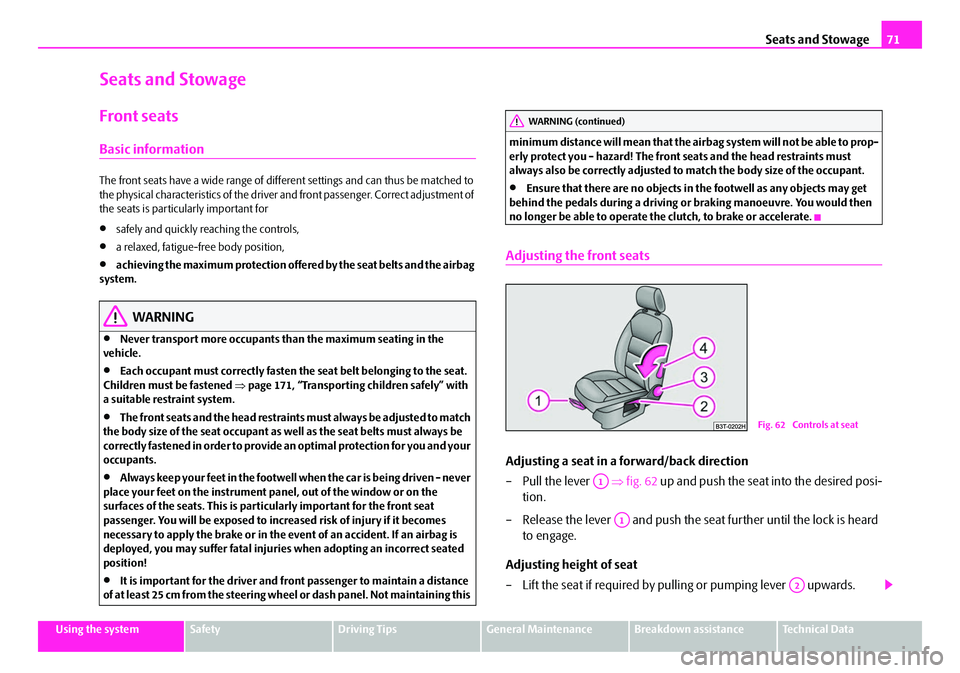
Adjusting a seat in a forward/back direction
–Pull the lever ⇒fig. 62 up and push the seat into the desired posi-
tion.
– Release the lever and push the seat further until the lock is heard to engage.
Adjusting height of seat
– Lift the seat if required by pulling or pumping lever upwards.
WARNING (continued)
Fig. 62 Controls at seat
A1
A1
A2
NKO B6 20.book Page 71 Wednesday, March 26, 2008 3:15 PM
Page 80 of 272
Seats and Stowage79
Using the systemSafetyDriving TipsGeneral MaintenanceBreakdown assistanceTechnical Data
– Attach the items of luggage to the lashing eyes or the safety net*
⇒page 79.
In the event of an accident, there is such a high kinetic energy which is produced by
small and light objects that they can caus e severe injuries. The magnitude of the
kinetic energy depends on the speed at wh ich the vehicle is travelling and on the
weight of the object. The speed at which the vehicle is travelling is in this case the
more significant factor.
Example: In the event of a frontal collis ion at a speed of 50 km/h, an unsecured
object with a weight of 4.5 kg produces an energy, which corresponds to 20 times
its own weight. This means that it results in a weight of approx. 90 kg. You can
imagine the injuries that can occur, if this “bullet” is flying through the interior
compartment and hits an occupant.
WARNING
•Store the objects in the luggage comp artment and attach them to the
lashing eyes.
•Loose objects in the passenger compartment can be thrown forward
during a sudden manoeuvre or in case of an accident and can injure the
occupants or other oncoming traffic. This risk is still increased, if the objects
which are flying around are hit by a depl oyed airbag. In this case, the objects
which are thrown back can injure the occupants - hazard.
•Please note that the handling properti es of your vehicle may be affected
when transporting heavy objects as a result of the displacement of the
centre of gravity. The speed and style of driving must be adjusted accord-
ingly.
•The items carried in the luggage compar tment should be stored in such
a way that no objects are able to slip forward if there are any sudden driving
or braking manoeuvres undertaken - risk of injury!
•Never drive with the boot lid fully opened or slightly ajar otherwise
exhaust gases may get into the interior of the vehicle - risk of poisoning!
•On no account exceed the permissi ble axle loads and the permissible
gross weight of the vehi cle - risk of accident!
•Never transport occupants in the luggage compartment!
Caution
Please ensure that the heating elements of the rear window heater are not
damaged as a result of objects sliding in this area.
Note
Tyre pressure must be adjusted to the load ⇒page 222, fig. 195 .
Lashing eyes
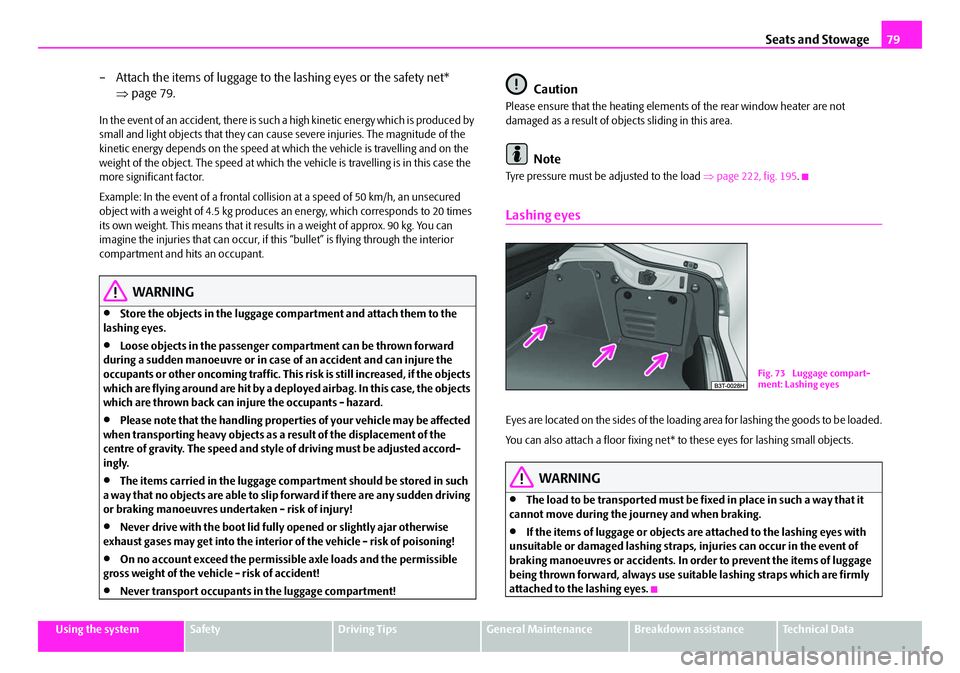
Eyes are located on the sides of the loading area for lashing the goods to be loaded.
You can also attach a floor fixing net* to these eyes for lashing small objects.
WARNING
•The load to be transported must be fixed in place in such a way that it
cannot move during the journey and when braking.
•If the items of luggage or objects ar e attached to the lashing eyes with
unsuitable or damaged lashing straps, injuries can occur in the event of
braking manoeuvres or accidents. In order to prevent the items of luggage
being thrown forward, always use suit able lashing straps which are firmly
attached to the lashing eyes.
Fig. 73 Luggage compart-
ment: Lashing eyes
NKO B6 20.book Page 79 Wednesday, March 26, 2008 3:15 PM
Page 83 of 272
Seats and Stowage
82
Caution
Please ensure that the heating elements of the rear window heater are not
damaged as a result of objects placed in this area.
Note
Opening the boot lid also lifts up the luggage compartment cover.
Remove raised floor*
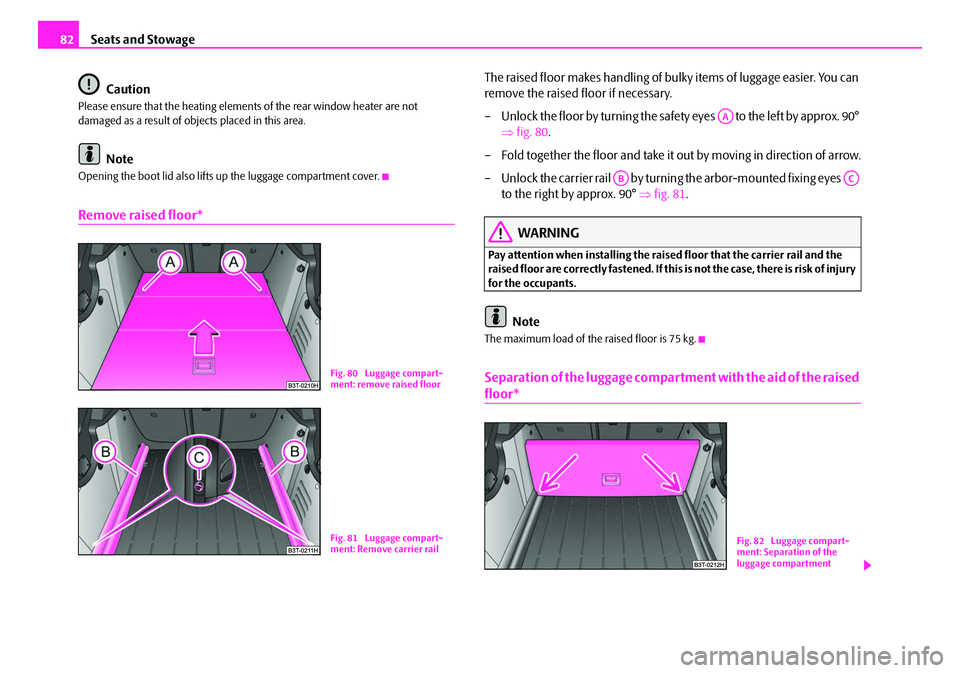
The raised floor makes handling of bu lky items of luggage easier. You can
remove the raised floor if necessary.
– Unlock the floor by turning the safety eyes to the left by approx. 90° ⇒fig. 80 .
– Fold together the floor and take it out by moving in direction of arrow.
– Unlock the carrier rail by turning the arbor-mounted fixing eyes to the right by approx. 90° ⇒fig. 81 .
WARNING
Pay attention when installing the raised floor that the carrier rail and the
raised floor are correctly fast ened. If this is not the case, there is risk of injury
for the occupants.
Note
The maximum load of the raised floor is 75 kg.
Separation of the luggage compartment with the aid of the raised
floor*
Fig. 80 Luggage compart-
ment: remove raised floor
Fig. 81 Luggage compart-
ment: Remove carrier rail
AA
ABAC
Fig. 82 Luggage compart-
ment: Separation of the
luggage compartment
NKO B6 20.book Page 82 Wednesday, March 26, 2008 3:15 PM
Page 97 of 272

The air conditioning system
96
The air conditioning system
Climatic* (semi-automatic air conditioning system)
Description
The Climatic is a combined cooling and heating system. It makes it
possible to optimally control the air temperature at any season of the
year.
Description of the Climatic
It is important for your safety and for your driving comfort that the Climatic is oper-
ating properly.
The cooling only operates if button ⇒page 97, fig. 110 is pressed, and the
following conditions are met:
•engine running,
•outside temperature above +2°C and
•blower switch switched on (positions 1 to 4).
If the cooling system is switched on, the temperature and air humidity drops in the
vehicle. The wellbeing of the occupants of the car is enhanced as a result of this
particularly at high outside temperatures and a high air humidity. The system
prevents the windows misting up during the cold season of the year.
The heating effect is dependent upon th e coolant temperature, thus full heat
output only occurs when the engine has reached its operating temperature.
It is possible to briefly activate recirc ulated air mode in order to enhance the
cooling effect ⇒.
Air at a temperature of about 5°C may flow out of the vents under certain circum-
stances when the cooling system is operating. Lengthy and uneven distribution of
the air flow out of the vents and large differences in temperature, for example when
getting out of the vehicle, can resu lt in chills in sensitive persons.
The air inlet in front of the windscreen must be free of ice, snow or leaves in order
to ensure that the heating and cooling systems operate properly. After switching on the cooling
Condensation from the evaporator of the air condi-
tioning may drip down and form a puddle below the vehicle. This is quite normal
and not an indication of a leak!
WARNING
•For your own safety and that of other road users, ensure that all the
windows are free of ice, snow and mist ing. Please familiarize yourself about
how to correctly operate the heating an d ventilation systems, how to demist
and defrost the windows, as well as with the cooling mode.
•You should not leave recirculated air mode on over a longer period of
time, as “stale” air may result in fatigue in the driver and occupants, divert
your attention and also cause the windows to mist up. The risk of having an
accident increases. Switch recirculated air mode off as soon as the windows
begin misting up.
Note
•We recommend that you do not smoke in the vehicle when the recirculating air
mode is operating since the smoke which is drawn at the evaporator from the inte-
rior of the vehicle forms deposits in the evaporator of the air conditioning system.
This produces a permanent odour when th e air conditioning system is operating
which can only be eliminated through co nsiderable effort and expense (replace-
ment of compressor).
ACA1
NKO B6 20.book Page 96 Wednesday, March 26, 2008 3:15 PM
Page 98 of 272
The air conditioning system97
Using the systemSafetyDriving TipsGeneral MaintenanceBreakdown assistanceTechnical Data
Using the system
Fig. 110 Climatic: Control elements
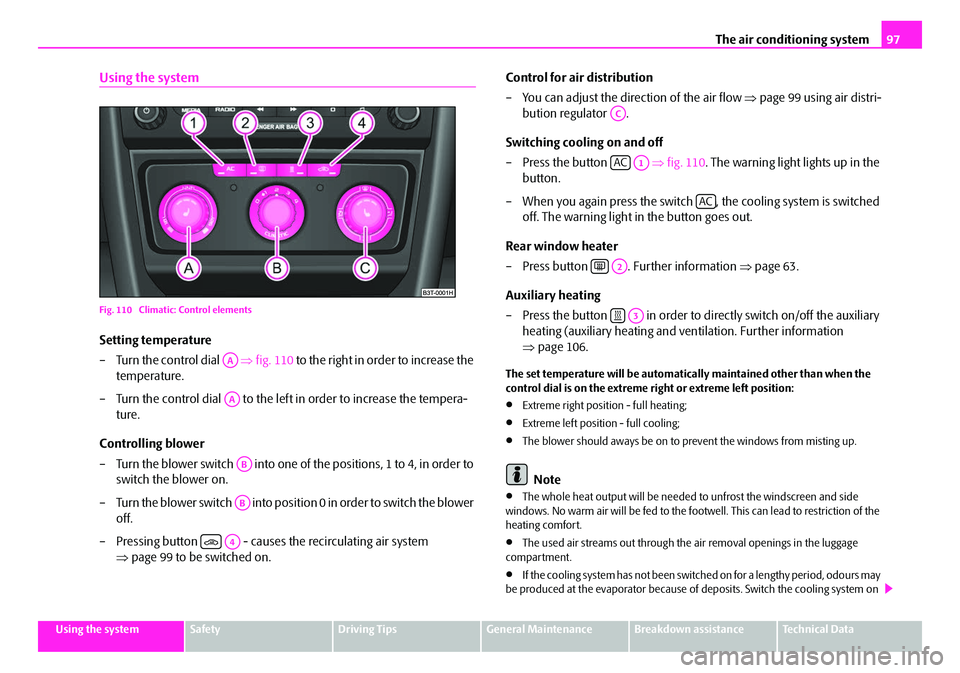
Setting temperature
– Turn the control dial ⇒fig. 110 to the right in order to increase the
temperature.
– Turn the control dial to the left in order to increase the tempera- ture.
Controlling blower
– Turn the blower switch into one of the positions, 1 to 4, in order to switch the blower on.
– Turn the blower switch into position 0 in order to switch the blower off.
– Pressing button - causes the recirculating air system ⇒page 99 to be switched on. Control for air distribution
– You can adjust the direction of the air flow
⇒page 99 using air distri-
bution regulator .
Switching cooling on and off
– Press the button ⇒ fig. 110. The warning light lights up in the
button.
– When you again press the switch , the cooling system is switched off. The warning light in the button goes out.
Rear window heater
– Press button . Further information ⇒ page 63.
Auxiliary heating
– Press the button in order to directly switch on/off the auxiliary heating (auxiliary heating and ventilation. Further information
⇒page 106.
The set temperature will be automatically maintained other than when the
control dial is on the extreme right or extreme left position:
•Extreme right position - full heating;
•Extreme left position - full cooling;
•The blower should aways be on to prevent the windows from misting up.
Note
•The whole heat output will be needed to unfrost the windscreen and side
windows. No warm air will be fed to the footwell. This can lead to restriction of the
heating comfort.
•The used air streams out through the air removal openings in the luggage
compartment.
•If the cooling system has not been switched on for a lengthy period, odours may
be produced at the evaporator because of deposits. Switch the cooling system on
AA
AA
AB
AB
A4
AC
ACA1
AC
A2
A3
NKO B6 20.book Page 97 Wednesday, March 26, 2008 3:15 PM
Page 99 of 272

The air conditioning system
98
at least once a month for approximately 5 mi nutes at the highest blower stage - also
during the cold season of the year - in order to remove such odours. Also open a
window for a short time.•Please refer to the information regarding recirculated air mode ⇒page 99.
Set Climatic
Recommended settings of Climatic contro ls for the respective operating modes:
Set-upSetting of the control dialButtonAir outlet vents 2
Defrosting the windscreen and
side windowsrecommended
22°C3switched offdo not switch onopen and align with the side window
Free windscreen and side win-
dows from mistdesired tempera-
ture2switched ondo not switch onopen and align with the side window
The fastest heatingrecommended 22°C2switched offbriefly switched onopen
Comfortable heatingdesired tempera- ture2 or 3 or switched offdo not switch onopen
The fastest coolingrecommended
22°Cbriefly 4, then 2 or 3switched onbriefly switched onopen
Optimal coolingdesired tempera- ture1, 2 or 3switched ondo not switch onopen and align to the roof
Fresh air mode - ventilation up to the stop
towards the leftdesired positionswitched offdo not switch onopen
AAABACA1A4
NKO B6 20.book Page 98 Wednesday, March 26, 2008 3:15 PM
Page 100 of 272

The air conditioning system99
Using the systemSafetyDriving TipsGeneral MaintenanceBreakdown assistanceTechnical Data
Recirculated air mode
In recirculated air mode air is sucked out of the interior of the vehicle
and then fed back into the interior.
Recirculated air mode prevents polluted air outside the vehicle from
getting into the vehicle, for example when driving through a tunnel or
when standing in a traffic jam.
Switching recirculated air mode on
– Press the button ⇒page 97, fig. 110 the warning light lights
up in the button.
Switching recirculated air mode off
– Press again the button - the warning light in the button goes out.
The recirculated air mode is switched off au tomatically if the air distribution control
is in position ⇒ page 97, fig. 110 . You can also switch recirculated air mode
on again from this setting by repeatedly pressing button .
WARNING
You should not leave recirculated air mode on over a longer period of time,
as “stale” air may result in fatigue in the driver and occupants, divert your
attention and also cause the windows to mist up. The risk of having an acci-
dent increases. Switch recirculated air mode off as soon as the windows
begin misting up.
Air outlet vents
Fig. 111 Air vents at the front
Fig. 112 Air vents at the rear
Open air outlet vents
– Turn the rotary knob to position
.
Close air outlet vents
– Turn the rotary knob to position 0.
A4
AC
NKO B6 20.book Page 99 Wednesday, March 26, 2008 3:15 PM