child restraint SKODA SUPERB 2008 2.G / (B6/3T) Owner's Manual
[x] Cancel search | Manufacturer: SKODA, Model Year: 2008, Model line: SUPERB, Model: SKODA SUPERB 2008 2.G / (B6/3T)Pages: 272, PDF Size: 18.25 MB
Page 4 of 272
Contents3
Contents
Layout of this Owner's Manual
(explanations)
. . . . . . . . . . . . . . . . . . . . . . . . . .
Using the system. . . . . . . . . . . . . . . . . . . . . .
Cockpit. . . . . . . . . . . . . . . . . . . . . . . . . . . . . . . . . . . . . . . .
Overview . . . . . . . . . . . . . . . . . . . . . . . . . . . . . . . . . . . .
Instruments and Indicator/Warning Lights. . .
General view of the instrument cluster . . . . . . . . .
Engine revolutions counter . . . . . . . . . . . . . . . . . . . .
Speedometer . . . . . . . . . . . . . . . . . . . . . . . . . . . . . . . .
Coolant temperature gauge . . . . . . . . . . . . . . . . . . .
Fuel gauge . . . . . . . . . . . . . . . . . . . . . . . . . . . . . . . . . . .
Counter for distance driven . . . . . . . . . . . . . . . . . . .
Service Interval Display . . . . . . . . . . . . . . . . . . . . . . .
Digital clock . . . . . . . . . . . . . . . . . . . . . . . . . . . . . . . . . .
Multi-functional indicato r (onboard computer)*
Information display* . . . . . . . . . . . . . . . . . . . . . . . . . .
Audio . . . . . . . . . . . . . . . . . . . . . . . . . . . . . . . . . . . . . . . .
Navigation system* . . . . . . . . . . . . . . . . . . . . . . . . . . .
Auto Check Control* . . . . . . . . . . . . . . . . . . . . . . . . . .
Warning lights . . . . . . . . . . . . . . . . . . . . . . . . . . . . . . . .
Unlocking and locking . . . . . . . . . . . . . . . . . . . . . . . .
Key . . . . . . . . . . . . . . . . . . . . . . . . . . . . . . . . . . . . . . . . . .
Changing the battery of the radio remote control
Electronic immobiliser . . . . . . . . . . . . . . . . . . . . . . . .
Child safety lock . . . . . . . . . . . . . . . . . . . . . . . . . . . . . .
Central locking system . . . . . . . . . . . . . . . . . . . . . . . .
Remote control . . . . . . . . . . . . . . . . . . . . . . . . . . . . . . .
Description . . . . . . . . . . . . . . . . . . . . . . . . . . . . . . . . . .
Unlocking and locking car . . . . . . . . . . . . . . . . . . . . .
Synchonisation of the remote control . . . . . . . . . . Anti-theft alarm system* . . . . . . . . . . . . . . . . . . . . . .
Power windows . . . . . . . . . . . . . . . . . . . . . . . . . . . . . .
Electric sliding/tilting roof* . . . . . . . . . . . . . . . . . . . .
Lights and Visibility . . . . . . . . . . . . . . . . . . . . . . . . . . .
Lights . . . . . . . . . . . . . . . . . . . . . . . . . . . . . . . . . . . . . . . .
Interior lighting . . . . . . . . . . . . . . . . . . . . . . . . . . . . . . .
Visibility . . . . . . . . . . . . . . . . . . . . . . . . . . . . . . . . . . . . .
Windshield wiper and wash system . . . . . . . . . . . .
Rear-view mirror . . . . . . . . . . . . . . . . . . . . . . . . . . . . .
Exterior mirror . . . . . . . . . . . . . . . . . . . . . . . . . . . . . . .
Automatic dimming exterior mirror* . . . . . . . . . . .
Seats and Stowage. . . . . . . . . . . . . . . . . . . . . . . . . . . .
Front seats . . . . . . . . . . . . . . . . . . . . . . . . . . . . . . . . . . .
Adjusting front seats electrically* . . . . . . . . . . . . . .
Head restraints . . . . . . . . . . . . . . . . . . . . . . . . . . . . . . .
Middle rear head restraint* . . . . . . . . . . . . . . . . . . . .
Rear seats . . . . . . . . . . . . . . . . . . . . . . . . . . . . . . . . . . . .
luggage compartment . . . . . . . . . . . . . . . . . . . . . . . .
The roof rack* . . . . . . . . . . . . . . . . . . . . . . . . . . . . . . . .
Cup holder . . . . . . . . . . . . . . . . . . . . . . . . . . . . . . . . . . .
Ashtray . . . . . . . . . . . . . . . . . . . . . . . . . . . . . . . . . . . . . .
Cigarette lighter*, power sockets . . . . . . . . . . . . . . .
Storage compartments . . . . . . . . . . . . . . . . . . . . . . . .
The air conditioning system . . . . . . . . . . . . . . . . . .
Climatic* (semi-automat ic air conditioning
system) . . . . . . . . . . . . . . . . . . . . . . . . . . . . . . . . . . . . . .
Climatronic* (automatic air conditioning) . . . . . .
Auxiliary heating (auxiliary heating and
ventilation)* . . . . . . . . . . . . . . . . . . . . . . . . . . . . . . . . .
Starting-off and Driving. . . . . . . . . . . . . . . . . . . . . . .
Setting steering wheel position . . . . . . . . . . . . . . . .
Ignition lock . . . . . . . . . . . . . . . . . . . . . . . . . . . . . . . . . .
Starting the engine . . . . . . . . . . . . . . . . . . . . . . . . . . . Rear parking aid* . . . . . . . . . . . . . . . . . . . . . . . . . . . . .
Front and rear parking aid* . . . . . . . . . . . . . . . . . . . .
Park Assist* . . . . . . . . . . . . . . . . . . . . . . . . . . . . . . . . . .
Cruise control system (CCS)* . . . . . . . . . . . . . . . . . .
Automatic gearbox DSG*. . . . . . . . . . . . . . . . . . . . .
Automatic gearbox DSG* . . . . . . . . . . . . . . . . . . . . .
Communication . . . . . . . . . . . . . . . . . . . . . . . . . . . . . .
Multifunction steering wheel* . . . . . . . . . . . . . . . . .
Universal telephone preinstallation GSM II* . . . .
Universal telephone preinstallation GSM III* . . . .
Phone voice phonebook* . . . . . . . . . . . . . . . . . . . . .
Mobile phones and two-way radio systems . . . . .
Input AUX-IN . . . . . . . . . . . . . . . . . . . . . . . . . . . . . . . .
CD changer* . . . . . . . . . . . . . . . . . . . . . . . . . . . . . . . . .
Safety . . . . . . . . . . . . . . . . . . . . . . . . . . . . . . . . . . . . . .
Passive Safety . . . . . . . . . . . . . . . . . . . . . . . . . . . . . . . . .
Basic information . . . . . . . . . . . . . . . . . . . . . . . . . . . .
Correct seated position . . . . . . . . . . . . . . . . . . . . . . .
Seat belts. . . . . . . . . . . . . . . . . . . . . . . . . . . . . . . . . . . . . .
Why seat belts? . . . . . . . . . . . . . . . . . . . . . . . . . . . . . .
The physical principle of a frontal collision . . . . .
Important safety information regarding the use of
seat belts . . . . . . . . . . . . . . . . . . . . . . . . . . . . . . . . . . . .
How are seat belts correctly fastened? . . . . . . . . .
Airbag system. . . . . . . . . . . . . . . . . . . . . . . . . . . . . . . . .
Description of the airbag system . . . . . . . . . . . . . . .
Front airbag . . . . . . . . . . . . . . . . . . . . . . . . . . . . . . . . . .
Driver's knee airbag* . . . . . . . . . . . . . . . . . . . . . . . . .
Side airbags* . . . . . . . . . . . . . . . . . . . . . . . . . . . . . . . . .
6
7
8
8
10
10
11
11
11
11
12
12
14
14
19
21
21
22
26
36
36
36
37
37
38
43
43
44
45 45
47
50
53
53
61
63
65
68
69
70
71
71
72
75
75
76
78
83
84
85
86
87
96
96
100
106
110
110
111
112 115
116
117
120
123
123
130
130
133
137
143
145
146
146
149
149
149
150
154
154
155
155
156
160
160
161
164
165
NKO B6 20.book Page 3 Wednesday, March 26, 2008 3:15 PM
Page 72 of 272
Seats and Stowage71
Using the systemSafetyDriving TipsGeneral MaintenanceBreakdown assistanceTechnical Data
Seats and Stowage
Front seats
Basic information
The front seats have a wide range of differ ent settings and can thus be matched to
the physical characteristics of the driver and front passenger. Correct adjustment of
the seats is particularly important for
•safely and quickly reaching the controls,
•a relaxed, fatigue-free body position,
•achieving the maximum protection offere d by the seat belts and the airbag
system.
WARNING
•Never transport more occupants than the maximum seating in the
vehicle.
•Each occupant must correctly fasten the seat belt belonging to the seat.
Children must be fastened ⇒page 171, “Transporting children safely” with
a suitable restraint system.
•The front seats and the head restraints must always be adjusted to match
the body size of the seat occupant as well as the seat belts must always be
correctly fastened in order to provide an optimal protection for you and your
occupants.
•Always keep your feet in the footwell when the car is being driven - never
place your feet on the instrument panel, out of the window or on the
surfaces of the seats. This is particularly important for the front seat
passenger. You will be exposed to increa sed risk of injury if it becomes
necessary to apply the brake or in the ev ent of an accident. If an airbag is
deployed, you may suffer fatal injuries when adopting an incorrect seated
position!
•It is important for the driver and front passenger to maintain a distance
of at least 25 cm from the steering wheel or dash panel. Not maintaining this minimum distance will mean that the airb
ag system will not be able to prop-
erly protect you - hazard! The front seats and the head restraints must
always also be correctly adjusted to match the body size of the occupant.
•Ensure that there are no objects in the footwell as any objects may get
behind the pedals during a driving or braking manoeuvre. You would then
no longer be able to operate the clutch, to brake or accelerate.
Adjusting the front seats
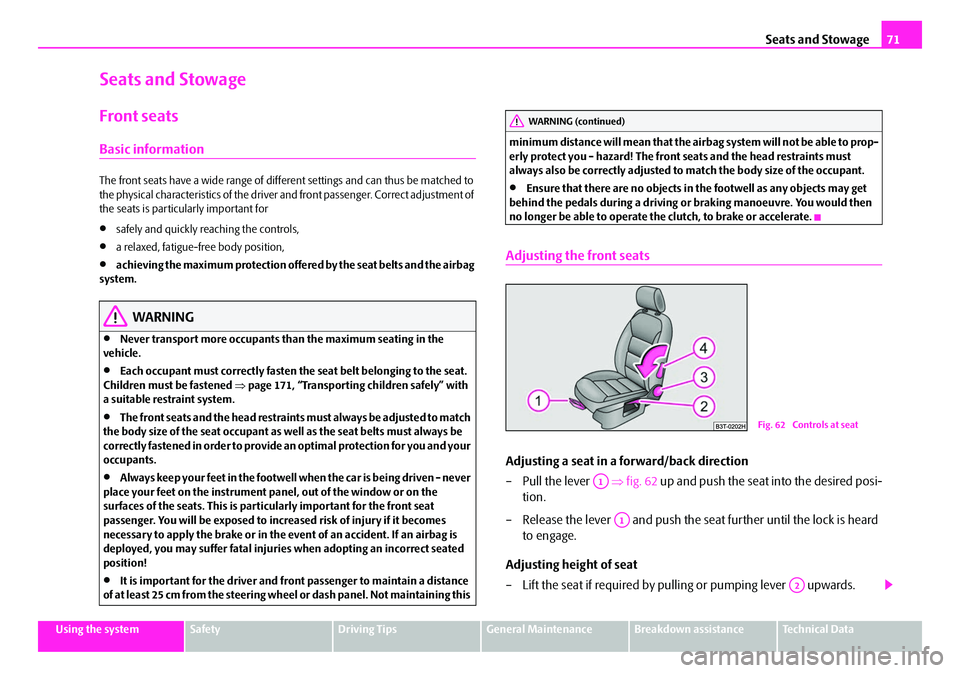
Adjusting a seat in a forward/back direction
–Pull the lever ⇒fig. 62 up and push the seat into the desired posi-
tion.
– Release the lever and push the seat further until the lock is heard to engage.
Adjusting height of seat
– Lift the seat if required by pulling or pumping lever upwards.
WARNING (continued)
Fig. 62 Controls at seat
A1
A1
A2
NKO B6 20.book Page 71 Wednesday, March 26, 2008 3:15 PM
Page 76 of 272
Seats and Stowage75
Using the systemSafetyDriving TipsGeneral MaintenanceBreakdown assistanceTechnical Data
Head restraints
Best protection is achieved if the top edge of the head restraint is at the
same level as the upper part of your head.
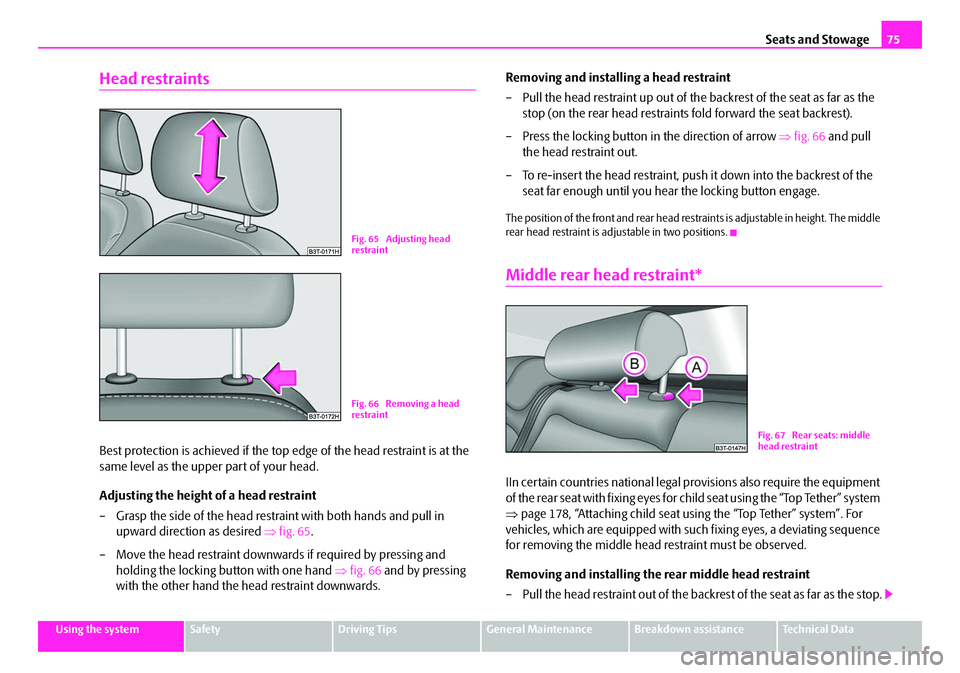
Adjusting the height of a head restraint
– Grasp the side of the head restraint with both hands and pull in
upward direction as desired ⇒fig. 65 .
– Move the head restraint downwards if required by pressing and holding the locking button with one hand ⇒fig. 66 and by pressing
with the other hand the head restraint downwards. Removing and installing a head restraint
– Pull the head restraint up out of the
backrest of the seat as far as the
stop (on the rear head restraints fold forward the seat backrest).
– Press the locking button in the direction of arrow ⇒fig. 66 and pull
the head restraint out.
– To re-insert the head restraint, push it down into the backrest of the
seat far enough until you hear the locking button engage.
The position of the front and rear head restraints is adjustable in height. The middle
rear head restraint is adjustable in two positions.
Middle rear head restraint*
IIn certain countries national legal pr ovisions also require the equipment
of the rear seat with fixing eyes for child seat using the “Top Tether” system
⇒ page 178, “Attaching child seat using the “Top Tether” system”. For
vehicles, which are equipped with such fixing eyes, a deviating sequence
for removing the middle head restraint must be observed.
Removing and installing the rear middle head restraint
– Pull the head restraint out of the backrest of the seat as far as the stop.
Fig. 65 Adjusting head
restraint
Fig. 66 Removing a head
restraint
Fig. 67 Rear seats: middle
head restraint
NKO B6 20.book Page 75 Wednesday, March 26, 2008 3:15 PM
Page 148 of 272

Passive Safety149
Using the systemSafetyDriving TipsGeneral MaintenanceBreakdown assistanceTechnical Data
Safety
Passive Safety
Basic information
Driving the safe way
Passive safety measures reduce the risk of injury in accident situa-
tions.
In this section you will find important inform ation, tips and notes on the subject of
passive safety in your vehicle. We ha ve combined everything here which you
should be familiar with, for example, regarding seat belts, airbags, child seats and
safety of children. It is therefore importan t, in particular, to comply with the notes
and warnings in this section for your own interest and in the interest of those trav-
elling with you.
WARNING
•This chapter contains important information on how to use the vehicle
for the driver and his occupants. You will find further information on safety,
which concerns you and those travelling with you, in the following chapters
of this Owner's Manual.
•The complete on-board literature should always be in the vehicle. This
applies in particular, if you rent out or sell the vehicle.
Safety equipment
The safety equipment is part of the occupant protection and it can
reduce the risk of injuries in accident situations.
“Do not put at risk” your safety and the safety of those travelling with you . In the
event of an accident, the safety equipmen t can reduce the risk of injuries. The
following list contains part of th e safety equipment in your vehicle:
•Three-point seat belts for all the seats,
•belt force limiter for front and outer rear seats*,
•belt tensioner for front and outer rear seats*,
•seat belt height adjuster for front seats,
•front airbag for the driver and front passenger,
•Driver's knee airbag*,
•front side airbags,
•rear side airbags*,
•head airbags*,
•anchoring points for child seat using the “ISOFIX” system,
•anchoring points for child seat using the “Top Tether” system,
•head restraint adjustable for height,
•adjustable steering column.
The specified safety equipment works toge ther, in order to optimally protect you
and those travelling with you in accident situations. The safety equipment does not
protect you or the people travelling with you, if you or your occupants adopt an
incorrect seated position or the equipmen t is not correctly adjusted or used.
Fo r t h i s re a s o n y o u w i l l b e p ro v i d e d w i th i n fo rm a ti o n o n w hy t h i s e q u i p m e nt i s v e r y
important, how it protects you and the o ccupants, what should be observed when
using the equipment and how you and the pe ople travelling with you can make full
use of the existing safety equipment. This Owner's Manual contains important
warning notes, which you and those travelli ng with you should pay attention to in
order to reduce a risk of injury.
Safety concerns everybody!
NKO B6 20.book Page 149 Wednesday, March 26, 2008 3:15 PM
Page 149 of 272

Passive Safety
150
Before setting off
The driver is always fully respon sible for his occupants and for the
operating safety of the vehicle.
For your own safety and the safety of the people travelling with you, please pay
attention to the following points before setting off.
•Ensure that the lighting and the turn signal system are functioning properly.
•Inspect the tyre inflation pressure.
•Ensure that all the windows offer a good visibility to the outside.
•Safely attach the items of luggage ⇒page 78, “Loading the luggage compart-
ment”.
•Ensure that no objects can obstruct the pedal.
•Adjust the mirror, the front seat and the head restraint to match your body size.
•Point out to your occupants that the head restraints must be adjusted to match
their body size.
•Protect the children in suitable child se ats with correctly fastened seat belts
⇒ page 171, “Transporting children safely”.
•Adopt the correct seated position ⇒page 150, “Correct seated position”. Also
inform your occupants to adopt the correct seated position.
•Fasten the seat belt correctly. Also inform your occupants to properly fasten the
seat belts ⇒page 156, “How are seat belts correctly fastened?”.
What influences the driving safety?
The driving safety is primarily dete rmined by the style of driving and
the personal behaviour of all the occupants.
The driver is fully responsible for himself and his occupants. If your driving safety is
effected, you place yourself and the oncomi ng traffic at risk. Please refer to the
following guidelines.
•Do not get distracted from concentrating on the traffic situation, e.g. by your
occupants or mobile phone calls.
•Never drive when your driving ability is impaired, e.g. through medication,
alcohol, drugs.
•Keep to the traffic regulations and the permissible speed limit.
•Adjust the driving speed at all times to the road condition as well as to the traffic
and weather conditions.
•Take regular breaks on long journe ys - at the latest every two hours.
Correct seated position
Correct seated position for the driver
Correct seated position for the driver is important for safe and
relaxed driving.
Fig. 145 The correct distance
of the driver from the
steering wheel
NKO B6 20.book Page 150 Wednesday, March 26, 2008 3:15 PM
Page 151 of 272

Passive Safety
152
Manual front passenger adjustment ⇒page 71, “Adjusting the front seats”.
Electrical front passenger seat adjustment ⇒page 72, “Adjusting front seats electri-
cally*”.
WARNING
•The front seats and the head restraints must always be adjusted to match
the body size of the seat occupant as well as the seat belts must always be
correctly fastened in order to provide an optimal protection for you and your
occupants.
•The front passenger must maintain a distance of at least 25 cm to the
dash panel. Not maintaining this minimum distance will mean that the
airbag system will not be able to properly protect you - hazard!
•Always keep your feet in the footwell when the car is being driven - never
place your feet on the instrument panel, out of the window or on the
surfaces of the seats. You will be exposed to increased risk of injury if it
becomes necessary to apply the brake or in the event of an accident. If an
airbag is deployed, you may suffer fata l injuries when adopting an incorrect
seated position!
•The backrests must not be angled too far back when driving otherwise
this will affect proper operation of th e seat belts and of the airbag system -
risk of injury!
Correct seated position for the occupants on the rear seats
Occupants on the rear seats must si t upright, keep the feet in the
footwell and must have their se at belts correctly fastened.
To reduce the risk of injury in the event of a sudden braking manoeuvre or an acci-
dent, the occupants on the rear seats must observe the following.
•Adjust the head restraints so that the top edge of the head restraints are at the
same level as the upper part of your head ⇒page 151, fig. 146 .
•Fasten the seat belt correctly ⇒ page 156, “How are seat belts correctly
fastened?”.
•If you are transporting ⇒page 171, “Transporting children safely” children in
the vehicle, please use a suitable child restraint system.
WARNING
•The head restraints must always be adjusted to match the body size, in
order to offer an optimal protection for you and your occupants.
•Always keep your feet in the footwell when the car is being driven - never
put your feet out of the window or on the surfaces of the seats. You will be
exposed to increased risk of injury if it becomes necessary to apply the brake
or in the event of an accident. If an airbag is deployed, you may suffer fatal
injuries when adopting an incorrect seated position!
•If the occupants on the rear seats are not sitting upright, the risk of injury
is increased due to incorrec t routing of the seat belt.
Examples of an incorrect seated position
An incorrect seated position can lead to severe injuries or death for
the occupants.
Seat belts offer their optimum protection on ly if the webbing of the seat belts is
properly routed. Incorrect seated positio ns considerably reduce the protective
functions of the seat belts and therefore incr ease the risk of injury due to an incor-
rect routing of the seat belt. The driver is fully responsible for himself and the occu-
pants, in particular for the children. Do not permit an occupant to adopt an incor-
rect seated position when the car is moving.
The following list contains the examples of seated positions which are dangerous
for the occupants. This list is not comple te, however we would like you to get inter-
ested in this subject.
Therefore, while the car is moving never:
•stand up in the vehicle,
•stand up on the seats,
•kneel onto the seats,
•tilt the backrest fully to the back,
NKO B6 20.book Page 152 Wednesday, March 26, 2008 3:15 PM
Page 155 of 272

Seat belts
156
•No two persons (also not children) should ever use a single seat belt
together.
•The maximum protection which seat belts can offer is only achieved if
you are correctly seated ⇒page 150, “Correct seated position”.
•The belt webbing must no t run across solid or fragile objects (e.g. spec-
tacles, ball-point pens, keys etc.) as this may be a cause of injuries.
•Bulky, loose clothing (e.g. a winter coat over a jacket) does not allow you
to be correctly seated and impairs proper operation of the seat belts.
•It is prohibited to use clamps or other objects to adjust seat belts (e.g. for
shortening the belts for smaller persons).
•The lock tongue should only be insert ed into the lock which is the correct
one for your seat. Wrong use of the safety belt will reduce its capacity to
protect and the risk of injury increases.
•The backrests of the front seats must not be tilted too far to the rear
otherwise the seatbelts can lose their effectiveness.
•The belt webbing must always be ke pt clean. Soiled belt webbing may
impair proper operation of the inertia reel ⇒page 203, “Seat belts”.
•The slot of the belt tongue must not be blocked by paper or similar
objects otherwise the belt tongue will not lock in place properly.
•Inspect the seat belts regularly to ensure they are in good condition. If
you find seat belts which have damage to the seat belt webbing, seat belt
connections, to the inertia reels or to the lock, the relevant safety belt must
be replaced by a specialist garage.
•The seat belts must not be removed or changed in any way. Do not make
an attempt to repair the seat belts yourself.
•Damaged seat belts which have been subjected to stress in an accident
and were therefore stretched, must be replaced - this is best done by a
specialist garage. The anchorage points of the belts must also be inspected.
The anchorage points for the be lts should also be checked.
•In certain countries it is possible to use seat belts which differ in terms of
their operation from the seat belts which are described on the pages which
follow.
How are seat belts correctly fastened?
Fastening three-point seat belts
Fasten your seat belt before starting!
– Correctly adjust the front seat and the head restraint before fastening
your seat belt ⇒page 75.
WARNING (continued)
Fig. 150 Routing of webbing
over the shoulders and the
lap belt
Fig. 151 Routing of belt
webbing for an expectant
mother
NKO B6 20.book Page 156 Wednesday, March 26, 2008 3:15 PM
Page 162 of 272

Airbag system163
Using the systemSafetyDriving TipsGeneral MaintenanceBreakdown assistanceTechnical Data
Important safety information regarding the front airbag system
Correct use of the airbag system considerably reduces the risk of
injury!
WARNING
•Never transport children on the front seat of a vehicle without using a
proper restraint system. If airbags are deployed in the event of an accident,
the child might suffer severe or even fatal injuries!
•For the driver and front passenger it is important to maintain a distance
of at least 25 cm from the steering wheel or dash panel ⇒fig. 157 . Not main-
taining this minimum distance will mean that the airbag system will not be
able to properly protect you - hazard! The front seats and the head restraints
must always also be correctly adjusted to match the body size of the occu-
pant.
•It is essential to always switch off ⇒page 168, “Deactivating an airbag”
the front passenger airbag when attach ing a child safety seat on the front
passenger seat where the child is seated with its back facing in direction of
travel (in some countries also when the ch ild is facing the direction of travel).
If this is not done, there is a risk of the child suffering severe or even fatal
injuries if the front passenger airbag is deployed. In certain countries
national legal provisions also requir e that the side or head passenger
airbags be deactivated. When transporting a child on the front passenger seat, please comply with the appropriate national regulations regarding the
use of child safety seats.
•There must not by any further persons, animals or objects positioned
between the front seated occupants and the deployment area of the airbag.
•The steering wheel and the surface of the airbag module in the dash
panel on the passenger side must not be stuck onto, covered or modified in
any other way. These parts should only be cleaned with a dry cloth or a cloth
moistened with water. No objects such as cup holders, mobile phone
mounts, etc. may be attached to the covers of the airbag modules or be
located within the immediate area.
•No modifications of any kind may be made to parts of the airbag system.
Any work on the airbag system includ ing installing and removing system
components because of other repair work (e.g. removing the steering
wheel) must only be carried out by a specialist garage.
•Never carry out changes on the front bumper or on the body.
•Never place any objects on the surface of the front passenger airbag in
the dash panel.
Fig. 157 Safe distance to
steering wheel
WARNING (continued)
NKO B6 20.book Page 163 Wednesday, March 26, 2008 3:15 PM
Page 170 of 272

Transporting children safely171
Using the systemSafetyDriving TipsGeneral MaintenanceBreakdown assistanceTechnical Data
Transporting children safely
What you should know about transporting children!
An introduction to the subject
Accident statistics have revealed that children are generally more
safely transported on the rear seat s than on the front passenger seat.
Children younger than 12 years of age should normally travel on the rear seat of the
vehicle (take note of any na tional legal provisions which differ from this). They
should be secured there by means of a child restraint system or by using the existing
seat belts depending on their age, body si ze and weight. The child seat should be
mounted behind the front passen ger seat for safety reasons.
The physical principle of an accident do es, of course, also apply to children
⇒ page 155, “The physical principle of a fronta l collision”. They differ from adults in
that their muscles and bone structure of ch ildren are not yet fully developed. Thus
children are exposed to increased risk of injury.
Children should be transported by using special child safety seats in order to
reduce this risk of injury.
Use only child safety seats which are offici ally approved and are suitable for chil-
dren and which comply with the ECE-R 44 Standard, which classifies child safety
seats into 5 groups ⇒page 174, “Classification of child seats into groups”. Child
restraint systems which have been tested for conformity with ECE-R 44 have a non-
detachable test seal (a large E within a circle and below this the test number)
attached to the seat.
We recommend that you use ch ild safety seats from the Škoda genuine accessories.
These child seats were developed and also tested for use in Škoda vehicles. They
fulfil the standard ECE-R 44.
WARNING
Always comply with legal provisions and instructions from the relevant child
safety seat manufacturer when in stalling and using the child seat ⇒
page 171, “Important safety information regarding the use of child safety
seats”.
Note
Any varying national legal regulations take priority over the information provided in
these instructions for use, or stated in this chapter.
Important safety information regarding the use of child safety
seats
Correct use of child safety seats considerably reduces the risk of
injury!
WARNING
•All the occupants of the car - in particular children - must wear a seat belt
when the car is moving.
•Chi ld re n le s s tha n 1. 5 0 m i n h e ig ht or younger than 12 years must not use
a normal seat belt withou t a child restraint system otherwise this may result
in injuries to the stomach and neck areas. Comply with the national legal
requirements.
•One should never carry children, and also not babies! - on one's lap.
•You can transport a child safely in a suitable child safety seat ⇒page 174,
“Child seat”!
•Only one child may be fastened with a seat belt into a child safety seat.
•Never leave the child sitting unattended in the seat.
•Certain outside climatic conditions can cause life-threatening tempera-
tures in the vehicle.
WARNING (continued)
NKO B6 20.book Page 171 Wednesday, March 26, 2008 3:15 PM
Page 171 of 272

Transporting children safely
172
•Never allow your child to be transported in a vehicle without the use of a
suitable restraint system.
•Children should also never stand up in a vehicle or kneel on the seats
when the vehicle is moving. In the even t of an accident the child will be
thrown through the vehicle and may as a result suffer fatal injuries, and also
injure other occupants.
•Children are exposed to an increased risk of injury in the event of an acci-
dent if they lean forward or adopt an incorrect seated position when the
vehicle is moving. This particularly applies to children who are transported
on the front passenger seat if the airb ag system deploys in the event of an
accident. This can result in severe or even fatal injuries.
•It is important that the belt webbing is properly routed if the seat belts
are to offer their maximum protection ⇒page 156, “How are seat belts
correctly fastened?”. Pay particular atte ntion to the information provided by
the manufacturer of the child safety se at regarding correct routing of the
belt. Seat belts which are not correctly adjusted can themselves cause inju-
ries even in minor accidents.
•Safety belts must be checked to ensure that they are running properly.
One should also ensure that the belt is not damaged by sharp-edged fittings.
•It is essential to always switch off ⇒page 169 the front passenger airbag
when attaching a child safety seat on the front passenger seat where the
child is seated with its back facing in direction of travel (in some countries
also when the child is facing the direction of travel). If this is not done, there
is a risk of the child suffering severe or even fatal injuries if the front
passenger airbag is deploy ed. In certain countries national legal provisions
also require that the si de and head airbags be deactivated. When trans-
porting a child on the front passenger seat, please comply with the appro-
priate national regulations regarding the use of child safety seats.
Use of child safety seats on the front passenger seat
Child safety seats should always be attached to the rear seats.
We recommend, for safety reasons, that you always mount a child restraint systems
on the rear seats whenever possible. If you still decide, however, to use a child
safety seat on the front passenger seat th en you must pay attention to the following
warnings in connection with the use of th e airbag system on the front passenger
seat.
WARNING
•Warning - particular hazard! Never use a child safety seat on the front
passenger seat in which the child is seat ed with its back facing the direction
of travel. This child safety seat is positioned in the deployment area of the
front passenger airbag. The airbag may cause the child severe, or even fatal
injuries, in the event of it being deployed.
•This is also clearly stated on the st icker which is located on the centre
column of the body on the front passenger side ⇒fig. 165 . The sticker is
visible upon opening the front passen ger door. For some countries, the
sticker is also affixed to the sun visor of the front passenger.
•It is essential to always switch off ⇒page 168, “Deactivating an airbag”
the front passenger airbag when attach ing a child safety seat on the front
passenger seat where the child is seated with its back facing in direction of
travel (in some countries al so when the child is facing the direction of travel).
WARNING (continued)
Fig. 165 Sticker on the centre
column of the body on the
front passenger side.
NKO B6 20.book Page 172 Wednesday, March 26, 2008 3:15 PM