height SKODA SUPERB 2008 Owner´s Manual
[x] Cancel search | Manufacturer: SKODA, Model Year: 2008, Model line: SUPERB, Model: SKODA SUPERB 2008Pages: 252, PDF Size: 16.33 MB
Page 100 of 252
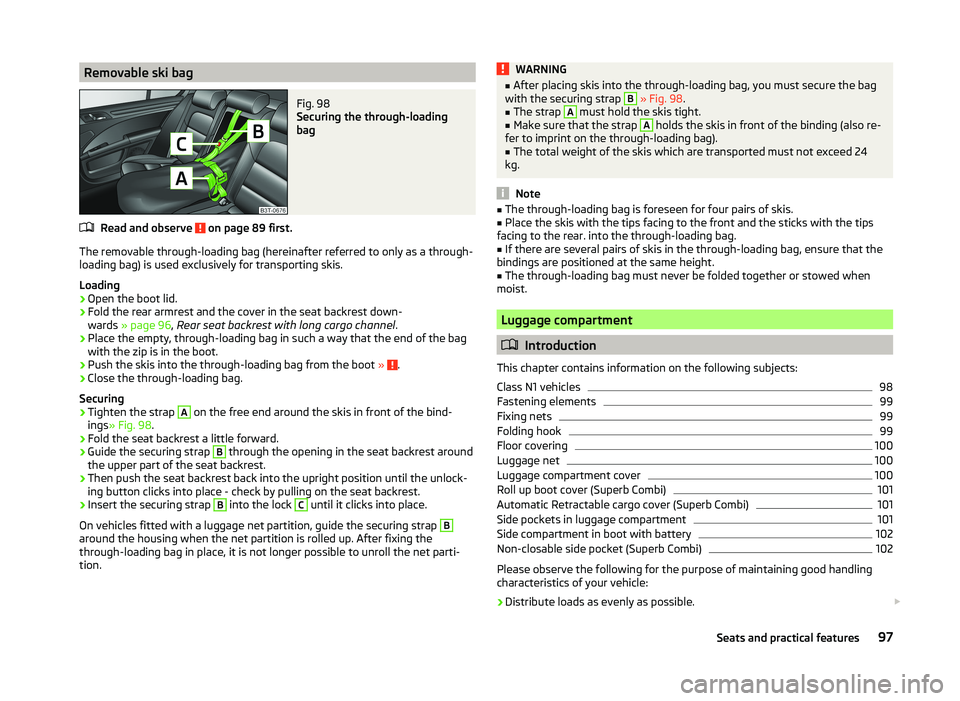
Removable ski bagFig. 98
Securing the through-loading
bag
Read and observe on page 89 first.
The removable through-loading bag (hereinafter referred to only as a through- loading bag) is used exclusively for transporting skis.
Loading
›
Open the boot lid.
›
Fold the rear armrest and the cover in the seat backrest down-
wards » page 96 , Rear seat backrest with long cargo channel .
›
Place the empty, through-loading bag in such a way that the end of the bag
with the zip is in the boot.
›
Push the skis into the through-loading bag from the boot » .
›
Close the through-loading bag.
Securing
›
Tighten the strap
A
on the free end around the skis in front of the bind-
ings » Fig. 98 .
›
Fold the seat backrest a little forward.
›
Guide the securing strap
B
through the opening in the seat backrest around
the upper part of the seat backrest.
›
Then push the seat backrest back into the upright position until the unlock-
ing button clicks into place - check by pulling on the seat backrest.
›
Insert the securing strap
B
into the lock
C
until it clicks into place.
On vehicles fitted with a luggage net partition, guide the securing strap
B
around the housing when the net partition is rolled up. After fixing the
through-loading bag in place, it is not longer possible to unroll the net parti-
tion.
WARNING■ After placing skis into the through-loading bag, you must secure the bag
with the securing strap B » Fig. 98 .■
The strap
A
must hold the skis tight.
■
Make sure that the strap
A
holds the skis in front of the binding (also re-
fer to imprint on the through-loading bag).
■
The total weight of the skis which are transported must not exceed 24
kg.
Note
■ The through-loading bag is foreseen for four pairs of skis.■Place the skis with the tips facing to the front and the sticks with the tips
facing to the rear. into the through-loading bag.■
If there are several pairs of skis in the through-loading bag, ensure that the
bindings are positioned at the same height.
■
The through-loading bag must never be folded together or stowed when
moist.
Luggage compartment
Introduction
This chapter contains information on the following subjects:
Class N1 vehicles
98
Fastening elements
99
Fixing nets
99
Folding hook
99
Floor covering
100
Luggage net
100
Luggage compartment cover
100
Roll up boot cover (Superb Combi)
101
Automatic Retractable cargo cover (Superb Combi)
101
Side pockets in luggage compartment
101
Side compartment in boot with battery
102
Non-closable side pocket (Superb Combi)
102
Please observe the following for the purpose of maintaining good handling
characteristics of your vehicle:
›
Distribute loads as evenly as possible.
97Seats and practical features
Page 112 of 252
WARNING (Continued)■Distribute the load evenly over the roof rack system.■When transporting heavy objects or objects which take up a large area on
the roof rack system, handling of the car may change as a result of the dis-
placement of the centre of gravity. The style of driving and speed must
therefore be adapted to the current circumstances.■
Avoid abrupt and sudden driving/braking manoeuvres.
■
Adjust the speed and driving style to the visibility, weather, road and traf-
fic conditions.
■
The permissible roof load, permissible axle loads and permissible total ve-
hicle weight must not be exceeded under any circumstances – risk of acci-
dent!
CAUTION
■ Only roof racks from the ŠKODA Original Accessories range should be used.■The fitting instructions supplied with the roof luggage rack system must be
observed when handling roof racks.■
On models fitted with a power sliding/tilting roof or a panoramic sliding roof,
ensure that the opened sliding/tilting roof or the panoramic sliding roof does
not strike any items of luggage transported on the roof.
■
Ensure that the boot lid does not hit the roof load when opened.
■
The height of the vehicle changes after mounting a roof luggage rack system
and the load that is secured to it. Compare the vehicle height with available
clearances, such as underpasses and garage doors.
■
Always remove the roof luggage rack system before entering an automated
car wash.
■
Ensure the roof aerial is not impaired by the secured load.
For the sake of the environment
The increased aerodynamic drag results in higher fuel consumption.Attachment points
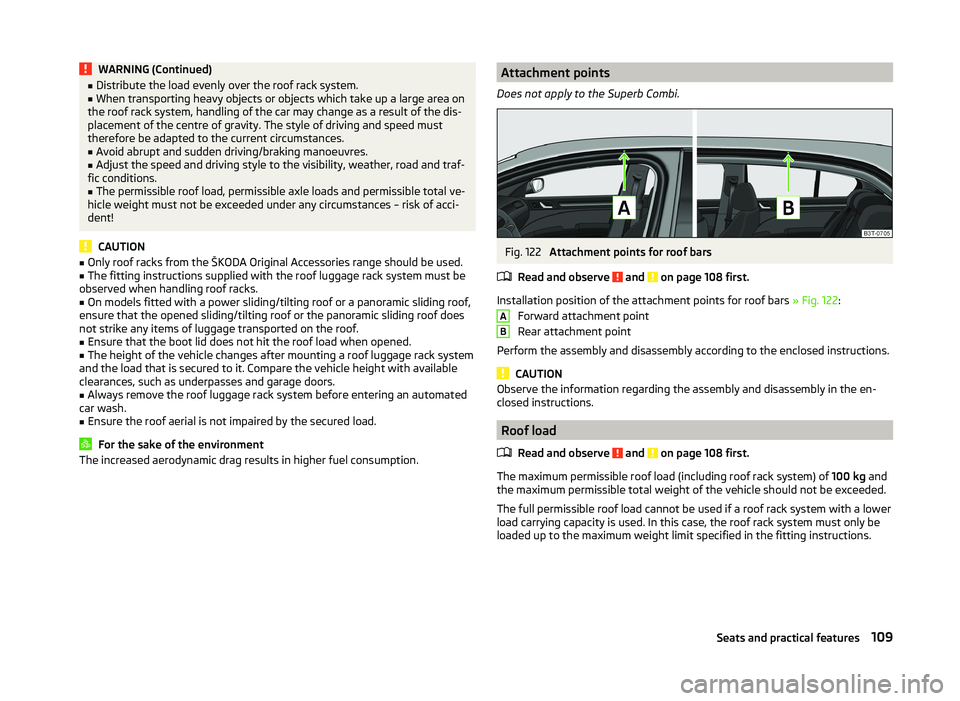
Does not apply to the Superb Combi.Fig. 122
Attachment points for roof bars
Read and observe
and on page 108 first.
Installation position of the attachment points for roof bars » Fig. 122:
Forward attachment point
Rear attachment point
Perform the assembly and disassembly according to the enclosed instructions.
CAUTION
Observe the information regarding the assembly and disassembly in the en-
closed instructions.
Roof load
Read and observe
and on page 108 first.
The maximum permissible roof load (including roof rack system) of 100 kg and
the maximum permissible total weight of the vehicle should not be exceeded.
The full permissible roof load cannot be used if a roof rack system with a lower
load carrying capacity is used. In this case, the roof rack system must only be
loaded up to the maximum weight limit specified in the fitting instructions.
AB109Seats and practical features
Page 114 of 252
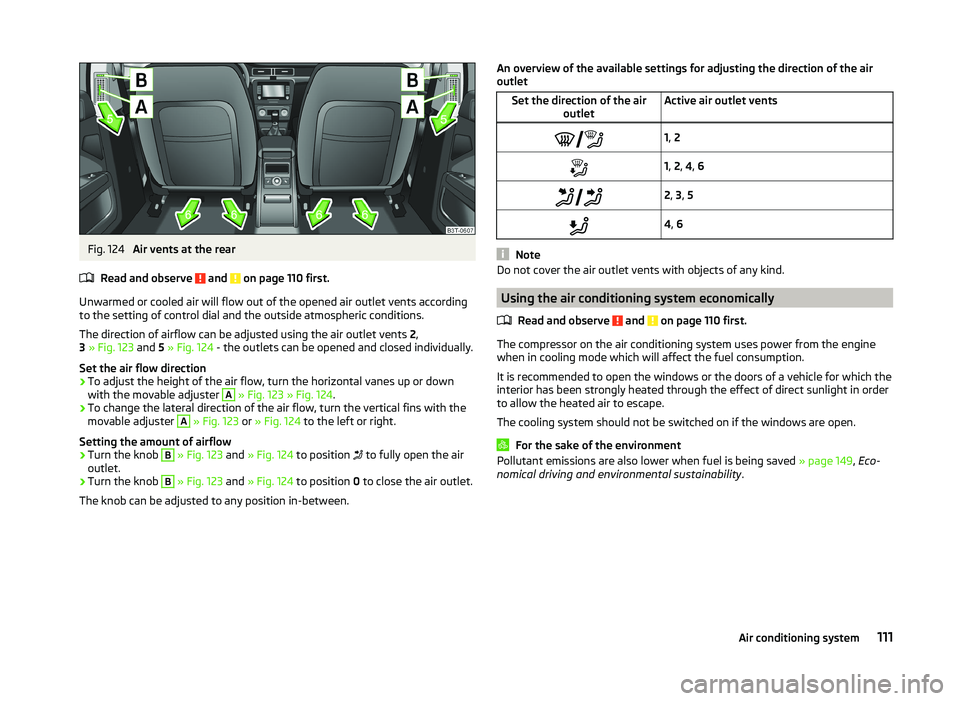
Fig. 124
Air vents at the rear
Read and observe
and on page 110 first.
Unwarmed or cooled air will flow out of the opened air outlet vents according to the setting of control dial and the outside atmospheric conditions.
The direction of airflow can be adjusted using the air outlet vents 2,
3 » Fig. 123 and 5 » Fig. 124 - the outlets can be opened and closed individually.
Set the air flow direction
›
To adjust the height of the air flow, turn the horizontal vanes up or down
with the movable adjuster
A
» Fig. 123 » Fig. 124 .
›
To change the lateral direction of the air flow, turn the vertical fins with the
movable adjuster
A
» Fig. 123 or » Fig. 124 to the left or right.
Setting the amount of airflow
›
Turn the knob
B
» Fig. 123 and » Fig. 124 to position
to fully open the air
outlet.
›
Turn the knob
B
» Fig. 123 and » Fig. 124 to position 0 to close the air outlet.
The knob can be adjusted to any position in-between.
An overview of the available settings for adjusting the direction of the air
outletSet the direction of the air outletActive air outlet vents1, 21, 2 , 4 , 6 2, 3 , 54 , 6
Note
Do not cover the air outlet vents with objects of any kind.
Using the air conditioning system economically
Read and observe
and on page 110 first.
The compressor on the air conditioning system uses power from the enginewhen in cooling mode which will affect the fuel consumption.
It is recommended to open the windows or the doors of a vehicle for which the
interior has been strongly heated through the effect of direct sunlight in order
to allow the heated air to escape.
The cooling system should not be switched on if the windows are open.
For the sake of the environment
Pollutant emissions are also lower when fuel is being saved » page 149, Eco-
nomical driving and environmental sustainability .111Air conditioning system
Page 174 of 252
Exterior mirrors
You have to have additional exterior mirrors fitted if you are not able to see
the traffic behind the trailer with the standard rear-view mirrors. National legal
requirements must be observed.
Headlights
The front of the vehicle can be lifted when a trailer is being towed and the
headlights can dazzle other road users.
Adjust the headlight setting on the headlight range control » page 68, Operat-
ing the lights and the instrument illumination .WARNING■
Incorrect or improperly connected electrical installation can cause acci-
dents and serious injury due to electric shock.■
Work on the electrical system must only be carried out by specialist ga-
rages.
■
Never directly connect the trailer's electrical system with the electrical
connections for the tail lights or other current sources.
■
After coupling the trailer and connecting up the power socket, check the
rear lights on the trailer to ensure they are working.
■
The handbrake on the towing vehicle must be applied when coupling and
uncoupling the trailer.
■
Never use the safety eyelet for towing!
CAUTION
Incorrect or improperly connected electrical installations may cause malfunc-
tion of the entire vehicle electronics.
Loading a trailer
The vehicle/trailer combination must be balanced, whereby the maximum per-
missible drawbar load must be utilised. If the drawbar load is too low, it jeop-
ardises the performance of the vehicle/trailer combination.
Distribution of the load
Distribute the load in the trailer in such a way that heavy items are located as
close to the axle as possible. Secure the items from slipping.
The distribution of the weight is very poor if your vehicle is unladen and the
trailer is laden. Maintain a particularly low speed if you cannot avoid driving
with this combination.
Tyre pressure
Correct the tyre inflation pressure on your vehicle for a “full load” » page 198.
Trailer load
The permissible trailer load must not be exceeded under any circumstan-
ces » page 228 , Technical data .
The details given in the vehicle's technical documentation always take prece- dence over the details in the Owner's Manual.
The trailer loads specified apply only to altitudes up to 1,000 metres above
mean sea level.
The engine output falls as altitude increases, as does the ability to climb.
Therefore, for every additional 1,000 m in height (or part), the maximum per-
missible towed weight must be reduced by 10 %.
The towed weight comprises the actual weights of the (loaded) towing vehicle
and the (loaded) trailer.
The trailer and drawbar load information on the type plate of the towing
equipment are merely test data for the towing equipment. The vehicle-specific
values are detailed in the vehicle documents.WARNING■ The maximum permissible axle and drawbar load and the permissible
weight of the trailer must not exceed - this could cause an accident!■
A sliding cargo can significantly adversely affect stability and driving safe-
ty - there is a risk of accident!
Towing a trailer
Driving speed
For safety reasons, do not drive faster than 80 km/h when towing a trailer.
Immediately reduce your speed as soon as even the slightest swaying of the
trailer is detected. Never attempt to stop the trailer from “swaying” by acceler-
ating.
Brakes
Apply the brakes in good time! If the trailer is fitted with a trailer brake, apply
the brakes gently at first and then brake firmly. This will avoid brake jolts re-
sulting from the trailer wheels locking.
On downhill sections shift down a gear in good time to also use the engine as
a brake.
171Hitch and trailer
Page 190 of 252
WARNING (Continued)■Avoid short circuits in the electrical system - particularly on the vehicle's
battery.■
Always make sure that no jewellery, loose clothing or long hair can get
caught in rotating engine parts – risk to life! Always remove any jewellery,
tie back long hair and wear tight fitting clothing before completing any
work.
WARNINGInformation for working on the fuel system or the electrical system■Always disconnect the vehicle battery from the electrical system.■
Do not smoke.
■
Never work near open flames.
■
Always have a functioning fire extinguisher nearby.
WARNING■ Read and observe the information and warning instructions on the fluid
containers.■
Keep the working fluids in sealed original containers and safe from peo-
ple who are not completely independent, e.g. children.
■
If you intend to work underneath the vehicle, you must secure the vehicle
from rolling away and support it with suitable supporting blocks; the car
jack is not sufficient – risk of injury!
CAUTION
Always top up using the correct specification of fluids. This may result in major
operating problems and also vehicle damage!
For the sake of the environment
In view of the requirements for the environmentally friendly disposal of fluids and the special tools and knowledge required for such work, we recommend
that fluids be changed by a specialist garage.
Note
■ Please consult a specialist garage for any questions relating to fluids.■Fluids with the proper specifications can be purchased from the ŠKODA Origi-
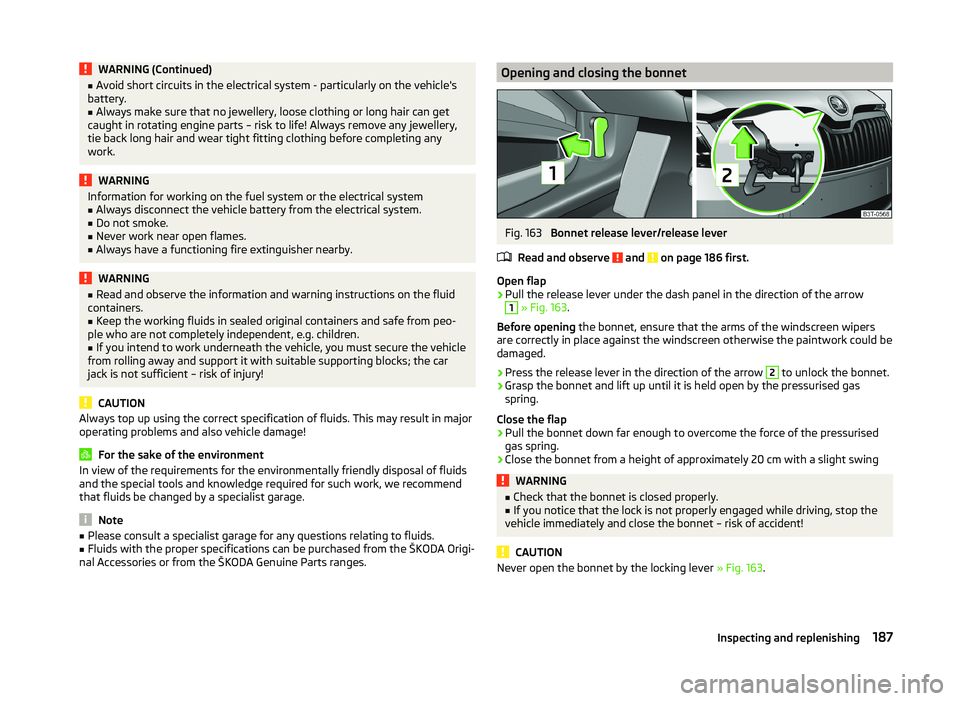
nal Accessories or from the ŠKODA Genuine Parts ranges.Opening and closing the bonnetFig. 163
Bonnet release lever/release lever
Read and observe
and on page 186 first.
Open flap
›
Pull the release lever under the dash panel in the direction of the arrow
1
» Fig. 163 .
Before opening the bonnet, ensure that the arms of the windscreen wipers
are correctly in place against the windscreen otherwise the paintwork could be
damaged.
›
Press the release lever in the direction of the arrow
2
to unlock the bonnet.
›
Grasp the bonnet and lift up until it is held open by the pressurised gas
spring.
Close the flap
›
Pull the bonnet down far enough to overcome the force of the pressurised
gas spring.
›
Close the bonnet from a height of approximately 20 cm with a slight swing
WARNING■ Check that the bonnet is closed properly.■If you notice that the lock is not properly engaged while driving, stop the
vehicle immediately and close the bonnet – risk of accident!
CAUTION
Never open the bonnet by the locking lever » Fig. 163.187Inspecting and replenishing
Page 204 of 252
CAUTION■Only use the manual pressure and do not hit the full wheel trim – there is a
risk of damaging the trim.■
When using the anti-theft wheel bolt, ensure that it is in the hole in the
valve area.
■
If wheel trims are fitted, an adequate flow of air must be assured in order to
cool the brake system.
Note
We recommend that you use wheel trims from ŠKODA Original Accessories.
Wheel bolts
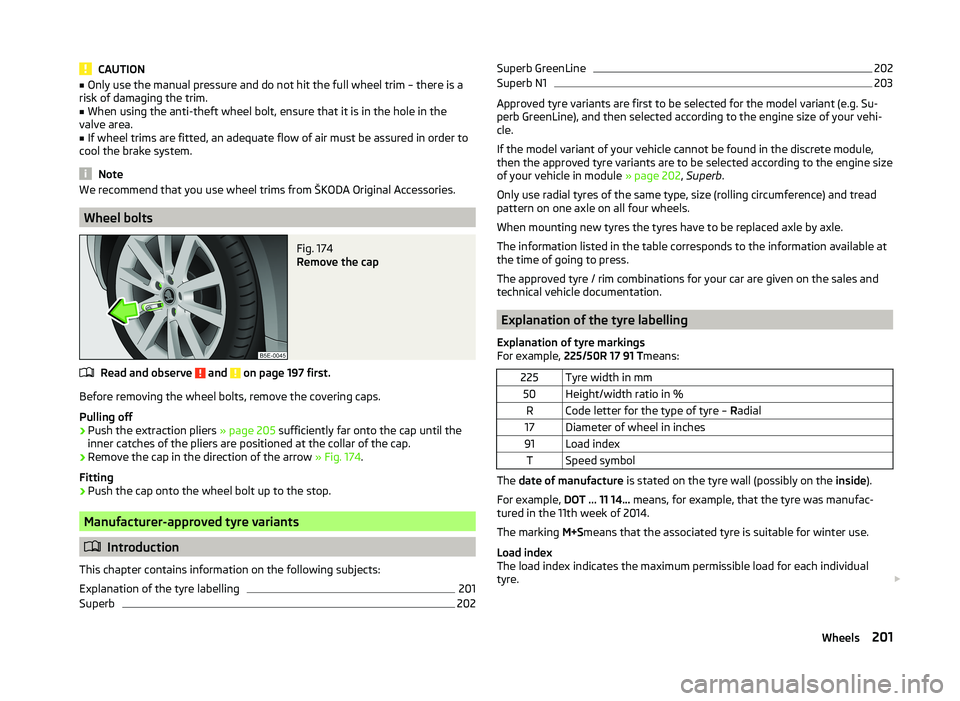
Fig. 174
Remove the cap
Read and observe and on page 197 first.
Before removing the wheel bolts, remove the covering caps.
Pulling off
›
Push the extraction pliers » page 205 sufficiently far onto the cap until the
inner catches of the pliers are positioned at the collar of the cap.
›
Remove the cap in the direction of the arrow » Fig. 174.
Fitting
›
Push the cap onto the wheel bolt up to the stop.
Manufacturer-approved tyre variants
Introduction
This chapter contains information on the following subjects:
Explanation of the tyre labelling
201
Superb
202Superb GreenLine202Superb N1203
Approved tyre variants are first to be selected for the model variant (e.g. Su-
perb GreenLine), and then selected according to the engine size of your vehi-
cle.
If the model variant of your vehicle cannot be found in the discrete module,
then the approved tyre variants are to be selected according to the engine size
of your vehicle in module » page 202, Superb .
Only use radial tyres of the same type, size (rolling circumference) and tread
pattern on one axle on all four wheels.
When mounting new tyres the tyres have to be replaced axle by axle.
The information listed in the table corresponds to the information available at the time of going to press.
The approved tyre / rim combinations for your car are given on the sales and
technical vehicle documentation.
Explanation of the tyre labelling
Explanation of tyre markings
For example, 225/50R 17 91 T means:
225Tyre width in mm50Height/width ratio in %RCode letter for the type of tyre – Radial17Diameter of wheel in inches91Load indexTSpeed symbol
The date of manufacture is stated on the tyre wall (possibly on the inside).
For example, DOT ... 11 14... means, for example, that the tyre was manufac-
tured in the 11th week of 2014.
The marking M+Smeans that the associated tyre is suitable for winter use.
Load index
The load index indicates the maximum permissible load for each individual
tyre.
201Wheels
Page 233 of 252

Dimensions
Vehicle dimensions for operating weight without driver (in mm) SuperbSuperb GreenLineSuperb CombiSuperb Combi GreenLineLength4833483348334833Width1817181718171817Width including exterior mirror2009200920092009Height1462/1482 a)
/ 1447 b)1464/1449 b)1511/1529 a)
/ 1497 b)1511/1496 b)Clearance139/159a)
/124 b)
/141 c)140/125 b)141/159a)
/127 b)
/140 c)141/126 b)Wheel base2761276127612761Track gauge front/rear1545/1518
(1537/1510) c)1545/15181545/1517
(1537/1510) c)1545/1517a)
Applies to vehicles with a rough road package.
b)
Applies to vehicles with a sport chassis.
c)
Applies to vehicles with a 3.6 l/191 kW FSI engine.
230Technical data
Page 239 of 252
Index
A
Abroad Driving abroad
153
Unleaded petrol153
ABS Operation
155
Warning light38
Accessories173
Adaptive headlights (AHL)70
Adjust Auxiliary heating (auxiliary heating and ventila- tion)
119
Head restraints83
Adjusting Belt height
15
Exterior mirrors80
Interior mirror79
Manual air conditioning114
Seats81, 82
Steering wheel10
Adjusting the seats9, 81
Adjustment Range of light
68
Aerial177
See windows179
AHL70
Warning light38
Airbag16
Deactivating21
Deactivating the front passenger airbag21
Deployment16
Front airbag17
Head airbag20
Indicator light40
Knee airbag18
Modifications and damage to the airbag system 175
Side airbag
19
Airbag system16
Air conditioning system110
Air outlets110
Climatronic115
Manual air conditioning system112
Air outlets110
Air recirculation Climatronic
117
Alarm Switching off
55
Triggering55
Anti-theft alarm system Activating/deactivating
56
Trailer172
Anti-theft wheel bolts208
Antilock brake system (ABS)155
Armrest Front
87
rear96
Rear87
Ashtray91
ASR Operation
155
warning light37
Assist systems154
ABS38, 155
ASR37, 155
Cruise Control System161
DSR155
EDL155
ESC37, 154
HBA155
HHC156
Park assist157
Parking aid156
START STOP162
Audio see radio / navigation system
4
Auto Check Control33
Automatic driving lamp control70
Automatic gearbox Selector lever-emergency unlocking217
Starting off and driving147
Tiptronic146
Using the selector lever145
Automatic gearbox modes145
Automatic load deactivation197
Automatic retractable cargo cover (Superb Combi))
101
Automatic transmission145
Kickdown147
Malfunction148
Selector lever lock146
AUX Installation in the storage compartment
92
Auxiliary heating (auxiliary heating and ventila- tion)
118
Adjust119
Radio remote control120
Switching on/off119
Avoiding damage to the vehicle Driving through water
152
Avoiding damage to your vehicle152
B
Ball head Check fitting
168
Fitting168
Ready position167
Removing169
Battery In the remote control key
215
Replace the remote control of the auxiliary heater (parking heater)
216
Belts12
Belt tensioners15
Bonnet Closing
187
Opening187
Warning light36
236Index
Page 246 of 252
S
SAFE see Safe securing
54
SAFELOCK see Safe securing
54
Safe securing54
Safety8
Child safety22
Child safety seats22
Correct seated position9
Head restraints83
ISOFIX25
TOP TETHER27
Saving electrical energy149
Screens see Sun screen in the rear doors
76
Seals Taking care of your vehicle
178
Seat belt warning light
35
Seat belts12
Belt tensioners15
Cleaning183
fastening and unfastening14
Height adjustment15
Inertia reels15
The physical principle of a frontal collision13
Seat features85
Seats Convenience features of passenger seat
87
Electric adjustment82
Front armrest87
Head restraints83
Heating85
Manually adjusting82
Rear armrest87
save84
Seat backrests87
Storing in memory of remote control key84
Ventilated front seats86
Seats and practical features81
Adjusting the seats81
see Automatic gearbox Manual gear shifting on the multifunction steering wheel
146
Selector lever Refer to Selector lever
145
Selector lever lock / starter (system KESSY) Warning light
41
Service174
Service interval display48
Setting32
Setting the32
Shelves88
Shifting gears Driving and saving energy
149
Side airbag19
Side compartment in boot with battery102
Side compartments in the luggage compart- ment
101
ski bag97
Sliding/tilting roof Close (Superb Combi)
66
Closing64
Closing the sun screen (Superb Combi)66
Electric sliding/tilting roof64
Emergency operation218
Opening/closing the sun screen (Superb Combi) 66
Opening and tilting
64
Opening and tilting (Superb Combi)66
Operation64
Operation (Superb Combi)66
Snow chains203
Spare wheel200
Speedometer31
See speedometer31
Speed symbol Refer to Wheels202
Spoiler175
Starting and stopping the engine - KESSY140
Starting and stopping the engine using the key 138
Starting engine Jump-starting
211
Starting the engine Jump-starting
211
Key139
see KESSY142
START STOP162
Information messages164
Jump-starting212
Manually deactivating/activating the system164
Operating conditions for the system163
operation in vehicles with automatic gearbox163
operation in vehicles with manual gearbox163
system related automatic start-up164
Steering lock / unlock see KESSY
141
Steering wheel10
Stopping the engine Key
140
Storage compartment in rear centre console95
Storage compartment on passenger side94
Storage compartments88
Storage compartment under passenger seat94
Storage pockets on the front seats95
Storing skis96
Sun screen76
Sun screen in the rear doors76
Sun visors76
Switch see Ignition
139
Switching off the engine see KESSY
142
Switch light on and off68
243Index
Page 248 of 252
Operation in winter195
Replacing196
Safety instructions193
Vehicle care Alcantara
182
Fabrics182
Synthetic leather182
washing176
Vehicle Condition see Auto Check Control
33
Vehicle data sticker228
Vehicle dimensions230
Vehicle height230
Vehicle Identification Number (VIN)228
Vehicle key lock
51
unlock51
Vehicle length230
Vehicle tool kit205
Vehicle width230
Visibility75
Visors see Sun screen
76
see Sun visors76
W
Warning at excessive speeds
46
Warning lights34
warning messages Diesel particulate filter
39
Warning symbols see Warning lights
34
Warning triangle204
Washing Automatic car wash system
177
by hand176
Chrome parts178
High-pressure cleaner177
Washing vehicles176
Water Driving through152
Wax treatment See Taking care of your vehicle
178
Weather conditions173
Wheel bolts Anti-theft wheel bolts
208
Caps201
Loosening and tightening207
Wheel rims197
Wheels Changing
205
Full trim200
General information197
Load index201
Replacing wheels198
Service life of tyres198
Snow chains203
Spare wheel200
Speed symbol202
Storing wheels198
Temporary spare wheel200
Tyre pressure198
Tyre size201
Tyre sizes198
Tyre wear indicator198
Unidirectional tyres199
Winter tyres203
Wi-Fi130
Windows179
De-icing179
See Electrical power windows61
Windscreen De-icing
179
Heater75
Windscreen washer fluid Checking
188
Replenishing188
Warning light40
Winter188
Windscreen washers Windscreen washers78
Windscreen washer system188
Windscreen wiper Replacing the rear window wiper blade
219
Windscreen wipers Operating
78
Replacing the windscreen wiper blades219
Windscreen washer fluid188
Windscreen wipers and washers77
Winter De-icing windows
179
Winter operation203
Snow chains203
Winter tyres203
Winter tyres See Wheels
203
WLAN130
MAXI DOT131
Network connection130
Switching off130
Switching on130
245Index