towing SKODA SUPERB 2008 Owner´s Manual
[x] Cancel search | Manufacturer: SKODA, Model Year: 2008, Model line: SUPERB, Model: SKODA SUPERB 2008Pages: 252, PDF Size: 16.33 MB
Page 208 of 252
The fire extinguisher must be checked by an authorised person once a year.
National legal requirements must be observed.WARNINGThe fire extinguisher must always be secured safely so that they do not
come loose when making an emergency braking or in a vehicle collision
which could cause injuries to occupants.
Note
■ The fire extinguisher must comply with national legal requirements.■Pay attention to the expiration date of the fire extinguisher. Proper function-
ing of the fire extinguisher is not assured once it has passed its expiry date.■
The fire extinguisher is part of the scope of delivery in certain countries only.
Vehicle tool kit
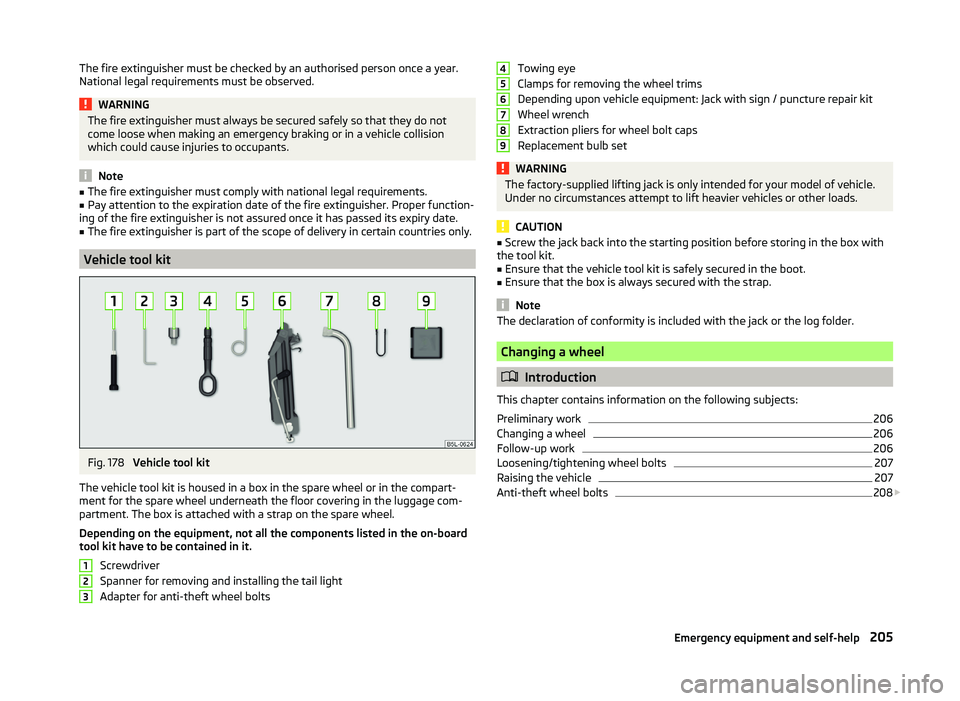
Fig. 178
Vehicle tool kit
The vehicle tool kit is housed in a box in the spare wheel or in the compart-
ment for the spare wheel underneath the floor covering in the luggage com-
partment. The box is attached with a strap on the spare wheel.
Depending on the equipment, not all the components listed in the on-board
tool kit have to be contained in it.
Screwdriver
Spanner for removing and installing the tail light
Adapter for anti-theft wheel bolts
123Towing eye
Clamps for removing the wheel trims
Depending upon vehicle equipment: Jack with sign / puncture repair kit
Wheel wrench
Extraction pliers for wheel bolt caps
Replacement bulb setWARNINGThe factory-supplied lifting jack is only intended for your model of vehicle.
Under no circumstances attempt to lift heavier vehicles or other loads.
CAUTION
■ Screw the jack back into the starting position before storing in the box with
the tool kit.■
Ensure that the vehicle tool kit is safely secured in the boot.
■
Ensure that the box is always secured with the strap.
Note
The declaration of conformity is included with the jack or the log folder.
Changing a wheel
Introduction
This chapter contains information on the following subjects:
Preliminary work
206
Changing a wheel
206
Follow-up work
206
Loosening/tightening wheel bolts
207
Raising the vehicle
207
Anti-theft wheel bolts
208
456789205Emergency equipment and self-help
Page 216 of 252
›After starting the engine, close the protective cap of the jump-starting point.
Towing the vehicle
Introduction
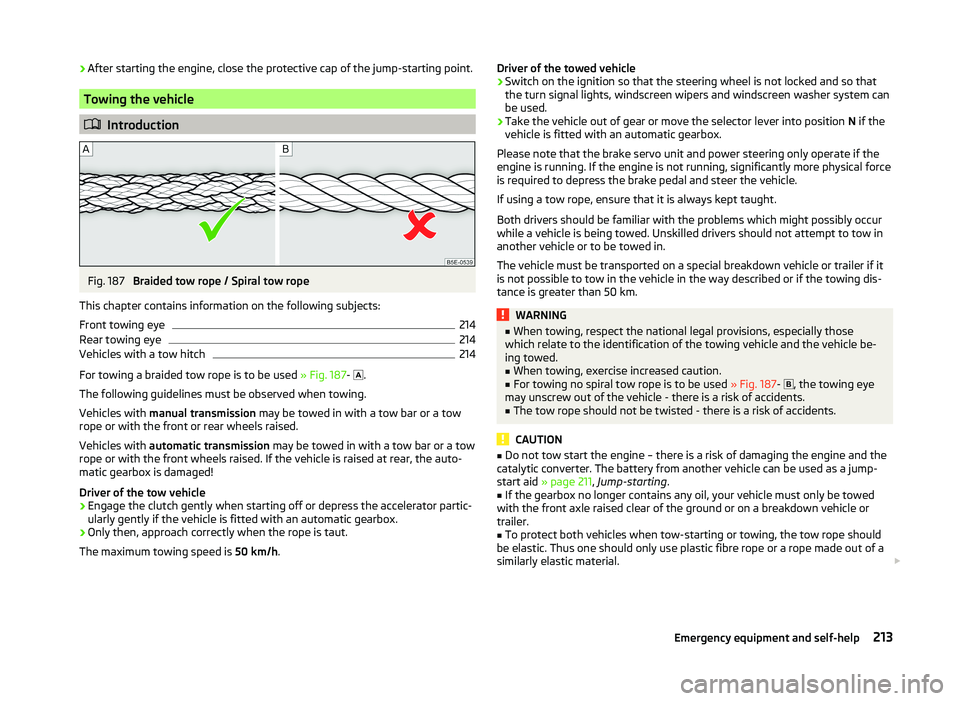
Fig. 187
Braided tow rope / Spiral tow rope
This chapter contains information on the following subjects:
Front towing eye
214
Rear towing eye
214
Vehicles with a tow hitch
214
For towing a braided tow rope is to be used » Fig. 187-
.
The following guidelines must be observed when towing.
Vehicles with manual transmission may be towed in with a tow bar or a tow
rope or with the front or rear wheels raised.
Vehicles with automatic transmission may be towed in with a tow bar or a tow
rope or with the front wheels raised. If the vehicle is raised at rear, the auto-
matic gearbox is damaged!
Driver of the tow vehicle
›
Engage the clutch gently when starting off or depress the accelerator partic-
ularly gently if the vehicle is fitted with an automatic gearbox.
›
Only then, approach correctly when the rope is taut.
The maximum towing speed is 50 km/h.
Driver of the towed vehicle›Switch on the ignition so that the steering wheel is not locked and so that
the turn signal lights, windscreen wipers and windscreen washer system can
be used.›
Take the vehicle out of gear or move the selector lever into position N if the
vehicle is fitted with an automatic gearbox.
Please note that the brake servo unit and power steering only operate if the
engine is running. If the engine is not running, significantly more physical force
is required to depress the brake pedal and steer the vehicle.
If using a tow rope, ensure that it is always kept taught.
Both drivers should be familiar with the problems which might possibly occur while a vehicle is being towed. Unskilled drivers should not attempt to tow in
another vehicle or to be towed in.
The vehicle must be transported on a special breakdown vehicle or trailer if it
is not possible to tow in the vehicle in the way described or if the towing dis-
tance is greater than 50 km.
WARNING■ When towing, respect the national legal provisions, especially those
which relate to the identification of the towing vehicle and the vehicle be-
ing towed.■
When towing, exercise increased caution.
■
For towing no spiral tow rope is to be used » Fig. 187-
, the towing eye
may unscrew out of the vehicle - there is a risk of accidents.
■
The tow rope should not be twisted - there is a risk of accidents.
CAUTION
■ Do not tow start the engine – there is a risk of damaging the engine and the
catalytic converter. The battery from another vehicle can be used as a jump-
start aid » page 211 , Jump-starting .■
If the gearbox no longer contains any oil, your vehicle must only be towed
with the front axle raised clear of the ground or on a breakdown vehicle or
trailer.
■
To protect both vehicles when tow-starting or towing, the tow rope should
be elastic. Thus one should only use plastic fibre rope or a rope made out of a
similarly elastic material.
213Emergency equipment and self-help
Page 217 of 252
■There is always a risk of excessive stresses and damage resulting at the
points to which you attach the tow rope or tow bar when you attempt to tow a
vehicle which is not standing on a paved road.■
Attach the tow rope or the tow bar to the towing eyes » page 214 , Front
towing eye or » page 214 , Rear towing eye to the detachable ball head of the
towing equipment » page 166 .
Note
We recommend using a tow rope from ŠKODA Original Accessories, which is
available from a ŠKODA Partner.
Front towing eye
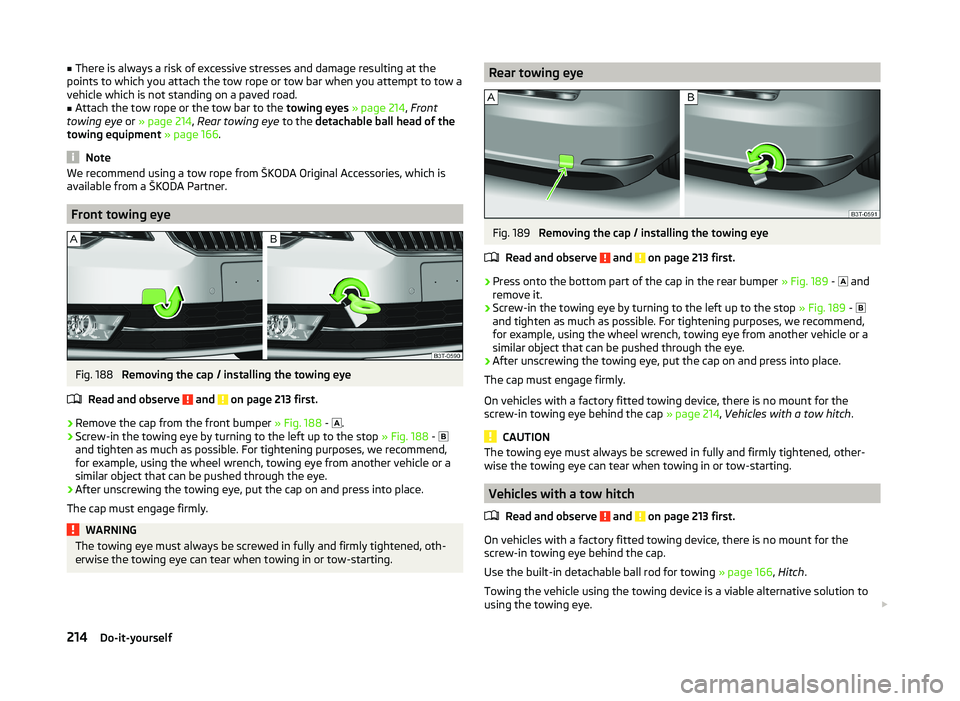
Fig. 188
Removing the cap / installing the towing eye
Read and observe
and on page 213 first.
›
Remove the cap from the front bumper » Fig. 188 -
.
›
Screw-in the towing eye by turning to the left up to the stop
» Fig. 188 -
and tighten as much as possible. For tightening purposes, we recommend,
for example, using the wheel wrench, towing eye from another vehicle or a
similar object that can be pushed through the eye.
›
After unscrewing the towing eye, put the cap on and press into place.
The cap must engage firmly.
WARNINGThe towing eye must always be screwed in fully and firmly tightened, oth-
erwise the towing eye can tear when towing in or tow-starting.Rear towing eyeFig. 189
Removing the cap / installing the towing eye
Read and observe
and on page 213 first.
›
Press onto the bottom part of the cap in the rear bumper » Fig. 189 -
and
remove it.
›
Screw-in the towing eye by turning to the left up to the stop » Fig. 189 -
and tighten as much as possible. For tightening purposes, we recommend,
for example, using the wheel wrench, towing eye from another vehicle or a
similar object that can be pushed through the eye.
›
After unscrewing the towing eye, put the cap on and press into place.
The cap must engage firmly.
On vehicles with a factory fitted towing device, there is no mount for the
screw-in towing eye behind the cap » page 214, Vehicles with a tow hitch .
CAUTION
The towing eye must always be screwed in fully and firmly tightened, other-
wise the towing eye can tear when towing in or tow-starting.
Vehicles with a tow hitch
Read and observe
and on page 213 first.
On vehicles with a factory fitted towing device, there is no mount for the
screw-in towing eye behind the cap.
Use the built-in detachable ball rod for towing » page 166, Hitch .
Towing the vehicle using the towing device is a viable alternative solution to using the towing eye.
214Do-it-yourself
Page 218 of 252
If the towing device is removed completely, it must be replaced with the
standard reinforcement of the rear bumper which is part of the mount for the
towing eye.
If this procedure is not observed, the vehicle may not meet the national legal
provisions.
CAUTION
The detachable ball rod and/or the vehicle can be damaged if an unsuitable
tow bar is used.
Note
The detachable ball rod must always be in the vehicle so that it can be used for
towing, if necessary.
Radio remote control
Introduction
This chapter contains information on the following subjects:
Replacing the battery in the remote control key
215
Synchronising the remote control
215
Replace the battery in the remote control of the auxiliary heater (parking
heater)
216
CAUTION
■ The replacement battery must have the same specification as the original
battery.■
We recommend having faulty batteries replaced by a ŠKODA service partner.
■
Pay attention to the correct polarity when changing the battery.
For the sake of the environment
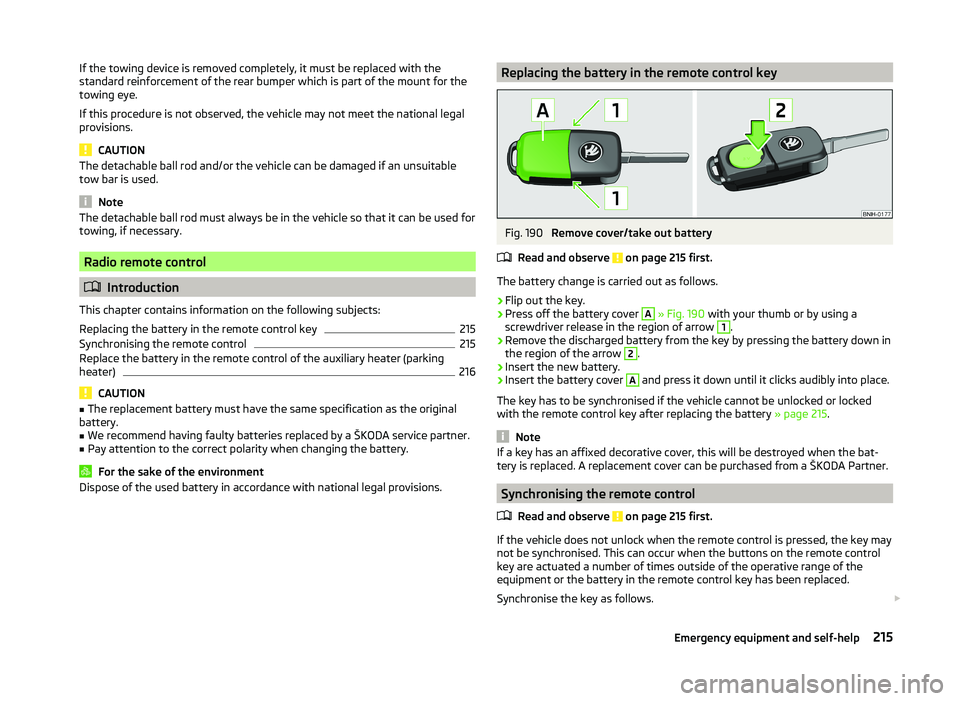
Dispose of the used battery in accordance with national legal provisions.Replacing the battery in the remote control keyFig. 190
Remove cover/take out battery
Read and observe
on page 215 first.
The battery change is carried out as follows.
›
Flip out the key.
›
Press off the battery cover
A
» Fig. 190 with your thumb or by using a
screwdriver release in the region of arrow
1
.
›
Remove the discharged battery from the key by pressing the battery down in
the region of the arrow
2
.
›
Insert the new battery.
›
Insert the battery cover
A
and press it down until it clicks audibly into place.
The key has to be synchronised if the vehicle cannot be unlocked or locked
with the remote control key after replacing the battery » page 215.
Note
If a key has an affixed decorative cover, this will be destroyed when the bat-
tery is replaced. A replacement cover can be purchased from a ŠKODA Partner.
Synchronising the remote control
Read and observe
on page 215 first.
If the vehicle does not unlock when the remote control is pressed, the key maynot be synchronised. This can occur when the buttons on the remote control
key are actuated a number of times outside of the operative range of the
equipment or the battery in the remote control key has been replaced.
Synchronise the key as follows.
215Emergency equipment and self-help
Page 231 of 252
Technical data
Technical data
Vehicle data
Introduction
This chapter contains information on the following subjects:
Vehicle identification data
228
Operating weight and payload
229
Measurement of fuel consumption and CO 2 emissions according to ECE
Regulations and EU Directives
229
Dimensions
230
Vehicle-specific information depending on engine type
231
Multi-purpose vehicles (AF)
235
The details given in the vehicle's technical documentation always take prece-
dence over the details in the Owner's Manual.
The listed performance values were determined without performance-reduc- ing equipment, e.g. air conditioning system.
Vehicle identification data
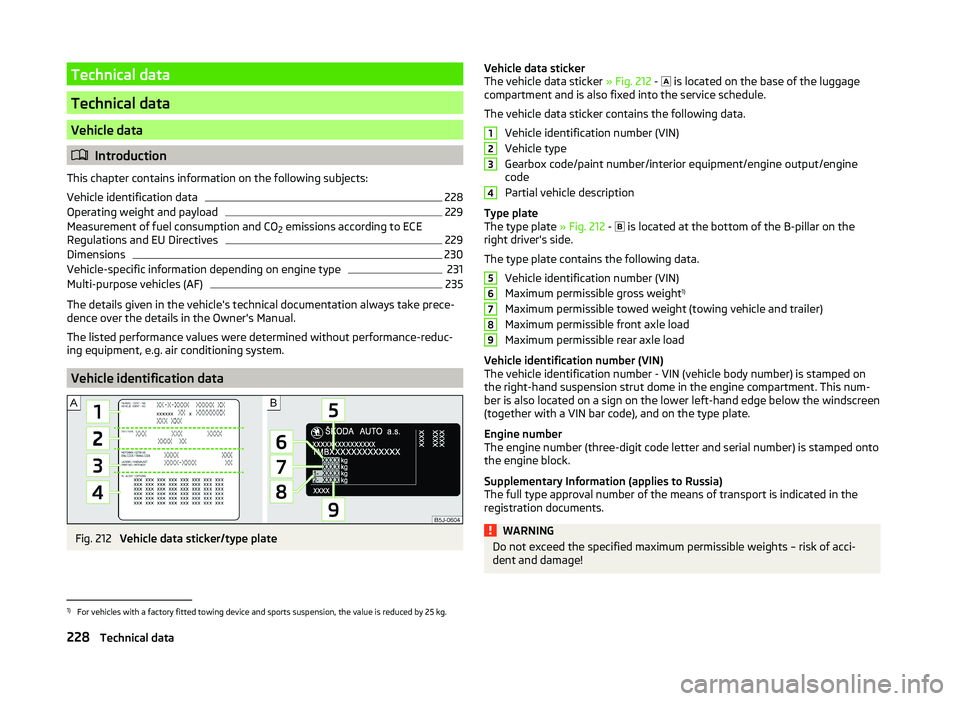
Fig. 212
Vehicle data sticker/type plate
Vehicle data sticker
The vehicle data sticker » Fig. 212 - is located on the base of the luggage
compartment and is also fixed into the service schedule.
The vehicle data sticker contains the following data. Vehicle identification number (VIN)
Vehicle type
Gearbox code/paint number/interior equipment/engine output/engine
code
Partial vehicle description
Type plate
The type plate » Fig. 212 -
is located at the bottom of the B-pillar on the
right driver's side.
The type plate contains the following data. Vehicle identification number (VIN)
Maximum permissible gross weight 1)
Maximum permissible towed weight (towing vehicle and trailer)
Maximum permissible front axle load
Maximum permissible rear axle load
Vehicle identification number (VIN)
The vehicle identification number - VIN (vehicle body number) is stamped on
the right-hand suspension strut dome in the engine compartment. This num- ber is also located on a sign on the lower left-hand edge below the windscreen
(together with a VIN bar code), and on the type plate.
Engine number
The engine number (three-digit code letter and serial number) is stamped onto
the engine block.
Supplementary Information (applies to Russia)
The full type approval number of the means of transport is indicated in the
registration documents.WARNINGDo not exceed the specified maximum permissible weights – risk of acci-
dent and damage!1234567891)
For vehicles with a factory fitted towing device and sports suspension, the value is reduced by 25 kg.
228Technical data
Page 232 of 252
Operating weight and payload
Operating weight
This value represents the minimum operating weight without additional
weight-increasing equipment such as air conditioning system, spare wheel, or
trailer hitch.
The specified operating weight is for orientation purposes only.
The operating weight also contains the weight of the driver (75 kg), the weight
of the operating fluids, the tool kit, and a fuel tank filled to 90 % capacity.
Operating weight of the vehicle » page 231, Vehicle-specific information de-
pending on engine type .
Payload
It is possible to calculate the approximate maximum payload from the differ-
ence between the permissible total weight and the operating weight.
The payload consists of the following weights.
› The weight of the passengers.
› The weight of all items of luggage and other loads.
› The weight of the roof, including the roof rack system.
› The weight of the equipment that is excluded from the operating weight.
› Trailer drawbar load when towing a trailer (max. 80 kg).
Note
If required, you can find out the precise weight of your vehicle at a specialist
garage.
Measurement of fuel consumption and CO 2 emissions according to
ECE Regulations and EU Directives
The data on fuel consumption and CO 2 emissions were not available at the
time of going to press.
The data on fuel consumption and CO 2 emissions are given on the ŠKODA
websites or in the sales and technical vehicle documentation.
The measurement of the intra-urban cycle begins with a cold start of the en-
gine. Afterwards urban driving is simulated.
In the extra-urban driving cycle, the vehicle is accelerated and decelerated in
all gears, corresponding to daily routine driving conditions. The driving speed
varies between 0 and 120 km/h.
The calculation of the combined fuel consumption considers a weighting of
about 37 % for the intra-urban cycle and 63 % for the extra-urban cycle.
Note
■ The fuel consumption and emission levels given on the ŠKODA websites or in
the commercial and technical vehicle documentation have been established in
accordance with rules and under conditions that are set out by legal or techni-
cal rules for the determination of operational and technical data of motor vehi-
cles.■
Depending on the extent of the equipment, the driving style, traffic condi-
tions, weather influences and vehicle condition, consumption values can in
practice result in fuel economy figures in the use of the vehicle that differ from
the fuel consumption values listed on the ŠKODA websites or in the commer-
cial and technical vehicle documentation.
229Technical data
Page 240 of 252
BootAutomatic retraction (Superb Combi)101
Extending variable loading floor105
Folding hook99
Non-closable side pocket (Superb Combi)102
Removable Light (Superb Combi)103
Roll up boot cover (Superb Combi)101
Side compartment with battery102
Boot cover (Superb Combi)101
Boot lid57
automatic locking58
Warning light36
(Superb Combi)58
Brake booster144
Brake fluid192
Checking193
Information messages35
specification193
Brake linings warning light
41
Brakes Brake assist systems
154
Brake booster144
Brake fluid193
Handbrake144
Information messages35
Running in149
Warning light35
Braking Information on braking
143
Break recommendation See Fatigue detection
165
Button in the driver's door Electrical power windows
61
C
Car care
173
Jack180
Car computer See multifunction display
44
Car park ticket holder89
Carrier Roof rack
108
Cavity protection180
CD changer136
Central locking50
Central locking button55
Changing brake fluid
193
bulbs223
Wheels205
Changing a wheel Follow-up work
206
Preliminary work206
Remove and attaching a wheel206
Changing brake fluid
193
Charging a vehicle battery196
Check Fit ball head properly
168
Checking Battery electrolyte level
195
Brake fluid193
Coolant192
Engine oil190
Oil level190
Windscreen washer fluid188
Checks Statutory checks
173
Children and safety22
Child safety Side airbag
24
Child safety lock55
Child seat Classification
25
ISOFIX25
on the front passenger seat23
TOP TETHER27
Use of child seats25
Use of ISOFIX child seats26
Chrome parts refer to Taking care of your vehicle178
Cigarette lighter91
Cleaning Alcantara
182
Covers of electrically heated seats182
Fabrics182
Headlight lenses179
Natural leather181
Plastic parts178
Synthetic leather182
Wheels180
Cleaning the vehicle Towing device
180
Cleaning vehicle176
Climatronic115
Air recirculation117
automatic mode116
Control elements115
Controlling blower118
Cooling system116
Defrosting windscreen118
Setting the temperature116
Clothes hook94
Cockpit 12-Volt power outlet
92
Ashtray91
Cigarette lighter91
General view29
Lighting73
Practical features88
Storage compartments88
Comfort control window
63
COMING HOME72
Compartments88
Components of the puncture repair kits209
Computer See multifunction display
44
237Index
Page 242 of 252
Selector lever-unlocking217
Sliding/tilting roof218
Start engine - KESSY142
Switching off the ignition –KESSY143
Towing the vehicle213
Towing the vehicle using the tow hitch214
tyre repair209
Unlocking the boot lid217
Unlocking the driver's door216
Emergency equipment Fire extinguisher
204
First-aid kit 204
Jack205
Vehicle tool kit205
Warning triangle204
Emissions229
Engine Running in
148
Engine compartment186
Brake fluid193
Coolant191
Overview188
Vehicle battery193
Engine number228
Engine oil189
Capacity189
Checking190
Note messages36
Replenishing191
Specifications189
Engine oil level Warning light
37
Engine oil pressure Warning light
36
Entry lighting75
Environment149
Environmental compatibility151
Environmentally friendly driving149
EPC Warning light
39
ESCFunction154
Warning light37
Exhaust inspection system Warning light
38
Extendable variable loading floor Fixing set
106
Extending variable loading floor105
Divide boot105
Movable lashing eyes107
Partial extension105
F
Fastening elements
99
Fatigue detection165
Function165
Information messages165
Films179
Fire extinguisher204
First-aid kit 204
Floor covering Fixing
100
Fog lights71
Warning light41
Fog lights with CORNER function71
Folding hook99
Fold in passenger's mirror80
Footmats145
see Footmats145
Force limit Electric boot lid (Superb Combi)
59
Power windows63
Sliding/tilting roof64
Sliding/tilting roof (Superb Combi)66
Front airbag17
Front door warning light74
Front interior light73
Fuel183
Diesel185
Fuel gauge32
refer to Fuel183
Refuelling184
Unleaded petrol184
Fuel consumption149, 229
Fuel reserve Warning light
39
Fuses Assignment
220
Colour coding220
Fuse assignment in the engine compartment222
Replacing220
G
Gearbox Warning messages
33
Gear change Gear recommendation
43
Information on the selected gear43
Gear changing Gear stick
144
General view Cockpit
29
Generator Indicator light
35
Genuine parts174
Glasses storage box93
Glow plug system Warning light
38
GSM124, 126
H
Handbrake
144
Warning light35
Hands-free system Voice control
131
Hazard warning light system72
239Index
Page 247 of 252
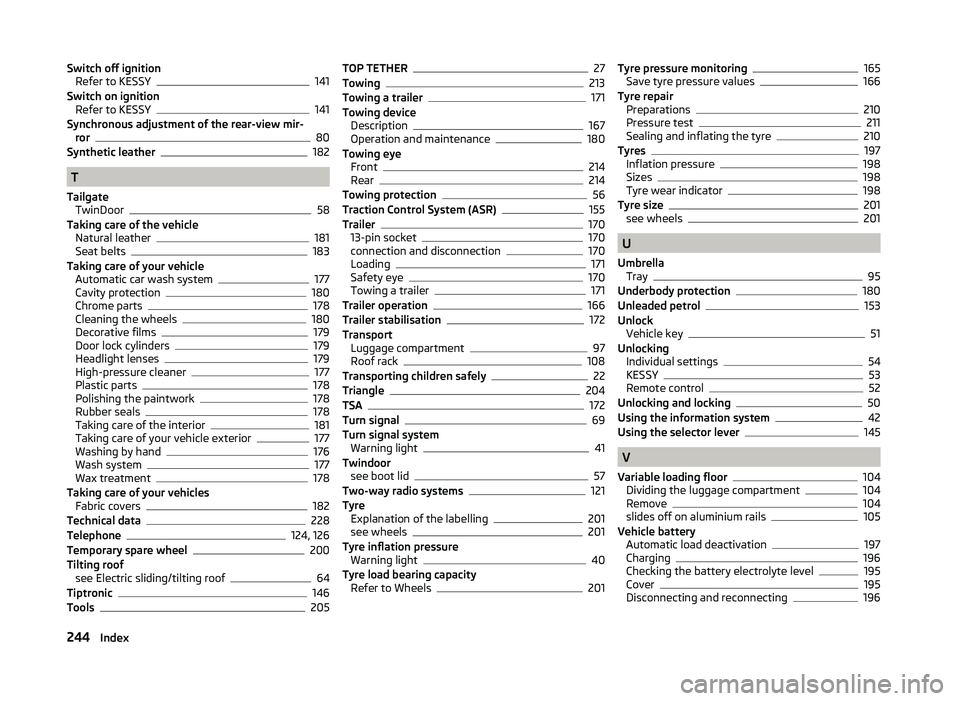
Switch off ignitionRefer to KESSY141
Switch on ignition Refer to KESSY
141
Synchronous adjustment of the rear-view mir- ror
80
Synthetic leather182
T
Tailgate TwinDoor
58
Taking care of the vehicle Natural leather
181
Seat belts183
Taking care of your vehicle Automatic car wash system
177
Cavity protection180
Chrome parts178
Cleaning the wheels180
Decorative films179
Door lock cylinders179
Headlight lenses179
High-pressure cleaner177
Plastic parts178
Polishing the paintwork178
Rubber seals178
Taking care of the interior181
Taking care of your vehicle exterior177
Washing by hand176
Wash system177
Wax treatment178
Taking care of your vehicles Fabric covers
182
Technical data228
Telephone124, 126
Temporary spare wheel200
Tilting roof see Electric sliding/tilting roof
64
Tiptronic146
Tools205
TOP TETHER27
Towing213
Towing a trailer171
Towing device Description
167
Operation and maintenance180
Towing eye Front
214
Rear214
Towing protection56
Traction Control System (ASR)155
Trailer170
13-pin socket170
connection and disconnection170
Loading171
Safety eye170
Towing a trailer171
Trailer operation166
Trailer stabilisation172
Transport Luggage compartment
97
Roof rack108
Transporting children safely22
Triangle204
TSA172
Turn signal69
Turn signal system Warning light
41
Twindoor see boot lid
57
Two-way radio systems121
Tyre Explanation of the labelling
201
see wheels201
Tyre inflation pressure Warning light
40
Tyre load bearing capacity Refer to Wheels
201
Tyre pressure monitoring165
Save tyre pressure values166
Tyre repair Preparations
210
Pressure test211
Sealing and inflating the tyre210
Tyres197
Inflation pressure198
Sizes198
Tyre wear indicator198
Tyre size201
see wheels201
U
Umbrella Tray
95
Underbody protection180
Unleaded petrol153
Unlock Vehicle key
51
Unlocking Individual settings
54
KESSY53
Remote control52
Unlocking and locking50
Using the information system42
Using the selector lever145
V
Variable loading floor
104
Dividing the luggage compartment104
Remove104
slides off on aluminium rails105
Vehicle battery Automatic load deactivation
197
Charging196
Checking the battery electrolyte level195
Cover195
Disconnecting and reconnecting196
244Index