wiper SKODA SUPERB 2011 Owner´s Manual
[x] Cancel search | Manufacturer: SKODA, Model Year: 2011, Model line: SUPERB, Model: SKODA SUPERB 2011Pages: 252, PDF Size: 16.33 MB
Page 190 of 252
WARNING (Continued)■Avoid short circuits in the electrical system - particularly on the vehicle's
battery.■
Always make sure that no jewellery, loose clothing or long hair can get
caught in rotating engine parts – risk to life! Always remove any jewellery,
tie back long hair and wear tight fitting clothing before completing any
work.
WARNINGInformation for working on the fuel system or the electrical system■Always disconnect the vehicle battery from the electrical system.■
Do not smoke.
■
Never work near open flames.
■
Always have a functioning fire extinguisher nearby.
WARNING■ Read and observe the information and warning instructions on the fluid
containers.■
Keep the working fluids in sealed original containers and safe from peo-
ple who are not completely independent, e.g. children.
■
If you intend to work underneath the vehicle, you must secure the vehicle
from rolling away and support it with suitable supporting blocks; the car
jack is not sufficient – risk of injury!
CAUTION
Always top up using the correct specification of fluids. This may result in major
operating problems and also vehicle damage!
For the sake of the environment
In view of the requirements for the environmentally friendly disposal of fluids and the special tools and knowledge required for such work, we recommend
that fluids be changed by a specialist garage.
Note
■ Please consult a specialist garage for any questions relating to fluids.■Fluids with the proper specifications can be purchased from the ŠKODA Origi-
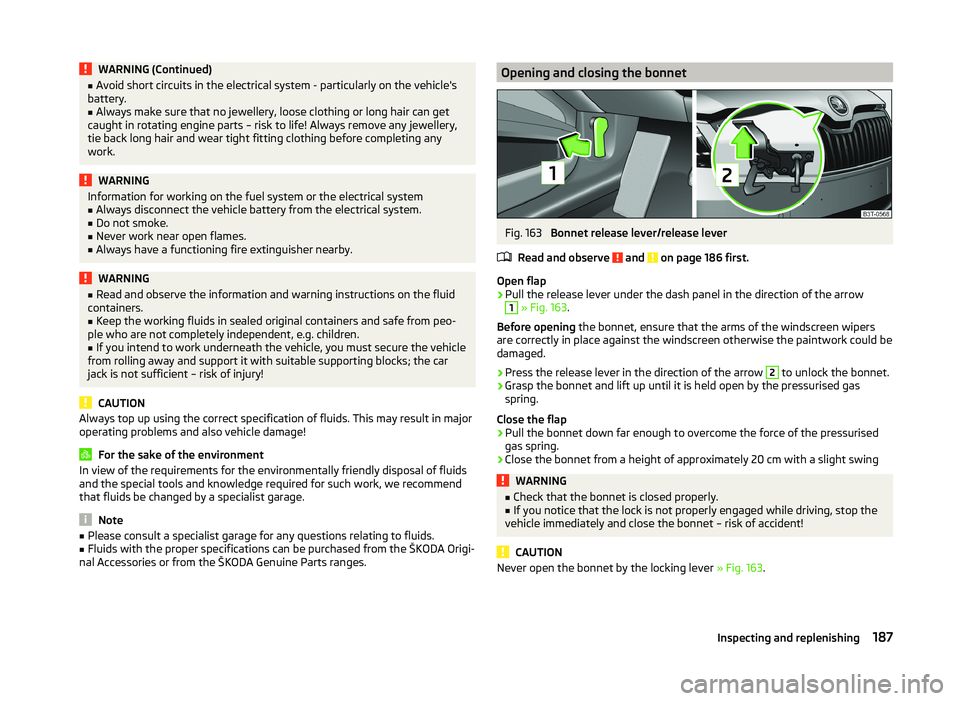
nal Accessories or from the ŠKODA Genuine Parts ranges.Opening and closing the bonnetFig. 163
Bonnet release lever/release lever
Read and observe
and on page 186 first.
Open flap
›
Pull the release lever under the dash panel in the direction of the arrow
1
» Fig. 163 .
Before opening the bonnet, ensure that the arms of the windscreen wipers
are correctly in place against the windscreen otherwise the paintwork could be
damaged.
›
Press the release lever in the direction of the arrow
2
to unlock the bonnet.
›
Grasp the bonnet and lift up until it is held open by the pressurised gas
spring.
Close the flap
›
Pull the bonnet down far enough to overcome the force of the pressurised
gas spring.
›
Close the bonnet from a height of approximately 20 cm with a slight swing
WARNING■ Check that the bonnet is closed properly.■If you notice that the lock is not properly engaged while driving, stop the
vehicle immediately and close the bonnet – risk of accident!
CAUTION
Never open the bonnet by the locking lever » Fig. 163.187Inspecting and replenishing
Page 216 of 252
›After starting the engine, close the protective cap of the jump-starting point.
Towing the vehicle
Introduction
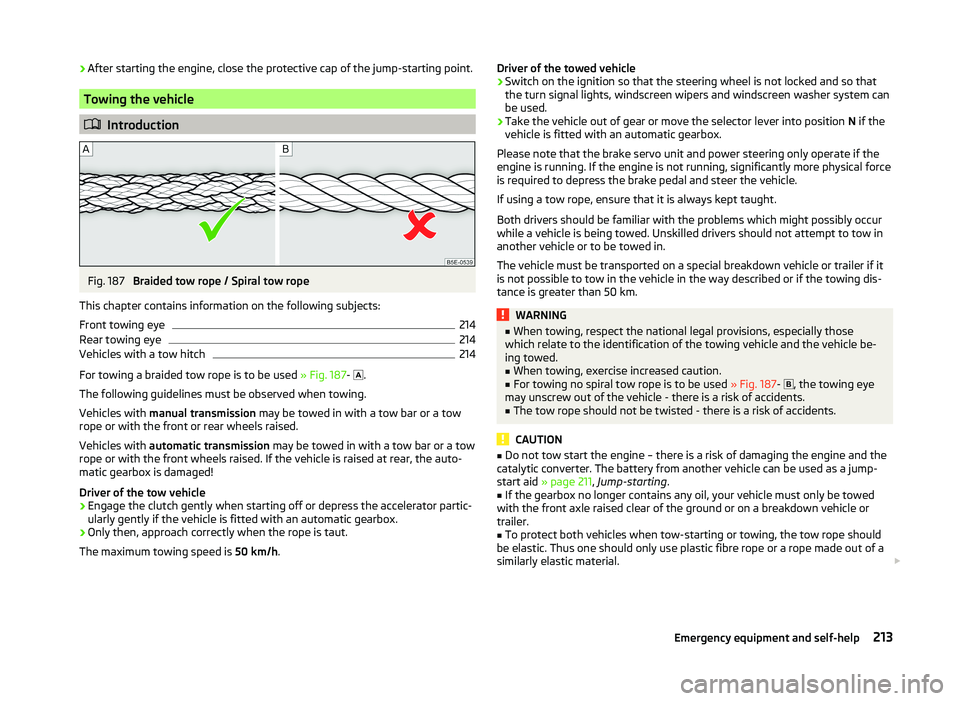
Fig. 187
Braided tow rope / Spiral tow rope
This chapter contains information on the following subjects:
Front towing eye
214
Rear towing eye
214
Vehicles with a tow hitch
214
For towing a braided tow rope is to be used » Fig. 187-
.
The following guidelines must be observed when towing.
Vehicles with manual transmission may be towed in with a tow bar or a tow
rope or with the front or rear wheels raised.
Vehicles with automatic transmission may be towed in with a tow bar or a tow
rope or with the front wheels raised. If the vehicle is raised at rear, the auto-
matic gearbox is damaged!
Driver of the tow vehicle
›
Engage the clutch gently when starting off or depress the accelerator partic-
ularly gently if the vehicle is fitted with an automatic gearbox.
›
Only then, approach correctly when the rope is taut.
The maximum towing speed is 50 km/h.
Driver of the towed vehicle›Switch on the ignition so that the steering wheel is not locked and so that
the turn signal lights, windscreen wipers and windscreen washer system can
be used.›
Take the vehicle out of gear or move the selector lever into position N if the
vehicle is fitted with an automatic gearbox.
Please note that the brake servo unit and power steering only operate if the
engine is running. If the engine is not running, significantly more physical force
is required to depress the brake pedal and steer the vehicle.
If using a tow rope, ensure that it is always kept taught.
Both drivers should be familiar with the problems which might possibly occur while a vehicle is being towed. Unskilled drivers should not attempt to tow in
another vehicle or to be towed in.
The vehicle must be transported on a special breakdown vehicle or trailer if it
is not possible to tow in the vehicle in the way described or if the towing dis-
tance is greater than 50 km.
WARNING■ When towing, respect the national legal provisions, especially those
which relate to the identification of the towing vehicle and the vehicle be-
ing towed.■
When towing, exercise increased caution.
■
For towing no spiral tow rope is to be used » Fig. 187-
, the towing eye
may unscrew out of the vehicle - there is a risk of accidents.
■
The tow rope should not be twisted - there is a risk of accidents.
CAUTION
■ Do not tow start the engine – there is a risk of damaging the engine and the
catalytic converter. The battery from another vehicle can be used as a jump-
start aid » page 211 , Jump-starting .■
If the gearbox no longer contains any oil, your vehicle must only be towed
with the front axle raised clear of the ground or on a breakdown vehicle or
trailer.
■
To protect both vehicles when tow-starting or towing, the tow rope should
be elastic. Thus one should only use plastic fibre rope or a rope made out of a
similarly elastic material.
213Emergency equipment and self-help
Page 221 of 252
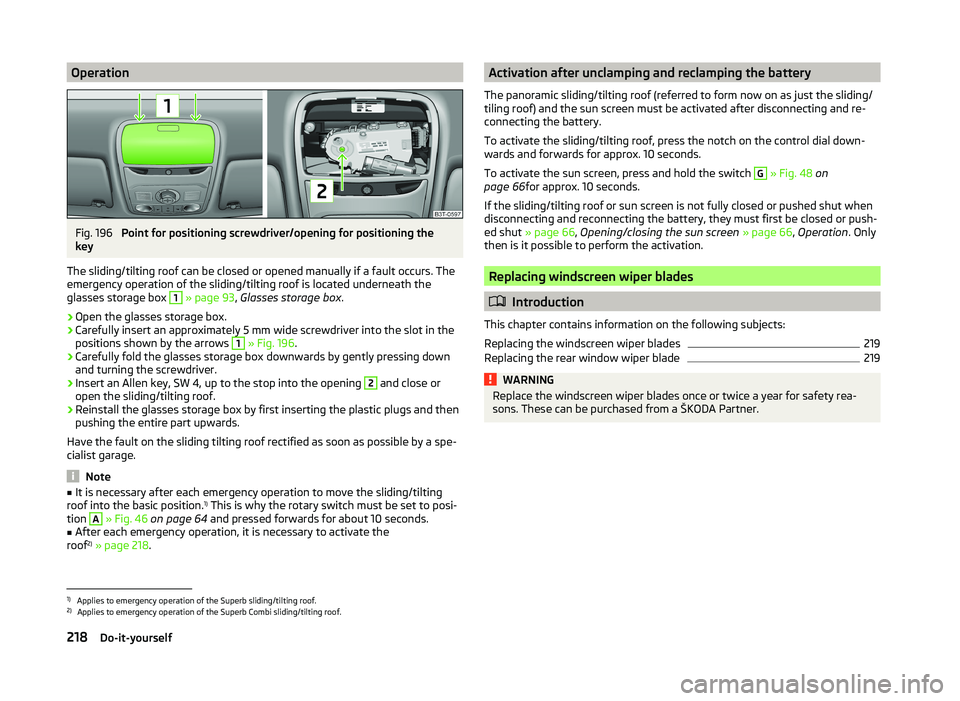
OperationFig. 196
Point for positioning screwdriver/opening for positioning the
key
The sliding/tilting roof can be closed or opened manually if a fault occurs. The
emergency operation of the sliding/tilting roof is located underneath the
glasses storage box
1
» page 93 , Glasses storage box .
›
Open the glasses storage box.
›
Carefully insert an approximately 5 mm wide screwdriver into the slot in the
positions shown by the arrows
1
» Fig. 196 .
›
Carefully fold the glasses storage box downwards by gently pressing down
and turning the screwdriver.
›
Insert an Allen key, SW 4, up to the stop into the opening
2
and close or
open the sliding/tilting roof.
›
Reinstall the glasses storage box by first inserting the plastic plugs and then
pushing the entire part upwards.
Have the fault on the sliding tilting roof rectified as soon as possible by a spe- cialist garage.
Note
■ It is necessary after each emergency operation to move the sliding/tilting
roof into the basic position. 1)
This is why the rotary switch must be set to posi-
tion A
» Fig. 46 on page 64 and pressed forwards for about 10 seconds.
■
After each emergency operation, it is necessary to activate the
roof 2)
» page 218 .
Activation after unclamping and reclamping the battery
The panoramic sliding/tilting roof (referred to form now on as just the sliding/
tiling roof) and the sun screen must be activated after disconnecting and re-
connecting the battery.
To activate the sliding/tilting roof, press the notch on the control dial down-
wards and forwards for approx. 10 seconds.
To activate the sun screen, press and hold the switch G
» Fig. 48 on
page 66 for approx. 10 seconds.
If the sliding/tilting roof or sun screen is not fully closed or pushed shut when
disconnecting and reconnecting the battery, they must first be closed or push-
ed shut » page 66 , Opening/closing the sun screen » page 66 , Operation . Only
then is it possible to perform the activation.
Replacing windscreen wiper blades
Introduction
This chapter contains information on the following subjects:
Replacing the windscreen wiper blades
219
Replacing the rear window wiper blade
219WARNINGReplace the windscreen wiper blades once or twice a year for safety rea-
sons. These can be purchased from a ŠKODA Partner.1)
Applies to emergency operation of the Superb sliding/tilting roof.
2)
Applies to emergency operation of the Superb Combi sliding/tilting roof.
218Do-it-yourself
Page 222 of 252
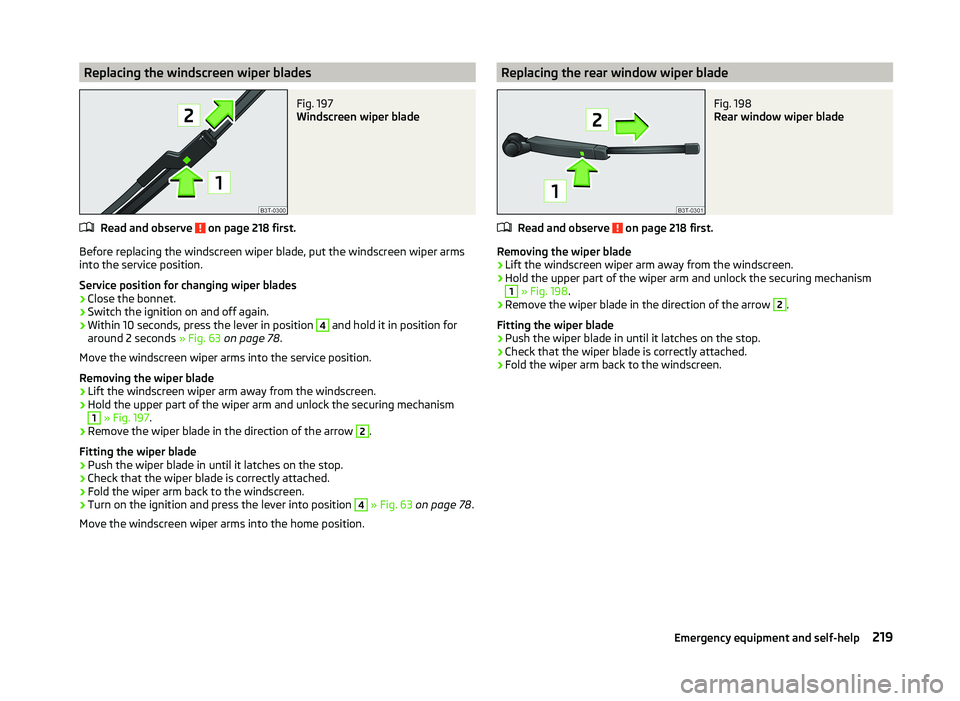
Replacing the windscreen wiper bladesFig. 197
Windscreen wiper blade
Read and observe on page 218 first.
Before replacing the windscreen wiper blade, put the windscreen wiper arms
into the service position.
Service position for changing wiper blades
›
Close the bonnet.
›
Switch the ignition on and off again.
›
Within 10 seconds, press the lever in position
4
and hold it in position for
around 2 seconds » Fig. 63 on page 78 .
Move the windscreen wiper arms into the service position.
Removing the wiper blade
›
Lift the windscreen wiper arm away from the windscreen.
›
Hold the upper part of the wiper arm and unlock the securing mechanism
1
» Fig. 197 .
›
Remove the wiper blade in the direction of the arrow
2
.
Fitting the wiper blade
›
Push the wiper blade in until it latches on the stop.
›
Check that the wiper blade is correctly attached.
›
Fold the wiper arm back to the windscreen.
›
Turn on the ignition and press the lever into position
4
» Fig. 63 on page 78 .
Move the windscreen wiper arms into the home position.
Replacing the rear window wiper bladeFig. 198
Rear window wiper blade
Read and observe on page 218 first.
Removing the wiper blade
›
Lift the windscreen wiper arm away from the windscreen.
›
Hold the upper part of the wiper arm and unlock the securing mechanism
1
» Fig. 198 .
›
Remove the wiper blade in the direction of the arrow
2
.
Fitting the wiper blade
›
Push the wiper blade in until it latches on the stop.
›
Check that the wiper blade is correctly attached.
›
Fold the wiper arm back to the windscreen.
219Emergency equipment and self-help
Page 224 of 252
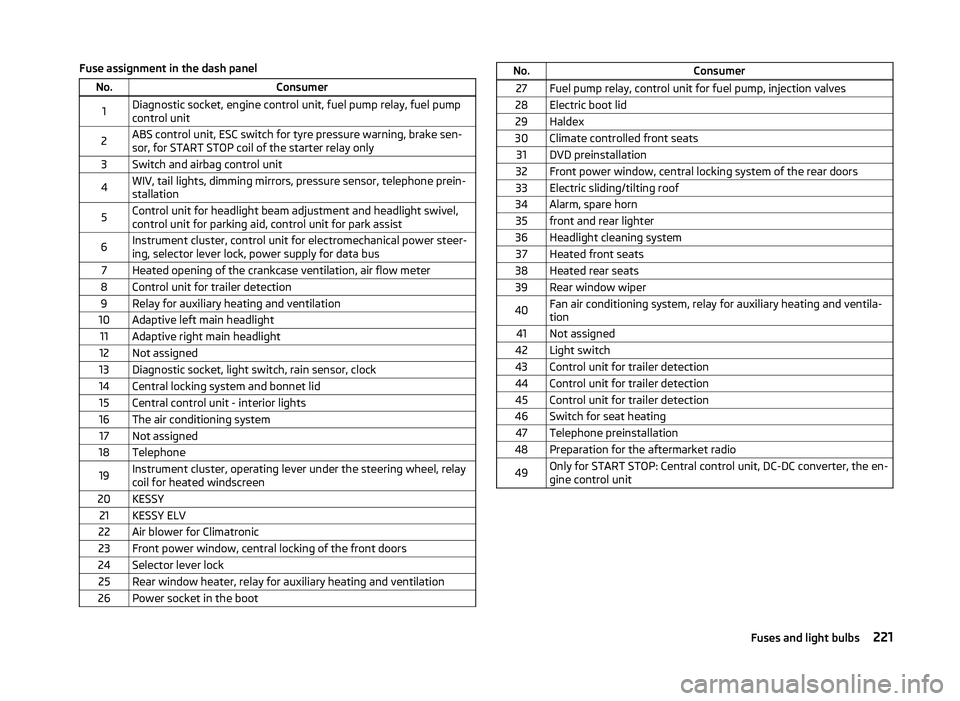
Fuse assignment in the dash panelNo.Consumer1Diagnostic socket, engine control unit, fuel pump relay, fuel pump
control unit2ABS control unit, ESC switch for tyre pressure warning, brake sen-
sor, for START STOP coil of the starter relay only3Switch and airbag control unit4WIV, tail lights, dimming mirrors, pressure sensor, telephone prein-
stallation5Control unit for headlight beam adjustment and headlight swivel,
control unit for parking aid, control unit for park assist6Instrument cluster, control unit for electromechanical power steer-
ing, selector lever lock, power supply for data bus7Heated opening of the crankcase ventilation, air flow meter8Control unit for trailer detection9Relay for auxiliary heating and ventilation10Adaptive left main headlight11Adaptive right main headlight12Not assigned13Diagnostic socket, light switch, rain sensor, clock14Central locking system and bonnet lid15Central control unit - interior lights16The air conditioning system17Not assigned18Telephone19Instrument cluster, operating lever under the steering wheel, relay
coil for heated windscreen20KESSY21KESSY ELV22Air blower for Climatronic23Front power window, central locking of the front doors24Selector lever lock25Rear window heater, relay for auxiliary heating and ventilation26Power socket in the bootNo.Consumer27Fuel pump relay, control unit for fuel pump, injection valves28Electric boot lid29Haldex30Climate controlled front seats31DVD preinstallation32Front power window, central locking system of the rear doors33Electric sliding/tilting roof34Alarm, spare horn35front and rear lighter36Headlight cleaning system37Heated front seats38Heated rear seats39Rear window wiper40Fan air conditioning system, relay for auxiliary heating and ventila-
tion41Not assigned42Light switch43Control unit for trailer detection44Control unit for trailer detection45Control unit for trailer detection46Switch for seat heating47Telephone preinstallation48Preparation for the aftermarket radio49Only for START STOP: Central control unit, DC-DC converter, the en-
gine control unit221Fuses and light bulbs
Page 225 of 252
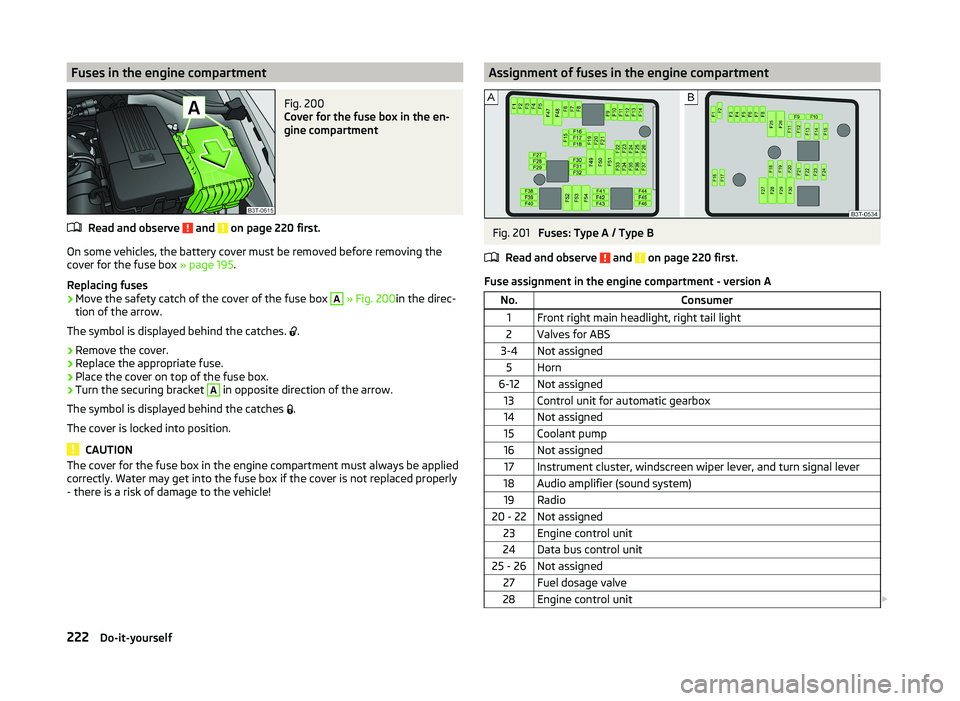
Fuses in the engine compartmentFig. 200
Cover for the fuse box in the en-
gine compartment
Read and observe and on page 220 first.
On some vehicles, the battery cover must be removed before removing the
cover for the fuse box » page 195.
Replacing fuses
›
Move the safety catch of the cover of the fuse box
A
» Fig. 200 in the direc-
tion of the arrow.
The symbol is displayed behind the catches. .
›
Remove the cover.
›
Replace the appropriate fuse.
›
Place the cover on top of the fuse box.
›
Turn the securing bracket
A
in opposite direction of the arrow.
The symbol is displayed behind the catches .
The cover is locked into position.
CAUTION
The cover for the fuse box in the engine compartment must always be applied
correctly. Water may get into the fuse box if the cover is not replaced properly
- there is a risk of damage to the vehicle!Assignment of fuses in the engine compartmentFig. 201
Fuses: Type A / Type B
Read and observe
and on page 220 first.
Fuse assignment in the engine compartment - version A
No.Consumer1Front right main headlight, right tail light2Valves for ABS3-4Not assigned5Horn6-12Not assigned13Control unit for automatic gearbox14Not assigned15Coolant pump16Not assigned17Instrument cluster, windscreen wiper lever, and turn signal lever18Audio amplifier (sound system)19Radio20 - 22Not assigned23Engine control unit24Data bus control unit25 - 26Not assigned27Fuel dosage valve28Engine control unit 222Do-it-yourself
Page 226 of 252
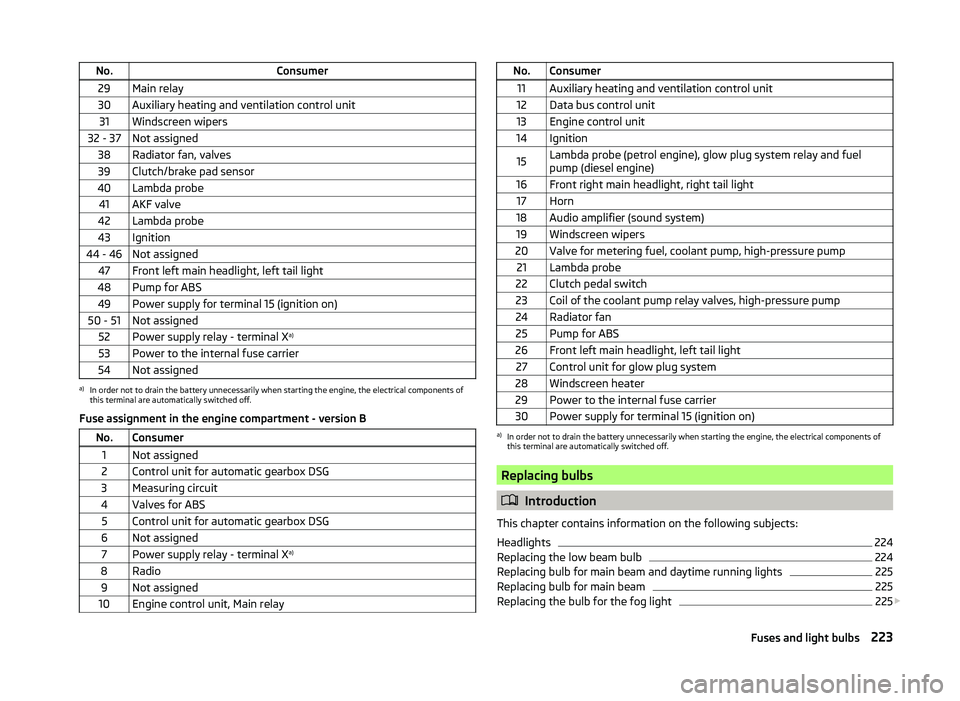
No.Consumer29Main relay30Auxiliary heating and ventilation control unit31Windscreen wipers32 - 37Not assigned38Radiator fan, valves39Clutch/brake pad sensor40Lambda probe41AKF valve42Lambda probe43Ignition44 - 46Not assigned47Front left main headlight, left tail light48Pump for ABS49Power supply for terminal 15 (ignition on)50 - 51Not assigned52Power supply relay - terminal Xa)53Power to the internal fuse carrier54Not assigneda)
In order not to drain the battery unnecessarily when starting the engine, the electrical components of
this terminal are automatically switched off.
Fuse assignment in the engine compartment - version B
No.Consumer1Not assigned2Control unit for automatic gearbox DSG3Measuring circuit4Valves for ABS5Control unit for automatic gearbox DSG6Not assigned7Power supply relay - terminal X a)8Radio9Not assigned10Engine control unit, Main relayNo.Consumer11Auxiliary heating and ventilation control unit12Data bus control unit13Engine control unit14Ignition15Lambda probe (petrol engine), glow plug system relay and fuel
pump (diesel engine)16Front right main headlight, right tail light17Horn18Audio amplifier (sound system)19Windscreen wipers20Valve for metering fuel, coolant pump, high-pressure pump21Lambda probe22Clutch pedal switch23Coil of the coolant pump relay valves, high-pressure pump24Radiator fan25Pump for ABS26Front left main headlight, left tail light27Control unit for glow plug system28Windscreen heater29Power to the internal fuse carrier30Power supply for terminal 15 (ignition on)a)
In order not to drain the battery unnecessarily when starting the engine, the electrical components of
this terminal are automatically switched off.
Replacing bulbs
Introduction
This chapter contains information on the following subjects:
Headlights
224
Replacing the low beam bulb
224
Replacing bulb for main beam and daytime running lights
225
Replacing bulb for main beam
225
Replacing the bulb for the fog light
225
223Fuses and light bulbs
Page 243 of 252
HBA155
Head airbag20
Headlight cleaning system Headlight cleaning system
79
Headlights Driving abroad
153
Headlight cleaning system79
Replacing a bulb224
Head restraint83
Head restraints83
Heater Windscreen and rear window
75
Heating Exterior mirrors
80
Seats85
HHC156
Hill Hold Control (HHC)156
Hitch166
Accessories169
Drawback load166
Horn29
Hydraulic Brake Assist (HBA)155
I
Ignition
139
Immobilizer139
Individual settings Locking
54
Unlocking54
Inertia reels15
Information messages see KESSY
53
Information system42
Compass point display48
Display a low temperature43
Door warning44
Gear recommendation43
MAXI DOT display46
Multifunction display44
Operation42
Service interval display48
instrument cluster Auto Check Control
33
Instrument cluster30
Counter for distance driven32
Display31
Display of the second speed33
Fuel gauge32
Overview30
Revolution counter31
see instrument cluster30
Speedometer31
Temperature gauge31
Warning lights34
Interior monitor56
Internet connection129
ISOFIX25
J
Jack
205
Maintenance180
Jacking points Raise vehicle
207
Jump-starting211
K
KESSY Information messages
53
Lock / unlock the steering141
Locking53
Starting the engine142
Switching off the engine142
Switch off ignition141
Switch on ignition141
Unlocking53
Key Starting the engine
139
Stopping the engine140
Knee airbag18
L
Lamp failure Warning light
38
Lamps Warning light
38
LEAVING HOME72
Lever Main beam
69
Turn signal69
Windscreen wipers78
Light Cockpit
73
COMING HOME / LEAVING HOME72
Fog lights with CORNER function71
Headlight range control68
Instrument illumination68
Low beam68
Parking light68
switching on and off68
Travel mode71
Light bulbs Rear light (Superb Combi)
226
Lighting Luggage compartment
97
Lights67
Adaptive headlights (AFS)70
Automatic driving lamp control70
Daylight running69
Fog lights71
Hazard warning light system72
Headlight flasher69
Main beam69
Parking lights73
Rear fog light71
Replacing bulbs223
Tourist lights71
Turn signal69
Warning lights34
Lock Vehicle key
51
240Index
Page 245 of 252
Park Assistautomatic emergency braking160
Operation158
Parking Park assist
157
Parking aid156
Parking aid156
Function157
Parking light68
Part replacement173
Passive safety Before setting off
8
Driving safety8
Safety equipment8
Passive Safety8
Payload229
Pedals145
Footmats145
Petrol refer to Fuel
184
Polishing the paintwork See Taking care of your vehicle
178
Power outlet 12 V
92
Power Steering / steering lock (KESSY system) warning light
36
Power windows Button in the front passenger door
63
Practical features88
12 Volt power outlet92
Ashtray91
Car park ticket holder89
Cigarette lighter91
Clothes hook94
Cup holders90
Glasses storage box93
Removable ski bag97
Seat backrest with long cargo channel96
Storage compartment for umbrella95
Storage compartment in rear centre console95
Storage compartment in the front centre con- sole90
Storage compartment on passenger side94
Storage compartment on the driver's side89
Storage compartments in the doors90
Storage compartment under passenger seat94
Storage compartment under the front armrest 92
Storage net in front centre console
93
Storage pockets on the front seats95
Puncture set209
R
Radiator fan
188
Radio4
Radio reception See windows
179
Radio remote control Auxiliary heating
120
Raise vehicle207
Rear-view mirror Exterior mirrors
80
Fold in passenger mirror80
Synchronous adjustment of the rear-view mir- ror
80
Rear fog light71
Warning light38
Rear interior light74
Rear mirror79
Interior mirror79
Rear seats Seat folded forward Combi
88
Rear window - heater75
Recirculated air mode Manual air conditioning
114
Refuelling184
Fuel184
Remote control Locking
52
Replacing the battery215
Synchronisation process215
Unlocking52
Remote control key Replacing the battery
215
Removable lights (Superb Combi) Changing rechargeable light batteries
103
Removable Light (Superb Combi) Remove light
103
Removable ski bag97
Removable variable loading floor Fit and remove
106
Repairs and technical alterations173
Replacing Bulb for main beam
225
Bulb for main beam and daytime running lights 225
Bulb for the fog light
225
Bulb for the licence plate light226
Bulb in rear light (Superb Combi)227
Fuses220
Fuses in the dash panel220
Fuses in the engine compartment222
Low beam bulb224
Vehicle battery196
Wiper blades219
Replenishing Coolant
192
Engine oil191
Windscreen washer fluid188
Revolution counter31
Roof luggage rack Attachment points
109
Roof rack108
Roof rack system Roof load
109
Running in Brake pads
149
Engine148
The first 1,500 km148
Tyres149
242Index
Page 248 of 252
Operation in winter195
Replacing196
Safety instructions193
Vehicle care Alcantara
182
Fabrics182
Synthetic leather182
washing176
Vehicle Condition see Auto Check Control
33
Vehicle data sticker228
Vehicle dimensions230
Vehicle height230
Vehicle Identification Number (VIN)228
Vehicle key lock
51
unlock51
Vehicle length230
Vehicle tool kit205
Vehicle width230
Visibility75
Visors see Sun screen
76
see Sun visors76
W
Warning at excessive speeds
46
Warning lights34
warning messages Diesel particulate filter
39
Warning symbols see Warning lights
34
Warning triangle204
Washing Automatic car wash system
177
by hand176
Chrome parts178
High-pressure cleaner177
Washing vehicles176
Water Driving through152
Wax treatment See Taking care of your vehicle
178
Weather conditions173
Wheel bolts Anti-theft wheel bolts
208
Caps201
Loosening and tightening207
Wheel rims197
Wheels Changing
205
Full trim200
General information197
Load index201
Replacing wheels198
Service life of tyres198
Snow chains203
Spare wheel200
Speed symbol202
Storing wheels198
Temporary spare wheel200
Tyre pressure198
Tyre size201
Tyre sizes198
Tyre wear indicator198
Unidirectional tyres199
Winter tyres203
Wi-Fi130
Windows179
De-icing179
See Electrical power windows61
Windscreen De-icing
179
Heater75
Windscreen washer fluid Checking
188
Replenishing188
Warning light40
Winter188
Windscreen washers Windscreen washers78
Windscreen washer system188
Windscreen wiper Replacing the rear window wiper blade
219
Windscreen wipers Operating
78
Replacing the windscreen wiper blades219
Windscreen washer fluid188
Windscreen wipers and washers77
Winter De-icing windows
179
Winter operation203
Snow chains203
Winter tyres203
Winter tyres See Wheels
203
WLAN130
MAXI DOT131
Network connection130
Switching off130
Switching on130
245Index