roof SKODA SUPERB 2011 Owner´s Manual
[x] Cancel search | Manufacturer: SKODA, Model Year: 2011, Model line: SUPERB, Model: SKODA SUPERB 2011Pages: 252, PDF Size: 16.33 MB
Page 180 of 252
Automatic car wash systemsRead and observe
and on page 176 first.
The usual precautionary measures must be taken before washing the vehicle
in an automatic car wash system (e.g. closing the windows and the sliding/tilt-
ing roof etc.).
If your vehicle is fitted with any particular attached parts, such as a spoiler,
roof rack system, two-way radio aerial etc., it is best to consult the operator of
the car wash system beforehand.
After an automatic wash with wax treatment, the lips of the wipers should be
cleaned with cleaning agents specially designed for the purpose, and then de-
greased.
WARNINGFold in the exterior mirrors to prevent damage before washing the vehicle
in an automatic car wash system. Never manually fold in electric exterior
mirrors - always use the electric controls.
Washing with a high-pressure cleaner
Read and observe
and on page 176 first.
When washing the vehicle with a high-pressure cleaner, the instructions for
use of the equipment must be observed. This applies in particular to the pres-
sure used and to the spraying distance .
Maintain a sufficiently large distance to the parking aid sensors and soft mate-
rials such as rubber hoses or insulation material.
WARNINGNever use circular spray nozzles or dirt cutters!
CAUTION
■ If washing the vehicle in the winter using a hose or high-pressure cleaner,
ensure that the jet of water is not aimed directly at the locking cylinders or the
door/panel joints – risk of freezing!■
To avoid damaging the parking aid sensors while cleaning with high-pressure
cleaners or steam jets, the sensors must only be directly sprayed for short pe-
riods while a minimum distance of 10 cm must be observed.
■ The temperature of the water used for cleaning must not exceed 60 °C – risk
of damaging the vehicle.■
See also Washing cars with decorative films using a high-pressure clean-
er » page 179 .
Taking care of your vehicle exterior
Introduction
This chapter contains information on the following subjects:
Taking care of your vehicle's paintwork
178
Plastic parts
178
Rubber seals
178
Chrome parts
178
Decorative films
179
Windows and exterior mirrors
179
Headlight lenses
179
Door lock cylinders
179
Cavity protection
180
Jack
180
Wheels
180
Towing device and mounting recess
180
Underbody protection
180
We recommend using vehicle care products from ŠKODA Original Accessories.
These are available from ŠKODA Partners. The usage instructions on the pack-
age must be observed.
WARNING■ Vehicle care products may be harmful to your health if not used according
to the instructions.■
Always keep the vehicle care products safe from people who are not com-
pletely independent, e.g. children - there is a danger of poisoning!
■
Protect your hands and arms from sharp-edged metal parts when clean-
ing the underfloor, the inside of the wheel housings or the wheel trims –
risk of cuts!
177Car care
Page 184 of 252
Taking care of the interior
Introduction
This chapter contains information on the following subjects:
Natural leather
181
Synthetic leather, fabrics and Alcantara ®
182
Seat covers
182
Seat belts
183
Regular and proper care helps to ensure efficiency and maintain the
value of
your vehicle.
We recommend using vehicle care products from ŠKODA Original Accessories.
These are available from ŠKODA Partners. The usage instructions on the pack-
age must be observed.
WARNING■ Vehicle care products may be harmful to your health if not used according
to the instructions.■
Always keep the vehicle care products safe from people who are not com-
pletely independent, e.g. children - there is a danger of poisoning!
CAUTION
■ Be sure to check clothing for colourfastness to avoid any damage or visible
stains on the material (leather), panels and textiles.■
Remove fresh stains such as those from ball-point pens, ink, lipstick, shoe
polish, etc., from the material (leather), panels and textiles as quickly as possi-
ble.
■
Air fresheners and scents can be hazardous to heath when the temperature
inside the vehicle is high.
■
Do not attach scent dispensers or air fresheners to the dash panel – risk of
damage to the dash panel.
■
Do not stick any stickers on the inside of the rear windows, the rear side win-
dows and in the vicinity of the heating elements on the windscreen or near the
window aerial. These may get damaged.
■
Do not clean the roof panelling with a brush – risk of damage to the surface
of the panelling.
■
Cleaner that contain solvents can damage the material being cleaned.
■
Apply only a small amount of the cleaning and care product.
For the sake of the environmentUsed cans of vehicle care product represent hazardous waste that is harmful
to the environment. These must be disposed of in accordance with national
legislation.
Note
Because of the special tools and knowledge required, and to avoid any poten-
tial problems with the cleaning and care of the interior of your vehicle, we rec-
ommend that cleaning and care of the interior of your vehicle be carried out by
a ŠKODA Service Partner.
Natural leather
Read and observe
and on page 181 first.
Leather is a natural material with specific properties, and requires regular
cleaning and maintenance.
The leather should be cleaned on a regular basis depending on the amount of
wear-and-tear.
Dust and dirt in the pores and folds act as abrasive materials. This leads to se-
vere corrosion and the premature brittleness of the leather surface.
We recommend that you remove dust regularly and at short intervals using a
cloth or vacuum cleaner.
Clean soiled leather surfaces with a water-dampened cotton or woollen cloth
and then dry with a clean, dry cloth »
.
Clean severely soiled areas with a cloth soaked in a mild soap solution (2 ta-
blespoons of neutral soap to 1 litre of water).
To remove stains, use a cleaning agent specially designed for this purpose.
Treat the leather regularly and at suitable intervals using a suitable leather
care product.
CAUTION
■ Ensure that no part of the leather is soaked through during cleaning and that
no water gets into the seams. Otherwise, the leather could become brittle or
cracked.■
Avoid leaving the vehicle for lengthy periods in bright sunlight to avoid the
leather from bleaching. If the vehicle is parked in the open for lengthy periods,
protect the leather from direct sunlight by covering it.
181Car care
Page 199 of 252
CAUTIONFor technical reasons, on vehicles with the description “AGM”, the electrolyte
level cannot be checked.
Note
The battery acid level is also checked regularly by a specialist garage as part of
the inspection service.
Charging
Read and observe
and on page 194 first.
A properly charged vehicle battery is essential for reliably starting the engine.
›
Switch off the ignition and all of the electrical components.
›
Disconnect both battery cables (“negative” first, then “positive”) only when“rapid charging” the battery.
›
Attach the terminal clamps of the charger to the battery terminals (red =
“positive”, black = “negative”).
›
Plug the mains cable of the charger into the power socket and switch the
charger on.
›
Once charging is complete: Switch off the charger and remove the mains ca-
ble from the power socket.
›
Only then disconnect the charger's terminal clamps.
›
Reconnect the cables to the battery (first “positive”, then “negative”).
It is not necessary to disconnect the battery cables if you are recharging the
vehicle battery using low amperages (for example from a mini-charger). Refer
to the charger manufacturer's instructions .
A charging current of 0.1 multiple of the total vehicle battery capacity (or low-
er) must be used until full charging is achieved.
Both cables must be disconnected before charging the battery with high
amperages, known as “ rapid charging”.
The vent plugs of the vehicle battery should not be opened for charging.
WARNING“Quick-charging” the vehicle battery is dangerous and requires a special
charger and specialist knowledge.CAUTIONOn vehicles with the START/STOP system, the pole terminal of the charger
must not be connected directly to the negative terminal of the vehicle battery,
but only to the engine earth » page 212, Jump-starting in vehicles with the
START STOP system .
Note
We therefore recommend that vehicle batteries be rapid charged by a special-
ist garage.
Replacing
Read and observe
and on page 194 first.
The new vehicle battery must have the same capacity, voltage, current and
size as the original battery. Suitable vehicle battery types can be purchased
from a specialist garage.
We recommend having the battery replaced by a specialist garage, where the
new vehicle battery will be installed properly and the original battery will be
disposed of in accordance with national regulations.
Disconnecting or reconnecting
Read and observe
and on page 194 first.
The following functions are initially deactivated or are no longer able to oper-
ate faultlessly after the vehicle battery has been disconnected and reconnec-
ted.
FunctionOperating measureElectrical power window (operational faults)» page 64Panoramic sliding roof (operational faults)» page 218Enter the radio/navigation system code
number» User manual of the radio
or » user manual of the naviga-
tion systemSetting the clock» page 32Data in the multifunction display are de-
leted.» page 44 196General Maintenance
Page 220 of 252
Locking the door without a locking cylinderFig. 193
Left rear door: Emergency lock-
ing
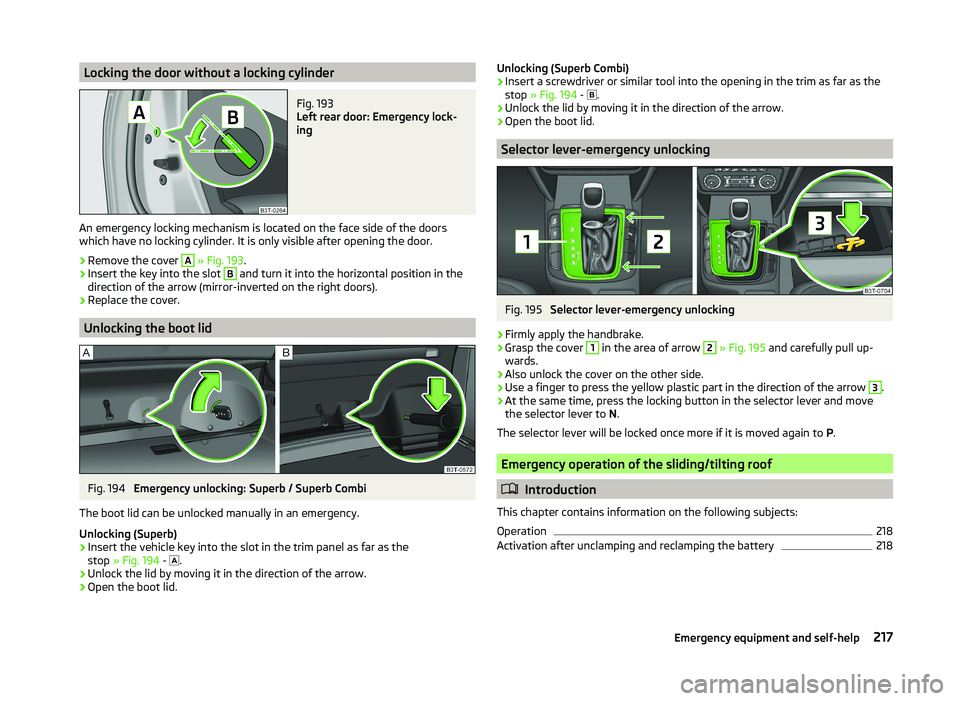
An emergency locking mechanism is located on the face side of the doors
which have no locking cylinder. It is only visible after opening the door.
›
Remove the cover
A
» Fig. 193 .
›
Insert the key into the slot
B
and turn it into the horizontal position in the
direction of the arrow (mirror-inverted on the right doors).
›
Replace the cover.
Unlocking the boot lid
Fig. 194
Emergency unlocking: Superb / Superb Combi
The boot lid can be unlocked manually in an emergency.
Unlocking (Superb)
›
Insert the vehicle key into the slot in the trim panel as far as the
stop » Fig. 194 -
.
›
Unlock the lid by moving it in the direction of the arrow.
›
Open the boot lid.
Unlocking (Superb Combi)›Insert a screwdriver or similar tool into the opening in the trim as far as the
stop » Fig. 194 -
.›
Unlock the lid by moving it in the direction of the arrow.
›
Open the boot lid.
Selector lever-emergency unlocking
Fig. 195
Selector lever-emergency unlocking
›
Firmly apply the handbrake.
›
Grasp the cover
1
in the area of arrow
2
» Fig. 195 and carefully pull up-
wards.
›
Also unlock the cover on the other side.
›
Use a finger to press the yellow plastic part in the direction of the arrow
3
.
›
At the same time, press the locking button in the selector lever and move the selector lever to N.
The selector lever will be locked once more if it is moved again to P.
Emergency operation of the sliding/tilting roof
Introduction
This chapter contains information on the following subjects:
Operation
218
Activation after unclamping and reclamping the battery
218217Emergency equipment and self-help
Page 221 of 252
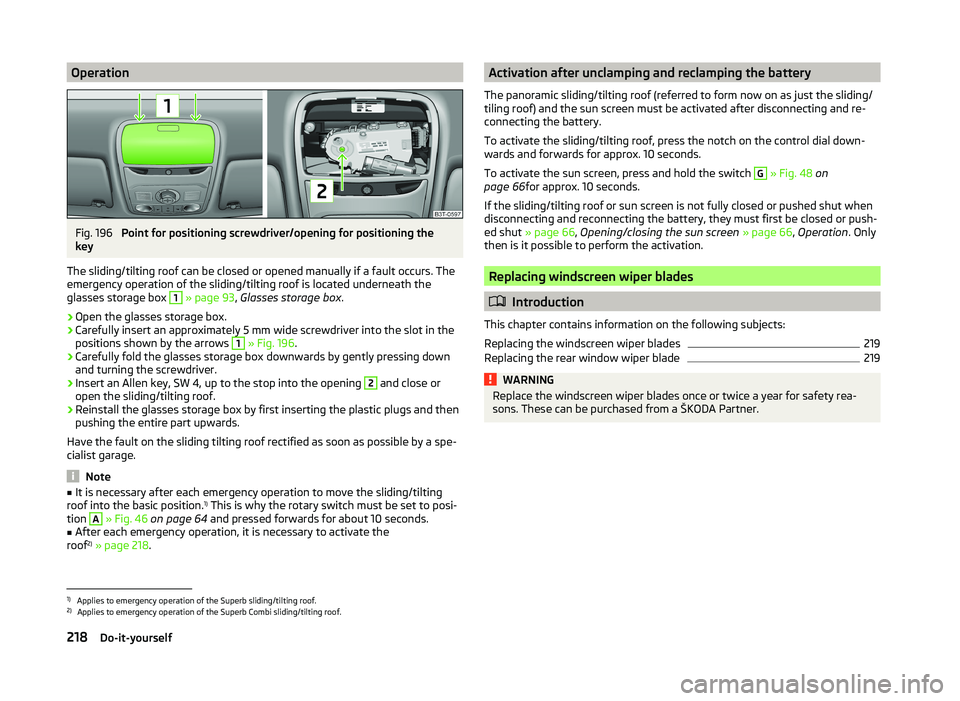
OperationFig. 196
Point for positioning screwdriver/opening for positioning the
key
The sliding/tilting roof can be closed or opened manually if a fault occurs. The
emergency operation of the sliding/tilting roof is located underneath the
glasses storage box
1
» page 93 , Glasses storage box .
›
Open the glasses storage box.
›
Carefully insert an approximately 5 mm wide screwdriver into the slot in the
positions shown by the arrows
1
» Fig. 196 .
›
Carefully fold the glasses storage box downwards by gently pressing down
and turning the screwdriver.
›
Insert an Allen key, SW 4, up to the stop into the opening
2
and close or
open the sliding/tilting roof.
›
Reinstall the glasses storage box by first inserting the plastic plugs and then
pushing the entire part upwards.
Have the fault on the sliding tilting roof rectified as soon as possible by a spe- cialist garage.
Note
■ It is necessary after each emergency operation to move the sliding/tilting
roof into the basic position. 1)
This is why the rotary switch must be set to posi-
tion A
» Fig. 46 on page 64 and pressed forwards for about 10 seconds.
■
After each emergency operation, it is necessary to activate the
roof 2)
» page 218 .
Activation after unclamping and reclamping the battery
The panoramic sliding/tilting roof (referred to form now on as just the sliding/
tiling roof) and the sun screen must be activated after disconnecting and re-
connecting the battery.
To activate the sliding/tilting roof, press the notch on the control dial down-
wards and forwards for approx. 10 seconds.
To activate the sun screen, press and hold the switch G
» Fig. 48 on
page 66 for approx. 10 seconds.
If the sliding/tilting roof or sun screen is not fully closed or pushed shut when
disconnecting and reconnecting the battery, they must first be closed or push-
ed shut » page 66 , Opening/closing the sun screen » page 66 , Operation . Only
then is it possible to perform the activation.
Replacing windscreen wiper blades
Introduction
This chapter contains information on the following subjects:
Replacing the windscreen wiper blades
219
Replacing the rear window wiper blade
219WARNINGReplace the windscreen wiper blades once or twice a year for safety rea-
sons. These can be purchased from a ŠKODA Partner.1)
Applies to emergency operation of the Superb sliding/tilting roof.
2)
Applies to emergency operation of the Superb Combi sliding/tilting roof.
218Do-it-yourself
Page 224 of 252
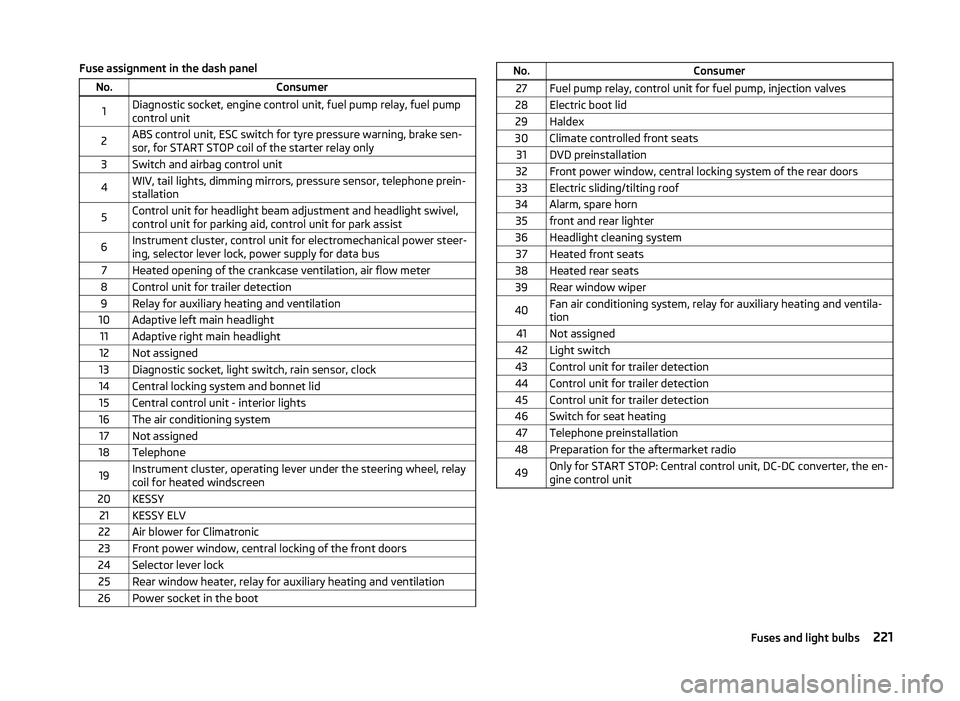
Fuse assignment in the dash panelNo.Consumer1Diagnostic socket, engine control unit, fuel pump relay, fuel pump
control unit2ABS control unit, ESC switch for tyre pressure warning, brake sen-
sor, for START STOP coil of the starter relay only3Switch and airbag control unit4WIV, tail lights, dimming mirrors, pressure sensor, telephone prein-
stallation5Control unit for headlight beam adjustment and headlight swivel,
control unit for parking aid, control unit for park assist6Instrument cluster, control unit for electromechanical power steer-
ing, selector lever lock, power supply for data bus7Heated opening of the crankcase ventilation, air flow meter8Control unit for trailer detection9Relay for auxiliary heating and ventilation10Adaptive left main headlight11Adaptive right main headlight12Not assigned13Diagnostic socket, light switch, rain sensor, clock14Central locking system and bonnet lid15Central control unit - interior lights16The air conditioning system17Not assigned18Telephone19Instrument cluster, operating lever under the steering wheel, relay
coil for heated windscreen20KESSY21KESSY ELV22Air blower for Climatronic23Front power window, central locking of the front doors24Selector lever lock25Rear window heater, relay for auxiliary heating and ventilation26Power socket in the bootNo.Consumer27Fuel pump relay, control unit for fuel pump, injection valves28Electric boot lid29Haldex30Climate controlled front seats31DVD preinstallation32Front power window, central locking system of the rear doors33Electric sliding/tilting roof34Alarm, spare horn35front and rear lighter36Headlight cleaning system37Heated front seats38Heated rear seats39Rear window wiper40Fan air conditioning system, relay for auxiliary heating and ventila-
tion41Not assigned42Light switch43Control unit for trailer detection44Control unit for trailer detection45Control unit for trailer detection46Switch for seat heating47Telephone preinstallation48Preparation for the aftermarket radio49Only for START STOP: Central control unit, DC-DC converter, the en-
gine control unit221Fuses and light bulbs
Page 232 of 252
Operating weight and payload
Operating weight
This value represents the minimum operating weight without additional
weight-increasing equipment such as air conditioning system, spare wheel, or
trailer hitch.
The specified operating weight is for orientation purposes only.
The operating weight also contains the weight of the driver (75 kg), the weight
of the operating fluids, the tool kit, and a fuel tank filled to 90 % capacity.
Operating weight of the vehicle » page 231, Vehicle-specific information de-
pending on engine type .
Payload
It is possible to calculate the approximate maximum payload from the differ-
ence between the permissible total weight and the operating weight.
The payload consists of the following weights.
› The weight of the passengers.
› The weight of all items of luggage and other loads.
› The weight of the roof, including the roof rack system.
› The weight of the equipment that is excluded from the operating weight.
› Trailer drawbar load when towing a trailer (max. 80 kg).
Note
If required, you can find out the precise weight of your vehicle at a specialist
garage.
Measurement of fuel consumption and CO 2 emissions according to
ECE Regulations and EU Directives
The data on fuel consumption and CO 2 emissions were not available at the
time of going to press.
The data on fuel consumption and CO 2 emissions are given on the ŠKODA
websites or in the sales and technical vehicle documentation.
The measurement of the intra-urban cycle begins with a cold start of the en-
gine. Afterwards urban driving is simulated.
In the extra-urban driving cycle, the vehicle is accelerated and decelerated in
all gears, corresponding to daily routine driving conditions. The driving speed
varies between 0 and 120 km/h.
The calculation of the combined fuel consumption considers a weighting of
about 37 % for the intra-urban cycle and 63 % for the extra-urban cycle.
Note
■ The fuel consumption and emission levels given on the ŠKODA websites or in
the commercial and technical vehicle documentation have been established in
accordance with rules and under conditions that are set out by legal or techni-
cal rules for the determination of operational and technical data of motor vehi-
cles.■
Depending on the extent of the equipment, the driving style, traffic condi-
tions, weather influences and vehicle condition, consumption values can in
practice result in fuel economy figures in the use of the vehicle that differ from
the fuel consumption values listed on the ŠKODA websites or in the commer-
cial and technical vehicle documentation.
229Technical data
Page 240 of 252
BootAutomatic retraction (Superb Combi)101
Extending variable loading floor105
Folding hook99
Non-closable side pocket (Superb Combi)102
Removable Light (Superb Combi)103
Roll up boot cover (Superb Combi)101
Side compartment with battery102
Boot cover (Superb Combi)101
Boot lid57
automatic locking58
Warning light36
(Superb Combi)58
Brake booster144
Brake fluid192
Checking193
Information messages35
specification193
Brake linings warning light
41
Brakes Brake assist systems
154
Brake booster144
Brake fluid193
Handbrake144
Information messages35
Running in149
Warning light35
Braking Information on braking
143
Break recommendation See Fatigue detection
165
Button in the driver's door Electrical power windows
61
C
Car care
173
Jack180
Car computer See multifunction display
44
Car park ticket holder89
Carrier Roof rack
108
Cavity protection180
CD changer136
Central locking50
Central locking button55
Changing brake fluid
193
bulbs223
Wheels205
Changing a wheel Follow-up work
206
Preliminary work206
Remove and attaching a wheel206
Changing brake fluid
193
Charging a vehicle battery196
Check Fit ball head properly
168
Checking Battery electrolyte level
195
Brake fluid193
Coolant192
Engine oil190
Oil level190
Windscreen washer fluid188
Checks Statutory checks
173
Children and safety22
Child safety Side airbag
24
Child safety lock55
Child seat Classification
25
ISOFIX25
on the front passenger seat23
TOP TETHER27
Use of child seats25
Use of ISOFIX child seats26
Chrome parts refer to Taking care of your vehicle178
Cigarette lighter91
Cleaning Alcantara
182
Covers of electrically heated seats182
Fabrics182
Headlight lenses179
Natural leather181
Plastic parts178
Synthetic leather182
Wheels180
Cleaning the vehicle Towing device
180
Cleaning vehicle176
Climatronic115
Air recirculation117
automatic mode116
Control elements115
Controlling blower118
Cooling system116
Defrosting windscreen118
Setting the temperature116
Clothes hook94
Cockpit 12-Volt power outlet
92
Ashtray91
Cigarette lighter91
General view29
Lighting73
Practical features88
Storage compartments88
Comfort control window
63
COMING HOME72
Compartments88
Components of the puncture repair kits209
Computer See multifunction display
44
237Index
Page 241 of 252

Convenience operationsliding / tilting roof65
sliding / tilting roof (Superb Estate)67
Convenience turn signal70
Coolant191
Checking192
Messages36
Replenishing192
Temperature gauge31
Warning light36
CORNER See Fog lights with CORNER function
71
Correct seated position9
Driver9
Front passenger10
Instructions11
Rear seats11
Counter for distance driven32
Cruise control system Activating/deactivating
161
Changing the stored speed162
Storing and maintaining speed162
Switching off temporarily162
Warning light41
Cruise Control System161
Cup holders90
D
DAY LIGHT see Daylight running lights
69
Daylight running lights69
De-icing the windscreen and rear window75
Deactivating an airbag21
Decorative films179
Delayed locking of the boot lid see boot lid
58
Diesel refer to Fuel
185
diesel - particulate filter39
Diesel fuel Operation in winter
185
Diesel particulate filter warning light
39
Digital Clock Time
32
Dipstick190
Display31
Compass points48
Coolant temperature31
Fuel supply32
Gear changes43
Service intervals48
Display a low temperature43
Display of the second speed33
Distance driven32
Door Child safety lock
55
Closing52
Emergency locking217
Emergency locking the driver's door216
Opening52
Warning light for open door36
Door open Warning light
36
Driver Steering Recommendation (DSR)155
Driving Abroad
153
Driving through water on streets152
Emissions229
Fuel consumption229
Driving economically Economical gear changing
149
Driving through water152
DSR155
DVD-preinstallation136
E
Economical and environmentally friendly driv- ing
149
Economical driving Ballast
151
Driving at full throttle150
Idling150
Looking ahead149
Regular maintenance151
Saving energy151
Short distances150
Tyre pressure150
EDL Operation
155
Electrical power windows63
Button in the driver's door61, 62
Button in the rear doors63
Operational faults64
Electric boot lid Force limit
59
Manual operation59
Electric luggage compartment lid Acoustic signals
61
Adjusting the top lid position61
Deleting the top lid position61
Malfunctions61
Operating59
Electric sliding/tilting roof64
Electronic Differential Lock (EDL)155
Electronic immobilizer139
Electronic Stability Control (ESC)154
Emergency Activation of the sliding/tilting roof
218
Changing a wheel205
Hazard warning light system72
jump-starting211
Jump-starting211
Locking the door without a locking cylinder217
Locking the driver's door216
238Index
Page 242 of 252
Selector lever-unlocking217
Sliding/tilting roof218
Start engine - KESSY142
Switching off the ignition –KESSY143
Towing the vehicle213
Towing the vehicle using the tow hitch214
tyre repair209
Unlocking the boot lid217
Unlocking the driver's door216
Emergency equipment Fire extinguisher
204
First-aid kit 204
Jack205
Vehicle tool kit205
Warning triangle204
Emissions229
Engine Running in
148
Engine compartment186
Brake fluid193
Coolant191
Overview188
Vehicle battery193
Engine number228
Engine oil189
Capacity189
Checking190
Note messages36
Replenishing191
Specifications189
Engine oil level Warning light
37
Engine oil pressure Warning light
36
Entry lighting75
Environment149
Environmental compatibility151
Environmentally friendly driving149
EPC Warning light
39
ESCFunction154
Warning light37
Exhaust inspection system Warning light
38
Extendable variable loading floor Fixing set
106
Extending variable loading floor105
Divide boot105
Movable lashing eyes107
Partial extension105
F
Fastening elements
99
Fatigue detection165
Function165
Information messages165
Films179
Fire extinguisher204
First-aid kit 204
Floor covering Fixing
100
Fog lights71
Warning light41
Fog lights with CORNER function71
Folding hook99
Fold in passenger's mirror80
Footmats145
see Footmats145
Force limit Electric boot lid (Superb Combi)
59
Power windows63
Sliding/tilting roof64
Sliding/tilting roof (Superb Combi)66
Front airbag17
Front door warning light74
Front interior light73
Fuel183
Diesel185
Fuel gauge32
refer to Fuel183
Refuelling184
Unleaded petrol184
Fuel consumption149, 229
Fuel reserve Warning light
39
Fuses Assignment
220
Colour coding220
Fuse assignment in the engine compartment222
Replacing220
G
Gearbox Warning messages
33
Gear change Gear recommendation
43
Information on the selected gear43
Gear changing Gear stick
144
General view Cockpit
29
Generator Indicator light
35
Genuine parts174
Glasses storage box93
Glow plug system Warning light
38
GSM124, 126
H
Handbrake
144
Warning light35
Hands-free system Voice control
131
Hazard warning light system72
239Index