trailer SKODA SUPERB 2011 Owner´s Manual
[x] Cancel search | Manufacturer: SKODA, Model Year: 2011, Model line: SUPERB, Model: SKODA SUPERB 2011Pages: 252, PDF Size: 16.33 MB
Page 193 of 252
Specifications and capacity (in l) for vehicles with fixed service intervalsPetrol enginesSpecificationCapacity1.4 l/92 kW TSIVW 501 01, VW 502 003.6
1.8 l/112, 118 kW TSI
VW 502 00
4.6
applies to RussiaSAE 0W-30
VW 502 00 / 505 00
2.0 l/147 kW TSI
VW 502 00
4.6
applies to Russia SAE 0W-30
VW 502 00 / 505 003.6 l/191 kW FSIVW 502 005.5Diesel engines a)SpecificationCapacity1.6 l/77 kW TDI CRVW 507 004.32.0 ltr/103 kW TDI CR DPFVW 507 004.32.0 ltr/125 kW TDI CR DPFVW 507 004.3a)
Engine oil VW 505 01 can optionally be used in diesel engines
without DPF
CAUTION
■
If the above engine oils are not available, a different engine oil can be used in
an emergency. To prevent damage to the engine, a maximum of 0.5 litres only
of the following engine oils may be used until the next oil change: ■ For petrol engine models: ACEA A3/ACEA B4 or API SN/API SM;
■ For diesel engine models: ACEA C3 or API CJ-4.
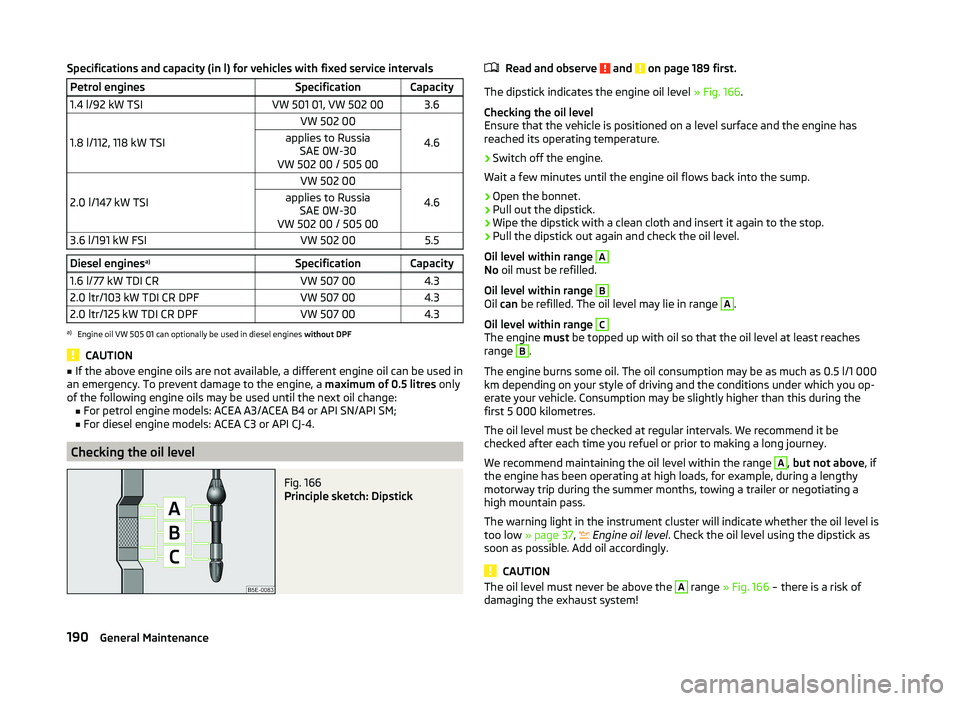
Checking the oil level
Fig. 166
Principle sketch: Dipstick
Read and observe and on page 189 first.
The dipstick indicates the engine oil level » Fig. 166.
Checking the oil level
Ensure that the vehicle is positioned on a level surface and the engine has
reached its operating temperature.
›
Switch off the engine.
Wait a few minutes until the engine oil flows back into the sump.
›
Open the bonnet.
›
Pull out the dipstick.
›
Wipe the dipstick with a clean cloth and insert it again to the stop.
›
Pull the dipstick out again and check the oil level.
Oil level within range
A
No oil must be refilled.
Oil level within range
B
Oil can be refilled. The oil level may lie in range
A
.
Oil level within range
C
The engine must be topped up with oil so that the oil level at least reaches
range
B
.
The engine burns some oil. The oil consumption may be as much as 0.5 l/1 000
km depending on your style of driving and the conditions under which you op-
erate your vehicle. Consumption may be slightly higher than this during the
first 5 000 kilometres.
The oil level must be checked at regular intervals. We recommend it be
checked after each time you refuel or prior to making a long journey.
We recommend maintaining the oil level within the range
A
, but not above , if
the engine has been operating at high loads, for example, during a lengthy
motorway trip during the summer months, towing a trailer or negotiating a
high mountain pass.
The warning light in the instrument cluster will indicate whether the oil level is
too low » page 37 ,
Engine oil level
. Check the oil level using the dipstick as
soon as possible. Add oil accordingly.
CAUTION
The oil level must never be above the A range » Fig. 166 – there is a risk of
damaging the exhaust system!190General Maintenance
Page 209 of 252
WARNING■If you are in flowing traffic, switch on the hazard warning light system
and set up the warning triangle at the prescribed distance! The national le-
gal requirements must be observed.■
Park the vehicle as far away as possible from the flow of traffic. Park on
as flat and firm a surface as possible.
■
The following instructions must be followed if the vehicle is subsequently
fitted with tyres or rims that differ from the factory fitted ones » page 201,
Explanation of the tyre labelling .
WARNINGInformation on the wheel bolts■The wheel bolts must be clean and must turn easily. Never treat them
with grease or oil.■
The prescribed tightening torque of the wheel bolts for steel and light al-
loy wheels is 120 Nm.
■
If the wheel bolts are tightened to a too low tightening torque, the rim
can come loose when the car is moving. A tightening torque which is too
high can damage the bolts and threads and this can result in permanent
deformation of the contact surfaces on the rim.
■
In case of incorrect treatment of the wheel bolts, the wheel can loosen
when the car is moving.
Note
The national legal requirements must be observed when changing a wheel.
Preliminary work
Read and observe
on page 206 first.
Before changing the wheel, the following work must be carried out.
›
Have all the occupants get out. The passengers should not stand on the
road (instead they should remain behind a crash barrier, for instance) while
the wheel is being changed.
›
Switch off the engine.
›
Select the 1st gear or place the selector lever of the automatic transmission
in the P-position .
›
Apply the handbrake firmly.
›
Uncouple a trailer.
›Remove the
vehicle tool kit » page 205 and the spare wheel » page 200 from
the boot.
Changing a wheel
Read and observe
on page 206 first.
When changing a wheel, the following instructions must be followed.
›
Remove the full wheel trim or the caps of the wheel bolts.
›
First of all slacken the anti-theft wheel bolt and then the other wheel bolts.
›
Jack up the vehicle until the wheel that needs changing is clear of the
ground.
›
Unscrew the wheel bolts and place them on a clean surface (cloth, paper, etc.).
›
Remove the wheel carefully.
›
Attach the spare wheel and slightly screw on the wheel bolts.
›
Lower the vehicle.
›
Tighten the opposite wheel bolts alternately (cross-wise) with the wheelwrench. Tighten the anti-theft wheel bolt last.
›
Replace the wheel trim or the caps.
When fitting unidirectional tyres, ensure that the indication is cor-
rect » page 197 .
WARNINGIf it is established when changing a wheel that the wheel bolts are corro-
ded and difficult to move, then these must be replaced.
Follow-up work
Read and observe
on page 206 first.
After changing the wheel, the following work must be carried out.
›
Stow and attach the replaced wheel in the spare wheel well using a special
bolt » page 200 .
›
Stow the tool kit in the space provided and secure using the strap.
›
Check the tyre pressure on the installed spare wheel as soon as possible.
›
Have the tightening torque of the wheel bolts checked with a torque
wrench as soon as possible.
206Do-it-yourself
Page 213 of 252
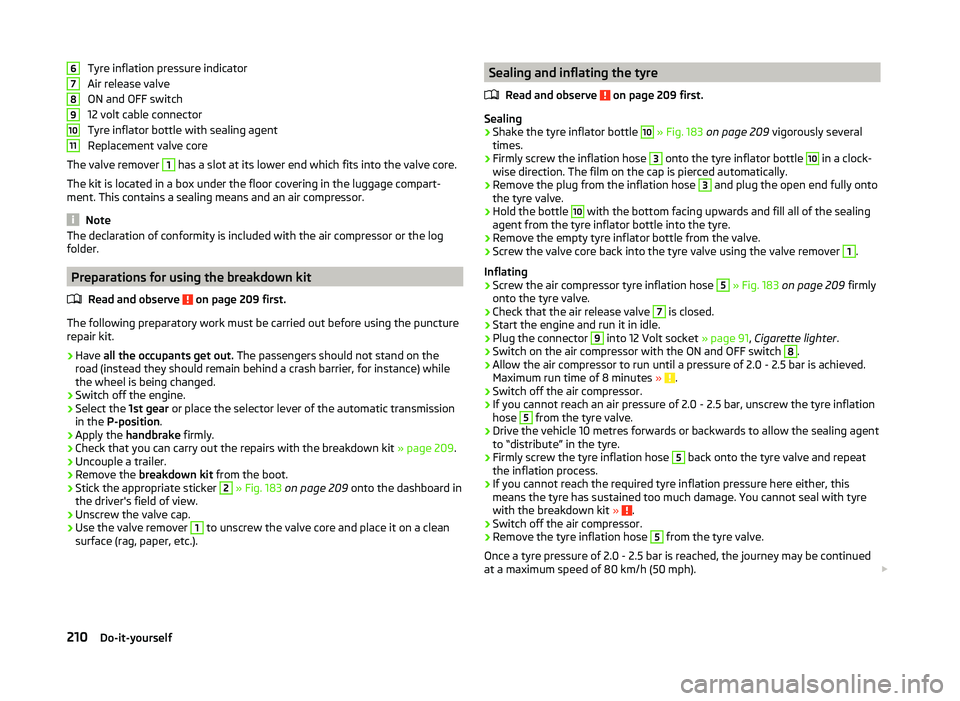
Tyre inflation pressure indicator
Air release valve
ON and OFF switch
12 volt cable connector
Tyre inflator bottle with sealing agent
Replacement valve core
The valve remover 1
has a slot at its lower end which fits into the valve core.
The kit is located in a box under the floor covering in the luggage compart-
ment. This contains a sealing means and an air compressor.
Note
The declaration of conformity is included with the air compressor or the log
folder.
Preparations for using the breakdown kit
Read and observe
on page 209 first.
The following preparatory work must be carried out before using the puncturerepair kit.
›
Have all the occupants get out. The passengers should not stand on the
road (instead they should remain behind a crash barrier, for instance) while
the wheel is being changed.
›
Switch off the engine.
›
Select the 1st gear or place the selector lever of the automatic transmission
in the P-position .
›
Apply the handbrake firmly.
›
Check that you can carry out the repairs with the breakdown kit
» page 209.
›
Uncouple a trailer.
›
Remove the breakdown kit from the boot.
›
Stick the appropriate sticker
2
» Fig. 183 on page 209 onto the dashboard in
the driver's field of view.
›
Unscrew the valve cap.
›
Use the valve remover
1
to unscrew the valve core and place it on a clean
surface (rag, paper, etc.).
67891011Sealing and inflating the tyre
Read and observe
on page 209 first.
Sealing
›
Shake the tyre inflator bottle
10
» Fig. 183 on page 209 vigorously several
times.
›
Firmly screw the inflation hose
3
onto the tyre inflator bottle
10
in a clock-
wise direction. The film on the cap is pierced automatically.
›
Remove the plug from the inflation hose
3
and plug the open end fully onto
the tyre valve.
›
Hold the bottle
10
with the bottom facing upwards and fill all of the sealing
agent from the tyre inflator bottle into the tyre.
›
Remove the empty tyre inflator bottle from the valve.
›
Screw the valve core back into the tyre valve using the valve remover
1
.
Inflating
›
Screw the air compressor tyre inflation hose
5
» Fig. 183 on page 209 firmly
onto the tyre valve.
›
Check that the air release valve
7
is closed.
›
Start the engine and run it in idle.
›
Plug the connector
9
into 12 Volt socket » page 91, Cigarette lighter .
›
Switch on the air compressor with the ON and OFF switch
8
.
›
Allow the air compressor to run until a pressure of 2.0 - 2.5 bar is achieved.
Maximum run time of 8 minutes » .
›
Switch off the air compressor.
›
If you cannot reach an air pressure of 2.0 - 2.5 bar, unscrew the tyre inflation
hose
5
from the tyre valve.
›
Drive the vehicle 10 metres forwards or backwards to allow the sealing agent
to “distribute” in the tyre.
›
Firmly screw the tyre inflation hose
5
back onto the tyre valve and repeat
the inflation process.
›
If you cannot reach the required tyre inflation pressure here either, this
means the tyre has sustained too much damage. You cannot seal with tyre with the breakdown kit »
.
›
Switch off the air compressor.
›
Remove the tyre inflation hose
5
from the tyre valve.
Once a tyre pressure of 2.0 - 2.5 bar is reached, the journey may be continued
at a maximum speed of 80 km/h (50 mph).
210Do-it-yourself
Page 216 of 252
›After starting the engine, close the protective cap of the jump-starting point.
Towing the vehicle
Introduction
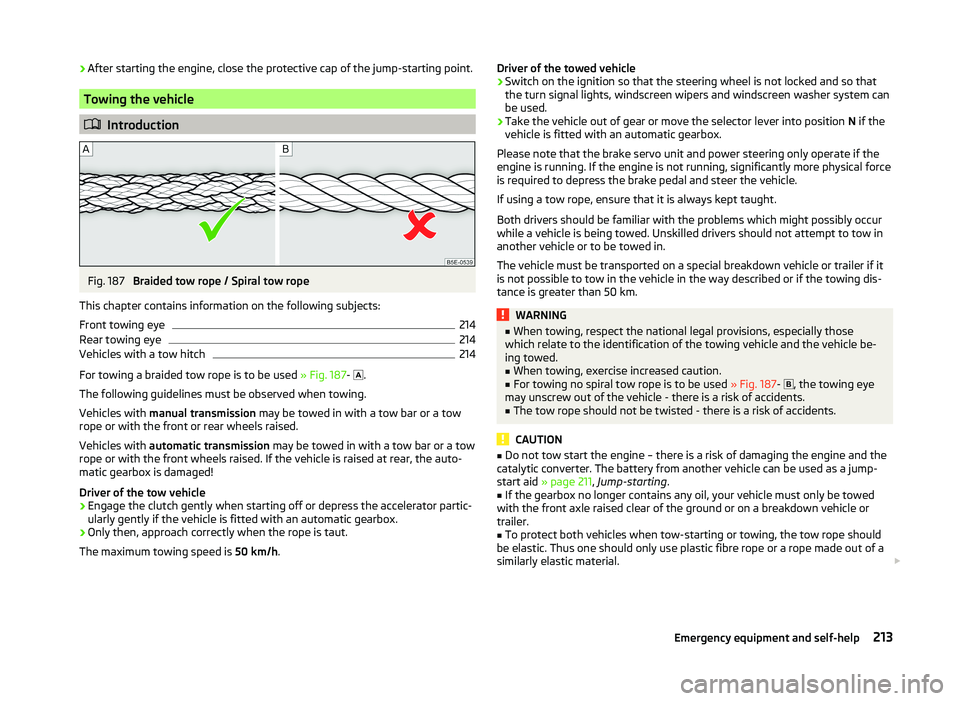
Fig. 187
Braided tow rope / Spiral tow rope
This chapter contains information on the following subjects:
Front towing eye
214
Rear towing eye
214
Vehicles with a tow hitch
214
For towing a braided tow rope is to be used » Fig. 187-
.
The following guidelines must be observed when towing.
Vehicles with manual transmission may be towed in with a tow bar or a tow
rope or with the front or rear wheels raised.
Vehicles with automatic transmission may be towed in with a tow bar or a tow
rope or with the front wheels raised. If the vehicle is raised at rear, the auto-
matic gearbox is damaged!
Driver of the tow vehicle
›
Engage the clutch gently when starting off or depress the accelerator partic-
ularly gently if the vehicle is fitted with an automatic gearbox.
›
Only then, approach correctly when the rope is taut.
The maximum towing speed is 50 km/h.
Driver of the towed vehicle›Switch on the ignition so that the steering wheel is not locked and so that
the turn signal lights, windscreen wipers and windscreen washer system can
be used.›
Take the vehicle out of gear or move the selector lever into position N if the
vehicle is fitted with an automatic gearbox.
Please note that the brake servo unit and power steering only operate if the
engine is running. If the engine is not running, significantly more physical force
is required to depress the brake pedal and steer the vehicle.
If using a tow rope, ensure that it is always kept taught.
Both drivers should be familiar with the problems which might possibly occur while a vehicle is being towed. Unskilled drivers should not attempt to tow in
another vehicle or to be towed in.
The vehicle must be transported on a special breakdown vehicle or trailer if it
is not possible to tow in the vehicle in the way described or if the towing dis-
tance is greater than 50 km.
WARNING■ When towing, respect the national legal provisions, especially those
which relate to the identification of the towing vehicle and the vehicle be-
ing towed.■
When towing, exercise increased caution.
■
For towing no spiral tow rope is to be used » Fig. 187-
, the towing eye
may unscrew out of the vehicle - there is a risk of accidents.
■
The tow rope should not be twisted - there is a risk of accidents.
CAUTION
■ Do not tow start the engine – there is a risk of damaging the engine and the
catalytic converter. The battery from another vehicle can be used as a jump-
start aid » page 211 , Jump-starting .■
If the gearbox no longer contains any oil, your vehicle must only be towed
with the front axle raised clear of the ground or on a breakdown vehicle or
trailer.
■
To protect both vehicles when tow-starting or towing, the tow rope should
be elastic. Thus one should only use plastic fibre rope or a rope made out of a
similarly elastic material.
213Emergency equipment and self-help
Page 224 of 252
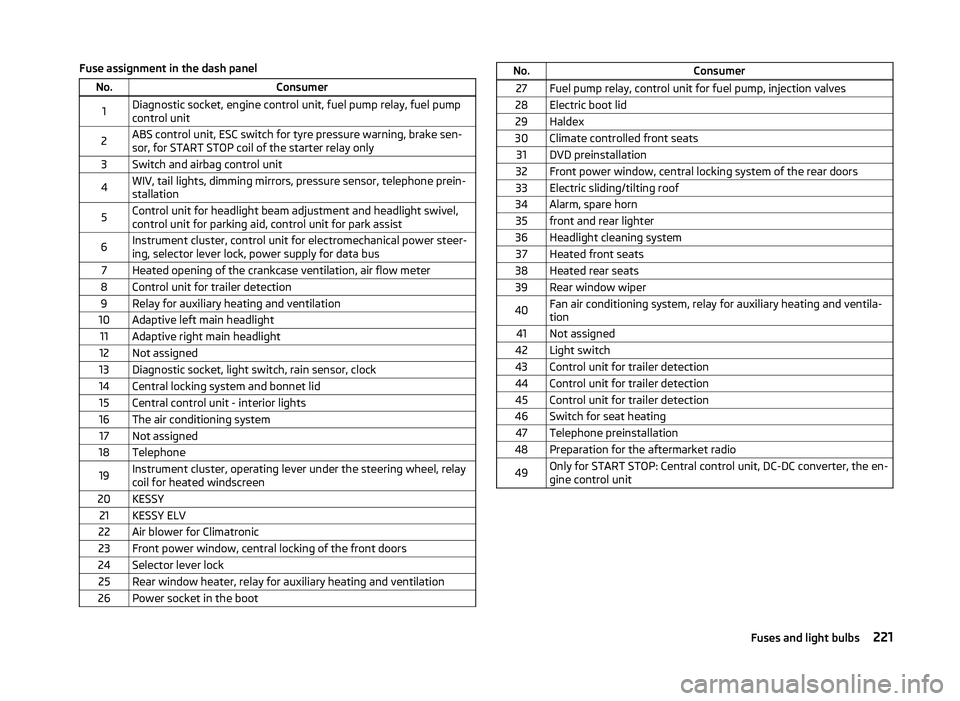
Fuse assignment in the dash panelNo.Consumer1Diagnostic socket, engine control unit, fuel pump relay, fuel pump
control unit2ABS control unit, ESC switch for tyre pressure warning, brake sen-
sor, for START STOP coil of the starter relay only3Switch and airbag control unit4WIV, tail lights, dimming mirrors, pressure sensor, telephone prein-
stallation5Control unit for headlight beam adjustment and headlight swivel,
control unit for parking aid, control unit for park assist6Instrument cluster, control unit for electromechanical power steer-
ing, selector lever lock, power supply for data bus7Heated opening of the crankcase ventilation, air flow meter8Control unit for trailer detection9Relay for auxiliary heating and ventilation10Adaptive left main headlight11Adaptive right main headlight12Not assigned13Diagnostic socket, light switch, rain sensor, clock14Central locking system and bonnet lid15Central control unit - interior lights16The air conditioning system17Not assigned18Telephone19Instrument cluster, operating lever under the steering wheel, relay
coil for heated windscreen20KESSY21KESSY ELV22Air blower for Climatronic23Front power window, central locking of the front doors24Selector lever lock25Rear window heater, relay for auxiliary heating and ventilation26Power socket in the bootNo.Consumer27Fuel pump relay, control unit for fuel pump, injection valves28Electric boot lid29Haldex30Climate controlled front seats31DVD preinstallation32Front power window, central locking system of the rear doors33Electric sliding/tilting roof34Alarm, spare horn35front and rear lighter36Headlight cleaning system37Heated front seats38Heated rear seats39Rear window wiper40Fan air conditioning system, relay for auxiliary heating and ventila-
tion41Not assigned42Light switch43Control unit for trailer detection44Control unit for trailer detection45Control unit for trailer detection46Switch for seat heating47Telephone preinstallation48Preparation for the aftermarket radio49Only for START STOP: Central control unit, DC-DC converter, the en-
gine control unit221Fuses and light bulbs
Page 231 of 252
Technical data
Technical data
Vehicle data
Introduction
This chapter contains information on the following subjects:
Vehicle identification data
228
Operating weight and payload
229
Measurement of fuel consumption and CO 2 emissions according to ECE
Regulations and EU Directives
229
Dimensions
230
Vehicle-specific information depending on engine type
231
Multi-purpose vehicles (AF)
235
The details given in the vehicle's technical documentation always take prece-
dence over the details in the Owner's Manual.
The listed performance values were determined without performance-reduc- ing equipment, e.g. air conditioning system.
Vehicle identification data
Fig. 212
Vehicle data sticker/type plate
Vehicle data sticker
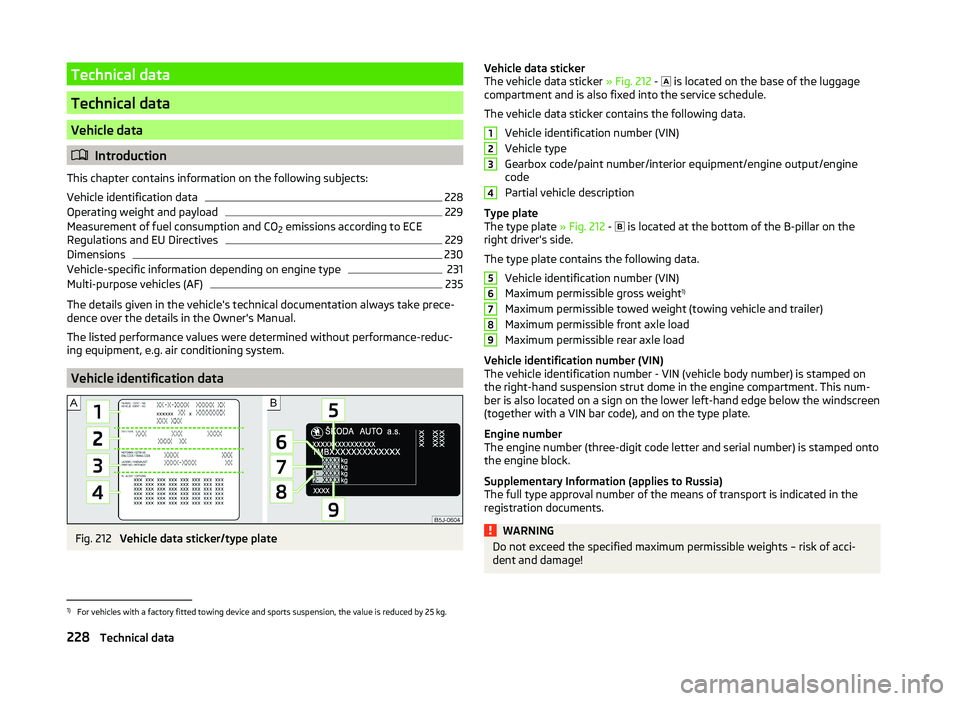
The vehicle data sticker » Fig. 212 - is located on the base of the luggage
compartment and is also fixed into the service schedule.
The vehicle data sticker contains the following data. Vehicle identification number (VIN)
Vehicle type
Gearbox code/paint number/interior equipment/engine output/engine
code
Partial vehicle description
Type plate
The type plate » Fig. 212 -
is located at the bottom of the B-pillar on the
right driver's side.
The type plate contains the following data. Vehicle identification number (VIN)
Maximum permissible gross weight 1)
Maximum permissible towed weight (towing vehicle and trailer)
Maximum permissible front axle load
Maximum permissible rear axle load
Vehicle identification number (VIN)
The vehicle identification number - VIN (vehicle body number) is stamped on
the right-hand suspension strut dome in the engine compartment. This num- ber is also located on a sign on the lower left-hand edge below the windscreen
(together with a VIN bar code), and on the type plate.
Engine number
The engine number (three-digit code letter and serial number) is stamped onto
the engine block.
Supplementary Information (applies to Russia)
The full type approval number of the means of transport is indicated in the
registration documents.WARNINGDo not exceed the specified maximum permissible weights – risk of acci-
dent and damage!1234567891)
For vehicles with a factory fitted towing device and sports suspension, the value is reduced by 25 kg.
228Technical data
Page 232 of 252
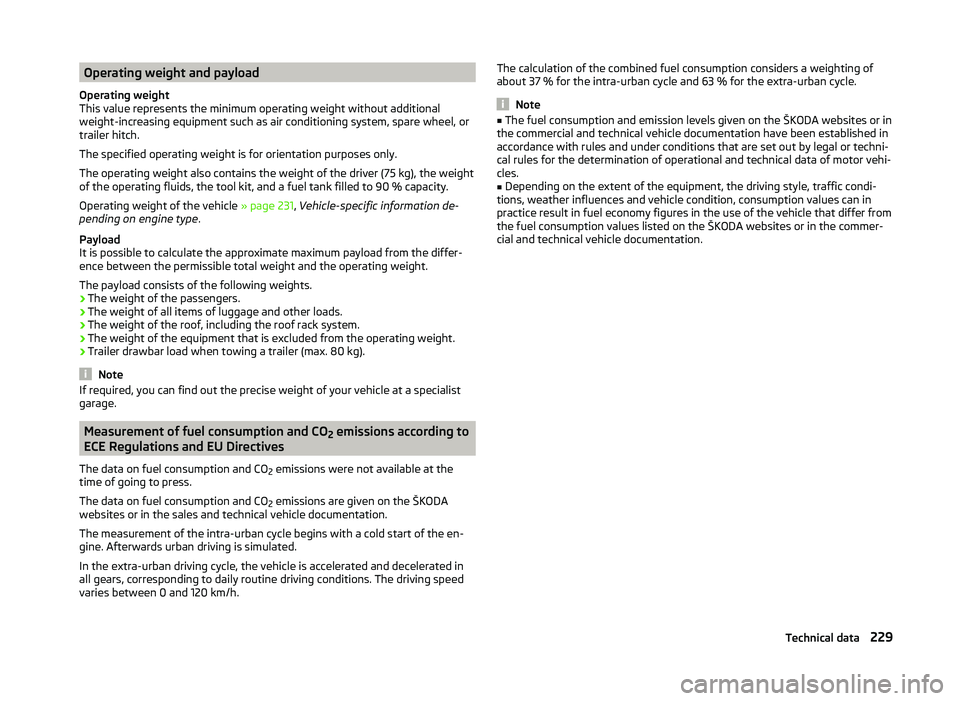
Operating weight and payload
Operating weight
This value represents the minimum operating weight without additional
weight-increasing equipment such as air conditioning system, spare wheel, or
trailer hitch.
The specified operating weight is for orientation purposes only.
The operating weight also contains the weight of the driver (75 kg), the weight
of the operating fluids, the tool kit, and a fuel tank filled to 90 % capacity.
Operating weight of the vehicle » page 231, Vehicle-specific information de-
pending on engine type .
Payload
It is possible to calculate the approximate maximum payload from the differ-
ence between the permissible total weight and the operating weight.
The payload consists of the following weights.
› The weight of the passengers.
› The weight of all items of luggage and other loads.
› The weight of the roof, including the roof rack system.
› The weight of the equipment that is excluded from the operating weight.
› Trailer drawbar load when towing a trailer (max. 80 kg).
Note
If required, you can find out the precise weight of your vehicle at a specialist
garage.
Measurement of fuel consumption and CO 2 emissions according to
ECE Regulations and EU Directives
The data on fuel consumption and CO 2 emissions were not available at the
time of going to press.
The data on fuel consumption and CO 2 emissions are given on the ŠKODA
websites or in the sales and technical vehicle documentation.
The measurement of the intra-urban cycle begins with a cold start of the en-
gine. Afterwards urban driving is simulated.
In the extra-urban driving cycle, the vehicle is accelerated and decelerated in
all gears, corresponding to daily routine driving conditions. The driving speed
varies between 0 and 120 km/h.
The calculation of the combined fuel consumption considers a weighting of
about 37 % for the intra-urban cycle and 63 % for the extra-urban cycle.
Note
■ The fuel consumption and emission levels given on the ŠKODA websites or in
the commercial and technical vehicle documentation have been established in
accordance with rules and under conditions that are set out by legal or techni-
cal rules for the determination of operational and technical data of motor vehi-
cles.■
Depending on the extent of the equipment, the driving style, traffic condi-
tions, weather influences and vehicle condition, consumption values can in
practice result in fuel economy figures in the use of the vehicle that differ from
the fuel consumption values listed on the ŠKODA websites or in the commer-
cial and technical vehicle documentation.
229Technical data
Page 234 of 252
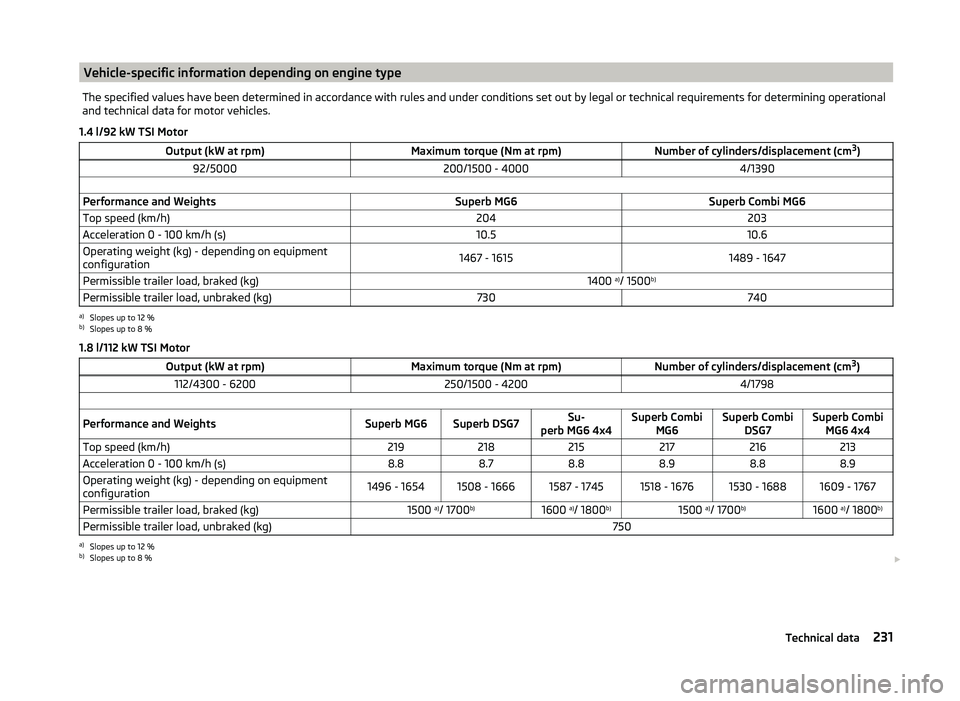
Vehicle-specific information depending on engine typeThe specified values have been determined in accordance with rules and under conditions set out by legal or technical requirements for determining operational
and technical data for motor vehicles.
1.4 l/92 kW TSI Motor
Output (kW at rpm)Maximum torque (Nm at rpm)Number of cylinders/displacement (cm 3
)92/5000200/1500 - 40004/1390 Performance and WeightsSuperb MG6Superb Combi MG6Top speed (km/h)204203Acceleration 0 - 100 km/h (s)10.510.6Operating weight (kg) - depending on equipment
configuration1467 - 16151489 - 1647Permissible trailer load, braked (kg)1400 a)
/ 1500 b)Permissible trailer load, unbraked (kg)730740a)
Slopes up to 12 %
b)
Slopes up to 8 %
1.8 l/112 kW TSI Motor
Output (kW at rpm)Maximum torque (Nm at rpm)Number of cylinders/displacement (cm 3
)112/4300 - 6200250/1500 - 42004/1798 Performance and WeightsSuperb MG6Superb DSG7Su-
perb MG6 4x4Superb Combi MG6Superb CombiDSG7Superb CombiMG6 4x4Top speed (km/h)219218215217216213Acceleration 0 - 100 km/h (s)8.88.78.88.98.88.9Operating weight (kg) - depending on equipment
configuration1496 - 16541508 - 16661587 - 17451518 - 16761530 - 16881609 - 1767Permissible trailer load, braked (kg)1500 a)
/ 1700 b)1600 a)
/ 1800 b)1500 a)
/ 1700 b)1600 a)
/ 1800 b)Permissible trailer load, unbraked (kg)750a)
Slopes up to 12 %
b)
Slopes up to 8 %
231Technical data
Page 235 of 252
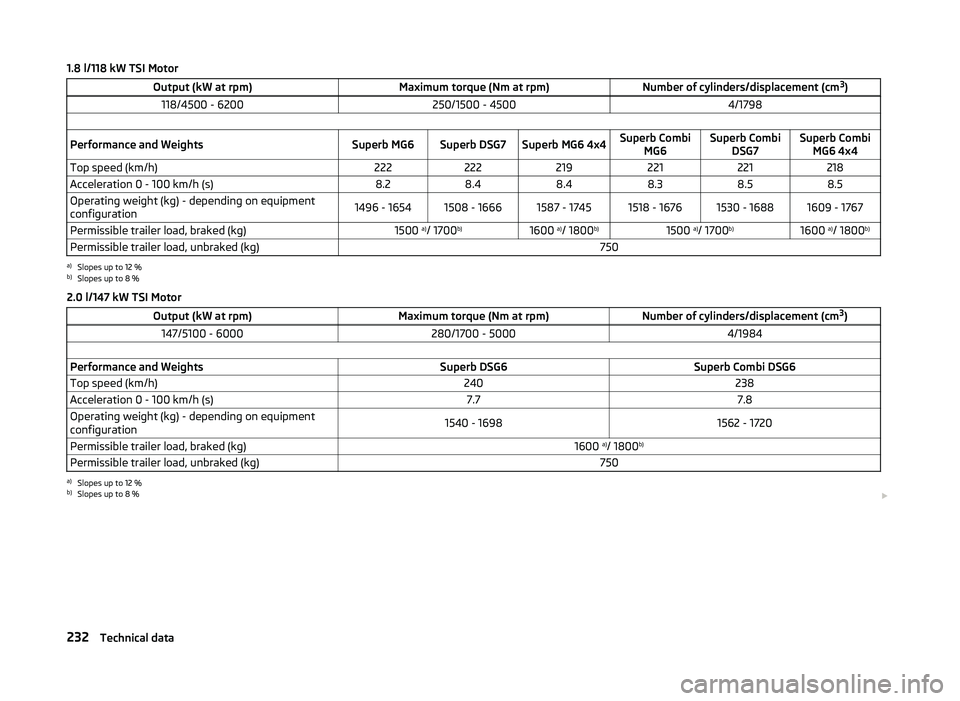
1.8 l/118 kW TSI MotorOutput (kW at rpm)Maximum torque (Nm at rpm)Number of cylinders/displacement (cm3
)118/4500 - 6200250/1500 - 45004/1798 Performance and WeightsSuperb MG6Superb DSG7Superb MG6 4x4Superb Combi
MG6Superb CombiDSG7Superb CombiMG6 4x4Top speed (km/h)222222219221221218Acceleration 0 - 100 km/h (s)8.28.48.48.38.58.5Operating weight (kg) - depending on equipment
configuration1496 - 16541508 - 16661587 - 17451518 - 16761530 - 16881609 - 1767Permissible trailer load, braked (kg)1500 a)
/ 1700 b)1600 a)
/ 1800 b)1500 a)
/ 1700 b)1600 a)
/ 1800 b)Permissible trailer load, unbraked (kg)750a)
Slopes up to 12 %
b)
Slopes up to 8 %
2.0 l/147 kW TSI Motor
Output (kW at rpm)Maximum torque (Nm at rpm)Number of cylinders/displacement (cm 3
)147/5100 - 6000280/1700 - 50004/1984 Performance and WeightsSuperb DSG6Superb Combi DSG6Top speed (km/h)240238Acceleration 0 - 100 km/h (s)7.77.8Operating weight (kg) - depending on equipment
configuration1540 - 16981562 - 1720Permissible trailer load, braked (kg)1600 a)
/ 1800 b)Permissible trailer load, unbraked (kg)750a)
Slopes up to 12 %
b)
Slopes up to 8 %
232Technical data
Page 236 of 252
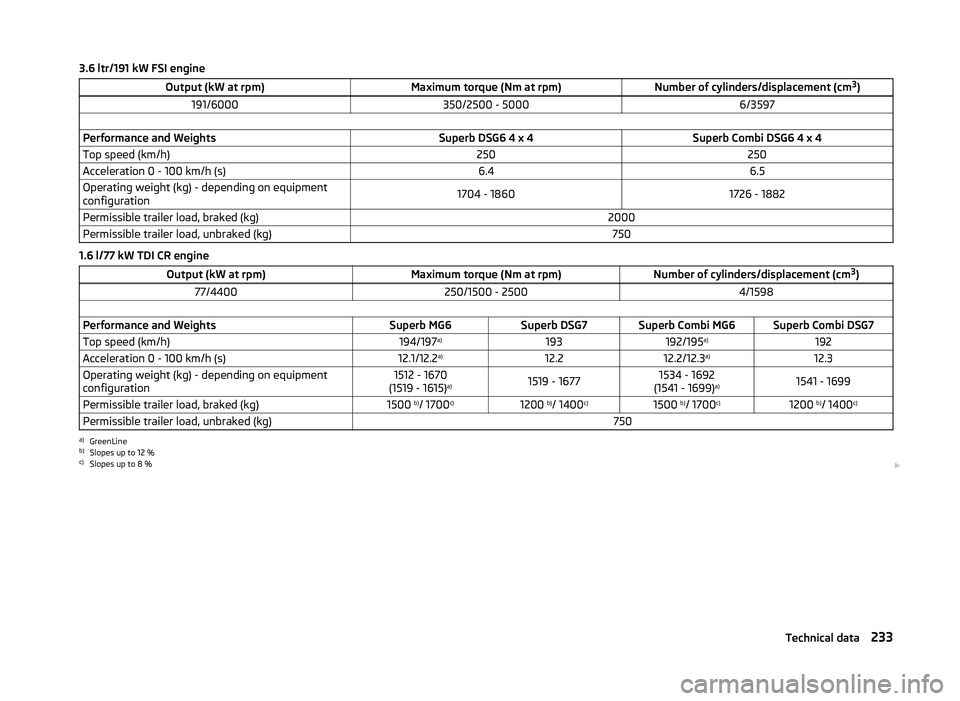
3.6 ltr/191 kW FSI engineOutput (kW at rpm)Maximum torque (Nm at rpm)Number of cylinders/displacement (cm3
)191/6000350/2500 - 50006/3597 Performance and WeightsSuperb DSG6 4 x 4Superb Combi DSG6 4 x 4Top speed (km/h)250250Acceleration 0 - 100 km/h (s)6.46.5Operating weight (kg) - depending on equipment
configuration1704 - 18601726 - 1882Permissible trailer load, braked (kg)2000Permissible trailer load, unbraked (kg)750
1.6 l/77 kW TDI CR engine
Output (kW at rpm)Maximum torque (Nm at rpm)Number of cylinders/displacement (cm 3
)77/4400250/1500 - 25004/1598 Performance and WeightsSuperb MG6Superb DSG7Superb Combi MG6Superb Combi DSG7Top speed (km/h)194/197 a)193192/195a)192Acceleration 0 - 100 km/h (s)12.1/12.2 a)12.212.2/12.3 a)12.3Operating weight (kg) - depending on equipment
configuration1512 - 1670
(1519 - 1615) a)1519 - 16771534 - 1692
(1541 - 1699) a)1541 - 1699Permissible trailer load, braked (kg)1500
b)
/ 1700 c)1200 b)
/ 1400 c)1500 b)
/ 1700 c)1200 b)
/ 1400 c)Permissible trailer load, unbraked (kg)750a)
GreenLine
b)
Slopes up to 12 %
c)
Slopes up to 8 %
233Technical data