heating SKODA SUPERB 2011 Owner´s Manual
[x] Cancel search | Manufacturer: SKODA, Model Year: 2011, Model line: SUPERB, Model: SKODA SUPERB 2011Pages: 252, PDF Size: 16.33 MB
Page 187 of 252
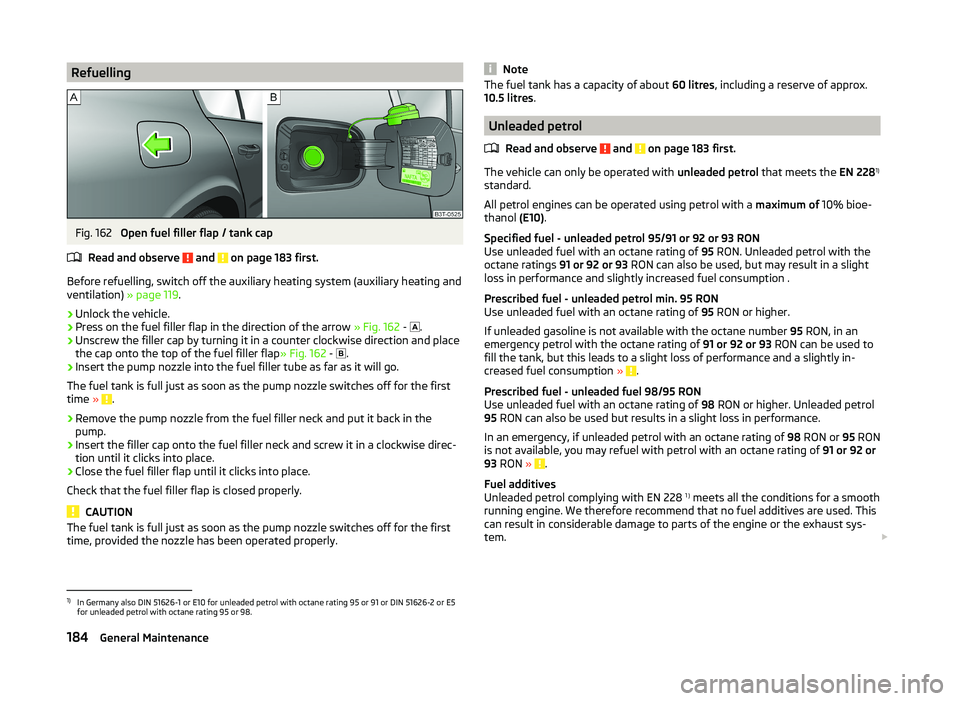
RefuellingFig. 162
Open fuel filler flap / tank cap
Read and observe
and on page 183 first.
Before refuelling, switch off the auxiliary heating system (auxiliary heating and
ventilation) » page 119.
›
Unlock the vehicle.
›
Press on the fuel filler flap in the direction of the arrow » Fig. 162 -
.
›
Unscrew the filler cap by turning it in a counter clockwise direction and place
the cap onto the top of the fuel filler flap » Fig. 162 -
.
›
Insert the pump nozzle into the fuel filler tube as far as it will go.
The fuel tank is full just as soon as the pump nozzle switches off for the first
time »
.
›
Remove the pump nozzle from the fuel filler neck and put it back in the
pump.
›
Insert the filler cap onto the fuel filler neck and screw it in a clockwise direc-
tion until it clicks into place.
›
Close the fuel filler flap until it clicks into place.
Check that the fuel filler flap is closed properly.
CAUTION
The fuel tank is full just as soon as the pump nozzle switches off for the first
time, provided the nozzle has been operated properly.NoteThe fuel tank has a capacity of about 60 litres, including a reserve of approx.
10.5 litres .
Unleaded petrol
Read and observe
and on page 183 first.
The vehicle can only be operated with unleaded petrol that meets the EN 2281)
standard.
All petrol engines can be operated using petrol with a maximum of 10% bioe-
thanol (E10).
Specified fuel - unleaded petrol 95/91 or 92 or 93 RON
Use unleaded fuel with an octane rating of 95 RON. Unleaded petrol with the
octane ratings 91 or 92 or 93 RON can also be used, but may result in a slight
loss in performance and slightly increased fuel consumption .
Prescribed fuel - unleaded petrol min. 95 RON
Use unleaded fuel with an octane rating of 95 RON or higher.
If unleaded gasoline is not available with the octane number 95 RON, in an
emergency petrol with the octane rating of 91 or 92 or 93 RON can be used to
fill the tank, but this leads to a slight loss of performance and a slightly in-
creased fuel consumption »
.
Prescribed fuel - unleaded fuel 98/95 RON
Use unleaded fuel with an octane rating of 98 RON or higher. Unleaded petrol
95 RON can also be used but results in a slight loss in performance.
In an emergency, if unleaded petrol with an octane rating of 98 RON or 95 RON
is not available, you may refuel with petrol with an octane rating of 91 or 92 or
93 RON »
.
Fuel additives
Unleaded petrol complying with EN 228 1 )
meets all the conditions for a smooth
running engine. We therefore recommend that no fuel additives are used. This
can result in considerable damage to parts of the engine or the exhaust sys-
tem.
1)
In Germany also DIN 51626-1 or E10 for unleaded petrol with octane rating 95 or 91 or DIN 51626-2 or E5
for unleaded petrol with octane rating 95 or 98.
184General Maintenance
Page 188 of 252
CAUTION■Even one filling of the tank with petrol that does not meet the standards can
lead to serious damage to parts of the exhaust system!■
If a fuel other than unleaded fuel which complies to the above mentioned
standards (e.g. leaded petrol) is used by mistake, do not start the engine or
switch on the ignition! Engine parts could be significantly damaged!
CAUTION
■ If, in an emergency, the vehicle has to be refuelled with petrol of a lower oc-
tane number than the one prescribed, the journey must only be continued at
medium engine speeds and a low engine load. Driving at high engine revs or a
high engine load can severely damage the engine! Refuel using petrol of the
prescribed octane number as soon as possible.■
Engine parts can be damaged if petrol with a lower octane number than the
one prescribed is used.
■
Even in the event of an emergency, petrol of a lower octane number than 91
RON must not be used, otherwise the engine can be severely damaged!
CAUTION
In no case may fuel additives with metal components be used, especially not
with manganese and iron content. There is a risk of causing considerable
damage to parts of the engine or exhaust system!
CAUTION
Fuels with metal components, such as LRP (lead replacement petrol) must
not be used. There is a risk of causing considerable damage to parts of the
engine or exhaust system!
Note
■ Unleaded petrol that has a higher octane number than that required by the
engine can be used without limitations.■
The use of petrol with an octane rating higher than 95 RON in does not re-
sult in either a noticeable increase in power nor lower fuel consumption in ve-
hicles for which unleaded petrol 95/91, 92 or 93 RON is specified.
■
On vehicles using prescribed unleaded petrol of min. 95 RON, the use of pet-
rol with a higher octane number than 95 RON can increase the power and re-
duce fuel consumption.
Diesel fuel
Read and observe
and on page 183 first.
The vehicle can only be operated with diesel fuel that meets the EN 5901)
standard.
All diesel engines can be operated using diesel fuel with a maximum of 7% bi-
odiesel (B7)2)
.
On the Indian market, your vehicle will only be able to run on diesel fuel com-
pliant with standard IS 1460/Bharat IV. If diesel fuel which complies with this
standard is not available, you can refuel with diesel fuel according to standard
IS 1460/Bharat III in case of emergency.
Operation in winter - Winter-grade diesel fuel
In the cold season, only use “winter-grade diesel fuel” which will still operate
properly even at a temperature of -20 °C.
It is often the case in countries with different climatic conditions that diesel
fuels available have a different temperature characteristic. ŠKODA Partners
and filling stations in the relevant country will be able to provide you with in-
formation regarding the diesel fuels available.
Preheating fuel
The vehicle is fitted with a fuel filter preheating system. This secures opera-
tion of a vehicle using diesel fuel down to an environmental temperature of
-25 °C.
Diesel fuel additives
The diesel fuel in accordance with the prescribed standards meets all the con-
ditions for a smooth running engine. We therefore recommend that no diesel
fuel additives are used. This can result in considerable damage to parts of the
engine or the exhaust system.
1)
In Germany also DIN 51628, in Austria ÖNORM C 1590, in Russia GOST R 52368-2005 / EN 590:2004.
2)
In Germany complying with standard DIN 52638, in Austria ÖNORM C 1590, in France EN 590.
185Inspecting and replenishing
Page 194 of 252
ReplenishingRead and observe
and on page 189 first.
›
Check the oil level » page 190.
›
Unscrew the cap of the engine oil filler opening » Fig. 164 on page 188 .
›
Replenish the oil in portions of 0.5 litres in accordance with the correct speci-
fications » page 189 .
›
Check the oil level » page 190.
›
Carefully screw on the oil filler opening cap and push the dipstick in fully.
Coolant
Introduction
This chapter contains information on the following subjects:
Capacity
191
Checking the coolant level
192
Replenishing
192
The coolant consists of water with coolant additive. This mixture guarantees
antifreeze protection, protects the cooling/heater system against corrosion
and prevents lime formation.
Vehicles exported to countries with a mild climate are already factory-filled
with a coolant which offers antifreeze protection down to about -25 ℃. In
these countries, the concentration of coolant additive should be at least 40%.
Vehicles exported to countries with a cold climate are already factory-filled
with a coolant which offers antifreeze protection down to about -35 °C. In
these countries, the concentration of coolant additive should be at least 50%.
If a higher concentration of antifreeze is required for climatic reasons, the con-
centration of coolant additive can be increased up to a maximum of 60% (anti-
freeze protection down to approx. -40 °C).
When refilling, only use the same antifreeze identified on the coolant expan-
sion vessel » Fig. 167 on page 192 .
WARNINGThe engine compartment of your car is a hazardous area. The following
warning instructions must be followed at all times when working in the en- gine compartment » page 186.
CAUTION
■
Do not continue if for some reason it is not possible to fill with coolant un-
der the current circumstances! Switch off the engine and seek assistance from
a specialist garage.■
If the expansion tank is empty, do not top up with coolant. The system could
ventilate - there is a risk of engine damage,
do not continue driving! Switch
off the engine and seek assistance from a specialist garage.
■
The concentration of coolant additive in the coolant must never be under
40%.
■
Over 60% of coolant additive in the coolant reduces the antifreeze protec-
tion and cooling effect.
■
A coolant additive that does not comply with the correct specifications can
significantly reduce the corrosion protection.
■
Any faults resulting from corrosion may cause a loss of coolant and can con-
sequently result in major engine damage!
■
Do not fill the coolant above the mark
A
» Fig. 167 on page 192 .
■
If a fault causes the engine to overheat, we recommend visiting a specialist
garage, as otherwise serious engine damage may occur.
■
Additional headlights and other attached components in front of the air inlet
impair the cooling efficiency of the coolant.
■
Never cover the radiator - there is a risk of the engine overheating.
Capacity
Read and observe
and on page 191 first.
Coolant capacity (in litres) 1)
Petrol enginesCapacity1.4 l/92 kW TSI7.71.8 l/112 kW TSI
1.8 l/118 kW TSI8.6 1)
The coolant capacity is approximately 1 Litre greater on vehicles that are fitted with an auxiliary heater
(auxiliary heating and ventilation).
191Inspecting and replenishing
Page 214 of 252

WARNING■If you cannot inflate the tyre to at least 2.0 bar, this means the damage
sustained was too serious. The sealing agent cannot be used to seal the
tyre.
Do not continue to drive! Seek help from a specialist garage.■
The tyre inflation hose and air compressor may get hot as the tyre is be-
ing inflated – there is a risk of burning.
CAUTION
Switch off the air compressor after running 8 minutes at the latest – there is a
risk of overheating. Allow the air compressor to cool a few minutes before
switching it on again.
Notes for driving with tyre repaired
Read and observe
on page 209 first.
The inflation pressure of the repaired tyre must be checked after driving for 10minutes.
If the tyre pressure is 1.3 bar or less
›
Do not continue to drive! You cannot properly seal with tyre with the
breakdown kit.
If the tyre pressure is 1.3 bar or more
›
Set the tyre pressure back to the correct value.
›
Continue driving carefully to the nearest specialist garage at a maximum speed of 80 km/h (50 mph).
Jump-starting
Introduction
This chapter contains information on the following subjects:
Jump-starting using the battery from another vehicle
211
Jump-starting in vehicles with the START STOP system
212
Jump-starting vehicles with the vehicle battery in the boot
212
The battery of another vehicle can be used to jump-start your vehicle if the en-
gine will not start because the battery is flat.
WARNING■ Pay attention to the warning instructions relating to work in the engine
compartment » page 186.■
A discharged vehicle battery may already freeze at temperatures just be-
low 0 °C. If the battery is frozen, do not jump-start with the battery of an-
other vehicle – there is a risk of explosion.
■
Keep any sources of ignition (naked flame, smouldering cigarettes, etc.)
away from the battery – risk of explosion!
■
Never jump-start vehicle batteries with insufficient acid levels – risk of
explosion and chemical burns.
■
The vent screws of the battery cells must be tightened firmly.
Note
We recommend you buy jump-start cables from a car battery specialist.
Jump-starting using the battery from another vehicle
Fig. 184
Jump-starting: A – flat battery, B
– battery providing current
Read and observe on page 211 first.
The starting process using the battery of another vehicle requires the use of
jumper cables.
The jump-start cables must be attached in the following sequence.
›
Attach clamp
1
to the positive terminal of the discharged battery
A
» Fig. 184 .
›
Attach clamp
2
to the positive terminal of the battery supplying power
B
.
›
Attach clamp
3
to the negative terminal of the battery supplying power
B
.
›
Attach clamp
4
to a solid metal component firmly connected to the engine
block or to the engine block itself.
Starting engine
›
Start the engine on the vehicle providing the power and allow it to idle.
211Emergency equipment and self-help
Page 224 of 252
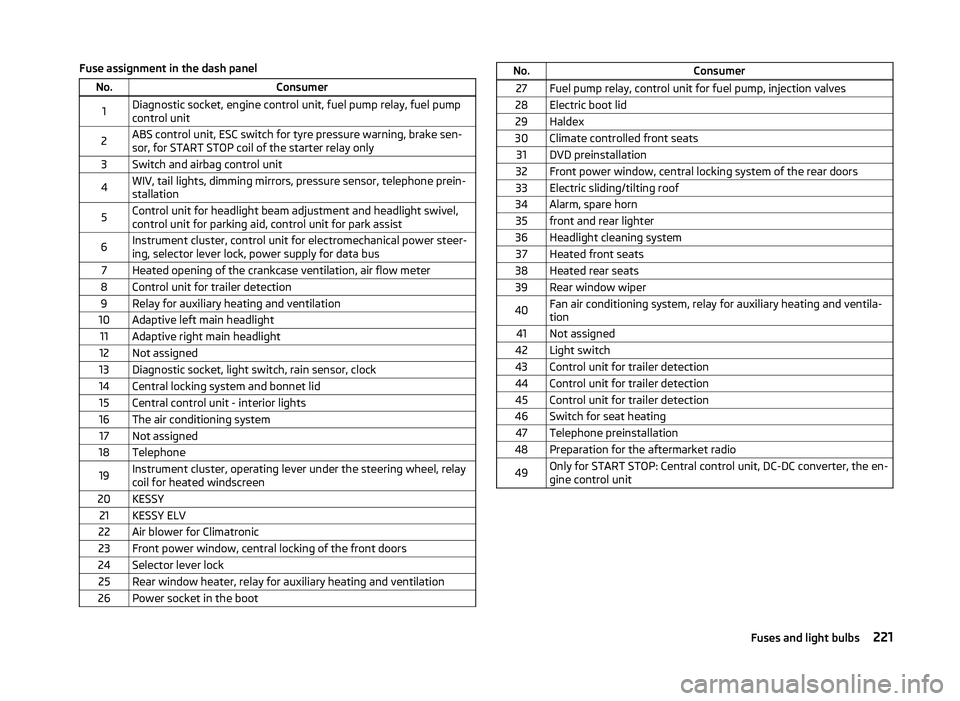
Fuse assignment in the dash panelNo.Consumer1Diagnostic socket, engine control unit, fuel pump relay, fuel pump
control unit2ABS control unit, ESC switch for tyre pressure warning, brake sen-
sor, for START STOP coil of the starter relay only3Switch and airbag control unit4WIV, tail lights, dimming mirrors, pressure sensor, telephone prein-
stallation5Control unit for headlight beam adjustment and headlight swivel,
control unit for parking aid, control unit for park assist6Instrument cluster, control unit for electromechanical power steer-
ing, selector lever lock, power supply for data bus7Heated opening of the crankcase ventilation, air flow meter8Control unit for trailer detection9Relay for auxiliary heating and ventilation10Adaptive left main headlight11Adaptive right main headlight12Not assigned13Diagnostic socket, light switch, rain sensor, clock14Central locking system and bonnet lid15Central control unit - interior lights16The air conditioning system17Not assigned18Telephone19Instrument cluster, operating lever under the steering wheel, relay
coil for heated windscreen20KESSY21KESSY ELV22Air blower for Climatronic23Front power window, central locking of the front doors24Selector lever lock25Rear window heater, relay for auxiliary heating and ventilation26Power socket in the bootNo.Consumer27Fuel pump relay, control unit for fuel pump, injection valves28Electric boot lid29Haldex30Climate controlled front seats31DVD preinstallation32Front power window, central locking system of the rear doors33Electric sliding/tilting roof34Alarm, spare horn35front and rear lighter36Headlight cleaning system37Heated front seats38Heated rear seats39Rear window wiper40Fan air conditioning system, relay for auxiliary heating and ventila-
tion41Not assigned42Light switch43Control unit for trailer detection44Control unit for trailer detection45Control unit for trailer detection46Switch for seat heating47Telephone preinstallation48Preparation for the aftermarket radio49Only for START STOP: Central control unit, DC-DC converter, the en-
gine control unit221Fuses and light bulbs
Page 226 of 252
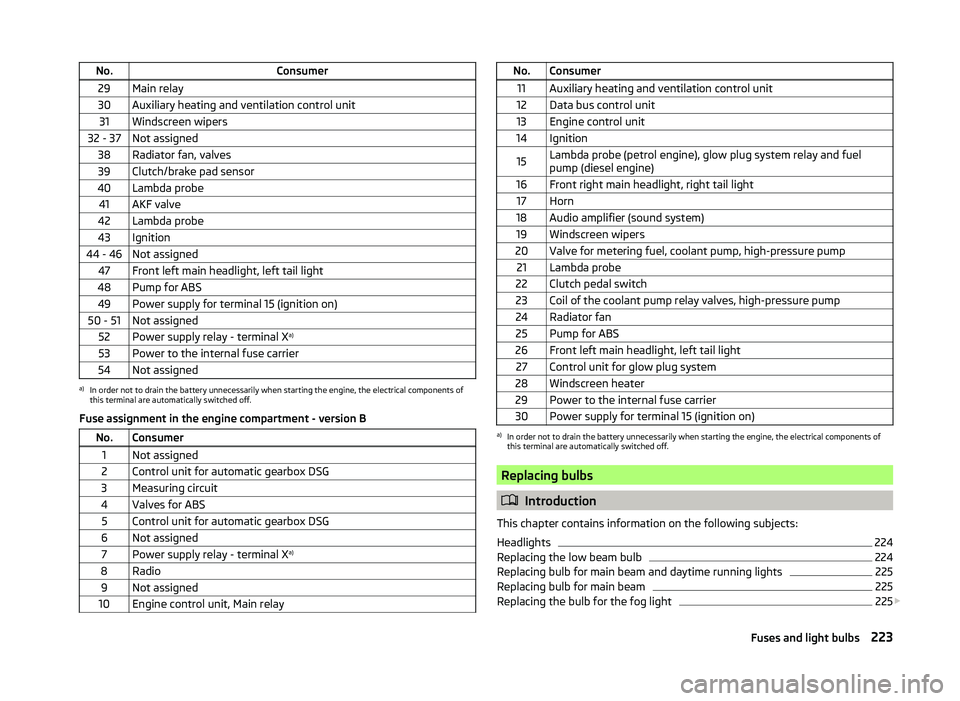
No.Consumer29Main relay30Auxiliary heating and ventilation control unit31Windscreen wipers32 - 37Not assigned38Radiator fan, valves39Clutch/brake pad sensor40Lambda probe41AKF valve42Lambda probe43Ignition44 - 46Not assigned47Front left main headlight, left tail light48Pump for ABS49Power supply for terminal 15 (ignition on)50 - 51Not assigned52Power supply relay - terminal Xa)53Power to the internal fuse carrier54Not assigneda)
In order not to drain the battery unnecessarily when starting the engine, the electrical components of
this terminal are automatically switched off.
Fuse assignment in the engine compartment - version B
No.Consumer1Not assigned2Control unit for automatic gearbox DSG3Measuring circuit4Valves for ABS5Control unit for automatic gearbox DSG6Not assigned7Power supply relay - terminal X a)8Radio9Not assigned10Engine control unit, Main relayNo.Consumer11Auxiliary heating and ventilation control unit12Data bus control unit13Engine control unit14Ignition15Lambda probe (petrol engine), glow plug system relay and fuel
pump (diesel engine)16Front right main headlight, right tail light17Horn18Audio amplifier (sound system)19Windscreen wipers20Valve for metering fuel, coolant pump, high-pressure pump21Lambda probe22Clutch pedal switch23Coil of the coolant pump relay valves, high-pressure pump24Radiator fan25Pump for ABS26Front left main headlight, left tail light27Control unit for glow plug system28Windscreen heater29Power to the internal fuse carrier30Power supply for terminal 15 (ignition on)a)
In order not to drain the battery unnecessarily when starting the engine, the electrical components of
this terminal are automatically switched off.
Replacing bulbs
Introduction
This chapter contains information on the following subjects:
Headlights
224
Replacing the low beam bulb
224
Replacing bulb for main beam and daytime running lights
225
Replacing bulb for main beam
225
Replacing the bulb for the fog light
225
223Fuses and light bulbs
Page 239 of 252
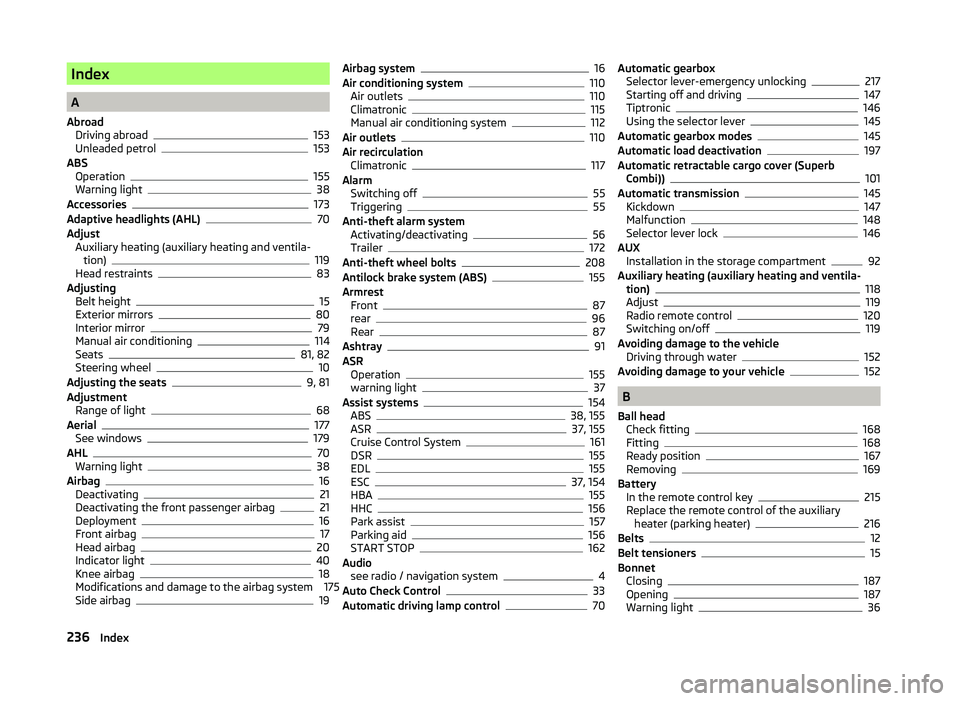
Index
A
Abroad Driving abroad
153
Unleaded petrol153
ABS Operation
155
Warning light38
Accessories173
Adaptive headlights (AHL)70
Adjust Auxiliary heating (auxiliary heating and ventila- tion)
119
Head restraints83
Adjusting Belt height
15
Exterior mirrors80
Interior mirror79
Manual air conditioning114
Seats81, 82
Steering wheel10
Adjusting the seats9, 81
Adjustment Range of light
68
Aerial177
See windows179
AHL70
Warning light38
Airbag16
Deactivating21
Deactivating the front passenger airbag21
Deployment16
Front airbag17
Head airbag20
Indicator light40
Knee airbag18
Modifications and damage to the airbag system 175
Side airbag
19
Airbag system16
Air conditioning system110
Air outlets110
Climatronic115
Manual air conditioning system112
Air outlets110
Air recirculation Climatronic
117
Alarm Switching off
55
Triggering55
Anti-theft alarm system Activating/deactivating
56
Trailer172
Anti-theft wheel bolts208
Antilock brake system (ABS)155
Armrest Front
87
rear96
Rear87
Ashtray91
ASR Operation
155
warning light37
Assist systems154
ABS38, 155
ASR37, 155
Cruise Control System161
DSR155
EDL155
ESC37, 154
HBA155
HHC156
Park assist157
Parking aid156
START STOP162
Audio see radio / navigation system
4
Auto Check Control33
Automatic driving lamp control70
Automatic gearbox Selector lever-emergency unlocking217
Starting off and driving147
Tiptronic146
Using the selector lever145
Automatic gearbox modes145
Automatic load deactivation197
Automatic retractable cargo cover (Superb Combi))
101
Automatic transmission145
Kickdown147
Malfunction148
Selector lever lock146
AUX Installation in the storage compartment
92
Auxiliary heating (auxiliary heating and ventila- tion)
118
Adjust119
Radio remote control120
Switching on/off119
Avoiding damage to the vehicle Driving through water
152
Avoiding damage to your vehicle152
B
Ball head Check fitting
168
Fitting168
Ready position167
Removing169
Battery In the remote control key
215
Replace the remote control of the auxiliary heater (parking heater)
216
Belts12
Belt tensioners15
Bonnet Closing
187
Opening187
Warning light36
236Index
Page 243 of 252
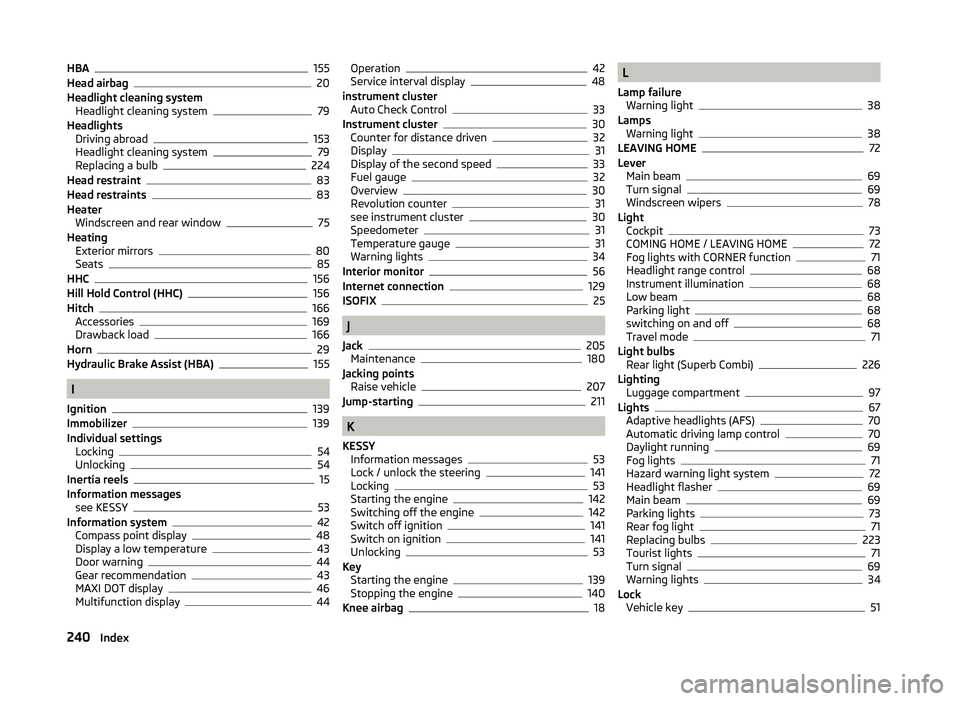
HBA155
Head airbag20
Headlight cleaning system Headlight cleaning system
79
Headlights Driving abroad
153
Headlight cleaning system79
Replacing a bulb224
Head restraint83
Head restraints83
Heater Windscreen and rear window
75
Heating Exterior mirrors
80
Seats85
HHC156
Hill Hold Control (HHC)156
Hitch166
Accessories169
Drawback load166
Horn29
Hydraulic Brake Assist (HBA)155
I
Ignition
139
Immobilizer139
Individual settings Locking
54
Unlocking54
Inertia reels15
Information messages see KESSY
53
Information system42
Compass point display48
Display a low temperature43
Door warning44
Gear recommendation43
MAXI DOT display46
Multifunction display44
Operation42
Service interval display48
instrument cluster Auto Check Control
33
Instrument cluster30
Counter for distance driven32
Display31
Display of the second speed33
Fuel gauge32
Overview30
Revolution counter31
see instrument cluster30
Speedometer31
Temperature gauge31
Warning lights34
Interior monitor56
Internet connection129
ISOFIX25
J
Jack
205
Maintenance180
Jacking points Raise vehicle
207
Jump-starting211
K
KESSY Information messages
53
Lock / unlock the steering141
Locking53
Starting the engine142
Switching off the engine142
Switch off ignition141
Switch on ignition141
Unlocking53
Key Starting the engine
139
Stopping the engine140
Knee airbag18
L
Lamp failure Warning light
38
Lamps Warning light
38
LEAVING HOME72
Lever Main beam
69
Turn signal69
Windscreen wipers78
Light Cockpit
73
COMING HOME / LEAVING HOME72
Fog lights with CORNER function71
Headlight range control68
Instrument illumination68
Low beam68
Parking light68
switching on and off68
Travel mode71
Light bulbs Rear light (Superb Combi)
226
Lighting Luggage compartment
97
Lights67
Adaptive headlights (AFS)70
Automatic driving lamp control70
Daylight running69
Fog lights71
Hazard warning light system72
Headlight flasher69
Main beam69
Parking lights73
Rear fog light71
Replacing bulbs223
Tourist lights71
Turn signal69
Warning lights34
Lock Vehicle key
51
240Index
Page 245 of 252
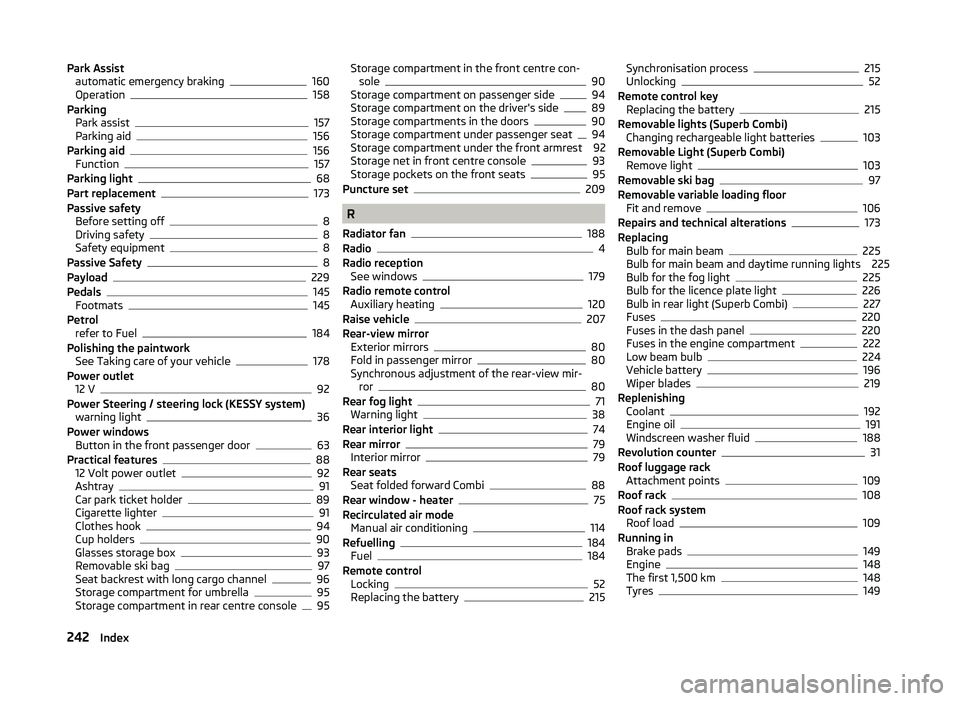
Park Assistautomatic emergency braking160
Operation158
Parking Park assist
157
Parking aid156
Parking aid156
Function157
Parking light68
Part replacement173
Passive safety Before setting off
8
Driving safety8
Safety equipment8
Passive Safety8
Payload229
Pedals145
Footmats145
Petrol refer to Fuel
184
Polishing the paintwork See Taking care of your vehicle
178
Power outlet 12 V
92
Power Steering / steering lock (KESSY system) warning light
36
Power windows Button in the front passenger door
63
Practical features88
12 Volt power outlet92
Ashtray91
Car park ticket holder89
Cigarette lighter91
Clothes hook94
Cup holders90
Glasses storage box93
Removable ski bag97
Seat backrest with long cargo channel96
Storage compartment for umbrella95
Storage compartment in rear centre console95
Storage compartment in the front centre con- sole90
Storage compartment on passenger side94
Storage compartment on the driver's side89
Storage compartments in the doors90
Storage compartment under passenger seat94
Storage compartment under the front armrest 92
Storage net in front centre console
93
Storage pockets on the front seats95
Puncture set209
R
Radiator fan
188
Radio4
Radio reception See windows
179
Radio remote control Auxiliary heating
120
Raise vehicle207
Rear-view mirror Exterior mirrors
80
Fold in passenger mirror80
Synchronous adjustment of the rear-view mir- ror
80
Rear fog light71
Warning light38
Rear interior light74
Rear mirror79
Interior mirror79
Rear seats Seat folded forward Combi
88
Rear window - heater75
Recirculated air mode Manual air conditioning
114
Refuelling184
Fuel184
Remote control Locking
52
Replacing the battery215
Synchronisation process215
Unlocking52
Remote control key Replacing the battery
215
Removable lights (Superb Combi) Changing rechargeable light batteries
103
Removable Light (Superb Combi) Remove light
103
Removable ski bag97
Removable variable loading floor Fit and remove
106
Repairs and technical alterations173
Replacing Bulb for main beam
225
Bulb for main beam and daytime running lights 225
Bulb for the fog light
225
Bulb for the licence plate light226
Bulb in rear light (Superb Combi)227
Fuses220
Fuses in the dash panel220
Fuses in the engine compartment222
Low beam bulb224
Vehicle battery196
Wiper blades219
Replenishing Coolant
192
Engine oil191
Windscreen washer fluid188
Revolution counter31
Roof luggage rack Attachment points
109
Roof rack108
Roof rack system Roof load
109
Running in Brake pads
149
Engine148
The first 1,500 km148
Tyres149
242Index
Page 246 of 252
S
SAFE see Safe securing
54
SAFELOCK see Safe securing
54
Safe securing54
Safety8
Child safety22
Child safety seats22
Correct seated position9
Head restraints83
ISOFIX25
TOP TETHER27
Saving electrical energy149
Screens see Sun screen in the rear doors
76
Seals Taking care of your vehicle
178
Seat belt warning light
35
Seat belts12
Belt tensioners15
Cleaning183
fastening and unfastening14
Height adjustment15
Inertia reels15
The physical principle of a frontal collision13
Seat features85
Seats Convenience features of passenger seat
87
Electric adjustment82
Front armrest87
Head restraints83
Heating85
Manually adjusting82
Rear armrest87
save84
Seat backrests87
Storing in memory of remote control key84
Ventilated front seats86
Seats and practical features81
Adjusting the seats81
see Automatic gearbox Manual gear shifting on the multifunction steering wheel
146
Selector lever Refer to Selector lever
145
Selector lever lock / starter (system KESSY) Warning light
41
Service174
Service interval display48
Setting32
Setting the32
Shelves88
Shifting gears Driving and saving energy
149
Side airbag19
Side compartment in boot with battery102
Side compartments in the luggage compart- ment
101
ski bag97
Sliding/tilting roof Close (Superb Combi)
66
Closing64
Closing the sun screen (Superb Combi)66
Electric sliding/tilting roof64
Emergency operation218
Opening/closing the sun screen (Superb Combi) 66
Opening and tilting
64
Opening and tilting (Superb Combi)66
Operation64
Operation (Superb Combi)66
Snow chains203
Spare wheel200
Speedometer31
See speedometer31
Speed symbol Refer to Wheels202
Spoiler175
Starting and stopping the engine - KESSY140
Starting and stopping the engine using the key 138
Starting engine Jump-starting
211
Starting the engine Jump-starting
211
Key139
see KESSY142
START STOP162
Information messages164
Jump-starting212
Manually deactivating/activating the system164
Operating conditions for the system163
operation in vehicles with automatic gearbox163
operation in vehicles with manual gearbox163
system related automatic start-up164
Steering lock / unlock see KESSY
141
Steering wheel10
Stopping the engine Key
140
Storage compartment in rear centre console95
Storage compartment on passenger side94
Storage compartments88
Storage compartment under passenger seat94
Storage pockets on the front seats95
Storing skis96
Sun screen76
Sun screen in the rear doors76
Sun visors76
Switch see Ignition
139
Switching off the engine see KESSY
142
Switch light on and off68
243Index