length SKODA YETI 2012 1.G / 5L Owner's Manual
[x] Cancel search | Manufacturer: SKODA, Model Year: 2012, Model line: YETI, Model: SKODA YETI 2012 1.G / 5LPages: 225, PDF Size: 5.47 MB
Page 43 of 225
If the light comes on automatically, the side lights and low beam as well as li-
cence plate light light up at the same time.
If the automatic driving lamp control is switched on, the light is regulated with
the light sensor in the rear mirror holder. If the light intensity drops below the set
value, e.g when driving during the day into a tunnel, the low beam and the side
lights as well as the licence plate light come on automatically. If the light intensity
increases again, the lights switch off automatically.
Rain lights
If the windscreen wiper is switched on in rain sensor mode for longer than 10
sec-
onds or in permanent wipe mode (position 2 or 3) » page 49 for longer than
15 seconds, the side lights and low beam are switched on automatically. The light
switches off if the windscreen wipe is in operation rain sensor for more than
around 4 minutes or is not switched on in the operation permanent wipe. Note
Do not affix any stickers in front of the light sensor, so that its functionality is not
impaired or disabled. ÐCornering lights
First read and observe the introductory information and safety warn-
ings on page 39.
The cornering lights are used to illuminate the curves by means of the cone of
light swivelling together with the front headlight with Xenon lights. This function
is active when the speed of the car increases to more than 10
km/h.
The swivelling function of the headlights can be switched off/on via the menu
point Assistants in the main menu of the information display » page 15.WARNING
If the cornering lights are defective, the headlights are automatically lowered
to the emergency position, which prevents a possible dazzling of oncoming
traffic. Thus the illuminated length of the road is shortened. Drive carefully
and visit a
ŠKODA specialist garage as soon as possible. Ð
ä Parking light
First read and observe the introductory information and safety warn-
ings on page 39.
Parking light
› Switch off the ignition.
› Pull the turn signal light lever
» Fig. 29 on page 45 upwards or downwards -
the side light on the right or left side of the vehicle is switched.
Parking light on both sides
› Turn the light switch
» Fig. 23 on page
40 to position and lock the vehicle. Note
■ The parking light can only be activated if the ignition is switched off.
■ If the right or left turn signal light has been switched on and the ignition is
switched off, the parking light is not automatically switched on. Ð COMING HOME/LEAVING HOME function
First read and observe the introductory information and safety warn-
ings on page 39.
When it is dark, this function makes it possible to switch on the lights for a short
time after leaving the vehicle or when approaching the vehicle.
Switching on the
COMING HOME function
› The light switch is in the position automatic driving lamp control
.
› Switch off the ignition.
› The light switches on after the driver's door is opened.
Switching on the
LEAVING HOME function
› After leaving the vehicle, the light switch is in the position automatic driving
lamp control .
› Unlock the vehicle with the radio remote control and the light is switched on.
Depending on the equipment fitted the
COMING HOME/LEAVING HOME function
switches on the following lights:
› Parking lights;
› Low beam;
› Entry lighting in the exterior mirrors;
› Licence plate light.
£
ä
ä
41
Lights and visibility
Page 77 of 225
Stowage compartment below front passenger seat
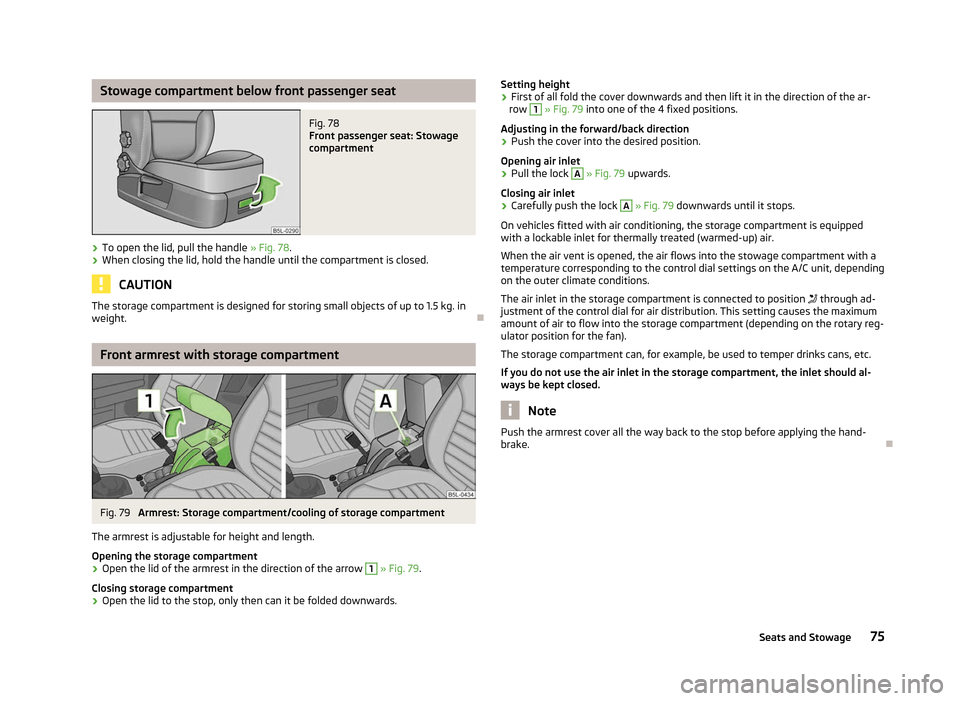
Fig. 78
Front passenger seat: Stowage
compartment
› To open the lid, pull the handle
» Fig. 78.
› When closing the lid, hold the handle until the compartment is closed. CAUTION
The storage compartment is designed for storing small objects of up to 1.5 kg. in
weight. ÐFront armrest with storage compartment
Fig. 79
Armrest: Storage compartment/cooling of storage compartment
The armrest is adjustable for height and length.
Opening the storage compartment
› Open the lid of the armrest in the direction of the arrow 1
» Fig. 79.
Closing storage compartment
› Open the lid to the stop, only then can it be folded downwards. Setting height
› First of all fold the cover downwards and then lift it in the direction of the ar-
row 1
» Fig. 79 into one of the 4 fixed positions.
Adjusting in the forward/back direction
› Push the cover into the desired position.
Opening air inlet
› Pull the lock A
» Fig. 79 upwards.
Closing air inlet
› Carefully push the lock A
» Fig. 79 downwards until it stops.
On vehicles fitted with air conditioning, the storage compartment is equipped
with a lockable inlet for thermally treated (warmed-up) air.
When the air vent is opened, the air flows into the stowage compartment with a
temperature corresponding to the control dial settings on the A/C unit, depending
on the outer climate conditions.
The air inlet in the storage compartment is connected to position through ad-
justment of the control dial for air distribution. This setting causes the maximum
amount of air to flow into the storage compartment (depending on the rotary reg-
ulator position for the fan).
The storage compartment can, for example, be used to temper drinks cans, etc.
If you do not use the air inlet in the storage compartment, the inlet should al-
ways be kept closed. Note
Push the armrest cover all the way back to the stop before applying the hand-
brake. Ð
75
Seats and Stowage
Page 78 of 225
Folding table on the front seat rest
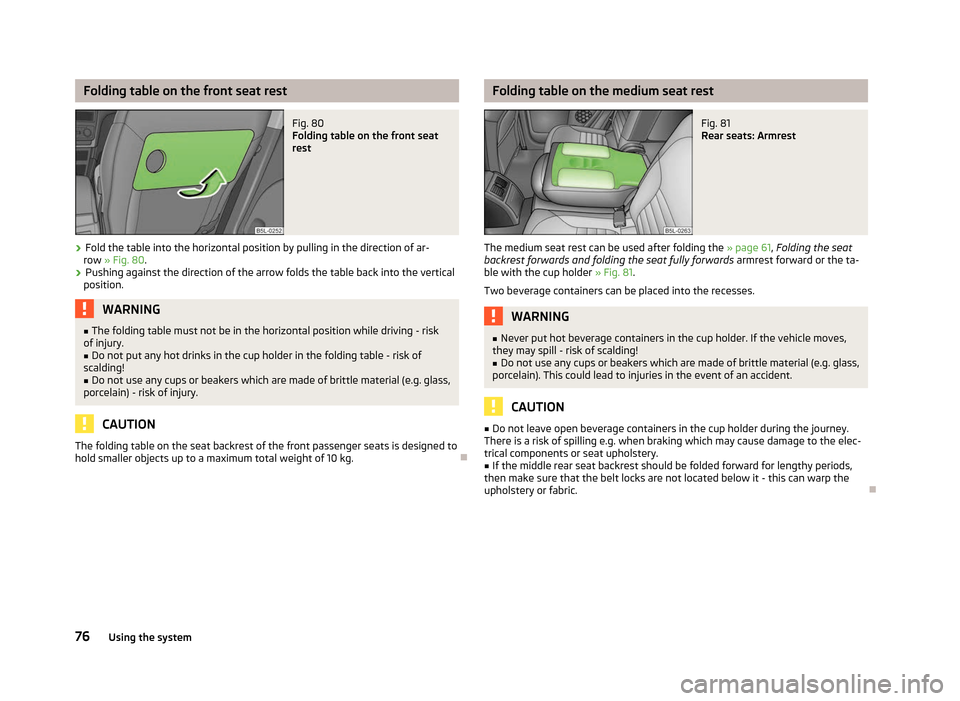
Fig. 80
Folding table on the front seat
rest
› Fold the table into the horizontal position by pulling in the direction of ar-
row » Fig. 80 .
› Pushing against the direction of the arrow folds the table back into the vertical
position. WARNING
■ The folding table must not be in the horizontal position while driving - risk
of injury.
■ Do not put any hot drinks in the cup holder in the folding table - risk of
scalding! ■ Do not use any cups or beakers which are made of brittle material (e.g. glass,
porcelain) - risk of injury. CAUTION
The folding table on the seat backrest of the front passenger seats is designed to
hold smaller objects up to a maximum total weight of 10 kg. Ð Folding table on the medium seat rest
Fig. 81
Rear seats: Armrest
The medium seat rest can be used after folding the » page 61, Folding the seat
backrest forwards and folding the seat fully forwards armrest forward or the ta-
ble with the cup holder » Fig. 81.
Two beverage containers can be placed into the recesses. WARNING
■ Never put hot beverage containers in the cup holder. If the vehicle moves,
they may spill - risk of scalding!
■ Do not use any cups or beakers which are made of brittle material (e.g. glass,
porcelain). This could lead to injuries in the event of an accident. CAUTION
■ Do not leave open beverage containers in the cup holder during the journey.
There is a risk of spilling e.g. when braking which may cause damage to the elec-
trical components or seat upholstery.
■ If the middle rear seat backrest should be folded forward for lengthy periods,
then make sure that the belt locks are not located below it - this can warp the
upholstery or fabric. Ð
76 Using the system
Page 85 of 225

Set-up
Setting of the control dial
Button 1
Air outlet vents 4
A B C
The fastest heating
To the right up to the
stop 3
Briefly switch on
Opening
Comfortable heating Desired temperature 2 or 3
Do not switch on
Opening
Fresh air mode - ventilation To the left up to the
stop Desired position
Do not switch on
OpeningNote
■ Controls A
, B
, C
and the button 1
» Fig. 89
on page 82.
■ Air outlet vents 4 » Fig. 87 on page 81.
■ We recommend that you leave the air outlet vents 3 » Fig. 87 on page 81 in the
opened position. ÐRecirculated air mode
Recirculated air mode prevents polluted air outside the vehicle from getting into
the vehicle, for example when driving through a tunnel or when standing in a
traffic jam.
Switching on
› Press the button
» Fig. 89
on page 82 and the indicator light in the button
illuminates.
Switching off
› Press the button
» Fig. 89
on page 82again - the indicator light in the but-
ton goes out.
Recirculated air mode is switched off automatically if the air distribution control C
is turned to position
» Fig. 89 on page 82. Recirculated air mode can be
switched on again from this setting by repeatedly pressing the button .
WARNING
Do not leave recirculated air mode on over a longer period of time, as “stale”
air can cause fatigue of the driver and passengers, reduce attention levels and
also cause the windows to mist up. The risk of having an accident increases.
Switch off recirculated air mode as soon as the windows start to mist up. Ð Air conditioning system (manual air conditioning
system) Introductory information
The cooling system only operates if the button AC 1
» Fig. 90 on page 84
is
pressed, and the following conditions are met:
› engine running;
› outside temperature above approx. +2 °C;
› blower switch switched on (positions 1 to 4).
Under certain circumstances, air at a temperature of about 5 °C can flow out of
the vents when the cooling system is switched on. Lengthy and uneven distribu-
tion of the air flow out of the vents and large differences in temperature, for ex-
ample when getting out of the vehicle, can result in chills in sensitive persons. Note
We recommend that you have the air conditioning system cleaned by a ŠKODA
specialist garage once every year. Ð
83
Heating and air conditioning system
Page 89 of 225

Note
Below the top row of buttons is located the interior temperature sensor. Do not
stick anything on or cover the sensor, otherwise it could have an unfavourable ef-
fect on the Climatronic. ÐAutomatic mode
The automatic mode is used in order to maintain a constant temperature and to
demist the windows in the interior of the car.
Switching on
› Set a temperature between +18 °C and +26
℃.
› Move the air outlet vents
3 and 4 » Fig. 87 on page 81 so that the air flow is
directed slightly upwards.
› Press the button
AUTO 8
» Fig. 91 on page 86
. The indicator light in the top
right or left corner lights up, depending on which mode was last selected.
If the warning light in the top right corner of the button AUTO lights up, the Cli-
matronic operates in
“HIGH” mode. The “HIGH” mode is the standard setting of
the Climatronic.
When pressing again the button AUTO , the Climatronic changes into the “LOW”
mode and the indicator light in the top left corner lights up. The Climatronic uses
only in this mode the lower blower speed. However taking into account the noise
level, this is more comfortable, yet be aware that the effectiveness of the air con-
ditioning system is reduced particularly if the vehicle is fully occupied.
By pressing the button AUTO again, it is changed to “HIGH” mode.
Automatic mode is switched off by pressing one of the buttons for the air distri-
bution or by increasing/decreasing the blower speed. The temperature is never-
theless regulated. ÐSwitching the cooling system on and off
Switching the cooling system on and off › Press the button
AC » Fig. 91 on page 86
. The indicator light lights up in the
button.
› When you again press the button
AC , the air conditioning system is switched
off. The indicator light in the button goes out. Only the function of the ventila-
tion remains active when no lower temperature than the outside temperature
can be reached. Ð Setting temperature
The interior temperature for the left and right side can be set separately.
› The temperature for both sides can be set with the control dial 7
» Fig. 91 on
page 86
after switching on the ignition.
› If you wish to set the temperature for the right side, turn the control dial 14
.
The indicator light in the button DUAL lights up, this indicates that differing
temperatures for the left and right side can be set.
If the indicator light in the button DUAL is illuminated, the temperature for both
sides cannot be set with the control dial 7
. You can reactivate this function by
pressing the button DUAL . The indicator light in the button goes out.
The interior temperature can be set between +18 °C and +26 ℃. The interior tem-
perature is regulated automatically within this range. If a temperature lower than
+18 °C is selected, a blue symbol lights up at the start of the numerical scale. If a
temperature higher than +26 °C is selected, a red symbol lights up at the start of
the numerical scale. In both limit positions the Climatronic operates at maximum
cooling or heating capacity, respectively. The temperature is not controlled in this
case.
Lengthy and uneven distribution of the air flow out of the vents (especially
around the feet) and large differences in temperature, for example, when getting
out of the vehicle, can cause susceptible individuals to catch a cold. Ð Recirculated air mode
Recirculated air mode prevents polluted air outside the vehicle from getting into
the vehicle, for example when driving through a tunnel or when standing in a
traffic jam. If a considerable increase in concentration of pollutants is recognized
by the air quality sensor, when the automatic air distribution control is switched
on, the air distribution control will temporarily be switched off. If the concentra-
tion of pollutants decreases to the normal level, the air distribution control is au-
tomatically switched off so that fresh air can be guided into the vehicle interior. In
recirculated air mode air is sucked out of the interior of the vehicle and then fed
back into the interior. When the automatic air distribution control is switched on,
an air quality sensor measures the concentration of pollutants in the drawn in air.
Switching recirculated air mode on
› Repeatedly press the button
5
» Fig. 91 on page 86
until the indicator
light on the left side of the button is illuminated. £
87
Heating and air conditioning system
Page 103 of 225
On vehicles with a factory-fitted towing device, the border of the danger area
starts (continuous tone) 5
cm further away from the vehicle. The length of the ve-
hicle can be increased with an installed detachable towing device.
On vehicles with a factory-fitted towing device, the rear sensors are deactivated
when towing a trailer.
Activating/deactivating the rear parking aid
The parking aid is activated automatically when reverse gear is engaged and the
ignition is turned on. This is confirmed by a brief audible signal.
The parking aid is deactivated by removing the reverse gear.
Activating/deactivating the front and rear parking aid
The parking aid is activated when the ignition is turned on and reverse gear is en-
gaged and or by pressing the button » Fig. 101 - the symbol
lights up in the
button. This is confirmed by a brief audible signal.
The parking aid is deactivated by pressing the button or at a speed of more
than 10 km/h – the symbol in the button is no longer illuminated. WARNING
■ The parking aid is not a substitute for the driver paying proper attention and
it is always the driver's responsibility to take care when reversing the vehicle
or carrying out similar manoeuvres. Pay particular attention to small children
and animals as they are not recognised by the parking aid sensors.
■ Before reversing or parking, check that there is no small obstacle, such as a
rock, thin post, trailer drawbar etc., in front of or behind the vehicle. Such ob-
stacles may not be recognised by the parking aid sensors.
■ Under certain circumstances, surfaces of certain objects and types of cloth-
ing cannot reflect the signals from the parking aid. Thus, these objects or peo-
ple who wear such clothing are not recognised by the parking aid sensors.
■ External sound sources can have a detrimental effect on the parking aid.
Under unfavourable conditions, objects or people may not be recognised. Note
■ If a warning signal sounds for about 3
seconds after activating the system and
there is no obstacle close to your car, this indicates a system fault. The fault is
confirmed additionally when the symbol flashes in the button . Have the
fault rectified by a
ŠKODA specialist garage.
■ The sensors must be kept clean (free of ice, etc.) to enable the parking aid to
operate properly.
■ If the parking aid is activated and the selector lever of the automatic gearbox is
in the position P, the warning signal is interrupted (the vehicle cannot move). Ð Park assist
ä
Introduction
This chapter contains information on the following subjects:
Park assist display on the information display 102
Parking with the help of the park assist system and completing the parking
procedure 103
Messages in the information display 104
The parking aid is part of the park assist system, therefore the information and
safety guidelines » page 100, Parking aid must be read and observed.
The park assist system helps you to park in a suitable parallel parking space be-
tween two vehicles or behind a vehicle.
After switching on the ignition and when driving at a speed of up to 30
km/h, the
park assist system automatically searches for suitable parking spaces on the driv-
er's and passenger's side of the vehicle.
During the parking procedure the park assist only takes over the steering move-
ments, the pedals continue to be operated by the driver.
If the park assist system is switched on, a yellow indicator light illuminates up in
the button » Fig. 102 on page 102.
The function of the system is based on:
› the measurement and evaluation of the size of parking spaces when driving,
› the determination of the correct position of the vehicle for parking,
› the calculation of the line on which the vehicle drives backwards into the park-
ing space,
› the automatic turning of the front wheels when parking.
£
101
Starting-off and Driving
Page 149 of 225

WARNING
■ In view of the high temperatures which can be produced in the catalytic con-
verter, the vehicle should be parked in such a way that the catalytic converter
cannot come into contact with easily flammable materials under the vehicle -
risk of fire!
■ Never use additional underbody protection or anti-corrosion agents for ex-
haust pipes, catalytic converters or heat shields - risk of fire! CAUTION
■ Never drive until the fuel tank is completely empty! The irregular supply of fuel
can cause misfiring, which can result in considerable damage to parts of the en-
gine and exhaust system. ■ Just filling the tank with leaded petrol once will damage the exhaust system! ÐEconomical and environmentally friendly driving
Introductory information
Your fuel consumption, any pollution of the environmental and the wear-and-tear
to the engine, brakes and tyres, depend essentially on three factors:
› your personal style of driving;
› the conditions under which your vehicle is operated;
› technical aspects.
The fuel economy by can be improved by 10
-15 % by always looking ahead and
driving in an economical way.
Fuel consumption is also be influenced by external factors which are beyond the
driver's control. Consumption increases during the winter or under difficult condi-
tions, on poor roads, etc.
Fuel consumption can vary considerably from the manufacturer's data, as a result
of outside temperatures, the weather and driving style.
The technical requirements for low fuel usage and economic efficiency of the ve-
hicle have already been built into the vehicle at the works. ŠKODA places a partic-
ular emphasis on minimising negative effects on the environment. It is necessary
to take note of the guidelines given in this chapter in order to make best use of
these characteristics and to maintain their effectiveness. The optimal engine speed should be obtained when accelerating, in order to
avoid a high fuel consumption and resonance of the vehicle.
Ð Looking ahead when driving
A vehicle's highest fuel consumption occurs when accelerating, therefore unnec-
essary accelerating and braking should be avoided. If looking ahead when driving,
less braking and consequently less accelerating are required. If possible, let your
vehicle coast to a stop, or use the engine brake, if you can see that the next set
of traffic lights is on red, for example. Ð Shifting to save energy
Fig. 131
Principle sketch: Fuel consump-
tion in litres/100 km depending
on the selected gear
Shifting up early saves on fuel.
Manual gearbox › Drive no more than about one length of your vehicle in first gear.
› Shift up into the next gear at approx. 2
000 revolutions.
An effective way of achieving good fuel economy is to shift up early. Observe the
recommended gear » page 11, Recommended gear .
A suitably selected gear can have an effect on fuel consumption » Fig. 131.
Automatic gearbox › Slowly
apply the accelerator pedal. However, do not depress it to the kickdown
position.
› If the accelerator pedal is only depressed slowly on a vehicle fitted with an au-
tomatic gearbox, an economic driving programme is automatically selected.
£
147
Driving and the Environment
Page 167 of 225

Artificial leather and materials
First read and observe the introductory information and safety warn-
ings on page 160.
The artificial leather can be cleaned using a damp cloth. If this does not prove to
be adequate, these parts can only be treated with special
solvent-free plastic
cleaning and care products .
Clean upholstery cover materials and cloth trims on doors, boot cover, etc. using
specific cleaning agents, e.g., dry foam. Use a soft sponge, brush, or commercially
available microfibre cloth. Use a cloth and a specific cleaning agent to clean the
roof trim.
Some clothing materials, such as dark denim, do, in part, not have sufficient col-
our fastness. This can cause damage or clearly visible discolouration to seat cov-
ers (fabric or leather) even when used correctly. This particularly applies to light
seat covers (fabric or leather). This is not a defect in the seat cover, but poor col-
our fastness of the clothing textiles. ÐFabric covers on electrically heated seats
First read and observe the introductory information and safety warn-
ings on page 160.
Do not clean the seat covers
using moisture as this can damage the seat heating
system.
Use a specific cleaning agent such as dry foam or similar to clean the covers. ÐNatural leather
First read and observe the introductory information and safety warn-
ings on page 160.
Depending on the amount of wear-and-tear, the leather should be cleaned on a
regular basis.
Normal cleaning
Clean soiled areas of the leather with slightly moistened cotton or woollen cloth.
ä
ä
ä
Severe soiling
Ensure that the leather is not soaked through at any point and that no water gets
into the stitching of the seams.
Dry off the leather with a soft, dry cloth.
Removing stains
Remove fresh water-based stains (e.g., coffee, tea, juices, blood) with an absorb-
ent cloth or household cleaning paper. A specific cleaning agent is required for
dried-on stains.
Remove fresh grease-based stains (e.g. butter, mayonnaise, chocolate, etc.) with
an absorbent cloth, household cleaning paper, or use a suitable cleaner if the
stain has not yet penetrated into the surface.
Use a grease solvent for grease stains which have dried in .
Remove specific stains (e.g. ball-point pens, marker pen, nail varnish, dispersion
paint, shoe polish, etc.) with a special stain remover suitable for leather.
Leather care
Treat the leather roughly every six months with a suitable leather care product.
Apply only a small amount of the cleaning and care product.
Dry off the leather with a soft, dry cloth. CAUTION
■ Avoid leaving the vehicle for lengthy periods in bright sunlight to avoid the
leather from bleaching. If the vehicle is parked in the open for lengthy periods,
protect the leather from direct sunlight by covering it.
■ Sharp-edged objects on items of clothing such as zip fasteners, rivets, sharp-
edged belts, jewellery and pendants may leave permanent scratches or signs of
rubbing on the surface.
■ The use of a mechanical steering wheel lock may damage the leather surface of
the steering wheel. Note
■ Use a care cream with light blocker and impregnation effect on a regular basis
and each time after cleaning. The cream nourishes the leather, allows it to
breathe and keeps it supple and also provides moisture. It also creates surface
protection. ■ Clean the leather every 2 to 3 months, remove any fresh stains as they occur. £
165
Taking care of and cleaning the vehicle
Page 174 of 225
Checking the engine oil level
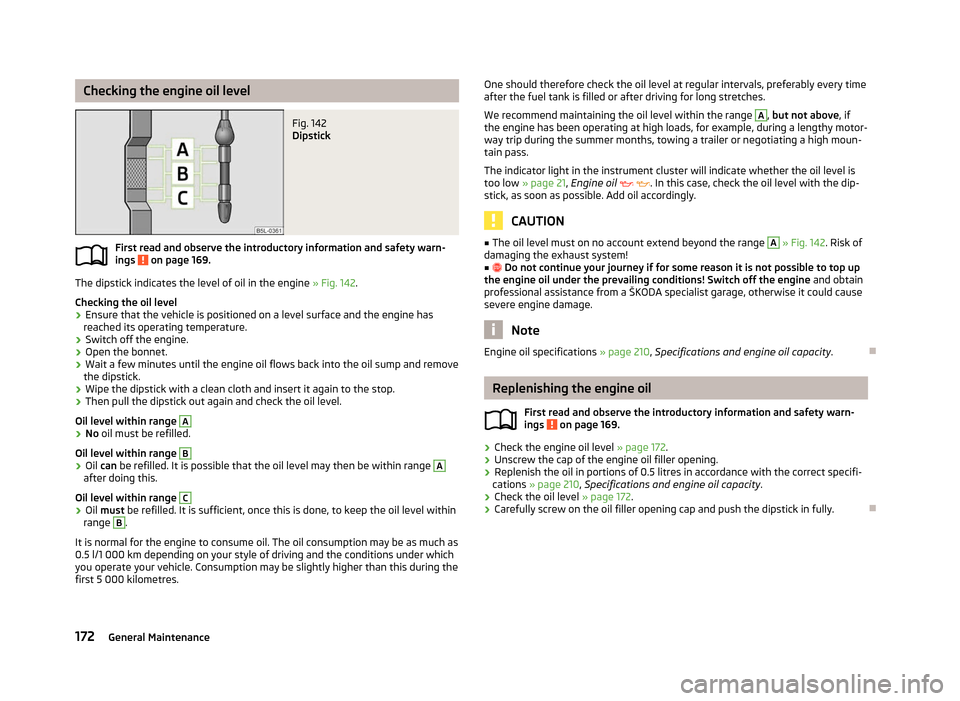
Fig. 142
Dipstick
First read and observe the introductory information and safety warn-
ings on page 169.
The dipstick indicates the level of oil in the engine
» Fig. 142.
Checking the oil level
› Ensure that the vehicle is positioned on a level surface and the engine has
reached its operating temperature.
› Switch off the engine.
› Open the bonnet.
› Wait a few minutes until the engine oil flows back into the oil sump and remove
the dipstick.
› Wipe the dipstick with a clean cloth and insert it again to the stop.
› Then pull the dipstick out again and check the oil level.
Oil level within range A
›
No oil must be refilled.
Oil level within range B
›
Oil can
be refilled. It is possible that the oil level may then be within range A
after doing this.
Oil level within range C
›
Oil must be refilled. It is sufficient, once this is done, to keep the oil level within
range B
.
It is normal for the engine to consume oil. The oil consumption may be as much as
0.5 l/1 000 km depending on your style of driving and the conditions under which
you operate your vehicle. Consumption may be slightly higher than this during the
first 5 000 kilometres. ä
One should therefore check the oil level at regular intervals, preferably every time
after the fuel tank is filled or after driving for long stretches.
We recommend maintaining the oil level within the range A
, but not above
, if
the engine has been operating at high loads, for example, during a lengthy motor-
way trip during the summer months, towing a trailer or negotiating a high moun-
tain pass.
The indicator light in the instrument cluster will indicate whether the oil level is
too low » page 21, Engine oil . In this case, check the oil level with the dip-
stick, as soon as possible. Add oil accordingly. CAUTION
■ The oil level must on no account extend beyond the range A
» Fig. 142. Risk of
damaging the exhaust system!
■ Do not continue your journey if for some reason it is not possible to top up
the engine oil under the prevailing conditions! Switch off the engine and obtain
professional assistance from a
ŠKODA specialist garage, otherwise it could cause
severe engine damage. Note
Engine oil specifications » page 210, Specifications and engine oil capacity .Ð Replenishing the engine oil
First read and observe the introductory information and safety warn-
ings on page 169.
›
Check the engine oil level
» page 172.
› Unscrew the cap of the engine oil filler opening.
› Replenish the oil in portions of 0.5 litres in accordance with the correct specifi-
cations » page 210, Specifications and engine oil capacity .
› Check the oil level
» page 172.
› Carefully screw on the oil filler opening cap and push the dipstick in fully. Ð
ä
172 General Maintenance
Page 189 of 225
Wheel bolts
First read and observe the introductory information and safety warn-
ings on page 181.
Wheels and
wheel bolts are matched to each other in terms of design. Each time
you fit other wheels, e.g. light alloy wheels or wheels with winter tyres, you must
therefore also use the matching wheel bolts of the correct length and shape of
spherical cap. This is essential to ensure that the wheels are tightly fitted and
that the brake system operates properly. ÐWinter tyres
First read and observe the introductory information and safety warn-
ings on page 181.
The handling of your vehicle will be significantly improved when driving on wintry
roads if you fit winter tyres. Summer tyres do not offer the same grip on ice, snow
and at temperatures below 7 °C because of their construction (width, rubber
blend, tread pattern). This particularly applies to vehicles which are equipped with
low-profile tyres
or high-speed tyres (code index H or V on wall of tyre).
To achieve the best possible handling properties, winter tyres must be fitted on
all 4 wheels, the minimum tread depth must be 4
mm and tyres must be no older
than 4 years.
Winter tyres of a lower speed category can be used provided that the permissible
maximum speed of these tyres is not exceeded even if the possible maximum
speed of the vehicle is higher. For the sake of the environment
Fit the summer tyres on again in good time as they provide better handling prop-
erties, a shorter braking distance, less tyre noise, and reduced tyre wear on roads
which are free of snow and ice as well as at temperatures above 7
°C. The fuel
consumption is also lower. ÐSnow chains
First read and observe the introductory information and safety warn-
ings on page 181.ä
ä
ä
Snow chains must only be mounted on the front wheels.
When driving on wintry roads, snow chains improve not only traction, but also the
braking performance.
For technical reasons, it is only permissible to fit snow chains with the following
wheel/tyre combinations.
Valid for vehicles with front-wheel drive
For technical reasons, it is only permissible to fit snow chains with the following
wheel/tyre combinations.
Wheel size Depth (D)Tyre size
6J x 16 50 mm 205/55
7J x 16 45 mm 205/55
6J x 17 45 mm 205/50 Valid for vehicles with four-wheel drive
Snow chains can be used on the front wheels as on vehicles with front-wheel
drive » page 187, Valid for vehicles with front-wheel drive
.
In order to increase the traction (start-up properties), the use of snow chains is
also technically permissible on the rear axle (this means on the front and rear axle
at the same time) for the following wheel/tyre combinations.
Wheel size Depth (D)Tyre size
6J x 16 50 mm 205/55
7J x 16 45 mm 205/55
6J x 17 45 mm 205/50 The use of snow chains is only technically permissible on the rear axle for the fol-
lowing standard wheel/tyre combinations.
Wheel size Depth (D)Tyre size
7J x 16 45 mm 215/60
7J x 17 45 mm 225/50 When fitting snow chains on the front and rear axle at the same time, the maxi-
mum speed is limited to
50 km/h.
Only fit snow chains with links and locks not larger than 12 mm.
Remove the full wheel trims before installing the snow chains.
Observe the national legal regulations relating to the use of snow chains and the
maximum vehicle speed with snow chains. £
187
Wheels and Tyres