air condition SKODA YETI 2013 1.G / 5L Owner's Guide
[x] Cancel search | Manufacturer: SKODA, Model Year: 2013, Model line: YETI, Model: SKODA YETI 2013 1.G / 5LPages: 266, PDF Size: 26.71 MB
Page 187 of 266
ŠKODA Service Partners feature modern, specially developed tools and equip-
ment. Here, trained specialists have a comprehensive range of ŠKODA Genuine Parts and ŠKODA Genuine Accessories at their disposal.
All ŠKODA Service Partners operate in accordance with the latest manufacturerguidelines and instructions. All service work is therefore carried out on time and
in accordance with the quality standards. Adhering to these instructions and
guidelines helps ensure road safety and helps keep your vehicle in a good techni-
cal condition.
The ŠKODA Service Partners also offer a wide range of other services. ŠKODA Service Partners are therefore properly prepared to service your vehicleand to provide quality work. We therefore recommend that you have your vehicle
maintained by a ŠKODA Service Partner.
Service work, adjustments and technical alterations
Introduction
This chapter contains information on the following subjects:
Tests required by law
185
ŠKODA Service Partners
185
ŠKODA Genuine Parts
185
ŠKODA Genuine Accessories
186
Spoiler
186
Airbags
186
The instructions and guidelines from ŠKODA AUTO a.s. must be observed when
carrying out any modifications, repairs or technical alterations to your vehicle.
Adhering to these instructions and guidelines helps ensure road safety and helps
keep your vehicle in a good technical condition. After carrying out modifications,
repairs or technical alterations, the vehicle will comply with German road trans-
port regulations (StVZO)
Always consult a ŠKODA Partner » page 185 before buying accessories or parts,
or before carrying out any modifications, repairs or technical alterations to your
vehicle.
WARNING■ If work on your vehicle is not carried out properly, this can lead to operation-
al faults - risk of accident and serious injuries.■
We recommend only having these modifications and technical alterations
carried out by a specialist garage.
■
Interference on the electronic components and their software can lead to
operational faults. This interference can also impair not directly affected sys-
tems because of the networking of the electronic components. The operation- al safety of the vehicle may be at significant risk and can lead to increased
wear of parts.
■
The ŠKODA Partner accepts no liability for products that have not been ap-
proved by ŠKODA AUTO a.s. even though these may be products with an op-
erational approval or that have been approved by a government testing insti-
tute.
WARNING■ We advise you only to use ŠKODA Original Accessories and ŠKODA Original
Parts which have been expressly approved for use on your vehicle. Reliability,
safety and suitability for your vehicle are guaranteed with these.■
ŠKODA Original Accessories and ŠKODA Original Parts can be purchased
from ŠKODA Partners, who will also perform the professional assembly of the purchased parts.
For the sake of the environment
Technical documents regarding alterations carried out on the vehicle must be
kept by the vehicle user in order to be handed over to the recyclers at a later
date. This ensures that the vehicle is recycled in an environmentally sound man-
ner.
Note
Any damage caused by technical alterations made without the approval of the
manufacturer is excluded from the warranty.
184General Maintenance
Page 188 of 266
Tests required by lawFirst read and observe the introductory information and safety warn-ings
on page 184.
Many countries have legislation requiring the operational reliability and roadwor- thiness and/or exhaust gas properties of a vehicle to be tested at specific inter-
vals. These tests can be carried out by workshops or testing stations that have
been legally authorized for this purpose.
The ŠKODA Service Partners are up-to-date on the legally required tests and will
prepare the vehicle for the tests as part of a service operation if required, or will
be responsible for carrying out these tests. The specialist garages can carry out
the specified tests directly if required by the customer if they are authorised to do
so. This saves you time and money.
Even if you want to take your vehicle to an officially approved test centre for prior checking in preparation of a legally required test, we recommend that you consult
the service consultant of your ŠKODA Service Partner beforehand.
Based on their appraisal, the service consultant will tell you which areas you
should focus on in order to ensure that your vehicle will pass the technical test
without any problems. This allows you to avoid additional expenses resulting
from a possible subsequent test.
ŠKODA Service Partners
First read and observe the introductory information and safety warn-ings
on page 184.
ŠKODA Service Partners feature modern, specially developed tools and equip- ment. Here, trained specialists have access to a comprehensive range of ŠKODA
Original Parts and ŠKODA Original Accessories for carrying out modifications, re- pairs and technical alterations.
All ŠKODA service partners operate according to the most recent guidelines and instructions from ŠKODA AUTO a.s. All service and repair work is therefore carried
out on time and at the appropriate quality. Adhering to these instructions and
guidelines helps ensure road safety and helps keep your vehicle in a good techni-
cal condition.
ŠKODA Service Partners are therefore properly prepared to service your vehicle
and to provide quality work. We therefore advise you to have all modifications, re-
pairs and technical alterations to your vehicle carried out by a ŠKODA Service
Partner.
ŠKODA Genuine Parts
First read and observe the introductory information and safety warn-
ings
on page 184.
We recommend the use of ŠKODA Genuine Parts for your vehicle, as these parts
are approved by ŠKODA AUTO a.s.. They correspond precisely to the ŠKODA AUTO
a.s. regulations with regard to design, dimensional accuracy and material, and are
identical to the components used in series production.
ŠKODA AUTO a.s. is able to vouch for the safety, suitability and long service life ofthese products. We therefore recommend that you only use ŠKODA Genuine
Parts.
ŠKODA AUTO a.s. supplies the market with a complete range of ŠKODA Genuine
Parts - not only while the model is still in production but for at least 15 years after the end of series production for wear parts and at least 10 years after the end of
series production for all other vehicle parts.
ŠKODA Service Partners are liable for any defects of ŠKODA Genuine Parts for a
period of 2 years after sale in accordance with the materials defect liability, unless agreed otherwise in the purchase agreement. You should keep the approved war-ranty certificate and the invoices for these components for this period of time, so
that the commencement of the term can be verified.
Body repairs
ŠKODA vehicles are designed such that if any damage occurs to the body, it is on- ly necessary to replace those parts that are actually damaged.
However, before you decide to have damaged body parts replaced, you shouldfirst of all contact your specialist garage to determine whether or not the parts
can also be repaired. Repairs to body parts are usually cheaper.
185Vehicle care
Page 190 of 266
WARNINGInformation on the use of the airbag system■It is prohibited to manipulate individual parts of the airbag system, as this
might result in the airbag being deployed.■
Never install any airbag parts into the vehicle that have been removed from
old cars or have been recycled.
■
Never install damaged airbag parts in the vehicle. The airbags may then not
be deployed properly or even at all in the event of an accident.
■
No modifications of any kind must be made to parts of the airbag system.
WARNING■ A change to the vehicle's wheel suspension, including the use of non-ap-
proved wheels and tire combinations, can alter the functioning of the airbag system - risk of accident and fatal injury!■
Never make any changes to the front bumper or the bodywork.
WARNINGThe airbag control unit operates using pressure sensors located in the front
doors. For this reason, no adjustments may be carried out to the doors or door
panels (e.g. installation of additional loudspeakers). Resulting damage can have a negative impact on the function of the airbag system. Any work on thefront doors and door panels must be carried out by a specialist garage. The
following instructions must be observed.■
Never drive with inner door panels removed.
■
Never drive if parts of the inner door panel have been removed and the re-
sulting openings have not been properly sealed.
■
Never drive if the loudspeakers in the doors have been removed, unless the
loudspeaker openings have been properly sealed.
■
Always make sure that the openings are covered or filled if additional loud-
speakers or other equipment parts have been installed in the inner door pan-
els.
Washing your car
Introduction
This chapter contains information on the following subjects:
Washing by hand
188
Automatic car wash systems
188
Washing with a high-pressure cleaner
188
The best way to protect your vehicle against harmful environmental influences is frequent washing.
How often the vehicle should be washed depends on factors such as:
› Frequency of use.
› Parking situation (garage, under trees etc.).
› Season.
› Weather conditions.
› Environmental influences.
The longer insect residues, bird droppings, tree sap, road and industrial dust, tar, soot particles, road salt and other aggressive deposits remain adhering to the paintwork of your vehicle, the more detrimental their destructive effect can be.
High temperatures, such as those caused by intensive sun's rays, accentuate this
caustic effect.
It is essential to also thoroughly clean the underside of the vehicle at the end of
the winter.
WARNING■ When washing your vehicle in the winter: Water and ice in the braking sys-
tem can affect the braking efficiency – risk of accident!■
Only wash the vehicle when the ignition is switched off – risk of accident!
CAUTION
Do not wash your vehicle in bright sunlight – risk of paint damage.
For the sake of the environment
Only wash the vehicle at washing bays intended for this purpose.
187Vehicle care
Page 198 of 266
■Do not sit on wet seats - risk of seat deformation.■Always clean the seats from “seam to seam”.
Seat belts
First read and observe the introductory information and safety warn-
ings
on page 192.
The belt webbing must always be kept clean.
Wash dirty seat belts with mild soapy water.
Remove coarse dirt with a soft brush.
Dirty belt webbing may impair the correct functioning of the inertia reel.
WARNING■ The seat belts must not be removed for cleaning.■Never clean the seat belts chemically as chemical cleaning products could
destroy the fabric.■
The seat belts must not be allowed to come into contact with corrosive liq-
uids (e.g. acids).
■
Check the condition of all the seat belts on a regular basis. If any damage to
the belt webbing, seat belt connections, inertia reel or lock is detected, the
seat belt must be replaced by a specialist garage.
■
The seat belts must be fully dried before being rolled up.
195Vehicle care
Page 215 of 266

Wheels
Tyres and wheel rims
Introduction
This chapter contains information on the following subjects:
Service life of tyres
213
New tyres
214
Unidirectional tyres
215
Tyre pressure monitor
215
Spare wheel
216
Full wheel trim
217
Wheel bolts
217
Wheel bolts
217WARNINGThe national legal regulations must be observed for the use of tyres.WARNINGInstructions for the use of tyres■For the first 500 km, new tyres do not yet provide optimum grip, and appro-
priate care should therefore be taken when driving – risk of accident!■
Only use radial tyres of the same type, size (rolling circumference) and tread
pattern on all four wheels.
■
For reasons of driving safety, do not replace tyres individually.
■
Never exceed the maximum permissible load bearing capacity for fitted
tyres – risk of accident!
■
Never exceed the maximum permissible speed for fitted tyres – risk of acci-
dent!
■
Incorrect wheel alignment at the front or rear impairs handling – risk of acci-
dent!
WARNING (Continued)■ Unusual vibrations or pulling of the vehicle to one side could be a sign of
tyre damage. If there is any doubt that a wheel is damaged, immediately re-
duce your speed and stop! If no external damage is evident, drive slowly and
carefully to the nearest specialist garage to have the vehicle checked.■
Only use tyres or wheel rims that have been approved by ŠKODA for your
model of vehicle. Failure to observe this instruction may impair the road safety
of your vehicle – risk of accident!
WARNINGInformation regarding tyre damage or wear■Never use tyres if you do not know anything about the condition and age.■
Never drive with damaged tyres – risk of accident!
■
Immediately replace damaged wheel rims or tyres.
■
You must have your tyres replaced with new ones at the latest when the
wear indicators have been worn down.
■
Worn tyres impair necessary adhesion to the road surface, particularly at
high speeds on wet roads. This could lead to “aquaplaning” (uncontrolled ve- hicle movement – “swimming” on a wet road surface).
WARNINGInformation on tyre pressure■The tyre control display does not absolve the driver of the responsibility to
ensure the correct tyre inflation pressure. Check the tyre inflation pressure at
regular intervals.■
Insufficient or excessive inflation pressure impairs handling – risk of acci-
dent!
■
If the inflation pressure is too low, the tyre will have to overcome a higher
rolling resistance. This will cause a significant increase in the temperature of
the tyre, especially at higher speeds. This can result in tread separation and a
tyre blowout.
212General Maintenance
Page 240 of 266
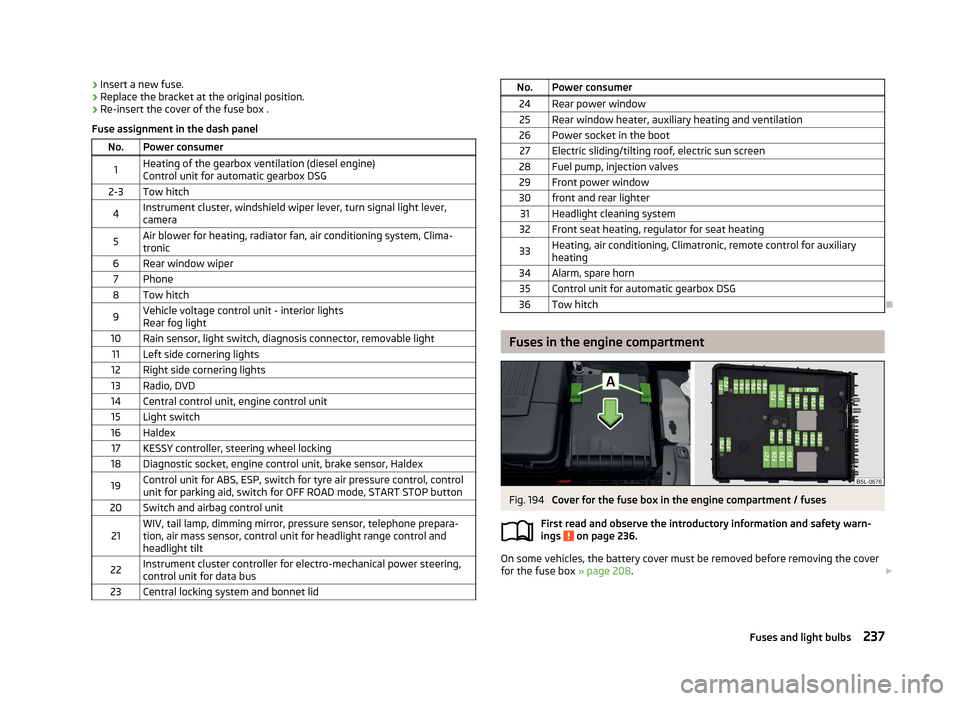
›Insert a new fuse.›Replace the bracket at the original position.›
Re-insert the cover of the fuse box .
Fuse assignment in the dash panel
No.Power consumer1Heating of the gearbox ventilation (diesel engine)
Control unit for automatic gearbox DSG2-3Tow hitch4Instrument cluster, windshield wiper lever, turn signal light lever,
camera5Air blower for heating, radiator fan, air conditioning system, Clima-
tronic6Rear window wiper7Phone8Tow hitch9Vehicle voltage control unit - interior lights
Rear fog light10Rain sensor, light switch, diagnosis connector, removable light11Left side cornering lights12Right side cornering lights13Radio, DVD14Central control unit, engine control unit15Light switch16Haldex17KESSY controller, steering wheel locking18Diagnostic socket, engine control unit, brake sensor, Haldex19Control unit for ABS, ESP, switch for tyre air pressure control, control
unit for parking aid, switch for OFF ROAD mode, START STOP button20Switch and airbag control unit21WIV, tail lamp, dimming mirror, pressure sensor, telephone prepara- tion, air mass sensor, control unit for headlight range control and
headlight tilt22Instrument cluster controller for electro-mechanical power steering, control unit for data bus23Central locking system and bonnet lidNo.Power consumer24Rear power window25Rear window heater, auxiliary heating and ventilation26Power socket in the boot27Electric sliding/tilting roof, electric sun screen28Fuel pump, injection valves29Front power window30front and rear lighter31Headlight cleaning system32Front seat heating, regulator for seat heating33Heating, air conditioning, Climatronic, remote control for auxiliary
heating34Alarm, spare horn35Control unit for automatic gearbox DSG36Tow hitch
Fuses in the engine compartment
Fig. 194
Cover for the fuse box in the engine compartment / fuses
First read and observe the introductory information and safety warn-
ings
on page 236.
On some vehicles, the battery cover must be removed before removing the cover
for the fuse box » page 208.
237Fuses and light bulbs
Page 247 of 266
Technical data
Technical data
Vehicle data
Introduction
This chapter contains information on the following subjects:
Vehicle identification data
244
Dimensions
245
angle and gradeability
246
Vehicle-specific details per engine type
247
The details given in the vehicle's technical documentation always take prece-
dence over the details in the Owner's Manual.
The listed performance values were determined without performance-reducing
equipment, e.g. air conditioning system.
Vehicle identification data
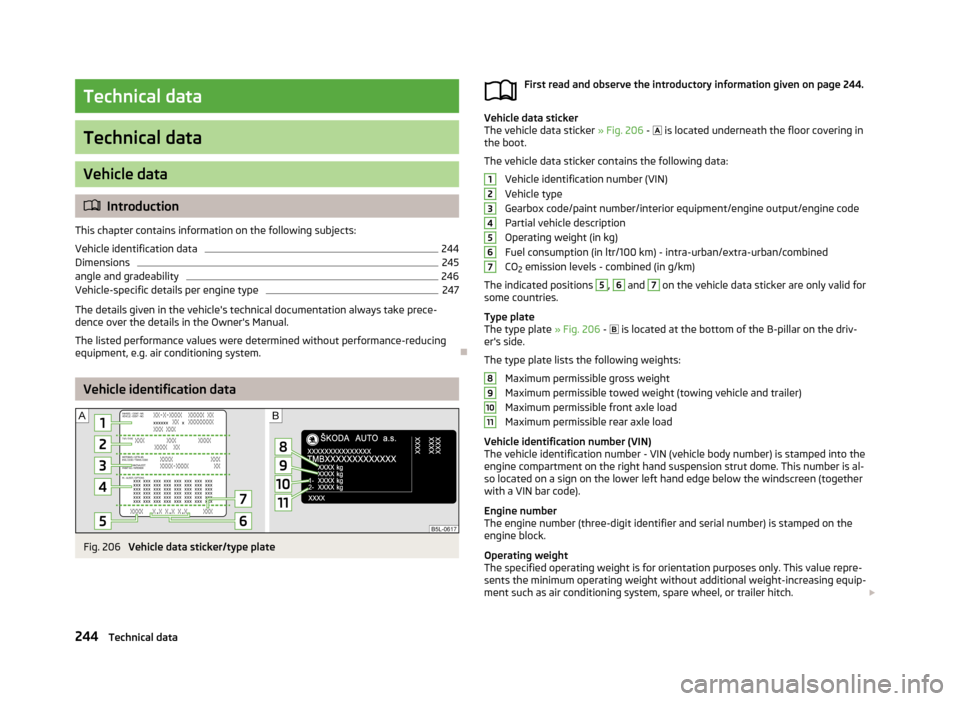
Fig. 206
Vehicle data sticker/type plate
First read and observe the introductory information given on page 244.
Vehicle data sticker
The vehicle data sticker » Fig. 206 - is located underneath the floor covering in
the boot.
The vehicle data sticker contains the following data: Vehicle identification number (VIN)
Vehicle type
Gearbox code/paint number/interior equipment/engine output/engine code Partial vehicle description
Operating weight (in kg) Fuel consumption (in ltr/100 km) - intra-urban/extra-urban/combined
CO 2 emission levels - combined (in g/km)
The indicated positions
5
,
6
and
7
on the vehicle data sticker are only valid for
some countries.
Type plate
The type plate » Fig. 206 -
is located at the bottom of the B-pillar on the driv-
er's side.
The type plate lists the following weights: Maximum permissible gross weight
Maximum permissible towed weight (towing vehicle and trailer)
Maximum permissible front axle load
Maximum permissible rear axle load
Vehicle identification number (VIN)
The vehicle identification number - VIN (vehicle body number) is stamped into the
engine compartment on the right hand suspension strut dome. This number is al-so located on a sign on the lower left hand edge below the windscreen (together
with a VIN bar code).
Engine number
The engine number (three-digit identifier and serial number) is stamped on the
engine block.
Operating weight
The specified operating weight is for orientation purposes only. This value repre- sents the minimum operating weight without additional weight-increasing equip-
ment such as air conditioning system, spare wheel, or trailer hitch.
1234567891011244Technical data
Page 254 of 266
Index
A
Abroad Driving abroad
135
Unleaded petrol135
ABS Operation
137
Warning light19
Accessories184
Adaptive headlights (AFS)50
Adjusting Belt height
167
Exterior mirrors59
Head restraints66
Interior mirror59
Seats62
Steering wheel117
Adjusting the headrests
67
Adjusting the seats161
Adjustment Headlight beam
47
Aerial188
See windows191
AFS50
Airbag169
Deactivating175
Deactivating the front passenger airbag176
Deployment169
Front airbag171
Head airbag174
Indicator light21
Knee airbag172
Modifications and damage to the airbag system 186
Side airbag
173
Airbag system169
Air conditioning Climatronic95
manual air conditioning94
Recirculation93
Air conditioning system Air outlets
92
Air outlets92
Alarm Switching off
39
Triggering39
Anti-theft alarm system Activating/deactivating
39
Trailer159
Antilock brake system (ABS)137
Armrest Front
65
Artificial leather194
Ashtray74
ASR warning light
18
Assistence systems OFF ROAD-mode
138
Assist systems136
ABS19, 137
ASR18
Cruise Control System147
DSR137
EDL137
ESC18, 136
HBA137
HHC138
Park assist143
Parking aid140
START-STOP149
TCS137
Auto Check Control13
Automatic driving lamp control49
Automatic gearbox Manual shifting of gears
127
Selector lever-emergency unlocking233
Starting-off and driving128
Tiptronic127
Automatic load deactivation210
Automatic transmission126
Kickdown128
Malfunction128
Selector lever lock127
Using the selector lever127
Auxiliary heating and ventilation System settings
98
auxiliary heating and ventilations Switching on and off directly
98
Auxiliary heating (auxiliary heating and ventila- tion)
97
Radio remote control99
B
Ball head Check fitting
155
Ball rod installing
154
Ready position153
removing155
Bar with sliding hook84
Battery In the remote control key
231
Belts164
Belt tensioners168
Bonnet Closing
200
Opening200
Boot Class N1 vehicles
88
see Boot lid41
Boot lid41
Automatic locking41
Warning light17
Brake information messages
15
warning light15
251Index
Page 257 of 266
Engine oil202
Capacity203
Changing204
Checking203
Replenishing204
Specifications203
Environment130
Environmental compatibility133
Environmentally friendly driving130
EPC Warning light
20
ESC Function
136
Warning light18
Exhaust inspection system Warning light
19
F
Fastening elements
82
Fatigue detection151
Function151
Information messages151
Films190
Fire extinguisher220
First aid kit219
Flexible storage compartment84
Floor covering in the luggage compartment
85
fog lights Remove protective grille - version 1
240
Remove protective grille - version 2240
Remove protective grille with plug - version 1241
remove protective grille with plug - version 2241
replacing bulb241
Fog lights51
Warning light22
Fog lights with CORNER function51
Folding seats back into the initial position
70
Folding down the seats67
Folding table at the center backrest
80
on front seat backrest80
Fold in passenger's mirror60
Footmats126
see footmats126
Force limit Power windows
43
Sliding/tilting roof45
Fording134
Front airbag171
Front door warning light54
Front interior light53
Front seats61
Fuel196
Diesel198
Fuel gauge12
refer to Fuel196
Refuelling196
Unleaded petrol197
Fuel consumption130
Fuel reserve Indicator light
20
Fuses Assignment
236
Colour coding236
Fuse assignment in the engine compartment238
Replacing236
G
Gearbox Information messages
13
Gear change Gear recommendation
24
Information on the selected gear24
Gear changing Gear stick
125
General view Cockpit9
Generator Indicator light
16
Glow plug system Warning light
19
gradeability see pitch angle
246
GSM103, 105
H
Handbrake
125
Warning light15
Hands-free system Voice control
110
Hazard warning light system52
HBA137
Head airbag174
Headlight cleaning system Headlight cleaning system
58
Headlights Bulb arrangement
239
Driving abroad135
Headlight cleaning system58
Head restraint66
Heater Windscreen and rear window
55
Heating Control elements
94
Exterior mirrors59
Recirculation93
Seats64
Heating and air-conditioning91
HHC138
Hill Hold Control (HHC)138
Hook83
Horn9
Hydraulic Brake Assist (HBA)137
254Index
Page 259 of 266
Luggage compartment lid40
M
Main beam
49
Warning light22
Maintenance132
Decorative films190
Manual air conditioning Operating elements
94
Manual gear changing see gear changing
125
Materials defect liability5
MAXI DOT See MAXI DOT display
28
MAXI DOT display28
Main menu28
Operation23
Settings29
Maximum speed247
Memory Function for the seat63
MFD See multifunction display
25
Mirror Exterior mirrors
59
Mirrors Interior mirror
59
Vanity55
Mobile phone100, 103, 105
Connecting to the hands-free system103, 106
Modes of the automatic transmission127
Modifications184
Modifications and technical alterations Airbags
186
Service185
Spoiler186
Multifunction display Functions
25
Information26
Memory26
Operation23
Multimedia113
AUX115
MDI115
N
N1
88
Net partition86
Nets83
O
OFF ROAD
138
activation / deactivation140
operation138
OFF ROAD mode warning light
22
oil information messages
17
Oil See Engine oil
203
oil pressure information messages
17
On-board computer See multifunction display
25
Operate windscreen wipers
57
Operation in winter Diesel fuel
198
Vehicle battery209
Outside temperature26
Overhang angle246
Overview Engine compartment
201
Warning lights14
P
Paintwork See Paintwork care
189
Paintwork care189
Park assist143
Finding a parking space144
Information messages146
Parking145
Parking Automatic brake assist
146
Manoeuvring out of a parallel parking space146
Park assist143
Parking aid140
Parking aid140
Function141
Parking vehicle38
Part replacement184
Passive safety Before setting off
160
Driving safety161
Safety equipment160
Passive Safety160
Pedals126
Footmats126
Petrol refer to Fuel
197
pitch angle246
Polishing the paintwork See Taking care of your vehicle
189
Power outlet 12 V
75
Power steering118
Warning light17
Power windows Button in the front passenger door
43
Practical equipment Reflective vest
219
256Index