brake fluid SKODA YETI 2013 1.G / 5L Owner's Manual
[x] Cancel search | Manufacturer: SKODA, Model Year: 2013, Model line: YETI, Model: SKODA YETI 2013 1.G / 5LPages: 266, PDF Size: 26.71 MB
Page 7 of 266
Taking care of your vehicle exterior189Taking care of the interior192
Inspecting and replenishing
196
Fuel
196
Engine compartment
199
Engine oil
202
Coolant
204
Brake fluid
206
Vehicle battery
207
Wheels
212
Tyres and wheel rims
212
Winter operation
217
Do-it-yourself
Emergency equipment and self-help
219
Emergency equipment
219
Changing a wheel
221
Tyre repair
224
Jump-starting
226
Towing the vehicle
228
Remote control and removable light
230
Emergency unlocking/locking
232
Emergency operation of the sliding/tilting roof
234
Replacing windscreen wiper blades
234
Fuses and light bulbs
236
Fuses
236
Bulbs
238
Technical data
Technical data
244
Vehicle data
244
Index
4Table of Contents
Page 17 of 266
The menu item Vehicle status is shown in the main menu of the MAXI DOT dis-
play whenever at least one fault message exists. After selecting this menu, the
first of the error messages is displayed. Several error messages are shown on the
display under the message e.g. 1/3. This indicates that the first of a total of three
error messages is being displayed.
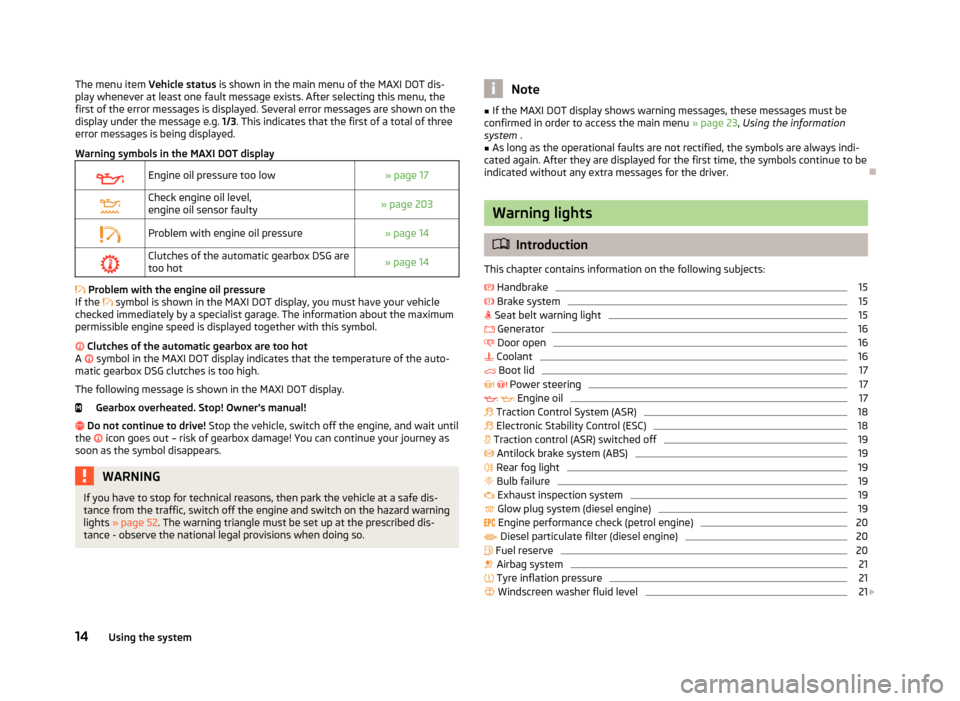
Warning symbols in the MAXI DOT displayEngine oil pressure too low» page 17Check engine oil level,
engine oil sensor faulty» page 203Problem with engine oil pressure» page 14Clutches of the automatic gearbox DSG are too hot» page 14
Problem with the engine oil pressure
If the
symbol is shown in the MAXI DOT display, you must have your vehicle
checked immediately by a specialist garage. The information about the maximum
permissible engine speed is displayed together with this symbol.
Clutches of the automatic gearbox are too hot
A
symbol in the MAXI DOT display indicates that the temperature of the auto-
matic gearbox DSG clutches is too high.
The following message is shown in the MAXI DOT display. Gearbox overheated. Stop! Owner's manual!
Do not continue to drive! Stop the vehicle, switch off the engine, and wait until
the
icon goes out – risk of gearbox damage! You can continue your journey as
soon as the symbol disappears.
WARNINGIf you have to stop for technical reasons, then park the vehicle at a safe dis- tance from the traffic, switch off the engine and switch on the hazard warning
lights » page 52 . The warning triangle must be set up at the prescribed dis-
tance - observe the national legal provisions when doing so.Note■ If the MAXI DOT display shows warning messages, these messages must be
confirmed in order to access the main menu » page 23, Using the information
system .■
As long as the operational faults are not rectified, the symbols are always indi-
cated again. After they are displayed for the first time, the symbols continue to be
indicated without any extra messages for the driver.
Warning lights
Introduction
This chapter contains information on the following subjects:
Handbrake
15
Brake system
15
Seat belt warning light
15
Generator
16
Door open
16
Coolant
16
Boot lid
17
Power steering
17
Engine oil
17
Traction Control System (ASR)
18
Electronic Stability Control (ESC)
18
Traction control (ASR) switched off
19
Antilock brake system (ABS)
19
Rear fog light
19
Bulb failure
19
Exhaust inspection system
19
Glow plug system (diesel engine)
19
Engine performance check (petrol engine)
20
Diesel particulate filter (diesel engine)
20
Fuel reserve
20
Airbag system
21
Tyre inflation pressure
21
Windscreen washer fluid level
21
14Using the system
Page 18 of 266
Turn signal system21 Fog lights22
Cruise control system
22
Selector lever lock
22
OFF ROADmode
22
Main beam
22
The warning lights indicate certain functions or faults.
Some warning lights can be accompanied by acoustic signals and messages in the
display of the instrument cluster.
After switching on the ignition, some warning lights illuminate briefly as a func-
tion test.
If the tested systems are OK, the corresponding warning lights go out a few sec-
onds after switching on the ignition.
WARNING■ Ignoring illuminated warning lights and related messages or instructions in
the display of the instrument cluster may lead to serious personal injury or
damage to the vehicle.■
If you have to stop for technical reasons, then park the vehicle at a safe dis-
tance from the traffic, switch off the engine and switch on the hazard warning lights » page 52 . The warning triangle must be set up at the prescribed dis-
tance - observe the national legal provisions when doing so.
■
The engine compartment of your car is a hazardous area. The following
warning instructions must be followed at all times when working in the en-
gine compartment » page 199, Engine compartment .
Handbrake
First read and observe the introductory information and safety warn-
ings
on page 14.
The indicator light
comes on if the handbrake is applied.
An acoustic signal will sound if you drive the vehicle above 6 km/h for at least 3
seconds while the handbrake is applied.
The following message is shown in the MAXI DOT display. Release parking brake!
Brake system
First read and observe the introductory information and safety warn-
ings
on page 14.
If the warning light lights up, the brake fluid level in the brake system is too
low.
The following message is shown in the MAXI DOT display. Brake fluid: Owner's manual!
Stop the vehicle, switch off the engine, and check the level of the brake flu-
id » page 206 .
If the warning light
lights up together with the warning light
, there is a
problem with the ABS.
WARNING■ If you have to stop for technical reasons, then park the vehicle at a safe dis-
tance from the traffic, switch off the engine and activate the hazard warning
light system » page 52. The warning triangle must be set up at the prescri-
bed distance - observe the national legal provisions when doing so.■
The following guidelines should be observed when opening the bonnet and
checking the brake fluid level » page 199, Engine compartment .
■
If the warning light is displayed simultaneously with warning light
» page 19 , Antilock brake system (ABS) , do not continue your jour-
ney! Seek help from a specialist garage.
■
A fault to the braking system can increase the vehicle's braking distance -
risk of accident!
Seat belt warning light
First read and observe the introductory information and safety warn-ings
on page 14.
The warning light
comes on after the ignition is switched on as a reminder for
the driver and front passenger to fasten the seat belt.
The warning light
goes out once the driver or front passenger has fastened
their seat belt.
15Instruments and Indicator Lights
Page 128 of 266
Low brake fluid level
An insufficient level of brake fluid may result in problems in the brake system. The
level of the brake fluid is monitored electronically » page 15, Brake system .
Brake booster
The brake booster increases the pressure generated with the brake pedal. The
brake booster only operates when the engine is running.
Handbrake
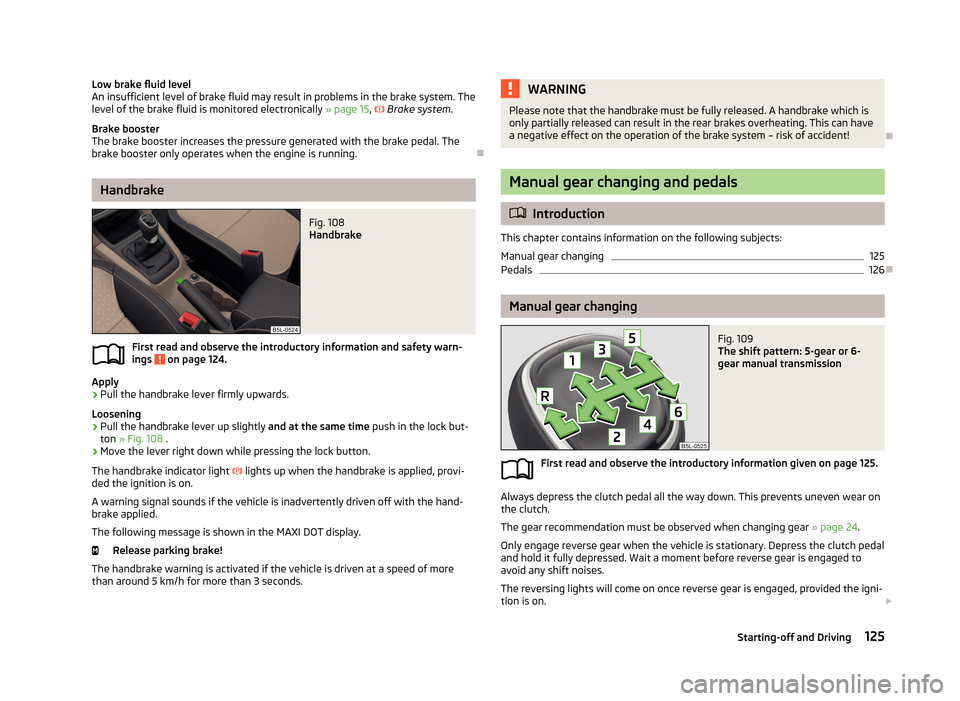
Fig. 108
Handbrake
First read and observe the introductory information and safety warn- ings on page 124.
Apply
›
Pull the handbrake lever firmly upwards.
Loosening
›
Pull the handbrake lever up slightly and at the same time push in the lock but-
ton » Fig. 108 .
›
Move the lever right down while pressing the lock button.
The handbrake indicator light
lights up when the handbrake is applied, provi-
ded the ignition is on.
A warning signal sounds if the vehicle is inadvertently driven off with the hand-
brake applied.
The following message is shown in the MAXI DOT display. Release parking brake!
The handbrake warning is activated if the vehicle is driven at a speed of more
than around 5 km/h for more than 3 seconds.
WARNINGPlease note that the handbrake must be fully released. A handbrake which is
only partially released can result in the rear brakes overheating. This can have a negative effect on the operation of the brake system – risk of accident!
Manual gear changing and pedals
Introduction
This chapter contains information on the following subjects:
Manual gear changing
125
Pedals
126
Manual gear changing
Fig. 109
The shift pattern: 5-gear or 6-
gear manual transmission
First read and observe the introductory information given on page 125.
Always depress the clutch pedal all the way down. This prevents uneven wear on the clutch.
The gear recommendation must be observed when changing gear » page 24.
Only engage reverse gear when the vehicle is stationary. Depress the clutch pedal
and hold it fully depressed. Wait a moment before reverse gear is engaged to
avoid any shift noises.
The reversing lights will come on once reverse gear is engaged, provided the igni- tion is on.
125Starting-off and Driving
Page 186 of 266
In order to operate a vehicle with a variable service interval, it must only be fil-
led and topped up with the prescribed engine oil.
If this engine oil is not available, the oil change is subject to a fixed service inter-
val. In this case, the vehicle must be changed to the fixed service interval.
Note
■
The corresponding motor oil specifications » page 203.■A specialist garage can perform the changeover from the variable service inter-
val to the fixed service interval, or from the fixed service interval to the variable
service interval.
Fixed service intervals QI1 - QI4
First read and observe the introductory information given on page 182.
InspectionQI1 - QI4
After the first 30,000 km or 2 years a)
, then every
30,000 km or every 1 year a)
.Every 15,000 km or every 1 year a)
(applies to Rus-
sia).
Oil change service
QI1Every 5,000 km or every 1 year a)
.QI2Every 7,000 km or every 1 year a)
.QI3Every 10,000 km or every 1 year a)
.QI4Every 15,000 km or every 1 year a)
.Brake fluid
change First change after 3 years, then every 2 years,a)
(whichever comes first).
WARNINGThe brake fluid must always be changed after the first 3 years and then every
2 years. Longer intervals between changing the brake fluid can cause vapour
bubbles to form in the brake system on sharp braking. This can impair the effi- ciency of the brakes – risk of accident!NoteFor diesel operation with a high sulphur content, the oil must be changed every
7,500 km. Ask your specialist garage for information on the countries where die-
sel fuel has a high sulphur content.
Variable service interval QI6
First read and observe the introductory information given on page 182.
The service intervals depend on the intensity at which the vehicle is driven and
the local conditions in which the vehicle is used. For example, your vehicle is sub-
jected to different loads when driven over short distances than when driven over
long distances. The service intervals are therefore variable.
InspectionAfter the first 30,000 km or 2 years a)
, then every 30,000 km
or every 1 year a)
.Oil change serviceAccording to the service interval display (at the latest after
30,000 km or 2 years a)
).Brake fluid
changeFirst change after 3 years, then every 2 years,a)
(whichever comes first).
WARNINGThe brake fluid must always be changed after the first 3 years and then every
2 years. Longer intervals between changing the brake fluid can cause vapour
bubbles to form in the brake system on sharp braking. This can impair the effi- ciency of the brakes – risk of accident!
Information about the ŠKODA service
First read and observe the introductory information given on page 182.
You have access to an extensive servicing network of ŠKODA Service Partners for
the maintenance of your vehicle.
183Vehicle care
Page 202 of 266
Engine compartment
Introduction
This chapter contains information on the following subjects:
Opening and closing the bonnet
200
Engine compartment overview
201
Radiator fan
201
Windscreen washer system
201WARNINGInjuries or scolding or risks of accident or fire may occur when working in the
engine compartment. For this reason, it is essential to comply with the warn- ing instructions outlined below and with the general applicable safety rules.
The engine compartment of your car is a hazardous area!WARNINGInstructions before beginning work in the engine compartment■Turn off the engine and withdraw the ignition key.■
Firmly apply the handbrake.
■
If the vehicle is fitted with a manual gearbox, move the gearshift lever into
Neutral, or if the vehicle is fitted with an automatic gearbox, move the selec-
tor lever into position P.
■
Allow the engine to cool.
■
Never open the bonnet if you can see steam or coolant escaping from the
engine compartment – risk of scalding! Wait until no more steam or coolant is escaping.
WARNINGInformation for working in the engine room■Keep children clear of the engine compartment.■
Never touch the radiator fan while the engine is still warm. The fan might
suddenly start running!
■
Do not touch any hot engine parts – risk of burns!
■
The coolant is harmful to health.
WARNING (Continued)■ Avoid contact with the coolant.■Coolant vapours are harmful to health.■
Never open the end cover of the coolant expansion reservoir while the en-
gine is still warm. The cooling system is pressurized!
■
When opening the end cover of the coolant expansion reservoir, cover it
with a cloth to protect your face, hands and arms from hot steam or hot cool-
ant.
■
If any coolant splashes into your eyes, immediately rinse out your eyes with
clear water and contact a doctor as soon as possible.
■
Always store the coolant additive securely in its original container, and in
particular out of the reach of children – risk of poisoning!
■
If coolant is swallowed, consult a doctor immediately.
■
Do not leave any items (e.g. cloths or tools) in the engine compartment.
■
Never spill fluids on the hot engine. Such fluids (e.g. the antifreeze con-
tained in the coolant) may ignite!
WARNINGInformation for working in the engine compartment with the engine running■Pay particular attention to rotating engine parts (e.g. V-ribbed belt, genera-
tor, radiator fan) and the high-voltage ignition system – risk to life!■
Never touch the electric wiring on the ignition system.
■
Avoid short circuits in the electrical system - particularly on the vehicle's
battery.
■
Always make sure that no jewellery, loose clothing or long hair can get
caught in rotating engine parts – risk to life! Always remove any jewellery, tie
back long hair and wear tight fitting clothing before completing any work.
WARNINGInformation for working on the fuel system or the electrical system■Always disconnect the vehicle battery from the electrical system.■
Do not smoke.
■
Never work near open flames.
■
Always have a functioning fire extinguisher nearby.
199Inspecting and replenishing
Page 204 of 266
›Take the bonnet support out of its holder 3
» Fig. 157 in the direction of the
arrow and secure the opened bonnet by inserting the end of the support into the opening 4
.
Closing
›
Lift the bonnet slightly and unhook the bonnet support. Insert the bonnet sup-
port into the holder
3
designed to hold it.
›
Let the bonnet drop into the lock carrier lock from a height of around 20 cm – do
not push it in .
WARNINGCheck that the bonnet is closed properly.
CAUTION
Never open the bonnet using the release lever » Fig. 156.
Engine compartment overview
Fig. 158
Principle sketch: Engine compartment
First read and observe the introductory information and safety warn- ings
on page 199.
Explanation of graphic » Fig. 158
Coolant expansion reservoir
205
Windscreen washer fluid reservoir
20112Engine oil dipstick203Engine oil filler opening204
Brake fluid reservoir
206
Battery (below a cover)
207
Note
The location of the inspection points in the engine compartment of petrol and
diesel engines is practically identical.
Radiator fan
First read and observe the introductory information and safety warn-
ings
on page 199.
The radiator fan is powered by an electric motor. Operation is controlled accord-
ing to the temperature of the coolant.
WARNINGAfter switching off the ignition, the fan may intermittently continue to oper-
ate for approx. 10 minutes.
Windscreen washer system
Fig. 159
Engine compartment: Wind-
screen washer fluid reservoir
First read and observe the introductory information and safety warn- ings on page 199.
The windscreen washer fluid reservoir
A
is located in the engine compart-
ment » Fig. 159 .
3456201Inspecting and replenishing
Page 209 of 266
If the coolant level in the coolant expansion tank is too low, this is indicated by
the warning light lighting up in the instrument cluster » page 16, Coolant .
We still recommend inspecting the coolant level directly at the reservoir from
time to time.
Loss of coolant
A loss of coolant is first and foremost an indication of a leak in the system. Do
not merely top up the coolant. Have the cooling system checked by a specialist
garage.
Replenishing
First read and observe the introductory information and safety warn-
ings
on page 204.
Only top up with new coolant.
›
Switch off the engine.
›
Allow the engine to cool.
›
Place a cloth over the cap of the coolant expansion tank and unscrew the cap carefully .
›
Replenish the coolant.
›
Turn the cap until it clicks into place.
Do not use an alternative additive if the specified coolant is not available in an emergency. In this case, use just water and have the correct mixing ratio of waterand coolant additive restored by a specialist garage as soon as possible.
Brake fluid
Introduction
This chapter contains information on the following subjects:
Checking the brake fluid level
206
Changing
207WARNING■ The engine compartment of your car is a hazardous area. The following
warning instructions must be followed at all times when working in the en-
gine compartment » page 199.■
If the fluid level has dropped below the MIN marking » Fig. 162 on page 206,
do not continue your journey - risk of accident! Seek help from a specialist
garage.
■
Do not use used brake fluid - the function of the brake system may be im-
paired – risk of accident!
CAUTION
Brake fluid damages the paintwork of the vehicle.
Note
■ The brake fluid is changed as part of a compulsory inspection service.■We recommend using oils from the ŠKODA Original Accessories range.
Checking the brake fluid level
Fig. 162
Engine compartment: Brake fluid
reservoir
First read and observe the introductory information and safety warn-
ings on page 206.
The brake fluid reservoir is located in the engine compartment » Fig. 162.
›
Switch off the engine.
›
Open the bonnet.
›
Check the level of brake fluid in the reservoir » Fig. 162.
The level must be between the “MIN” and “MAX” markings.
206General Maintenance
Page 210 of 266
A slight drop in the fluid level results when driving due to normal wear-and-tear
and automatic adjustment of the brake pads.
There may be an indication of a leak in the brake system, however, if the fluid lev-
el drops significantly within a short time or if it drops below the “MIN” marking.
If the brake fluid level is too low, this is indicated by the indicator light » page 15 , Brake system lighting up in the instrument cluster.
Changing
First read and observe the introductory information and safety warn-ings
on page 206.
Brake fluid absorbs moisture. Over time it therefore absorbs moisture from the
environment.
Excessive water in the brake fluid may be the cause of corrosion in the brake sys-
tem.
The water content lowers the boiling point of the brake fluid.
The brake fluid must comply with the following standards or specifications: › VW 50114;
› FMVSS 116 DOT4.
Vehicle battery
Introduction
This chapter contains information on the following subjects:
Opening the cover
208
Checking the battery electrolyte level
209
Charging
209
Replacing
210
Disconnecting and reconnecting
210
Automatic load deactivation
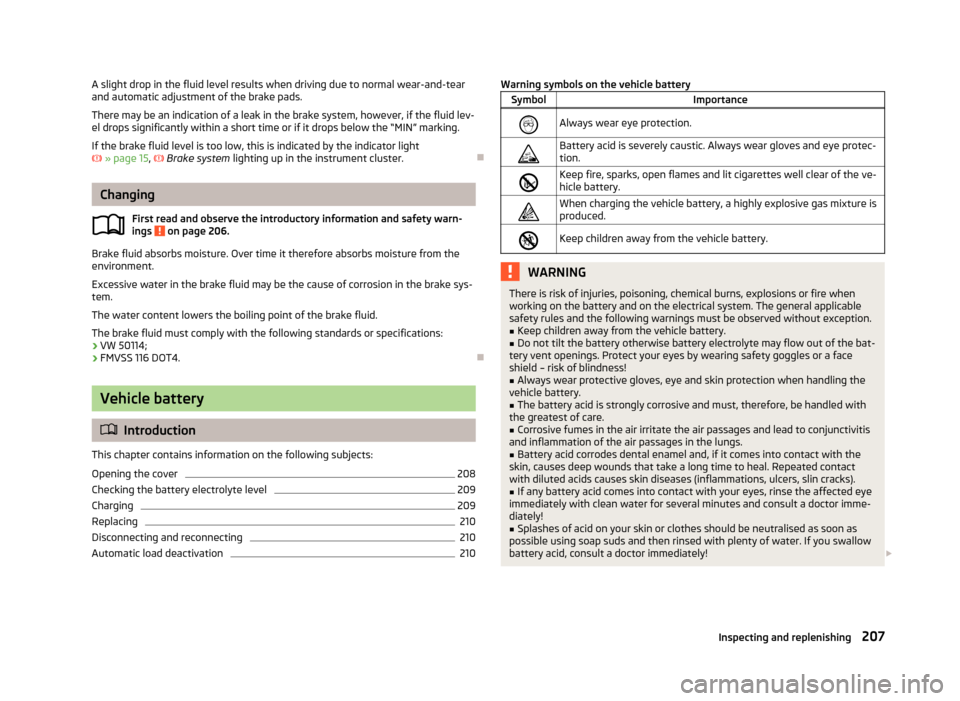
210Warning symbols on the vehicle batterySymbolImportanceAlways wear eye protection.Battery acid is severely caustic. Always wear gloves and eye protec- tion.Keep fire, sparks, open flames and lit cigarettes well clear of the ve-
hicle battery.When charging the vehicle battery, a highly explosive gas mixture is produced.Keep children away from the vehicle battery.WARNINGThere is risk of injuries, poisoning, chemical burns, explosions or fire when
working on the battery and on the electrical system. The general applicable
safety rules and the following warnings must be observed without exception.■
Keep children away from the vehicle battery.
■
Do not tilt the battery otherwise battery electrolyte may flow out of the bat-
tery vent openings. Protect your eyes by wearing safety goggles or a face
shield – risk of blindness!
■
Always wear protective gloves, eye and skin protection when handling the
vehicle battery.
■
The battery acid is strongly corrosive and must, therefore, be handled with
the greatest of care.
■
Corrosive fumes in the air irritate the air passages and lead to conjunctivitis
and inflammation of the air passages in the lungs.
■
Battery acid corrodes dental enamel and, if it comes into contact with the
skin, causes deep wounds that take a long time to heal. Repeated contact
with diluted acids causes skin diseases (inflammations, ulcers, slin cracks).
■
If any battery acid comes into contact with your eyes, rinse the affected eye
immediately with clean water for several minutes and consult a doctor imme-
diately!
■
Splashes of acid on your skin or clothes should be neutralised as soon as
possible using soap suds and then rinsed with plenty of water. If you swallow
battery acid, consult a doctor immediately!
207Inspecting and replenishing
Page 255 of 266
Brake booster125
Brake fluid206
Changing207
Checking206
information messages15
Brakes Brake assist systems
136
Brake booster125
Brake fluid206
Handbrake125
Running in130
Braking Information on braking
124
Breakdown kit225
Break recommendation See Fatigue detection
151
bulb failurel warning light
19
bulbs warning light
19
Bulbs Changing
238
In the rear light242
Button in the driver's door Electric power windows
41
C
Car computer See multifunction display
25
Car park ticket holder71
Carrier90
Cavity protection192
CD changer115
Central locking32
Central locking button36
changing bulb for low beam and high beam
240
ChangingBrake fluid207
Bulbs238
Bulbs in the rear light242
Engine oil204
Wheels221
Changing a wheel Follow-up tasks
222
Preparation222
Removing and refitting a wheel222
Charging a vehicle battery209
Check Fit ball head properly
155
Checking Battery electrolyte level
209
Brake fluid206
Coolant205
Engine oil203
Oil level203
Windscreen washer fluid201
Children and safety177
Child safety Side airbag
179
Child safety lock37
Child safety seat Use of child safety seats
179
Child seat Classification
179
ISOFIX180
on the front passenger seat178
TOP TETHER181
Use of ISOFIX child seats180
Chrome parts refer to Taking care of your vehicle
190
Cigarette lighter74
Cleaning182
Alcantara194
Artificial leather194
cloths194
Covers of electrically heated seats194
Headlight lenses191
Natural leather193
Plastic parts190
Wheels192
Climatronic Operarting elements
95
Recirculation93
Clothes hook79
Cockpit 12-volt power outlet
75
Ashtray74
Cigarette lighter74
General view9
Lighting53
Practical equipment70
Storage compartments70
Comfort control window
43
COMING HOME51
Compartment for glasses77
Compartments70
Computer See multifunction display
25
Convenience operation sliding / tilting roof
46
convenience turn signal49
coolant warning light
16
warning reports16
Coolant204
Checking205
Replenishing206
Temperature gauge11
CORNER See Fog lights with CORNER function
51
Correct seated position161
Driver162
Front passenger162
Rear seats162
Correct seating position Instructions
162
252Index