airbag off SKODA YETI 2017 Owner´s Manual
[x] Cancel search | Manufacturer: SKODA, Model Year: 2017, Model line: YETI, Model: SKODA YETI 2017Pages: 200, PDF Size: 28.93 MB
Page 72 of 200
Retrieving the saved setting
The retrieval is possible when turned the ignition is switched on and the vehi-
cle speed is less than 5 km/h or when the ignition key is inserted in the igni-
tion lock.›
Hold the desired memory button
B
» Fig. 57 .
Stopping the ongoing adjustment
›
Press any button on the driver's seat or the
button on the remote control
key.
Note
Every time you save new seat and exterior mirror settings for driving forwards,
you must also save the front passenger mirror setting for reversing again.
Memory function of the remote control key
Read and observe
on page 68 first.
Every time the vehicle is locked, the driver´s seat and exterior mirror settingsare saved and assigned to the key with which the vehicle was locked.
After the following unlocking of the vehicle with the same key, the driver´s
seat and exterior mirrors that are saved to this key will be adopted.
Activating the function
›
Unlock the vehicle with the corresponding remote control key and open the
driver door.
›
Press and hold any memory button
B
» Fig. 57 on page 69 .
›
After the seat has assumed the position stored under this button, at the
same time press the button on the remote control key within 10 seconds.
Activation is confirmed by an acoustic signal.
Storing front passenger´s exterior mirror settings for reversing
Above the MAXI DOT display in the
Mirror down
menu item, the lowering func-
tion for the mirror on the passenger side must be enabled for reversing
» page 43 , Menu item
Settings
.
›
Unlock the vehicle with the remote control key and switch on the ignition.
›
Turn the rotary knob for the exterior mirror control to the position for the
front passenger mirror area » page 67.
›
Engage reverse gear.
›
Adjust the front passenger's mirror to the desired position.
›
Disengage reverse gear. The adjusted position of the exterior mirror is stored
in the remote control key memory.
Deactivating the function›Unlock the vehicle with the remote control key.›
Press and hold down the
A
» Fig. 57 on page 69 button. At the same time,
press the
button on the remote control key within 10 seconds. Deactivation
is confirmed by an acoustic signal.
Stopping the ongoing adjustment
›
Press any button on the driver's seat or the
button on the remote control
key.
Folding front passenger seat
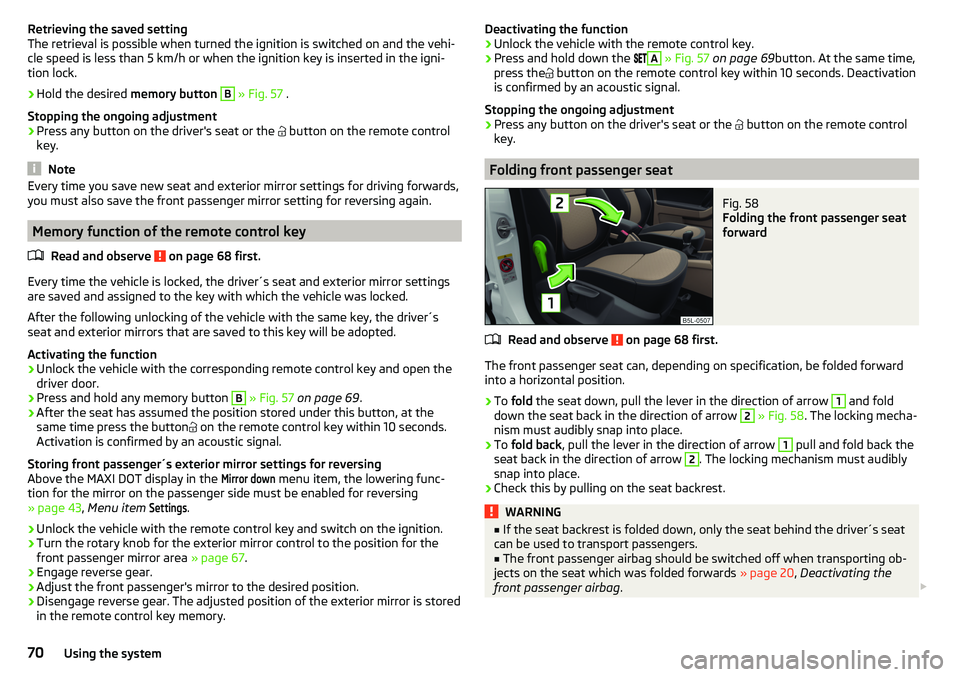
Fig. 58
Folding the front passenger seat
forward
Read and observe on page 68 first.
The front passenger seat can, depending on specification, be folded forward into a horizontal position.
›
To fold the seat down, pull the lever in the direction of arrow
1
and fold
down the seat back in the direction of arrow
2
» Fig. 58 . The locking mecha-
nism must audibly snap into place.
›
To fold back , pull the lever in the direction of arrow
1
pull and fold back the
seat back in the direction of arrow
2
. The locking mechanism must audibly
snap into place.
›
Check this by pulling on the seat backrest.
WARNING■ If the seat backrest is folded down, only the seat behind the driver´s seat
can be used to transport passengers.■
The front passenger airbag should be switched off when transporting ob-
jects on the seat which was folded forwards » page 20, Deactivating the
front passenger airbag .
70Using the system
Page 124 of 200
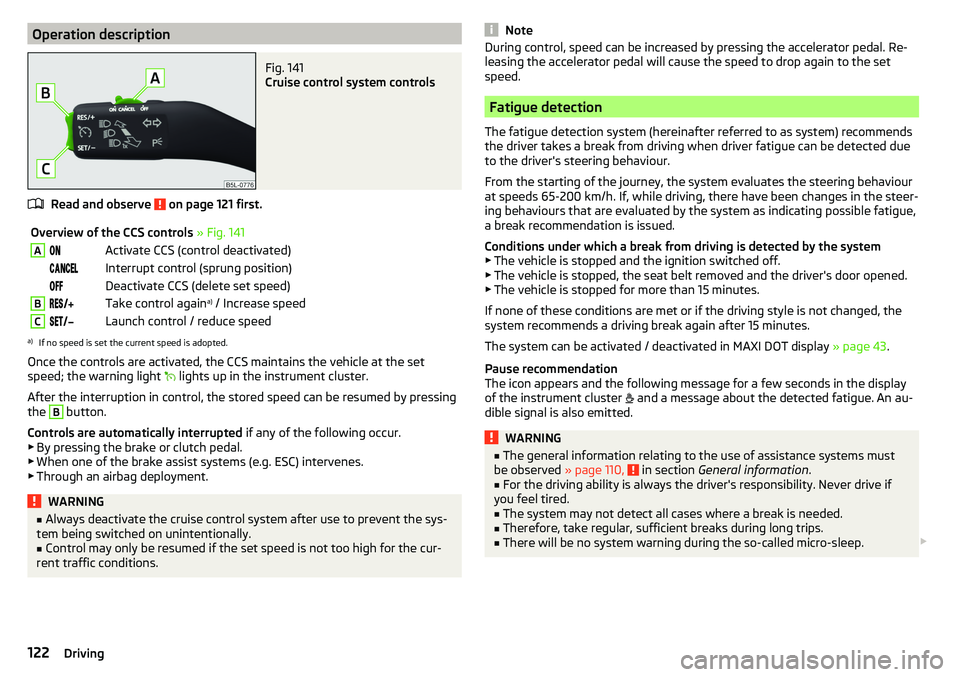
Operation descriptionFig. 141
Cruise control system controls
Read and observe on page 121 first.
Overview of the CCS controls » Fig. 141AActivate CCS (control deactivated) Interrupt control (sprung position) Deactivate CCS (delete set speed)BTake control again a)
/ Increase speedCLaunch control / reduce speeda)
If no speed is set the current speed is adopted.
Once the controls are activated, the CCS maintains the vehicle at the set
speed; the warning light lights up in the instrument cluster.
After the interruption in control, the stored speed can be resumed by pressing
the
B
button.
Controls are automatically interrupted if any of the following occur.
▶ By pressing the brake or clutch pedal.
▶ When one of the brake assist systems (e.g. ESC) intervenes.
▶ Through an airbag deployment.
WARNING■ Always deactivate the cruise control system after use to prevent the sys-
tem being switched on unintentionally.■
Control may only be resumed if the set speed is not too high for the cur-
rent traffic conditions.
NoteDuring control, speed can be increased by pressing the accelerator pedal. Re-
leasing the accelerator pedal will cause the speed to drop again to the set
speed.
Fatigue detection
The fatigue detection system (hereinafter referred to as system) recommends
the driver takes a break from driving when driver fatigue can be detected due
to the driver's steering behaviour.
From the starting of the journey, the system evaluates the steering behaviour
at speeds 65-200 km/h. If, while driving, there have been changes in the steer-
ing behaviours that are evaluated by the system as indicating possible fatigue,
a break recommendation is issued.
Conditions under which a break from driving is detected by the system ▶ The vehicle is stopped and the ignition switched off.
▶ The vehicle is stopped, the seat belt removed and the driver's door opened.
▶ The vehicle is stopped for more than 15 minutes.
If none of these conditions are met or if the driving style is not changed, the
system recommends a driving break again after 15 minutes.
The system can be activated / deactivated in MAXI DOT display » page 43.
Pause recommendation
The icon appears and the following message for a few seconds in the display
of the instrument cluster and a message about the detected fatigue. An au-
dible signal is also emitted.
WARNING■ The general information relating to the use of assistance systems must
be observed » page 110, in section General information .■
For the driving ability is always the driver's responsibility. Never drive if
you feel tired.
■
The system may not detect all cases where a break is needed.
■
Therefore, take regular, sufficient breaks during long trips.
■
There will be no system warning during the so-called micro-sleep.
122Driving
Page 133 of 200
General Maintenance
Care and maintenance
Service work, adjustments and technical alterations
Introduction
This chapter contains information on the following subjects:
Vehicle operating under different weather conditions
131
Statutory checks
131
ŠKODA service partner
131
ŠKODA Original parts
132
ŠKODA Original accessories
132
Spoiler
132
Component protection
132
Airbags
132
Acceptance and recycling of used vehicles
133
The instructions and guidelines from ŠKODA AUTO must be observed when us-
ing accessories or carrying out any modifications, repairs or technical altera-
tions to your vehicle.
Adhering to these instructions and guidelines helps ensure road safety and
helps keep your vehicle in a good technical condition.
WARNING■ Adjustments, repairs and technical changes to the vehicle should only be
carried out by a specialist. Work carried out incorrectly (including work on
the electronic components and their software) can result in malfunctions -
there is a risk of an accident and, potentially, increased wear on parts!■
We recommend that you use only ŠKODA Original Accessories and ŠKODA
Original Parts which have been expressly approved for use on your vehicle.
Reliability, safety and suitability for your vehicle are guaranteed with these.
■
Do not use any products which have not been approved by ŠKODA AUTO,
even though these may be products with a type approval or which have
been approved by a nationally recognised testing laboratory.
Vehicle operating under different weather conditions
Read and observe
on page 131 first.
If you would like to operate your vehicle in countries other than those with itsintended weather conditions, you should contact a ŠKODA Partner. He or she
will advise you if certain precautions need to be taken to ensure the full func-
tioning of the vehicle or to prevent damage (e.g. coolant, changing the battery
or similar).
Statutory checks
Read and observe
on page 131 first.
Many countries have legislation requiring the operational reliability, safety and,where applicable, roadworthiness and/or exhaust gas properties of a vehicle
to be tested at regular intervals. These tests can be carried out by workshops
or testing stations that have been legally authorized for this purpose.
The ŠKODA Service partners can prepare your vehicle for the official inspec-
tions, so as to ensure that it passes.
Even if you want to take your vehicle to an officially approved test centre for
prior checking in preparation for a legally required test, we recommend that
you consult your ŠKODA Service Partner beforehand.
ŠKODA service partner
Read and observe
on page 131 first.
All ŠKODA service partners work according to the instructions and guidelines
from ŠKODA AUTO. All service and repair work is therefore carried out on time
and at the appropriate quality. Adhering to these instructions and guidelines
helps ensure road safety and helps keep your vehicle in a good technical con-
dition.
We therefore advise you to have all modifications, repairs and technical altera-
tions to your vehicle carried out by a ŠKODA Service Partner.
131Care and maintenance
Page 170 of 200

Fuses in the dashboardFig. 193
Distribution board cover.
Read and observe and on page 167 first.
The fuses are located on the left side of the dash panel behind a cover.
Replacing fuses
›
Remove the ignition key, turn off the lights and all electrical consumers.
›
Insert a screwdriver into the opening in the cover in the direction of the ar-
row » Fig. 193 .
›
Remove the cover of the fuse box and remove.
›
Remove the plastic clip from the holder in the fuse box cover in the dash
panel.
›
Use the clip to pull the fuse out, then insert a new fuse.
›
Re-insert the cover of the fuse box .
›
Replace the bracket at the original position.
Fuse arrangement in the dashboard
Fig. 194
Fuses
Read and observe and on page 167 first.No.Consumer1Heating of the gearbox vent (diesel engine)
Automatic gearbox2Towing hitch - left light3Trailer device - electrical outlet4Instrument cluster control lever under the steering wheel, camera5Air blower for heating, radiator fan, air conditioning system, Clima-
tronic6Rear window wiper7emergency call8Towing hitch - right light9Interior lighting, rear fog light10Rain sensor, light switch, diagnostic socket11Left side front headlight12Right side front headlight13Radio14Central control system, engine management system15Light switch16All-wheel drive17KESSY, steering lock18Diagnostic connector, engine control system, brake sensor, four-
wheel drive, START-STOP19ABS, ESP, switch for tyre air pressure control, parking aid, switch for
OFF ROAD mode, START STOP button20Airbag21Variable Service Interval - WIV, reversing lamps, dimmable mirrors,
pressure sensor, telephone preparation, air mass meter, headlamp
levelling and swivelling headlights22Instrument cluster, electromechanical power steering, databus23Central locking, boot lid24Electric windows - Rear25Rear window heater, auxiliary heating and ventilation26Power socket in the boot 168Do-it-yourself
Page 186 of 200
Index
A
ABS Operation
110
Warning light34
Acceptance and recycling of used vehicles
133
Accessories131
Adaptive headlight see xenon headlight
60
AdBlue141
Check level141
indicator light30
refill142
Adjusting Steering wheel
11
Adjusting seats manually68
Adjusting the seats10
Advice on tyre/wheel usage150
AFS Display messages
34
Warning light34
AHL see xenon headlight
60
Air-conditioning system Air outlet vents
96
Airbag
16
Adjustments and impairments to the airbag system
132
Deactivation19
Deployment17
Warning light36
Airbag system16
Air conditioning93
Air distribution control96
Climatronic94
Manual air conditioning94
Air distribution control96
Air outlet vents96
Alarm51
Trailer130
All-year tyres152
Alternator Warning light
32
Anti-lock braking system (ABS)110
Anti-theft alarm system51
Trailer130
Anti-theft wheel bolts157
Armrest Front
71
Ashtray78
Assist systems110
Auto Check Control30
Automatic drive Selector lever
106
Automatic driving light control60
Automatic gearbox Kickdown
108
Selector lever-emergency unlocking166
Selector lever lock107
Starting-off and driving108
Tiptronic107
Automatic shutdown of consumers147
Automatic transmission106
Selector lever lock107
AUX77
Auxiliary heating (auxiliary heating and ventila- tion)
97
Avoiding damage to your vehicle109
B
Bar with sliding hook
88
Battery Changing batteries for the removable light
164
Changing in key164
Replace the battery in the remote control in the auxiliary heating
164
Belts13
Belt tensioners15
Bluetooth See Owner's Manual Infotainment
6
Bonnet Closing
143
Opening143
Boot Class N1 vehicles
91
See boot lid53
Boot lid Automatic locking
53
Open/Close53
Warning light32
Brake Assist (HBA)111
Brake booster103
Brake fluid147
Check147
specification147
Brake pads New
103
Brake pedal (automatic transmission) Warning light
37
Brakes Brake booster
103
Brake fluid147
Braking and stabilisation systems110
Handbrake104
Information on braking103
Warning lights32
Brake system110
Breakdown kit159
Breakdown service see Help in an emergency
8
Bulbs Replacing
170
Buttons in the door Electric window
54
184Index
Page 191 of 200
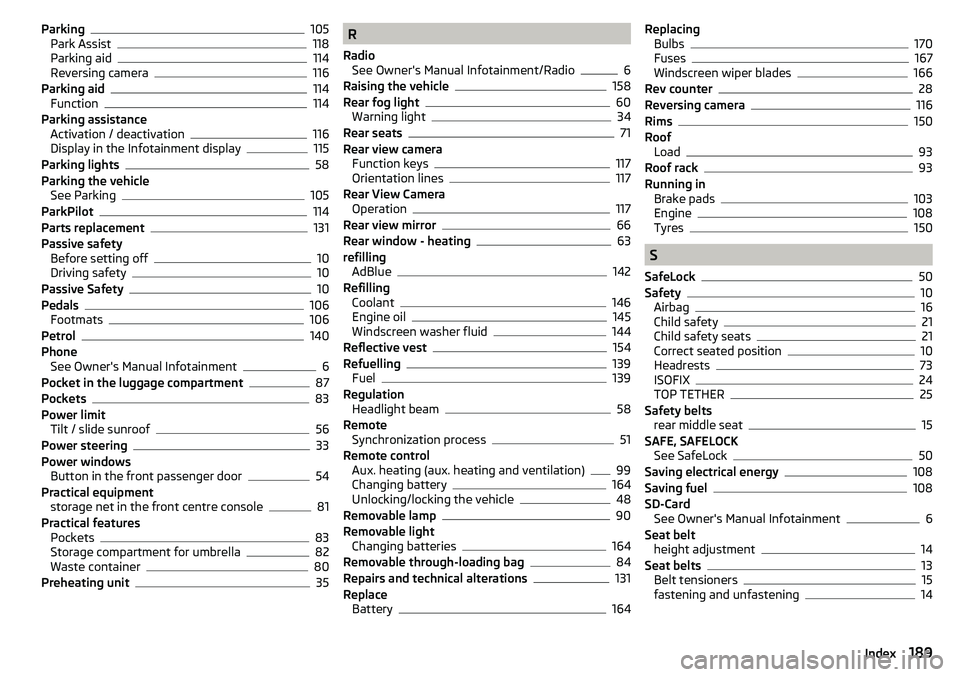
Parking105
Park Assist118
Parking aid114
Reversing camera116
Parking aid114
Function114
Parking assistance Activation / deactivation
116
Display in the Infotainment display115
Parking lights58
Parking the vehicle See Parking
105
ParkPilot114
Parts replacement131
Passive safety Before setting off
10
Driving safety10
Passive Safety10
Pedals106
Footmats106
Petrol140
Phone See Owner's Manual Infotainment
6
Pocket in the luggage compartment87
Pockets83
Power limit Tilt / slide sunroof
56
Power steering33
Power windows Button in the front passenger door
54
Practical equipment storage net in the front centre console
81
Practical features Pockets
83
Storage compartment for umbrella82
Waste container80
Preheating unit35
R
Radio See Owner's Manual Infotainment/Radio
6
Raising the vehicle158
Rear fog light60
Warning light34
Rear seats71
Rear view camera Function keys
117
Orientation lines117
Rear View Camera Operation
117
Rear view mirror66
Rear window - heating63
refilling AdBlue
142
Refilling Coolant
146
Engine oil145
Windscreen washer fluid144
Reflective vest154
Refuelling139
Fuel139
Regulation Headlight beam
58
Remote Synchronization process
51
Remote control Aux. heating (aux. heating and ventilation)
99
Changing battery164
Unlocking/locking the vehicle48
Removable lamp90
Removable light Changing batteries
164
Removable through-loading bag84
Repairs and technical alterations131
Replace Battery
164
Replacing Bulbs170
Fuses167
Windscreen wiper blades166
Rev counter28
Reversing camera116
Rims150
Roof Load
93
Roof rack93
Running in Brake pads
103
Engine108
Tyres150
S
SafeLock
50
Safety10
Airbag16
Child safety21
Child safety seats21
Correct seated position10
Headrests73
ISOFIX24
TOP TETHER25
Safety belts rear middle seat
15
SAFE, SAFELOCK See SafeLock
50
Saving electrical energy108
Saving fuel108
SD-Card See Owner's Manual Infotainment
6
Seat belt height adjustment
14
Seat belts13
Belt tensioners15
fastening and unfastening14
189Index