engine coolant SKODA YETI 2017 Owner´s Manual
[x] Cancel search | Manufacturer: SKODA, Model Year: 2017, Model line: YETI, Model: SKODA YETI 2017Pages: 200, PDF Size: 28.93 MB
Page 146 of 200
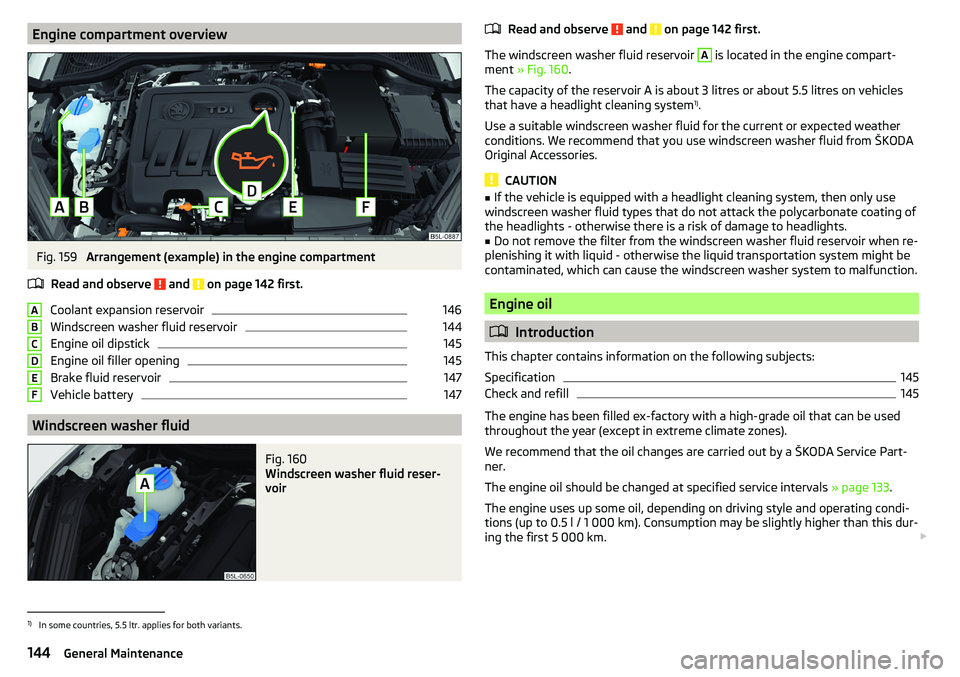
Engine compartment overviewFig. 159
Arrangement (example) in the engine compartment
Read and observe
and on page 142 first.
Coolant expansion reservoir
146
Windscreen washer fluid reservoir
144
Engine oil dipstick
145
Engine oil filler opening
145
Brake fluid reservoir
147
Vehicle battery
147
Windscreen washer fluid
Fig. 160
Windscreen washer fluid reser-
voir
ABCDEFRead and observe and on page 142 first.
The windscreen washer fluid reservoir
A
is located in the engine compart-
ment » Fig. 160 .
The capacity of the reservoir A is about 3 litres or about 5.5 litres on vehicles
that have a headlight cleaning system 1)
.
Use a suitable windscreen washer fluid for the current or expected weather
conditions. We recommend that you use windscreen washer fluid from ŠKODA
Original Accessories.
CAUTION
■ If the vehicle is equipped with a headlight cleaning system, then only use
windscreen washer fluid types that do not attack the polycarbonate coating of
the headlights - otherwise there is a risk of damage to headlights.■
Do not remove the filter from the windscreen washer fluid reservoir when re-
plenishing it with liquid - otherwise the liquid transportation system might be
contaminated, which can cause the windscreen washer system to malfunction.
Engine oil
Introduction
This chapter contains information on the following subjects:
Specification
145
Check and refill
145
The engine has been filled ex-factory with a high-grade oil that can be used
throughout the year (except in extreme climate zones).
We recommend that the oil changes are carried out by a ŠKODA Service Part- ner.
The engine oil should be changed at specified service intervals » page 133.
The engine uses up some oil, depending on driving style and operating condi-
tions (up to 0.5 l / 1 000 km). Consumption may be slightly higher than this dur-
ing the first 5 000 km.
1)
In some countries, 5.5 ltr. applies for both variants.
144General Maintenance
Page 148 of 200
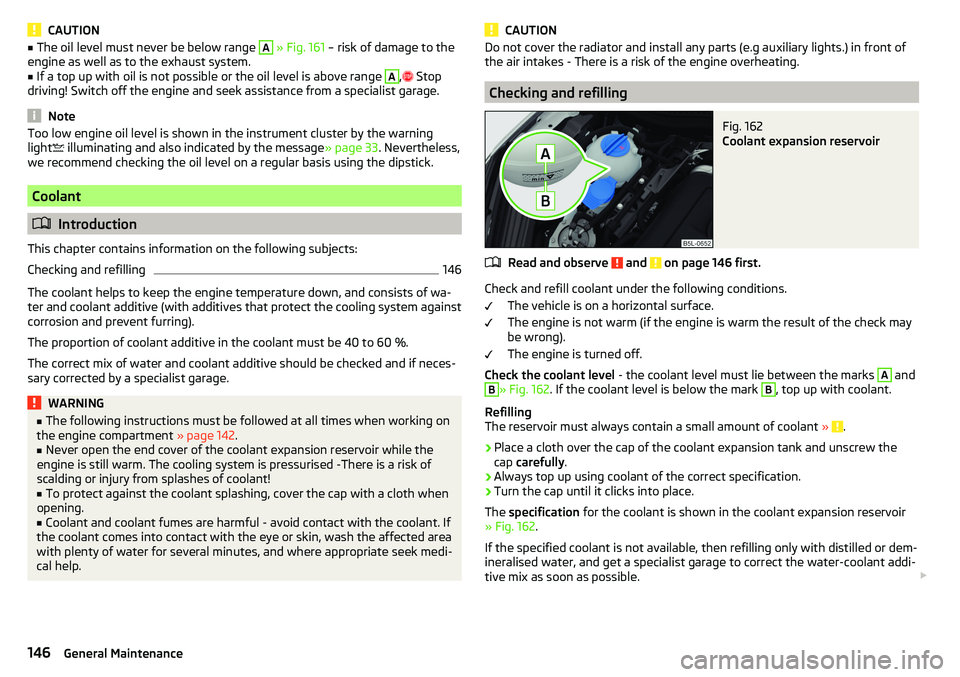
CAUTION■The oil level must never be below range A » Fig. 161 – risk of damage to the
engine as well as to the exhaust system.■
If a top up with oil is not possible or the oil level is above range
A
,
Stop
driving! Switch off the engine and seek assistance from a specialist garage.
Note
Too low engine oil level is shown in the instrument cluster by the warning
light illuminating and also indicated by the message » page 33. Nevertheless,
we recommend checking the oil level on a regular basis using the dipstick.
Coolant
Introduction
This chapter contains information on the following subjects:
Checking and refilling
146
The coolant helps to keep the engine temperature down, and consists of wa- ter and coolant additive (with additives that protect the cooling system against
corrosion and prevent furring).
The proportion of coolant additive in the coolant must be 40 to 60 %.
The correct mix of water and coolant additive should be checked and if neces-
sary corrected by a specialist garage.
WARNING■ The following instructions must be followed at all times when working on
the engine compartment » page 142.■
Never open the end cover of the coolant expansion reservoir while the
engine is still warm. The cooling system is pressurised -There is a risk of
scalding or injury from splashes of coolant!
■
To protect against the coolant splashing, cover the cap with a cloth when
opening.
■
Coolant and coolant fumes are harmful - avoid contact with the coolant. If
the coolant comes into contact with the eye or skin, wash the affected area
with plenty of water for several minutes, and where appropriate seek medi-
cal help.
CAUTIONDo not cover the radiator and install any parts (e.g auxiliary lights.) in front of
the air intakes - There is a risk of the engine overheating.
Checking and refilling
Fig. 162
Coolant expansion reservoir
Read and observe and on page 146 first.
Check and refill coolant under the following conditions.
The vehicle is on a horizontal surface.
The engine is not warm (if the engine is warm the result of the check may
be wrong).
The engine is turned off.
Check the coolant level - the coolant level must lie between the marks
A
and
B
» Fig. 162. If the coolant level is below the mark
B
, top up with coolant.
Refilling
The reservoir must always contain a small amount of coolant »
.
›
Place a cloth over the cap of the coolant expansion tank and unscrew the
cap carefully .
›
Always top up using coolant of the correct specification.
›
Turn the cap until it clicks into place.
The specification for the coolant is shown in the coolant expansion reservoir
» Fig. 162 .
If the specified coolant is not available, then refilling only with distilled or dem-
ineralised water, and get a specialist garage to correct the water-coolant addi-
tive mix as soon as possible.
146General Maintenance
Page 149 of 200
CAUTION■If the expansion tank is empty, do not top up with coolant. The system could
aerate - There is a risk of engine damage! Stop driving! Switch off the en-
gine and seek assistance from a specialist garage.■
Do not fill the coolant above the mark
A
» Fig. 162 . The coolant could, when
heated, be expelled from the cooling system - There is a risk of damage to the
engine parts.
■
If it is not possible to add coolant,
stop driving! Switch off the engine and
seek assistance from a specialist garage.
■
A coolant additive which does not correspond to the correct specification can
reduce the anti-corrosion effect of the cooling system - risk of damage to the
cooling system and the engine.
■
If non-distilled (non-demineralised) water has been used to top up, the cool-
ant should be replaced by a specialist garage - There is a risk of engine dam-
age.
■
A loss of coolant indicates leaks in the cooling system -There is a risk of en-
gine damage. Top up with coolant and then seek assistance from a specialist
garage.
Note
Too low coolant level is indicated in the instrument cluster by the warning
light and shown by the message » page 32. We still recommend inspecting
the coolant level directly at the reservoir from time to time.
Brake fluid
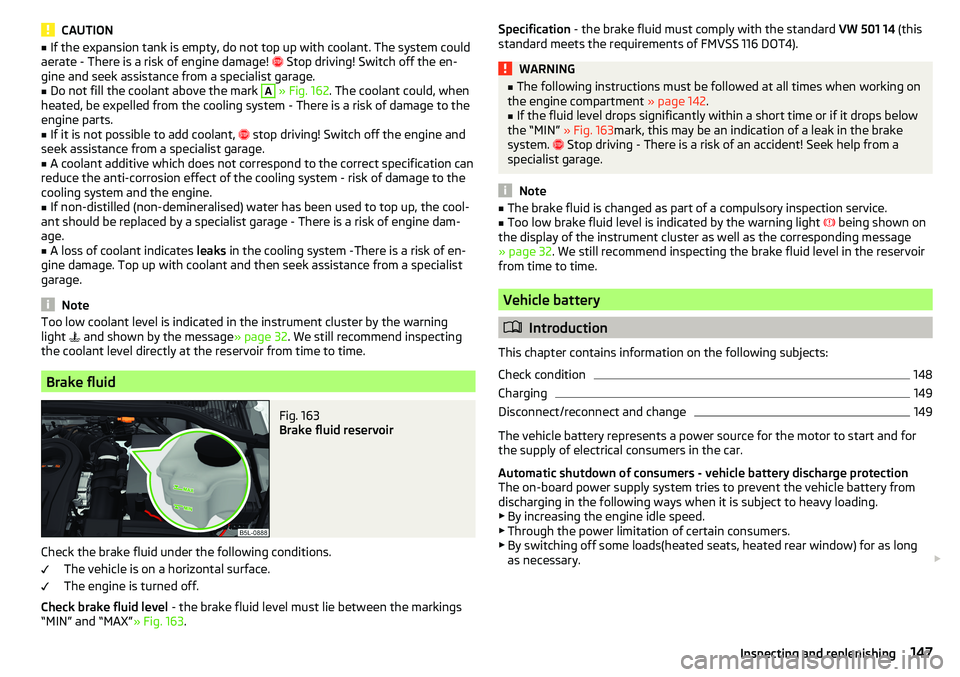
Fig. 163
Brake fluid reservoir
Check the brake fluid under the following conditions.
The vehicle is on a horizontal surface.
The engine is turned off.
Check brake fluid level - the brake fluid level must lie between the markings
“MIN” and “MAX” » Fig. 163.
Specification - the brake fluid must comply with the standard VW 501 14 (this
standard meets the requirements of FMVSS 116 DOT4).WARNING■ The following instructions must be followed at all times when working on
the engine compartment » page 142.■
If the fluid level drops significantly within a short time or if it drops below
the “MIN” » Fig. 163mark, this may be an indication of a leak in the brake
system.
Stop driving - There is a risk of an accident! Seek help from a
specialist garage.
Note
■ The brake fluid is changed as part of a compulsory inspection service.■Too low brake fluid level is indicated by the warning light being shown on
the display of the instrument cluster as well as the corresponding message
» page 32 . We still recommend inspecting the brake fluid level in the reservoir
from time to time.
Vehicle battery
Introduction
This chapter contains information on the following subjects:
Check condition
148
Charging
149
Disconnect/reconnect and change
149
The vehicle battery represents a power source for the motor to start and for the supply of electrical consumers in the car.
Automatic shutdown of consumers - vehicle battery discharge protection
The on-board power supply system tries to prevent the vehicle battery from
discharging in the following ways when it is subject to heavy loading. ▶ By increasing the engine idle speed.
▶ Through the power limitation of certain consumers.
▶ By switching off some loads(heated seats, heated rear window) for as long
as necessary.
147Inspecting and replenishing
Page 172 of 200

No.Consumer18Music amplifier19Windscreen wipers20Control valve for fuel pressure, high pressure pump21Lambda probe22Clutch pedal switch, brake pedal switch23Coolant pump, loading pressure control valve, switchover valve for
radiator, fuel pump24Active charcoal filter, exhaust gas recirculation valve, radiator fan25ABS26Left front headlight, left taillight27Glow plug system28Windscreen heater29Power to the internal fuse carrier (fuses no. 24,27,31,32), electrically
adjustable seats30Terminal X a)a)
In order not to drain the battery unnecessarily when starting the engine, the electrical components of
this terminal are automatically switched off.
Bulbs
Introduction
This chapter contains information on the following subjects:
Bulb arrangement in the front headlights
171
Changing bulbs for low and main beam (Halogen headlights)
171
Remove protective guard for foglights
171
Protective grille for removing fog lights- plug for Park Assist sensor
172
Changing light bulbs for fog lights
172
Changing the bulb for the licence plate light
173
Removing/installing taillights
173
Replacing the bulbs in the taillight assembly
174
We recommend having bulbs replaced by a specialist garage or seeking other
expert help in the event of any uncertainties.
▶ Switch off the ignition and all of the lights before replacing a bulb.
▶ Faulty bulbs must only be replaced with the same type of bulbs. The designa-
tion is located on the light socket or the glass bulb.
We recommend having the headlight settings checked by a specialist garage after replacing a bulb in the low, high or fog beam.
In the case of failure of a Xenon gas discharge bulb or an LED diode, visit a
specialist garage.WARNING■ Always read and observe the warnings before completing any work in the
engine compartment » page 142.■
Accidents can be caused if the road in front of the vehicle is not suffi-
ciently illuminated and the vehicle cannot or can only be seen with difficul-
ty by other road users.
■
Bulbs H7 and H4 are pressurised and may burst when changed - there is a
risk of injury. We therefore recommended wearing gloves and safety
glasses when changing a bulb.
■
Do not carry out any work on the Xenon gas discharge lamps - risk of
death!
CAUTION
Do not take hold of the glass bulb with naked fingers (even the smallest
amount of dirt reduces the working life of the light bulb). Use a clean cloth,
napkin, or similar.
Note
■ This Owner's Manual only describes the replacement of bulbs where it is pos-
sible to replace the bulbs on your own without any complications arising. Other
bulbs must be replaced by a specialist garage.■
We recommend that a box of replacement bulbs always be carried in the ve-
hicle.
170Do-it-yourself
Page 187 of 200
C
Camera See reversing camera
116
Car battery Check condition
148
Cover148
Disconnecting and reconnecting149
Replacing149
Winter operation148
Car care Exterior
136
Interior138
Car computer See multifunction display
41
Care and maintenance131
Carrier93
Car washing135
Exterior136
Interior138
Washing135
Central locking47
Problems51
Central locking button49
Changing Batteries for the removable light
164
Battery164
Windscreen wiper blades167
Changing a wheel155
Changing155
Changing gear Selector lever
106
Changing wheels Wheels
155
Charging a vehicle battery149
Check Brake fluid
147
Engine oil145
Fasten ball rod properly126
Oil level145
Checking Battery status148
Coolant146
Checks Statutory checks
131
Children and safety21
Child safety lock51
Child seat21
Classification23
Installation location23, 24
ISOFIX24
on the front passenger seat22, 23
TOP TETHER25
Cigarette lighter78
Climatronic air distribution control
96
Automatic operation95
Operating elements94
Clothes hook82
Cockpit27
Lighting62
Comfort control window
55
Comfort signalling59
COMING HOME61
Compartments75
Component protection132
Computer See multifunction display
41
Convenience operation sliding / tilting roof
57
Coolant146
Checking146
Refilling146
Temperature display29
Warning light32
CORNER See Fog lights with the CORNER function
61
Cornering lightsDisplay messages34
Correct routing of seat belt
14
Correct seated position10
Correct seating position12
Cruise control system Warning light
37
Cruise Control System121
Cup holders77
D
DAY LIGHT see Daylight running lights
59
Daylight running lights59
Deactivation Airbag
19
Delayed locking of the boot lid See boot lid
53
Departure angle179
Diesel140
Diesel fuel140
Diesel particle filter (DPF)35
Digital Clock39
Digital Service Plan135
Dipped beam58
Dipstick145
Display Cardinal points
38
Coolant temperature29
Fuel level29
Gear changes39
In the instrument cluster38
Service intervals44
Display MAXI DOT42
Display of the second speed39
Display of the second speedometer39
Disposal Acceptance and recycling of used vehicles
133
185Index
Page 188 of 200
DoorChild safety lock51
Emergency locking165
Emergency locking of the driver's door165
Opening/Closing50
warning light door open32
Door alarm38
Door open warning light
32
Drive Driving through water
109
Driver Steering Recommendation (DSR)111
Driving Emissions
177
Fuel consumption177
through water109
Top speed181
DSR111
E
Economical driving
108
EDL111
Electrical power windows55
Button in the rear doors54
Electric power windows53
Electric window Buttons in the driver´s door
54
Electric windows Operational faults
55
Electronic Differential Lock (EDL)111
Electronic immobiliser100
Emergency Hazard warning light system
61
Jump-starting161
Selector lever-unlocking166
Starting / stopping the engine with the push of a button
101
Starting the engine / stopping with the push of a button
102
Towing the vehicle162
Towing the vehicle using the trailer device163
Tyre repair159
Unlocking/locking the door165
Unlocking / locking the door165
Emergency equipment Fire extinguisher
154
First aid kit154
Jack155
Reflective vest154
Vehicle tool kit155
Warning triangle154
Emission control system35
Emissions177
Engine Running in
108
Engine compartment142
Brake fluid147
Coolant146
Engine oil144
Overview144
Vehicle battery147
Windscreen washer fluid144
Engine drag torque control (MSR)110
Engine number175
engine oil specification
145
Engine oil144
Check145
Oil changing144
Refilling145
Warning light33
EPC35
ESC Operation
110
Warning light34
Extended warranty5
Exterior temperature41
F
Fastening elements
87
Fatigue detection122
Films136
Fire extinguisher154
First aid kit154
Flashing59
Flexible storage compartment88
Floor covering in the luggage compartment88
Fog lights Warning light
37
Fog lights/rear fog light60
Fog lights with the CORNER function61
folding table on the rear seat backrest
84
Folding table on the front seat backrest
83
Footmats106
see footmats106
Force limiter Sliding/tilting roof
56
Window55
Front seats68
Fuel139
Diesel140
Fuel gauge29
refer to Fuel139
Refuelling139
Unleaded petrol140
Warning light36
Fuel consumption177
Fuel filter information messages
30
Fuel reserve36
Fuses167
in the dashboard168
in the engine compartment169
186Index
Page 191 of 200
Parking105
Park Assist118
Parking aid114
Reversing camera116
Parking aid114
Function114
Parking assistance Activation / deactivation
116
Display in the Infotainment display115
Parking lights58
Parking the vehicle See Parking
105
ParkPilot114
Parts replacement131
Passive safety Before setting off
10
Driving safety10
Passive Safety10
Pedals106
Footmats106
Petrol140
Phone See Owner's Manual Infotainment
6
Pocket in the luggage compartment87
Pockets83
Power limit Tilt / slide sunroof
56
Power steering33
Power windows Button in the front passenger door
54
Practical equipment storage net in the front centre console
81
Practical features Pockets
83
Storage compartment for umbrella82
Waste container80
Preheating unit35
R
Radio See Owner's Manual Infotainment/Radio
6
Raising the vehicle158
Rear fog light60
Warning light34
Rear seats71
Rear view camera Function keys
117
Orientation lines117
Rear View Camera Operation
117
Rear view mirror66
Rear window - heating63
refilling AdBlue
142
Refilling Coolant
146
Engine oil145
Windscreen washer fluid144
Reflective vest154
Refuelling139
Fuel139
Regulation Headlight beam
58
Remote Synchronization process
51
Remote control Aux. heating (aux. heating and ventilation)
99
Changing battery164
Unlocking/locking the vehicle48
Removable lamp90
Removable light Changing batteries
164
Removable through-loading bag84
Repairs and technical alterations131
Replace Battery
164
Replacing Bulbs170
Fuses167
Windscreen wiper blades166
Rev counter28
Reversing camera116
Rims150
Roof Load
93
Roof rack93
Running in Brake pads
103
Engine108
Tyres150
S
SafeLock
50
Safety10
Airbag16
Child safety21
Child safety seats21
Correct seated position10
Headrests73
ISOFIX24
TOP TETHER25
Safety belts rear middle seat
15
SAFE, SAFELOCK See SafeLock
50
Saving electrical energy108
Saving fuel108
SD-Card See Owner's Manual Infotainment
6
Seat belt height adjustment
14
Seat belts13
Belt tensioners15
fastening and unfastening14
189Index