fuel pressure SMART FORTWO 2016 User Guide
[x] Cancel search | Manufacturer: SMART, Model Year: 2016, Model line: FORTWO, Model: SMART FORTWO 2016Pages: 214, PDF Size: 4.93 MB
Page 197 of 214
Rim
This is the part of the wheel on which the tire
is mounted.
GAWR (Gross Axle Weight Rating)
The GAWR is the maximum gross axle weight
rating. The actual load on an axle must never
exceed the gross axle weight rating. The
gross axle weight rating can be found on the
vehicle identification plate on the B-pillar
on the driver's side.
Speed rating
The speed rating is part of the tire identi-
fication. It specifies the speed range for
which the tire is approved.
GVW (Gross Vehicle Weight)
The gross vehicle weight includes the weight
of the vehicle including fuel, tools, the spare
wheel, accessories installed, occupants, lug-
gage and the drawbar noseweight, if appli-
cable. The gross vehicle weight must not
exceed the gross vehicle weight rating GVWR
as specified on the vehicle identification
plate on the B-pillar on the driver's side.
GVWR (Gross Vehicle Weight Rating)
The GVWR is the maximum permissible gross
weight of a fully loaded vehicle (the weight of
the vehicle including all accessories, occu-
pants, fuel, luggage and the drawbar nose-
weight, if applicable). The gross vehicle
weight rating is specified on the vehicle
identification plate on the B-pillar on the
driver's side.
Maximum loaded vehicle weight
The maximum weight is the sum of:
Rthe curb weight of the vehicle
Rthe weight of the accessories
Rthe load limit
Rthe weight of the factory installed optional
equipment
Kilopascal (kPa)
Metric unit for tire pressure. 6.9 kPa corre-
sponds to 1 psi. Another unit for tire pressure
is bar. 100 kilopascals (kPa) are the equiva-
lent of 1 bar.
Load index
In addition to the load-bearing index, the
load index may also be imprinted on the side-
wall of the tire. This specifies the load-
bearing capacity more precisely.
Curb weight
The weight of a vehicle with standard equip-
ment including the maximum capacity of fuel,
oil and coolant. It also includes the air-con-
ditioning system and optional equipment if
these are installed in the vehicle, but does
not include passengers or luggage.
Maximum load rating
The maximum load rating is the maximum per-
missible weight in kilograms or pounds for
which a tire is approved.
Maximum permissible tire pressure
Maximum permissible tire pressure for one
tire.
Maximum load on one tire
Maximum load on one tire. This is calculated by dividing the maximum axle load of one axle
by two.
PSI (pounds per square inch)
A standard unit of measure for tire pressure.
Aspect ratio
Relationship between tire height and tire
width in percent.
Tire pressure
This is pressure inside the tire applying an
outward force to each square inch of the tire'ssurface. The tire pressure is specified in
pounds per square inch (psi), in kilopascal
(kPa) or in bar. The tire pressure should only
be corrected when the tires are cold.
Cold tire pressure
The tires are cold:
Rif the vehicle has been parked with the
tires out of direct sunlight for at least
three hours and
Rif the vehicle has not been driven further
than 1 mile (1.6 km)
All about wheels and tires195
>> Wheels and tires.
Z
Page 202 of 214
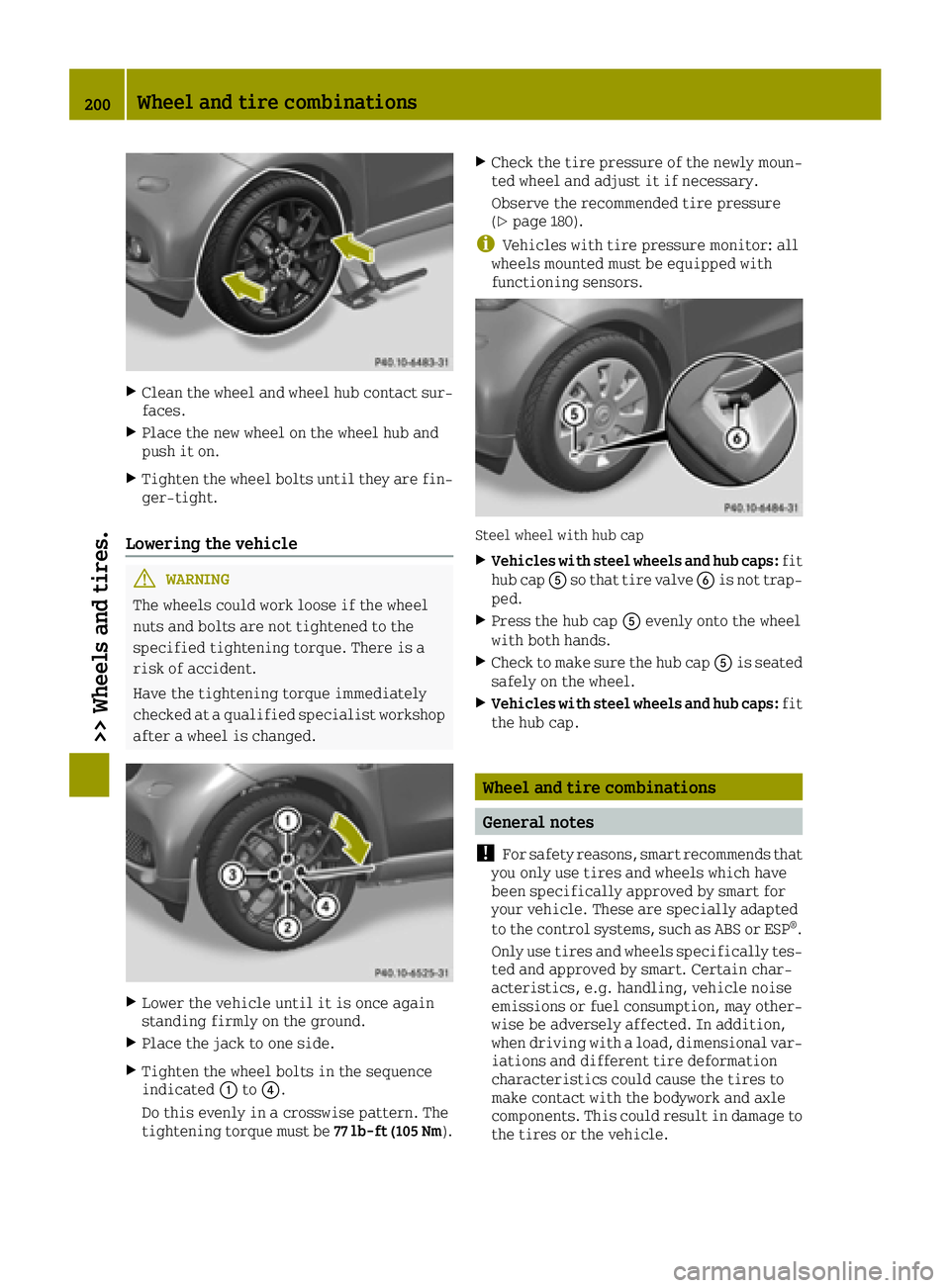
XClean the wheel and wheel hub contact sur-faces.
XPlace the new wheel on the wheel hub and
push it on.
XTighten the wheel bolts until they are fin-
ger-tight.
Lowering the vehicle
GWARNING
The wheels could work loose if the wheel
nuts and bolts are not tightened to the
specified tightening torque. There is a
risk of accident.
Have the tightening torque immediately
checked at a qualified specialist workshop
after a wheel is changed.
XLower the vehicle until it is once again
standing firmly on the ground.
XPlace the jack to one side.
XTighten the wheel bolts in the sequence
indicated 0043to0085.
Do this evenly in a crosswise pattern. The
tightening torque must be 77 lb-ft (105 Nm).
XCheck the tire pressure of the newly moun-
ted wheel and adjust it if necessary.
Observe the recommended tire pressure
(
Ypage 180).
iVehicles with tire pressure monitor: all
wheels mounted must be equipped with
functioning sensors.
Steel wheel with hub cap
XVehicles with steel wheels and hub caps: fit
hub cap 0083so that tire valve 0084is not trap-
ped.
XPress the hub cap 0083evenly onto the wheel
with both hands.
XCheck to make sure the hub cap 0083is seated
safely on the wheel.
XVehicles with steel wheels and hub caps: fit
the hub cap.
Wheel and tire combinations
General notes
!
For safety reasons, smart recommends that
you only use tires and wheels which have
been specifically approved by smart for
your vehicle. These are specially adapted
to the control systems, such as ABS or ESP
®.
Only use tires and wheels specifically tes-
ted and approved by smart. Certain char-
acteristics, e.g. handling, vehicle noise
emissions or fuel consumption, may other-
wise be adversely affected. In addition,
when driving with a load, dimensional var-
iations and different tire deformation
characteristics could cause the tires to
make contact with the bodywork and axle
components. This could result in damage to
the tires or the vehicle.
200Wheel and tire combinations
>> Wheels and tires.
Page 203 of 214
smart accepts no liability for damage
resulting from the use of tires or wheels
other than those tested and approved.
Information on wheels and tires can be
obtained at a qualified specialist work-
shop, e.g. a smart center.
!Retreaded tires have not been tested by
smart and are not recommended. Previous
damage sustained by the tires (before the
retreading process) cannot always be rec-
ognized. As a result, smart cannot guaran-
tee vehicle safety if retreaded tires are
fitted.
Overview of abbreviations used in the fol-
lowing tire tables:
RBA: both axles
RFA: front axle
RRA: rear axle
The recommended pressures for various oper- ating conditions can be found:
Ron the Tire and Loading Information plac-
ard with the recommended tire pressures on
the B-pillar on the driver's side
Rin the tire pressure table on the inside of
the fuel filler flap
Observe the notes on recommended tire pres-
sures under various operating conditions
(
Ypage 180).
Check tire pressures regularly, and only when
the tires are cold. Comply with the mainte-
nance recommendations of the tire manufac-
turer in the vehicle document wallet.
Notes on the vehicle equipment – always
equip the vehicle with:
Rtires of the same size on a given axle (left/
right)
Rwith the same type of tires on all wheels at a given time (summer tires, winter tires)
Exception: it is permissible to fit a dif-
ferent type or make in the event of a flat
tire.
iThe following pages contain information
on approved wheel rim and tire sizes for
equipping your vehicle with winter tires.
Winter tires are not available at the fac-
tory as standard equipment or optional
extras.
If you want to equip your vehicle with
approved winter tires, it may be necessary
to obtain wheel rims in the corresponding size. The size of the approved winter tires
may differ from the standard tires. This is
dependent on the model and the equipment
installed at the factory.
The tires and wheel rims, as well as further
information, can be obtained at a quali-
fied specialist workshop.
iNot all wheel and tire combinations are
available at the factory for all countries.
Wheel and tire combinations201
>> Wheels and tires.
Z