key battery SMART FORTWO 2016 User Guide
[x] Cancel search | Manufacturer: SMART, Model Year: 2016, Model line: FORTWO, Model: SMART FORTWO 2016Pages: 214, PDF Size: 4.93 MB
Page 102 of 214
Problems with fuel and fuel tank
ProblemPossible causes/consequences and0050Solutions
Fuel is leaking from the
vehicle.The fuel line or the fuel tank is faulty.
GWARNING
Risk of explosion or fire.
XTurn the key to position 0in the ignition lock and remove it
immediately (Ypage 87).
XDo not restart the engine under any circumstances.
XConsult a qualified specialist workshop.
The fuel filler flap
cannot be opened.The fuel filler flap is not unlocked.
XUnlock the vehicle (Ypage 51).
The SmartKey battery is discharged or nearly discharged.
XUnlock the vehicle using the key element in the emergency lock
(Ypage 55).
The fuel filler flap is unlocked, but the opening mechanism is
jammed.
XConsult a qualified specialist workshop.
Parking
Important safety notes
GWARNING
Flammable material such as leaves, grass or
twigs may ignite if they come into contact
with hot parts of the exhaust system or
exhaust gas flow. There is a risk of fire.
Park the vehicle so that no flammable mate- rials come into contact with parts of the
vehicle which are hot. Take particular care
not to park on dry grassland or harvested
grain fields.
GWARNING
If you leave children unsupervised in the
vehicle, they could set it in motion by, for example:
Rrelease the parking brake.
Rshift the automatic transmission out of
park position Por shift manual trans-
mission into neutral.
Rstart the engine.
In addition, they may operate vehicle
equipment and become trapped. There is a
risk of an accident and injury.
When leaving the vehicle, always take the
SmartKey with you and lock the vehicle.
Never leave children unsupervised in the
vehicle.
!Always secure the vehicle correctly
against rolling away. Otherwise, the vehi-
cle or its drivetrain could be damaged.
100Parking
>> Driving and parking.
Page 149 of 214
Sun visors
Overview
GWARNING
If the mirror cover of the vanity mirror is
folded up when the vehicle is in motion, you
could be blinded by incident light. There
is a risk of an accident.
Always keep the mirror cover folded down
while driving.
0043Mirror cover
0044Bracket
0087Retaining strap
0085Vanity mirror
Glare from the side
XFold down the sun visor.
XPull the sun visor out of bracket 0044.
XSwing the sun visor to the side.
Ashtray
!
The cup holder in the center console is not
heat resistant. Before placing lit ciga-
rettes in the ashtray, make sure that the
ashtray is fully inserted in the cup holder.
Make sure that lit cigarettes do not fall
into the cup holder.
Otherwise, the cup holder could be dam-
aged.
XTo open: lift up cover 0043.
XTo close:push down cover 0043.
XTo remove:pull the ashtray up and out.
XTo insert:insert the ashtray into the cup
holder.
iIf you remove the ashtray, you can use the
resulting compartment for stowage.
12 V sockets
General notes
XTurn the SmartKey to position 1in the igni-
tion lock (Ypage 87).
The sockets can be used for accessories with a
maximum draw of 120 W(10A). Example acces-
sories include mobile phone chargers.
If you use the sockets for long periods when
the engine is switched off, the battery may
discharge.
Socket in the front-compartment center
console
XLift up the cover of socket 0043.
Features147
>> Stowage and features.
Z
Page 167 of 214
Always make sure that neither you nor the bat-
tery is electrostatically charged. There is a
build-up of electrostatic charge, e.g.:
Rby wearing clothing made from synthetic
fibers
Rdue to friction between clothing and seats
Rif you push or pull the battery across the
carpet or other synthetic materials
Rif you wipe the battery with a cloth.
GWARNING
During the charging process, a battery pro-
duces hydrogen gas. If a short circuit
occurs or sparks are created, the hydrogen
gas can ignite. There is a risk of an explo- sion.
RMake sure that the positive terminal of a
connected battery does not come into
contact with vehicle parts.
RNever place metal objects or tools on a
battery.
RIt is important that you observe the
described order of the battery terminals
when connecting and disconnecting a
battery.
RWhen jump-starting, make sure that the
battery poles with identical polarity are
connected.
RIt is particularly important to observe
the described order when connecting and
disconnecting the jumper cables.
RNever connect or disconnect the battery
terminals while the engine is running.
GWARNING
Battery acid is caustic. There is a risk of
injury.
Avoid contact with skin, eyes or clothing.
Do not inhale any battery gases. Do not lean
over the battery. Keep children away from
batteries. Wash away battery acid immedi-
ately with plenty of clean water and seek
medical attention.
HEnvironmental note
Batteries contain danger-
ous substances. It is
against the law to dispose
of them with the household
rubbish. They must be col-
lected separately and recy-
cled to protect the envi-
ronment.
Dispose of batteries in an
environmentally friendly
manner. Take discharged
batteries to a qualified
specialist workshop or a
special collection point
for used batteries.
!Have the battery checked regularly at a
qualified specialist workshop.
Observe the service intervals in the Main-
tenance Booklet or contact a qualified spe-
cialist workshop for more information.
!You should have all work involving the
battery carried out at a qualified special-
ist workshop. In the exceptional case that
it is necessary for you to disconnect the
battery yourself, make sure that:
Ryou switch off the engine and remove the
SmartKey. Check that all the indicator
lamps in the instrument cluster are off.
Otherwise, electronic components, such
as the alternator, may be damaged.
Ryou first remove the negative terminal
clamp and then the positive terminal
clamp. Never swap the terminal clamps.
Otherwise, the vehicle's electronic sys-
tem may be damaged.
The battery and the cover of the positive
terminal clamp must be installed securely
during operation.
Comply with safety precautions and take pro-
tective measures when handling batteries.
WARNING
Fire, open flames and smoking are
prohibited when handling the bat-
tery. Avoid creating sparks.
Battery (vehicle)165
>> Breakdown assistance.
Z
Page 168 of 214
Battery acid is caustic. Avoid con-
tact with skin, eyes or clothing.
Wear suitable protective clothing,especially gloves, apron and face-
guard.
Rinse any acid spills immediately
with clear water. Contact a physi-
cian if necessary.
Wear eye protection.
Keep children away.
Observe this Operator's Manual.
For safety reasons, smart recommends that you
only use batteries which have been tested and
approved specifically for your vehicle by
smart. These batteries provide increased
impact protection to prevent vehicle occu-
pants from suffering acid burns should the
battery be damaged in the event of an acci-
dent.
In order for the battery to achieve the maxi-
mum possible service life, it must always be
sufficiently charged.
Like other batteries, the vehicle battery may discharge over time if you do not use the
vehicle. In this case, have the battery dis-
connected at a qualified specialist work-
shop. To maintain the charge, you can also
charge the battery with a charger recommen-
ded by smart. Contact a qualified specialist
workshop for further information.
Have the battery charge status checked more
frequently if you use the vehicle mainly for
short trips or if you leave it standing idle for
a lengthy period. Consult a qualified spe-
cialist workshop if you wish to leave your
vehicle parked for a long period of time.
When replacing a battery, only use a battery
recommended by smart.
iRemove the SmartKey if you park the vehi-
cle and do not require any electrical con-
sumers. The vehicle will then use very lit-
tle energy, thus conserving battery power.
Charging the battery
GWARNING
During charging and jump-starting, explo- sive gases can escape from the battery.
There is a risk of an explosion.
Particularly avoid fire, open flames, cre-
ating sparks and smoking. Ensure there is
sufficient ventilation while charging and
jump-starting. Do not lean over a battery.
GWARNING
Battery acid is caustic. There is a risk of
injury.
Avoid contact with skin, eyes or clothing.
Do not inhale any battery gases. Do not lean
over the battery. Keep children away from
batteries. Wash away battery acid immedi-
ately with plenty of clean water and seek
medical attention.
GWARNING
A discharged battery can freeze at temper-
atures below freezing point. When jump-
starting the vehicle or charging the bat-
tery, gases can escape from the battery.
There is a risk of an explosion.
Allow the frozen battery to thaw out before
charging it or jump-starting.
!Only use battery chargers with a maximum
charging voltage of 14.8 V.
XOpen the service cover (Ypage 151).
XConnect the battery charger to the positive
terminal and ground point in the same
order as when connecting the donor battery
in the jump-starting procedure
(
Ypage 168).
If, at low temperatures, the indicator lamps/
warning lamps in the instrument cluster do
not light up, it is highly likely that the dis-
charged battery has frozen. In this case you
may neither jump-start the vehicle nor
charge the battery. The service life of a
thawed-out battery may be shorter. The start-
ing characteristics can be impaired, partic-
ularly at low temperatures. Have the thawed-
out battery checked at a qualified specialist
workshop.
166Battery (vehicle)
>> Breakdown assistance.
Page 171 of 214
Do not start the vehicle using a rapid charging device. If your vehicle's battery is discharged,
the engine can be jump-started from another vehicle or from a second battery using jumper
cables. Observe the following points:
RThe battery is not accessible in all vehicles. If the other vehicle's battery is not accessible,
jump-start the vehicle using a second battery or a jump-starting device.
RYou may only jump-start the vehicle when the engine and exhaust system are cold.
RDo not start the engine if the battery is frozen. Let the battery thaw first.
ROnly jump-start from batteries with a 12 V voltage rating.
ROnly use jumper cables which have a sufficient cross-section and insulated terminal
clamps.
RIf the battery is fully discharged, leave the battery that is being used to jump-start con-
nected for a few minutes before attempting to start. This charges the battery slightly.
RMake sure that the two vehicles do not touch.
Make sure that:
RThe jumper cables are not damaged.
RBare parts of the terminal clamp do not come into contact with other metal parts while the
jumper cables are connected to the battery.
RThe jump leads cannot come into contact with parts which can move when the engine is
running, such as the wiper rods or the fan.
XSecure the vehicle using the parking brake.
XTurn the key to position 0in the ignition lock and remove it.
XSwitch off all electrical consumers, e.g. rear window heating, lighting etc.
XOpen the service cover.
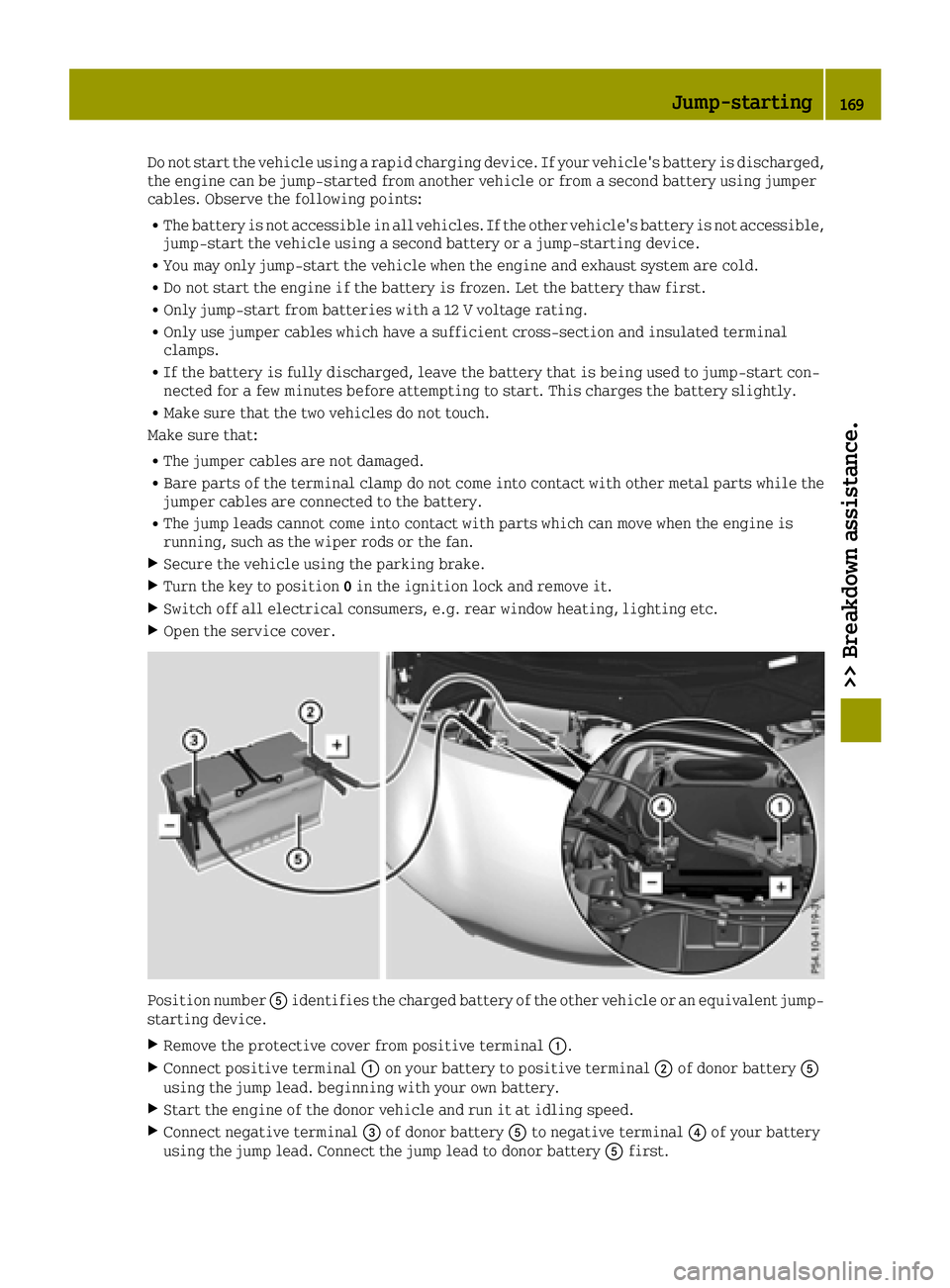
Position number 0083identifies the charged battery of the other vehicle or an equivalent jump-
starting device.
XRemove the protective cover from positive terminal 0043.
XConnect positive terminal0043on your battery to positive terminal 0044of donor battery 0083
using the jump lead. beginning with your own battery.
XStart the engine of the donor vehicle and run it at idling speed.
XConnect negative terminal 0087of donor battery 0083to negative terminal 0085of your battery
using the jump lead. Connect the jump lead to donor battery 0083first.
Jump-starting169
>> Breakdown assistance.
Z
Page 173 of 214
It is better to have the vehicle transported
than to have it towed.
Vehicles with automatic transmission:when
towing a vehicle, the transmission must be in
position N.
The battery must be connected and charged.
Otherwise, you:
Rcannot turn the SmartKey to position 2in
the ignition lock
Rcannot shift the transmission to position N
on vehicles with automatic transmission
iDeactivate the automatic locking feature
(Ypage 55). You could otherwise be locked
out when pushing or towing the vehicle.
iVehicles with the basic carrier fitted:
Do not tow away the vehicle with the basic
carrier fitted.
Do not secure the tow cable or tow bar to the
basic carrier.
Installing/removing the towing eye
Installing the towing eye
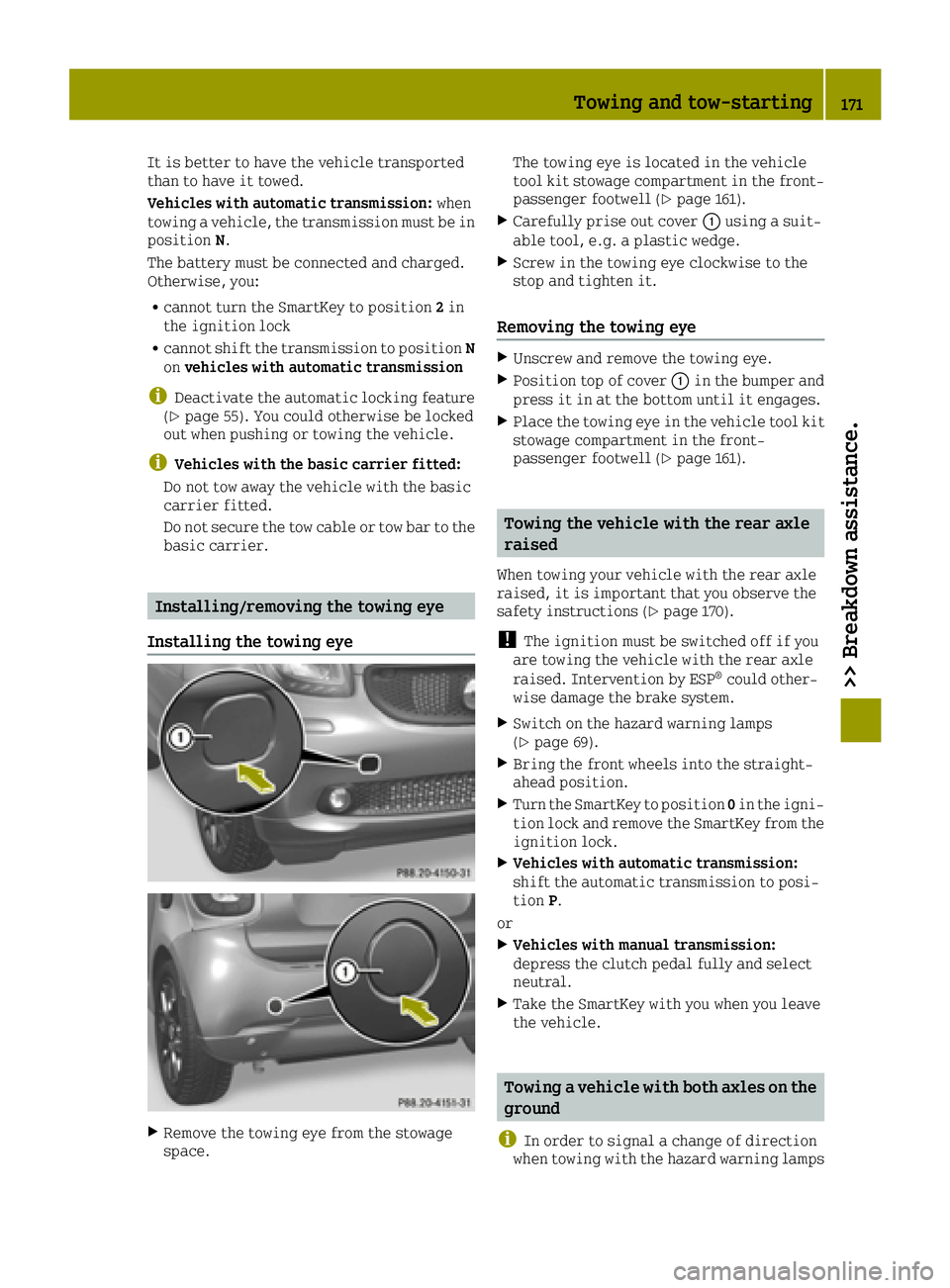
XRemove the towing eye from the stowage
space. The towing eye is located in the vehicle
tool kit stowage compartment in the front-
passenger footwell (
Ypage 161).
XCarefully prise out cover 0043using a suit-
able tool, e.g. a plastic wedge.
XScrew in the towing eye clockwise to the
stop and tighten it.
Removing the towing eye
XUnscrew and remove the towing eye.
XPosition top of cover 0043in the bumper and
press it in at the bottom until it engages.
XPlace the towing eye in the vehicle tool kit
stowage compartment in the front-
passenger footwell (
Ypage 161).
Towing the vehicle with the rear axle
raised
When towing your vehicle with the rear axle
raised, it is important that you observe the
safety instructions (
Ypage 170).
!The ignition must be switched off if you
are towing the vehicle with the rear axle
raised. Intervention by ESP
®could other-
wise damage the brake system.
XSwitch on the hazard warning lamps
(Ypage 69).
XBring the front wheels into the straight-
ahead position.
XTurn the SmartKey to position 0in the igni-
tion lock and remove the SmartKey from the
ignition lock.
XVehicles with automatic transmission:
shift the automatic transmission to posi-
tion P.
or
XVehicles with manual transmission:
depress the clutch pedal fully and select
neutral.
XTake the SmartKey with you when you leave
the vehicle.
Towing a vehicle with both axles on the
ground
i
In order to signal a change of direction
when towing with the hazard warning lamps
Towing and tow-starting171
>> Breakdown assistance.
Z
Page 174 of 214
switched on, use the combination switch as
usual. In this case, only the indicator
lamps for the direction of travel flash.
After resetting the combination switch, the
hazard warning lamp starts flashing again.
Vehicles with automatic transmission: the
automatic transmission automatically shifts
to position Pwhen you open the driver's or
front-passenger door or when you remove the
key from the ignition lock. In order to ensure
that the automatic transmission stays in
position Nwhen towing the vehicle, you must
observe the following points:
XMake sure that the vehicle is stationary.
XTurn the SmartKey to position 2in the igni-
tion lock.
XDepress and hold the brake pedal.
XShift the automatic transmission to posi-
tion N.
Vehicles with manual transmission:
XLeave the SmartKey in position 2in the
ignition lock.
XRelease the brake pedal.
XRelease the parking brake.
XSwitch on the hazard warning lamps
(Ypage 69).
It is important that you observe the safety
instructions when towing away your vehicle
(
Ypage 170).
Transporting the vehicle
!
You may only secure the vehicle by the
wheels, not by parts of the vehicle such as
axle or steering components. Otherwise,
the vehicle could be damaged.
XVehicles with automatic transmission:
turn the SmartKey to position 2in the igni-
tion lock (
Ypage 87).
XVehicles with manual transmission:
depress the clutch pedal fully and select
neutral.
XShift the transmission to position N.
As soon as the vehicle has been loaded:
XPrevent the vehicle from rolling away by
applying the parking brake.
XVehicles with automatic transmission:
shift the transmission to position P.
XVehicles with manual transmission:
depress the clutch pedal fully and engage
first or reverse gear.
XTurn the SmartKey to position0in the igni-
tion lock and remove it.
XSecure the vehicle.
The towing eye can be used to pull the vehicle
onto a trailer or transporter for transporting
purposes.
Tow-starting (emergency engine start-
ing)
!
Vehicles with automatic transmission
must not be started by tow-starting. This
could otherwise damage the transmission.
iYou can find information on "Jump-start-
ing" at (Ypage 168).
Before tow-starting:
Rthe battery must be connected
Rthe engine must be cold
Rthe exhaust system has cooled down.
XSwitch on the hazard warning lamps
(Ypage 69).
XInstall the towing eye (Ypage 171).
XSecure the rigid towing bar or the towing
rope.
XDepress and hold the brake pedal.
XTurn the SmartKey to position 2in the igni-
tion lock.
XDepress the clutch pedal fully, engage sec-
ond gear and keep the clutch pedal fully
depressed.
XRelease the brake pedal.
XTow-start the vehicle.
XRelease the clutch pedal slowly; do not
depress the accelerator pedal while doing
so.
XWhen the engine is started, immediately
depress the clutch pedal fully and select
neutral.
XPull over at a suitable place and stop the
vehicle safely, paying attention to road
and traffic conditions.
XSecure the vehicle against rolling away
with the parking brake.
XRemove the rigid towing bar or towing
rope.
172Towing and tow-starting
>> Breakdown assistance.