phone SMART FORTWO 2016 User Guide
[x] Cancel search | Manufacturer: SMART, Model Year: 2016, Model line: FORTWO, Model: SMART FORTWO 2016Pages: 214, PDF Size: 4.93 MB
Page 186 of 214
warning lamp will flash for approximately
a minute and then remain continuously
illuminated. This sequence will be repea-
ted every time the vehicle is started as long
as the malfunction exists. When the mal-
function indicator is illuminated, the sys-
tem may not be able to detect or signal low
tire pressure as intended.
TPMS malfunctions may occur for a variety
of reasons, including the installation of
incompatible replacement or alternate
tires or wheels on the vehicle that prevent
the TPMS from functioning properly. Always
check the TPMS malfunction telltale after
replacing one or more tires or wheels on
your vehicle to ensure that the replacement
or alternate Tires and wheels allow the
TPMS to continue to function properly.
It is the driver's responsibility to set the
tire pressure to that recommended for cold
tires which is suitable for the operating sit-
uation (
Ypage 180). Note that the correct tire
pressure for the current operating situation
must first be taught-in to the tire pressure
monitor. If there is a substantial loss of
pressure, the warning threshold for the warn-
ing message is aligned to the reference val-
ues taught-in. Restart the tire pressure mon-
itor after adjusting to the cold tire pressure.
The current pressures are saved as new ref-
erence values. As a result, a warning message
will appear if the tire pressure drops sig-
nificantly.
The tire pressure monitor does not warn you of
an incorrectly set tire pressure. Observe the notes on the recommended tire pressure
(
Ypage 180).
The tire pressure monitor is not able to warn
you of a sudden loss of pressure, e.g. if the
tire is penetrated by a foreign object. In the
event of a sudden loss of pressure, bring the
vehicle to a halt by braking carefully. Avoid
abrupt steering maneuvers. The tire pressure monitor has a yellow warn-
ing lamp in the instrument cluster for indi-
cating a pressure loss or malfunction.
Whether the warning lamp flashes or lights up
indicates whether a tire pressure is too low
or the tire pressure monitor is malfunction-
ing:
RIf the warning lamp is lit continuously, the
tire pressure on one or more tires is sig-
nificantly too low. The tire pressure mon-
itor is not malfunctioning.
RIf the warning lamp flashes for around a
minute and then remains lit constantly, the
tire pressure monitor is malfunctioning.
iA message appears in the display in addi-
tion to the warning lamp.
Observe the information on display mes-
sages (
Ypage 126).
If the tire pressure monitor is malfunction-
ing, it may take up to ten minutes for the tire
pressure warning lamp to inform you of the
malfunction. The malfunction will be indi-
cated first by the tire pressure warning lamp
flashing for approximately one minute and
then remaining lit. When the malfunction has
been rectified, the tire pressure warning
lamp goes out after a few minutes of driving.
The operation of the tire pressure monitor
can be affected by interference from radio
transmitting equipment (e.g. radio head-
phones, two-way radios) that may be being
operated in or near the vehicle.
Tire pressure monitor warning messages
If the tire pressure monitor detects a pres-
sure loss in one or more tires, a warning mes-
sage is shown in the display. The yellow warn-
ing light in the tire pressure monitor lights
up. For certain display messages a warning
tone also sounds.
RIf the Correct Tire Pressuremessage
appears in the display, the tire pressure in
at least one tire is too low. Correct the tire
pressure at the next opportunity.
RIf the Tire Pressure Warning TireFailuremessage appears in the display,
the tire pressure in one or more tires has
dropped suddenly and the tires must be
checked.
Observe the instructions and safety notes for the display messages in the "Tires" section
184Tire pressure
>> Wheels and tires.
Page 206 of 214

Useful information
i
This Operator's Manual describes all
models and all standard and optional
equipment of your vehicle available at the
time of publication of the Operator's Man- ual. Country-specific differences are pos-
sible. Bear in mind that your vehicle may
not feature all functions described here.
This also applies to safety-relevant sys-
tems and functions.
iRead the information on qualified spe-
cialist workshops: (Ypage 20).
Information regarding technical data
General information
i
The data stated here specifically refers
to a vehicle with standard equipment. Con- sult a smart center for the data for all vehi-
cle variants and trim levels.
Vehicle electronics
Retrofitting two-way radios and
mobile phones (RF transmitters)
GWARNING
The electromagnetic radiation from modi-
fied or incorrectly retrofitted RF-trans-
mitters can interfere with the vehicle
electronics. This can compromise the
operational safety of the vehicle. There is
a risk of an accident.
You should have all work to electrical and
electronic equipment carried out at a
qualified specialist workshop.
GWARNING
The electromagnetic radiation from incor-
rectly operated RF transmitters can inter-
fere with the vehicle electronics, for
example:
Rif the RF transmitter is not connected
with an exterior antenna
Rthe exterior antenna has been installed
incorrectly or is not a low-reflection
type
This can compromise the operational safety
of the vehicle. There is a risk of an acci-
dent.
Have the low-reflection exterior antenna
mounted at a qualified specialist work-
shop. When operating RF transmitters in
the vehicle, always connect them with the
low-reflection exterior antenna.
!The operating permit may be invalidated
if the instructions for installation and use of RF transmitters are not observed.
In particular, the following conditions
must be complied with:
Ronly approved wavebands may be used.
Rcompliance with the maximum permissi-
ble output in these wavebands is
required.
Ronly approved antenna positions may be
used.
Excessive levels of electromagnetic radia-
tion may cause damage to your health and the
health of others. Using an exterior antenna
takes into account current scientific discus-
sions relating to the possible health hazards
that may result from electromagnetic fields.
The following antenna positions may be used
if RF transmitters have been properly instal- led:
204Vehicle electronics
>> Technical data.
Page 207 of 214
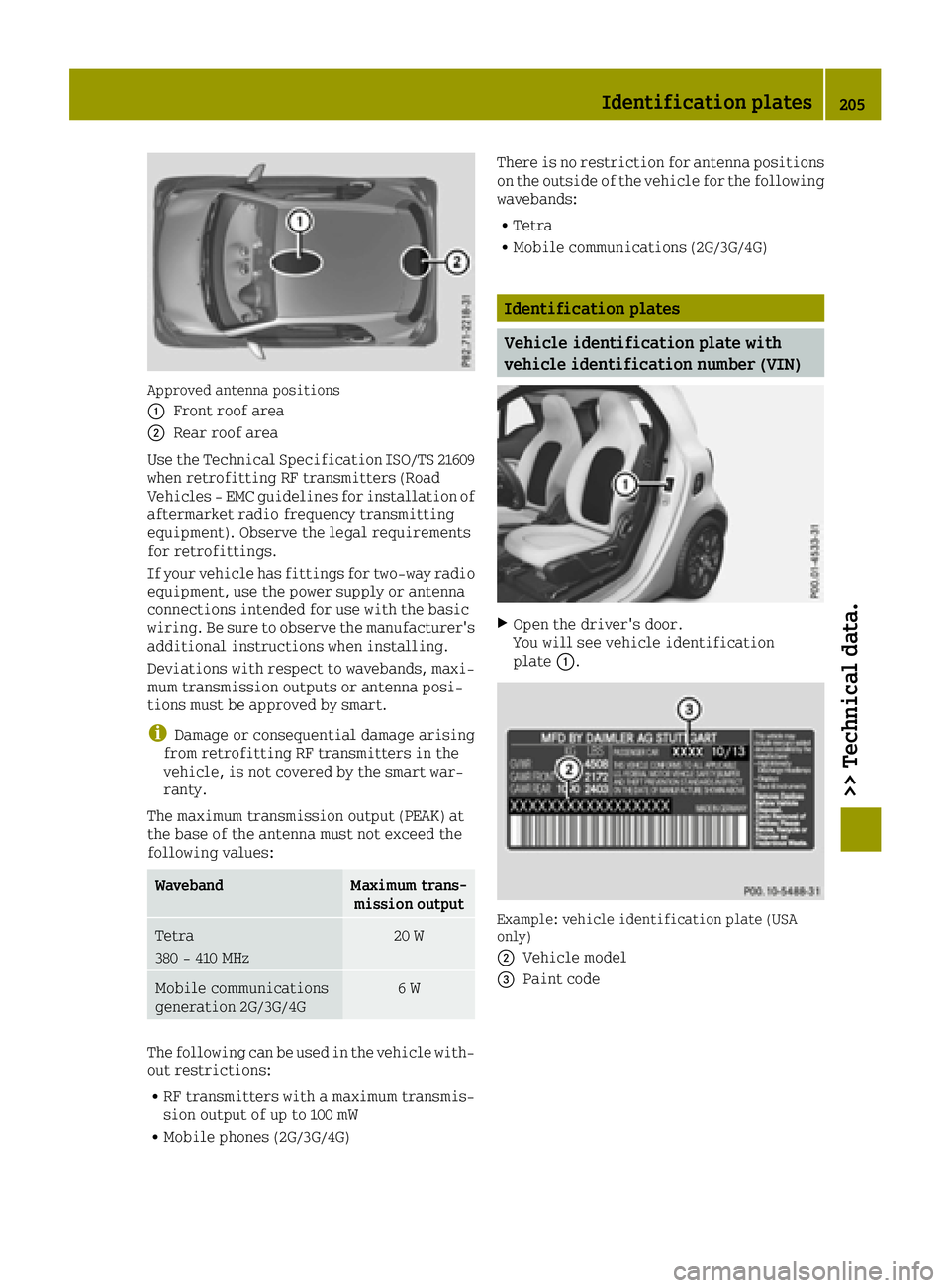
Approved antenna positions
0043
Front roof area
0044Rear roof area
Use the Technical Specification ISO/TS 21609
when retrofitting RF transmitters (Road
Vehicles - EMC guidelines for installation of
aftermarket radio frequency transmitting
equipment). Observe the legal requirements
for retrofittings.
If your vehicle has fittings for two-way radio
equipment, use the power supply or antenna
connections intended for use with the basic
wiring. Be sure to observe the manufacturer's additional instructions when installing.
Deviations with respect to wavebands, maxi-
mum transmission outputs or antenna posi-
tions must be approved by smart.
iDamage or consequential damage arising
from retrofitting RF transmitters in the
vehicle, is not covered by the smart war-
ranty.
The maximum transmission output (PEAK) at
the base of the antenna must not exceed the
following values:
WavebandMaximum trans- mission output
Tetra
380 - 410 MHz20 W
Mobile communications
generation 2G/3G/4G6 W
The following can be used in the vehicle with-
out restrictions:
RRF transmitters with a maximum transmis-
sion output of up to 100 mW
RMobile phones (2G/3G/4G) There is no restriction for antenna positions
on the outside of the vehicle for the following
wavebands:
RTetra
RMobile communications (2G/3G/4G)
Identification plates
Vehicle identification plate with
vehicle identification number (VIN)
XOpen the driver's door.
You will see vehicle identification
plate
0043.
Example: vehicle identification plate (USA
only)
0044
Vehicle model
0087Paint code
Identification plates205
>> Technical data.
Z