roof SMART FORTWO 2016 User Guide
[x] Cancel search | Manufacturer: SMART, Model Year: 2016, Model line: FORTWO, Model: SMART FORTWO 2016Pages: 214, PDF Size: 4.93 MB
Page 181 of 214
RAfter fitting new tires, run them in at mod-
erate speeds for the first 60 miles (100 km),
as they only reach their full performance
after this distance.
RDo not drive with tires which have too little
tread depth, as this significantly reduces
the traction on wet roads (hydroplaning).
RReplace the tires after six years at the lat-
est, regardless of wear.
Winter operation
General notes
Have your vehicle winterproofed at a quali-
fied specialist workshop at the onset of win-
ter.
Observe the notes in the "Changing a wheel"
section (
Ypage 196).
Driving with summer tires
At temperatures below 45 ‡(+7 †), summer
tires lose elasticity and therefore traction
and braking power. Change the tires on your
vehicle to M+S tires. Using summer tires at
very cold temperatures could cause tears to
form, thereby damaging the tires perma-
nently. smart cannot accept responsibility
for this type of damage.
GWARNING
Damaged tires can cause tire inflation
pressure loss. As a result, you could lose
control of your vehicle. There is a risk of
accident.
Check the tires regularly for signs of dam- age and replace any damaged tires imme-
diately.
M+S tires
GWARNING
M+S tires with a tire tread depth of less
than 00CFin (4 mm) are not suitable for use in
winter and do not provide sufficient trac-
tion. There is a risk of an accident.
M+S tires with a tread depth of less than 00CF
in (4 mm) must be replaced immediately.
At temperatures below 45 ‡(+7 †) use winter
tires marked with M+S.
Only winter tires bearing the 004Dsnowflake
symbol in addition to the M+S marking pro-
vide the best possible grip in wintry road
conditions. Only these tires will allow driv-
ing safety systems such as ABS and ESP
®to
function optimally in winter. These tires
have been developed specifically for driving
in snow.
Use M+S tires of the same make and tread on
all wheels to maintain safe handling charac- teristics.
Always observe the maximum permissible
speed specified for the M+S tires you have
mounted. Therefore, only use tire types and
sizes approved for smart. Observe the tire
load rating and speed rating required for
smart.
Tires with a specified direction of rotation
have additional benefits, e.g. if there is a
risk of aquaplaning. These advantages can
only be gained if the tires are fitted corre-
sponding to the direction of rotation.
An arrow on the sidewall of the tire indicates
its correct direction of rotation.
When you have mounted the M+S tires:
XCheck the tire pressures (Ypage 180).
XVehicles for USA: restart the tire pressure
monitor (Ypage 185).
Snow chains
GWARNING
If snow chains are installed to the front
wheels, they may drag against the vehicle
body or chassis components. This could
cause damage to the vehicle or the tires.
There is a risk of an accident.
To avoid hazardous situations:
Rnever install snow chains to the front
wheels
Ralways install snow chains in pairs to the rear wheels.
Winter operation179
>> Wheels and tires.
Z
Page 198 of 214
Tread
The part of the tire that comes into contact
with the road.
Bead
The tire bead ensures that the tire sits
securely on the wheel. There are several steel
wires in the bead to prevent the tire from
coming loose from the wheel rim.
Sidewall
The part of the tire between the tread and the
bead.
Weight of optional extras
The combined weight of those optional extras
that weigh more than the replaced standard
parts and more than 5 lbs (2.3 kilograms).
These optional extras, such as high-perform-
ance brakes, level control, a roof rack or a
high-performance battery, are not included
in the curb weight and the weight of the
accessories.
TIN (Tire Identification Number)
This is a unique identifier which can be used
by a tire manufacturer to identify tires, for
example for a product recall, and thus iden-
tify the purchasers. The TIN is made up of the manufacturer's identity code, tire size, tire
type code and the manufacturing date.
Load bearing index
The load bearing index (also load index) is a
code that contains the maximum load bearing
capacity of a tire.
Traction
Traction is the result of friction between the
tires and the road surface.
Treadwear indicators
Narrow bars (tread wear bars) that are dis-
tributed over the tire tread. If the tire tread
is level with the bars, the wear limit of 00CDin
(1.6 mm) has been reached.
Occupant distribution
The distribution of occupants in a vehicle at
their designated seating positions.
Total load limit
Nominal load and luggage load plus 68 kg
(150 lbs) multiplied by the number of seats in
the vehicle.
Changing a wheel
Flat tire
You can find information on what to do in the
event of a flat tire in the "Flat tire" section
(
Ypage 161).
Rotating the wheels
GWARNING
Never interchange the front and rear wheels
as they have different dimensions, e.g.
size, wheel offset etc. Otherwise, there
could be a negative effect on the road hold- ing and you could endanger yourself or oth-
ers.
!On vehicles equipped with a tire pressure
monitor, electronic components are loca-
ted in the wheel.
Tire-mounting tools should not be used
near the valve. This could damage the elec-
tronic components.
Only have tires changed at a qualified spe-
cialist workshop.
Various types of steel wheel can be fitted on
your vehicle. Some steel wheels have a red
mark in the hub cap area. The hub cap has to be
removed to see the red mark, see "Raising the
vehicle" in the "Wheel change" section
(
Ypage 197). When changing the wheels,
always fit wheels of the same type on all axles.
Always pay attention to the instructions and
safety notes when changing a wheel
(
Ypage 196).
The wear patterns on the front and rear tires
differ, depending on the operating condi-
tions. Front tires typically wear more on the
shoulders and the rear tires in the center.
Clean the contact surfaces of the wheel and
the brake disc thoroughly every time a wheel
is rotated. Check the tire pressure and reac-
tivate the tire pressure monitor if necessary.
196Changing a wheel
>> Wheels and tires.
Page 207 of 214
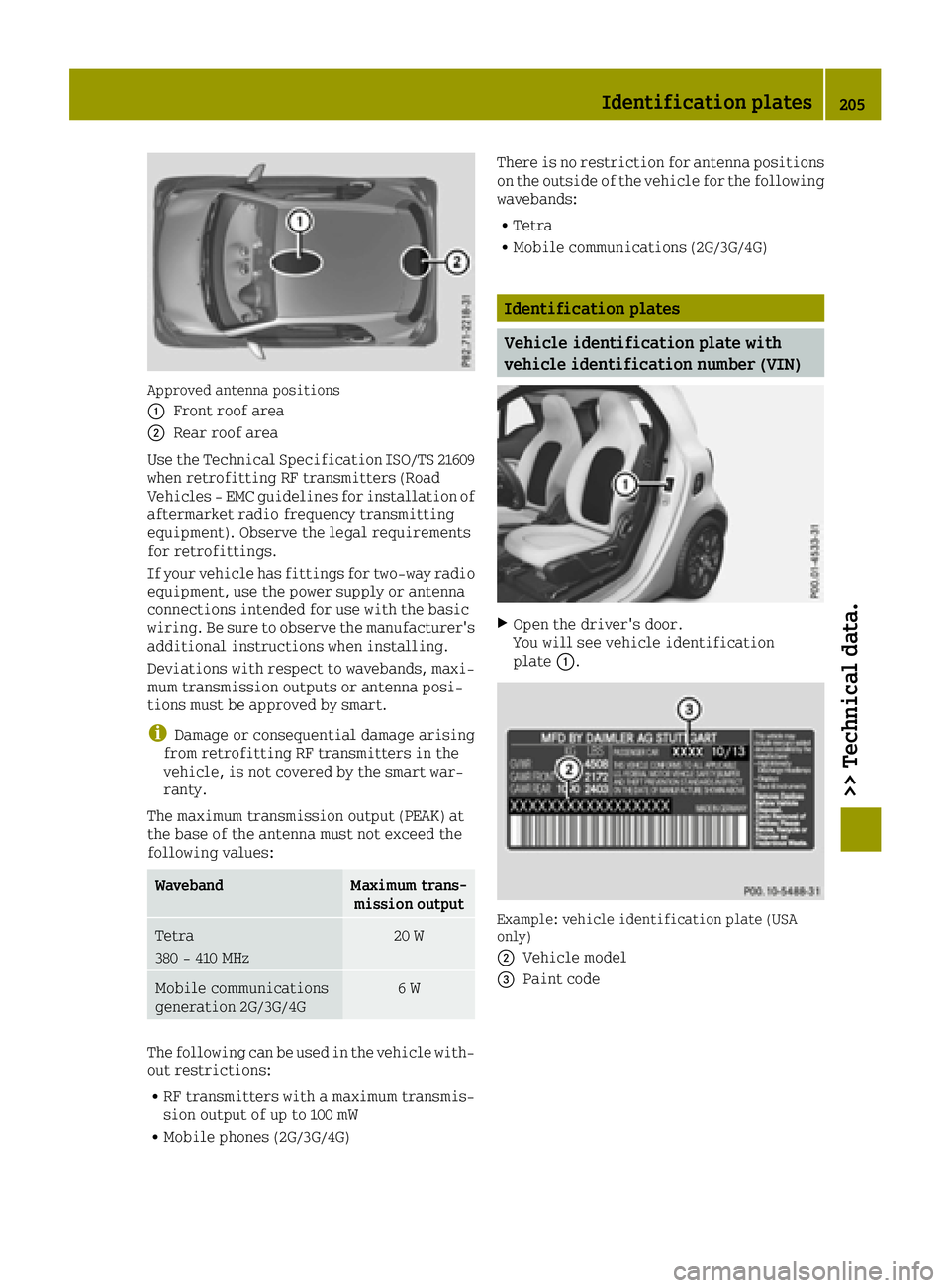
Approved antenna positions
0043
Front roof area
0044Rear roof area
Use the Technical Specification ISO/TS 21609
when retrofitting RF transmitters (Road
Vehicles - EMC guidelines for installation of
aftermarket radio frequency transmitting
equipment). Observe the legal requirements
for retrofittings.
If your vehicle has fittings for two-way radio
equipment, use the power supply or antenna
connections intended for use with the basic
wiring. Be sure to observe the manufacturer's additional instructions when installing.
Deviations with respect to wavebands, maxi-
mum transmission outputs or antenna posi-
tions must be approved by smart.
iDamage or consequential damage arising
from retrofitting RF transmitters in the
vehicle, is not covered by the smart war-
ranty.
The maximum transmission output (PEAK) at
the base of the antenna must not exceed the
following values:
WavebandMaximum trans- mission output
Tetra
380 - 410 MHz20 W
Mobile communications
generation 2G/3G/4G6 W
The following can be used in the vehicle with-
out restrictions:
RRF transmitters with a maximum transmis-
sion output of up to 100 mW
RMobile phones (2G/3G/4G) There is no restriction for antenna positions
on the outside of the vehicle for the following
wavebands:
RTetra
RMobile communications (2G/3G/4G)
Identification plates
Vehicle identification plate with
vehicle identification number (VIN)
XOpen the driver's door.
You will see vehicle identification
plate
0043.
Example: vehicle identification plate (USA
only)
0044
Vehicle model
0087Paint code
Identification plates205
>> Technical data.
Z