tailgate SMART FORTWO 2016 User Guide
[x] Cancel search | Manufacturer: SMART, Model Year: 2016, Model line: FORTWO, Model: SMART FORTWO 2016Pages: 214, PDF Size: 4.93 MB
Page 78 of 214
Always switch off the windshield wipers
and ignition before changing the wiper
blades.
!To avoid damaging the wiper blades, make
sure that you touch only the wiper arm of the
wiper.
!Never open the service cover/tailgate if a
windshield wiper arm has been folded away
from the windshield/rear window.
Never fold a windshield wiper arm without
a wiper blade back onto the windshield/
rear window.
Hold the windshield wiper arm firmly when
you change the wiper blade. If you release
the wiper arm without a wiper blade and it
falls onto the windshield/rear window, the
windshield/rear window may be damaged by
the force of the impact.
smart recommends that you have the wiper
blades changed at a qualified specialist
workshop.
Changing the windshield wiper blades
Removing the wiper blades
XTurn the key to position 1or 2in the igni-
tion lock (Ypage 87).
XPress the combination switch to the 004B
position (Ypage 74).
The wiper arms move slowly upwards.
XWhen the wiper arms are vertical in rela-
tion to the service cover, turn the key to
position 0and remove it from the ignition
lock.
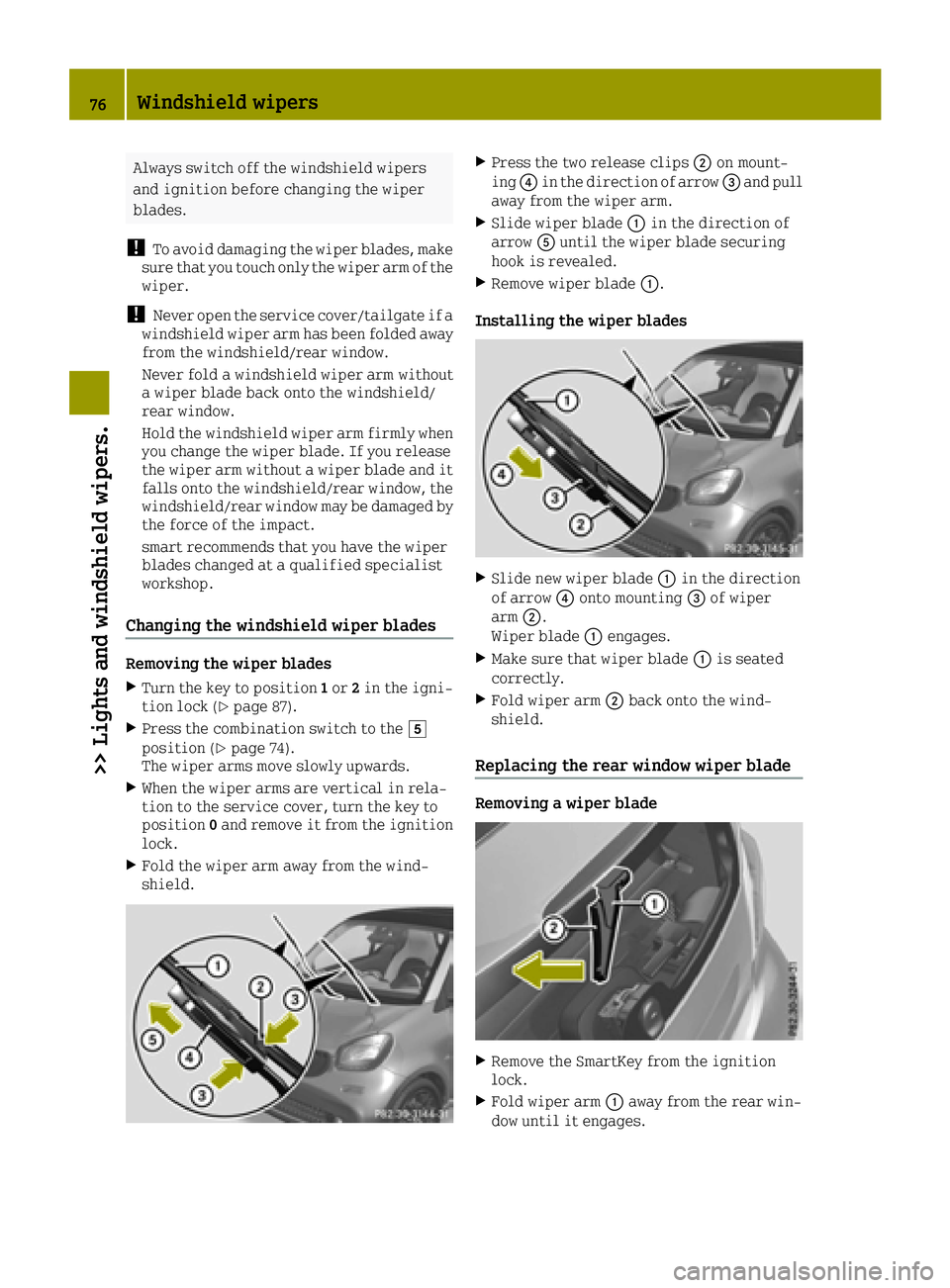
XFold the wiper arm away from the wind-
shield.
XPress the two release clips 0044on mount-
ing 0085in the direction of arrow 0087and pull
away from the wiper arm.
XSlide wiper blade 0043in the direction of
arrow 0083until the wiper blade securing
hook is revealed.
XRemove wiper blade 0043.
Installing the wiper blades
XSlide new wiper blade 0043in the direction
of arrow 0085onto mounting 0087of wiper
arm 0044.
Wiper blade 0043engages.
XMake sure that wiper blade 0043is seated
correctly.
XFold wiper arm 0044back onto the wind-
shield.
Replacing the rear window wiper blade
Removing a wiper blade
XRemove the SmartKey from the ignition
lock.
XFold wiper arm 0043away from the rear win-
dow until it engages.
76Windshield wipers
>> Lights and windshield wipers.
Page 130 of 214
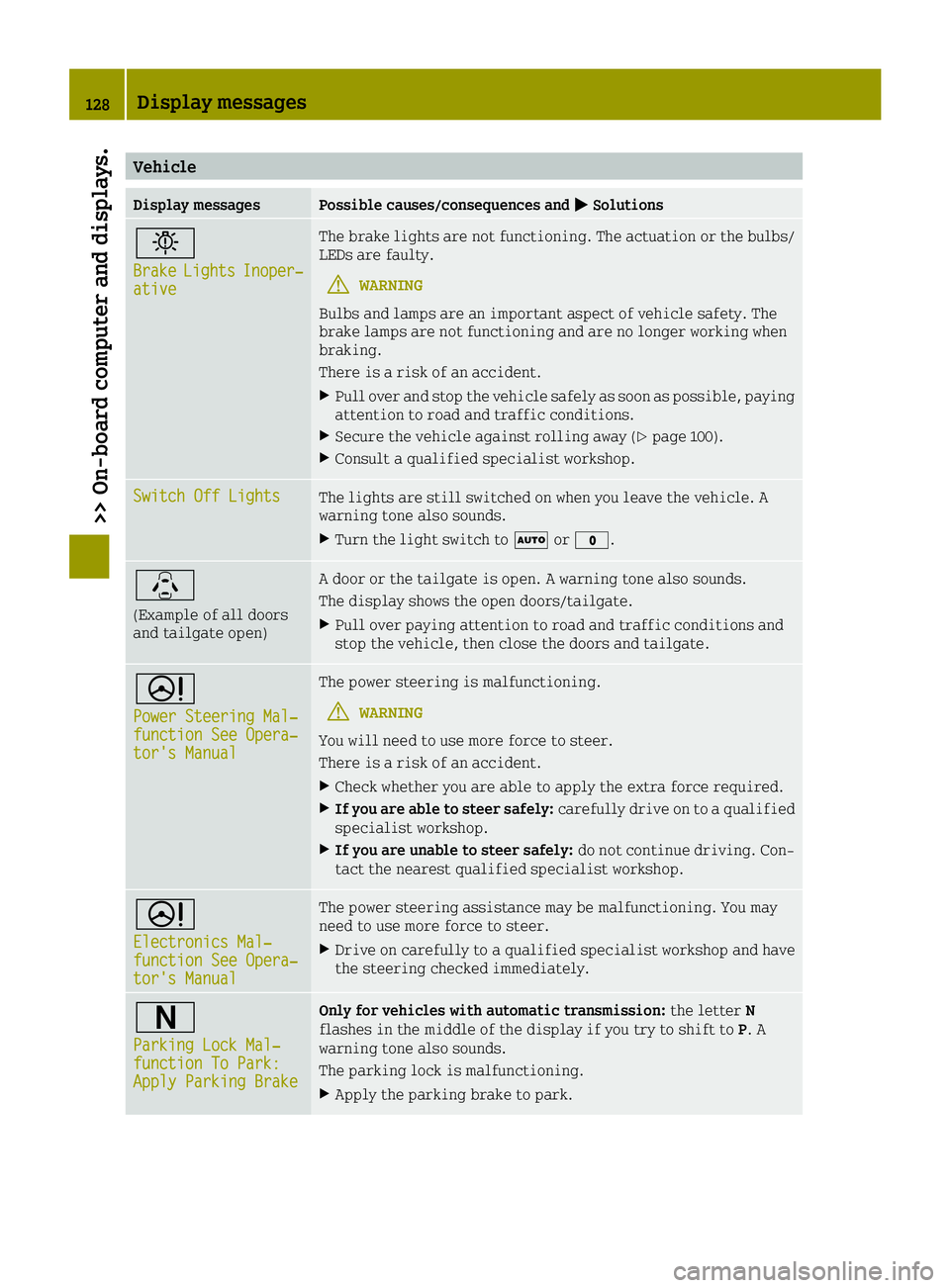
Vehicle
Display messagesPossible causes/consequences and0050Solutions
0049
BrakeLightsInoper‐ative
The brake lights are not functioning. The actuation or the bulbs/
LEDs are faulty.
GWARNING
Bulbs and lamps are an important aspect of vehicle safety. The
brake lamps are not functioning and are no longer working when
braking.
There is a risk of an accident.
XPull over and stop the vehicle safely as soon as possible, paying
attention to road and traffic conditions.
XSecure the vehicle against rolling away (Ypage 100).
XConsult a qualified specialist workshop.
Switch Off LightsThe lights are still switched on when you leave the vehicle. A
warning tone also sounds.
XTurn the light switch to 0058or003F.
\
(Example of all doors
and tailgate open)
A door or the tailgate is open. A warning tone also sounds.
The display shows the open doors/tailgate.
XPull over paying attention to road and traffic conditions and
stop the vehicle, then close the doors and tailgate.
0052
Power Steering Mal‐function See Opera‐tor's Manual
The power steering is malfunctioning.
GWARNING
You will need to use more force to steer.
There is a risk of an accident.
XCheck whether you are able to apply the extra force required.
XIf you are able to steer safely: carefully drive on to a qualified
specialist workshop.
XIf you are unable to steer safely: do not continue driving. Con-
tact the nearest qualified specialist workshop.
0052
Electronics Mal‐function See Opera‐tor's Manual
The power steering assistance may be malfunctioning. You may
need to use more force to steer.
XDrive on carefully to a qualified specialist workshop and have
the steering checked immediately.
0044
Parking Lock Mal‐function To Park:Apply Parking Brake
Only for vehicles with automatic transmission: the letterN
flashes in the middle of the display if you try to shift to P. A
warning tone also sounds.
The parking lock is malfunctioning.
XApply the parking brake to park.
128Display messages
>> On-board computer and displays.
Page 143 of 214

Vehicle
ProblemPossible causes/consequences and0050Solutions
\
The red door warning
lamp comes on while the
vehicle is moving.
In addition, further
warning lamps light up,
such as 00E5.The central vehicle electronics system is malfunctioning.
After the engine is switched off:
Rdo not lock/unlock the doors using the remote control function of
the key
Ryou can no longer start the engine.
XObserve the additional display messages in the display.
XPull over and stop the vehicle safely as soon as possible, paying
attention to road and traffic conditions. Do not continue driv-
ing under any circumstances.
XSecure the vehicle against rolling away (Ypage 100).
XConsult a qualified specialist workshop.
\
The red door warning
lamp is on.A door or the tailgate is open. If you are driving at speeds above
13 mph (20 km/h), an additional warning tone will sound.
XObserve the additional display messages in the display.
XPull over at a suitable place and stop the vehicle safely, paying
attention to road and traffic conditions.
XSecure the vehicle against rolling away (Ypage 100).
XClose all doors and the tailgate.
0052
The yellow power steer-
ing warning lamp is lit
while the engine is
running.The power steering is malfunctioning.
GWARNING
You may need to use more force to steer.
There is a risk of an accident.
XObserve the additional display messages in the display.
XCheck whether you are able to apply the extra force required.
XIf you are able to steer safely: carefully drive on to a qualified
specialist workshop.
XIf you are unable to steer safely: do not drive on. Contact the
nearest qualified specialist workshop.
Warning and indicator lamps in the instrument cluster141
>> On-board computer and displays.
Z
Page 144 of 214
Useful information
i
This Operator's Manual describes all
models and all standard and optional
equipment of your vehicle available at the
time of publication of the Operator's Man- ual. Country-specific differences are pos-
sible. Bear in mind that your vehicle may
not feature all functions described here.
This also applies to safety-relevant sys-
tems and functions.
iRead the information on qualified spe-
cialist workshops: (Ypage 20).
Stowage areas
Loading guidelines
GWARNING
If objects, luggage or loads are not secured or not secured sufficiently, they could
slip, tip over or be flung around and
thereby hit vehicle occupants. There is a
risk of injury, particularly in the event of
sudden braking or a sudden change in
direction.
Always store objects so that they cannot be
flung around. Secure objects, luggage or
loads against slipping or tipping before
the journey.
GWARNING
Combustion engines emit poisonous
exhaust gases such as carbon monoxide. If
the tailgate is open when the engine is
running, particularly if the vehicle is
moving, exhaust fumes could enter the
passenger compartment. There is a risk of
poisoning.
Turn off the engine before opening the
tailgate. Never drive with the tailgate
open.
Your vehicle has not been approved by the
manufacturer for towing a trailer. A trailer
could seriously impair driving safety.
Mounting a basic rack, a cycle rack or a ski/
snowboard rack on the rear of the vehicle will change the axle load distribution as speci-
fied by the vehicle manufacturer. Read the
operating instructions for the individual
accessories.
The handling characteristics of a laden vehi-
cle are dependent on the distribution of the
load within the vehicle. For this reason, you
should observe the following notes when
transporting a load:
Rnever exceed the maximum permissible
gross vehicle weight or the permissible
axle loads for the vehicle (including occu-
pants). The values are specified on the
vehicle identification plate on the B-pil-
lar of the driver's door
Rthe load must not protrude above the upper
edge of the head restraints
Rensure that no items of luggage can enter
the vehicle interior above or between the
front seats
Rensure that loaded objects are stowed
safely and are secured
Rload heavy objects at the bottom and light
objects at the top
Stowage space
Important safety notes
GWARNING
If you stow objects in the vehicle interior
in an unsuitable way, they could slip or be
thrown around and thus hit vehicle occu-
pants. Additionally, the cup holders, open
stowage spaces and mobile phone brackets
cannot restrain the objects placed in them
in the event of an accident. There is a risk
of injury, especially in the event of brak-
ing or sudden changes in direction.
RAlways stow objects so they cannot be
thrown around in these or similar situa-
tions.
RAlways ensure that objects do not pro-
trude from the stowage compartments or
stowage nets.
142Stowage areas
>> Stowage and features.
Page 145 of 214
RAll closable stowage compartments
should be closed before beginning your
journey.
RAlways stow and secure heavy, hard, poin-
ted, sharp-edged, fragile objects or
objects which are too large behind the
last bench seat or under the passenger
seats.
Observe the loading guidelines (
Ypage 142).
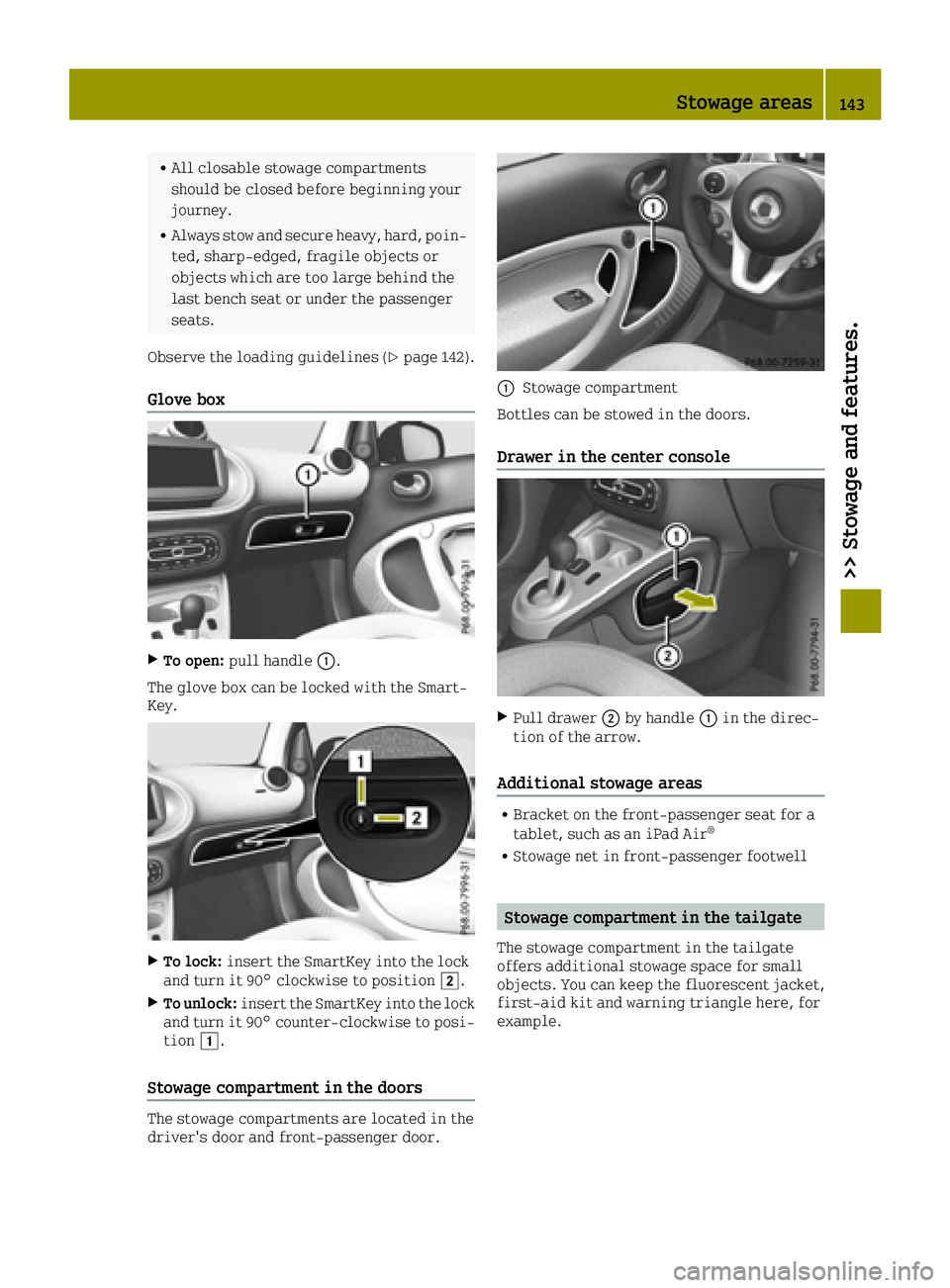
Glove box
XTo open: pull handle 0043.
The glove box can be locked with the Smart-
Key.
XTo lock: insert the SmartKey into the lock
and turn it 90° clockwise to position 0048.
XTo unlock:insert the SmartKey into the lock
and turn it 90° counter-clockwise to posi-
tion 0047.
Stowage compartment in the doors
The stowage compartments are located in the
driver's door and front-passenger door.
0043Stowage compartment
Bottles can be stowed in the doors.
Drawer in the center console
XPull drawer 0044by handle 0043in the direc-
tion of the arrow.
Additional stowage areas
RBracket on the front-passenger seat for a
tablet, such as an iPad Air®
RStowage net in front-passenger footwell
Stowage compartment in the tailgate
The stowage compartment in the tailgate
offers additional stowage space for small
objects. You can keep the fluorescent jacket,
first-aid kit and warning triangle here, for
example.
Stowage areas143
>> Stowage and features.
Z
Page 146 of 214
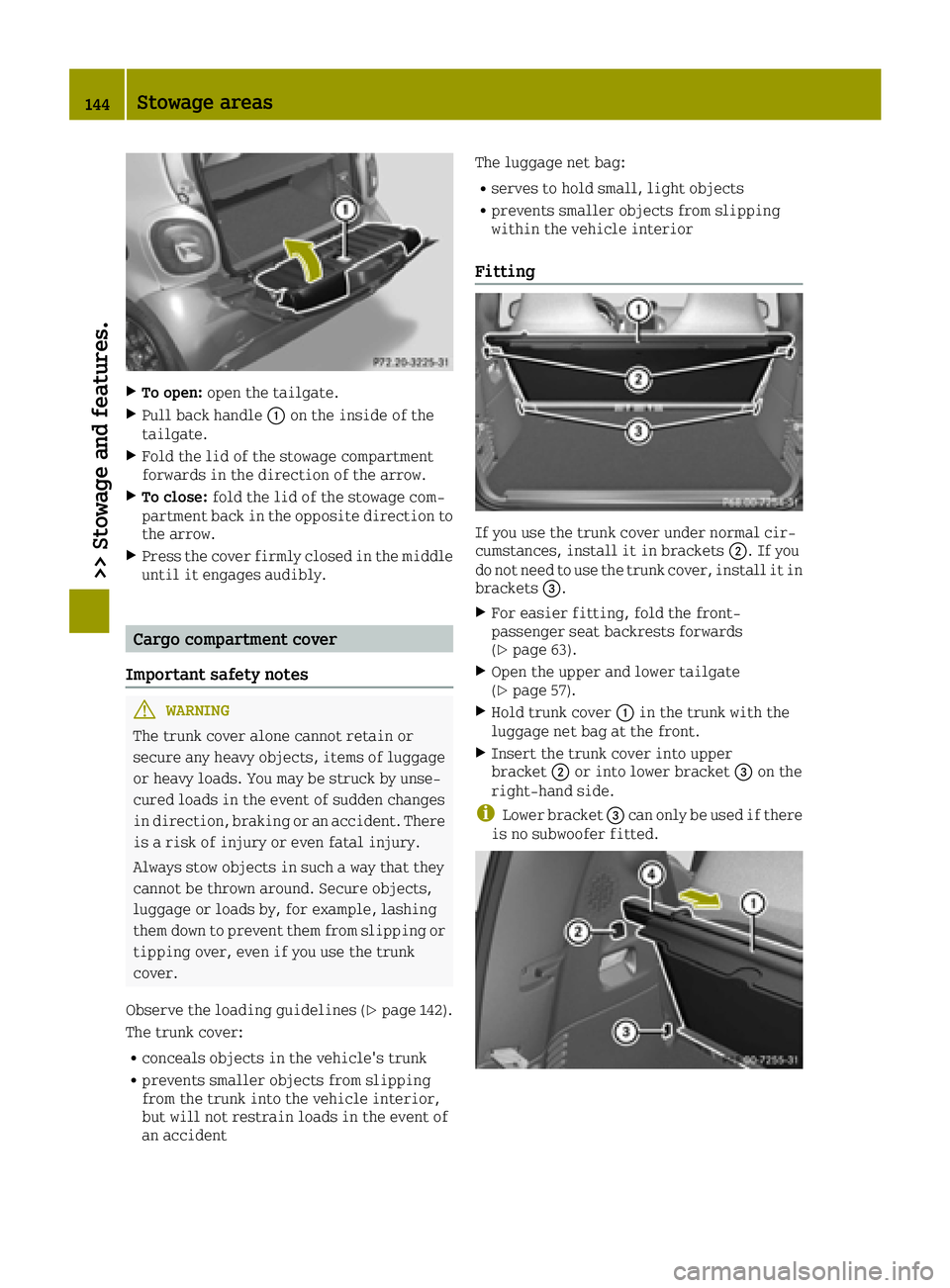
XTo open:open the tailgate.
XPull back handle 0043on the inside of the
tailgate.
XFold the lid of the stowage compartment
forwards in the direction of the arrow.
XTo close: fold the lid of the stowage com-
partment back in the opposite direction to the arrow.
XPress the cover firmly closed in the middle
until it engages audibly.
Cargo compartment cover
Important safety notes
GWARNING
The trunk cover alone cannot retain or
secure any heavy objects, items of luggage
or heavy loads. You may be struck by unse-
cured loads in the event of sudden changes
in direction, braking or an accident. There is a risk of injury or even fatal injury.
Always stow objects in such a way that they
cannot be thrown around. Secure objects,
luggage or loads by, for example, lashing
them down to prevent them from slipping or
tipping over, even if you use the trunk
cover.
Observe the loading guidelines (
Ypage 142).
The trunk cover:
Rconceals objects in the vehicle's trunk
Rprevents smaller objects from slipping
from the trunk into the vehicle interior,
but will not restrain loads in the event of
an accident The luggage net bag:
Rserves to hold small, light objects
Rprevents smaller objects from slipping
within the vehicle interior
Fitting
If you use the trunk cover under normal cir-
cumstances, install it in brackets
0044. If you
do not need to use the trunk cover, install it in brackets 0087.
XFor easier fitting, fold the front-
passenger seat backrests forwards
(
Ypage 63).
XOpen the upper and lower tailgate
(Ypage 57).
XHold trunk cover 0043in the trunk with the
luggage net bag at the front.
XInsert the trunk cover into upper
bracket 0044or into lower bracket 0087on the
right-hand side.
iLower bracket 0087can only be used if there
is no subwoofer fitted.
144Stowage areas
>> Stowage and features.
Page 151 of 214
Useful information
i
This Operator's Manual describes all
models and all standard and optional
equipment of your vehicle available at the
time of publication of the Operator's Man- ual. Country-specific differences are pos-
sible. Bear in mind that your vehicle may
not feature all functions described here.
This also applies to safety-relevant sys-
tems and functions.
iRead the information on qualified spe-
cialist workshops: (Ypage 20).
Checking service products
Engine compartment (rear)
Engine compartment cover
GWARNING
The engine compartment cover may become
very hot. If you remove the cover to do work on the engine compartment, there is a risk
of injury!
Allow the engine to cool down and then
remove the engine compartment cover after
cooling has taken place.
GWARNING
Combustion engines emit poisonous
exhaust gases such as carbon monoxide. If
the engine compartment cover has not been installed correctly, when the engine is
running, particularly if the vehicle is
moving, exhaust fumes could enter the
passenger compartment. There is a risk of
poisoning.
Always switch off the engine before remov-
ing the engine compartment cover. Make
sure that the engine compartment cover has
been installed correctly.
XTo open: apply the parking brake.
XSelect a gear.
XSwitch the ignition off.
XRemove the SmartKey from the ignition
lock.
XOpen the upper and lower tailgate
(Ypage 57).
XFor vehicles with the subwoofer: remove the
subwoofer (Ypage 149).
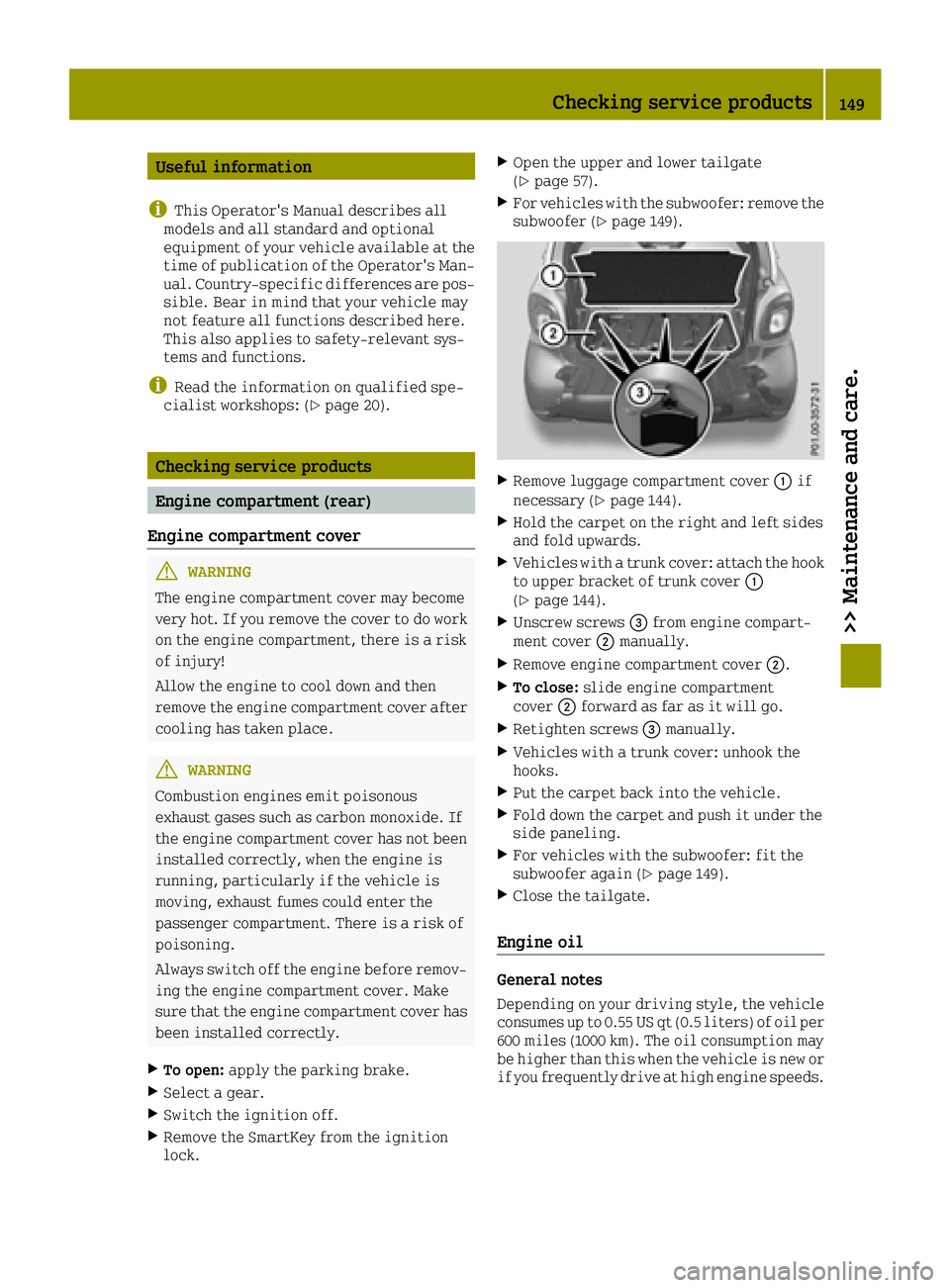
XRemove luggage compartment cover 0043if
necessary (Ypage 144).
XHold the carpet on the right and left sides
and fold upwards.
XVehicles with a trunk cover: attach the hook to upper bracket of trunk cover 0043
(
Ypage 144).
XUnscrew screws 0087from engine compart-
ment cover 0044manually.
XRemove engine compartment cover 0044.
XTo close:slide engine compartment
cover 0044forward as far as it will go.
XRetighten screws 0087manually.
XVehicles with a trunk cover: unhook the
hooks.
XPut the carpet back into the vehicle.
XFold down the carpet and push it under the
side paneling.
XFor vehicles with the subwoofer: fit the
subwoofer again (Ypage 149).
XClose the tailgate.
Engine oil
General notes
Depending on your driving style, the vehicle
consumes up to 0.55 US qt (0.5 liters) of oil per
600 miles (1000 km). The oil consumption may
be higher than this when the vehicle is new or
if you frequently drive at high engine speeds.
Checking service products149
>> Maintenance and care.
Z
Page 178 of 214
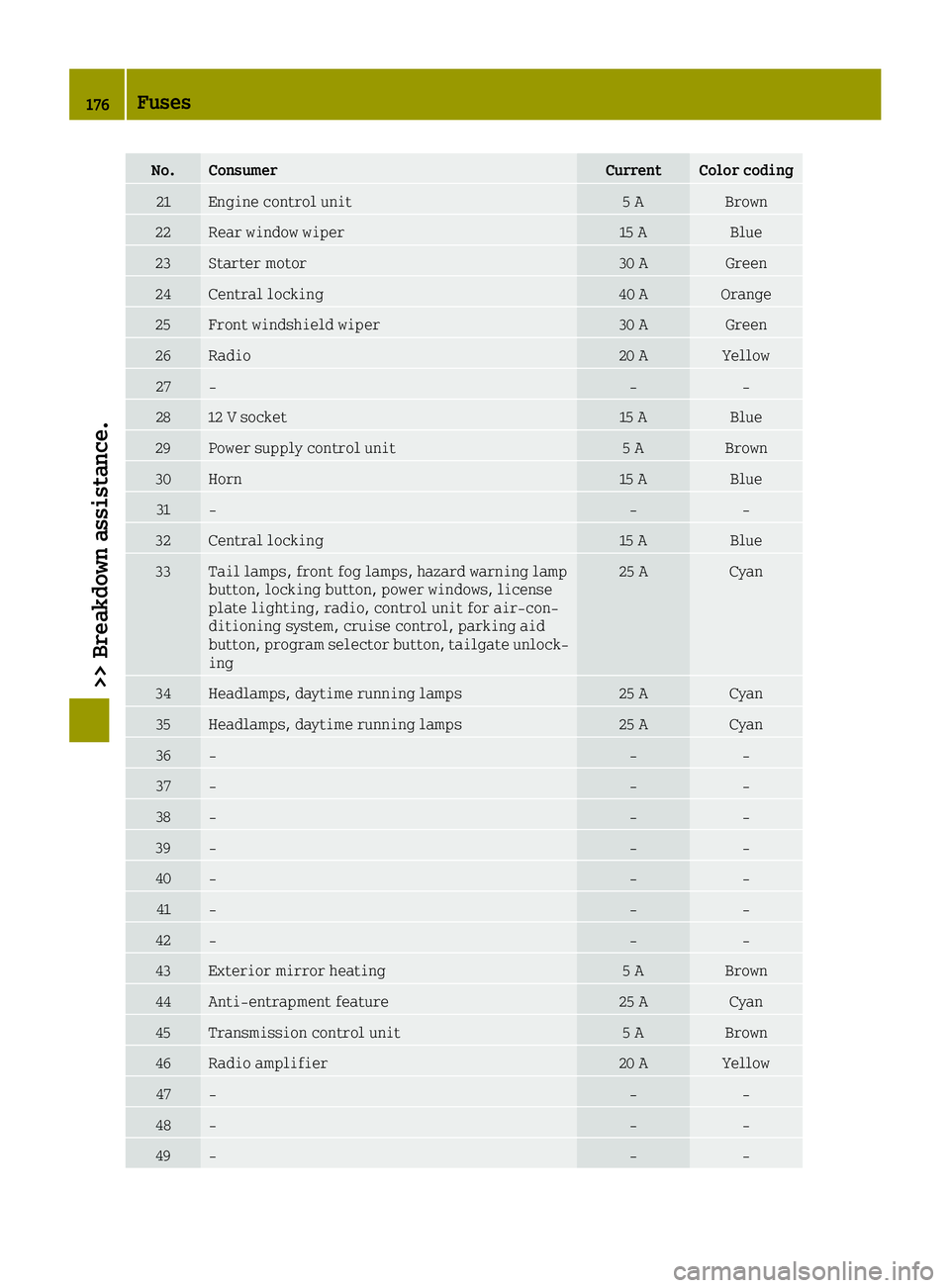
No.ConsumerCurrentColor coding
21Engine control unit5 ABrown
22Rear window wiper15 ABlue
23Starter motor30 AGreen
24Central locking40 AOrange
25Front windshield wiper30 AGreen
26Radio20 AYellow
27‑‑‑
2812 V socket15 ABlue
29Power supply control unit5 ABrown
30Horn15 ABlue
31‑‑‑
32Central locking15 ABlue
33Tail lamps, front fog lamps, hazard warning lamp
button, locking button, power windows, license
plate lighting, radio, control unit for air-con-
ditioning system, cruise control, parking aid
button, program selector button, tailgate unlock-
ing25 ACyan
34Headlamps, daytime running lamps25 ACyan
35Headlamps, daytime running lamps25 ACyan
36‑‑‑
37‑‑‑
38‑‑‑
39‑‑‑
40‑‑‑
41‑‑‑
42‑‑‑
43Exterior mirror heating5 ABrown
44Anti-entrapment feature25 ACyan
45Transmission control unit5 ABrown
46Radio amplifier20 AYellow
47‑‑‑
48‑‑‑
49‑‑‑
176Fuses
>> Breakdown assistance.
Page 200 of 214

Observe the following when raising the vehi-
cle:
Rmake sure you have a suitable jack and
wheel wrench. If used incorrectly, the jack
could tip over with the vehicle raised.
For further information inquire at any
smart center.
Rthe jack is designed only to raise and hold
the vehicle for a short time while a wheel
is being changed. It is not suited for per-
forming maintenance work under the vehi-
cle.
Ravoid changing the wheel on uphill and
downhill slopes.
Rbefore raising the vehicle, secure it from
rolling away by applying the parking brake
and inserting wheel chocks. Never disen-
gage the parking brake while the vehicle is
raised.
Rthe jack must be placed on a firm, flat and
non-slip surface. On a loose surface, a
large, flat load-bearing underlay must be
used. On a slippery surface, a non-slip
underlay must be used, e.g. rubber mats.
Rdo not use wooden blocks or similar objects
as a jack underlay. Otherwise, the jack will
not be able to achieve its load-bearing
capacity due to the restricted height.
Rmake sure that the distance between the
underside of the tires and the ground does
not exceed 1.2 in (3 cm).
Rnever place your hands and feet under the
raised vehicle.
Rdo not lie under the vehicle.
Rdo not start the engine when the vehicle is
raised.
Rdo not open or close a door or the tailgate
while the vehicle is raised.
Rmake sure that no persons are present in the
vehicle when the vehicle is raised.
!The jack is designed exclusively for
jacking up the vehicle at the jacking
points. Otherwise, your vehicle could be
damaged.
Steel wheel with hub cap
XVehicles with steel wheels and hub caps:
carefully reach into two of the hub cap
openings and remove the hub cap.
Steel wheel with hub cap
XVehicles with steel wheels and hub caps:
remove the hub cap.
XUsing wheel wrench 0043, loosen the bolts on
the wheel you wish to change by about one
full turn. Do not unscrew the bolts com-
pletely.
198Changing a wheel
>> Wheels and tires.
Page 214 of 214
Vehicle data
General notes
Please note that for the specified vehicle
data:
RThe heights specified may vary as a result
of:
-Tires
-Load
-Condition of the suspension
-Optional equipment
ROptional equipment reduces the maximum
payload.
You can find the correct values for your model
with the help of the VIN on the vehicle iden-
tification plate (
Ypage 205).
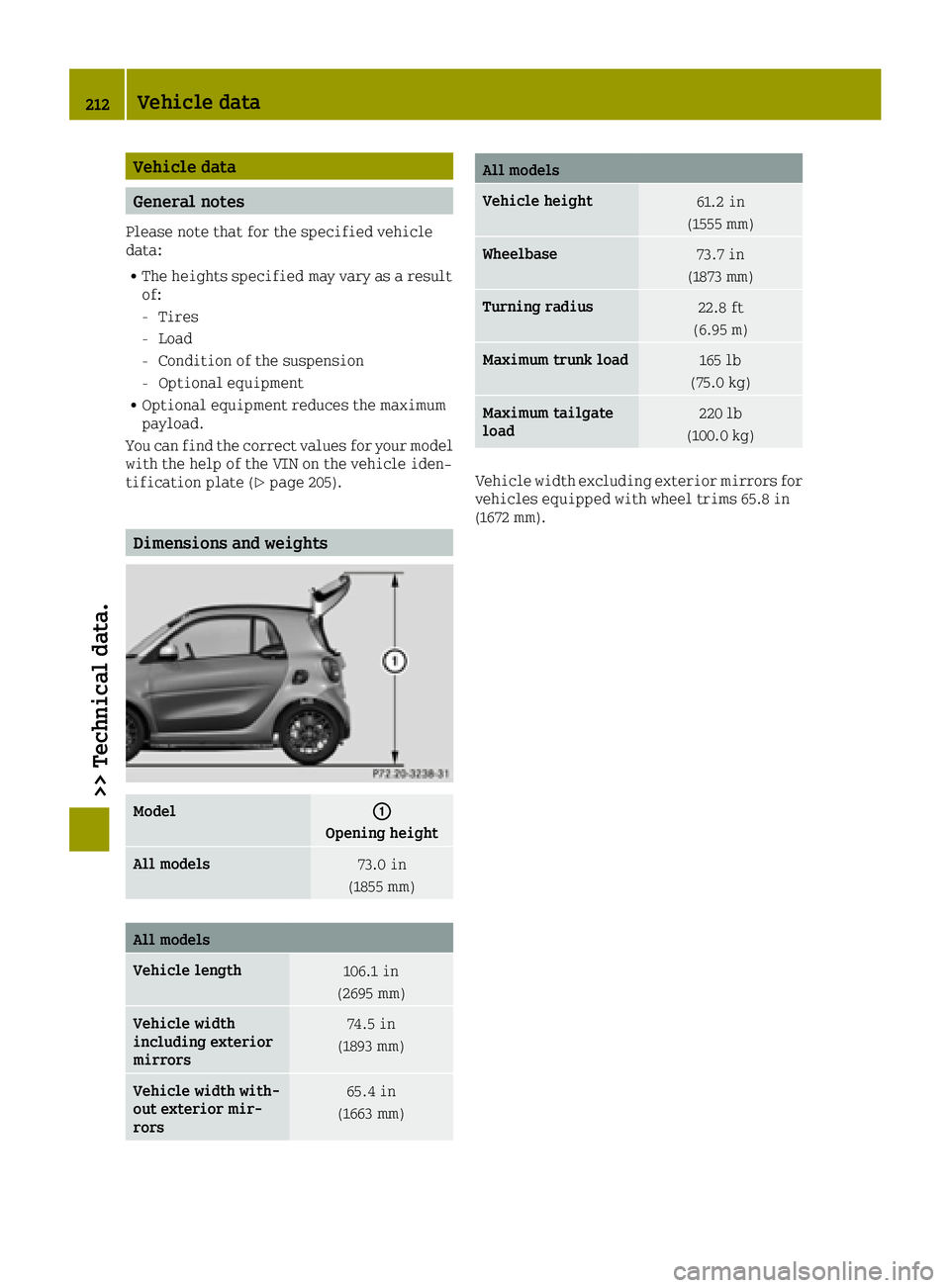
Dimensions and weights
Model0043
Opening height
All models73.0 in
(1855 mm)
All models
Vehicle length106.1 in
(2695 mm)
Vehicle width
including exterior
mirrors74.5 in
(1893 mm)
Vehicle width with-
out exterior mir-
rors65.4 in
(1663 mm)
All models
Vehicle height61.2 in
(1555 mm)
Wheelbase73.7 in
(1873 mm)
Turning radius22.8 ft
(6.95 m)
Maximum trunk load165 lb
(75.0 kg)
Maximum tailgate
load220 lb
(100.0 kg)
Vehicle width excluding exterior mirrors for
vehicles equipped with wheel trims 65.8 in
(1672 mm).
212Vehicle data
>> Technical data.