wheel SMART FORTWO 2016 User Guide
[x] Cancel search | Manufacturer: SMART, Model Year: 2016, Model line: FORTWO, Model: SMART FORTWO 2016Pages: 214, PDF Size: 4.93 MB
Page 21 of 214
electronic equipment carried out at a
qualified specialist workshop.
If you make any changes to the vehicle elec-
tronics, the general operating permit is ren-
dered invalid.
!There is a risk of damage to the vehicle if:
Rthe vehicle becomes stuck, e.g. on a high
curb or an unpaved road
Ryou drive too fast over an obstacle, e.g. a
curb or a hole in the road
Ra heavy object strikes the undercarriage
or parts of the chassis
In situations like this, the body, the under-
carriage, chassis parts, wheels or tires
could be damaged without the damage being
visible. Components damaged in this way
can unexpectedly fail or, in the case of an
accident, no longer withstand the strain
they are designed to.
If the underbody paneling is damaged,
combustible materials such as leaves,
grass or twigs can gather between the
underbody and the underbody paneling. If
these materials come in contact with hot
parts of the exhaust system, they can catch
fire.
In such situations, have the vehicle
checked and repaired immediately at a
qualified specialist workshop. If on con-
tinuing your journey you notice that driv-
ing safety is impaired, pull over and stop
the vehicle immediately, paying attention
to road and traffic conditions. In such
cases, consult a qualified specialist work-
shop.
Declarations of conformity
Vehicle components which receive
and/or transmit radio waves
USA: "The wireless devices of this vehicle
comply with Part 15 of the FCC Rules. Opera-
tion is subject to the following two condi-
tions: 1) These devices may not cause harmful interference, and 2) These devices must
accept any interference received, including
interference that may cause undesired oper-
ation. Changes or modifications not
expressly approved by the party responsible for compliance could void the user’s author-
ity to operate the equipment."
Canada:
"The wireless devices of this vehicle
comply with Industry Canada license-exempt
RSS standard(s). Operation is subject to the
following two conditions: (1) These devices
may not cause interference, and (2) These
devices must accept any interference,
including interference that may cause unde-
sired operation of the device."
Diagnostics connection
The diagnostics connection is only intended
for the connection of diagnostic equipment
at a qualified specialist workshop.
GWARNING
If you connect equipment to the diagnostics
connection in the vehicle, it may affect the
operation of the vehicle systems. As a
result, the operating safety of the vehicle
could be affected. There is a risk of an
accident.
Do not connect any equipment to a diagnos-
tics connection in the vehicle.
GWARNING
Objects in the driver's footwell can
restrict the pedal travel or obstruct a
depressed pedal. The operating and road
safety of the vehicle is jeopardized. There
is a risk of an accident.
Make sure that all objects in the vehicle are
stowed correctly, and that they cannot enter
the driver's footwell. Install the floormats securely and as specified in order to
ensure sufficient clearance for the pedals.
Do not use loose floormats and do not place
floormats on top of one another.
!If the engine is switched off and equip-
ment on the diagnostics connection is used,
the starter battery may discharge.
Connecting equipment to the diagnostics
connection can lead to emissions monitoring
information being reset, for example. This
may lead to the vehicle failing to meet the
>> Introduction.19
Z
Page 24 of 214
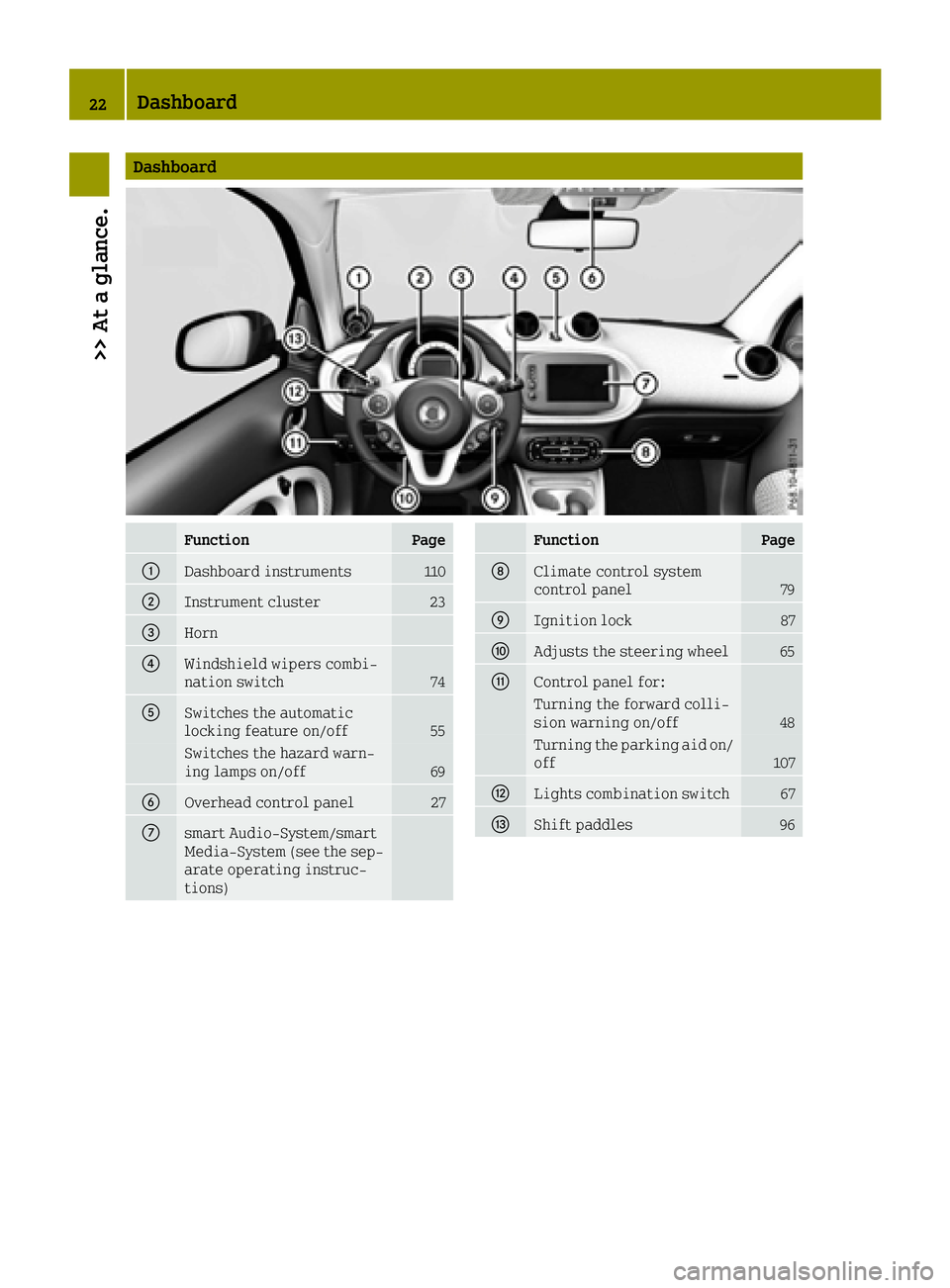
Dashboard
FunctionPage
0043Dashboard instruments110
0044Instrument cluster23
0087Horn
0085Windshield wipers combi-
nation switch74
0083Switches the automatic
locking feature on/off55
Switches the hazard warn-
ing lamps on/off69
0084Overhead control panel27
006Bsmart Audio-System/smart
Media-System (see the sep-
arate operating instruc-
tions)
FunctionPage
006CClimate control system
control panel79
006DIgnition lock87
006EAdjusts the steering wheel65
006FControl panel for:
Turning the forward colli-
sion warning on/off48
Turning the parking aid on/
off107
0070Lights combination switch67
0071Shift paddles96
22Dashboard
>> At a glance.
Page 27 of 214
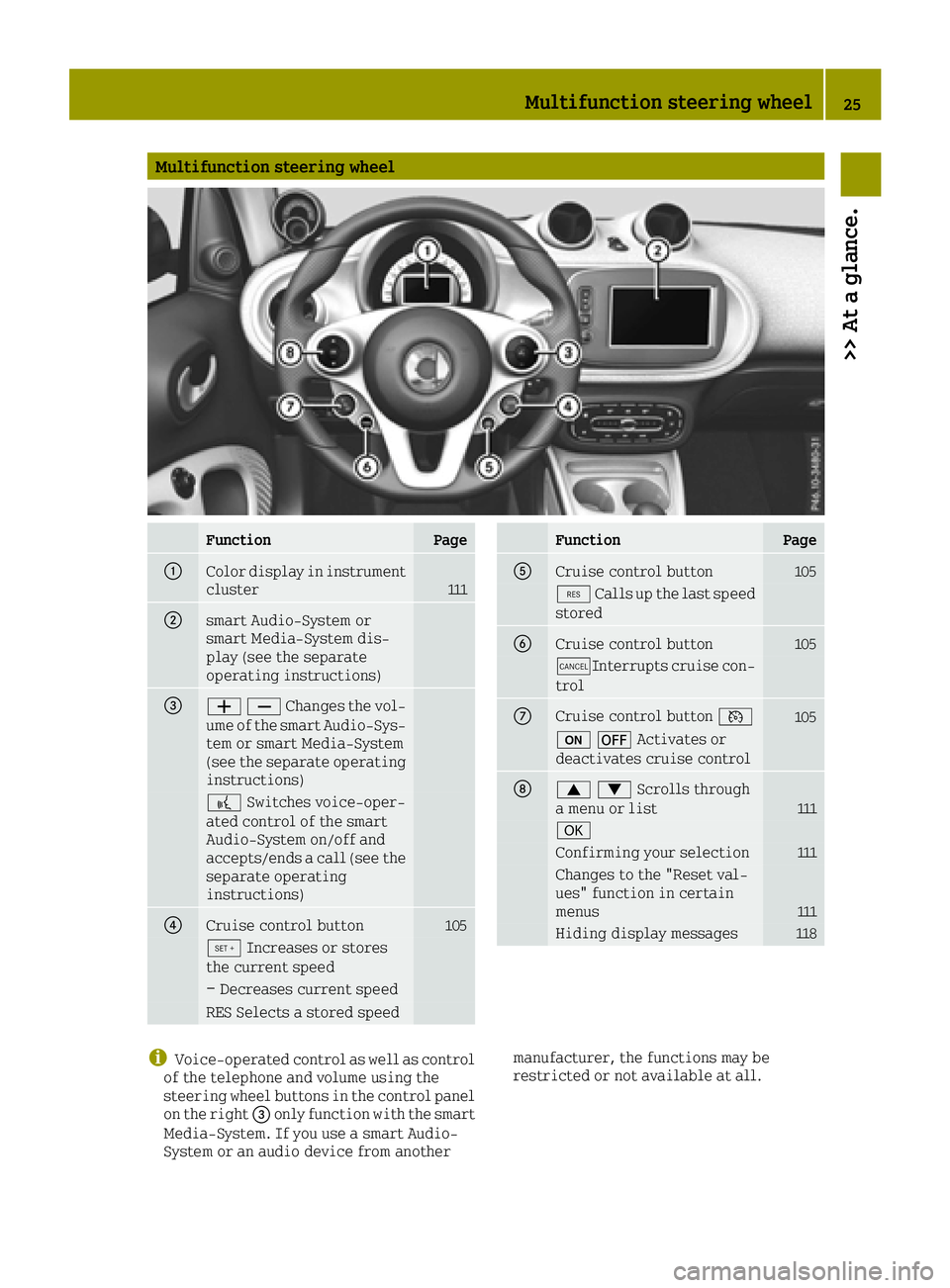
Multifunction steering wheel
FunctionPage
0043Color display in instrument
cluster111
0044smart Audio-System or
smart Media-System dis-
play (see the separate
operating instructions)
008700810082Changes the vol-ume of the smart Audio-Sys-
tem or smart Media-System
(see the separate operating
instructions)
0059 Switches voice-oper-
ated control of the smart
Audio-System on/off and
accepts/ends a call (see the
separate operating
instructions)
0085Cruise control button105
® Increases or stores
the current speed
− Decreases current speed
RES Selects a stored speed
FunctionPage
0083Cruise control button105
° Calls up the last speed
stored
0084Cruise control button105
±Interrupts cruise con-
trol
006BCruise control button 0085105
008B0078Activates or
deactivates cruise control
006C00630064Scrolls through
a menu or list111
0076
Confirming your selection111
Changes to the "Reset val-
ues" function in certain
menus
111
Hiding display messages118
iVoice-operated control as well as control
of the telephone and volume using the
steering wheel buttons in the control panel on the right 0087only function with the smart
Media-System. If you use a smart Audio-
System or an audio device from another manufacturer, the functions may be
restricted or not available at all.
Multifunction steering wheel25
>> At a glance.
Page 31 of 214
Useful information
i
This Operator's Manual describes all
models and all standard and optional
equipment of your vehicle available at the
time of publication of the Operator's Man- ual. Country-specific differences are pos-
sible. Bear in mind that your vehicle may
not feature all functions described here.
This also applies to safety-relevant sys-
tems and functions.
iRead the information on qualified spe-
cialist workshops: (Ypage 20).
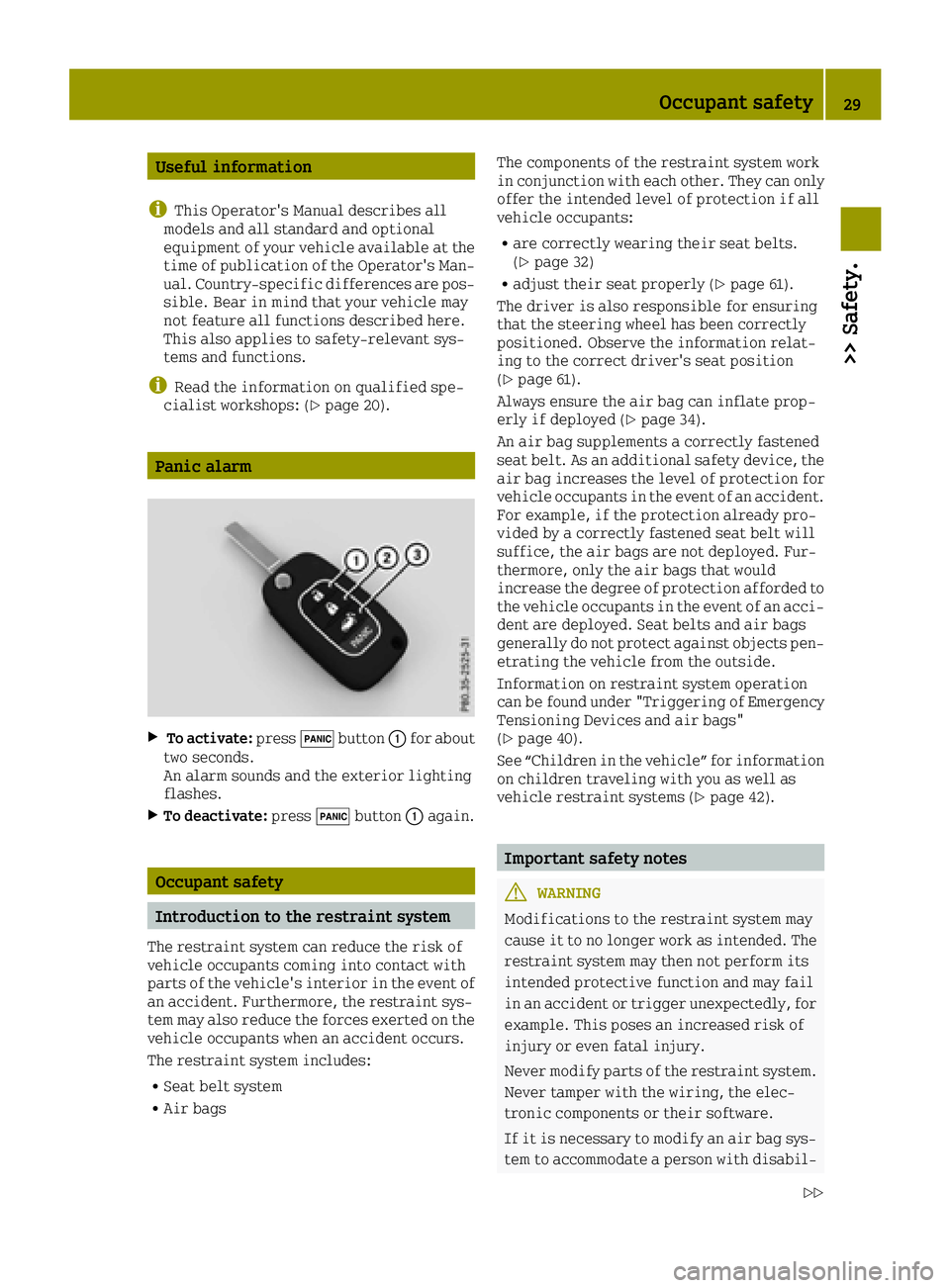
Panic alarm
XTo activate: press0033button 0043for about
two seconds.
An alarm sounds and the exterior lighting
flashes.
XTo deactivate: press0033button 0043again.
Occupant safety
Introduction to the restraint system
The restraint system can reduce the risk of
vehicle occupants coming into contact with
parts of the vehicle's interior in the event of
an accident. Furthermore, the restraint sys-
tem may also reduce the forces exerted on the
vehicle occupants when an accident occurs.
The restraint system includes:
RSeat belt system
RAir bags The components of the restraint system work
in conjunction with each other. They can only
offer the intended level of protection if all
vehicle occupants:
Rare correctly wearing their seat belts.
(Ypage 32)
Radjust their seat properly (Ypage 61).
The driver is also responsible for ensuring
that the steering wheel has been correctly
positioned. Observe the information relat-
ing to the correct driver's seat position
(
Ypage 61).
Always ensure the air bag can inflate prop-
erly if deployed (
Ypage 34).
An air bag supplements a correctly fastened
seat belt. As an additional safety device, the
air bag increases the level of protection for
vehicle occupants in the event of an accident.
For example, if the protection already pro-
vided by a correctly fastened seat belt will
suffice, the air bags are not deployed. Fur-
thermore, only the air bags that would
increase the degree of protection afforded to
the vehicle occupants in the event of an acci-
dent are deployed. Seat belts and air bags
generally do not protect against objects pen-
etrating the vehicle from the outside.
Information on restraint system operation
can be found under "Triggering of Emergency
Tensioning Devices and air bags"
(
Ypage 40).
See “Children in the vehicle” for information on children traveling with you as well as
vehicle restraint systems (
Ypage 42).
Important safety notes
GWARNING
Modifications to the restraint system may
cause it to no longer work as intended. The
restraint system may then not perform its
intended protective function and may fail
in an accident or trigger unexpectedly, for
example. This poses an increased risk of
injury or even fatal injury.
Never modify parts of the restraint system. Never tamper with the wiring, the elec-
tronic components or their software.
If it is necessary to modify an air bag sys-
tem to accommodate a person with disabil-
Occupant safety29
>> Safety.
Z
Page 36 of 214
Air bags
Introduction
The air bag installation point is identified
by the label AIR BAG.
An air bag supplements a correctly fastened
seat belt. However, it is not intended as a
substitute for the seat belt. Air bags provide
additional protection in the event of an acci- dent.
Not all air bags are deployed in an accident.
The various air bag systems work independ-
ently of each other (
Ypage 40).
There is, however, no system available today
that can completely rule out injury or death.
It is also not possible to rule out a risk of
injury caused by an air bag due to the high
speed at which the air bag must be deployed.
Important safety notes
GWARNING
If you do not sit in the correct seat posi-
tion, the air bag cannot protect as intended
and could even cause additional injury
when deployed. This poses an increased
risk of injury or even fatal injury.
To avoid hazardous situations, always make
sure that all of the vehicle's occupants:
Rhave fastened their seat belts correctly,
including pregnant women
Rare sitting correctly and maintain the
greatest possible distance to the air
bags
Rfollow the following instructions
Always make sure that there are no objects
between the air bag and the vehicle's occu- pants.
RAdjust the seats properly before beginning
your journey. Always make sure that the seatis in an almost upright position.
RMove the driver's and front-passenger
seats as far back as possible. The driver's
seat position must allow the vehicle to be
driven safely.
ROnly hold the steering wheel on the outside.This allows the air bag to be fully deployed.
RAlways lean against the backrest while
driving. Do not lean forwards or lean
against the door or side window. You may
otherwise be in the deployment area of the
air bags.
RAlways keep your feet in the footwell in
front of the seat. Do not put your feet on the
dashboard, for example. Your feet may oth-
erwise be in the deployment area of the air
bag.
RFor this reason, always secure persons lessthan 5 ft (1.50 m) tall in suitable restraint
systems. Up to this height, the seat belt
cannot be worn correctly.
If a child is traveling in your vehicle, also
observe the following notes:
RAlways secure children under twelve years
of age and less than 5 ft (1.50 m) tall in
suitable child restraint systems.
ROnly secure a child in a rearward-facing
child restraint system on the front-
passenger seat when the front-passenger
front air bag is deactivated. If the
PASSENGER AIR BAG OFF indicator lamp is
permanently lit, the front-passenger front air bag is deactivated (
Ypage 30).
RAlways observe the instructions and safety
notes on the "Occupant Classification Sys-
tem (OCS)" (
Ypage 36) and on "Children in
the vehicle" (Ypage 42) in addition to the
child restraint system manufacturer's
installation and operating instructions.
Objects in the vehicle interior may prevent
an air bag from functioning correctly. Before
starting your journey and to avoid risks
resulting from the speed of the air bag as it
deploys, make sure that:
Rthere are no people, animals or objects
between the vehicle occupants and an air
bag.
Rthere are no objects between the seat, door and B-pillar.
Rno hard objects, e.g. coat hangers, hang on
the grab handles or coat hooks.
Rno accessories, such as cup holders, are
attached to the vehicle within the deploy-
ment area of an air bag, e.g. to doors or side
windows.
Rno heavy, sharp-edged or fragile objects
are in the pockets of your clothing. Store
such objects in a suitable place.
34Occupant safety
>> Safety.
Page 37 of 214
GWARNING
If you modify the air bag cover or affix
objects such as stickers to it, the air bag
can no longer function correctly. There is
an increased risk of injury.
Never modify an air bag cover or affix
objects to it.
GWARNING
Sensors to control the air bags are located
in the doors. Modifications or work not
performed correctly to the doors or door
paneling, as well as damaged doors, can
lead to the function of the sensors being
impaired. The air bags might therefore not
function properly anymore. Consequently,
the air bags cannot protect vehicle occu-
pants as they are designed to do. There is an increased risk of injury.
Never modify the doors or parts of the
doors. Always have work on the doors or door
paneling carried out at a qualified spe-
cialist workshop.
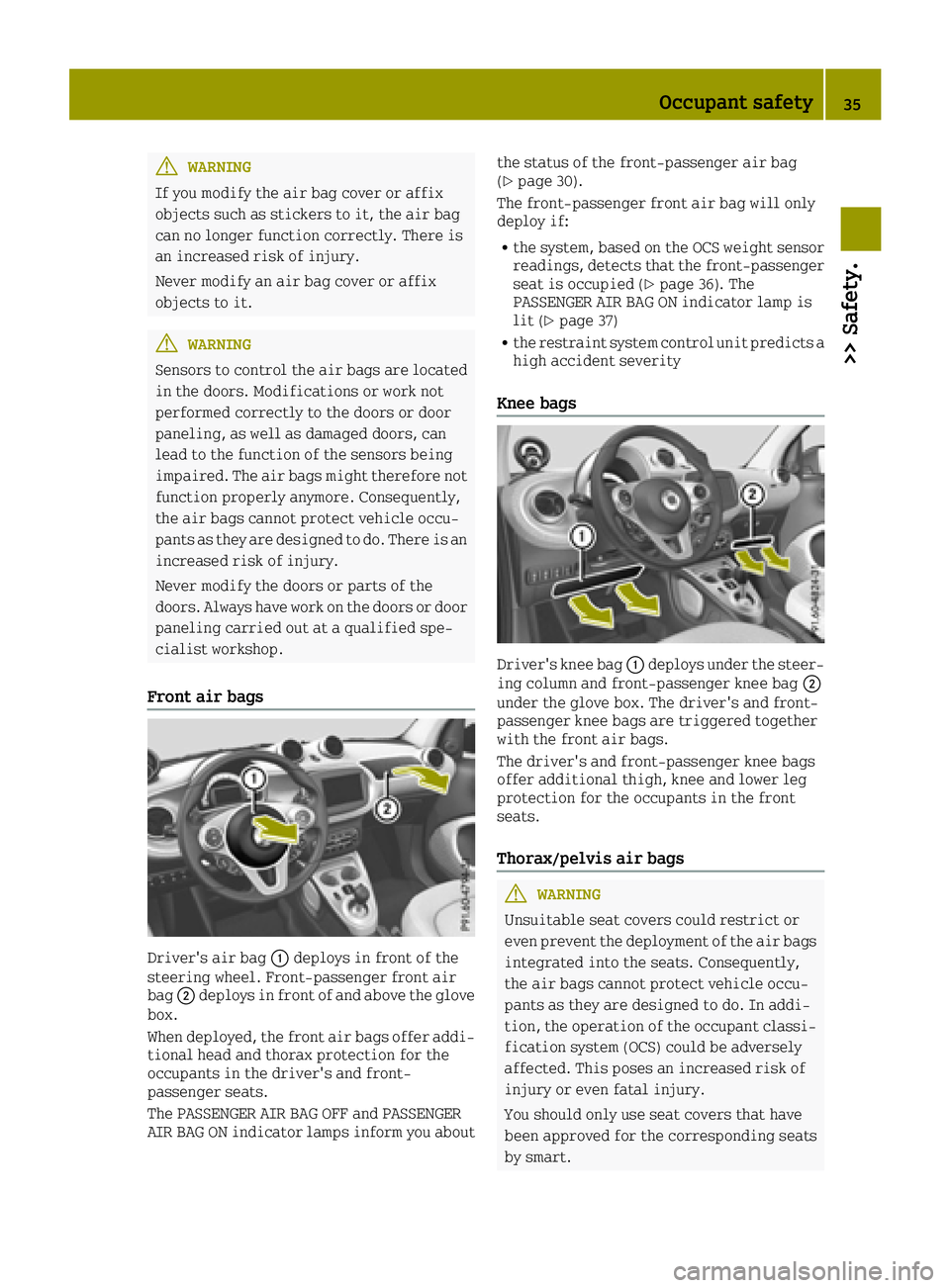
Front air bags
Driver's air bag 0043deploys in front of the
steering wheel. Front-passenger front air
bag 0044deploys in front of and above the glove
box.
When deployed, the front air bags offer addi-
tional head and thorax protection for the
occupants in the driver's and front-
passenger seats.
The PASSENGER AIR BAG OFF and PASSENGER
AIR BAG ON indicator lamps inform you about the status of the front-passenger air bag
(
Ypage 30).
The front-passenger front air bag will only
deploy if:
Rthe system, based on the OCS weight sensor
readings, detects that the front-passenger
seat is occupied (
Ypage 36). The
PASSENGER AIR BAG ON indicator lamp is
lit (
Ypage 37)
Rthe restraint system control unit predicts a high accident severity
Knee bags
Driver's knee bag 0043deploys under the steer-
ing column and front-passenger knee bag 0044
under the glove box. The driver's and front-
passenger knee bags are triggered together
with the front air bags.
The driver's and front-passenger knee bags
offer additional thigh, knee and lower leg
protection for the occupants in the front
seats.
Thorax/pelvis air bags
GWARNING
Unsuitable seat covers could restrict or
even prevent the deployment of the air bags integrated into the seats. Consequently,
the air bags cannot protect vehicle occu-
pants as they are designed to do. In addi-
tion, the operation of the occupant classi-
fication system (OCS) could be adversely
affected. This poses an increased risk of
injury or even fatal injury.
You should only use seat covers that have
been approved for the corresponding seats
by smart.
Occupant safety35
>> Safety.
Z
Page 49 of 214
Switching off the alarm
XTo switch off the alarm:press the0036
button on the key.
The alarm is switched off.
or
XSwitch on the ignition.
The alarm is switched off.
The alarm is not switched off, even if you
close the open door that triggered it, for
example.
Driving safety systems
Overview of driving safety systems
In this section, you will find information
about the following driving safety systems:
RABS (Anti-lock BrakingSystem)
(Ypage 47)
RDistance warning function (Ypage 48)
Resp®(Electronic StabilityProgram)
(Ypage 49)
REBD (Electronic Brake forceDistribution)
(Ypage 50)
Important safety notes
If you fail to adapt your driving style or
become distracted, the driving safety sys-
tems can neither reduce the risk of accident
nor override the laws of physics. Driving
safety systems are merely aids designed to
assist driving. You are responsible for the
distance to the vehicle in front, for vehicle
speed and for braking in good time. Always
adapt your driving style to suit the prevail-
ing road, weather and traffic conditions and
maintain a safe distance from the vehicle in
front. Drive carefully.
The driving safety systems described only
work as effectively as possible when there is
adequate contact between the tires and the
road surface. Please pay special attention to
the notes on tires, recommended minimum
tire tread depths, etc. (
Ypage 177).
In wintry driving conditions, always use win-
ter tires (M+S tires) and if necessary, snow
chains. Only in this way will the driving
safety systems described in this section work
as effectively as possible. For safety reasons, smart recommends that you
only use snow chains that have been specially
approved for your vehicle by smart, or fine-
link snow chains that are of a corresponding
standard of quality. For more information,
please contact a qualified specialist work-
shop.
ABS (Anti-lock Braking System)
General information
ABS regulates brake pressure in such a way
that the wheels do not lock when you brake.
This allows you to continue steering the vehi-
cle when braking.
The 0025 (Canada only) or 00DF(USA only) abs
warning lamp in the instrument cluster lights up when the ignition is switched on. It goes
out when the engine is running.
Important safety notes
iObserve the "Important safety notes" sec-
tion for driving safety systems (Ypage 47).
When ABS is malfunctioning, other systems,
including driving safety systems, will also
become inoperative. Observe the information
on the ABS warning lamp (
Ypage 132) and
display messages which may be shown in the
instrument cluster (
Ypage 121).
GWARNING
If ABS is faulty, the wheels could lock when
braking. The steerability and braking
characteristics may be severely impaired.
Additionally, further driving safety sys-
tems are deactivated. There is an increased
danger of skidding and accidents.
Drive on carefully. Have ABS checked imme-
diately at a qualified specialist workshop.
abs works from a speed of about 4 mph (6 km/h),
regardless of road-surface conditions. ABS
works on slippery surfaces, even if you only
brake gently.
Driving safety systems47
>> Safety.
Z
Page 51 of 214
XTo switch off:press button0044.
Indicator lamp 0043lights up.
XTo switch on: press button0044.
Indicator lamp 0043goes out.
Starting at a speed of around 4 mph (7 km/h),
the distance warning function warns you if
you rapidly approach a vehicle in front. An
intermittent warning tone will then sound
and the 00BAdistance warning lamp will
light up in the instrument cluster.
XBrake immediately in order to increase the distance from the vehicle in front.
or
XTake evasive action, provided it is safe to
do so.
Due to the nature of the system, particularly
complicated but non-critical driving condi-
tions may also cause the system to display a
warning.
With the help of the radar sensor system, the
distance warning function can detect obsta-
cles that are in the path of your vehicle for an
extended period of time.
Up to a speed of around 45 mph (70 km/h), the
distance warning function can also react to
stationary obstacles, such as stopped or
parked vehicles.
ESP®(Electronic Stability Program)
General notes
iObserve the "Important safety notes" sec-
tion (Ypage 47).
esp
®monitors driving stability and traction,
i.e. power transmission between the tires and the road surface.
If esp
®detects that the vehicle is deviating
from the direction desired by the driver, one
or more wheels are braked to stabilize the
vehicle. The engine output is also modified
to keep the vehicle on the desired course
within physical limits. esp
®assists the
driver when pulling away on wet or slippery
roads. esp
®can also stabilize the vehicle
during braking.
ETS (Electronic Traction System)
iObserve the "Important safety notes" sec-
tion (Ypage 47).
ETS traction control is part of esp
®.
ETS brakes the drive wheels individually if
they spin. This enables you to pull away and
accelerate on slippery surfaces, for example if the road surface is slippery on one side. In
addition, more drive torque is transferred to
the wheel with traction.
Important safety notes
GWARNING
If ESP
®is malfunctioning, ESP®is unable to
stabilize the vehicle. Additionally, fur-
ther driving safety systems are deactiva-
ted. This increases the risk of skidding and
an accident.
Drive on carefully. Have ESP
®checked at a
qualified specialist workshop.
!If you test the parking brake using a brake
dynamometer, switch the ignition off.
Application of the brakes by ESP
®may oth-
erwise destroy the brake system.
When towing the vehicle with the rear axle
raised, observe the notes on esp
®
(Ypage 171).
If the 00E5esp®warning lamp lights up per-
manently, esp®or hill start assist are
unavailable due to a malfunction.
Observe the information on warning lamps
(
Ypage 134) and display messages which may
be shown in the instrument cluster
(
Ypage 121).
iOnly use wheels with the recommended
tire sizes. Only then will esp®function
properly.
Characteristics of ESP®
General information
If the 00E5esp®warning lamp goes out before
the journey begins, esp®is automatically
active.
If esp
®intervenes, the 00E5esp®warning
lamp flashes in the instrument cluster.
Driving safety systems49
>> Safety.
Z
Page 52 of 214
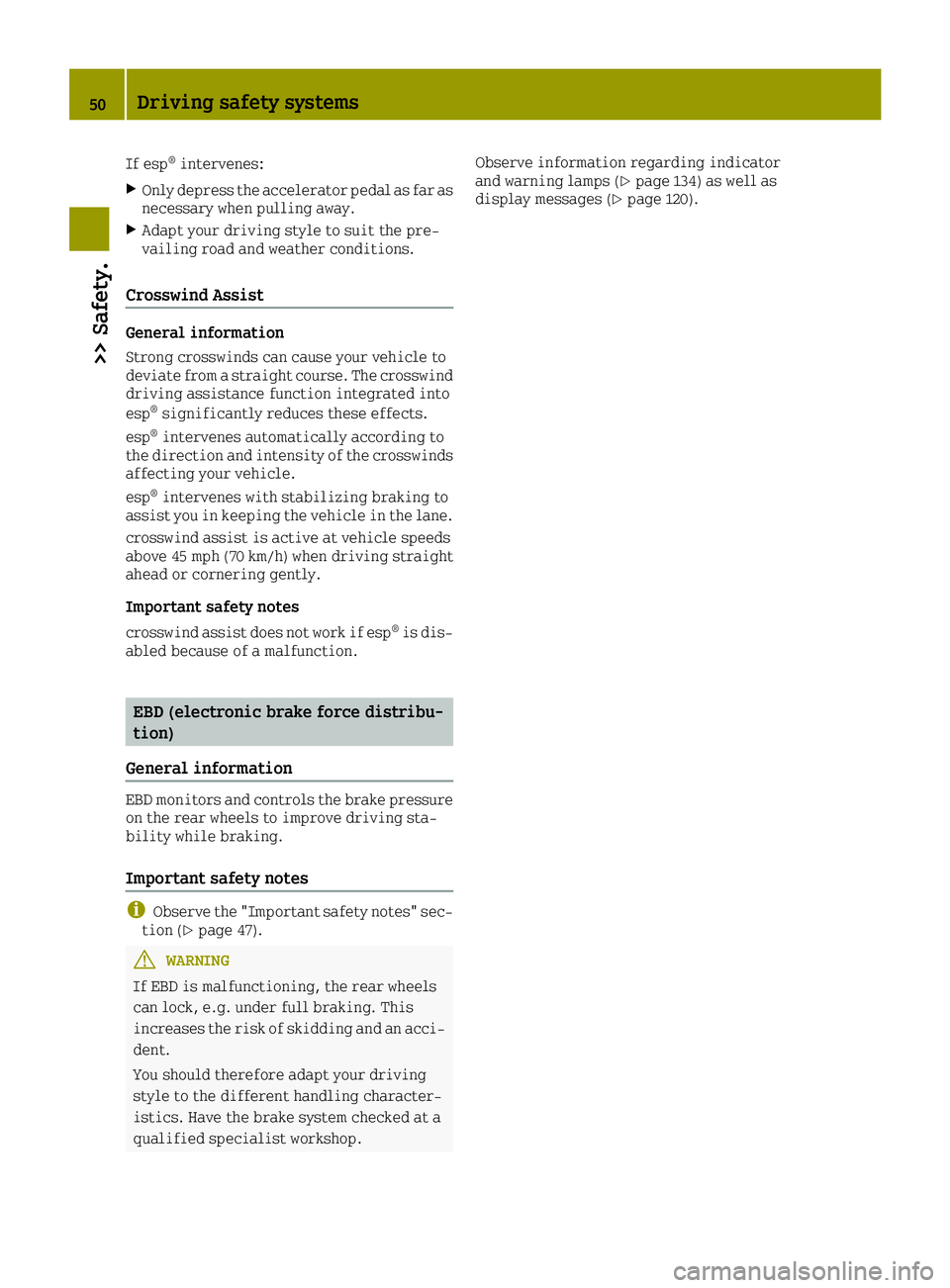
If esp®intervenes:
XOnly depress the accelerator pedal as far as
necessary when pulling away.
XAdapt your driving style to suit the pre-
vailing road and weather conditions.
Crosswind Assist
General information
Strong crosswinds can cause your vehicle to
deviate from a straight course. The crosswind
driving assistance function integrated into
esp
®significantly reduces these effects.
esp®intervenes automatically according to
the direction and intensity of the crosswinds
affecting your vehicle.
esp
®intervenes with stabilizing braking to
assist you in keeping the vehicle in the lane.
crosswind assist is active at vehicle speeds
above 45 mph (70 km/h )when driving straight
ahead or cornering gently.
Important safety notes
crosswind assist does not work if esp®is dis-
abled because of a malfunction.
EBD (electronic brake force distribu-
tion)
General information
EBD monitors and controls the brake pressure
on the rear wheels to improve driving sta-
bility while braking.
Important safety notes
iObserve the "Important safety notes" sec-
tion (Ypage 47).
GWARNING
If EBD is malfunctioning, the rear wheels
can lock, e.g. under full braking. This
increases the risk of skidding and an acci-
dent.
You should therefore adapt your driving
style to the different handling character-
istics. Have the brake system checked at a
qualified specialist workshop. Observe information regarding indicator
and warning lamps (
Ypage 134) as well as
display messages (Ypage 120).
50Driving safety systems
>> Safety.
Page 55 of 214
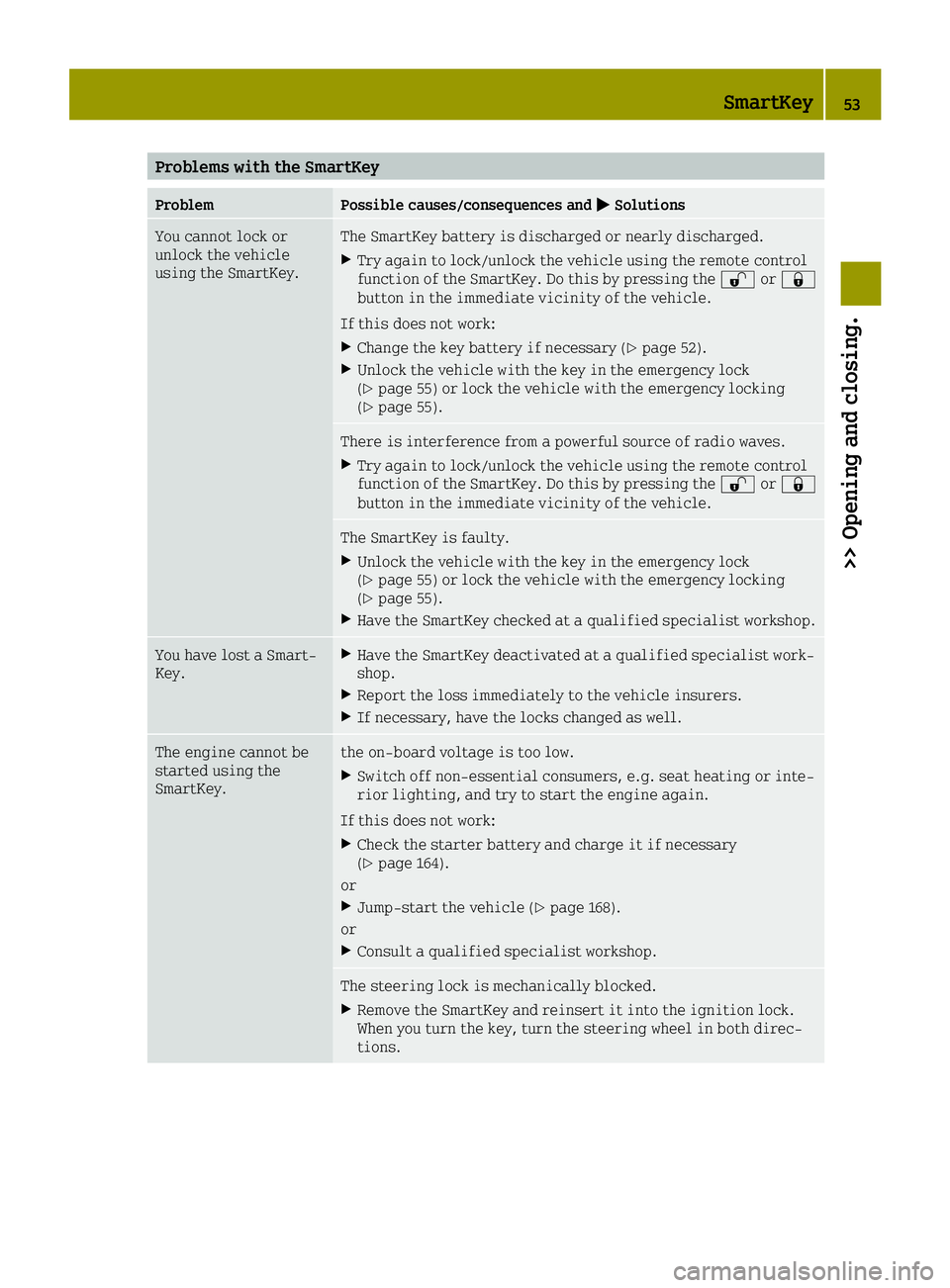
Problems with the SmartKey
ProblemPossible causes/consequences and0050Solutions
You cannot lock or
unlock the vehicle
using the SmartKey.The SmartKey battery is discharged or nearly discharged.
XTry again to lock/unlock the vehicle using the remote control
function of the SmartKey. Do this by pressing the 0036or0037
button in the immediate vicinity of the vehicle.
If this does not work:
XChange the key battery if necessary (Ypage 52).
XUnlock the vehicle with the key in the emergency lock
(Ypage 55) or lock the vehicle with the emergency locking
(Ypage 55).
There is interference from a powerful source of radio waves.
XTry again to lock/unlock the vehicle using the remote control
function of the SmartKey. Do this by pressing the 0036or0037
button in the immediate vicinity of the vehicle.
The SmartKey is faulty.
XUnlock the vehicle with the key in the emergency lock
(Ypage 55) or lock the vehicle with the emergency locking
(Ypage 55).
XHave the SmartKey checked at a qualified specialist workshop.
You have lost a Smart-
Key.XHave the SmartKey deactivated at a qualified specialist work-
shop.
XReport the loss immediately to the vehicle insurers.
XIf necessary, have the locks changed as well.
The engine cannot be
started using the
SmartKey.the on-board voltage is too low.
XSwitch off non-essential consumers, e.g. seat heating or inte-
rior lighting, and try to start the engine again.
If this does not work:
XCheck the starter battery and charge it if necessary
(Ypage 164).
or
XJump-start the vehicle (Ypage 168).
or
XConsult a qualified specialist workshop.
The steering lock is mechanically blocked.
XRemove the SmartKey and reinsert it into the ignition lock.
When you turn the key, turn the steering wheel in both direc-
tions.
SmartKey53
>> Opening and closing.
Z