tow SMART FORTWO 2016 Owner's Manual
[x] Cancel search | Manufacturer: SMART, Model Year: 2016, Model line: FORTWO, Model: SMART FORTWO 2016Pages: 214, PDF Size: 4.93 MB
Page 106 of 214
more quickly and protecting them against
corrosion.
Limited braking performance on salt-
treated roads
If you drive on salted roads, a layer of salt
residue may form on the brake discs and brake
pads. This can result in a significantly lon-
ger braking distance.
RBrake occasionally to remove any possible
salt residue. Make sure that you do not
endanger other road users when doing so.
RCarefully depress the brake pedal and the
beginning and end of a journey.
RMaintain a greater distance to the vehicle
ahead.
Servicing the brakes
!The brake fluid level may be too low, if:
Rif the red brake warning lamp lights up
in the instrument cluster and
Ryou hear a warning tone while the engine
is running
Observe additional warning messages in
the multifunction display.
The brake fluid level may be too low due to
brake pad wear or leaking brake lines.
Have the brake system checked immedi-
ately. Consult a qualified specialist work-
shop to arrange this.
!A function or performance test should
only be carried out on a 2-axle dynamome-
ter. If you wish to operate the vehicle on
such a dynamometer, please consult a
qualified specialist workshop in advance.
You could otherwise damage the drive train
or the brake system.
!As the ESP®system operates automati-
cally, the engine and the ignition must be
switched off (the SmartKey must be in posi-
tion 0or 1in the ignition lock) if:
Rthe parking brake is tested using a brake
dynamometer (maximum 10 seconds).
Rthe vehicle is towed with the front axle
raised.
Braking triggered automatically by ESP
®
may seriously damage the brake system. All checks and maintenance work on the brake
system must be carried out at a qualified
specialist workshop.
Have brake pads installed and brake fluid
replaced at a qualified specialist workshop.
If the brake system has only been subject to
moderate loads, you should test the function-
ality of your brakes at regular intervals.
When having brake pads/linings fitted, smart
recommends that you only use those which are
approved for smart vehicles or are of an
equivalent quality standard. Brake pads/
linings which have not been approved for
smart vehicles or which are not of an equiv-
alent quality could affect your vehicle's
operating safety.
smart recommends that you only use brake
fluid which is approved for smart vehicles or
is of an equivalent quality standard. Brake
fluid which has not been approved for smart
vehicles or which
is not of an equivalent
quality could affect your vehicle's operating
safety.
Driving on wet roads
Hydroplaning
If water has accumulated to a certain depth on the road surface, there is a danger of hydro-
planing occurring, even if:
Ryou drive at low speeds.
Rthe tires have adequate tread depth.
For this reason, in the event of heavy rain or in conditions in which hydroplaning may
occur, you must drive in the following man-
ner:
Rlower your speed.
Ravoid ruts.
Ravoid sudden steering movements
Rbrake carefully.
Driving on flooded roads
!Bear in mind that vehicles traveling in
front or in the opposite direction create
waves. This may cause the maximum per-
missible water depth to be exceeded.
Failure to observe these notes may result in damage to the engine, electrical systems
and transmission.
104Driving tips
>> Driving and parking.
Page 144 of 214
Useful information
i
This Operator's Manual describes all
models and all standard and optional
equipment of your vehicle available at the
time of publication of the Operator's Man- ual. Country-specific differences are pos-
sible. Bear in mind that your vehicle may
not feature all functions described here.
This also applies to safety-relevant sys-
tems and functions.
iRead the information on qualified spe-
cialist workshops: (Ypage 20).
Stowage areas
Loading guidelines
GWARNING
If objects, luggage or loads are not secured or not secured sufficiently, they could
slip, tip over or be flung around and
thereby hit vehicle occupants. There is a
risk of injury, particularly in the event of
sudden braking or a sudden change in
direction.
Always store objects so that they cannot be
flung around. Secure objects, luggage or
loads against slipping or tipping before
the journey.
GWARNING
Combustion engines emit poisonous
exhaust gases such as carbon monoxide. If
the tailgate is open when the engine is
running, particularly if the vehicle is
moving, exhaust fumes could enter the
passenger compartment. There is a risk of
poisoning.
Turn off the engine before opening the
tailgate. Never drive with the tailgate
open.
Your vehicle has not been approved by the
manufacturer for towing a trailer. A trailer
could seriously impair driving safety.
Mounting a basic rack, a cycle rack or a ski/
snowboard rack on the rear of the vehicle will change the axle load distribution as speci-
fied by the vehicle manufacturer. Read the
operating instructions for the individual
accessories.
The handling characteristics of a laden vehi-
cle are dependent on the distribution of the
load within the vehicle. For this reason, you
should observe the following notes when
transporting a load:
Rnever exceed the maximum permissible
gross vehicle weight or the permissible
axle loads for the vehicle (including occu-
pants). The values are specified on the
vehicle identification plate on the B-pil-
lar of the driver's door
Rthe load must not protrude above the upper
edge of the head restraints
Rensure that no items of luggage can enter
the vehicle interior above or between the
front seats
Rensure that loaded objects are stowed
safely and are secured
Rload heavy objects at the bottom and light
objects at the top
Stowage space
Important safety notes
GWARNING
If you stow objects in the vehicle interior
in an unsuitable way, they could slip or be
thrown around and thus hit vehicle occu-
pants. Additionally, the cup holders, open
stowage spaces and mobile phone brackets
cannot restrain the objects placed in them
in the event of an accident. There is a risk
of injury, especially in the event of brak-
ing or sudden changes in direction.
RAlways stow objects so they cannot be
thrown around in these or similar situa-
tions.
RAlways ensure that objects do not pro-
trude from the stowage compartments or
stowage nets.
142Stowage areas
>> Stowage and features.
Page 145 of 214
RAll closable stowage compartments
should be closed before beginning your
journey.
RAlways stow and secure heavy, hard, poin-
ted, sharp-edged, fragile objects or
objects which are too large behind the
last bench seat or under the passenger
seats.
Observe the loading guidelines (
Ypage 142).
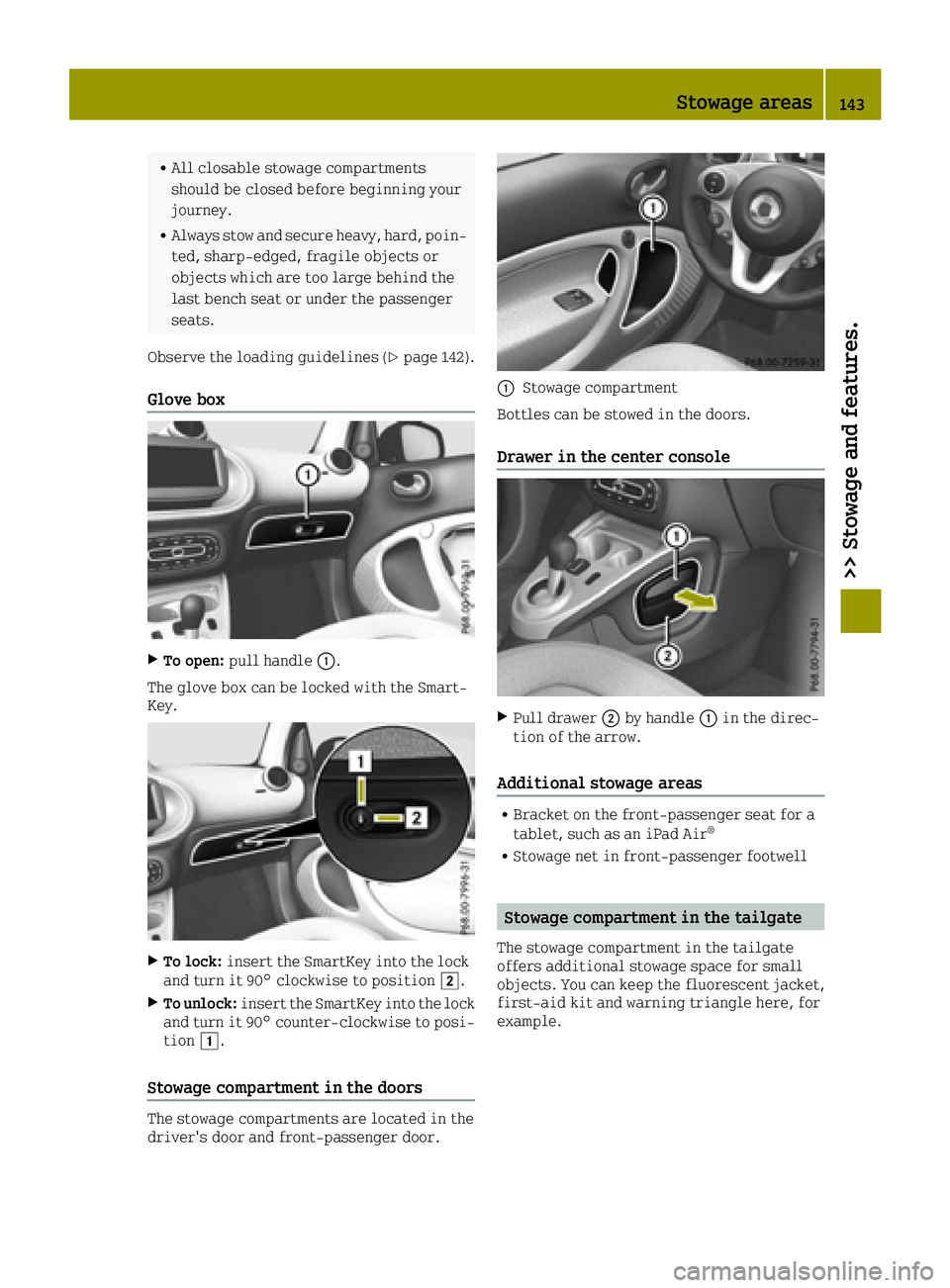
Glove box
XTo open: pull handle 0043.
The glove box can be locked with the Smart-
Key.
XTo lock: insert the SmartKey into the lock
and turn it 90° clockwise to position 0048.
XTo unlock:insert the SmartKey into the lock
and turn it 90° counter-clockwise to posi-
tion 0047.
Stowage compartment in the doors
The stowage compartments are located in the
driver's door and front-passenger door.
0043Stowage compartment
Bottles can be stowed in the doors.
Drawer in the center console
XPull drawer 0044by handle 0043in the direc-
tion of the arrow.
Additional stowage areas
RBracket on the front-passenger seat for a
tablet, such as an iPad Air®
RStowage net in front-passenger footwell
Stowage compartment in the tailgate
The stowage compartment in the tailgate
offers additional stowage space for small
objects. You can keep the fluorescent jacket,
first-aid kit and warning triangle here, for
example.
Stowage areas143
>> Stowage and features.
Z
Page 146 of 214
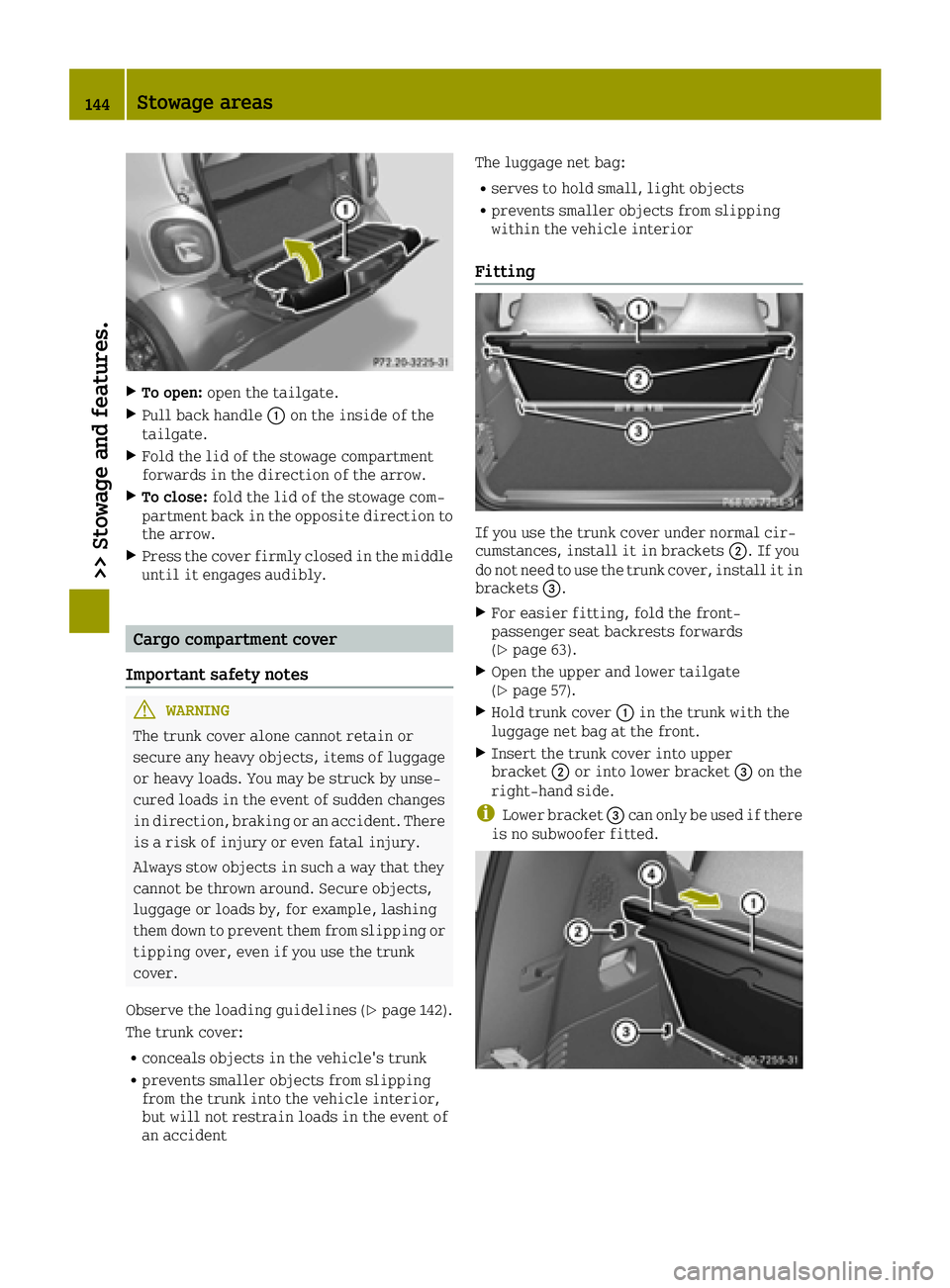
XTo open:open the tailgate.
XPull back handle 0043on the inside of the
tailgate.
XFold the lid of the stowage compartment
forwards in the direction of the arrow.
XTo close: fold the lid of the stowage com-
partment back in the opposite direction to the arrow.
XPress the cover firmly closed in the middle
until it engages audibly.
Cargo compartment cover
Important safety notes
GWARNING
The trunk cover alone cannot retain or
secure any heavy objects, items of luggage
or heavy loads. You may be struck by unse-
cured loads in the event of sudden changes
in direction, braking or an accident. There is a risk of injury or even fatal injury.
Always stow objects in such a way that they
cannot be thrown around. Secure objects,
luggage or loads by, for example, lashing
them down to prevent them from slipping or
tipping over, even if you use the trunk
cover.
Observe the loading guidelines (
Ypage 142).
The trunk cover:
Rconceals objects in the vehicle's trunk
Rprevents smaller objects from slipping
from the trunk into the vehicle interior,
but will not restrain loads in the event of
an accident The luggage net bag:
Rserves to hold small, light objects
Rprevents smaller objects from slipping
within the vehicle interior
Fitting
If you use the trunk cover under normal cir-
cumstances, install it in brackets
0044. If you
do not need to use the trunk cover, install it in brackets 0087.
XFor easier fitting, fold the front-
passenger seat backrests forwards
(
Ypage 63).
XOpen the upper and lower tailgate
(Ypage 57).
XHold trunk cover 0043in the trunk with the
luggage net bag at the front.
XInsert the trunk cover into upper
bracket 0044or into lower bracket 0087on the
right-hand side.
iLower bracket 0087can only be used if there
is no subwoofer fitted.
144Stowage areas
>> Stowage and features.
Page 147 of 214
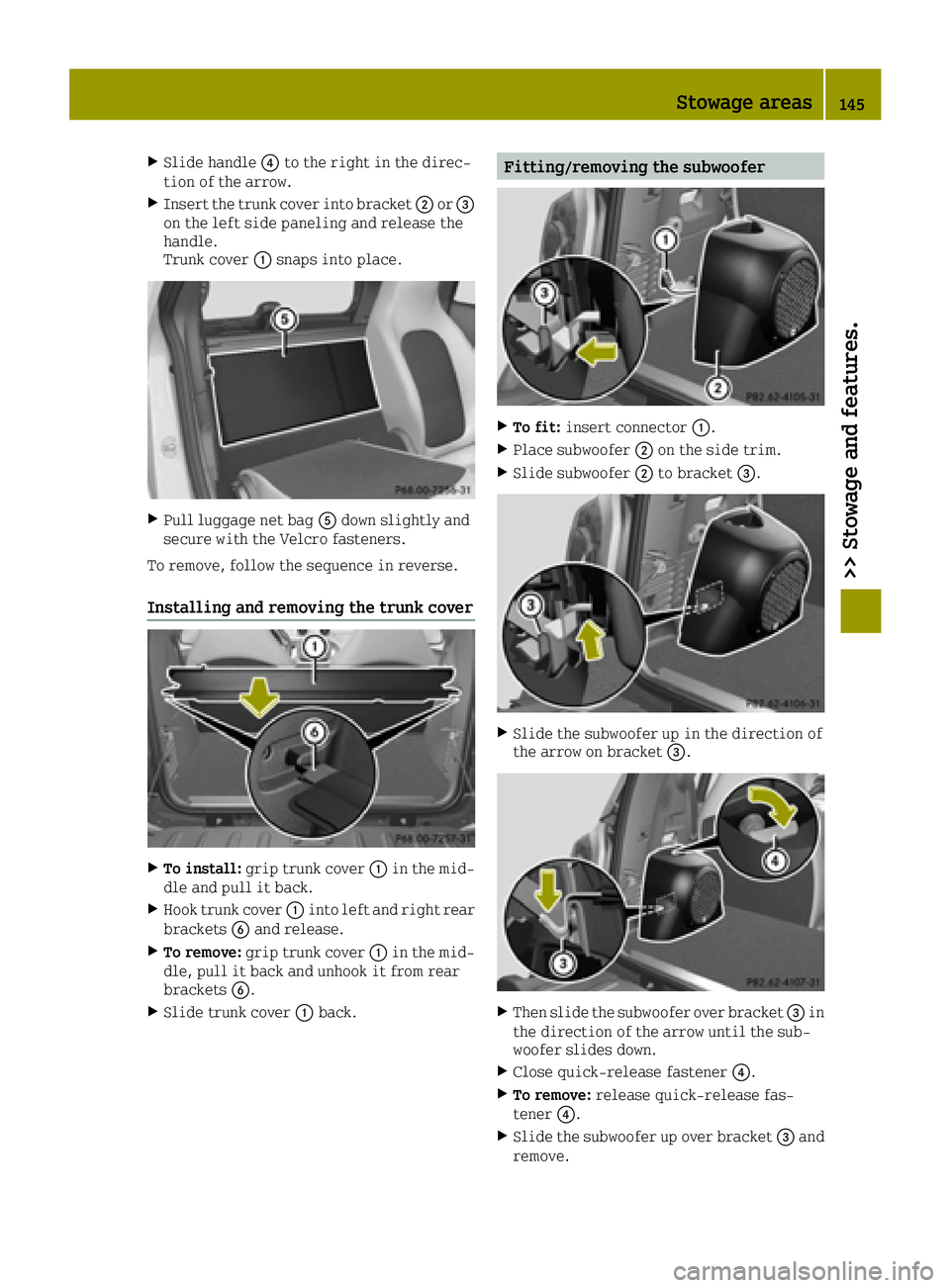
XSlide handle0085to the right in the direc-
tion of the arrow.
XInsert the trunk cover into bracket 0044or0087
on the left side paneling and release the
handle.
Trunk cover 0043snaps into place.
XPull luggage net bag 0083down slightly and
secure with the Velcro fasteners.
To remove, follow the sequence in reverse.
Installing and removing the trunk cover
XTo install: grip trunk cover 0043in the mid-
dle and pull it back.
XHook trunk cover 0043into left and right rear
brackets 0084and release.
XTo remove: grip trunk cover 0043in the mid-
dle, pull it back and unhook it from rear
brackets 0084.
XSlide trunk cover 0043back.
Fitting/removing the subwoofer
XTo fit: insert connector 0043.
XPlace subwoofer0044on the side trim.
XSlide subwoofer 0044to bracket 0087.
XSlide the subwoofer up in the direction of
the arrow on bracket 0087.
XThen slide the subwoofer over bracket 0087in
the direction of the arrow until the sub-
woofer slides down.
XClose quick-release fastener 0085.
XTo remove:release quick-release fas-
tener 0085.
XSlide the subwoofer up over bracket 0087and
remove.
Stowage areas145
>> Stowage and features.
Z
Page 148 of 214
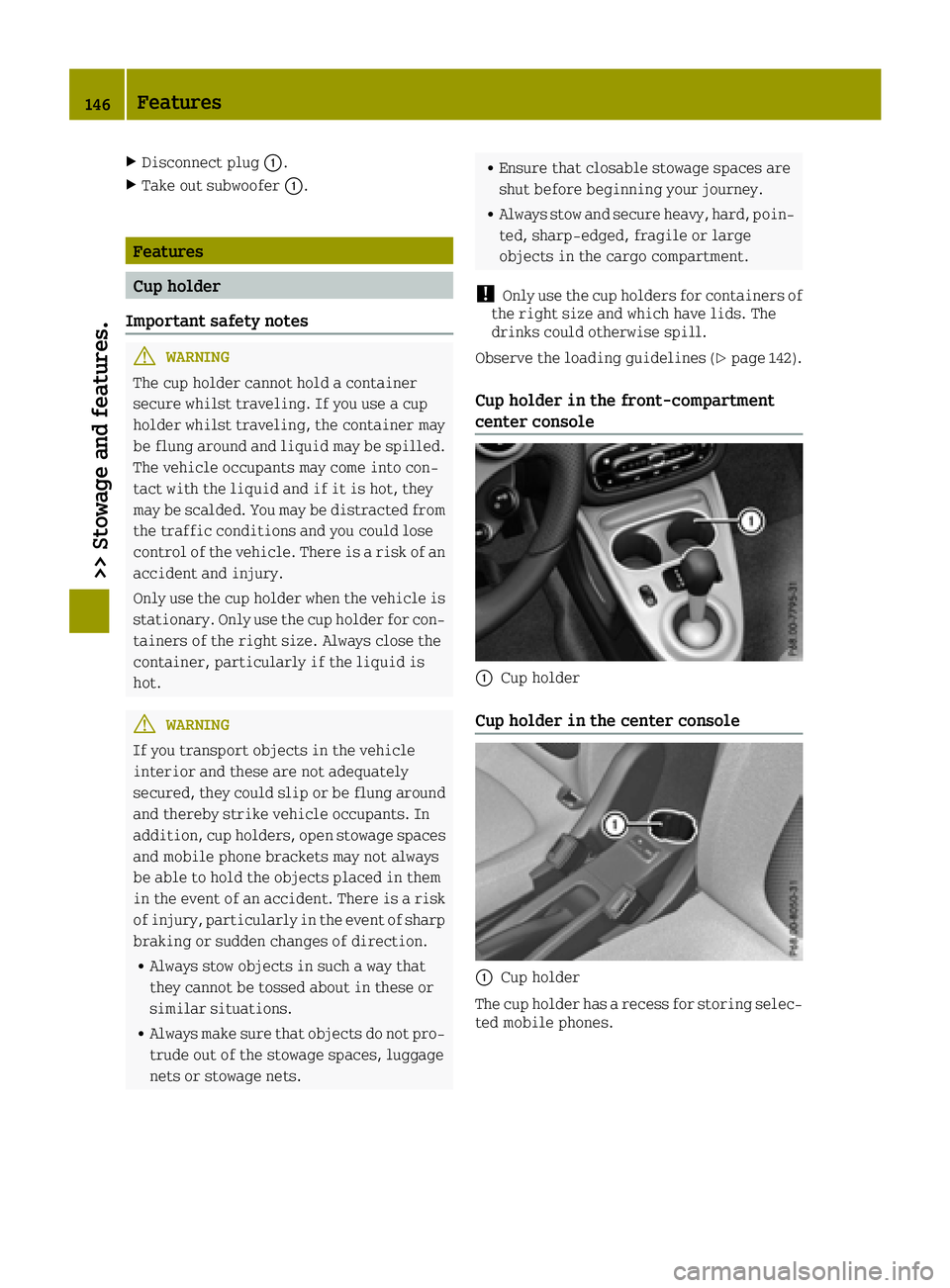
XDisconnect plug0043.
XTake out subwoofer 0043.
Features
Cup holder
Important safety notes
GWARNING
The cup holder cannot hold a container
secure whilst traveling. If you use a cup
holder whilst traveling, the container may
be flung around and liquid may be spilled.
The vehicle occupants may come into con-
tact with the liquid and if it is hot, they
may be scalded. You may be distracted from
the traffic conditions and you could lose
control of the vehicle. There is a risk of an
accident and injury.
Only use the cup holder when the vehicle is stationary. Only use the cup holder for con-
tainers of the right size. Always close the
container, particularly if the liquid is
hot.
GWARNING
If you transport objects in the vehicle
interior and these are not adequately
secured, they could slip or be flung around
and thereby strike vehicle occupants. In
addition, cup holders, open stowage spaces and mobile phone brackets may not always
be able to hold the objects placed in them
in the event of an accident. There is a risk
of injury, particularly in the event of sharp
braking or sudden changes of direction.
RAlways stow objects in such a way that
they cannot be tossed about in these or
similar situations.
RAlways make sure that objects do not pro-
trude out of the stowage spaces, luggage
nets or stowage nets.
REnsure that closable stowage spaces are
shut before beginning your journey.
RAlways stow and secure heavy, hard, poin-
ted, sharp-edged, fragile or large
objects in the cargo compartment.
!Only use the cup holders for containers of
the right size and which have lids. The
drinks could otherwise spill.
Observe the loading guidelines (
Ypage 142).
Cup holder in the front-compartment
center console
0043Cup holder
Cup holder in the center console
0043Cup holder
The cup holder has a recess for storing selec-
ted mobile phones.
146Features
>> Stowage and features.
Page 149 of 214
Sun visors
Overview
GWARNING
If the mirror cover of the vanity mirror is
folded up when the vehicle is in motion, you
could be blinded by incident light. There
is a risk of an accident.
Always keep the mirror cover folded down
while driving.
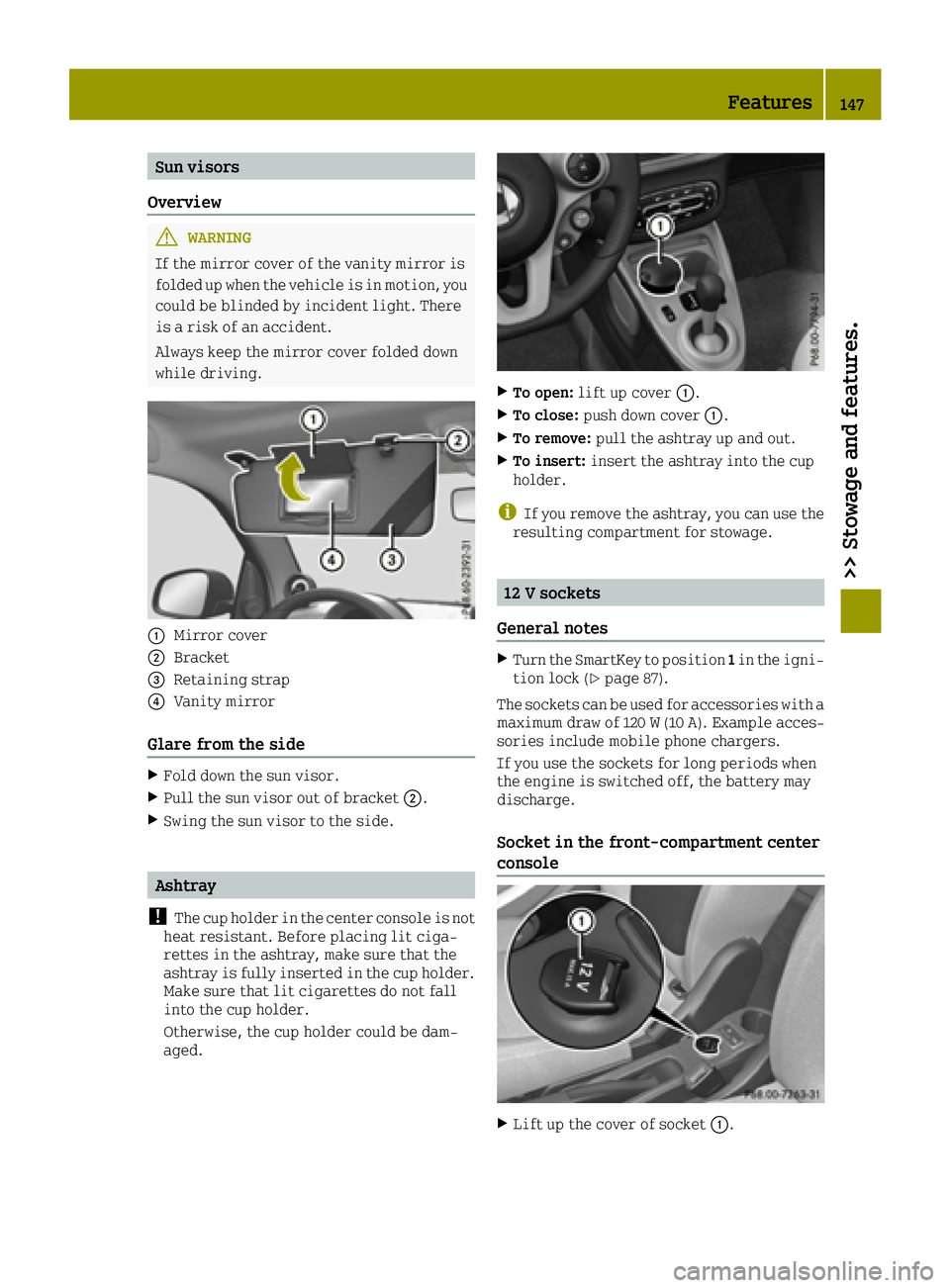
0043Mirror cover
0044Bracket
0087Retaining strap
0085Vanity mirror
Glare from the side
XFold down the sun visor.
XPull the sun visor out of bracket 0044.
XSwing the sun visor to the side.
Ashtray
!
The cup holder in the center console is not
heat resistant. Before placing lit ciga-
rettes in the ashtray, make sure that the
ashtray is fully inserted in the cup holder.
Make sure that lit cigarettes do not fall
into the cup holder.
Otherwise, the cup holder could be dam-
aged.
XTo open: lift up cover 0043.
XTo close:push down cover 0043.
XTo remove:pull the ashtray up and out.
XTo insert:insert the ashtray into the cup
holder.
iIf you remove the ashtray, you can use the
resulting compartment for stowage.
12 V sockets
General notes
XTurn the SmartKey to position 1in the igni-
tion lock (Ypage 87).
The sockets can be used for accessories with a
maximum draw of 120 W(10A). Example acces-
sories include mobile phone chargers.
If you use the sockets for long periods when
the engine is switched off, the battery may
discharge.
Socket in the front-compartment center
console
XLift up the cover of socket 0043.
Features147
>> Stowage and features.
Z
Page 150 of 214
Floormat on the driver's side
GWARNING
Objects in the driver's footwell can
restrict the pedal travel or obstruct a
depressed pedal. The operating and road
safety of the vehicle is jeopardized. There
is a risk of an accident.
Make sure that all objects in the vehicle are
stowed correctly, and that they cannot enter
the driver's footwell. Install the floormats securely and as specified in order to
ensure sufficient clearance for the pedals.
Do not use loose floormats and do not place
floormats on top of one another.
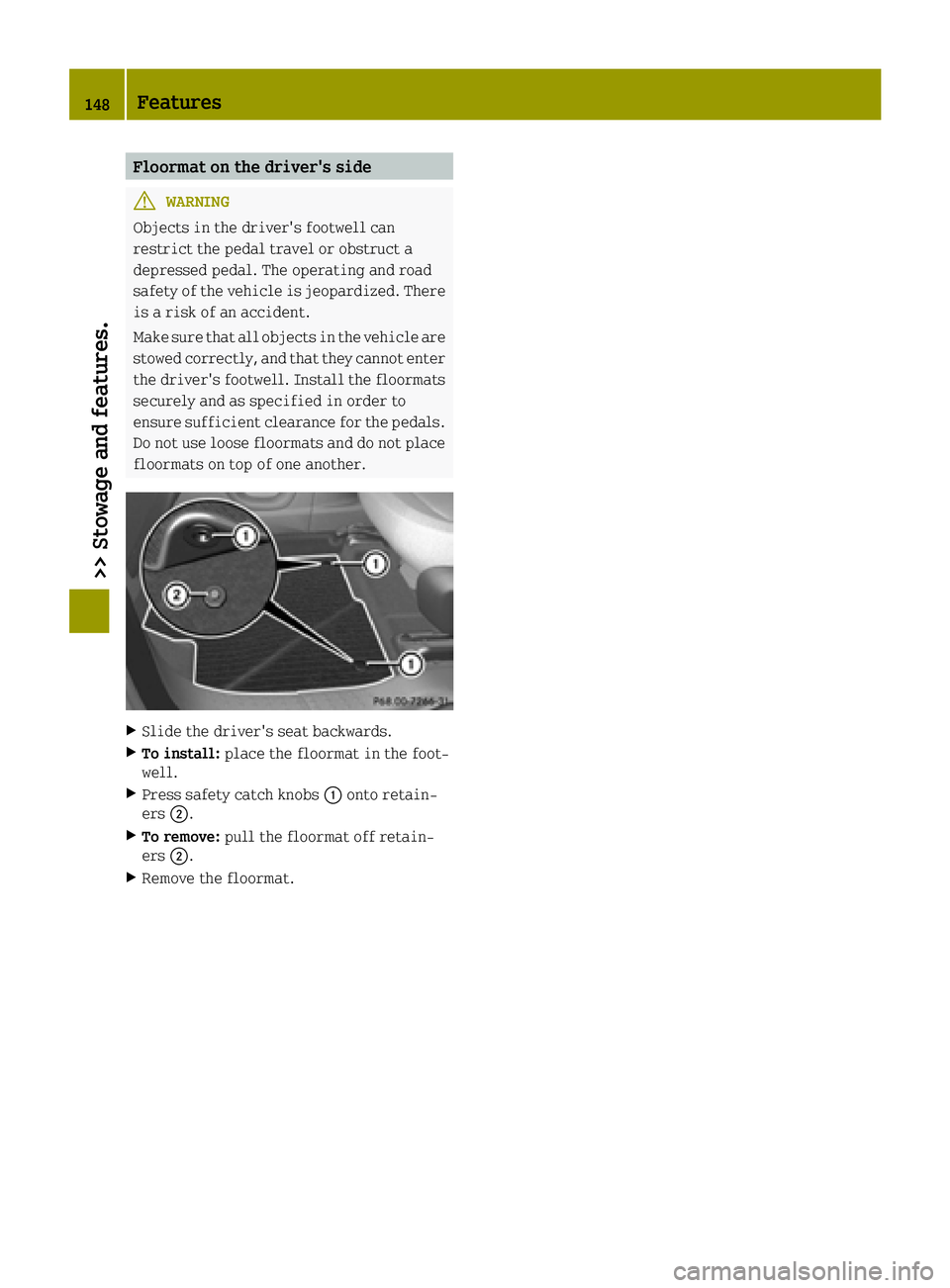
XSlide the driver's seat backwards.
XTo install: place the floormat in the foot-
well.
XPress safety catch knobs 0043onto retain-
ers 0044.
XTo remove: pull the floormat off retain-
ers 0044.
XRemove the floormat.
148Features
>> Stowage and features.
Page 157 of 214
!For cleaning your vehicle, do not use any
of the following:
Rdry, rough or hard cloths
Rabrasive cleaning agents
Rsolvents
Rcleaning agents containing solvents
Do not scrub.
Do not touch the surfaces or protective
films with hard objects, e.g. a ring or ice
scraper. You could otherwise scratch or
damage the surfaces and protective film.
!Do not park the vehicle for an extended
period straight after cleaning it, partic-
ularly after having cleaned the wheels with
wheel cleaner. Wheel cleaners could cause
increased corrosion of the brake discs and
brake pads/linings. For this reason, you
should drive for a few minutes after clean-
ing. Braking heats the brake discs and the
brake pads/linings, thus drying them. The
vehicle can then be parked.
Regular care of your vehicle is a condition
for retaining the quality in the long term.
Use care products and cleaning agents rec-
ommended and approved by smart.
Exterior care
Automatic car wash
GWARNING
Braking efficiency is reduced after wash-
ing the vehicle. There is a risk of an acci-
dent.
After the vehicle has been washed, brake
carefully while paying attention to the
traffic conditions until full braking power
is restored.
!Never clean your vehicle in a Touchless
Automatic Car Wash as these use special
cleaning agents. These cleaning agents can
damage the paintwork or plastic parts.
!Make sure that:
Rthe side windows are fully closed
Rthe climate control blower is switched
off
Rthe windshield wiper switch is at posi-
tion 0
The vehicle may otherwise be damaged.
You can wash the vehicle in an automatic car
wash from the very start.
If the vehicle is very dirty, pre-wash it
before cleaning it in an automatic car wash.
After using an automatic car wash, wipe off
wax from the windshield and the wiper blades.
This will prevent smears and reduce wiping
noises caused by residue on the windshield.
Washing by hand
In some countries, washing by hand is only
allowed at specially equipped washing bays.
Observe the legal requirements in each coun-
try.
XDo not use hot water and do not wash the
vehicle in direct sunlight.
XUse a soft sponge to clean.
XUse a mild cleaning agent, such as a car
shampoo approved by smart.
XThoroughly hose down the vehicle with a
gentle jet of water.
XDo not point the water jet directly towards
the air inlet.
XUse plenty of water and rinse out the sponge frequently.
XRinse the vehicle with clean water and dry
thoroughly with a chamois.
XDo not let the cleaning agent dry on the
paintwork.
Carefully remove all deposits of road salt as
soon as possible when driving in winter.
Power washers
GWARNING
The water jet from a circular jet nozzle
(dirt blasters) can cause invisible exte-
rior damage to the tires or chassis compo- nents. Components damaged in this way may
fail unexpectedly. There is a risk of an
accident.
Care155
>> Maintenance and care.
Z
Page 163 of 214
Useful information
i
This Operator's Manual describes all
models and all standard and optional
equipment of your vehicle available at the
time of publication of the Operator's Man- ual. Country-specific differences are pos-
sible. Bear in mind that your vehicle may
not feature all functions described here.
This also applies to safety-relevant sys-
tems and functions.
iRead the information on qualified spe-
cialist workshops: (Ypage 20).
Where will I find...?
Vehicle tool kit
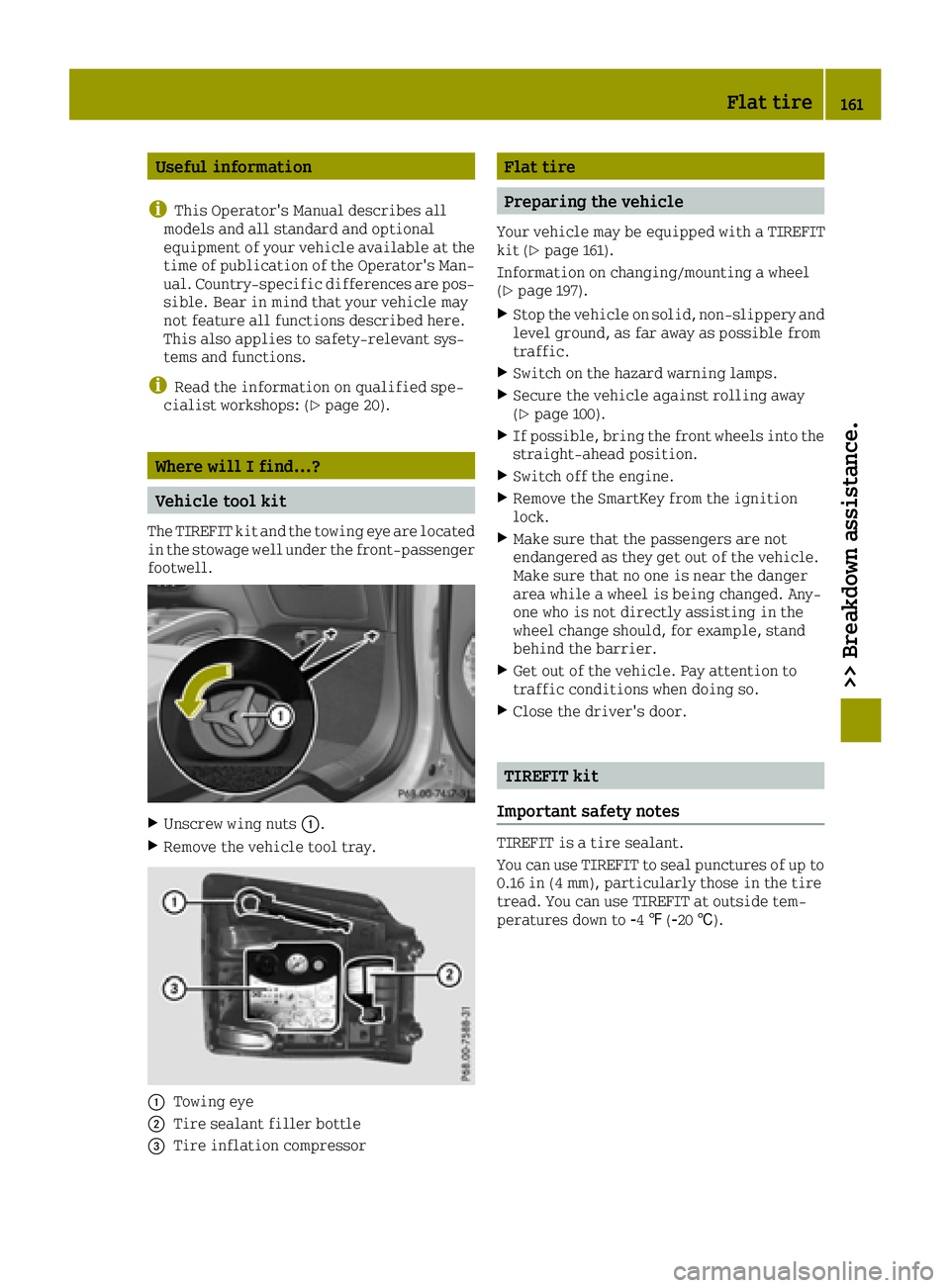
The TIREFIT kit and the towing eye are located
in the stowage well under the front-passenger
footwell.
XUnscrew wing nuts 0043.
XRemove the vehicle tool tray.
0043Towing eye
0044Tire sealant filler bottle
0087Tire inflation compressor
Flat tire
Preparing the vehicle
Your vehicle may be equipped with a TIREFIT
kit (Ypage 161).
Information on changing/mounting a wheel
(
Ypage 197).
XStop the vehicle on solid, non-slippery and
level ground, as far away as possible from
traffic.
XSwitch on the hazard warning lamps.
XSecure the vehicle against rolling away
(Ypage 100).
XIf possible, bring the front wheels into the
straight-ahead position.
XSwitch off the engine.
XRemove the SmartKey from the ignition
lock.
XMake sure that the passengers are not
endangered as they get out of the vehicle.
Make sure that no one is near the danger
area while a wheel is being changed. Any-
one who is not directly assisting in the
wheel change should, for example, stand
behind the barrier.
XGet out of the vehicle. Pay attention to
traffic conditions when doing so.
XClose the driver's door.
TIREFIT kit
Important safety notes
TIREFIT is a tire sealant.
You can use TIREFIT to seal punctures of up to
0.16 in (4 mm), particularly those in the tire
tread. You can use TIREFIT at outside tem-
peratures down to 00F84‡(00F820 †).
Flat tire161
>> Breakdown assistance.