warning lights SMART FORTWO 2016 Owner's Manual
[x] Cancel search | Manufacturer: SMART, Model Year: 2016, Model line: FORTWO, Model: SMART FORTWO 2016Pages: 214, PDF Size: 4.93 MB
Page 104 of 214
XTo apply:firmly pull parking brake 0044
upwards.
When the engine is running, the 0027(USA
only) or 004D(Canada only) indicator lamp
lights up in the instrument cluster.
XTo release: depress the brake pedal and
keep it depressed.
XPress release button 0043on parking
brake 0044and guide the parking brake down
to the stop.
The 0027 (USA only) or 004D(Canada only)
indicator lamp in the instrument cluster
goes out.
The parking brake is not yet engaged if:
Ra warning tone sounds
RThe Release Parking Brakemessage
appears in the multifunction display and
Rthe 004D indicator lamp in the instrument
cluster lights up
Parking the vehicle for a long period
If you leave the vehicle parked for longer than
four weeks, the battery may be damaged by
exhaustive discharging.
If you leave the vehicle parked for longer than
six weeks, the vehicle may suffer damage as a
result of lack of use.
XVisit a qualified specialist workshop and
seek advice.
iYou can obtain information about trickle
chargers from a qualified specialist work-
shop.
Driving tips
General notes
Important safety notes
GWARNING
If you switch off the ignition while driv-
ing, safety-relevant functions are only
available with limitations, or not at all.
This could affect, for example, the power
steering and the brake boosting effect. You will require considerably more effort to
steer and brake. There is a risk of an acci-dent.
Do not switch off the ignition while driv-
ing.
GWARNING
If you operate mobile communication
equipment while driving, you will be dis-
tracted from traffic conditions. You could
also lose control of the vehicle. There is a
risk of an accident.
Only operate this equipment when the vehi- cle is stationary.
Observe the legal requirements for the coun-
try in which you are driving. Some jurisdic-
tions prohibit the driver from using a mobile
phone while driving a vehicle.
If you make a call while driving, always use
hands-free mode. Only use the telephone when
the traffic situation permits. If you are
unsure, pull over to a safe location and stop
before using the telephone.
Bear in mind that at a speed of only 30 mph
(approximately 50 km/h), the vehicle covers a
distance of 44 ft (approximately 14 m) per
second.
Drive sensibly – save fuel
Observe the following tips to save fuel:
RThe tires should always be inflated to the
recommended tire pressure.
RRemove unnecessary loads.
RWarm up the engine at low engine speeds.
RAvoid frequent acceleration or braking.
RHave all maintenance work carried out as
indicated by the service intervals in the
Maintenance Booklet or by the service
interval display.
Fuel consumption also increases when driv-
ing in cold weather, in stop-start traffic and
in hilly terrain.
Drinking and driving
GWARNING
Drinking and driving and/or taking drugs
and driving are very dangerous combina-
102Driving tips
>> Driving and parking.
Page 106 of 214
more quickly and protecting them against
corrosion.
Limited braking performance on salt-
treated roads
If you drive on salted roads, a layer of salt
residue may form on the brake discs and brake
pads. This can result in a significantly lon-
ger braking distance.
RBrake occasionally to remove any possible
salt residue. Make sure that you do not
endanger other road users when doing so.
RCarefully depress the brake pedal and the
beginning and end of a journey.
RMaintain a greater distance to the vehicle
ahead.
Servicing the brakes
!The brake fluid level may be too low, if:
Rif the red brake warning lamp lights up
in the instrument cluster and
Ryou hear a warning tone while the engine
is running
Observe additional warning messages in
the multifunction display.
The brake fluid level may be too low due to
brake pad wear or leaking brake lines.
Have the brake system checked immedi-
ately. Consult a qualified specialist work-
shop to arrange this.
!A function or performance test should
only be carried out on a 2-axle dynamome-
ter. If you wish to operate the vehicle on
such a dynamometer, please consult a
qualified specialist workshop in advance.
You could otherwise damage the drive train
or the brake system.
!As the ESP®system operates automati-
cally, the engine and the ignition must be
switched off (the SmartKey must be in posi-
tion 0or 1in the ignition lock) if:
Rthe parking brake is tested using a brake
dynamometer (maximum 10 seconds).
Rthe vehicle is towed with the front axle
raised.
Braking triggered automatically by ESP
®
may seriously damage the brake system. All checks and maintenance work on the brake
system must be carried out at a qualified
specialist workshop.
Have brake pads installed and brake fluid
replaced at a qualified specialist workshop.
If the brake system has only been subject to
moderate loads, you should test the function-
ality of your brakes at regular intervals.
When having brake pads/linings fitted, smart
recommends that you only use those which are
approved for smart vehicles or are of an
equivalent quality standard. Brake pads/
linings which have not been approved for
smart vehicles or which are not of an equiv-
alent quality could affect your vehicle's
operating safety.
smart recommends that you only use brake
fluid which is approved for smart vehicles or
is of an equivalent quality standard. Brake
fluid which has not been approved for smart
vehicles or which
is not of an equivalent
quality could affect your vehicle's operating
safety.
Driving on wet roads
Hydroplaning
If water has accumulated to a certain depth on the road surface, there is a danger of hydro-
planing occurring, even if:
Ryou drive at low speeds.
Rthe tires have adequate tread depth.
For this reason, in the event of heavy rain or in conditions in which hydroplaning may
occur, you must drive in the following man-
ner:
Rlower your speed.
Ravoid ruts.
Ravoid sudden steering movements
Rbrake carefully.
Driving on flooded roads
!Bear in mind that vehicles traveling in
front or in the opposite direction create
waves. This may cause the maximum per-
missible water depth to be exceeded.
Failure to observe these notes may result in damage to the engine, electrical systems
and transmission.
104Driving tips
>> Driving and parking.
Page 124 of 214
Display messagesPossible causes/consequences and0050Solutions
Hill Start AssistInoperativeThe00E5 warning lamp also lights up in the instrument cluster.
Hill start assist is malfunctioning. If you release the brake, your
vehicle will not be held automatically when pulling away uphill
and may roll away immediately.
Further driving systems could be switched off automatically.
GWARNING
The brake system continues to function normally, but without the
functions listed above.
If ESP
®is not operational, ESP®is unable to stabilize the vehicle.
There is an increased risk of skidding and an accident.
XDrive on carefully.
XVisit a qualified specialist workshop.
122Display messages
>> On-board computer and displays.
Page 126 of 214
Engine
Display messagesPossible causes/consequences and0050Solutions
00B9
Reduced Power SeeOperator's Manual
The engine is running in emergency mode. For example, the fuel
injection may be faulty.
XDrive on carefully.
XVisit a qualified specialist workshop immediately.
iIn some states, you must immediately visit a qualified spe-
cialist workshop as soon as the yellow Check Engine warning
lamp lights up. This depends on the locally applicable legal
requirements. If in doubt, check whether such legal regulations
apply in the state in which you are currently driving.
00EF
Malfunction VisitWorkshop
The battery monitoring is malfunctioning.
XVisit a qualified specialist workshop.
00EF
StopSeeOperator'sManual
The battery is not being charged.
Possible causes are:
Ra defective alternator
Ra torn poly-V-belt
Ra malfunction in the electronics
XPull over and stop the vehicle safely and switch off the engine,
paying attention to road and traffic conditions.
!Do not continue driving. The engine could otherwise overheat.
XSecure the vehicle against rolling away (Ypage 100).
XConsult a qualified specialist workshop.
00B3
Stop Switch OffEngine
The oil pressure is too low. There is a risk of engine damage.
XPull over and stop the vehicle safely and switch off the engine,
paying attention to road and traffic conditions.
XSecure the vehicle against rolling away (Ypage 100).
XCheck the oil level (Ypage 150).
XIf necessary, add engine oil (Ypage 150).
Information on approved engine oils can also be obtained from any
qualified specialist workshop.
124Display messages
>> On-board computer and displays.
Page 130 of 214
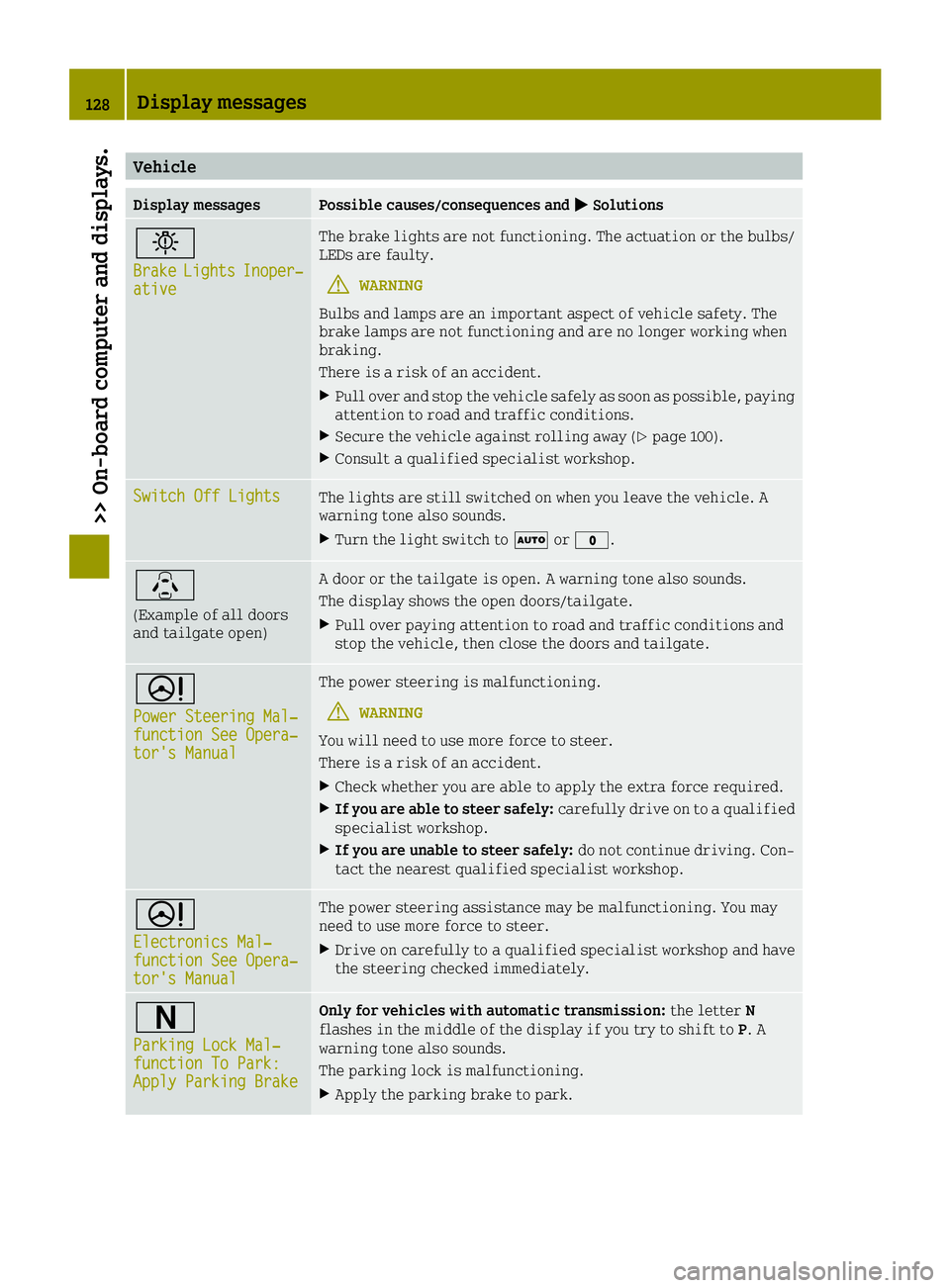
Vehicle
Display messagesPossible causes/consequences and0050Solutions
0049
BrakeLightsInoper‐ative
The brake lights are not functioning. The actuation or the bulbs/
LEDs are faulty.
GWARNING
Bulbs and lamps are an important aspect of vehicle safety. The
brake lamps are not functioning and are no longer working when
braking.
There is a risk of an accident.
XPull over and stop the vehicle safely as soon as possible, paying
attention to road and traffic conditions.
XSecure the vehicle against rolling away (Ypage 100).
XConsult a qualified specialist workshop.
Switch Off LightsThe lights are still switched on when you leave the vehicle. A
warning tone also sounds.
XTurn the light switch to 0058or003F.
\
(Example of all doors
and tailgate open)
A door or the tailgate is open. A warning tone also sounds.
The display shows the open doors/tailgate.
XPull over paying attention to road and traffic conditions and
stop the vehicle, then close the doors and tailgate.
0052
Power Steering Mal‐function See Opera‐tor's Manual
The power steering is malfunctioning.
GWARNING
You will need to use more force to steer.
There is a risk of an accident.
XCheck whether you are able to apply the extra force required.
XIf you are able to steer safely: carefully drive on to a qualified
specialist workshop.
XIf you are unable to steer safely: do not continue driving. Con-
tact the nearest qualified specialist workshop.
0052
Electronics Mal‐function See Opera‐tor's Manual
The power steering assistance may be malfunctioning. You may
need to use more force to steer.
XDrive on carefully to a qualified specialist workshop and have
the steering checked immediately.
0044
Parking Lock Mal‐function To Park:Apply Parking Brake
Only for vehicles with automatic transmission: the letterN
flashes in the middle of the display if you try to shift to P. A
warning tone also sounds.
The parking lock is malfunctioning.
XApply the parking brake to park.
128Display messages
>> On-board computer and displays.
Page 133 of 214
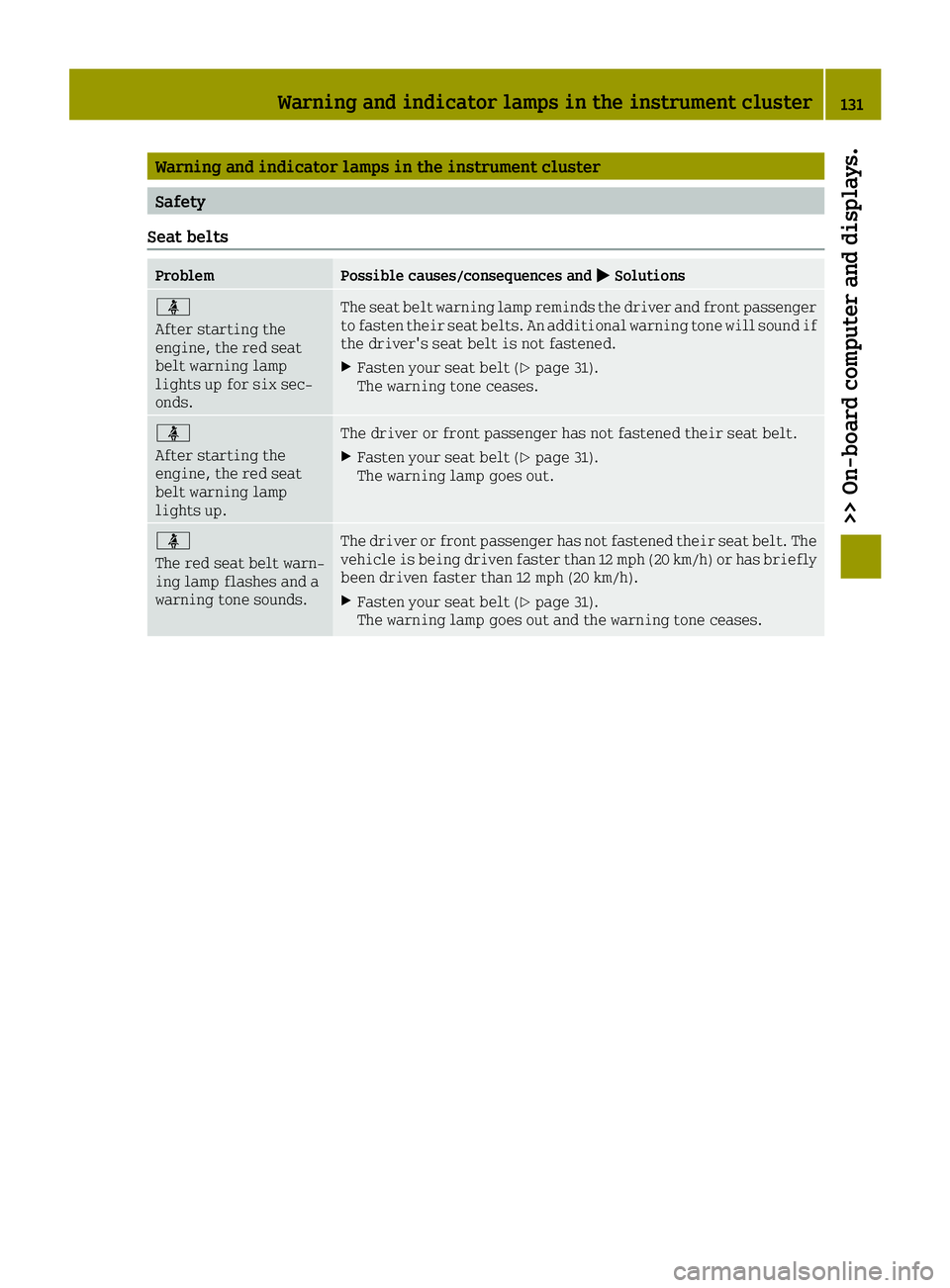
Warning and indicator lamps in the instrument cluster
Safety
Seat belts
ProblemPossible causes/consequences and 0050Solutions
00E9
After starting the
engine, the red seat
belt warning lamp
lights up for six sec-
onds.The seat belt warning lamp reminds the driver and front passenger
to fasten their seat belts. An additional warning tone will sound if
the driver's seat belt is not fastened.
XFasten your seat belt (Ypage 31).
The warning tone ceases.
00E9
After starting the
engine, the red seat
belt warning lamp
lights up.The driver or front passenger has not fastened their seat belt.
XFasten your seat belt (Ypage 31).
The warning lamp goes out.
00E9
The red seat belt warn-
ing lamp flashes and a
warning tone sounds.The driver or front passenger has not fastened their seat belt. The
vehicle is being driven faster than 12 mph (20 km/h) or has briefly
been driven faster than 12 mph (20 km/h).
XFasten your seat belt (Ypage 31).
The warning lamp goes out and the warning tone ceases.
Warning and indicator lamps in the instrument cluster131
>> On-board computer and displays.
Z
Page 138 of 214
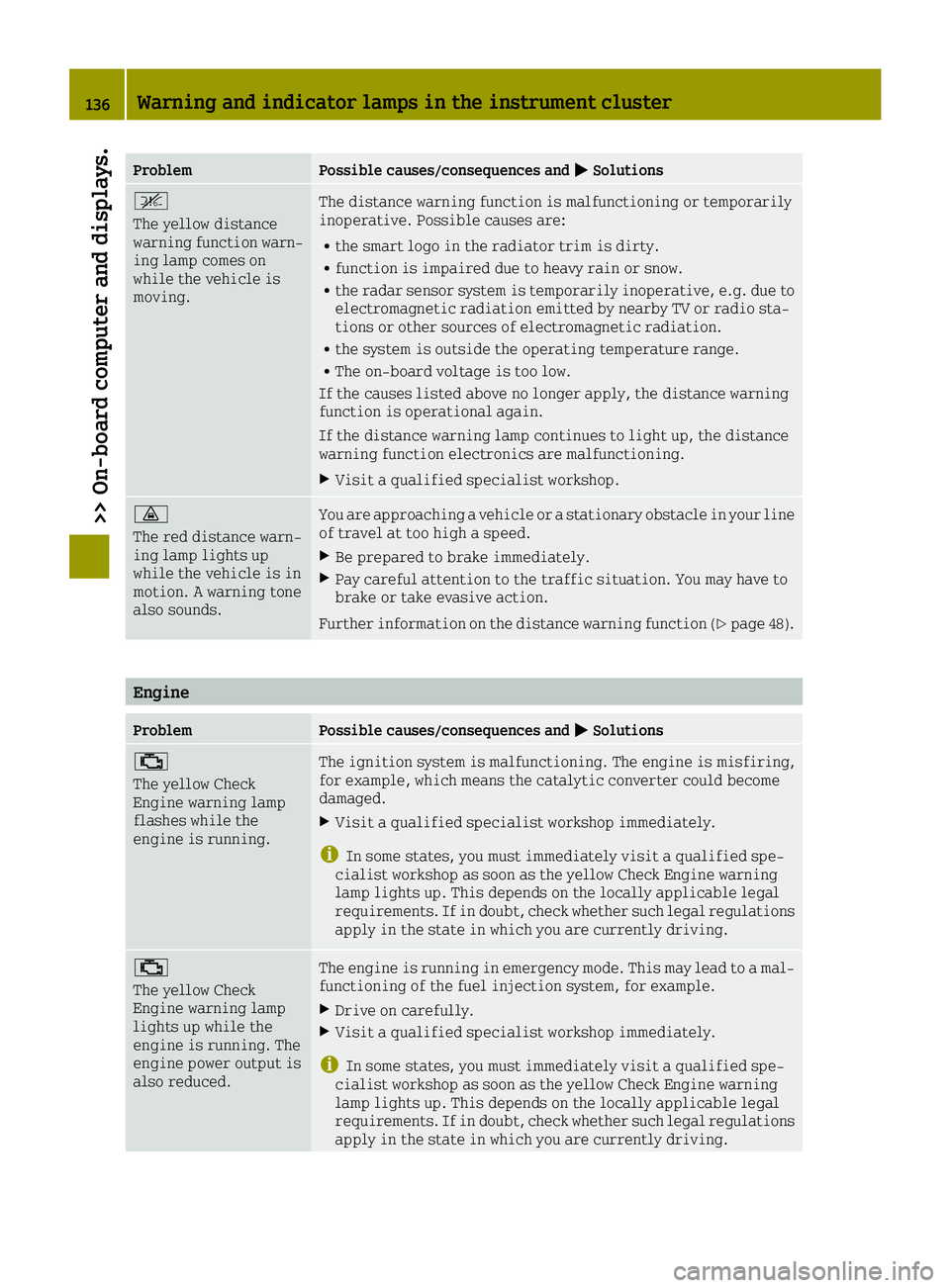
ProblemPossible causes/consequences and0050Solutions
^
The yellow distance
warning function warn-
ing lamp comes on
while the vehicle is
moving.The distance warning function is malfunctioning or temporarily
inoperative. Possible causes are:
Rthe smart logo in the radiator trim is dirty.
Rfunction is impaired due to heavy rain or snow.
Rthe radar sensor system is temporarily inoperative, e.g. due to
electromagnetic radiation emitted by nearby TV or radio sta-
tions or other sources of electromagnetic radiation.
Rthe system is outside the operating temperature range.
RThe on-board voltage is too low.
If the causes listed above no longer apply, the distance warning
function is operational again.
If the distance warning lamp continues to light up, the distance
warning function electronics are malfunctioning.
XVisit a qualified specialist workshop.
00BA
The red distance warn-
ing lamp lights up
while the vehicle is in
motion. A warning tone
also sounds.You are approaching a vehicle or a stationary obstacle in your line
of travel at too high a speed.
XBe prepared to brake immediately.
XPay careful attention to the traffic situation. You may have to
brake or take evasive action.
Further information on the distance warning function (
Ypage 48).
Engine
ProblemPossible causes/consequences and 0050Solutions
00B9
The yellow Check
Engine warning lamp
flashes while the
engine is running.The ignition system is malfunctioning. The engine is misfiring,
for example, which means the catalytic converter could become
damaged.
XVisit a qualified specialist workshop immediately.
iIn some states, you must immediately visit a qualified spe-
cialist workshop as soon as the yellow Check Engine warning
lamp lights up. This depends on the locally applicable legal
requirements. If in doubt, check whether such legal regulations
apply in the state in which you are currently driving.
00B9
The yellow Check
Engine warning lamp
lights up while the
engine is running. The
engine power output is
also reduced.The engine is running in emergency mode. This may lead to a mal-
functioning of the fuel injection system, for example.
XDrive on carefully.
XVisit a qualified specialist workshop immediately.
iIn some states, you must immediately visit a qualified spe-
cialist workshop as soon as the yellow Check Engine warning
lamp lights up. This depends on the locally applicable legal
requirements. If in doubt, check whether such legal regulations
apply in the state in which you are currently driving.
136Warning and indicator lamps in the instrument cluster
>> On-board computer and displays.
Page 139 of 214
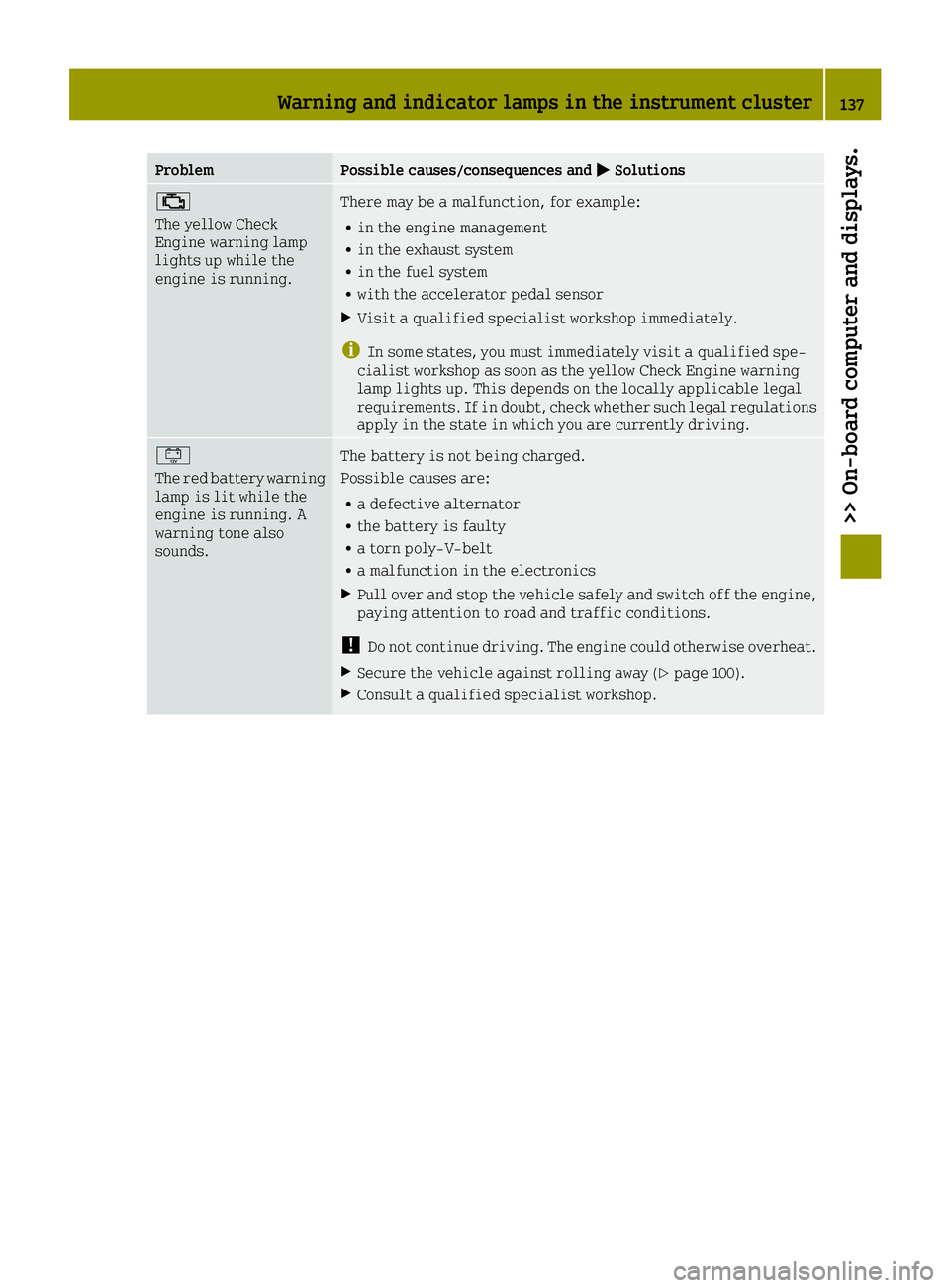
ProblemPossible causes/consequences and0050Solutions
00B9
The yellow Check
Engine warning lamp
lights up while the
engine is running.There may be a malfunction, for example:
Rin the engine management
Rin the exhaust system
Rin the fuel system
Rwith the accelerator pedal sensor
XVisit a qualified specialist workshop immediately.
iIn some states, you must immediately visit a qualified spe-
cialist workshop as soon as the yellow Check Engine warning
lamp lights up. This depends on the locally applicable legal
requirements. If in doubt, check whether such legal regulations
apply in the state in which you are currently driving.
00EF
The red battery warning
lamp is lit while the
engine is running. A
warning tone also
sounds.The battery is not being charged.
Possible causes are:
Ra defective alternator
Rthe battery is faulty
Ra torn poly-V-belt
Ra malfunction in the electronics
XPull over and stop the vehicle safely and switch off the engine,
paying attention to road and traffic conditions.
!Do not continue driving. The engine could otherwise overheat.
XSecure the vehicle against rolling away (Ypage 100).
XConsult a qualified specialist workshop.
Warning and indicator lamps in the instrument cluster137
>> On-board computer and displays.
Z
Page 185 of 214
iThe actual values for tires are vehicle-
specific and may deviate from the values in
the illustration.
Checking the tire pressures
Important safety notes
Observe the notes on tire pressure
(Ypage 180).
Information on air pressure for the tires on
your vehicle can be found:
Ron the vehicle's Tire and Loading Informa- tion placard on the B-pillar
Rin the tire pressure table in the fuel filler
flap (Ypage 98)
Rin the "Tire pressure" section
Checking tire pressures manually
To determine and set the correct tire pres-
sure, proceed as follows:
XRemove the valve cap of the tire that is to bechecked.
XPress the tire pressure gauge securely onto
the valve.
XRead the tire pressure and compare it with
the recommended value on the Tire and
Loading Information placard (
Ypage 180).
XIf the tire pressure is too low increase the
tire pressure to the recommended value.
XIf the tire pressure is too high, release
air. To do this, press down the metal pin in
the valve using the tip of a pen, for exam-
ple. Then check the tire pressure again
using the tire pressure checker.
XScrew the valve cap onto the valve.
XRepeat these steps for the other tires.
Tire pressure monitor
General notes
iThis function is only available in the
USA.
If a tire pressure monitor is installed, the
vehicle's wheels have sensors that monitor
the tire pressures in all four tires. The tire
pressure monitor warns you if the pressure
drops in one or more of the tires. The tire pressure monitor only functions if the cor-
responding sensors are fitted to all wheels.
Important safety notes
GWARNING
Each tire, including the spare (if provi-
ded), should be checked at least once every
two weeks when cold and inflated to the
pressure recommended by the vehicle man- ufacturer on the Tire and Loading Informa-
tion placard on the driver's door B-pillar
or the tire pressure label on the inside of
the fuel filler flap. If your vehicle has
tires of a different size than the size indi-
cated on the Tire and Loading Information
placard or, if available, the tire pressure
label, you should determine the proper tire
pressure for those tires.
As an added safety feature, your vehicle has been equipped with a tire pressure moni-
toring system (TPMS) that illuminates a low
tire pressure telltale when one or more of
your tires are significantly underinflated.
Accordingly, when the low tire pressure
telltale lights up, you should stop and
check your tires as soon as possible, and
inflate them to the proper pressure. Driv-
ing on a significantly underinflated tire
causes the tire to overheat and can lead to
tire failure.
Underinflation also reduces fuel effi-
ciency and tire tread life, and may affect
the vehicle's handling and stopping abil-
ity. Please note that the TPMS is not a sub-
stitute for proper tire maintenance, and it
is the driver's responsibility to maintain
correct tire pressure, even if underinfla-
tion has not reached the level to trigger
illumination of the TPMS low tire pressure
telltale.
Your vehicle has also been equipped with a
TPMS malfunction indicator to indicate
when the system is not operating properly.
The TPMS malfunction indicator is com-
bined with the low tire pressure telltale.
When the system detects a malfunction, the
Tire pressure183
>> Wheels and tires.
Z
Page 186 of 214
warning lamp will flash for approximately
a minute and then remain continuously
illuminated. This sequence will be repea-
ted every time the vehicle is started as long
as the malfunction exists. When the mal-
function indicator is illuminated, the sys-
tem may not be able to detect or signal low
tire pressure as intended.
TPMS malfunctions may occur for a variety
of reasons, including the installation of
incompatible replacement or alternate
tires or wheels on the vehicle that prevent
the TPMS from functioning properly. Always
check the TPMS malfunction telltale after
replacing one or more tires or wheels on
your vehicle to ensure that the replacement
or alternate Tires and wheels allow the
TPMS to continue to function properly.
It is the driver's responsibility to set the
tire pressure to that recommended for cold
tires which is suitable for the operating sit-
uation (
Ypage 180). Note that the correct tire
pressure for the current operating situation
must first be taught-in to the tire pressure
monitor. If there is a substantial loss of
pressure, the warning threshold for the warn-
ing message is aligned to the reference val-
ues taught-in. Restart the tire pressure mon-
itor after adjusting to the cold tire pressure.
The current pressures are saved as new ref-
erence values. As a result, a warning message
will appear if the tire pressure drops sig-
nificantly.
The tire pressure monitor does not warn you of
an incorrectly set tire pressure. Observe the notes on the recommended tire pressure
(
Ypage 180).
The tire pressure monitor is not able to warn
you of a sudden loss of pressure, e.g. if the
tire is penetrated by a foreign object. In the
event of a sudden loss of pressure, bring the
vehicle to a halt by braking carefully. Avoid
abrupt steering maneuvers. The tire pressure monitor has a yellow warn-
ing lamp in the instrument cluster for indi-
cating a pressure loss or malfunction.
Whether the warning lamp flashes or lights up
indicates whether a tire pressure is too low
or the tire pressure monitor is malfunction-
ing:
RIf the warning lamp is lit continuously, the
tire pressure on one or more tires is sig-
nificantly too low. The tire pressure mon-
itor is not malfunctioning.
RIf the warning lamp flashes for around a
minute and then remains lit constantly, the
tire pressure monitor is malfunctioning.
iA message appears in the display in addi-
tion to the warning lamp.
Observe the information on display mes-
sages (
Ypage 126).
If the tire pressure monitor is malfunction-
ing, it may take up to ten minutes for the tire
pressure warning lamp to inform you of the
malfunction. The malfunction will be indi-
cated first by the tire pressure warning lamp
flashing for approximately one minute and
then remaining lit. When the malfunction has
been rectified, the tire pressure warning
lamp goes out after a few minutes of driving.
The operation of the tire pressure monitor
can be affected by interference from radio
transmitting equipment (e.g. radio head-
phones, two-way radios) that may be being
operated in or near the vehicle.
Tire pressure monitor warning messages
If the tire pressure monitor detects a pres-
sure loss in one or more tires, a warning mes-
sage is shown in the display. The yellow warn-
ing light in the tire pressure monitor lights
up. For certain display messages a warning
tone also sounds.
RIf the Correct Tire Pressuremessage
appears in the display, the tire pressure in
at least one tire is too low. Correct the tire
pressure at the next opportunity.
RIf the Tire Pressure Warning TireFailuremessage appears in the display,
the tire pressure in one or more tires has
dropped suddenly and the tires must be
checked.
Observe the instructions and safety notes for the display messages in the "Tires" section
184Tire pressure
>> Wheels and tires.