ABS SMART FORTWO 2016 Owners Manual
[x] Cancel search | Manufacturer: SMART, Model Year: 2016, Model line: FORTWO, Model: SMART FORTWO 2016Pages: 214, PDF Size: 4.93 MB
Page 5 of 214
1, 2, 3 ...
12 V socketsee Sockets
A
ABS (Anti-lock Braking System)Display message ....................... 121
Function/notes .......................... 47
Important safety notes ............... .47
Warning lamp .......................... 134
Activating/deactivating cooling
with air dehumidification ............... 81
Additives (engine oil) ................... 209
Air bags
Deployment .............................. 40
Front air bag (driver, front
passenger) ............................... 35
Important safety notes ................ 34
Introduction ............................ 34
Knee bag .................................. 35
Occupant Classification System
(OCS) ...................................... 36
PASSENGER AIR BAG indicator
lamps ...................................... 30
Window curtain air bag ............... 36
Air pressure
see Tire pressure
Air vents
Important safety notes ................ 84
Setting ................................... 84
Setting the center air vents ......... 85
Setting the side air vents ........... 85
Air-conditioning system
see Climate control
Airbag
Thorax/pelvisbag ...................... 35
Warning lamp .......................... 132
Alarm
Anti-theft alarm system .............. 46
Switching off ............................ 47
Switching the function on/off ...... 46
Ambient lighting
Setting the brightness ............... 116
Switching on/off ...................... 116
Animals
see Pets in the vehicle Anti-lock Braking System
see ABS (Anti-lock Braking System)
Anti-skid chains
see Snow chains
Anti-theft alarm system
Function .................................. 46
Switching off the alarm .............. 47
Switching on/off ....................... 46
Ashtray ....................................... 147
Assistance system
see Driving systems
Authorized workshop
see Qualified specialist workshop
Automatic car wash (care) ............... 155
Automatic headlamp mode ................ 67
Automatic transmission
Accelerator pedal position ......... 93
Changing gear .......................... 93
Display message (color display) .. 128
Drive program .......................... 94
Drive program display ................ 92
Driving tips ............................. 93
Emergency running mode .............9 7
Gearshift paddles ...................... 96
Kickdown .................................9 4
Malfunction (on-board computer
with color display) ................... 128
Manual shifting ............ ............ 94
Manually releasing the selector
lever lock ................................ 97
Overview .................................9 2
Problem (malfunction) ..
............. .97
Program selector button .............. 94
Pulling away ............................. 88
Selector lever .......................... 92
Starting the engine .................. .88
Transmission position display ..... 92
Transmission positions .............. 93
Automatic transmission emergency
mode ............................................ 97
B
Backup lamp
Changing bulbs .........................7 3
Battery (SmartKey)
Important safety notes ................5 2
Replacing ................................ 52
Index3
Page 6 of 214
Battery (vehicle)Charging ................................ 166
Display message ......................1 24
Important safety notes ............... 164
Jump starting .......................... 168
Warning and indicator lamps ...... 137
Belt
see Seat belts
Blower
see Climate control
Brake fluid
Display message ..................... .120
Notes .................................... .210
Brake force distribution
see EBD (electronic brake force
distribution)
Brake lamps
Changing bulbs .........................7 3
Display message ....................... 128
Brake lights
Display message (color display) .. 128
Brakes
ABS ......................................... 47
Brake fluid (notes) .................. .210
EBD ........................................5 0
Important safety notes ............... 103
Maintenance ............................ 104
Parking brake ..........................1 01
Riding tips .............................1 03
Warning lamp .......................... 132
Breakdown
see Flat tire
see Towing away/tow-starting
Bulbs
see Replacing bulbs
C
Calling up a malfunctionsee Display messages
Car
see Vehicle
Car key
see SmartKey
Car wash
see Care
Care
Car wash .................................1 55Carpets .................................. 160
Display .................................. 158
Exhaust pipe ........................... 158
Exterior lights ........................ 158
Gear or selector lever ............... 159
General notes ..........................1
54
Interior ................................. 158
Matte finish ............................ 156
Paint ..................................... 156
Panoramic roof ........................ 157
Plastic trim ............................ 158
Power washer ........................... 155
Roof lining ............................. 160
Seat belt ................................ 159
Seat cover ...............................1 59
Sensors .................................. 158
Steering wheel ......................... 159
Washing by hand ....................... 155
Wheels ................................... 157
Windows ................................. 157
Wiper blades ........................... 157
Center console .............................. 26
Central locking
Locking/unlocking (SmartKey) ......5 1
Changing bulbs
Brake lamps .............................. 73
Front fog lamp .......................... 72
High-beam headlamps ................. 72
Low-beam headlamps .................. 72
Rear fog lamp ........................... 73
Reversing lamps ........................ 73
Tail lamps ............................... 73
Turn signals (front) ................... 72
Turn signals (rear) .................... 73
Child seat
Forward-facing restraint sys-
tem .........................................4 5
On the front-passenger seat .........4 5
Rearward-facing restraint sys-
tem ......................................... 45
Top Tether ............................... 44
Children
Restraint systems ...................... 43
Special seat belt retractor .......... 43
Cleaning
see Care
Climate control
Automatic climate control ........... 80
4Index
Page 8 of 214
Display messageCalling up (message memory) .......1 13
Color display .......................... 118
Language setting ......................1 17
Service display ....................... 153
Display messages
Calling up (on-board computer) ... 113
Driving systems ....................... 126
Engine ................................... 124
General notes (on-board com-
puter with a color display) .........118
Hiding ................................... 118
Lights .................................... 128
Safety systems .........................1 19
SmartKey ................................ 130
Tires .....................................1 26
Vehicle ................................. .128
Distance recorder .........................112
Distance warning function
Function/notes .........................4 8
Warning lamp (red) ................... 136
Warning lamp (yellow) ............... 135
Door
Warning lamp ........................... 141
Doors
Automatic locking (switch) .......... 55
Central locking/unlocking
(SmartKey) ................................ 51
Control panel ........................... 28
Display message ....................... 128
Emergency locking ..................... 55
Emergency unlocking .................. 55
Important safety notes ................ 54
Opening (from inside) ................ 54
Drinking and driving ..................... 102
Drive program
Automatic transmission .............. 94
Display ................................... 92
Driver's door
see Doors
Driver's seat
see Seats
Driving abroad
smart service .......................... 154
Driving on flooded roads ................ 104
Driving safety systems
ABS (Anti-lock Braking System) .... 47
Distance warning function .......... 48 EBD (electronic brake force
distribution) ........................... 50
ESP
®(Electronic Stability Pro-
gram) ...................................... 49
ETS (Electronic Traction Sys-
tem) ........................................ 49
Important safety information ....... 47
Overview ................................. 47
Driving system
Parking aid ............................. 107
Driving systems
Cruise control ......................... 105
Display message ....................... 126
Driving tips
Automatic transmission .............. 93
Brakes ................................... 103
Break-in period ........................ 86
Downhill gradient .................... 103
Drinking and driving ................ 102
Driving in winter ..................... 105
Driving on flooded roads ........... 104
Driving on wet roads ................. 104
Exhaust check .......................... 103
Fuel ...................................... 102
General .................................. 102
Hydroplaning .......................... 104
Icy road surfaces ..................... 105
Limited braking efficiency on
salted roads ............................ 104
Snow chains ............................. 179
Subjecting brakes to a load ........ 103
Wet road surface ...................... 103
E
EBD (electronic brake force distri-
bution)Display message ...................... 120
Function/notes ......................... 50
EBD (Electronic Brake-force Dis-
tribution)
Indicator lamp ........................ 133
Electronic Brake-force Distribu-
tion
see EBD (electronic brake force
distribution)
Electronic Traction System
see ETS (Electronic Traction System)
6Index
Page 17 of 214
Vehicle dimensions....................... 212
Vehicle emergency locking .............. 55
Vehicle identification number
see VIN
Vehicle identification plate .......... 205
Vehicle key
see SmartKey
Vehicle tool kit ............................ 161
Ventilation
see Climate control
VIN ............................................ 205
W
Warning and indicator lamps
ABS ....................................... 134
Airbag ................................... 132
Battery ................................... 137
Brakes ................................... 132
Check Engine ........................... 136
Coolant .................................. 138
Distance warning function (red) .. 136
Distance warning function (yel-
low) ....................................... 135
Door ...................................... 141
EBD ....................................... 133
Electronics .............................1 41
ESP
®...................................... 134
Oil pressure ............................ 138
Overview ................................. 24
Parking brake .......................... 132
PASSENGER AIR BAG .................... 30
Restraint system ......................1 32
Seat belt ................................. 131
Steering ................................. 141
Tire pressure monitor ............... 139
Warranty ....................................... 17
Wheel and tire combination
see Tires
Wheel bolt tightening torque .......... 200
Wheels
Changing a wheel ..................... 196
Checking ................................ 178
Cleaning ................................ 157
General notes .......................... 200
Important safety notes ............... 177
Interchanging/changing ............ 196
Mounting a new wheel ................ 199 Mounting a wheel ...................... 197
Removing a wheel ..................... 199
Snow chains ............................. 179
Storing .................................. 197
Tightening torque .................... 200
Wheel size/tire size ................. 200
Window curtain air bag
Operation ................................ 36
Windows
see Side windows
Windscreen
see Windshield
Windshield
Defrosting ............................... 82
Windshield washer fluid
see Windshield washer system
Windshield washer system
Adding washer fluid .................. 153
Important safety notes ............... 211
Windshield wipers
Intermittent wiping ................... 75
Problem (malfunction) ................ 78
Rear window wiper ..................... 75
Replacing the wiper blades ......... 75
Switching on/off ....................... 74
Winter driving
Slippery road surfaces .............. 105
Snow chains ............................. 179
Winter operation
General notes .......................... 179
Winter tires
M+S tires ................................ 179
Wiper blades
Cleaning ................................ 157
Important safety notes ................ 75
Replacing (rear window) ............. 76
Replacing (windshield) ............... 76
Workshop
see Qualified specialist workshop
Index15
Page 26 of 214
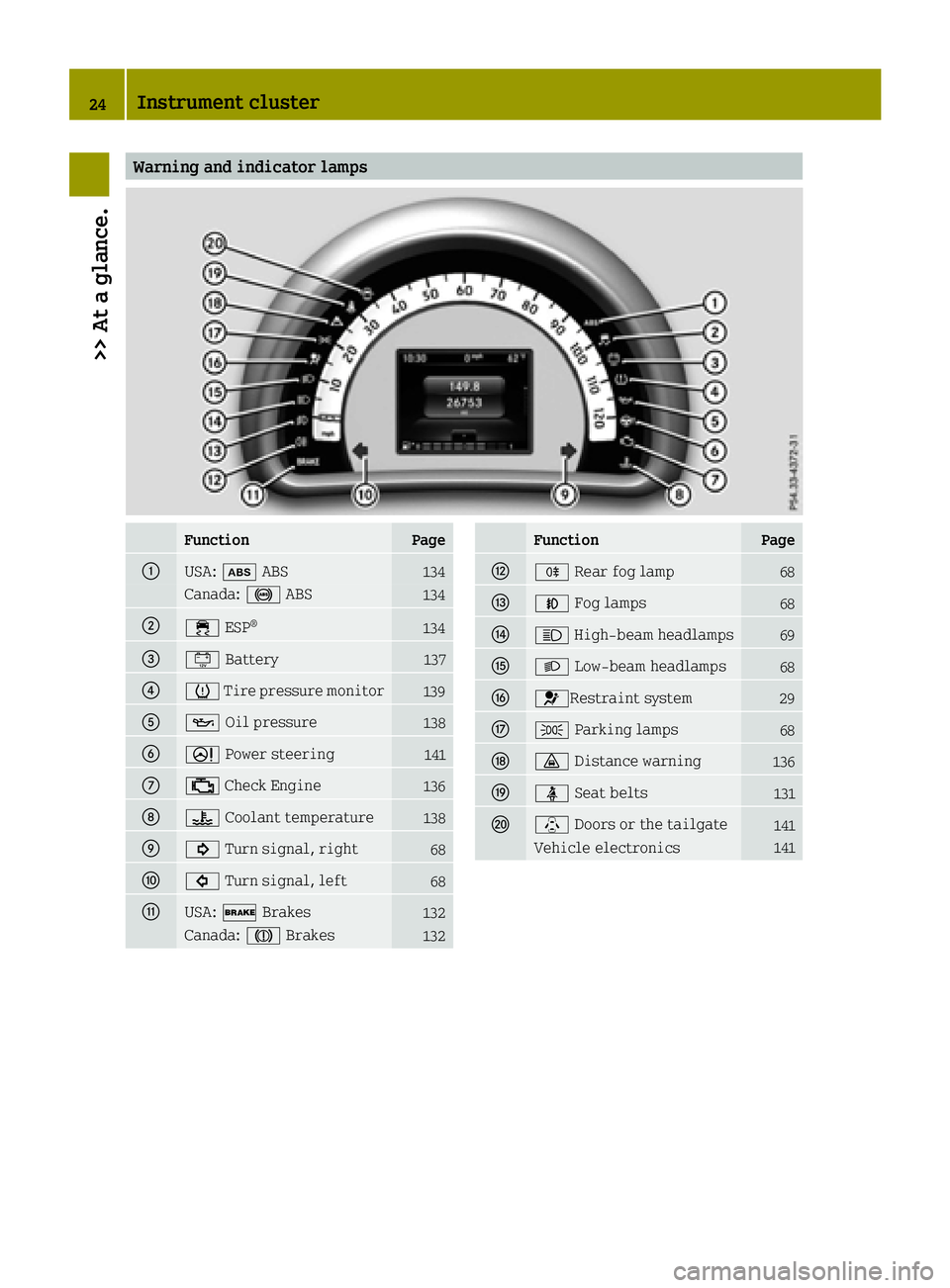
Warning and indicator lamps
FunctionPage
0043USA:00DF ABS134
Canada: 0025ABS134
004400E5ESP®134
008700EFBattery137
00850077Tire pressure monitor139
008300B3 Oil pressure138
00840052Power steering141
006B00B9Check Engine136
006C00AC Coolant temperature138
006D003DTurn signal, right68
006E003ETurn signal, left68
006FUSA:0027 Brakes132
Canada: 004DBrakes132
FunctionPage
0070005ERear fog lamp68
0071005AFog lamps68
00720057High-beam headlamps69
00730058 Low-beam headlamps68
00740075Restraint system29
00750060Parking lamps68
007600BADistance warning136
007700E9Seat belts131
0078\Doors or the tailgate141
Vehicle electronics141
24Instrument cluster
>> At a glance.
Page 33 of 214
(Ypage 34). There you can also find infor-
mation on the correct seat position.
Seat belts
Introduction
Seat belts are the most effective means of
restricting the movement of vehicle occu-
pants in the event of an accident or the vehi-
cle rolling over. This reduces the risk of
vehicle occupants coming into contact with
parts of the vehicle interior or being ejected
from the vehicle. Furthermore, the seat belt
helps to keep the vehicle occupant in the best
position in relation to the air bag.
The seat belt system comprises:
RSeat belts
REmergency Tensioning Devices and seat
belt force limiters
If the seat belt is pulled by the seat belt
guide quickly or with a jerky movement, the
belt retractor locks. The belt strap cannot be extracted any further.
The Emergency Tensioning Device tightens
the seat belt in an accident, pulling the belt
close against the body. However it does not
pull the vehicle occupant back in the direc-
tion of the backrest.
The Emergency Tensioning Device does not
correct an incorrect seat position or the
routing of an incorrectly fastened seat belt.
When triggered, a seat belt force limiter
helps to reduce the force exerted by the seat
belt on the vehicle occupant.
The seat belt force limiters are synchronized
with the front air bags which absorb part of
the deceleration force. This can reduce the
force exerted on the vehicle occupants during
an accident.
!If the front-passenger seat is unoccu-
pied, do not insert the belt tongue into the
buckle of the front-passenger seat. This
may otherwise lead to the triggering of the
Emergency Tensioning Device in the event
of an accident, which will then need to be
replaced.
Important safety notes
The use of seat belts and child restraint sys-
tems is required by law in:
Rall 50 states
Rthe U.S. territories
Rthe District of Columbia
Rall Canadian provinces
Even where this is not required by law, all
vehicle occupants should correctly fasten
their seat belts before starting the journey.
GWARNING
If the seat belt is incorrectly fastened, it
cannot protect as intended. Furthermore,
an incorrectly fastened seat belt can cause
additional injury, for example, in an acci-
dent, during braking or when abruptly
changing direction. This poses an
increased risk of injury or even fatal
injury.
Make sure that all vehicle occupants are
seated properly with a correctly fastened
seat belt.
GWARNING
The seat belt does not offer the intended
level of protection if you have not moved
the backrest to an almost vertical position.
When braking or in the event of an accident,
you could slide underneath the seat belt and
sustain abdomen or neck injuries, for
example. This poses an increased risk of
injury or even fatal injury.
Adjust the seat properly before beginning
your journey. Always ensure that the back-
rest is in an almost vertical position and
that the shoulder section of your seat belt
is routed across the center of your shoul-
der.
GWARNING
Persons under 5 ft (1.50 m)in height cannot
fasten the seat belt correctly without an
additional suitable restraint system. If
the seat belt is incorrectly fastened, it
cannot protect as intended. Furthermore,
an incorrectly fastened seat belt can cause
Occupant safety31
>> Safety.
Z
Page 47 of 214
system is fitted with a Top Tether belt, this
should always be used.
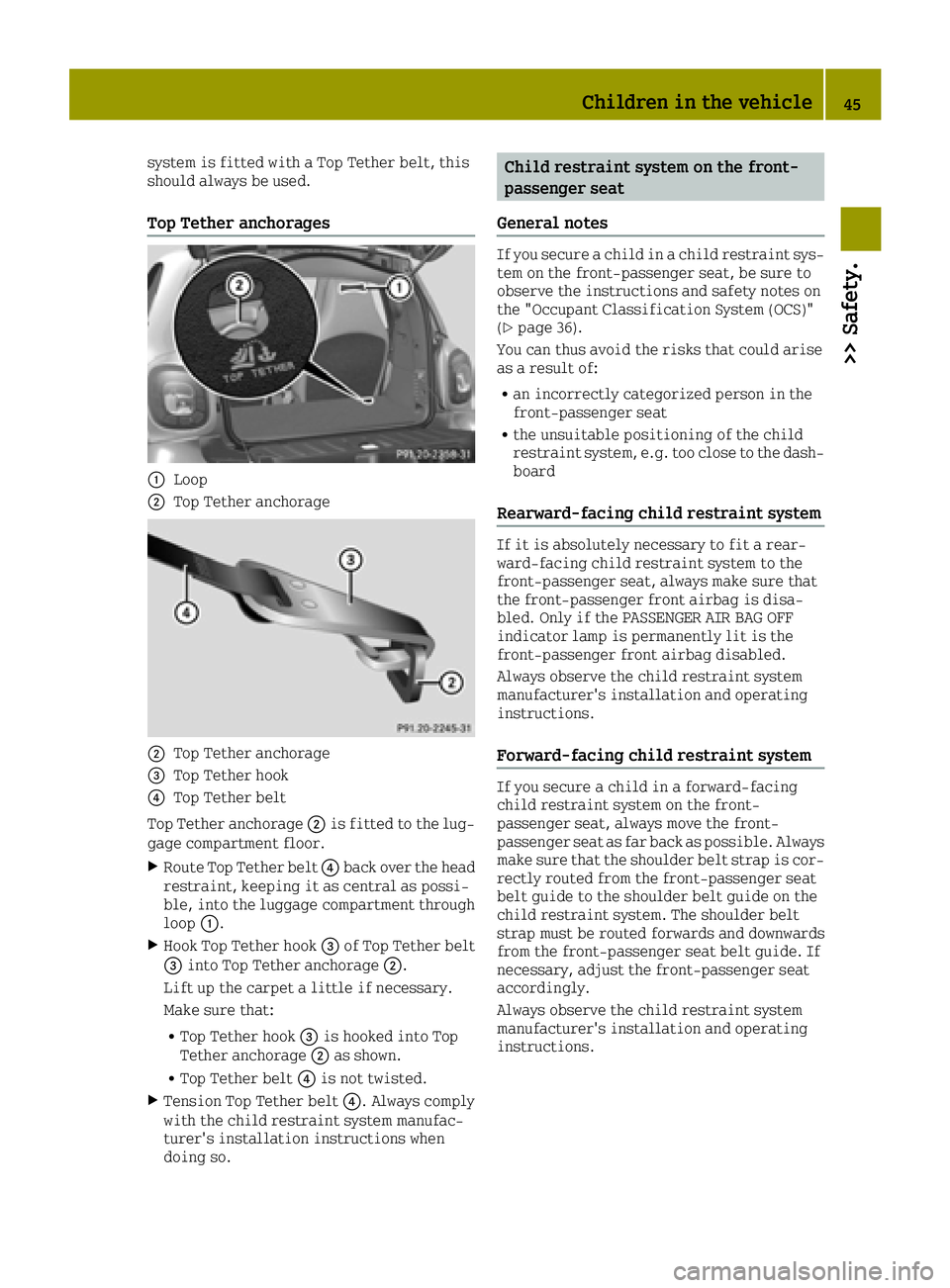
Top Tether anchorages
0043Loop
0044Top Tether anchorage
0044Top Tether anchorage
0087Top Tether hook
0085Top Tether belt
Top Tether anchorage 0044is fitted to the lug-
gage compartment floor.
XRoute Top Tether belt 0085back over the head
restraint, keeping it as central as possi-
ble, into the luggage compartment through
loop 0043.
XHook Top Tether hook 0087of Top Tether belt
0087 into Top Tether anchorage 0044.
Lift up the carpet a little if necessary.
Make sure that:
RTop Tether hook 0087is hooked into Top
Tether anchorage 0044as shown.
RTop Tether belt 0085is not twisted.
XTension Top Tether belt 0085. Always comply
with the child restraint system manufac-
turer's installation instructions when
doing so.
Child restraint system on the front-
passenger seat
General notes
If you secure a child in a child restraint sys-
tem on the front-passenger seat, be sure to
observe the instructions and safety notes on
the "Occupant Classification System (OCS)"
(
Ypage 36).
You can thus avoid the risks that could arise
as a result of:
Ran incorrectly categorized person in the
front-passenger seat
Rthe unsuitable positioning of the child
restraint system, e.g. too close to the dash-
board
Rearward-facing child restraint system
If it is absolutely necessary to fit a rear-
ward-facing child restraint system to the
front-passenger seat, always make sure that
the front-passenger front airbag is disa-
bled. Only if the PASSENGER AIR BAG OFF
indicator lamp is permanently lit is the
front-passenger front airbag disabled.
Always observe the child restraint system
manufacturer's installation and operating
instructions.
Forward-facing child restraint system
If you secure a child in a forward-facing
child restraint system on the front-
passenger seat, always move the front-
passenger seat as far back as possible. Always
make sure that the shoulder belt strap is cor-
rectly routed from the front-passenger seat
belt guide to the shoulder belt guide on the
child restraint system. The shoulder belt
strap must be routed forwards and downwards
from the front-passenger seat belt guide. If
necessary, adjust the front-passenger seat
accordingly.
Always observe the child restraint system
manufacturer's installation and operating
instructions.
Children in the vehicle45
>> Safety.
Z
Page 49 of 214
Switching off the alarm
XTo switch off the alarm:press the0036
button on the key.
The alarm is switched off.
or
XSwitch on the ignition.
The alarm is switched off.
The alarm is not switched off, even if you
close the open door that triggered it, for
example.
Driving safety systems
Overview of driving safety systems
In this section, you will find information
about the following driving safety systems:
RABS (Anti-lock BrakingSystem)
(Ypage 47)
RDistance warning function (Ypage 48)
Resp®(Electronic StabilityProgram)
(Ypage 49)
REBD (Electronic Brake forceDistribution)
(Ypage 50)
Important safety notes
If you fail to adapt your driving style or
become distracted, the driving safety sys-
tems can neither reduce the risk of accident
nor override the laws of physics. Driving
safety systems are merely aids designed to
assist driving. You are responsible for the
distance to the vehicle in front, for vehicle
speed and for braking in good time. Always
adapt your driving style to suit the prevail-
ing road, weather and traffic conditions and
maintain a safe distance from the vehicle in
front. Drive carefully.
The driving safety systems described only
work as effectively as possible when there is
adequate contact between the tires and the
road surface. Please pay special attention to
the notes on tires, recommended minimum
tire tread depths, etc. (
Ypage 177).
In wintry driving conditions, always use win-
ter tires (M+S tires) and if necessary, snow
chains. Only in this way will the driving
safety systems described in this section work
as effectively as possible. For safety reasons, smart recommends that you
only use snow chains that have been specially
approved for your vehicle by smart, or fine-
link snow chains that are of a corresponding
standard of quality. For more information,
please contact a qualified specialist work-
shop.
ABS (Anti-lock Braking System)
General information
ABS regulates brake pressure in such a way
that the wheels do not lock when you brake.
This allows you to continue steering the vehi-
cle when braking.
The 0025 (Canada only) or 00DF(USA only) abs
warning lamp in the instrument cluster lights up when the ignition is switched on. It goes
out when the engine is running.
Important safety notes
iObserve the "Important safety notes" sec-
tion for driving safety systems (Ypage 47).
When ABS is malfunctioning, other systems,
including driving safety systems, will also
become inoperative. Observe the information
on the ABS warning lamp (
Ypage 132) and
display messages which may be shown in the
instrument cluster (
Ypage 121).
GWARNING
If ABS is faulty, the wheels could lock when
braking. The steerability and braking
characteristics may be severely impaired.
Additionally, further driving safety sys-
tems are deactivated. There is an increased
danger of skidding and accidents.
Drive on carefully. Have ABS checked imme-
diately at a qualified specialist workshop.
abs works from a speed of about 4 mph (6 km/h),
regardless of road-surface conditions. ABS
works on slippery surfaces, even if you only
brake gently.
Driving safety systems47
>> Safety.
Z
Page 50 of 214
Braking
XIf ABS intervenes:continue to depress the
brake pedal vigorously until the braking
situation is over.
XTo make a full brake application: depress
the brake pedal with full force.
If abs intervenes when braking, you will feel
a pulsing in the brake pedal.
The pulsating brake pedal can be an indica-
tion of hazardous road conditions, and func-
tions as a reminder to take extra care while
driving.
Forward collision warning
General information
The distance warning function can help you to
minimize the risk of a collision with a vehi-
cle ahead or reduce the effects of such an
accident. If the distance warning function
detects that there is a risk of a collision, you
will be warned visually and acoustically.
Starting the engine also switches on the dis-
tance warning function.
Important safety notes
GWARNING
The distance warning function does not
react:
Rto people or animals
Rto oncoming vehicles
Rto crossing traffic
Rwhen cornering
Thus, the distance warning function cannot
provide a warning in all critical situa-
tions. There is a risk of an accident.
Always pay careful attention to the traffic
situation and be ready to brake.
GWARNING
The distance warning function cannot
always clearly identify objects and com-
plex traffic situations.
In such cases, the distance warning func-
tion may:
Rgive an unnecessary warning
Rnot give a warning
There is a risk of an accident.
Always pay careful attention to the traffic
situation and do not rely solely on the dis-
tance warning function.
Observe the "Important safety notes" section for driving safety systems (
Ypage 47).
In particular, the detection of obstacles can
be impaired if:
Rthere is dirt on the sensors or anything else
covering the sensors.
Rsnow or heavy rain
Rinterference by other radar sources
Rthe possibility of strong radar reflec-
tions, for example in parking garages
Ra narrow vehicle traveling in front, e.g. a
motorbike
Ra vehicle traveling in front on a different
line
Rnew vehicles or after a service on the dis-
tance warning system
Please observe the information in the sec-
tion on running-in the vehicle
(
Ypage 86).
Following damage to the front end of the vehi-
cle, have the configuration and operation of
the radar sensor checked at a qualified spe-
cialist workshop. This also applies to colli-
sions at low speeds where there is no visible
damage to the front of the vehicle.
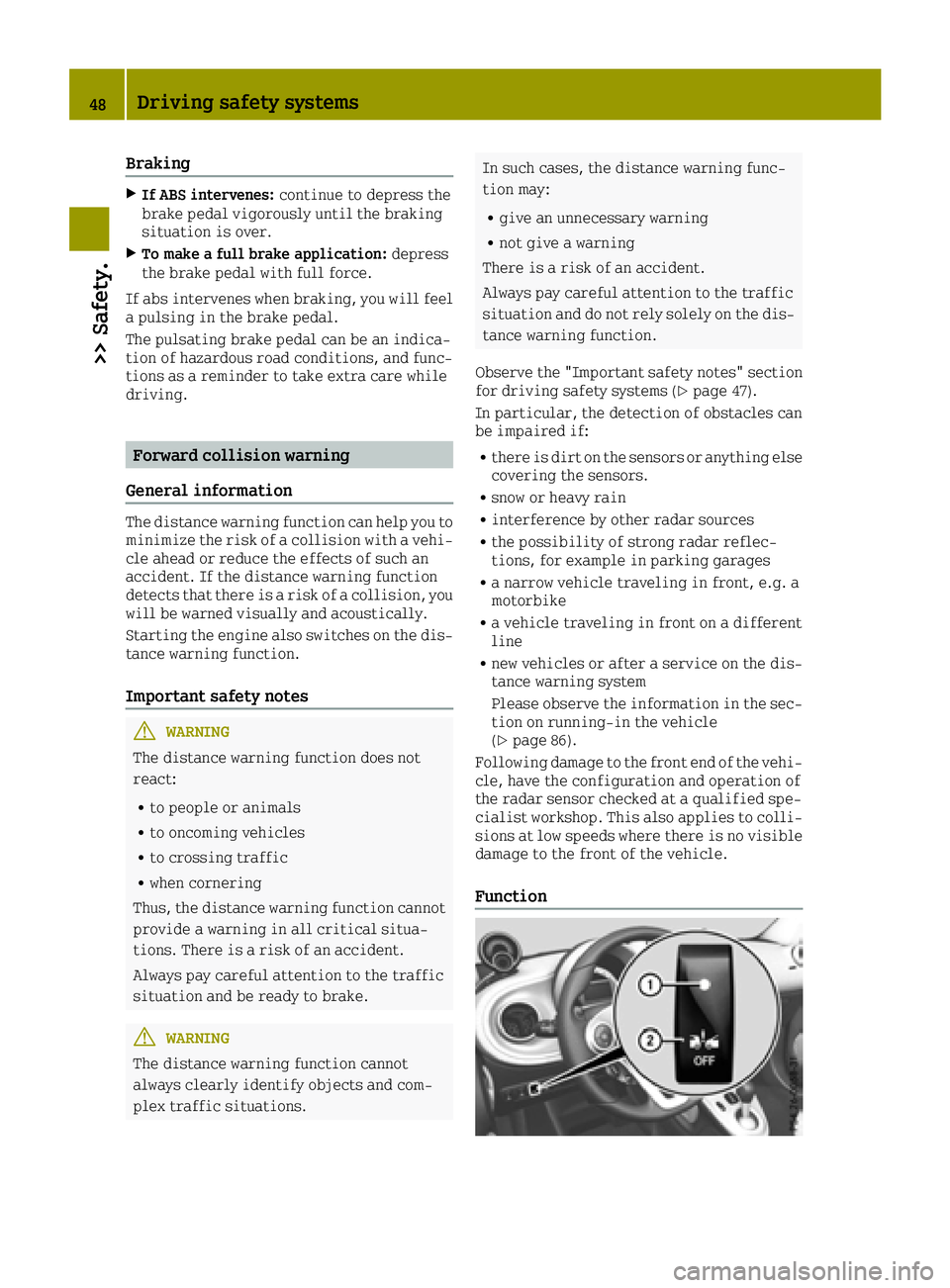
Function
48Driving safety systems
>> Safety.
Page 75 of 214
XBend the cover back into position.
XTighten the two screws0043again.
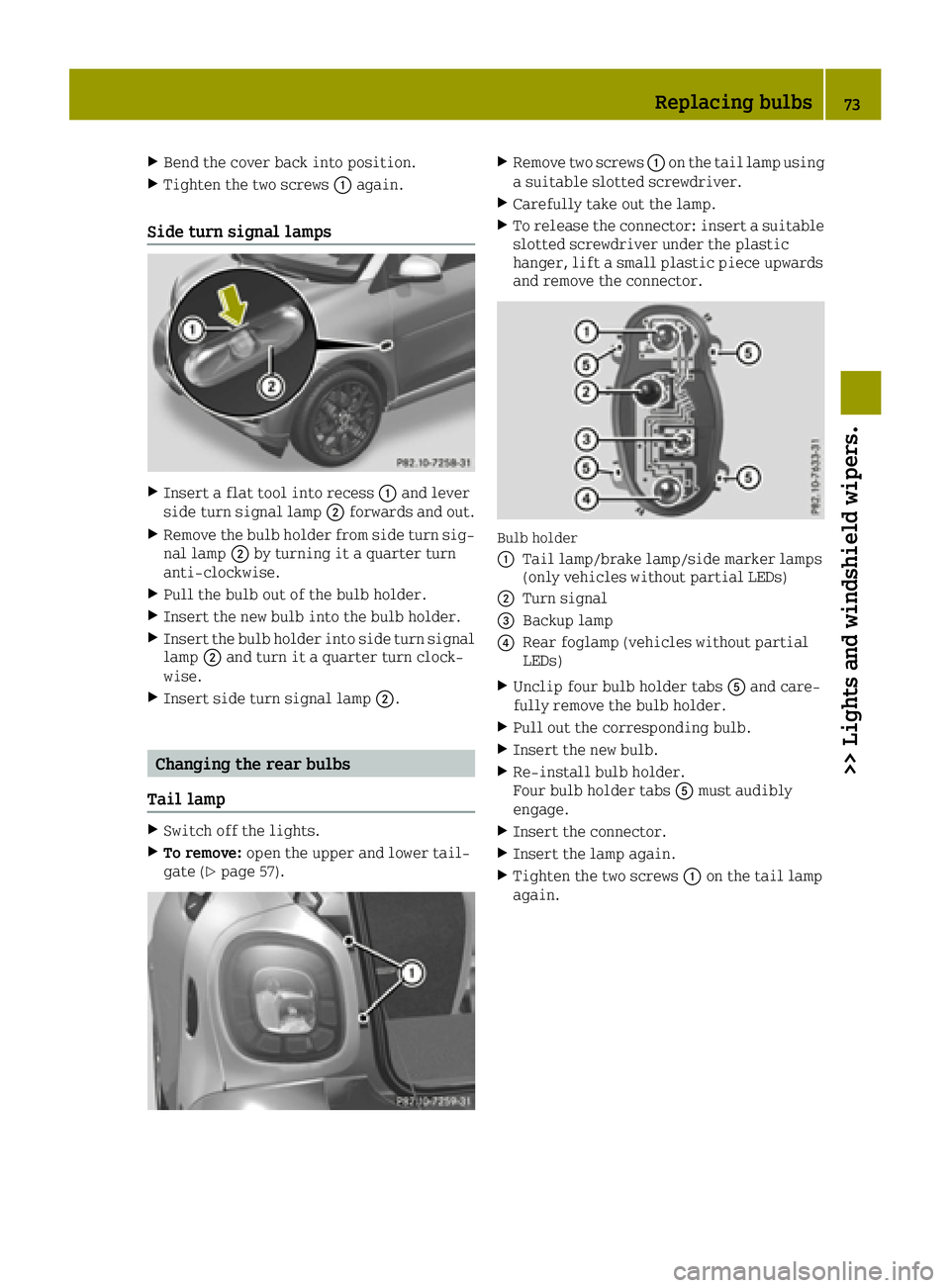
Side turn signal lamps
XInsert a flat tool into recess 0043and lever
side turn signal lamp 0044forwards and out.
XRemove the bulb holder from side turn sig-
nal lamp 0044by turning it a quarter turn
anti-clockwise.
XPull the bulb out of the bulb holder.
XInsert the new bulb into the bulb holder.
XInsert the bulb holder into side turn signal
lamp 0044and turn it a quarter turn clock-
wise.
XInsert side turn signal lamp 0044.
Changing the rear bulbs
Tail lamp
XSwitch off the lights.
XTo remove: open the upper and lower tail-
gate (Ypage 57).
XRemove two screws 0043on the tail lamp using
a suitable slotted screwdriver.
XCarefully take out the lamp.
XTo release the connector: insert a suitable
slotted screwdriver under the plastic
hanger, lift a small plastic piece upwards
and remove the connector.
Bulb holder
0043
Tail lamp/brake lamp/side marker lamps
(only vehicles without partial LEDs)
0044Turn signal
0087Backup lamp
0085Rear foglamp (vehicles without partial
LEDs)
XUnclip four bulb holder tabs 0083and care-
fully remove the bulb holder.
XPull out the corresponding bulb.
XInsert the new bulb.
XRe-install bulb holder.
Four bulb holder tabs 0083must audibly
engage.
XInsert the connector.
XInsert the lamp again.
XTighten the two screws 0043on the tail lamp
again.
Replacing bulbs73
>> Lights and windshield wipers.
Z