ECU SMART FORTWO COUPE 2010 User Guide
[x] Cancel search | Manufacturer: SMART, Model Year: 2010, Model line: FORTWO COUPE, Model: SMART FORTWO COUPE 2010Pages: 216, PDF Size: 9.7 MB
Page 74 of 216
the retractable soft top has opened
completely.XRelease the retractable soft top switch
or button 0035 on the key.XPress symbol 0056 on the retractable soft
top switch until the rear soft top has
folded down completely.
Closing the rear soft top
XPress symbol 0055 on the retractable soft
top switch until the rear soft top has
folded up completely.XRelease the retractable soft top switch.
i If you release the retractable soft top
switch while driving before the rear soft
top has closed completely, the rear soft
top will fold down again.
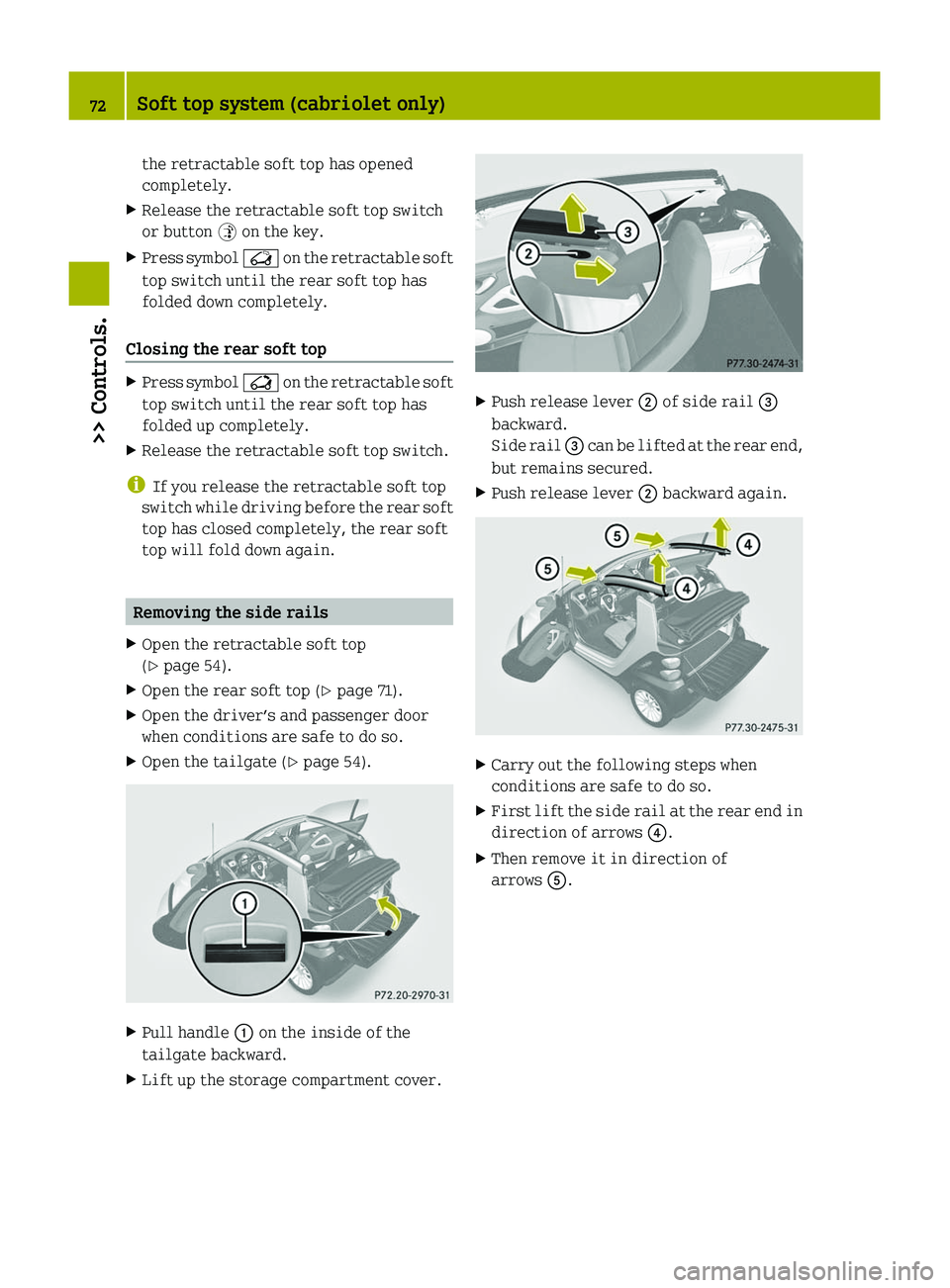
Removing the side rails
XOpen the retractable soft top
( Y page 54).XOpen the rear soft top ( Y page 71).XOpen the driver’s and passenger door
when conditions are safe to do so.XOpen the tailgate ( Y page 54).XPull handle 0046 on the inside of the
tailgate backward.XLift up the storage compartment cover.XPush release lever 0047 of side rail 008A
backward.
Side rail 008A can be lifted at the rear end,
but remains secured.XPush release lever 0047 backward again.XCarry out the following steps when
conditions are safe to do so.XFirst lift the side rail at the rear end in
direction of arrows 0088.XThen remove it in direction of
arrows 0086.72Soft top system (cabriolet only)>> Controls.
451_AKB; 3; 22, en-USd2ureepe,Version: 2.11.8.12009-07-27T09:36:34+02:00 - Seite 72
Page 79 of 216
in order to avoid damaging the
transmission.
You can drive in reverse gear at a speed
of up to 9 mph (15 km/h).XDepress the brake pedal.XPress the release button ( Y page 76) to
disengage the gear selector lever lock.XMove the gear selector lever to reverse
gear R.
R appears in the transmission position
indicator.XRelease the brake pedal.XCarefully depress the accelerator pedal.
Parking
GWarning!
Do not park this vehicle in areas where
combustible materials such as grass, hay or
leaves can come into contact with the hot
exhaust system. These materials could be
ignited and cause a vehicle fire.
Vehicle movement can cause serious
personal injury or damage to the vehicle or
the vehicle drivetrain. Therefore, always
do the following before turning off the
engine and leaving the vehicle:
R Keep right foot on the brake pedal.
R Engage the parking brake.
R Move the gear selector lever to park
position P.
R Slowly release the brake pedal.
R When parked on an incline, always turn
the front wheels towards the curb.
R Turn the key to starter switch position 0
and remove the key from the starter
switch.
R Take the key with you and lock the vehicle
when leaving.
GWarning!
With the engine not running, there is no
power assistance for the brake and
steering* systems. In this case, it is
important to keep in mind that a
considerably higher degree of effort is
necessary to brake and steer the vehicle.
Adapt your driving accordingly.
XProperly stop and park the vehicle.XDepress the brake pedal.XEngage the parking brake ( Y page 77).
When the ignition is switched on or the
engine is running, the brake warning
lamp 0027 (USA only) or 004D (Canada
only) in the instrument cluster comes on.XRelease the brake pedal.
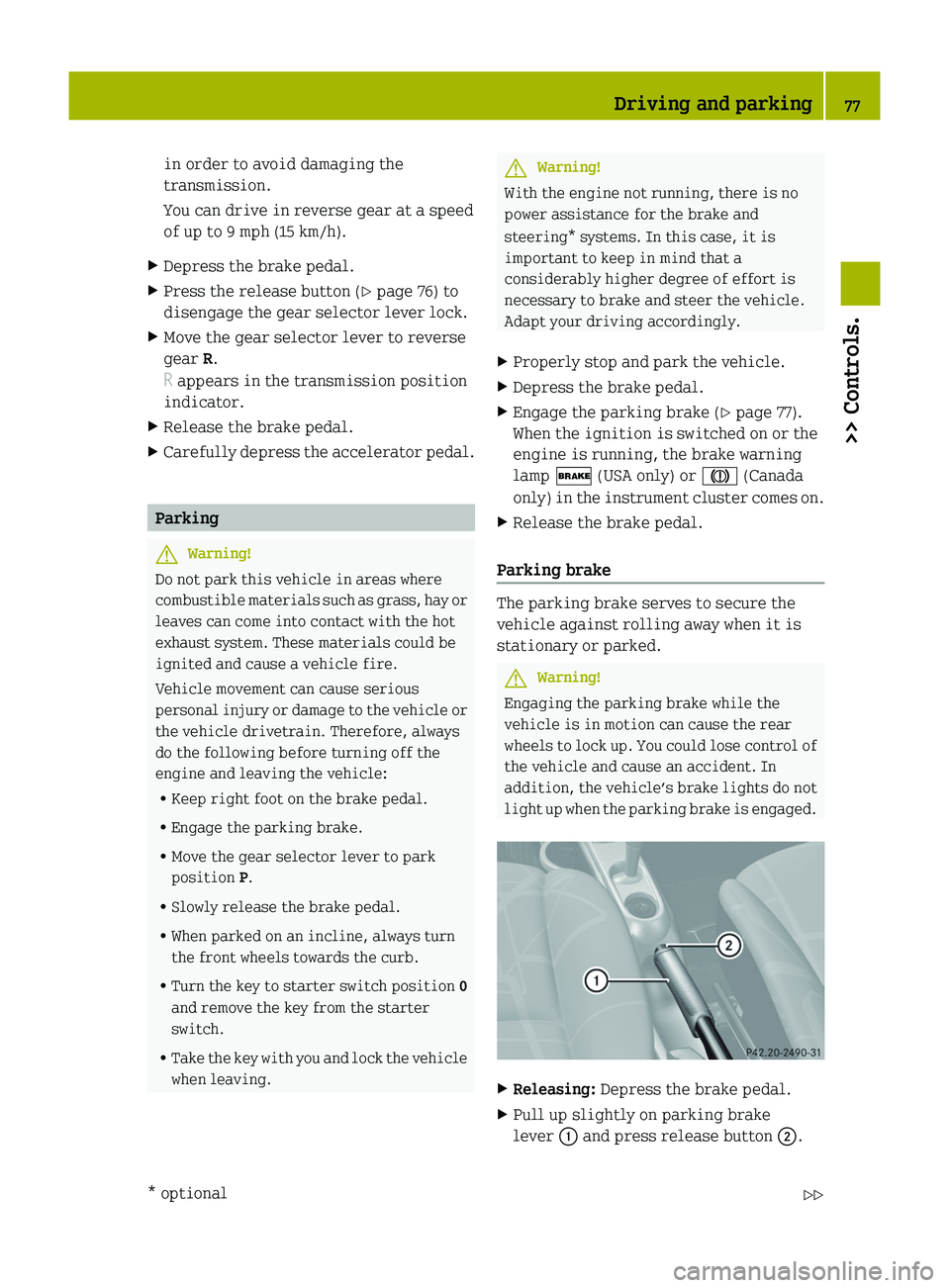
Parking brake
The parking brake serves to secure the
vehicle against rolling away when it is
stationary or parked.
GWarning!
Engaging the parking brake while the
vehicle is in motion can cause the rear
wheels to lock up. You could lose control of
the vehicle and cause an accident. In
addition, the vehicle’s brake lights do not
light up when the parking brake is engaged.
XReleasing: Depress the brake pedal.XPull up slightly on parking brake
lever 0046 and press release button 0047.Driving and parking77>> Controls.* optional451_AKB; 3; 22, en-USd2ureepe,Version: 2.11.8.12009-07-27T09:36:34+02:00 - Seite 77Z
Page 82 of 216
GWarning!
It is dangerous to shift the transmission
out of park position P or neutral position
N if the engine speed is higher than idle
speed. If your foot is not firmly on the brake
pedal, the vehicle could accelerate quickly
forward or in reverse. You could lose
control of the vehicle and hit someone or
something. Only shift into gear when the
engine is idling normally and when your
right foot is firmly on the brake pedal.
Shifting procedure
The transmission selects individual gears
automatically, depending on:
R the gear selector lever position D
( Y page 80)
R the position of the accelerator pedal
( Y page 81)
R the vehicle speed
R uphill or downhill grades
Press release button 0046 (Y page 79) to
disengage the gear selector lever lock
when moving the gear selector lever from
R P to R, N , or D
R R to P
R N to R or P
! Allow the engine to warm up under low
load use. Do not place full load on the
engine until the operating temperature
has been reached.
Shift into reverse gear R or parking
position P only when the vehicle is
stopped.
Avoid spinning of a drive wheel for an
extended period when driving off on
slippery road surfaces. Otherwise, the
drivetrain could be damaged, which is
not covered by the smart Limited
Warranty.
With manual gearshifting M selected
( Y page 82), you can use the gear selector
lever or steering wheel gearshift control
to change the gears manually.
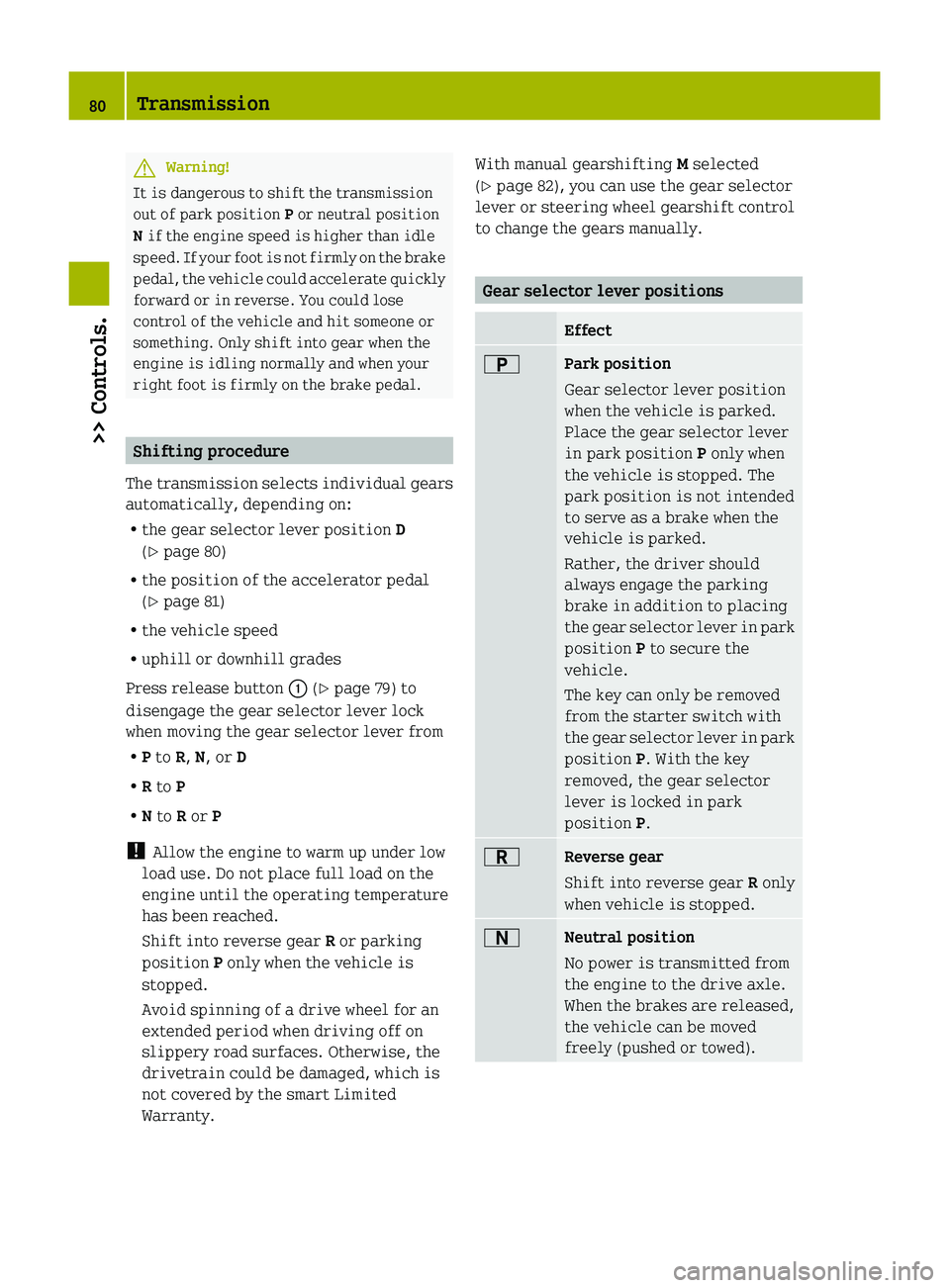
Gear selector lever positions
Effect0045Park position
Gear selector lever position
when the vehicle is parked.
Place the gear selector lever
in park position P only when
the vehicle is stopped. The
park position is not intended
to serve as a brake when the
vehicle is parked.
Rather, the driver should
always engage the parking
brake in addition to placing
the gear selector lever in park
position P to secure the
vehicle.
The key can only be removed
from the starter switch with
the gear selector lever in park
position P. With the key
removed, the gear selector
lever is locked in park
position P.0046Reverse gear
Shift into reverse gear R only
when vehicle is stopped.0044Neutral position
No power is transmitted from
the engine to the drive axle.
When the brakes are released,
the vehicle can be moved
freely (pushed or towed).80Transmission>> Controls.
451_AKB; 3; 22, en-USd2ureepe,Version: 2.11.8.12009-07-27T09:36:34+02:00 - Seite 80
Page 99 of 216
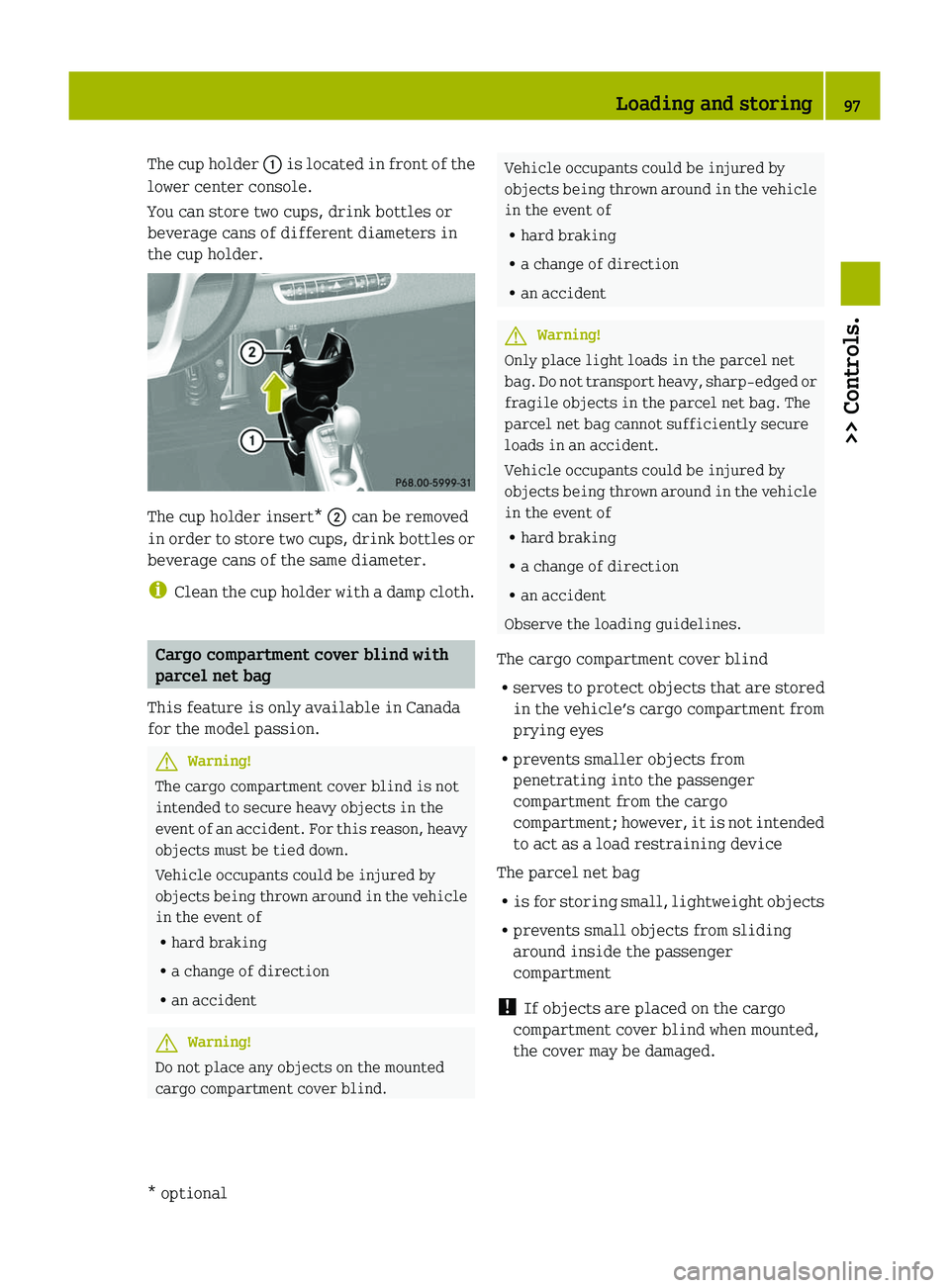
The cup holder 0046 is located in front of the
lower center console.
You can store two cups, drink bottles or
beverage cans of different diameters in
the cup holder.
The cup holder insert* 0047 can be removed
in order to store two cups, drink bottles or
beverage cans of the same diameter.
i Clean the cup holder with a damp cloth.
Cargo compartment cover blind with
parcel net bag
This feature is only available in Canada
for the model passion.
GWarning!
The cargo compartment cover blind is not
intended to secure heavy objects in the
event of an accident. For this reason, heavy
objects must be tied down.
Vehicle occupants could be injured by
objects being thrown around in the vehicle
in the event of
R hard braking
R a change of direction
R an accident
GWarning!
Do not place any objects on the mounted
cargo compartment cover blind.
Vehicle occupants could be injured by
objects being thrown around in the vehicle
in the event of
R hard braking
R a change of direction
R an accidentGWarning!
Only place light loads in the parcel net
bag. Do not transport heavy, sharp-edged or
fragile objects in the parcel net bag. The
parcel net bag cannot sufficiently secure
loads in an accident.
Vehicle occupants could be injured by
objects being thrown around in the vehicle
in the event of
R hard braking
R a change of direction
R an accident
Observe the loading guidelines.
The cargo compartment cover blind
R serves to protect objects that are stored
in the vehicle’s cargo compartment from
prying eyes
R prevents smaller objects from
penetrating into the passenger
compartment from the cargo
compartment; however, it is not intended
to act as a load restraining device
The parcel net bag
R is for storing small, lightweight objects
R prevents small objects from sliding
around inside the passenger
compartment
! If objects are placed on the cargo
compartment cover blind when mounted,
the cover may be damaged.
Loading and storing97>> Controls.* optional451_AKB; 3; 22, en-USd2ureepe,Version: 2.11.8.12009-07-27T09:36:34+02:00 - Seite 97Z
Page 100 of 216
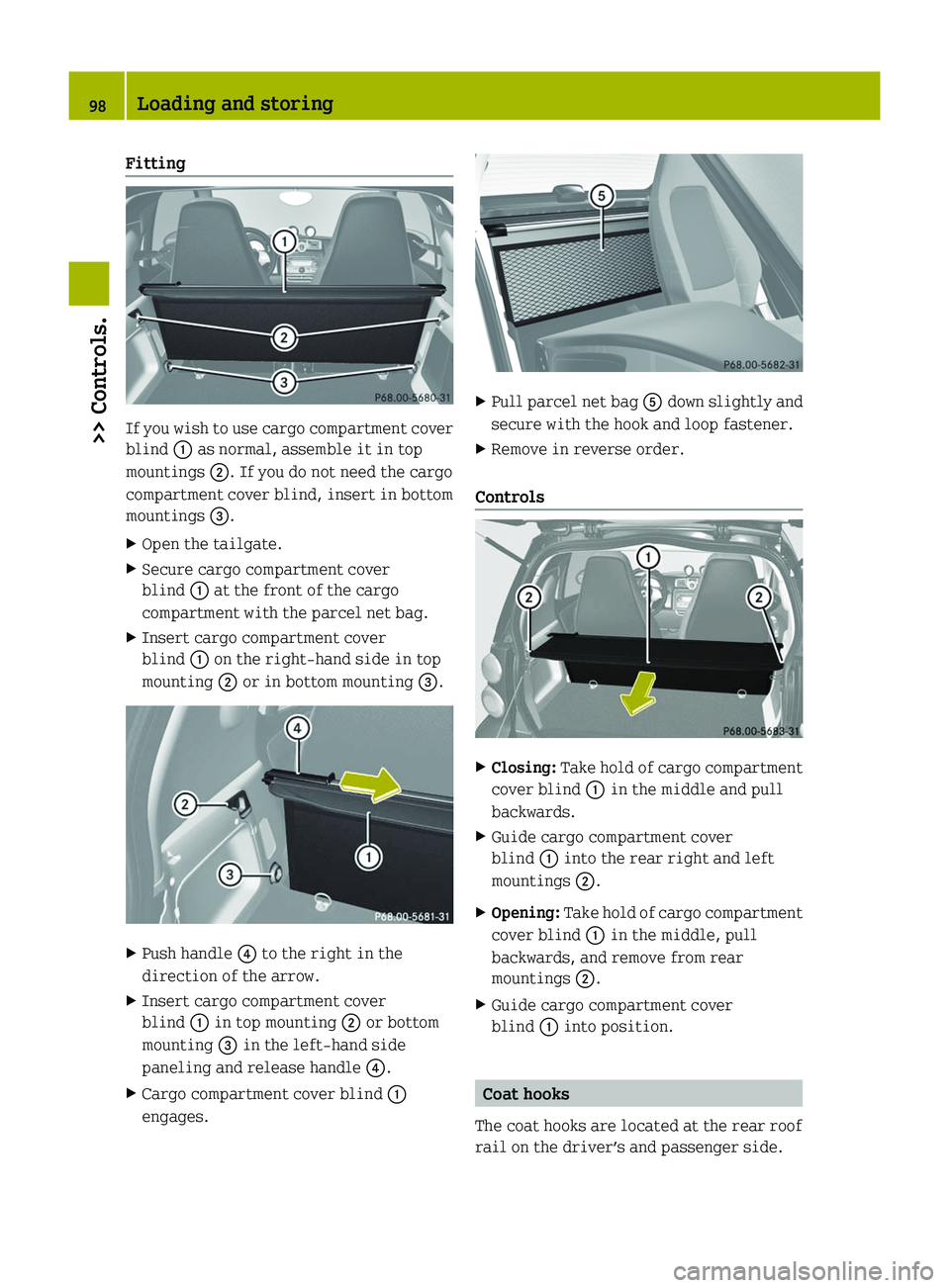
Fitting
If you wish to use cargo compartment cover
blind 0046 as normal, assemble it in top
mountings 0047. If you do not need the cargo
compartment cover blind, insert in bottom
mountings 008A.
XOpen the tailgate.XSecure cargo compartment cover
blind 0046 at the front of the cargo
compartment with the parcel net bag.XInsert cargo compartment cover
blind 0046 on the right-hand side in top
mounting 0047 or in bottom mounting 008A.XPush handle 0088 to the right in the
direction of the arrow.XInsert cargo compartment cover
blind 0046 in top mounting 0047 or bottom
mounting 008A in the left-hand side
paneling and release handle 0088.XCargo compartment cover blind 0046
engages.XPull parcel net bag 0086 down slightly and
secure with the hook and loop fastener.XRemove in reverse order.
Controls
XClosing: Take hold of cargo compartment
cover blind 0046 in the middle and pull
backwards.XGuide cargo compartment cover
blind 0046 into the rear right and left
mountings 0047.XOpening: Take hold of cargo compartment
cover blind 0046 in the middle, pull
backwards, and remove from rear
mountings 0047.XGuide cargo compartment cover
blind 0046 into position.
Coat hooks
The coat hooks are located at the rear roof
rail on the driver’s and passenger side.
98Loading and storing>> Controls.
451_AKB; 3; 22, en-USd2ureepe,Version: 2.11.8.12009-07-27T09:36:34+02:00 - Seite 98
Page 102 of 216
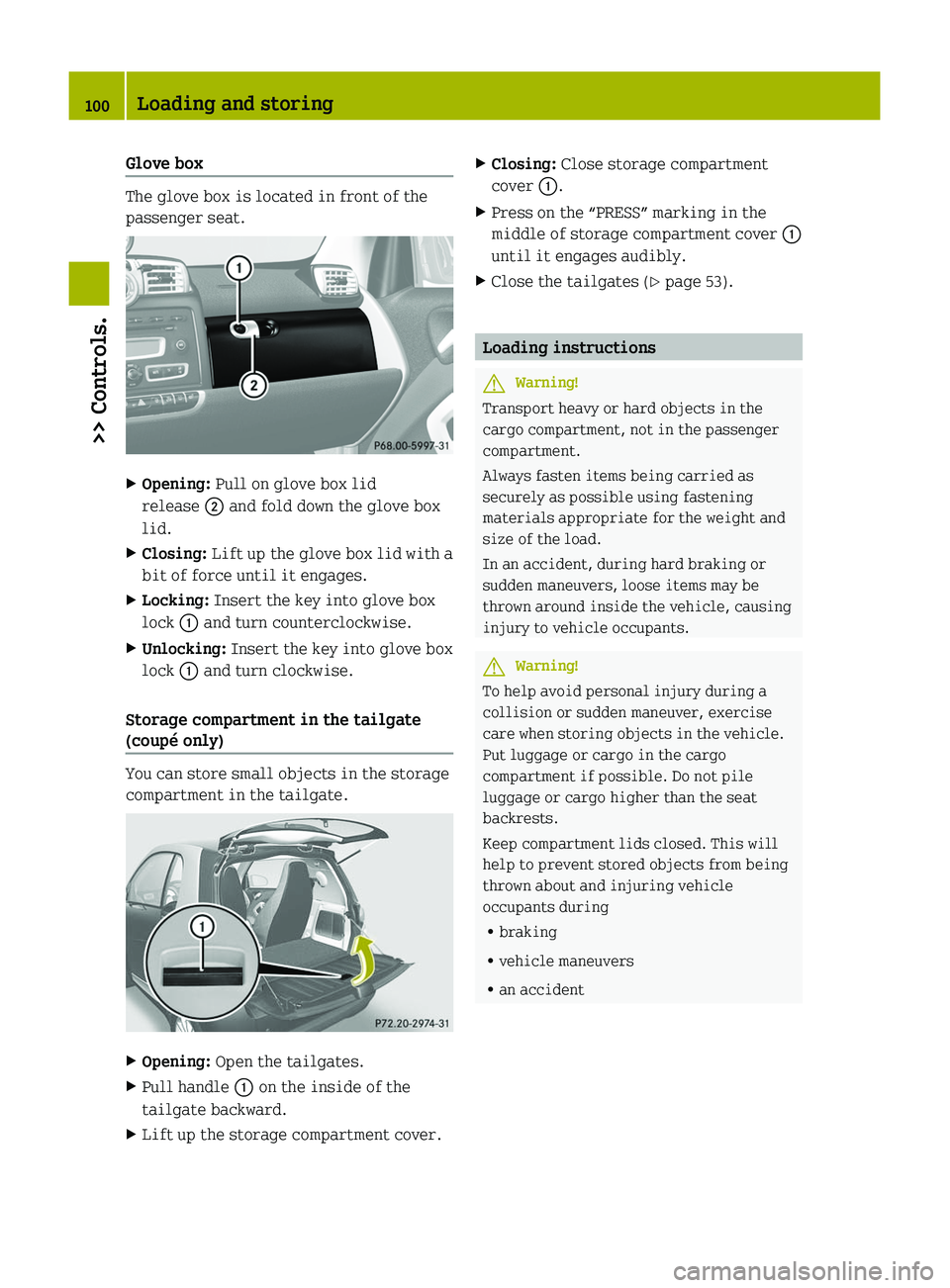
Glove box
The glove box is located in front of the
passenger seat.
XOpening: Pull on glove box lid
release 0047 and fold down the glove box
lid.XClosing: Lift up the glove box lid with a
bit of force until it engages.XLocking: Insert the key into glove box
lock 0046 and turn counterclockwise.XUnlocking: Insert the key into glove box
lock 0046 and turn clockwise.
Storage compartment in the tailgate
(coupé only)
You can store small objects in the storage
compartment in the tailgate.
XOpening: Open the tailgates.XPull handle 0046 on the inside of the
tailgate backward.XLift up the storage compartment cover.XClosing: Close storage compartment
cover 0046.XPress on the “PRESS” marking in the
middle of storage compartment cover 0046
until it engages audibly.XClose the tailgates ( Y page 53).
Loading instructions
GWarning!
Transport heavy or hard objects in the
cargo compartment, not in the passenger
compartment.
Always fasten items being carried as
securely as possible using fastening
materials appropriate for the weight and
size of the load.
In an accident, during hard braking or
sudden maneuvers, loose items may be
thrown around inside the vehicle, causing
injury to vehicle occupants.
GWarning!
To help avoid personal injury during a
collision or sudden maneuver, exercise
care when storing objects in the vehicle.
Put luggage or cargo in the cargo
compartment if possible. Do not pile
luggage or cargo higher than the seat
backrests.
Keep compartment lids closed. This will
help to prevent stored objects from being
thrown about and injuring vehicle
occupants during
R braking
R vehicle maneuvers
R an accident
100Loading and storing>> Controls.
451_AKB; 3; 22, en-USd2ureepe,Version: 2.11.8.12009-07-27T09:36:34+02:00 - Seite 100
Page 103 of 216
GWarning!
No racks or loads may be secured to the roof
of the vehicle, as
R the panorama roof* may be damaged, thus
injuring persons
R this can have a substantial adverse
effect on the driving dynamics of the
vehicle, thus causing accidents
R the rack and/or the load could detach and
through this cause an accident or other
people could be injured by the load and/
or rack that has fallen off
GWarning!
Make sure the tailgate is closed when the
engine is running and while driving.
Among other dangers, deadly carbon
monoxide (CO) gases may enter vehicle
interior resulting in unconsciousness and
death.
GWarning!
Do not store any flammable substances
inside the vehicle that could ignite and
start a fire.
GWarning!
The manufacturer has not approved your
vehicle for towing a trailer. A trailer can
permanently impair driving safety.
The gross vehicle weight which is the
weight of the vehicle including fuel, tools,
installed accessories, passengers, and
luggage/cargo must never exceed the load
limit and the Gross Vehicle Weight Rating
(GVWR) for your vehicle as specified on the
placard located on the driver’s door
B‑pillar ( Y page 198). In addition, the
load must be distributed in such a way so
that the weight on each axle never exceeds
the Gross Axle Weight Rating (GAWR) for the
front and rear axle. The GVWR and GAWR for
your vehicle are indicated on the
certification label which can be found on
the driver’s door B‑pillar.
For more information, see “Loading the
vehicle” ( Y page 120).
The handling characteristics of a fully
loaded vehicle depend greatly on the load
distribution. It is therefore recommended
to load the vehicle with the heaviest items
being placed towards the front of the
vehicle.
Please pay attention to and comply with the
following instructions when loading the
vehicle and transporting cargo:
R Always place items being carried
against seat backrests, and fasten them
as securely as possible.
R The heaviest portion of the cargo should
always be kept as low as possible against
seat backrests.
R Do not stack loads higher than the top
edge of the head restraints.
R Make sure no luggage/cargo items can get
above or next to the driver’s and/or
passenger seat into the passenger
compartment.
R Make sure luggage/cargo is properly
secured.
R Always use, if so equipped, cargo net*
when transporting cargo.
Useful features
Sun visors
The sun visors protect you from sun glare
while driving.
Useful features101>> Controls.* optional451_AKB; 3; 22, en-USd2ureepe,Version: 2.11.8.12009-07-27T09:36:34+02:00 - Seite 101Z
Page 105 of 216
Please note that
R if using the auxiliary power outlet the
maximum current drawn does not exceed
5 A
R the electric air pump can be connected
to the auxiliary power outlet for the time
it takes to inflate the tire without any
problem
R the vehicle battery will discharge when
current is drawn
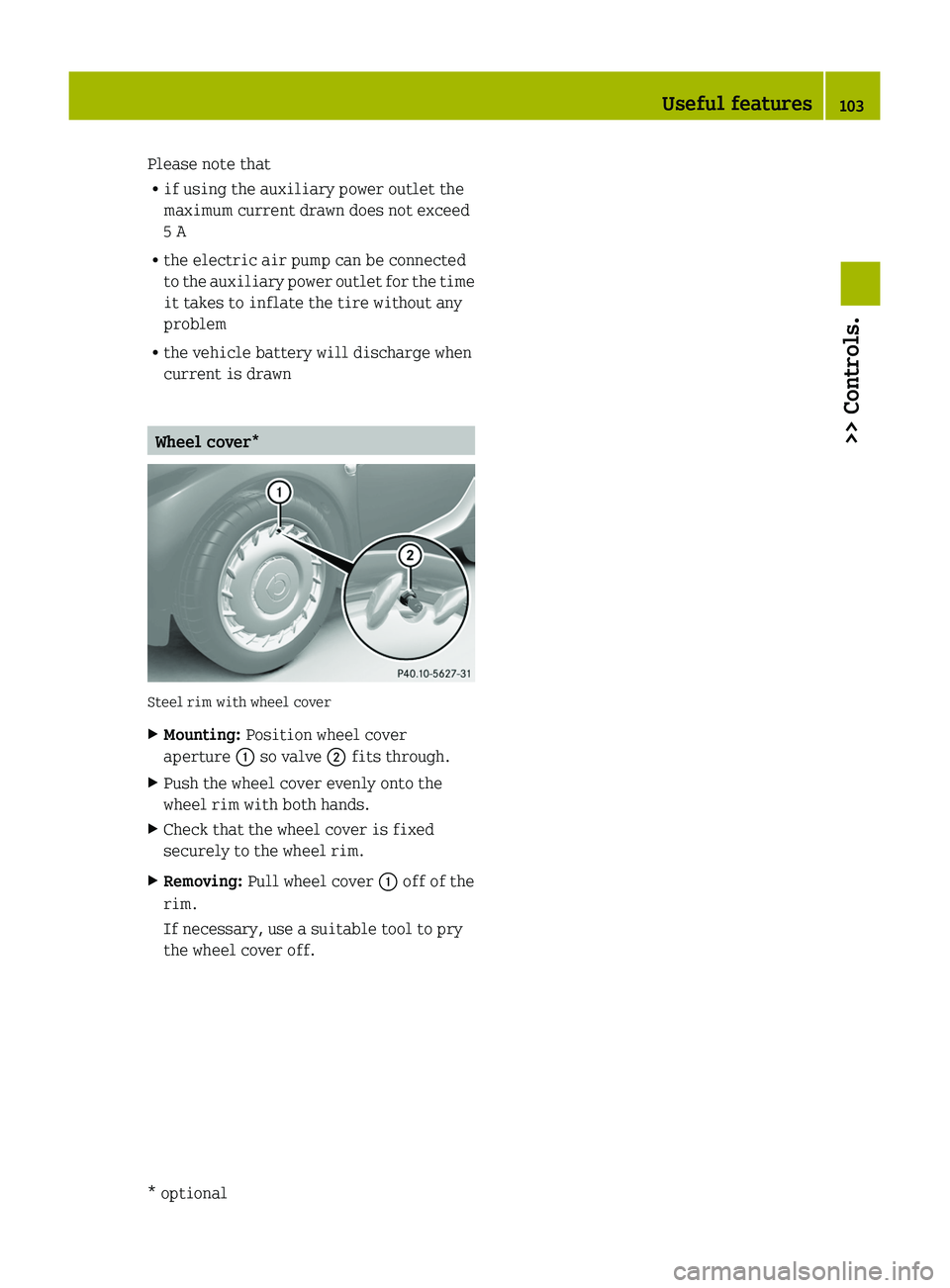
Wheel cover*
Steel rim with wheel cover
XMounting: Position wheel cover
aperture 0046 so valve 0047 fits through.XPush the wheel cover evenly onto the
wheel rim with both hands.XCheck that the wheel cover is fixed
securely to the wheel rim.XRemoving: Pull wheel cover 0046 off of the
rim.
If necessary, use a suitable tool to pry
the wheel cover off.Useful features103>> Controls.* optional451_AKB; 3; 22, en-USd2ureepe,Version: 2.11.8.12009-07-27T09:36:34+02:00 - Seite 103Z
Page 141 of 216
efficiency should be tested as soon as
possible after driving is resumed.GWarning!
Make sure not to endanger any other road
users when carrying out these braking
maneuvers.
GWarning!
If the vehicle becomes stuck in snow, make
sure snow is kept clear of the exhaust pipe
and from around the vehicle with the engine
running. Otherwise, deadly carbon
monoxide (CO) gases may enter vehicle
interior resulting in unconsciousness and
death.
To assure sufficient fresh air ventilation,
open a window slightly on the side of the
vehicle not facing the wind.
GWarning!
The outside temperature display is not
designed to serve as an ice-warning device
and is therefore unsuitable for that
purpose. Indicated temperatures just
above the freezing point do not guarantee
that the road surface is free of ice.
For more information, see “Winter driving”
( Y page 132).
Standing water
! Do not drive through flooded areas or
water of unknown depth. Before driving
through water, determine its depth.
Never accelerate before driving into
water. The bow wave could force water
into the engine and auxiliary
equipment, thus damaging them.
If you must drive through standing water,
drive slowly to prevent water from entering
the passenger compartment, the front
compartment, or the engine compartment.
Water in these areas could cause damage to
electrical components or wiring of the
engine or transmission, or could result in
water being ingested by the engine through
the air intake, causing severe internal
engine damage.
Any such damage is not covered by the smart
Limited Warranty.
Passenger compartment
GWarning!
Always fasten items being carried as
securely as possible.
In an accident, during hard braking or
sudden maneuvers, loose items thrown
around inside the vehicle may injure
vehicle occupants.
The cargo compartment is the preferred
place to carry objects.
Control and operation of radio
transmitters
Radio and telephone
GWarning!
Please do not forget that your primary
responsibility is to drive the vehicle
safely. Only operate the radio or telephone
16 if road, weather and traffic conditions
permit.
Bear in mind that at a speed of just 30 mph
(approximately 50 km/h), your vehicle is
covering a distance of 44 feet
(approximately 14 m) every second.
Telephones and two-way radios
GWarning!
Never operate radio transmitters equipped
with a built-in or attached antenna (i.e.
without being connected to an external
antenna) from inside the vehicle while the
engine is running. Doing so could lead to a
16 Observe all legal requirements.Driving instructions139>> Operation.451_AKB; 3; 22, en-USd2ureepe,Version: 2.11.8.12009-07-27T09:36:34+02:00 - Seite 139Z
Page 173 of 216
To ensure proper visibility
R it is vital that you have wiper blades that
are in perfect shape
R clean the wiper blades regularly with a
cleaning agent
R remove any tough dirt stains with a
sponge or brush
Windshield wiper blades
! Do not pull on the wiper blade inserts.
They could tear.
Removing
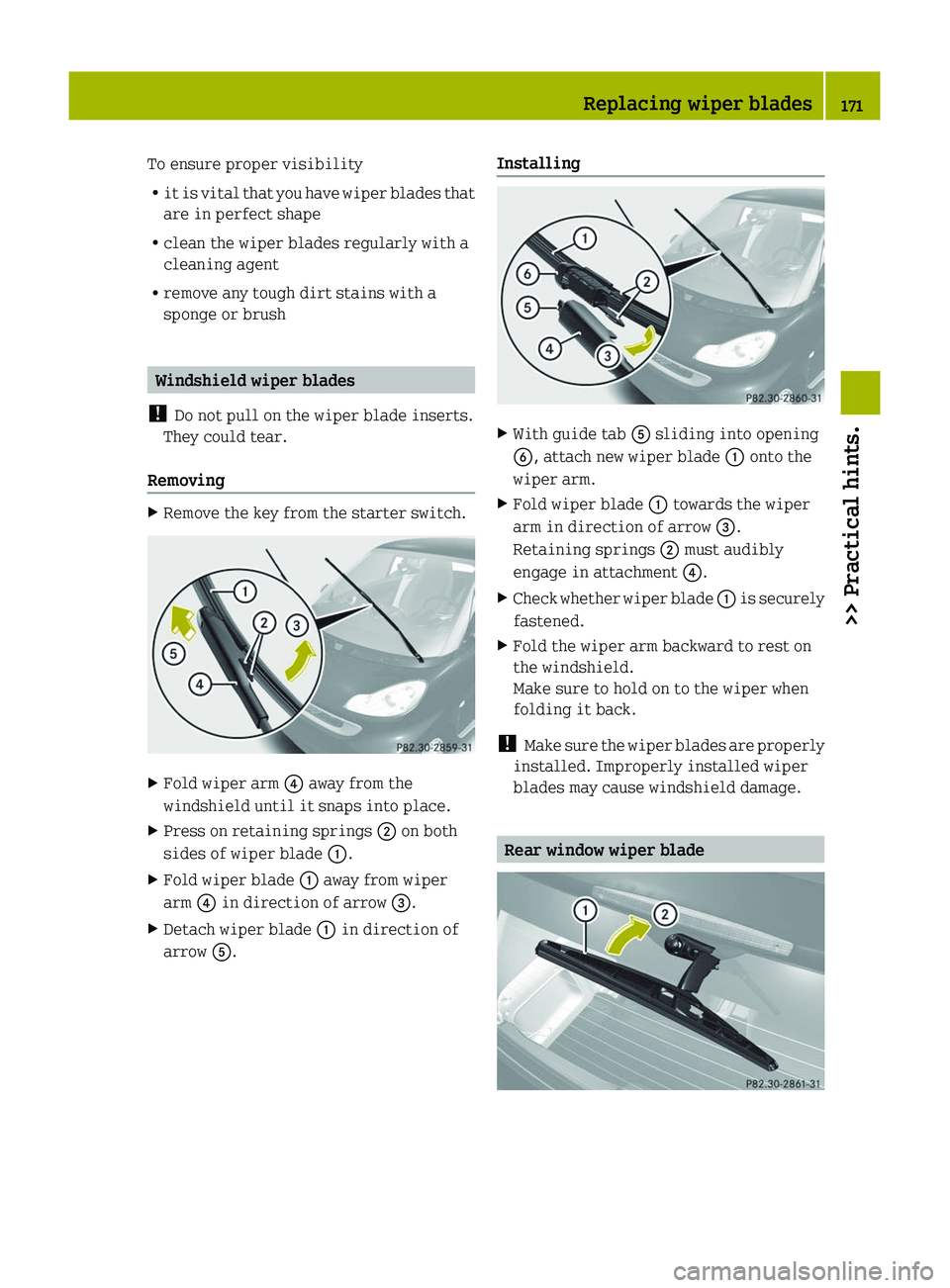
XRemove the key from the starter switch.XFold wiper arm 0088 away from the
windshield until it snaps into place.XPress on retaining springs 0047 on both
sides of wiper blade 0046.XFold wiper blade 0046 away from wiper
arm 0088 in direction of arrow 008A.XDetach wiper blade 0046 in direction of
arrow 0086.InstallingXWith guide tab 0086 sliding into opening
0087 , attach new wiper blade 0046 onto the
wiper arm.XFold wiper blade 0046 towards the wiper
arm in direction of arrow 008A.
Retaining springs 0047 must audibly
engage in attachment 0088.XCheck whether wiper blade 0046 is securely
fastened.XFold the wiper arm backward to rest on
the windshield.
Make sure to hold on to the wiper when
folding it back.
! Make sure the wiper blades are properly
installed. Improperly installed wiper
blades may cause windshield damage.
Rear window wiper blade
Replacing wiper blades171>> Practical hints.451_AKB; 3; 22, en-USd2ureepe,Version: 2.11.8.12009-07-27T09:36:34+02:00 - Seite 171Z