battery SMART FORTWO COUPE 2010 User Guide
[x] Cancel search | Manufacturer: SMART, Model Year: 2010, Model line: FORTWO COUPE, Model: SMART FORTWO COUPE 2010Pages: 216, PDF Size: 9.7 MB
Page 105 of 216
Please note that
R if using the auxiliary power outlet the
maximum current drawn does not exceed
5 A
R the electric air pump can be connected
to the auxiliary power outlet for the time
it takes to inflate the tire without any
problem
R the vehicle battery will discharge when
current is drawn
Wheel cover*
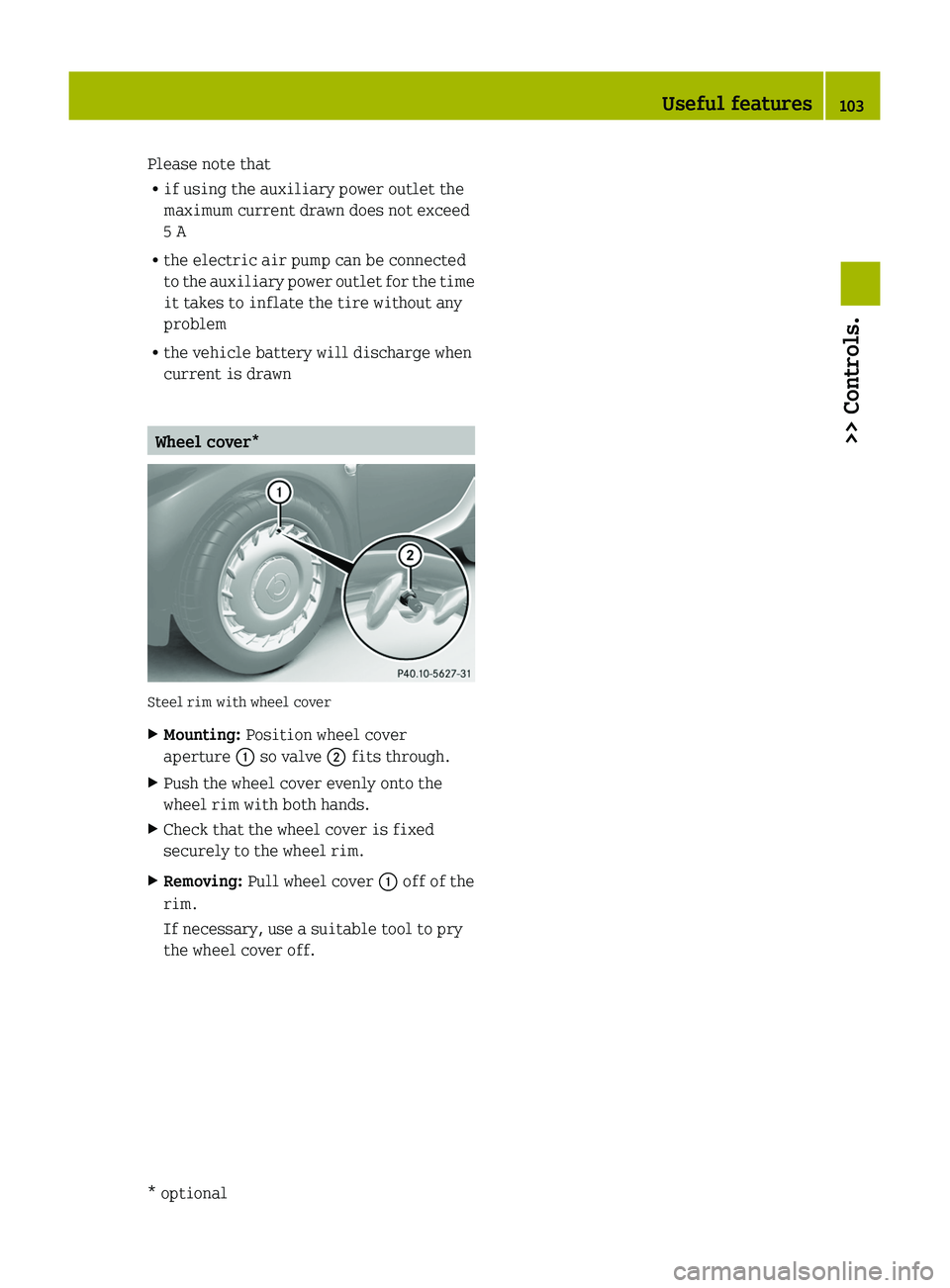
Steel rim with wheel cover
XMounting: Position wheel cover
aperture 0046 so valve 0047 fits through.XPush the wheel cover evenly onto the
wheel rim with both hands.XCheck that the wheel cover is fixed
securely to the wheel rim.XRemoving: Pull wheel cover 0046 off of the
rim.
If necessary, use a suitable tool to pry
the wheel cover off.Useful features103>> Controls.* optional451_AKB; 3; 22, en-USd2ureepe,Version: 2.11.8.12009-07-27T09:36:34+02:00 - Seite 103Z
Page 133 of 216
GVWR (Gross Vehicle Weight Rating)
This is the maximum permissible vehicle
weight of the fully loaded vehicle (weight
of the vehicle including all options,
passengers, fuel, and cargo. It is indicated
on certification label located on the
driver’s door B‑pillar.
Kilopascal (kPa)
The metric unit for air pressure. There are
6.9 kPa to 1 psi; another metric unit for air
pressure is bars. There are
100 kilopascals (kPa) to 1 bar.
Maximum load rating
The maximum load in kilograms and pounds
that can be carried by the tire.
Maximum loaded vehicle weight
The sum of curb weight, accessory weight,
total load limit and production options
weight.
Maximum permissible tire inflation
pressure
This number is the greatest amount of air
pressure that should ever be put in the tire.
Normal occupant weight
The number of occupants the vehicle is
designed to seat, multiplied by
68 kilograms (150 lbs).
Occupant distribution
The distribution of occupants in a vehicle
at their designated seating positions.
Production options weight
The combined weight of those installed
regular production options weighing over
5 lbs (2.3 kilograms) in excess of those
standard items which they replace, not
previously considered in curb weight or
accessory weight, including heavy duty
brakes, ride levelers, roof rack, heavy duty
battery, and special trim.
PSI (Pounds per square inch)
A standard unit of measure for air
pressure.
Recommended tire inflation pressure
The recommended tire inflation pressure
for normal driving conditions is listed on
the Tire and Loading Information placard
located on driver’s door B‑pillar and
provides best handling, tread life and
riding comfort.
Rim
A metal support for a tire or a tire and tube
assembly upon which the tire beads are
seated.
Sidewall
The portion of a tire between the tread and
the bead.
TIN (Tire Identification Number)
Unique identifier which facilitates
efforts by tire manufacturers to notify
purchasers in recall situations or other
safety matters concerning tires and gives
purchasers the means to easily identify
such tires. The TIN is comprised of
“Manufacturer’s identification mark”,
“Tire size”, “Tire type code” and “Date of
manufacture”.
Tire load rating
Numerical code associated with the
maximum load a tire can support.
Tires and wheels131>> Operation.451_AKB; 3; 22, en-USd2ureepe,Version: 2.11.8.12009-07-27T09:36:34+02:00 - Seite 131Z
Page 134 of 216
Tire ply composition and material used
This indicates the number of plies or the
number of layers of rubber-coated fabric
in the tire tread and sidewall. Tire
manufacturers also must indicate the ply
materials in the tire and sidewall, which
include steel, nylon, polyester, and others.
Tire speed rating
Part of tire designation; indicates the
speed range for which a tire is approved.
Total load limit
Rated cargo and luggage load plus
68 kilograms (150 lbs) times the vehicle’s
designated seating capacity.
Traction
Force exerted by the vehicle on the road via
the tires. The amount of grip provided.
Tread
The portion of a tire that comes into
contact with the road.
Treadwear indicators
Narrow bands, sometimes called “wear
bars” that show across the tread of a tire
when only 1
/ 16 in (1.6 mm) of tread remains.
Uniform Tire Quality Grading Standards
A tire information system that provides
consumers with ratings for a tire’s
traction, temperature and treadwear.
Ratings are determined by tire
manufacturers using U.S. government
testing procedures. The ratings are molded
into the sidewall of the tire.
Vehicle maximum load on the tire
Load on an individual tire that is
determined by distributing to each axle
its share of the maximum loaded vehicle
weight and dividing it by two.
Winter driving
Before the onset of winter, have your
vehicle winterized at an authorized smart
center. This service includes:
R Check of anticorrosion and antifreeze
concentration.
R Addition of washer concentrate to the
water of the windshield/rear window.
Use a windshield washer concentrate
labeled for winter which is formulated
for temperatures below freezing point
( Y page 208).
R Battery test. Battery capacity drops with
decreasing ambient temperature. A well
charged battery helps to make sure the
engine can be started, even at low
ambient temperatures.
R Tire change.
Winter tires
GWarning!
Winter tires with a tread depth of less than
1 / 6 in (4 mm) must be replaced. They are no
longer suitable for winter operation.
Always use winter tires at temperatures
below 45 ¦ (7¥ ) and whenever wintry road
conditions prevail. Not all M+S rated tires
provide special winter performance. Make
sure the tires you use show the mountain/
snowflake marking 004D on the tire
sidewall. These tires meet specific snow
traction performance requirements of the
Rubber Manufacturers Association (RMA)
and the Rubber Association of Canada (RAC)
and have been designed specifically for
use in snow conditions. Use of winter tires
is the only way to achieve the maximum
132Winter driving>> Operation.
451_AKB; 3; 22, en-USd2ureepe,Version: 2.11.8.12009-07-27T09:36:34+02:00 - Seite 132
Page 149 of 216
>> Practical hints.Where will I find ...? ........................148
Display messages ............................. 148
What to do if ... ............................... 149
Unlocking/locking manually ...............162
Replacing transmitter battery ............163
Replacing bulbs .............................. 164
Replacing wiper blades .....................170
Flat tire ........................................ 172
Wheel change ................................... 177
Battery .......................................... 180
Jump starting .................................. 183
Towing ........................................... 185
Fuses ............................................. 188451_AKB; 3; 22, en-USd2ureepe,Version: 2.11.8.12009-07-27T09:36:34+02:00 - Seite 147
Page 156 of 216
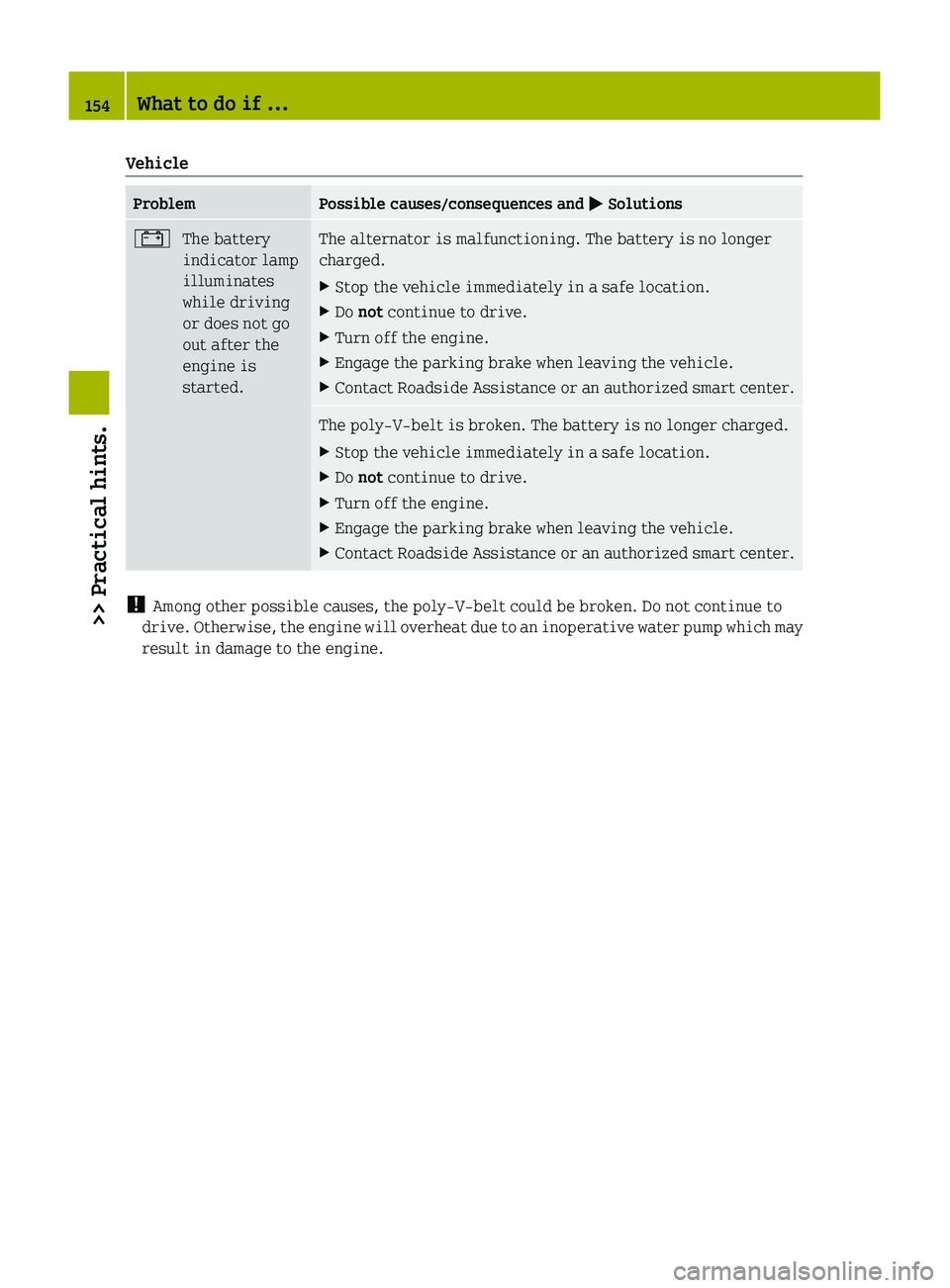
VehicleProblemPossible causes/consequences and 0050 Solutions003FThe battery
indicator lamp
illuminates
while driving
or does not go
out after the
engine is
started.The alternator is malfunctioning. The battery is no longer
charged.XStop the vehicle immediately in a safe location.XDo not continue to drive.XTurn off the engine.XEngage the parking brake when leaving the vehicle.XContact Roadside Assistance or an authorized smart center.The poly-V-belt is broken. The battery is no longer charged.XStop the vehicle immediately in a safe location.XDo not continue to drive.XTurn off the engine.XEngage the parking brake when leaving the vehicle.XContact Roadside Assistance or an authorized smart center.
!
Among other possible causes, the poly-V-belt could be broken. Do not continue to
drive. Otherwise, the engine will overheat due to an inoperative water pump which may
result in damage to the engine.
154What to do if ...>> Practical hints.
451_AKB; 3; 22, en-USd2ureepe,Version: 2.11.8.12009-07-27T09:36:34+02:00 - Seite 154
Page 162 of 216
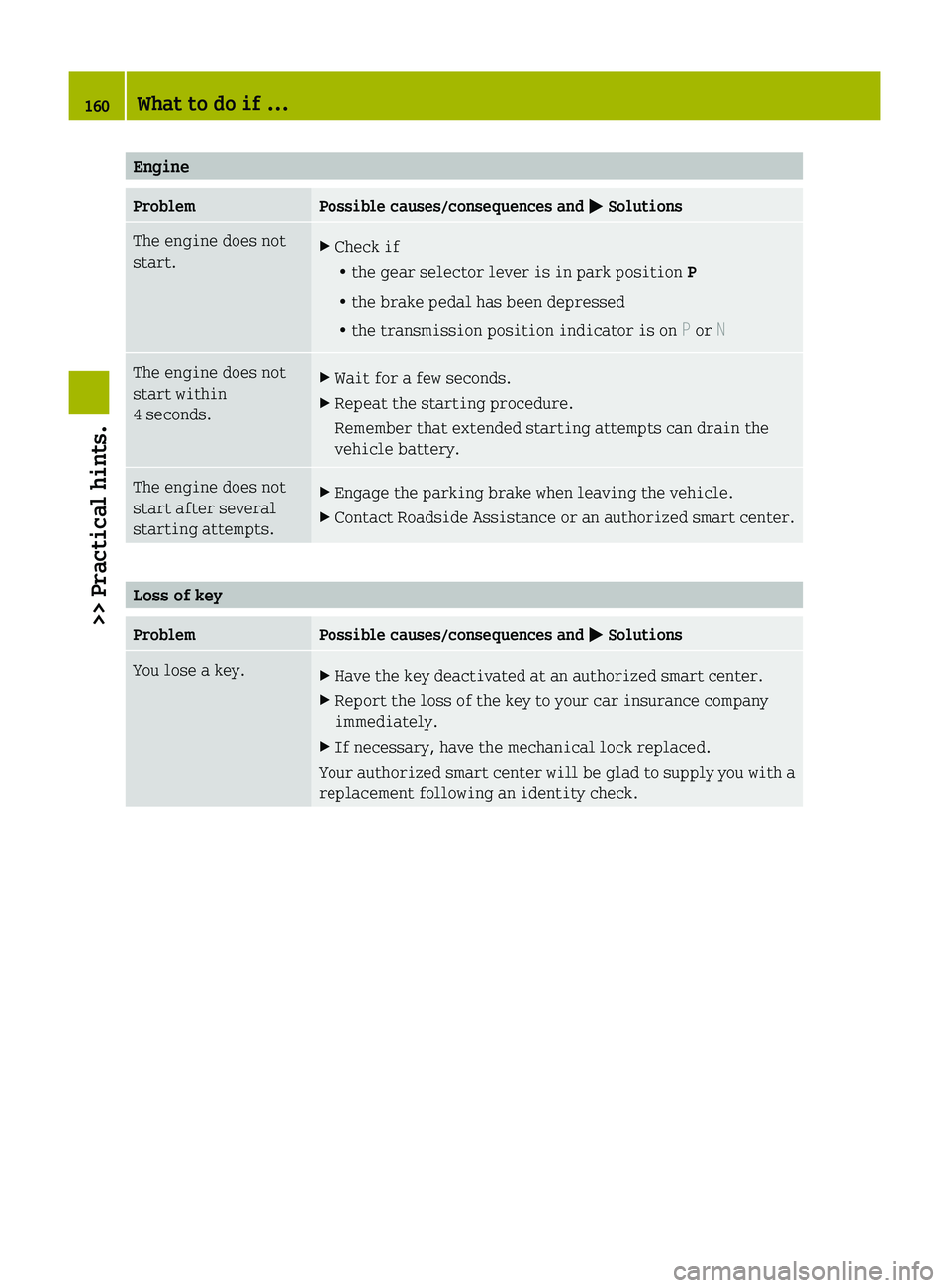
EngineProblemPossible causes/consequences and 0050 SolutionsThe engine does not
start.XCheck if
R the gear selector lever is in park position P
R the brake pedal has been depressed
R the transmission position indicator is on P or NThe engine does not
start within
4 seconds.XWait for a few seconds.XRepeat the starting procedure.
Remember that extended starting attempts can drain the
vehicle battery.The engine does not
start after several
starting attempts.XEngage the parking brake when leaving the vehicle.XContact Roadside Assistance or an authorized smart center.
Loss of key
ProblemPossible causes/consequences and 0050 SolutionsYou lose a key.XHave the key deactivated at an authorized smart center.XReport the loss of the key to your car insurance company
immediately.XIf necessary, have the mechanical lock replaced.
Your authorized smart center will be glad to supply you with a
replacement following an identity check.
160What to do if ...>> Practical hints.
451_AKB; 3; 22, en-USd2ureepe,Version: 2.11.8.12009-07-27T09:36:34+02:00 - Seite 160
Page 164 of 216
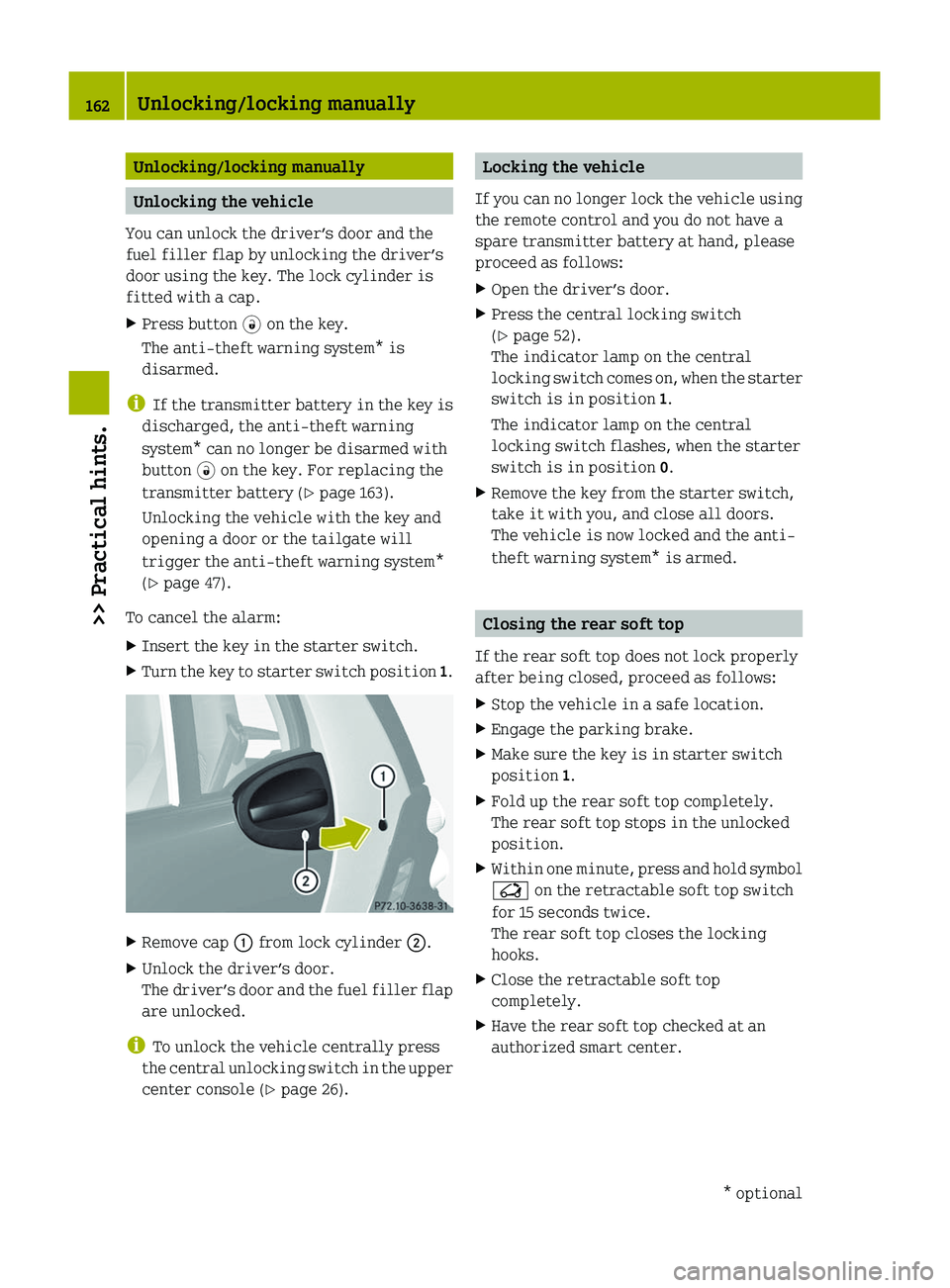
Unlocking/locking manually
Unlocking the vehicle
You can unlock the driver’s door and the
fuel filler flap by unlocking the driver’s
door using the key. The lock cylinder is
fitted with a cap.
XPress button 0034 on the key.
The anti-theft warning system* is
disarmed.
i If the transmitter battery in the key is
discharged, the anti-theft warning
system* can no longer be disarmed with
button 0034 on the key. For replacing the
transmitter battery ( Y page 163).
Unlocking the vehicle with the key and
opening a door or the tailgate will
trigger the anti-theft warning system*
( Y page 47).
To cancel the alarm:
XInsert the key in the starter switch.XTurn the key to starter switch position 1.XRemove cap 0046 from lock cylinder 0047.XUnlock the driver’s door.
The driver’s door and the fuel filler flap
are unlocked.
i To unlock the vehicle centrally press
the central unlocking switch in the upper
center console ( Y page 26).
Locking the vehicle
If you can no longer lock the vehicle using
the remote control and you do not have a
spare transmitter battery at hand, please
proceed as follows:XOpen the driver’s door.XPress the central locking switch
( Y page 52).
The indicator lamp on the central
locking switch comes on, when the starter
switch is in position 1.
The indicator lamp on the central
locking switch flashes, when the starter
switch is in position 0.XRemove the key from the starter switch,
take it with you, and close all doors.
The vehicle is now locked and the anti-
theft warning system* is armed.
Closing the rear soft top
If the rear soft top does not lock properly
after being closed, proceed as follows:
XStop the vehicle in a safe location.XEngage the parking brake.XMake sure the key is in starter switch
position 1.XFold up the rear soft top completely.
The rear soft top stops in the unlocked
position.XWithin one minute, press and hold symbol
0055 on the retractable soft top switch
for 15 seconds twice.
The rear soft top closes the locking
hooks.XClose the retractable soft top
completely.XHave the rear soft top checked at an
authorized smart center.162Unlocking/locking manually>> Practical hints.* optional451_AKB; 3; 22, en-USd2ureepe,Version: 2.11.8.12009-07-27T09:36:34+02:00 - Seite 162
Page 165 of 216
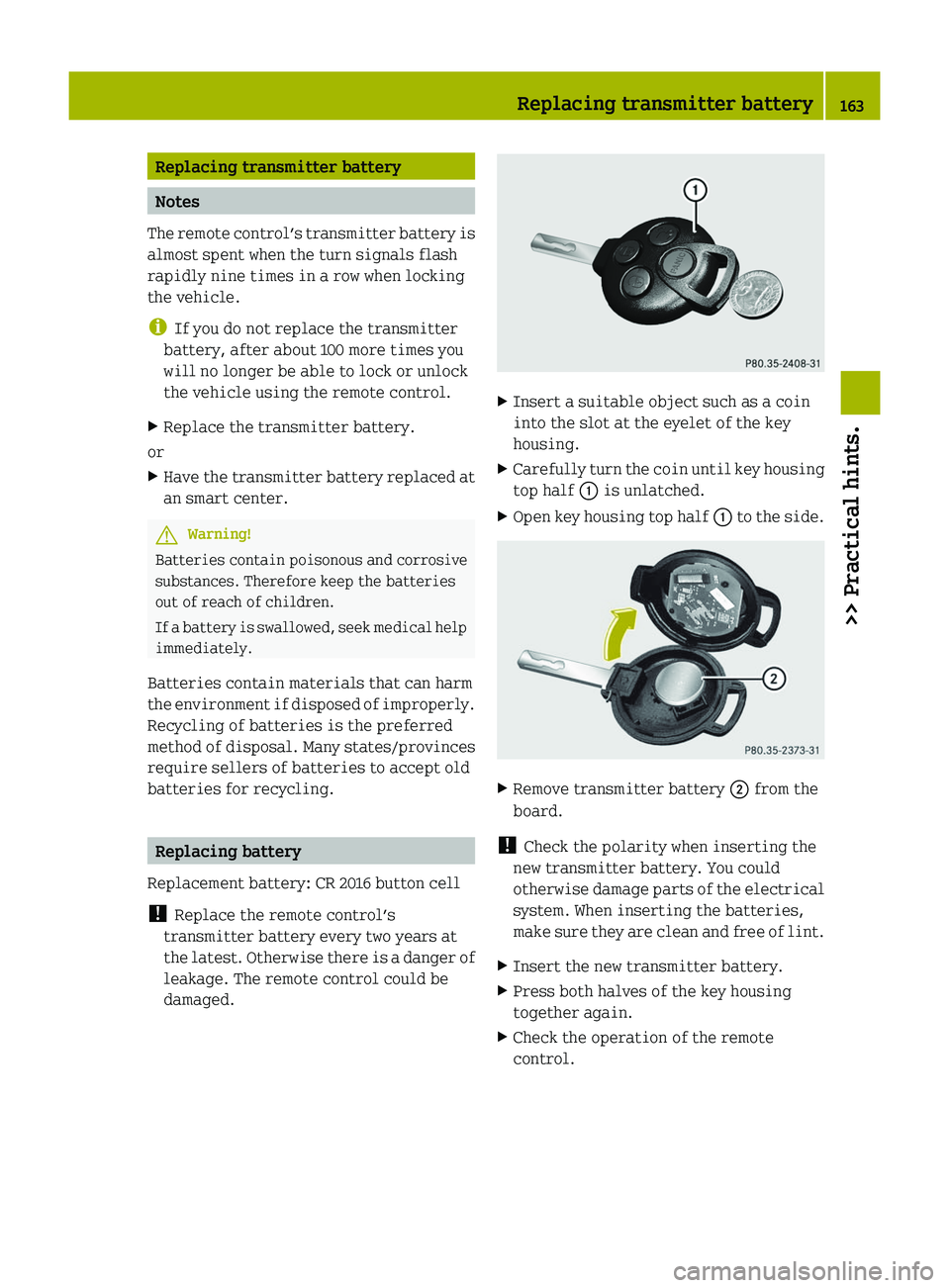
Replacing transmitter battery
Notes
The remote control’s transmitter battery is
almost spent when the turn signals flash
rapidly nine times in a row when locking
the vehicle.
i If you do not replace the transmitter
battery, after about 100 more times you
will no longer be able to lock or unlock
the vehicle using the remote control.
XReplace the transmitter battery.
or
XHave the transmitter battery replaced at
an smart center.GWarning!
Batteries contain poisonous and corrosive
substances. Therefore keep the batteries
out of reach of children.
If a battery is swallowed, seek medical help
immediately.
Batteries contain materials that can harm
the environment if disposed of improperly.
Recycling of batteries is the preferred
method of disposal. Many states/provinces
require sellers of batteries to accept old
batteries for recycling.
Replacing battery
Replacement battery: CR 2016 button cell
! Replace the remote control’s
transmitter battery every two years at
the latest. Otherwise there is a danger of
leakage. The remote control could be
damaged.
XInsert a suitable object such as a coin
into the slot at the eyelet of the key
housing.XCarefully turn the coin until key housing
top half 0046 is unlatched.XOpen key housing top half 0046 to the side.XRemove transmitter battery 0047 from the
board.
! Check the polarity when inserting the
new transmitter battery. You could
otherwise damage parts of the electrical
system. When inserting the batteries,
make sure they are clean and free of lint.
XInsert the new transmitter battery.XPress both halves of the key housing
together again.XCheck the operation of the remote
control.Replacing transmitter battery163>> Practical hints.451_AKB; 3; 22, en-USd2ureepe,Version: 2.11.8.12009-07-27T09:36:34+02:00 - Seite 163Z
Page 177 of 216
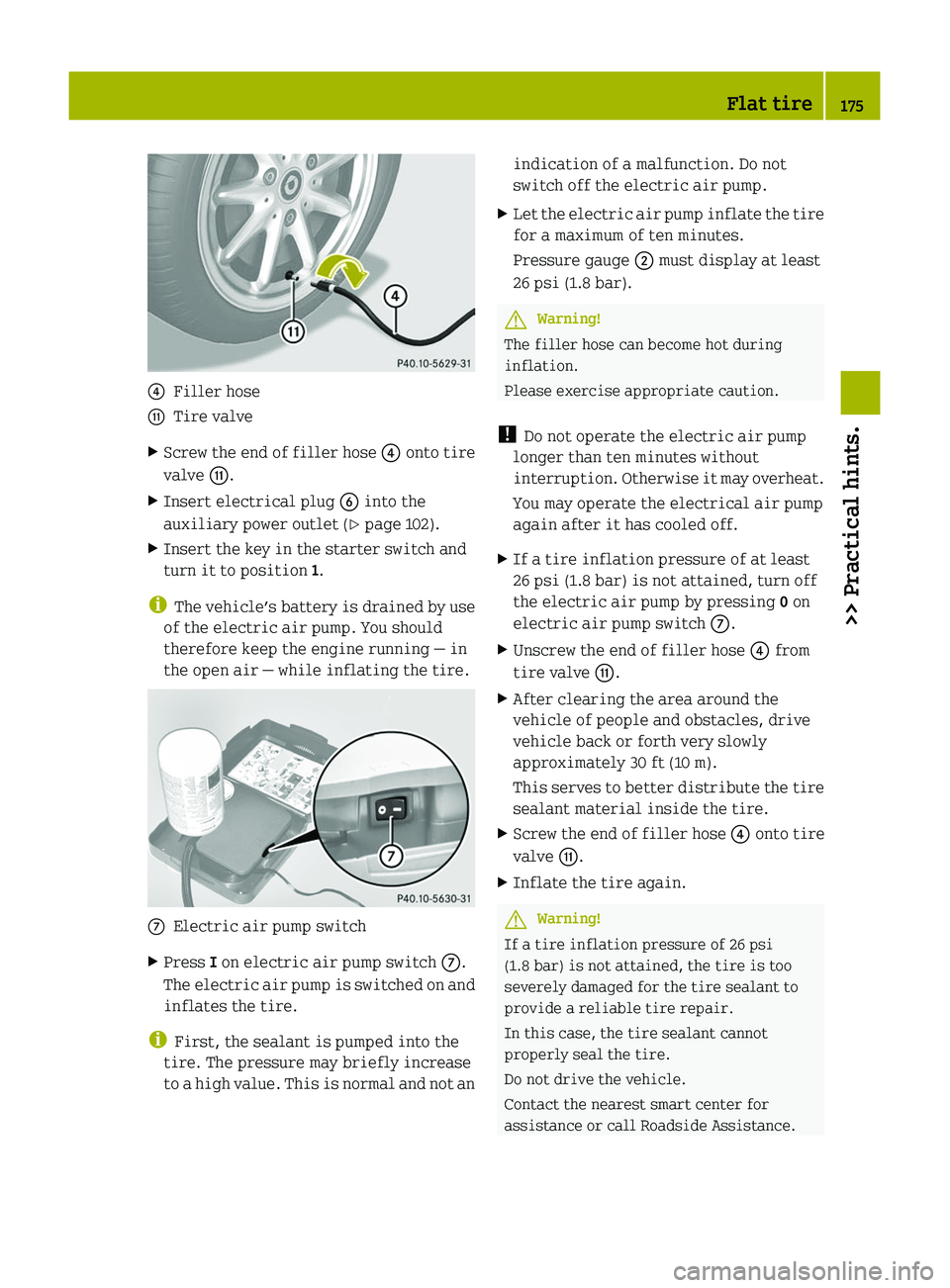
0088Filler hose0072Tire valveXScrew the end of filler hose 0088 onto tire
valve 0072.XInsert electrical plug 0087 into the
auxiliary power outlet ( Y page 102).XInsert the key in the starter switch and
turn it to position 1.
i
The vehicle’s battery is drained by use
of the electric air pump. You should
therefore keep the engine running — in
the open air — while inflating the tire.
006EElectric air pump switchXPress I on electric air pump switch 006E.
The electric air pump is switched on and
inflates the tire.
i First, the sealant is pumped into the
tire. The pressure may briefly increase
to a high value. This is normal and not an
indication of a malfunction. Do not
switch off the electric air pump.XLet the electric air pump inflate the tire
for a maximum of ten minutes.
Pressure gauge 0047 must display at least
26 psi (1.8 bar).GWarning!
The filler hose can become hot during
inflation.
Please exercise appropriate caution.
! Do not operate the electric air pump
longer than ten minutes without
interruption. Otherwise it may overheat.
You may operate the electrical air pump
again after it has cooled off.
XIf a tire inflation pressure of at least
26 psi (1.8 bar) is not attained, turn off
the electric air pump by pressing 0 on
electric air pump switch 006E.XUnscrew the end of filler hose 0088 from
tire valve 0072.XAfter clearing the area around the
vehicle of people and obstacles, drive
vehicle back or forth very slowly
approximately 30 ft (10 m).
This serves to better distribute the tire
sealant material inside the tire.XScrew the end of filler hose 0088 onto tire
valve 0072.XInflate the tire again.GWarning!
If a tire inflation pressure of 26 psi
(1.8 bar) is not attained, the tire is too
severely damaged for the tire sealant to
provide a reliable tire repair.
In this case, the tire sealant cannot
properly seal the tire.
Do not drive the vehicle.
Contact the nearest smart center for
assistance or call Roadside Assistance.
Flat tire175>> Practical hints.451_AKB; 3; 22, en-USd2ureepe,Version: 2.11.8.12009-07-27T09:36:34+02:00 - Seite 175Z
Page 182 of 216

loose if they are not tightened to a torque
of 80 lb-ft (110 Nm).
Steel rim with wheel cover
XVehicles with wheel cover on steel rim:
Position wheel cover aperture 0046 so
valve 0047 fits through.XPush the wheel cover evenly onto the
wheel rim with both hands.XCheck that the wheel cover is fixed
securely to the wheel rim.
i The Tire Pressure Monitoring System
(TPMS)* only functions on wheels that are
equipped with the proper electronic
sensors ( Y page 117).
Battery
About the battery
Your vehicle’s battery is located in the
passenger footwell below the footrest
( Y page 182).
The battery should always be sufficiently
charged in order to achieve its rated
service life. Refer to Maintenance Booklet
for battery maintenance intervals.
If you use your vehicle mostly for short-
distance trips, you will need to have the
battery charge checked more frequently.
When replacing the battery, always use
batteries approved by smart.
Battery: 12 V and 42 Ah
If you do not intend to operate your vehicle
for an extended period of time, consult an
authorized smart center about steps you
need to observe.GWarning!
Observe all safety instructions and
precautions when handling automotive
batteries.
Risk of explosion.Fire, open flames and
smoking are prohibited
when handling batteries.
Avoid creating sparks.Battery acid is caustic.
Do not allow it to come
into contact with skin,
eyes or clothing.
Wear suitable protective
clothing, especially
gloves, apron and
faceguard.Wear eye protection.
Rinse any acid spills
immediately with clear
water. Contact a physician
if necessary.Keep children away.Follow the instructions in
this Operator’s Manual.
Batteries contain materials that can harm
the environment if disposed of improperly.
Recycling of batteries is the preferred
method of disposal. Many states require
sellers of batteries to accept old batteries
for recycling.
180Battery>> Practical hints.* optional451_AKB; 3; 22, en-USd2ureepe,Version: 2.11.8.12009-07-27T09:36:34+02:00 - Seite 180