child restraint SMART FORTWO COUPE 2010 User Guide
[x] Cancel search | Manufacturer: SMART, Model Year: 2010, Model line: FORTWO COUPE, Model: SMART FORTWO COUPE 2010Pages: 216, PDF Size: 9.7 MB
Page 41 of 216
GWarning!
Children 12 years old and under must be
seated and properly secured in an
appropriate infant or child restraint
recommended for the size and weight of the
child.
The infant or child restraint must be
properly secured with the vehicle’s seat
belt, fully in accordance with the child
seat manufacturer’s instructions.
Children can be killed or seriously injured
by an inflating air bag. Note the following
important information:
R Your vehicle is equipped with air bag
technology designed to turn off the
passenger front air bag in your vehicle
when the system senses the weight of a
typical 12‑month‑old child or less along
with the weight of a standard
appropriate child restraint on the
passenger seat.
R A child in a rear-facing child restraint
on the passenger seat will be seriously
injured or even killed if the passenger
front air bag inflates in a collision
which could occur under some
circumstances, even with the air bag
technology installed in your vehicle.
R If you install a rear-facing child
restraint on the passenger seat, make
sure the 007F 007B indicator lamp
is illuminated, indicating that the
passenger front air bag is deactivated.
Should the 007F 007B indicator
lamp not illuminate or go out while the
restraint is installed, please check
installation.
Periodically check the 007F 007B
indicator lamp while driving to make
sure the 007F 007B indicator lamp
is illuminated.
If the 007F 007B indicator lamp
goes out or remains out, do not transport
a child on the passenger seat until the
system has been repaired.
A child in a rear-facing child restraint
on the passenger seat may be seriously
injured or even killed if the passenger
front air bag inflates.
R If you place a child in a forward-facing
child restraint on the passenger seat,
move the seat as far back as possible, use
the proper child restraint recommended
for the age, size and weight of the child
by the seat manufacturer, and secure
child restraint with the vehicle’s seat
belt according to the child seat
manufacturer’s instructions. For
children larger than the typical
12‑month‑old child, the passenger front
air bag may or may not be activated.
i Deployment of the driver front air bag
does not mean that the passenger front
air bag also should have deployed.
The Occupant Classification System
( Y page 37) may have determined
R that the seat was empty or occupied by the
weight up to or less than that of a typical
12‑month‑old child seated in a standard
child restraint — both instances where
the system suppresses deployment of the
passenger front air bag even though the
impact met the criteria and was of
sufficient severity to deploy the driver
front air bag
R that the seat was occupied by a small
individual (such as a young teenager or
a small adult) or a child weighing more
than the weight of a typical 12‑month‑old
child in a standard child restraint —
instances where the system may suppress
deployment of the passenger front air
bag even though the impact met the
criteria and was of sufficient severity
to deploy the driver front air bagOccupant safety39>> Safety.451_AKB; 3; 22, en-USd2ureepe,Version: 2.11.8.12009-07-27T09:36:34+02:00 - Seite 39Z
Page 43 of 216
Children in the vehicle
If an infant or child is traveling with you
in the vehicle:XSecure the child using an infant or child
restraint appropriate to the age and size
of the child.XMake sure the infant or child is properly
secured at all times while the vehicle is
in motion.GWarning!
Do not leave children unattended in the
vehicle, even if they are secured in a child
restraint system. The children could
R injure themselves on parts of the vehicle
R be seriously or fatally injured through
excessive exposure to extreme heat or
cold
Do not expose the child restraint system to
direct sunlight. The child restraint
system’s metal parts, for example, could
become very hot, and the child could be
burned on these parts.
If children open a door, they could
R injure other persons
R get out of the vehicle and injure
themselves or be injured by following
traffic
Do not carry heavy or hard objects in the
passenger compartment unless they are
firmly secured in place.
For more information, please refer to the
“Loading and storing section”.
Unsecured or improperly positioned cargo
increases a child’s risk of injury in the
event of
R strong braking maneuvers
R sudden changes of direction
R an accident
Infant and child restraint system
We recommend all infants and children be
properly restrained at all times while the
vehicle is in operation.
The passenger lap-shoulder belt has a
special seat belt retractor for secure
fastening of child restraints.
To fasten a child restraint, follow all
mounting instructions provided by the
child restraint manufacturer. Then pull the
shoulder seat belt out completely and let it
retract. During seat belt retraction, a
ratcheting sound can be heard to indicate
that the special seat belt retractor is
activated. The seat belt is now locked. Push
down on child restraint to take up any
slack.
To deactivate, release seat belt buckle and
let seat belt retract completely. To
deactivate the special seat belt retractor
for the passenger seat, the passenger seat
must be in the most backward position. The
seat belt can again be used in the usual
manner.
GWarning!
Never release the seat belt buckle while the
vehicle is in motion, since the special seat
belt retractor will be deactivated.
The use of infant or child restraints is
required by law in all 50 states, the
District of Columbia, the U.S. territories,
and all Canadian provinces and
territories.
Infants and small children should be seated
in an appropriate infant or child restraint
system properly secured in accordance
with the manufacturer’s instructions for
the child restraint, that complies with U.S.
Federal Motor Vehicle Safety Standards 213
and 225 and Canadian Motor Vehicle Safety
Standards 213, 213.1 and 213.2.
A statement by the child restraint
manufacturer of compliance with these
standards can be found on the instruction
label on the restraint and in the
Occupant safety41>> Safety.451_AKB; 3; 22, en-USd2ureepe,Version: 2.11.8.12009-07-27T09:36:34+02:00 - Seite 41Z
Page 44 of 216
instruction manual provided with the
restraint.
When using any infant restraint, toddler
restraint, or booster seat be sure to
carefully read and follow all
manufacturer’s instructions for
installation and use.
Please read and observe warning labels
affixed to the inside of the vehicle and to
infant or child restraints.GWarning!
Children 12 years old and under must be
seated and properly secured in an
appropriately sized infant restraint,
toddler restraint, or booster seat
recommended for the size and weight of the
child.
The infant or child restraint must be
properly secured with the vehicle’s seat
belt fully in accordance with the child seat
manufacturer’s instructions.
Occupants, especially children, should
never place their bodies or lean their
heads in the area of the door where the
head-thorax air bag inflates. This could
result in serious injuries or death should
the head-thorax air bag be triggered.
Always sit as upright as possible, properly
use the seat belt and use an appropriately
sized infant restraint, toddler restraint,
or booster seat recommended for the size
and weight of the child.
Children can be killed or seriously injured
by an inflating air bag. Note the following
important information when circumstances
require you to place a child in the
passenger seat:
R Your vehicle is equipped with air bag
technology designed to turn off the
passenger front air bag in your vehicle
when the Occupant Classification System
senses the weight of a typical
12‑month‑old child or less along with the
weight of an appropriate child restraint
on the passenger seat.
R A child in a rear-facing child restraint
on the passenger seat may be seriously
injured or even killed if the passenger
front air bag inflates in a collision.
R If you install a rear-facing child
restraint on the passenger seat, make
sure the 007F 007B indicator lamp
is illuminated, indicating that the
passenger front air bag is deactivated.
Should the 007F 007B indicator
lamp not illuminate or go out while the
restraint is installed, please check
installation. Periodically check the
007F 007B indicator lamp while
driving to make sure the
007F 007B indicator lamp is
illuminated. If the 007F 007B
indicator lamp goes out or remains out,
do not transport a child on the passenger
seat until the system has been repaired.
A child in a rear-facing child restraint
on the passenger seat may be seriously
injured or even killed if the passenger
front air bag inflates.
R If you place a child in a forward-facing
child restraint on the passenger seat,
move the seat as far back as possible, use
a proper child restraint recommended
for the age, size and weight of the child,
and secure child restraint with the
vehicle’s seat belt according to the child
seat manufacturer’s instructions. For
children larger than the typical
12‑month‑old child, the passenger front
air bag may or may not be activated.GWarning!
Infants and small children should never
share a seat belt with another occupant.
During an accident, they could be crushed
between the occupant and seat belt.
A child’s risk of serious or fatal injuries
is significantly increased if the child
42Occupant safety>> Safety.
451_AKB; 3; 22, en-USd2ureepe,Version: 2.11.8.12009-07-27T09:36:34+02:00 - Seite 42
Page 45 of 216
restraints are not properly secured in the
vehicle and/or the child is not properly
secured in the child restraint.
Children too big for a toddler restraint
must ride in a seat using regular seat belt.
Position shoulder belt across chest and
shoulder, not face or neck. A booster seat
may be necessary to achieve proper seat
belt positioning for children over 41 lbs
until they reach a height where a lap-
shoulder belt fits properly without a
booster.
When the child restraint is not in use,
remove it from the vehicle or secure it with
the seat belt to prevent the child restraint
from becoming a projectile in the event of
an accident.
Do not leave children unattended in the
vehicle, even if the children are secured in
a child restraint system. Unsupervised
children in a child restraint system may
use vehicle equipment and may cause an
accident and/or serious personal injury.
If you are using a rear-facing child
restraint system on the passenger seat, you
must verify that the passenger front air bag
is deactivated. When the passenger front
air bag is deactivated, the
007F 007B indicator lamp is
illuminated ( Y page 40).
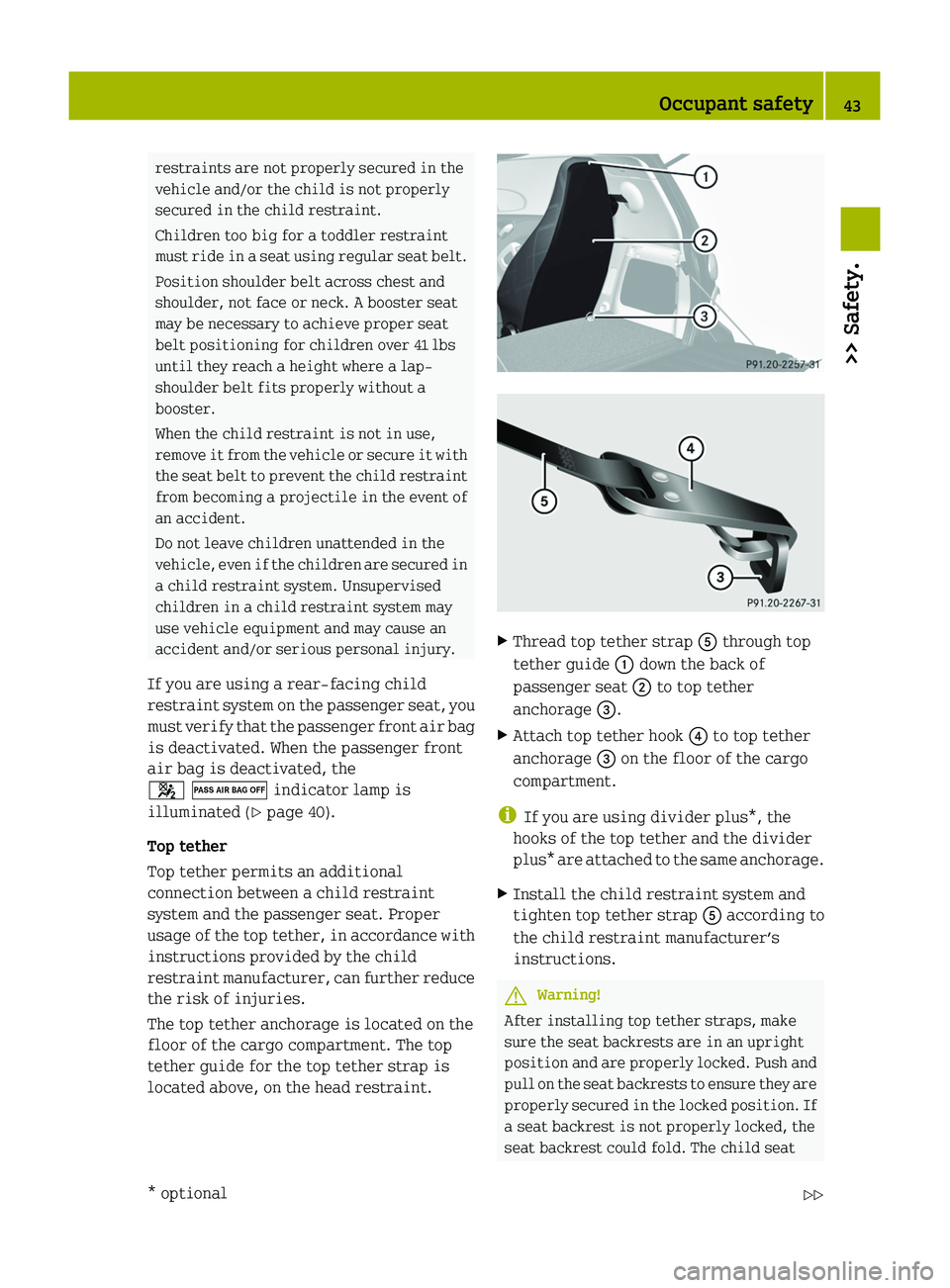
Top tether
Top tether permits an additional
connection between a child restraint
system and the passenger seat. Proper
usage of the top tether, in accordance with
instructions provided by the child
restraint manufacturer, can further reduce
the risk of injuries.
The top tether anchorage is located on the
floor of the cargo compartment. The top
tether guide for the top tether strap is
located above, on the head restraint.XThread top tether strap 0086 through top
tether guide 0046 down the back of
passenger seat 0047 to top tether
anchorage 008A.XAttach top tether hook 0088 to top tether
anchorage 008A on the floor of the cargo
compartment.
i If you are using divider plus*, the
hooks of the top tether and the divider
plus* are attached to the same anchorage.
XInstall the child restraint system and
tighten top tether strap 0086 according to
the child restraint manufacturer’s
instructions.GWarning!
After installing top tether straps, make
sure the seat backrests are in an upright
position and are properly locked. Push and
pull on the seat backrests to ensure they are
properly secured in the locked position. If
a seat backrest is not properly locked, the
seat backrest could fold. The child seat
Occupant safety43>> Safety.* optional451_AKB; 3; 22, en-USd2ureepe,Version: 2.11.8.12009-07-27T09:36:34+02:00 - Seite 43Z
Page 58 of 216
005DFor removing key004AIgnition (power supply for all
electrical consumers) and driving
position
All lamps (except low‑beam
headlamp indicator lamp,
high‑beam headlamp indicator
lamp, and turn signal indicator
lamps unless activated) in the
instrument cluster come on. If a
lamp in the instrument cluster fails
to come on when the ignition is
switched on, have it checked and
replaced if necessary. If a lamp in
the instrument cluster remains on
after starting the engine or comes
on while driving, refer to “Warning
and indicator lamps in the
instrument cluster” ( Y page 149).004BStarting ( Y page 75)
i
When you switch on the ignition, the
indicator and warning lamps (except
low‑beam headlamp indicator lamp,
high‑beam headlamp indicator lamp, and
turn signal indicator lamps unless
activated) in the instrument cluster
come on. The indicator and warning
lamps (except low‑beam headlamp
indicator lamp, high‑beam headlamp
indicator lamp, and turn signal
indicator lamps if activated) will go out
when the engine is running. This
indicates that the respective systems
are operational.
Seats
Safety notes
GWarning!
All seat adjustments, as well as fastening
of seat belts, must be done before the
vehicle is operated.
GWarning!
When adjusting the seat, make sure no one
becomes trapped.
Do not adjust the driver’s seat while
driving. Adjusting the seat while driving
could cause the driver to lose control of the
vehicle.
Never ride in a moving vehicle with the seat
backrest in an excessively reclined
position as this can be dangerous. You
could slide under the seat belt in a
collision. If you slide under the seat belt,
it could apply force at the abdomen or neck,
potentially causing serious or fatal
injuries. The seat backrest and seat belts
provide the best restraint when the wearer
is in a position that is as upright as
possible and seat belts are properly
positioned on the body.
Your seat must be adjusted so that you can
correctly fasten your seat belt.
Observe the following points:
R Adjust the seat backrest until your arms
are slightly angled when holding the
steering wheel.
R Adjust the seat to a comfortable seating
position that still allows you to reach the
accelerator/brake pedal safely. The
position should be as far back as
possible with the driver still able to
operate the controls properly.
R Never place hands under the seat or near
any moving parts while a seat is being
adjusted.
Failure to do so could result in an accident
and/or serious personal injury.
Observe the notes on the air bag system.
GWarning!
Children 12 years old and under must be
seated and properly secured in an
appropriately sized infant restraint,
toddler restraint, or booster seat
recommended for the size and weight of the
56Seats>> Controls.
451_AKB; 3; 22, en-USd2ureepe,Version: 2.11.8.12009-07-27T09:36:34+02:00 - Seite 56
Page 59 of 216
child. For additional information, see
“Children in the vehicle”.
A child’s risk of serious or fatal injuries
is significantly increased if the child
restraints are not properly secured in the
vehicle and/or the child is not properly
secured in the child restraint.GWarning!
Contact an authorized smart center if the
seats have become damaged.
The seat is an integral part of the vehicle’s
safety system in the same way as seat belts
and air bags. Damage to the seats may
reduce their ability to protect the
occupants in an accident.
Seat adjustment
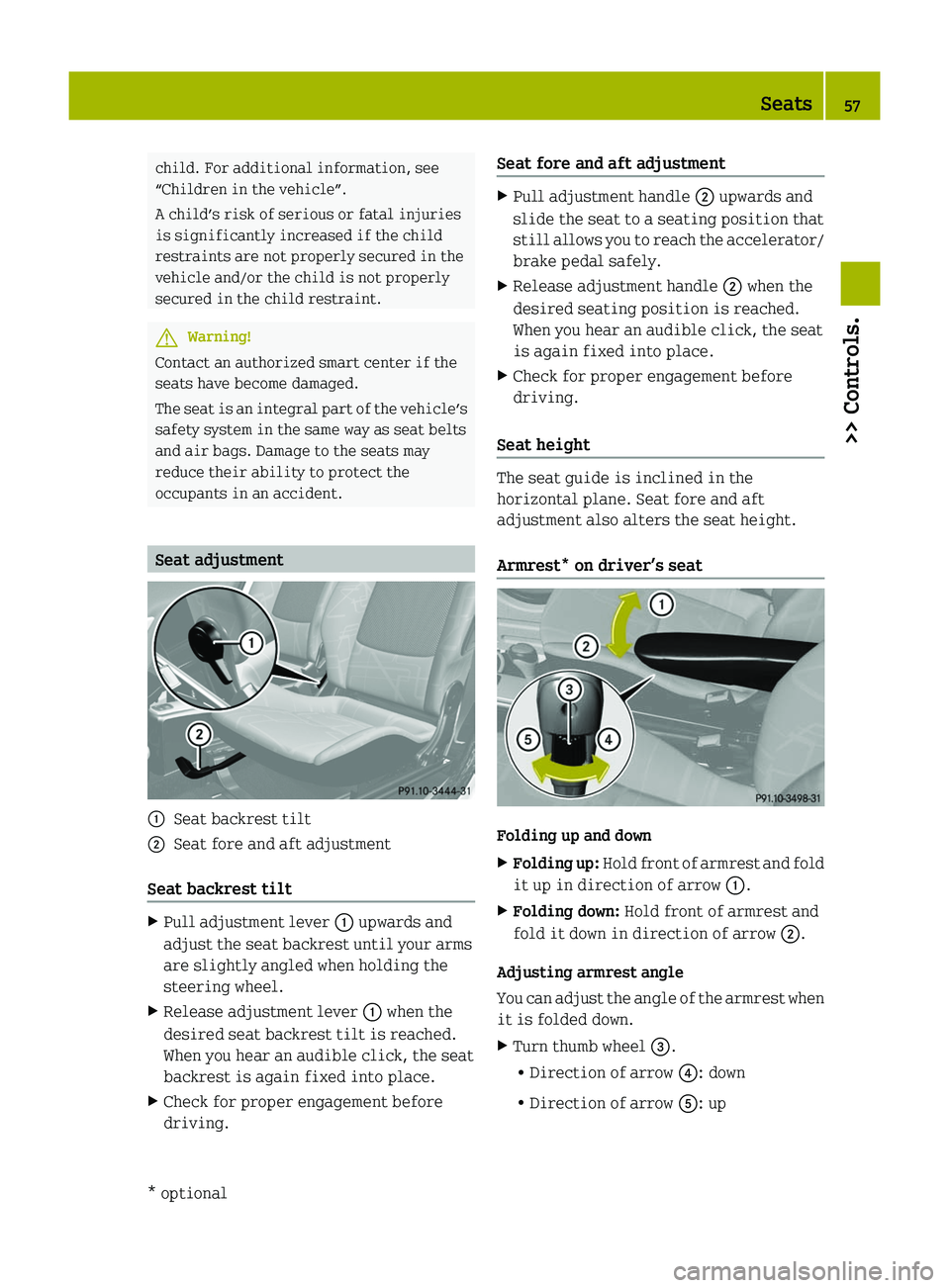
0046Seat backrest tilt0047Seat fore and aft adjustment
Seat backrest tilt
XPull adjustment lever 0046 upwards and
adjust the seat backrest until your arms
are slightly angled when holding the
steering wheel.XRelease adjustment lever 0046 when the
desired seat backrest tilt is reached.
When you hear an audible click, the seat
backrest is again fixed into place.XCheck for proper engagement before
driving.Seat fore and aft adjustmentXPull adjustment handle 0047 upwards and
slide the seat to a seating position that
still allows you to reach the accelerator/
brake pedal safely.XRelease adjustment handle 0047 when the
desired seating position is reached.
When you hear an audible click, the seat
is again fixed into place.XCheck for proper engagement before
driving.
Seat height
The seat guide is inclined in the
horizontal plane. Seat fore and aft
adjustment also alters the seat height.
Armrest* on driver’s seat
Folding up and down
XFolding up: Hold front of armrest and fold
it up in direction of arrow 0046.XFolding down: Hold front of armrest and
fold it down in direction of arrow 0047.
Adjusting armrest angle
You can adjust the angle of the armrest when
it is folded down.
XTurn thumb wheel 008A.
R Direction of arrow 0088: down
R Direction of arrow 0086: upSeats57>> Controls.* optional451_AKB; 3; 22, en-USd2ureepe,Version: 2.11.8.12009-07-27T09:36:34+02:00 - Seite 57Z
Page 63 of 216
protect you if you are properly wearing
your seat belt.GWarning!
Children 12 years old and under must be
seated and properly secured in an
appropriately sized infant restraint,
toddler restraint, or booster seat
recommended for the size and weight of the
child. For additional information, see
“Children in the vehicle”.
A child’s risk of serious or fatal injuries
is significantly increased if the child
restraints are not properly secured in the
vehicle and/or the child is not properly
secured in the child restraint.
GWarning!
Never let more people ride in the vehicle
than there are seat belts available. Make
sure everyone riding in the vehicle is
correctly restrained with a separate seat
belt. Never use a seat belt for more than one
person at a time.
GWarning!
Never ride in a moving vehicle with the seat
backrest in an excessively reclined
position as this can be dangerous. You
could slide under the seat belt in a
collision. If you slide under it, the belt
would apply force at the abdomen or neck,
causing serious or even fatal injuries. The
seat backrest and seat belt provide the best
restraint when the wearer is in a position
that is as upright as possible and the belt
is properly positioned on the body.
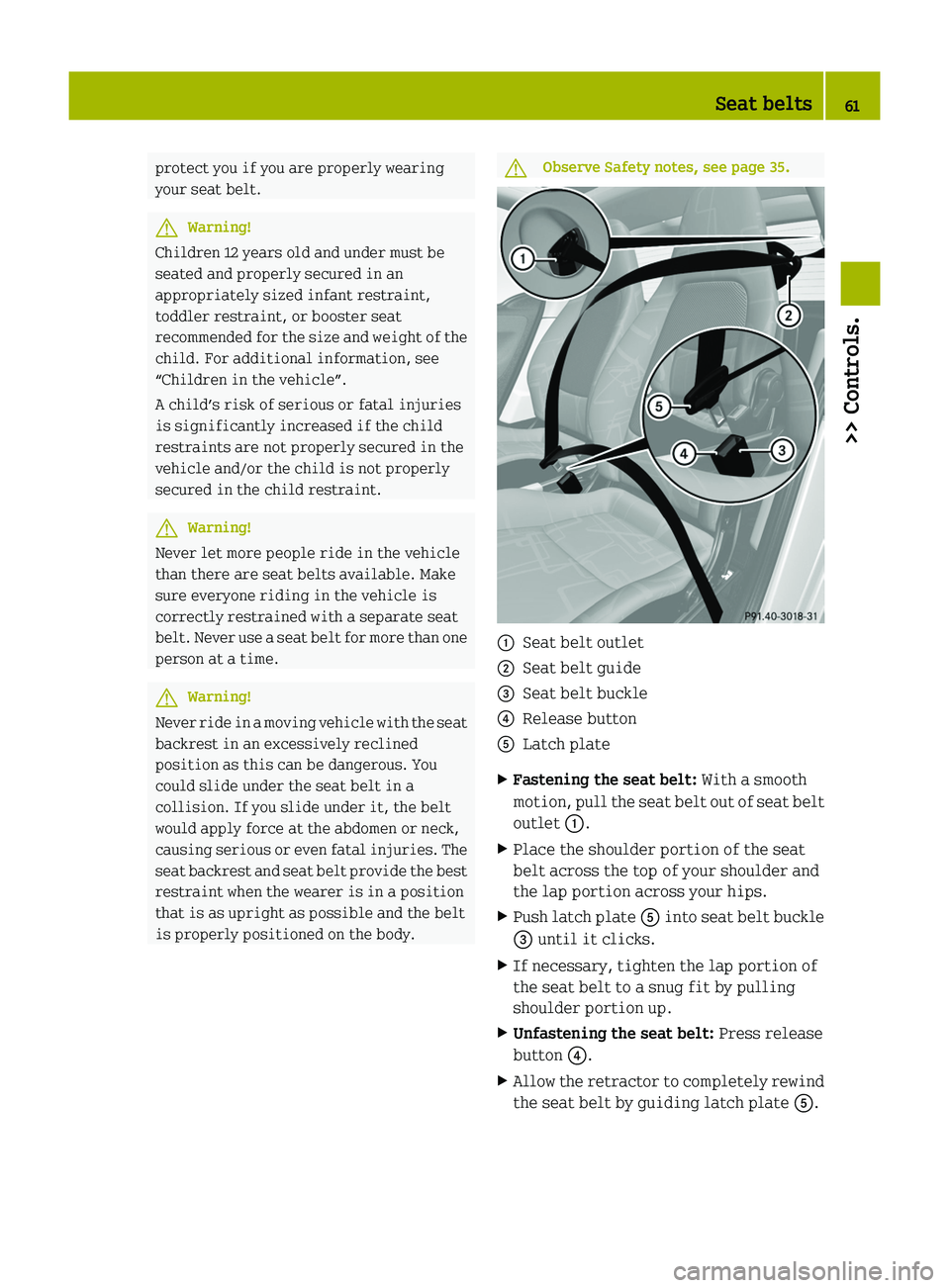
GObserve Safety notes, see page 35.0046Seat belt outlet0047Seat belt guide008ASeat belt buckle0088Release button0086Latch plateXFastening the seat belt: With a smooth
motion, pull the seat belt out of seat belt
outlet 0046.XPlace the shoulder portion of the seat
belt across the top of your shoulder and
the lap portion across your hips.XPush latch plate 0086 into seat belt buckle
008A until it clicks.XIf necessary, tighten the lap portion of
the seat belt to a snug fit by pulling
shoulder portion up.XUnfastening the seat belt: Press release
button 0088.XAllow the retractor to completely rewind
the seat belt by guiding latch plate 0086.Seat belts61>> Controls.451_AKB; 3; 22, en-USd2ureepe,Version: 2.11.8.12009-07-27T09:36:34+02:00 - Seite 61Z
Page 64 of 216
Proper use of seat belts
RDo not twist the seat belt when fastening.
R Adjust the seat belt so that the shoulder
portion is located as close as possible
to the middle of the shoulder (it should
not touch the neck). Never pass the
shoulder portion of the seat belt under
your arm.
R Position the lap belt as low as possible
on your hips (over hip joint) and not
across the abdomen.
R Place the seat backrest in a position that
is as upright as possible.
R Never use a seat belt for more than one
person at a time.
R Do not fasten a seat belt around a person
and another object at the same time. When
using a seat belt to secure infant or
toddler restraints or children in booster
seats, always follow the child seat
manufacturer’s instructions.
R Check your seat belt during travel to
make sure it is properly positioned.
R Make sure the seat belt is always fitted
snugly. Take special care to maintain a
snug fit when wearing loose clothing.
GWarning!
Do not pass seat belts over sharp edges.
They could tear.
Do not allow the seat belt to get caught in
the door or in the seat adjustment
mechanism. This could damage the seat
belt.
Never attempt to make modifications to
seat belts. This could impair the
effectiveness of the seat belts.
Do not bleach or dye seat belts as this may
severely weaken them. In a crash they may
not be able to provide adequate protection.
Damaged seat belts or seat belts that were
highly stressed in an accident must be
replaced. Contact an authorized smart
center.
Lighting
Exterior lamp switch
For safety, smart recommends that you
drive with your low‑beam headlamps on
during the day. In certain countries, local
laws dictate that low‑beam headlamps are
switched on automatically during
operation of the vehicle.
i If you drive in countries where
vehicles drive on the other side of the
road than the country in which the
vehicle is registered, you must have the
headlamps modified for symmetrical low
beams. Relevant information can be
obtained at any authorized smart center.
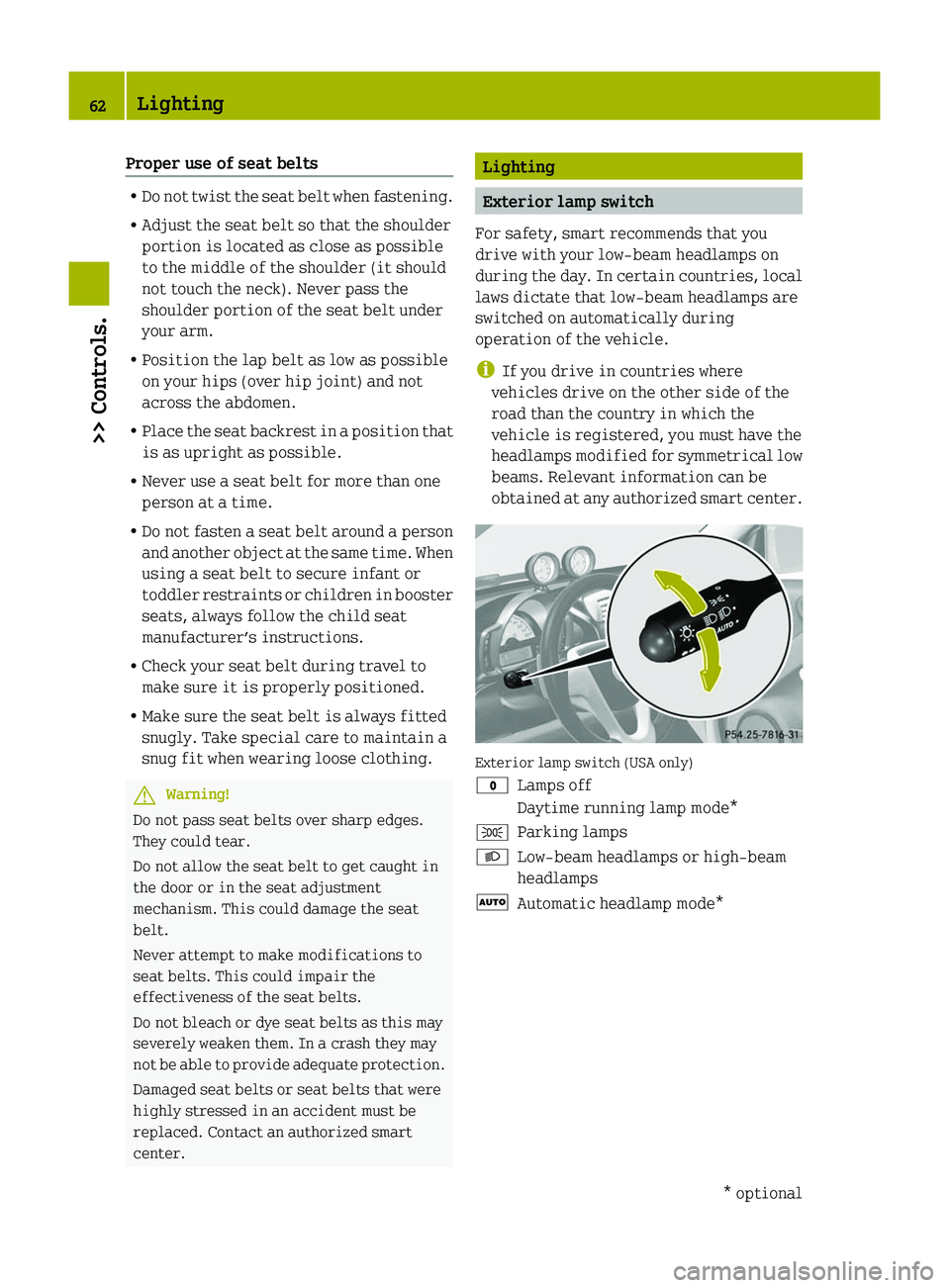
Exterior lamp switch (USA only)
0027Lamps off
Daytime running lamp mode*006CParking lamps0064Low‑beam headlamps or high‑beam
headlamps005AAutomatic headlamp mode*62Lighting>> Controls.* optional451_AKB; 3; 22, en-USd2ureepe,Version: 2.11.8.12009-07-27T09:36:34+02:00 - Seite 62
Page 154 of 216
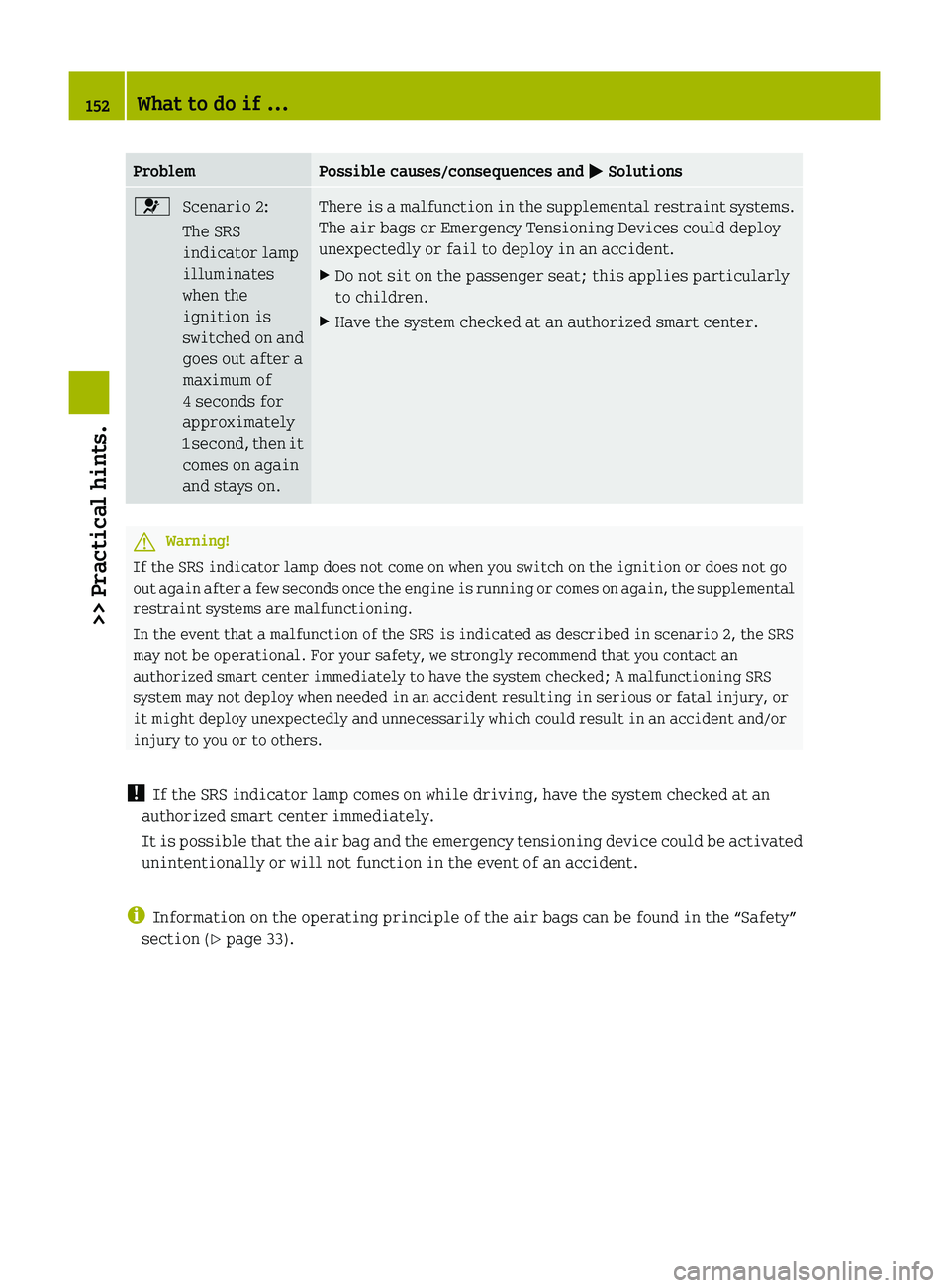
ProblemPossible causes/consequences and 0050 Solutions0081Scenario 2:
The SRS
indicator lamp
illuminates
when the
ignition is
switched on and
goes out after a
maximum of
4 seconds for
approximately
1 second, then it
comes on again
and stays on.There is a malfunction in the supplemental restraint systems.
The air bags or Emergency Tensioning Devices could deploy
unexpectedly or fail to deploy in an accident.XDo not sit on the passenger seat; this applies particularly
to children.XHave the system checked at an authorized smart center.GWarning!
If the SRS indicator lamp does not come on when you switch on the ignition or does not go
out again after a few seconds once the engine is running or comes on again, the supplemental
restraint systems are malfunctioning.
In the event that a malfunction of the SRS is indicated as described in scenario 2, the SRS
may not be operational. For your safety, we strongly recommend that you contact an
authorized smart center immediately to have the system checked; A malfunctioning SRS
system may not deploy when needed in an accident resulting in serious or fatal injury, or
it might deploy unexpectedly and unnecessarily which could result in an accident and/or
injury to you or to others.
! If the SRS indicator lamp comes on while driving, have the system checked at an
authorized smart center immediately.
It is possible that the air bag and the emergency tensioning device could be activated
unintentionally or will not function in the event of an accident.
i Information on the operating principle of the air bags can be found in the “Safety”
section ( Y page 33).
152What to do if ...>> Practical hints.
451_AKB; 3; 22, en-USd2ureepe,Version: 2.11.8.12009-07-27T09:36:34+02:00 - Seite 152
Page 161 of 216

This sequence will continue upon subsequent vehicle start-ups as long as the malfunction
exists. When the malfunction indicator is illuminated, the system may not be able to detect
or signal low tire pressure as intended.
TPMS malfunctions may occur for a variety of reasons, including the installation of
incompatible replacement or alternate tires or wheels on the vehicle that prevent the TPMS
from functioning properly. Always check the TPMS malfunction telltale after replacing one
or more tires or wheels on your vehicle to ensure that the replacement or alternate tires
and wheels allow the TPMS to continue to function properly.
Warning and indicator lamps in the overhead control panel
ProblemPossible causes/consequences and 0050 Solutions007F 007B
The passenger front
air bag off indicator
lamp illuminates and
remains illuminated
with the weight of a
typical adult or
someone larger than a
small individual on
the passenger seat.There is a malfunction in the system.XHave the system checked at an authorized smart center.007F 007B
The passenger front
air bag off indicator
lamp does not
illuminate or remains
out with the weight of
a typical
12‑month‑old child in
a standard child
restraint or less on
the passenger seatThere is a malfunction in the system.XHave the system checked at an authorized smart center.GWarning!
If the 007F 007B indicator lamp illuminates and remains illuminated with the weight
of a typical adult or someone larger than a small individual on the passenger seat, do not
have any passenger use the passenger seat until the system has been repaired.
GWarning!
If the 007F 007B indicator lamp does not illuminate or remains out with the weight of
a typical 12‑month‑old child in a standard child restraint or less on the passenger seat, do
not transport a child on the passenger seat until the system has been repaired.
What to do if ...159>> Practical hints.451_AKB; 3; 22, en-USd2ureepe,Version: 2.11.8.12009-07-27T09:36:34+02:00 - Seite 159Z