ignition SMART FORTWO COUPE 2010 User Guide
[x] Cancel search | Manufacturer: SMART, Model Year: 2010, Model line: FORTWO COUPE, Model: SMART FORTWO COUPE 2010Pages: 216, PDF Size: 9.7 MB
Page 79 of 216
in order to avoid damaging the
transmission.
You can drive in reverse gear at a speed
of up to 9 mph (15 km/h).XDepress the brake pedal.XPress the release button ( Y page 76) to
disengage the gear selector lever lock.XMove the gear selector lever to reverse
gear R.
R appears in the transmission position
indicator.XRelease the brake pedal.XCarefully depress the accelerator pedal.
Parking
GWarning!
Do not park this vehicle in areas where
combustible materials such as grass, hay or
leaves can come into contact with the hot
exhaust system. These materials could be
ignited and cause a vehicle fire.
Vehicle movement can cause serious
personal injury or damage to the vehicle or
the vehicle drivetrain. Therefore, always
do the following before turning off the
engine and leaving the vehicle:
R Keep right foot on the brake pedal.
R Engage the parking brake.
R Move the gear selector lever to park
position P.
R Slowly release the brake pedal.
R When parked on an incline, always turn
the front wheels towards the curb.
R Turn the key to starter switch position 0
and remove the key from the starter
switch.
R Take the key with you and lock the vehicle
when leaving.
GWarning!
With the engine not running, there is no
power assistance for the brake and
steering* systems. In this case, it is
important to keep in mind that a
considerably higher degree of effort is
necessary to brake and steer the vehicle.
Adapt your driving accordingly.
XProperly stop and park the vehicle.XDepress the brake pedal.XEngage the parking brake ( Y page 77).
When the ignition is switched on or the
engine is running, the brake warning
lamp 0027 (USA only) or 004D (Canada
only) in the instrument cluster comes on.XRelease the brake pedal.
Parking brake
The parking brake serves to secure the
vehicle against rolling away when it is
stationary or parked.
GWarning!
Engaging the parking brake while the
vehicle is in motion can cause the rear
wheels to lock up. You could lose control of
the vehicle and cause an accident. In
addition, the vehicle’s brake lights do not
light up when the parking brake is engaged.
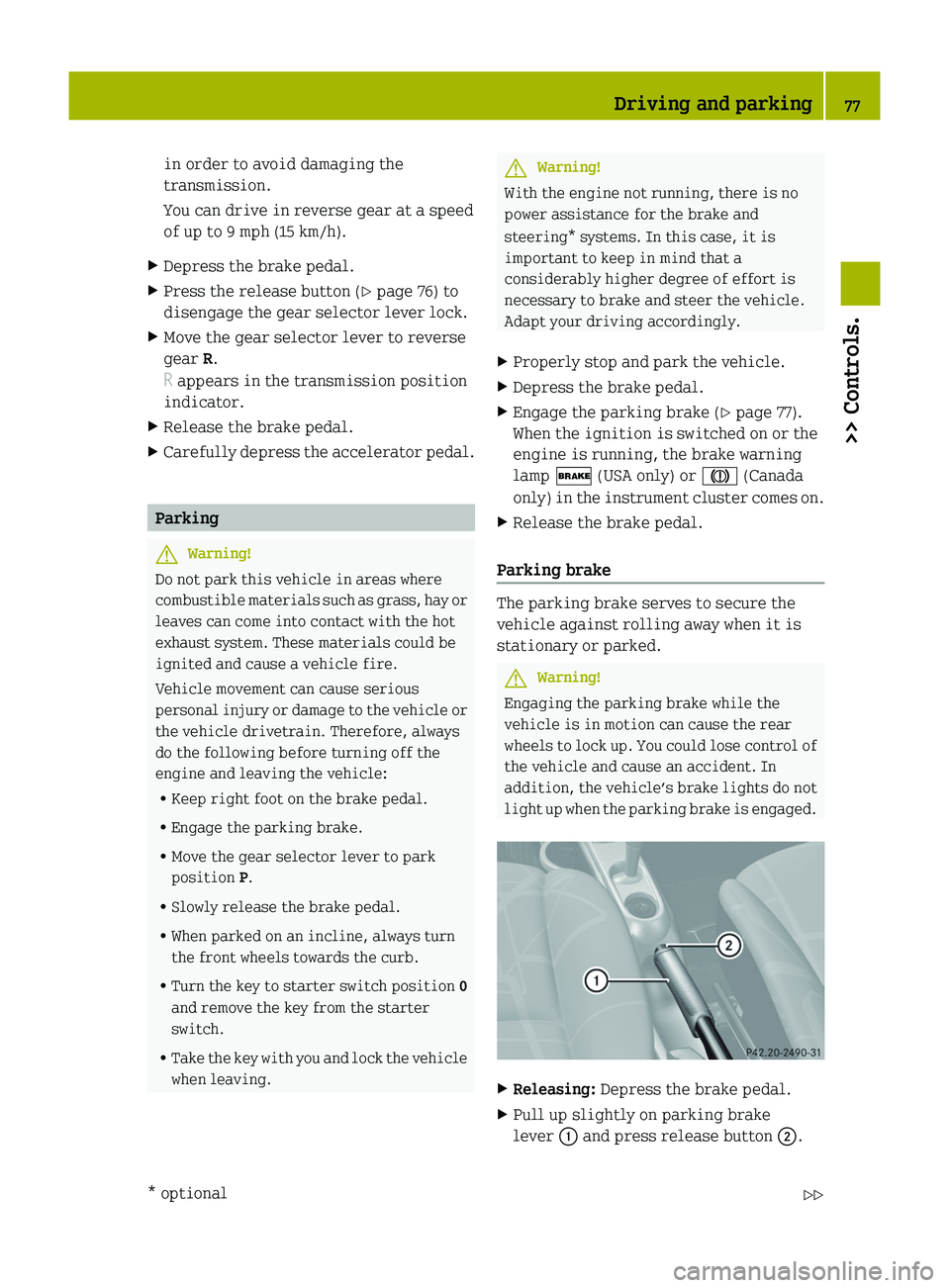
XReleasing: Depress the brake pedal.XPull up slightly on parking brake
lever 0046 and press release button 0047.Driving and parking77>> Controls.* optional451_AKB; 3; 22, en-USd2ureepe,Version: 2.11.8.12009-07-27T09:36:34+02:00 - Seite 77Z
Page 80 of 216
XPush parking brake lever 0046 down as far
as it will go.
When the ignition is switched on or the
engine is running, the brake warning
lamp 0027 (USA only) or 004D (Canada
only) in the instrument cluster goes out.XEngaging: Pull up parking brake
lever 0046 firmly.
When the ignition is switched on or the
engine is running, the brake warning
lamp 0027 (USA only) or 004D (Canada
only) in the instrument cluster comes on.GWarning!
Getting out of your vehicle with the
transmission not fully engaged in park
position P is dangerous. When the engine is
shut off and the brakes are released, the
vehicle can be moved freely with the gear
selector lever in all positions except park
position P. Also, when parked on an incline,
park position P alone may not prevent your
vehicle from moving, possibly hitting
people or objects.
Always engage the parking brake in
addition to shifting to park position P.
When parked on an incline, always turn the
front wheels towards the curb.
GWarning!
When leaving the vehicle, always remove the
key from the starter switch, take it with
you, and lock the vehicle. Do not leave
children unattended in the vehicle, or with
access to an unlocked vehicle. Children
could release the parking brake and/or
move the gear selector lever from park
position P, either of which could result in
an accident and/or serious personal
injury.
Brake pedal
The brake pedal has two brake circuits
independent of each other. A brake servo is
used during braking (when the engine is
running) to increase pedal force.
GWarning!
Make sure absolutely no objects are
obstructing the pedals’ range of motion.
Keep the driver’s footwell clear of all
obstacles. If there are any floormats* or
carpets in the footwell, make sure the
pedals still have sufficient clearance.
During sudden acceleration or braking
maneuvers, the objects could get caught
between or beneath the pedals and restrict
your ability to brake or accelerate. This
could lead to accidents and/or injury.
GWarning!
Considerably more effort will be required
to apply the brakes if
R the brake servo has failed
R a brake circuit has failed
R the engine is switched off, e.g. for
towing the vehicle
The braking distance is likewise greater.
Make sure the engine is running whenever
the vehicle is rolling. Have the brake
system repaired at an authorized smart
center, if there is a fault in the brake
system.
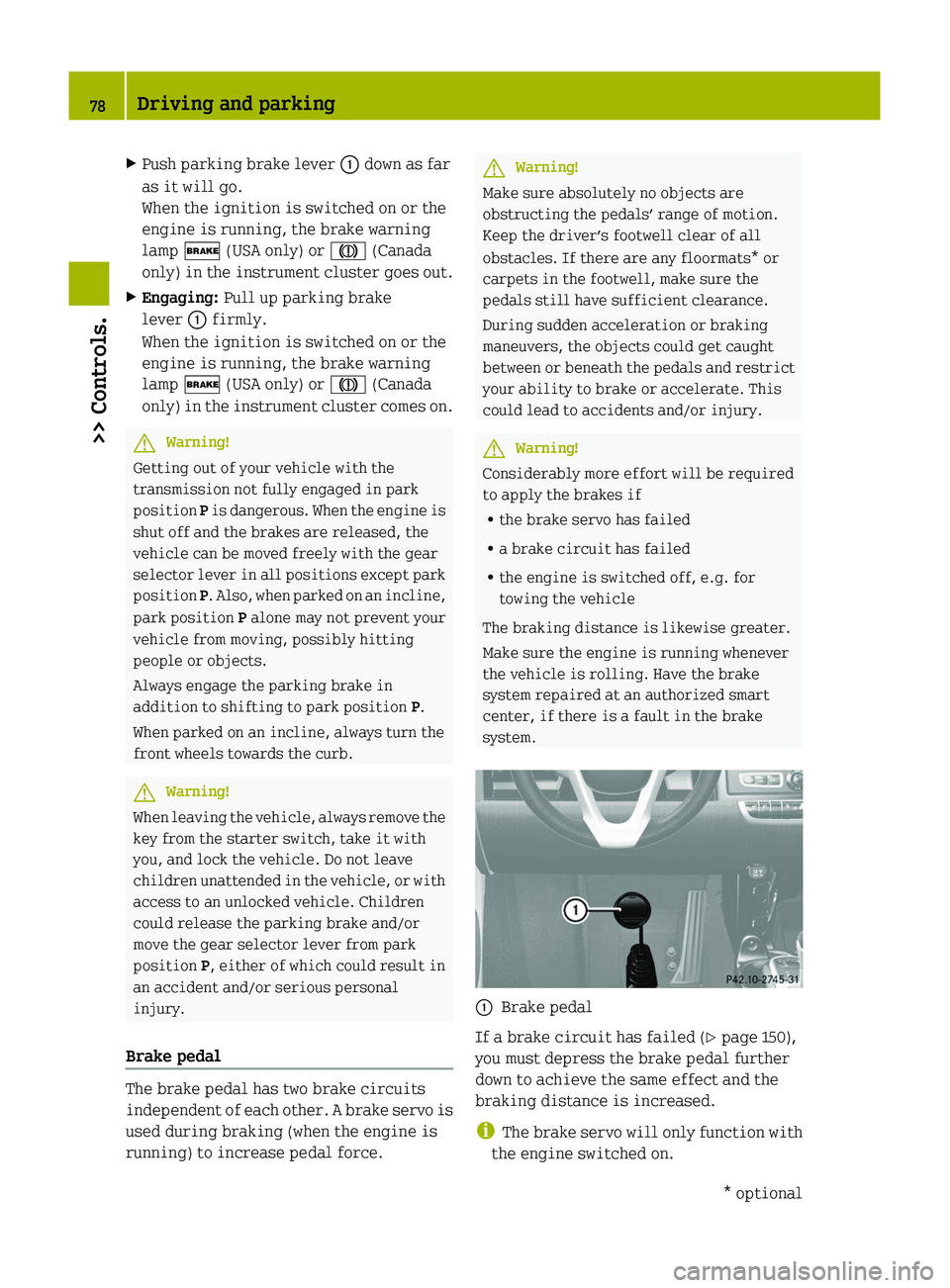
0046Brake pedal
If a brake circuit has failed ( Y page 150),
you must depress the brake pedal further
down to achieve the same effect and the
braking distance is increased.
i The brake servo will only function with
the engine switched on.
78Driving and parking>> Controls.* optional451_AKB; 3; 22, en-USd2ureepe,Version: 2.11.8.12009-07-27T09:36:34+02:00 - Seite 78
Page 95 of 216
Switching HVAC on/off
Heating
Control panel ( Y page 92).
XSwitching on: Make sure the key is in
starter switch position 1.XPush temperature control 0088 up.XSwitching off: Push temperature
control 0088 fully down.
Air conditioning with climate control*
Control panel ( Y page 92).
XMake sure the engine is running.XSwitching on: Push air volume
control 0046 to level 1 or higher.XPress air conditioning switch 0047.
The indicator lamp in air conditioning
switch 0047 comes on.XSwitching off: Press air conditioning
switch 0047 once more.
The indicator lamp in air conditioning
switch 0047 goes out.
i
The stored status is restored, if you
switch on the ignition again.
i The air condition will be suspended
temporarily:
R if the engine speed is too low
R when driving off
The air condition is switched off:
R at a coolant temperature of more than
239 ¦ (115 ¥)
R at outside temperatures below 38 ¦
(3 ¥ )
Setting the temperature
Heating
Control panel ( Y page 92).
i You should raise or lower the
temperature setting in small
increments.
XIncreasing or decreasing: Push
temperature control 0088 up or down.
Rapid cooling
XPush air volume control 0046 fully up.XTurn air distribution control 008A to
position 009E.XPush temperature control 0088 fully down.XAdjust the air vents as desired.
Rapid heating
XPush air volume control 0046 to level 3.XTurn air distribution control 008A to a
position between 0087 and 009D .XPush temperature control 0088 fully up.XAdjust the air vents towards the
occupants.
Air conditioning with climate control*
Control panel ( Y page 92).
i You should raise or lower the
temperature setting in small
increments, preferably starting at 70 ¦
(21 ¥).
XIncreasing or decreasing: Push
temperature control 0086 up or down.
Adjusting air vents
GWarning!
When operating the heating or air
conditioning with climate control*, the
air that enters the passenger compartment
HVAC (Heating, Ventilation, Air Conditioning)93>> Controls.* optional451_AKB; 3; 22, en-USd2ureepe,Version: 2.11.8.12009-07-27T09:36:34+02:00 - Seite 93Z
Page 110 of 216
compartment cover, parts in the area
around the engine compartment cover, and
parts of the engine.XTurn off the engine.XEngage the parking brake.XOpen the tailgate.GWarning!
Exercise extreme caution if you see flames
or smoke coming from the engine
compartment. Move away from the vehicle
and call the fire department.
If the coolant temperature warning lamp
indicates that the engine is overheated, do
not attempt to open the engine compartment
cover. Move away from the vehicle and wait
until the engine has cooled before opening
the engine compartment.
GWarning!
To help prevent personal injury, stay clear
of moving parts when the engine
compartment cover is open and the engine
is running.
GWarning!
The engine is equipped with a
transistorized ignition system that
utilizes high voltage. Do not touch any
components (ignition coils, spark plug
sockets, diagnostic socket) of the ignition
system
R while the engine is running
R while starting the engine
R if ignition is “on” and the engine is
turned manually
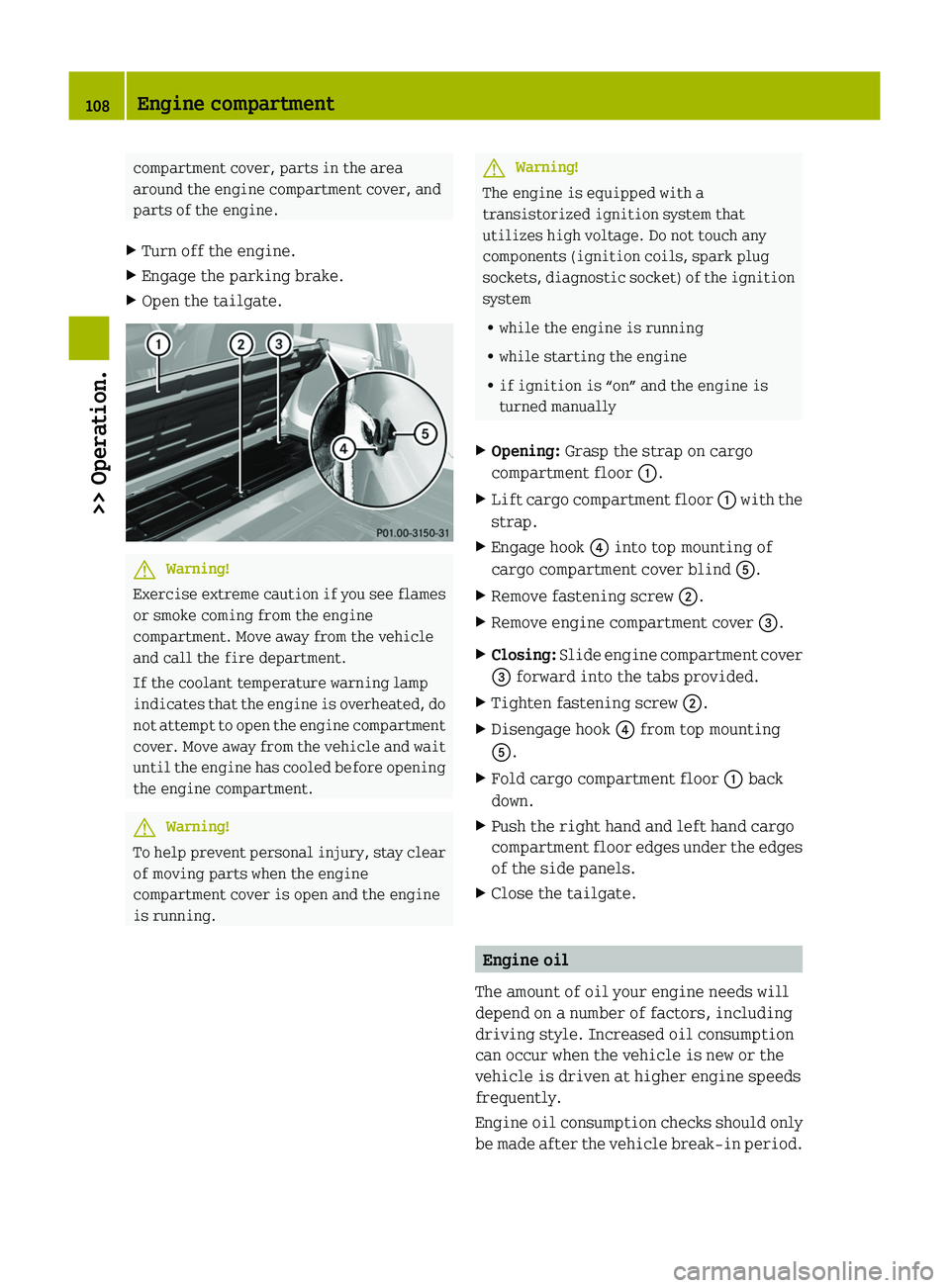
XOpening: Grasp the strap on cargo
compartment floor 0046.XLift cargo compartment floor 0046 with the
strap.XEngage hook 0088 into top mounting of
cargo compartment cover blind 0086.XRemove fastening screw 0047.XRemove engine compartment cover 008A.XClosing: Slide engine compartment cover
008A forward into the tabs provided.XTighten fastening screw 0047.XDisengage hook 0088 from top mounting
0086 .XFold cargo compartment floor 0046 back
down.XPush the right hand and left hand cargo
compartment floor edges under the edges
of the side panels.XClose the tailgate.
Engine oil
The amount of oil your engine needs will
depend on a number of factors, including
driving style. Increased oil consumption
can occur when the vehicle is new or the
vehicle is driven at higher engine speeds
frequently.
Engine oil consumption checks should only
be made after the vehicle break-in period.
108Engine compartment>> Operation.
451_AKB; 3; 22, en-USd2ureepe,Version: 2.11.8.12009-07-27T09:36:34+02:00 - Seite 108
Page 136 of 216
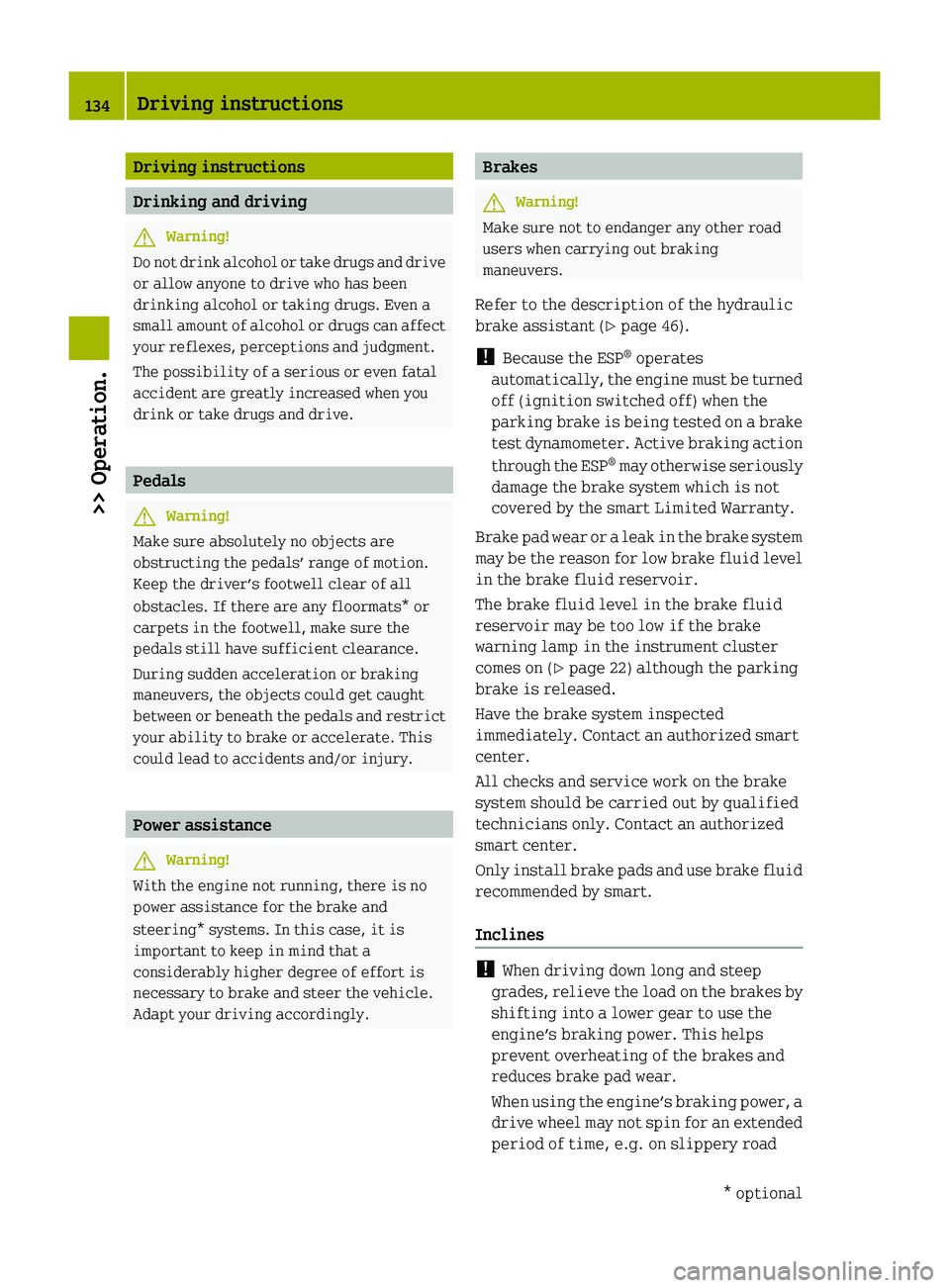
Driving instructions
Drinking and driving
GWarning!
Do not drink alcohol or take drugs and drive
or allow anyone to drive who has been
drinking alcohol or taking drugs. Even a
small amount of alcohol or drugs can affect
your reflexes, perceptions and judgment.
The possibility of a serious or even fatal
accident are greatly increased when you
drink or take drugs and drive.
Pedals
GWarning!
Make sure absolutely no objects are
obstructing the pedals’ range of motion.
Keep the driver’s footwell clear of all
obstacles. If there are any floormats* or
carpets in the footwell, make sure the
pedals still have sufficient clearance.
During sudden acceleration or braking
maneuvers, the objects could get caught
between or beneath the pedals and restrict
your ability to brake or accelerate. This
could lead to accidents and/or injury.
Power assistance
GWarning!
With the engine not running, there is no
power assistance for the brake and
steering* systems. In this case, it is
important to keep in mind that a
considerably higher degree of effort is
necessary to brake and steer the vehicle.
Adapt your driving accordingly.
BrakesGWarning!
Make sure not to endanger any other road
users when carrying out braking
maneuvers.
Refer to the description of the hydraulic
brake assistant ( Y page 46).
! Because the ESP ®
operates
automatically, the engine must be turned
off (ignition switched off) when the
parking brake is being tested on a brake
test dynamometer. Active braking action
through the ESP ®
may otherwise seriously
damage the brake system which is not
covered by the smart Limited Warranty.
Brake pad wear or a leak in the brake system
may be the reason for low brake fluid level
in the brake fluid reservoir.
The brake fluid level in the brake fluid
reservoir may be too low if the brake
warning lamp in the instrument cluster
comes on ( Y page 22) although the parking
brake is released.
Have the brake system inspected
immediately. Contact an authorized smart
center.
All checks and service work on the brake
system should be carried out by qualified
technicians only. Contact an authorized
smart center.
Only install brake pads and use brake fluid
recommended by smart.
Inclines
! When driving down long and steep
grades, relieve the load on the brakes by
shifting into a lower gear to use the
engine’s braking power. This helps
prevent overheating of the brakes and
reduces brake pad wear.
When using the engine’s braking power, a
drive wheel may not spin for an extended
period of time, e.g. on slippery road
134Driving instructions>> Operation.* optional451_AKB; 3; 22, en-USd2ureepe,Version: 2.11.8.12009-07-27T09:36:34+02:00 - Seite 134
Page 151 of 216
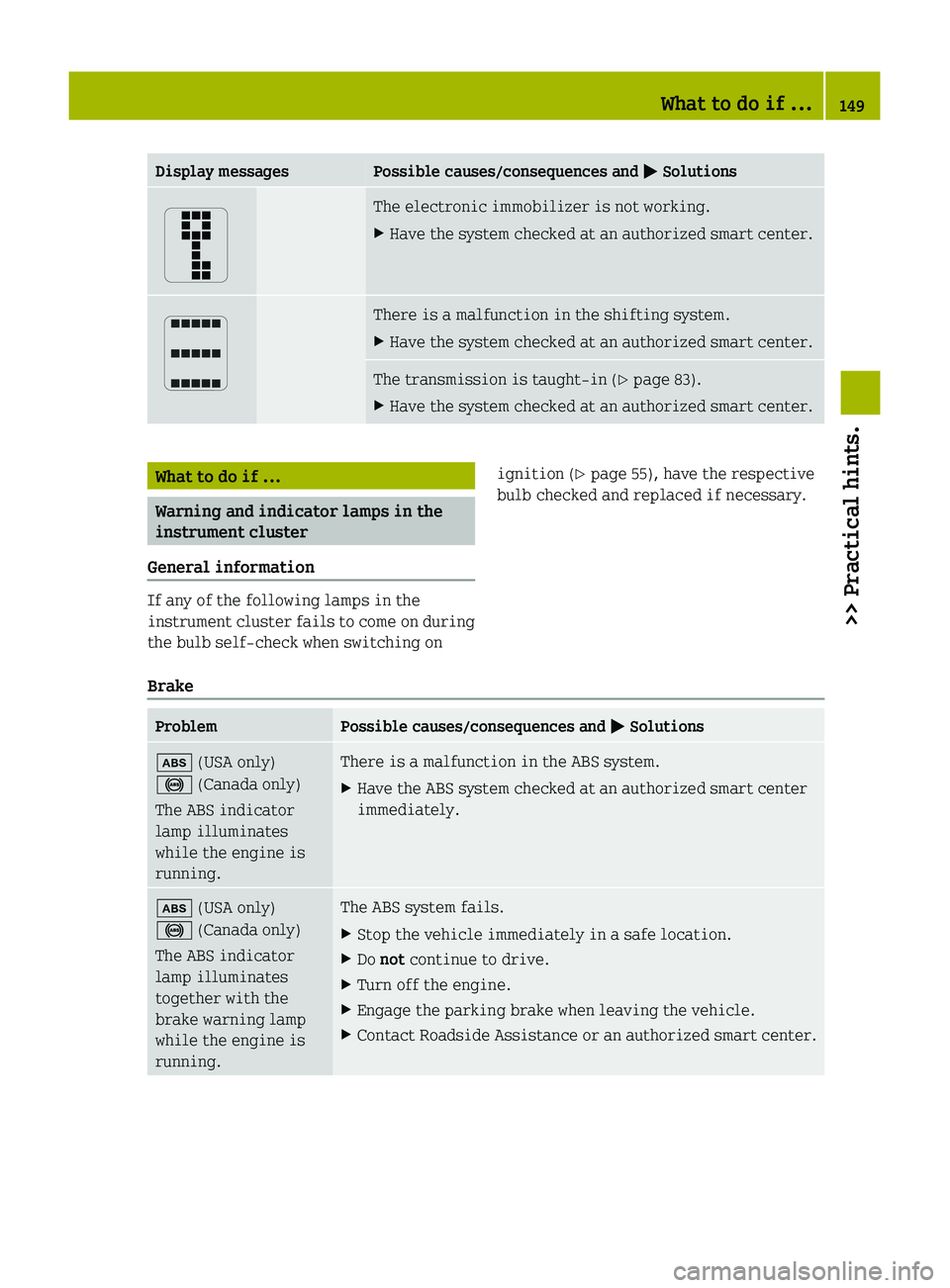
Display messagesPossible causes/consequences and 0050 SolutionsThe electronic immobilizer is not working.XHave the system checked at an authorized smart center.There is a malfunction in the shifting system.XHave the system checked at an authorized smart center.The transmission is taught-in ( Y page 83).XHave the system checked at an authorized smart center.What to do if ...
Warning and indicator lamps in the
instrument cluster
General information
If any of the following lamps in the
instrument cluster fails to come on during
the bulb self-check when switching on
ignition ( Y page 55), have the respective
bulb checked and replaced if necessary.
Brake
ProblemPossible causes/consequences and 0050 Solutions00EB (USA only)
0031 (Canada only)
The ABS indicator
lamp illuminates
while the engine is
running.There is a malfunction in the ABS system.XHave the ABS system checked at an authorized smart center
immediately.00EB (USA only)
0031 (Canada only)
The ABS indicator
lamp illuminates
together with the
brake warning lamp
while the engine is
running.The ABS system fails.XStop the vehicle immediately in a safe location.XDo not continue to drive.XTurn off the engine.XEngage the parking brake when leaving the vehicle.XContact Roadside Assistance or an authorized smart center.What to do if ...149>> Practical hints.451_AKB; 3; 22, en-USd2ureepe,Version: 2.11.8.12009-07-27T09:36:34+02:00 - Seite 149Z
Page 153 of 216

Safety systems ProblemPossible causes/consequences and 0050 Solutions0082The seat belt
telltale
illuminates
constantly for a
maximum of
6 seconds after
starting the
engine.Regardless of whether the seat belt is fastened or not, the seat
belt telltale always comes on and remains lit for 6 seconds
after starting the engine.XFasten your seat belts.0082The seat belt
telltale
illuminates
constantly. An
additional
warning chime
sounds for a
maximum of
6 seconds after
starting the
engine.The driver’s seat belt is unfastened.XFasten your seat belts.0082The seat belt
telltale flashes
with
increasing
frequency of a
warning chime
for a maximum
of 60 seconds.The vehicle speed once exceeds 15 mph (25 km/h), and both the
driver’s and passenger seat belt are unfastened.XFasten your seat belts.
If the driver’s or the passenger seat belt remains unfastened
after 60 seconds, the warning chime stops sounding. The seat
belt telltale stops flashing but continues to be illuminated.
The seat belt telltale will only go out if both the driver’s and
the passenger seat belt (with the passenger seat occupied) are
fastened, or the vehicle is standing still and a door is opened.
0081Scenario 1:
The SRS
indicator lamp
illuminates
when the
ignition is
switched on and
goes out after a
maximum of
4 seconds.The subsequent self check of the safety systems detected no
malfunction. The supplemental restraint system is
operational.What to do if ...151>> Practical hints.451_AKB; 3; 22, en-USd2ureepe,Version: 2.11.8.12009-07-27T09:36:34+02:00 - Seite 151Z
Page 154 of 216
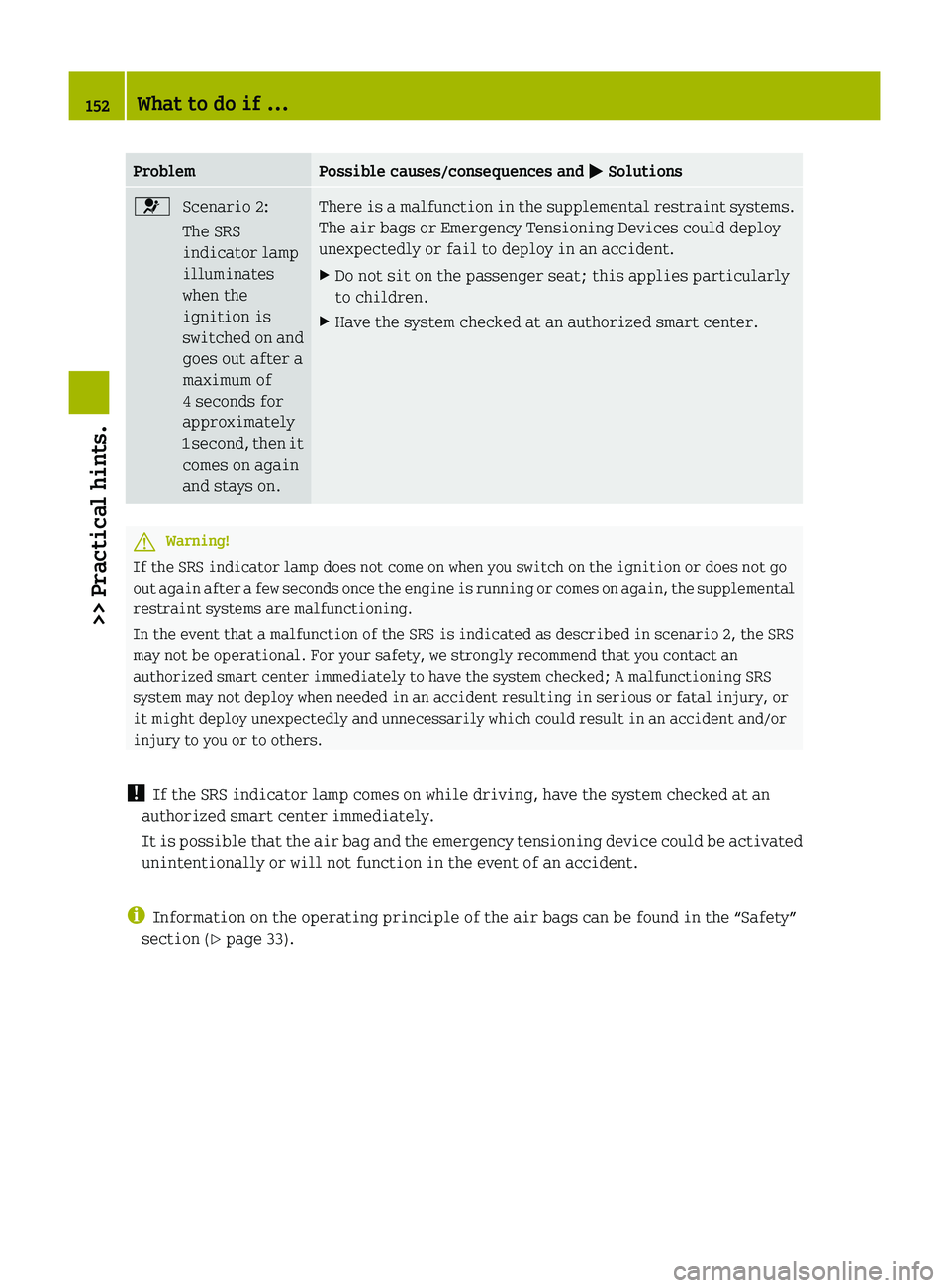
ProblemPossible causes/consequences and 0050 Solutions0081Scenario 2:
The SRS
indicator lamp
illuminates
when the
ignition is
switched on and
goes out after a
maximum of
4 seconds for
approximately
1 second, then it
comes on again
and stays on.There is a malfunction in the supplemental restraint systems.
The air bags or Emergency Tensioning Devices could deploy
unexpectedly or fail to deploy in an accident.XDo not sit on the passenger seat; this applies particularly
to children.XHave the system checked at an authorized smart center.GWarning!
If the SRS indicator lamp does not come on when you switch on the ignition or does not go
out again after a few seconds once the engine is running or comes on again, the supplemental
restraint systems are malfunctioning.
In the event that a malfunction of the SRS is indicated as described in scenario 2, the SRS
may not be operational. For your safety, we strongly recommend that you contact an
authorized smart center immediately to have the system checked; A malfunctioning SRS
system may not deploy when needed in an accident resulting in serious or fatal injury, or
it might deploy unexpectedly and unnecessarily which could result in an accident and/or
injury to you or to others.
! If the SRS indicator lamp comes on while driving, have the system checked at an
authorized smart center immediately.
It is possible that the air bag and the emergency tensioning device could be activated
unintentionally or will not function in the event of an accident.
i Information on the operating principle of the air bags can be found in the “Safety”
section ( Y page 33).
152What to do if ...>> Practical hints.
451_AKB; 3; 22, en-USd2ureepe,Version: 2.11.8.12009-07-27T09:36:34+02:00 - Seite 152
Page 157 of 216
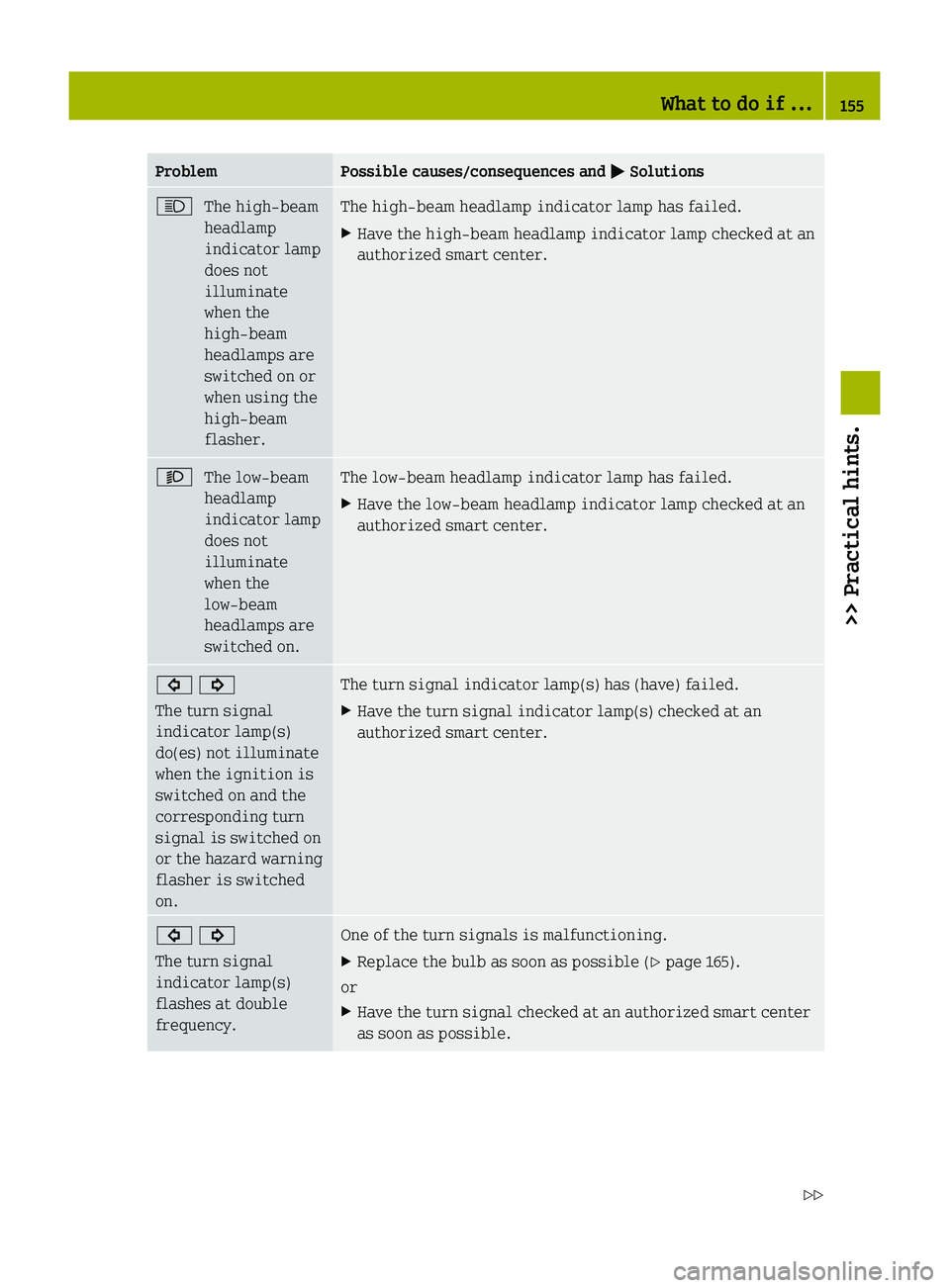
ProblemPossible causes/consequences and 0050 Solutions0063The high‑beam
headlamp
indicator lamp
does not
illuminate
when the
high‑beam
headlamps are
switched on or
when using the
high‑beam
flasher.The high‑beam headlamp indicator lamp has failed.XHave the high‑beam headlamp indicator lamp checked at an
authorized smart center.0065The low‑beam
headlamp
indicator lamp
does not
illuminate
when the
low‑beam
headlamps are
switched on.The low‑beam headlamp indicator lamp has failed.XHave the low‑beam headlamp indicator lamp checked at an
authorized smart center.0026 0024
The turn signal
indicator lamp(s)
do(es) not illuminate
when the ignition is
switched on and the
corresponding turn
signal is switched on
or the hazard warning
flasher is switched
on.The turn signal indicator lamp(s) has (have) failed.XHave the turn signal indicator lamp(s) checked at an
authorized smart center.0026 0024
The turn signal
indicator lamp(s)
flashes at double
frequency.One of the turn signals is malfunctioning.XReplace the bulb as soon as possible ( Y page 165).
or
XHave the turn signal checked at an authorized smart center
as soon as possible.What to do if ...155>> Practical hints.451_AKB; 3; 22, en-USd2ureepe,Version: 2.11.8.12009-07-27T09:36:34+02:00 - Seite 155Z
Page 169 of 216
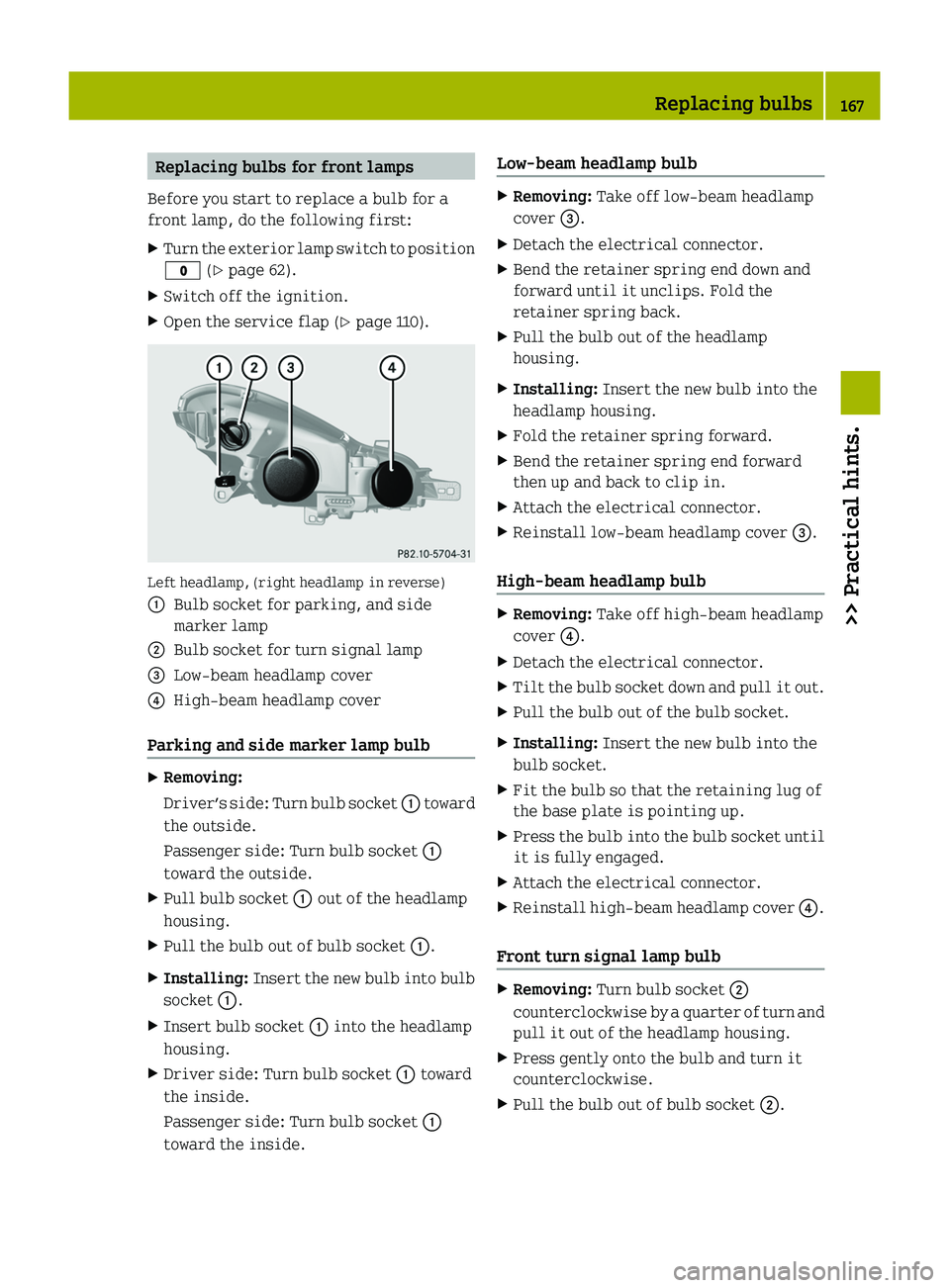
Replacing bulbs for front lamps
Before you start to replace a bulb for a
front lamp, do the following first:XTurn the exterior lamp switch to position
0027 (Y page 62).XSwitch off the ignition.XOpen the service flap ( Y page 110).
Left headlamp, (right headlamp in reverse)
0046Bulb socket for parking, and side
marker lamp0047Bulb socket for turn signal lamp008ALow‑beam headlamp cover0088High‑beam headlamp cover
Parking and side marker lamp bulb
XRemoving:
Driver’s side: Turn bulb socket 0046 toward
the outside.
Passenger side: Turn bulb socket 0046
toward the outside.XPull bulb socket 0046 out of the headlamp
housing.XPull the bulb out of bulb socket 0046.XInstalling: Insert the new bulb into bulb
socket 0046.XInsert bulb socket 0046 into the headlamp
housing.XDriver side: Turn bulb socket 0046 toward
the inside.
Passenger side: Turn bulb socket 0046
toward the inside.Low‑beam headlamp bulbXRemoving: Take off low‑beam headlamp
cover 008A.XDetach the electrical connector.XBend the retainer spring end down and
forward until it unclips. Fold the
retainer spring back.XPull the bulb out of the headlamp
housing.XInstalling: Insert the new bulb into the
headlamp housing.XFold the retainer spring forward.XBend the retainer spring end forward
then up and back to clip in.XAttach the electrical connector.XReinstall low‑beam headlamp cover 008A.
High‑beam headlamp bulb
XRemoving: Take off high‑beam headlamp
cover 0088.XDetach the electrical connector.XTilt the bulb socket down and pull it out.XPull the bulb out of the bulb socket.XInstalling: Insert the new bulb into the
bulb socket.XFit the bulb so that the retaining lug of
the base plate is pointing up.XPress the bulb into the bulb socket until
it is fully engaged.XAttach the electrical connector.XReinstall high‑beam headlamp cover 0088.
Front turn signal lamp bulb
XRemoving: Turn bulb socket 0047
counterclockwise by a quarter of turn and
pull it out of the headlamp housing.XPress gently onto the bulb and turn it
counterclockwise.XPull the bulb out of bulb socket 0047.Replacing bulbs167>> Practical hints.451_AKB; 3; 22, en-USd2ureepe,Version: 2.11.8.12009-07-27T09:36:34+02:00 - Seite 167Z