key SMART FORTWO COUPE 2010 User Guide
[x] Cancel search | Manufacturer: SMART, Model Year: 2010, Model line: FORTWO COUPE, Model: SMART FORTWO COUPE 2010Pages: 216, PDF Size: 9.7 MB
Page 34 of 216

restraint when the wearer is in a position
that is as upright as possible and the belt
is properly positioned on the body.GWarning!
Never let more people ride in the vehicle
than there are seat belts available. Make
sure everyone riding in the vehicle is
correctly restrained with a separate seat
belt. Never use a seat belt for more than one
person at a time.
GWarning!
Seat belts of a vehicle involved in an
accident must be inspected by smart. Only
then is it possible to determine whether
the seat belts were damaged or stressed in
the accident. Damaged or stressed seat
belts may not properly protect you in a
subsequent accident.
Only use seat belts which have been
approved by smart.
Do not make any modifications to the seat
belts. This can lead to unintended
activation of the Emergency Tensioning
Devices (ETDs) or to their failure to
activate when necessary.
Do not bleach or dye seat belts as this may
severely weaken them. In a crash, they may
not be able to provide adequate protection.
Have all work carried out only by qualified
technicians. Contact an authorized smart
center.
GWarning!
USE SEAT BELTS PROPERLY
R Seat belts can only work when used
properly. Never wear seat belts in any
other way than as described in this
section, as that could result in serious
injuries in case of an accident.
R Each occupant should wear their seat belt
at all times, because seat belts help
reduce the likelihood of and potential
severity of injuries in accidents,
including rollovers. The integrated
restraint system includes SRS (driver
front air bag, passenger front air bag,
head-thorax air bags) and Emergency
Tensioning Devices (ETDs) with seat belt
force limiters.
The system is designed to enhance the
protection provided by secured seat
belts in certain frontal and side
impacts.
R Never wear the shoulder belt under your
arm, against your neck or off your
shoulder. Doing so may cause your body to
move too far forward in a frontal crash,
which would increase the chance of head
and neck injuries. The seat belt would
also apply too much force to the ribs or
abdomen, which could severely injure
internal organs such as your liver or
spleen.
R Never wear seat belts over rigid or
breakable objects in or on your clothing,
such as eyeglasses, pens, keys, etc., as
these might cause injuries.
R Position the lap belt as low as possible
on your hips and not across the abdomen.
If the lap seat belt is positioned across
your abdomen, it could cause serious
injuries in a crash.
R Never use a seat belt for more than one
person at a time. Do not fasten a seat belt
around a person and another person or
other objects at the same time.
R Seat belts should not be worn twisted. In
a crash, you would not have the full width
of the seat belt to manage impact forces.
The twisted seat belt against your body
could cause injuries.
R Pregnant women should also always use a
lap-shoulder belt. The lap belt portion
should be positioned as low as possible
on the hips to avoid any possible
pressure on the abdomen.
R Never place your feet on the instrument
panel, dashboard or on the seat. Always32Occupant safety>> Safety.
451_AKB; 3; 22, en-USd2ureepe,Version: 2.11.8.12009-07-27T09:36:34+02:00 - Seite 32
Page 42 of 216
Passenger front air bag off indicator
lamp
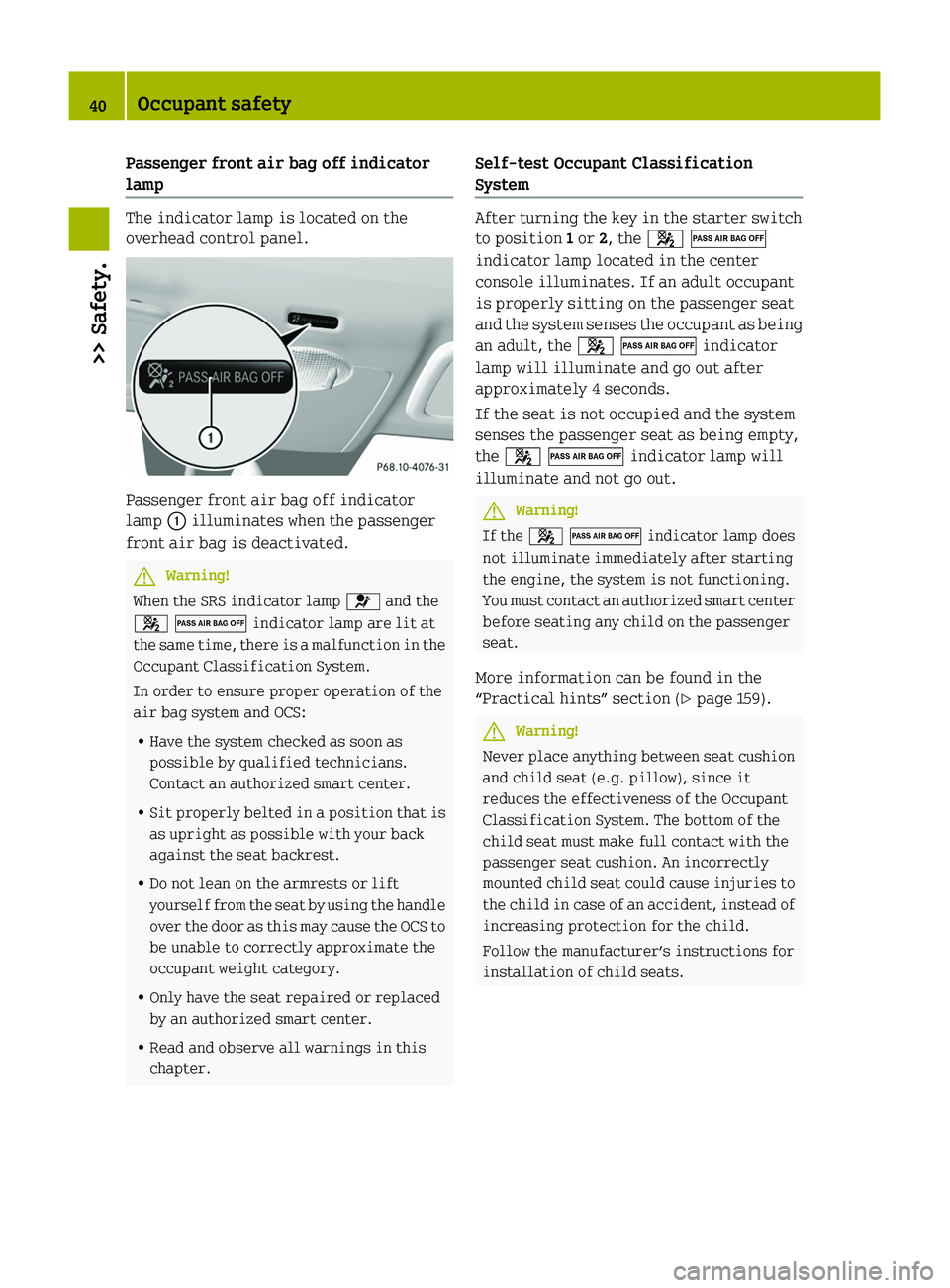
The indicator lamp is located on the
overhead control panel.
Passenger front air bag off indicator
lamp 0046 illuminates when the passenger
front air bag is deactivated.
GWarning!
When the SRS indicator lamp 0081 and the
007F 007B indicator lamp are lit at
the same time, there is a malfunction in the
Occupant Classification System.
In order to ensure proper operation of the
air bag system and OCS:
R Have the system checked as soon as
possible by qualified technicians.
Contact an authorized smart center.
R Sit properly belted in a position that is
as upright as possible with your back
against the seat backrest.
R Do not lean on the armrests or lift
yourself from the seat by using the handle
over the door as this may cause the OCS to
be unable to correctly approximate the
occupant weight category.
R Only have the seat repaired or replaced
by an authorized smart center.
R Read and observe all warnings in this
chapter.
Self-test Occupant Classification
System
After turning the key in the starter switch
to position 1 or 2, the 007F 007B
indicator lamp located in the center
console illuminates. If an adult occupant
is properly sitting on the passenger seat
and the system senses the occupant as being
an adult, the 007F 007B indicator
lamp will illuminate and go out after
approximately 4 seconds.
If the seat is not occupied and the system
senses the passenger seat as being empty,
the 007F 007B indicator lamp will
illuminate and not go out.
GWarning!
If the 007F 007B indicator lamp does
not illuminate immediately after starting
the engine, the system is not functioning.
You must contact an authorized smart center
before seating any child on the passenger
seat.
More information can be found in the
“Practical hints” section ( Y page 159).
GWarning!
Never place anything between seat cushion
and child seat (e.g. pillow), since it
reduces the effectiveness of the Occupant
Classification System. The bottom of the
child seat must make full contact with the
passenger seat cushion. An incorrectly
mounted child seat could cause injuries to
the child in case of an accident, instead of
increasing protection for the child.
Follow the manufacturer’s instructions for
installation of child seats.
40Occupant safety>> Safety.
451_AKB; 3; 22, en-USd2ureepe,Version: 2.11.8.12009-07-27T09:36:34+02:00 - Seite 40
Page 46 of 216
would no longer be properly supported or
positioned to provide its intended
benefit. That could cause serious or even
fatal injuries.
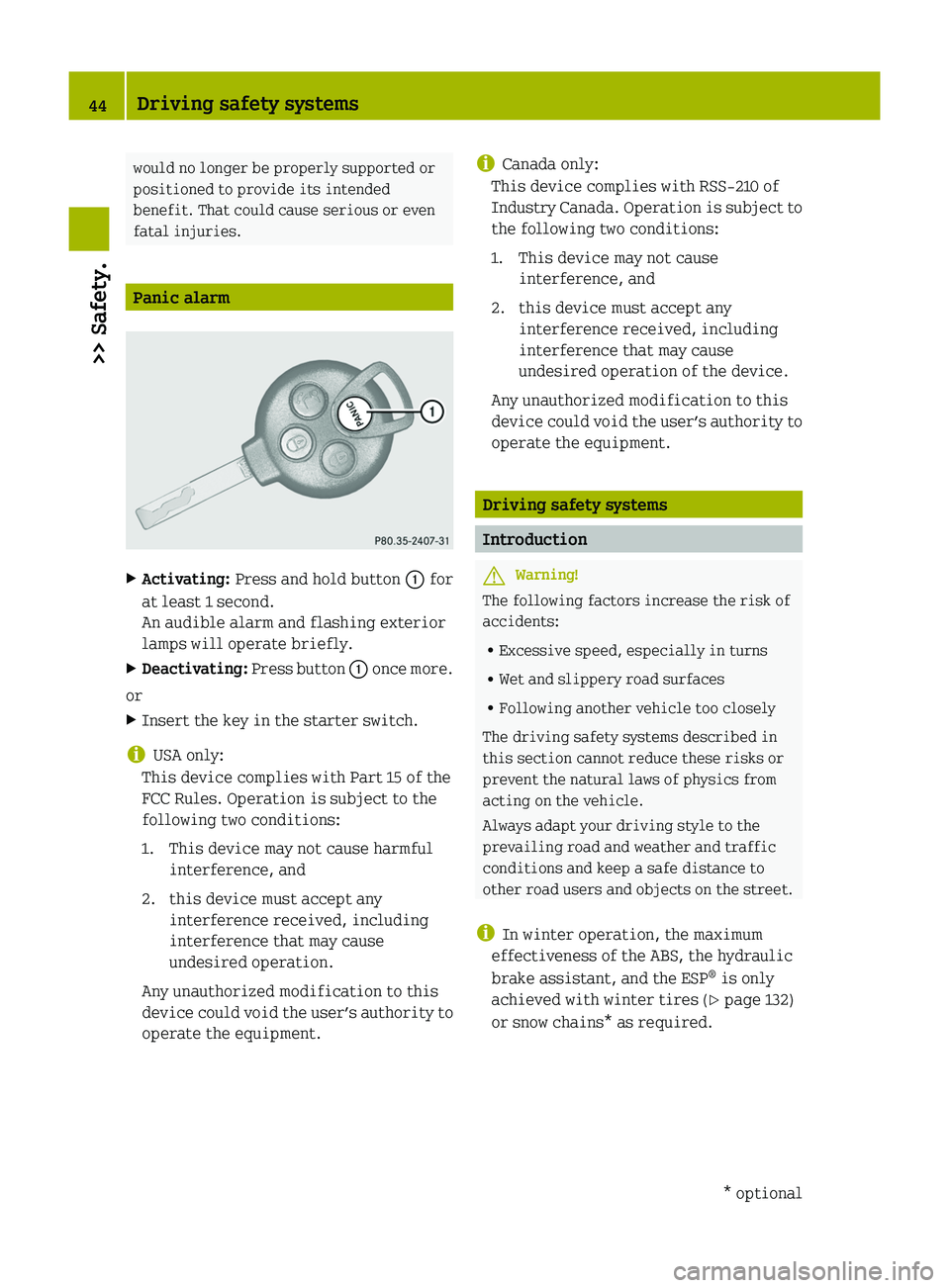
Panic alarm
XActivating: Press and hold button 0046 for
at least 1 second.
An audible alarm and flashing exterior
lamps will operate briefly.XDeactivating: Press button 0046 once more.
or
XInsert the key in the starter switch.
i USA only:
This device complies with Part 15 of the
FCC Rules. Operation is subject to the
following two conditions:
1. This device may not cause harmful interference, and
2. this device must accept any interference received, including
interference that may cause
undesired operation.
Any unauthorized modification to this
device could void the user’s authority to
operate the equipment.
i Canada only:
This device complies with RSS‑210 of
Industry Canada. Operation is subject to
the following two conditions:
1. This device may not cause interference, and
2. this device must accept any interference received, including
interference that may cause
undesired operation of the device.
Any unauthorized modification to this
device could void the user’s authority to
operate the equipment.
Driving safety systems
Introduction
GWarning!
The following factors increase the risk of
accidents:
R Excessive speed, especially in turns
R Wet and slippery road surfaces
R Following another vehicle too closely
The driving safety systems described in
this section cannot reduce these risks or
prevent the natural laws of physics from
acting on the vehicle.
Always adapt your driving style to the
prevailing road and weather and traffic
conditions and keep a safe distance to
other road users and objects on the street.
i In winter operation, the maximum
effectiveness of the ABS, the hydraulic
brake assistant, and the ESP ®
is only
achieved with winter tires ( Y page 132)
or snow chains* as required.
44Driving safety systems>> Safety.* optional451_AKB; 3; 22, en-USd2ureepe,Version: 2.11.8.12009-07-27T09:36:34+02:00 - Seite 44
Page 49 of 216
another vehicle too closely, or
hydroplaning. Only a safe, attentive, and
skillful driver can prevent accidents. The
capabilities of a hydraulic brake assistant
equipped vehicle must never be exploited
in a reckless or dangerous manner which
could jeopardize the user’s safety or the
safety of others.
Activating the hazard warning flasher
after an emergency braking maneuver
If you bring the vehicle to a complete stop
by strongly braking at a speed of more than
43 mph (70 km/h), the hazard warning
flasher automatically comes on as soon as
the vehicle is at a standstill. The hazard
warning flasher will remain on until it is
switched off using the hazard warning
flasher switch ( Y page 66) or until the
speed of the vehicle has exceeded 6 mph
(10 km/h).
Anti-theft systems
Electronic immobilizer
The electronic immobilizer prevents
unauthorized persons from starting your
vehicle.
When leaving the vehicle, always take the
key with you and lock the vehicle. The
engine can be started by anyone with a key
that is left inside the vehicle.
XActivating: Remove the key from the
starter switch.XDeactivating: Insert the key in the
starter switch.XTurn the key to starter switch position 1.Anti-theft warning system*
Once the anti-theft warning system has
been armed, a visual and audible alarm is
triggered when
R someone opens a door or the tailgate
R someone enters the vehicle’s interior
R there is motion inside the vehicle
R someone attempts to raise the vehicle
The alarm will also be triggered when
unlocking and opening the driver’s door
with the key.
i The alarm will stay on, even if the
driver’s door is immediately closed. For
canceling the alarm, see ( Y page 48).
Close the windows and the tailgate before
arming the alarm system. Make sure there
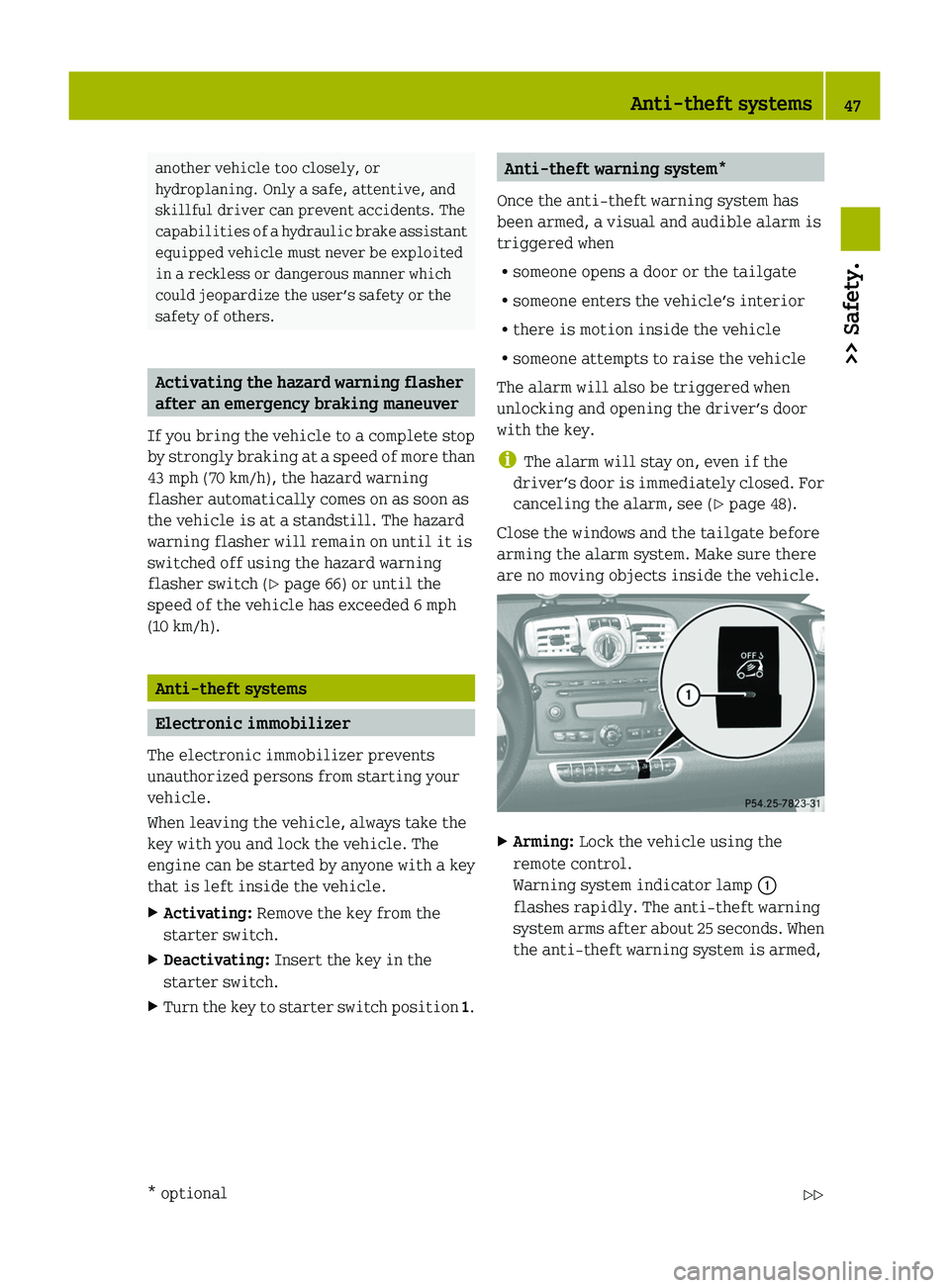
are no moving objects inside the vehicle.XArming: Lock the vehicle using the
remote control.
Warning system indicator lamp 0046
flashes rapidly. The anti-theft warning
system arms after about 25 seconds. When
the anti-theft warning system is armed,Anti-theft systems47>> Safety.* optional451_AKB; 3; 22, en-USd2ureepe,Version: 2.11.8.12009-07-27T09:36:34+02:00 - Seite 47Z
Page 50 of 216
warning system indicator lamp 0046
flashes about every three seconds.
i You can also arm the anti-theft warning
system by locking the vehicle without
using the remote control ( Y page 162).
XDisarming: Unlock the vehicle using the
remote control.
The anti-theft warning system is
disarmed. Warning system indicator
lamp 0046 stops flashing.
Canceling the alarm
XInsert the key in the starter switch.XTurn the key to starter switch position 1.
or
XPress button 0034 or 0038 on the key.
Tow-away alarm* and interior motion
sensor*
Once the anti-theft warning system has
been armed, a visual and audible alarm is
triggered when someone attempts to raise
the vehicle or if motion is detected inside
the vehicle.
XArming: Lock the vehicle using the
remote control.
The tow-away protection and the interior
motion sensor are armed after about
25 seconds.XDisarming: Unlock the vehicle using the
remote control.
The tow-away protection and the interior
motion sensor are disarmed.
Canceling the alarm
XInsert the key in the starter switch.XTurn the key to starter switch position 1.
or
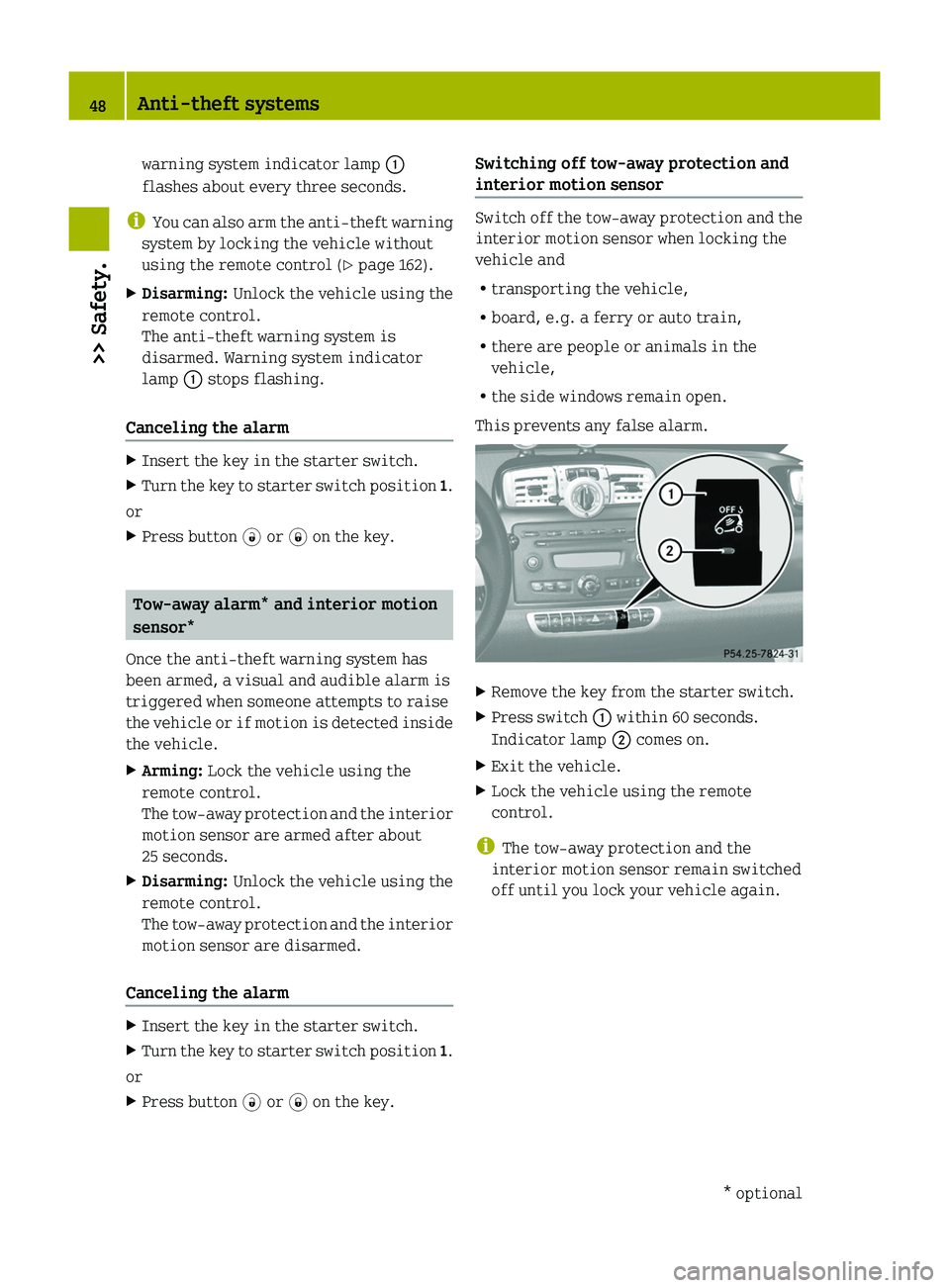
XPress button 0034 or 0038 on the key.Switching off tow-away protection and
interior motion sensor
Switch off the tow-away protection and the
interior motion sensor when locking the
vehicle and
R transporting the vehicle,
R board, e.g. a ferry or auto train,
R there are people or animals in the
vehicle,
R the side windows remain open.
This prevents any false alarm.
XRemove the key from the starter switch.XPress switch 0046 within 60 seconds.
Indicator lamp 0047 comes on.XExit the vehicle.XLock the vehicle using the remote
control.
i The tow-away protection and the
interior motion sensor remain switched
off until you lock your vehicle again.
48Anti-theft systems>> Safety.* optional451_AKB; 3; 22, en-USd2ureepe,Version: 2.11.8.12009-07-27T09:36:34+02:00 - Seite 48
Page 52 of 216
Opening and closing
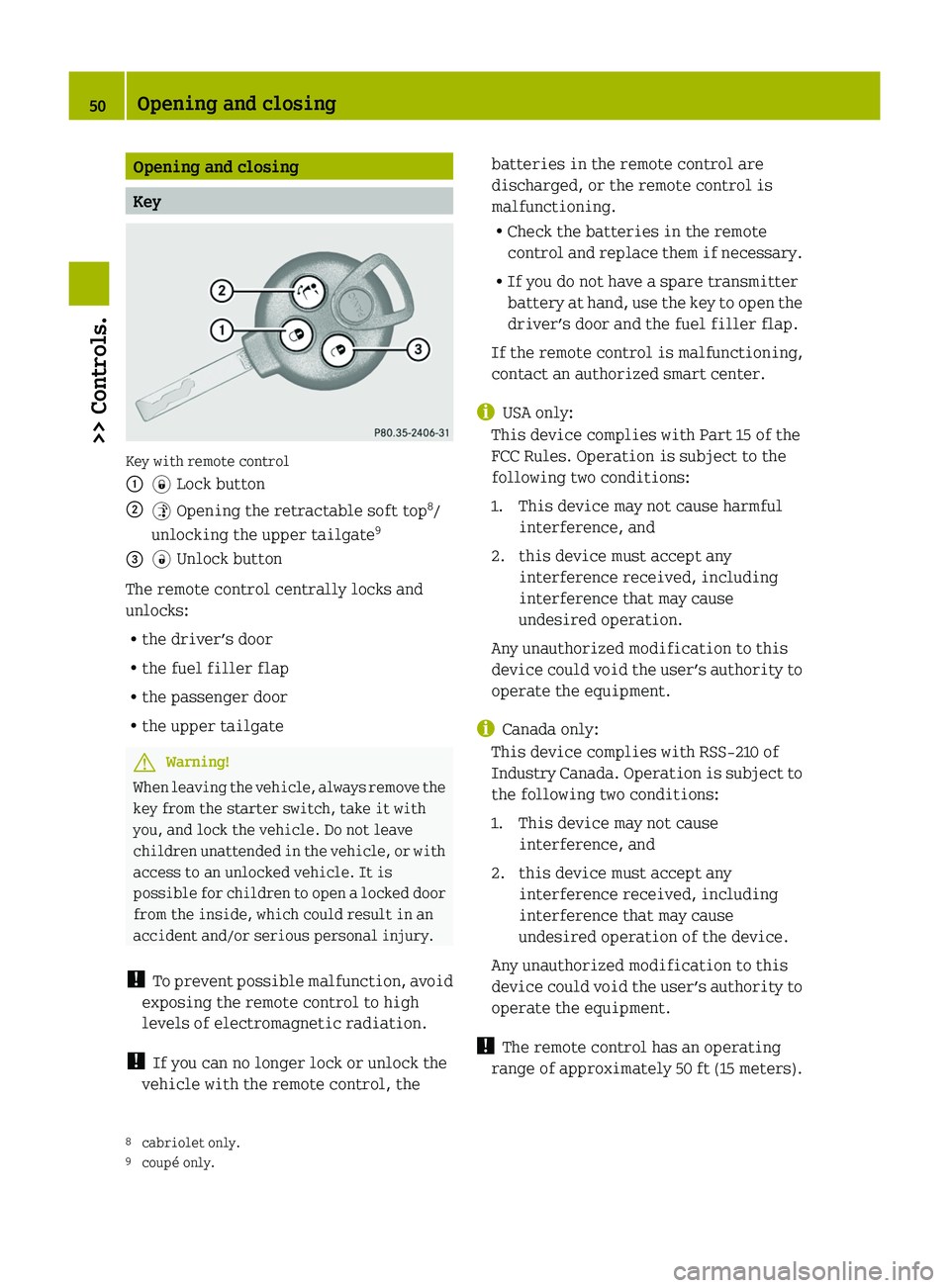
Key
Key with remote control
00460038 Lock button00470035 Opening the retractable soft top 8
/
unlocking the upper tailgate 9008A0034
Unlock button
The remote control centrally locks and
unlocks:
R the driver’s door
R the fuel filler flap
R the passenger door
R the upper tailgate
GWarning!
When leaving the vehicle, always remove the
key from the starter switch, take it with
you, and lock the vehicle. Do not leave
children unattended in the vehicle, or with
access to an unlocked vehicle. It is
possible for children to open a locked door
from the inside, which could result in an
accident and/or serious personal injury.
! To prevent possible malfunction, avoid
exposing the remote control to high
levels of electromagnetic radiation.
! If you can no longer lock or unlock the
vehicle with the remote control, the
batteries in the remote control are
discharged, or the remote control is
malfunctioning.
R Check the batteries in the remote
control and replace them if necessary.
R If you do not have a spare transmitter
battery at hand, use the key to open the
driver’s door and the fuel filler flap.
If the remote control is malfunctioning,
contact an authorized smart center.
i USA only:
This device complies with Part 15 of the
FCC Rules. Operation is subject to the
following two conditions:
1. This device may not cause harmful interference, and
2. this device must accept any interference received, including
interference that may cause
undesired operation.
Any unauthorized modification to this
device could void the user’s authority to
operate the equipment.
i Canada only:
This device complies with RSS-210 of
Industry Canada. Operation is subject to
the following two conditions:
1. This device may not cause interference, and
2. this device must accept any interference received, including
interference that may cause
undesired operation of the device.
Any unauthorized modification to this
device could void the user’s authority to
operate the equipment.
! The remote control has an operating
range of approximately 50 ft (15 meters).8 cabriolet only.
9 coupé only.50Opening and closing>> Controls.
451_AKB; 3; 22, en-USd2ureepe,Version: 2.11.8.12009-07-27T09:36:34+02:00 - Seite 50
Page 53 of 216
This can fluctuate greatly as a
consequence of local conditions
(reflective or absorbing objects) and
interference emitted by other radio
transmission systems. Similarly, the
operating range fluctuates in line with
the direction from which the remote
control is activated.
To prevent theft, however, it is advisable
to only unlock the vehicle when you are
in close proximity to it.
Locking and unlocking from the
outside
XSelective unlocking: Press button 0034 on
the key once.
All turn signal lamps flash once.
The anti-theft warning system* is
disarmed.
The driver’s door and the fuel filler flap
are unlocked.XGlobal unlocking: Press button 0034 on the
key twice.
All turn signal lamps flash once again.
The passenger door and the tailgate are
unlocked in addition to the driver’s door
and the fuel filler flap.XGlobal locking: Press button 0038 on the
key.
With the doors, the tailgate(s), and the
fuel filler flap closed the turn signal
lamps flash three times.
The anti-theft warning system* is armed.
The indicator lamp on the central
locking switch flashes ( Y page 52).
The interior and exterior 10
lamps come
on and then go out again after 12 seconds.Automatic locking
Auto-relock function
The vehicle will lock again automatically
within approximately 60 seconds of
unlocking with the key if neither the
driver’s nor passenger door is opened.
! To prevent an inadvertent lockout,
never leave your key lying in the vehicle.
Drive lock function
The vehicle locks automatically when the
ignition is switched on and the wheels are
turning at vehicle speeds of approximately
8 mph (14 km/h) or more. The drive lock
function is enabled at the factory.
XSwitching on: Switch off the ignition.XPress the central locking switch
( Y page 52) and button 0038 on the key
simultaneously.
An acoustic signal sounds.
The drive lock function is switched on.XSwitching off: Switch off the ignition.XPress the central unlocking switch
( Y page 52) and button 0034 on the key
simultaneously.
An acoustic signal sounds.
The drive lock function is switched off.
Locking and unlocking from the inside
GWarning!
When leaving the vehicle, always remove the
key from the starter switch, take it with
you, and lock the vehicle. Do not leave
children unattended in the vehicle, or with
access to an unlocked vehicle. A child’s
unsupervised access to a vehicle could
result in an accident and/or serious
personal injury.
You can lock and unlock the vehicle from
inside using the central locking or
10 Vehicles with rain-light sensor* only.Opening and closing51>> Controls.* optional451_AKB; 3; 22, en-USd2ureepe,Version: 2.11.8.12009-07-27T09:36:34+02:00 - Seite 51Z
Page 55 of 216
XPress button 0034 on the key twice.XPress and hold button 0035 on the key for
approximately two seconds.
or
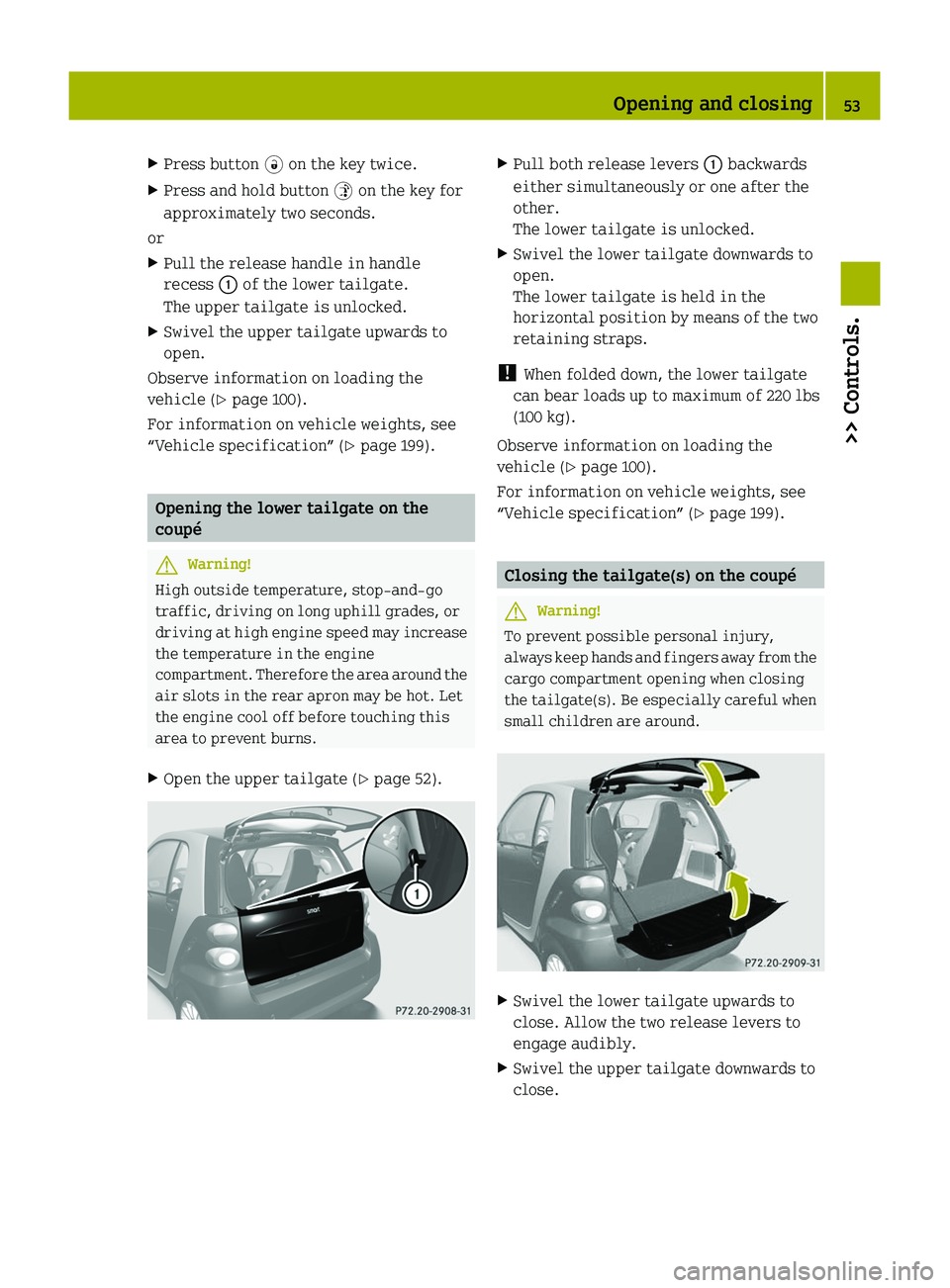
XPull the release handle in handle
recess 0046 of the lower tailgate.
The upper tailgate is unlocked.XSwivel the upper tailgate upwards to
open.
Observe information on loading the
vehicle ( Y page 100).
For information on vehicle weights, see
“Vehicle specification” ( Y page 199).
Opening the lower tailgate on the
coupé
GWarning!
High outside temperature, stop-and-go
traffic, driving on long uphill grades, or
driving at high engine speed may increase
the temperature in the engine
compartment. Therefore the area around the
air slots in the rear apron may be hot. Let
the engine cool off before touching this
area to prevent burns.
XOpen the upper tailgate ( Y page 52).XPull both release levers 0046 backwards
either simultaneously or one after the
other.
The lower tailgate is unlocked.XSwivel the lower tailgate downwards to
open.
The lower tailgate is held in the
horizontal position by means of the two
retaining straps.
! When folded down, the lower tailgate
can bear loads up to maximum of 220 lbs
(100 kg).
Observe information on loading the
vehicle ( Y page 100).
For information on vehicle weights, see
“Vehicle specification” ( Y page 199).
Closing the tailgate(s) on the coupé
GWarning!
To prevent possible personal injury,
always keep hands and fingers away from the
cargo compartment opening when closing
the tailgate(s). Be especially careful when
small children are around.
XSwivel the lower tailgate upwards to
close. Allow the two release levers to
engage audibly.XSwivel the upper tailgate downwards to
close.Opening and closing53>> Controls.451_AKB; 3; 22, en-USd2ureepe,Version: 2.11.8.12009-07-27T09:36:34+02:00 - Seite 53Z
Page 56 of 216
GWarning!
When leaving the vehicle, always remove the
key from the starter switch, take it with
you, and lock the vehicle. Do not leave
children unattended in the vehicle, or with
access to an unlocked vehicle. A child’s
unsupervised access to a vehicle could
result in an accident and/or serious
personal injury.
Opening and closing the retractable
soft top (cabriolet only)
You can fully open the retractable soft top
with the key.
Key with remote control
00460038 Lock button00470035 Opening the retractable soft top008A0034 Unlock buttonXOpening: Press button 0035 on the key for
approximately two seconds.
The retractable soft top opens.
i Pressing symbols 0034, 0038 or 0035 on the
key with remote control while opening
the retractable soft top will interrupt
the opening procedure.
XClosing: Press symbol 0055 on the
retractable soft top switch
( Y page 71).GWarning!
When closing the retractable soft top, make
sure there is no danger of anyone being
harmed by the closing procedure.
i The remote control has an operating
range of approximately 50 ft (15 meters).
Take care that you do not open your
vehicle’s retractable soft top
inadvertently.
Opening the tailgate on the cabriolet
GWarning!
Make sure the tailgate is closed when the
engine is running and while driving.
Among other dangers, deadly carbon
monoxide (CO) gases may enter vehicle
interior resulting in unconsciousness and
death.
GWarning!
High outside temperature, stop-and-go
traffic, driving on long uphill grades, or
driving at high engine speed may increase
the temperature in the engine
compartment. Therefore the area around the
air slots in the rear apron may be hot. Let
the engine cool off before touching this
area to prevent burns.
54Opening and closing>> Controls.
451_AKB; 3; 22, en-USd2ureepe,Version: 2.11.8.12009-07-27T09:36:34+02:00 - Seite 54
Page 57 of 216
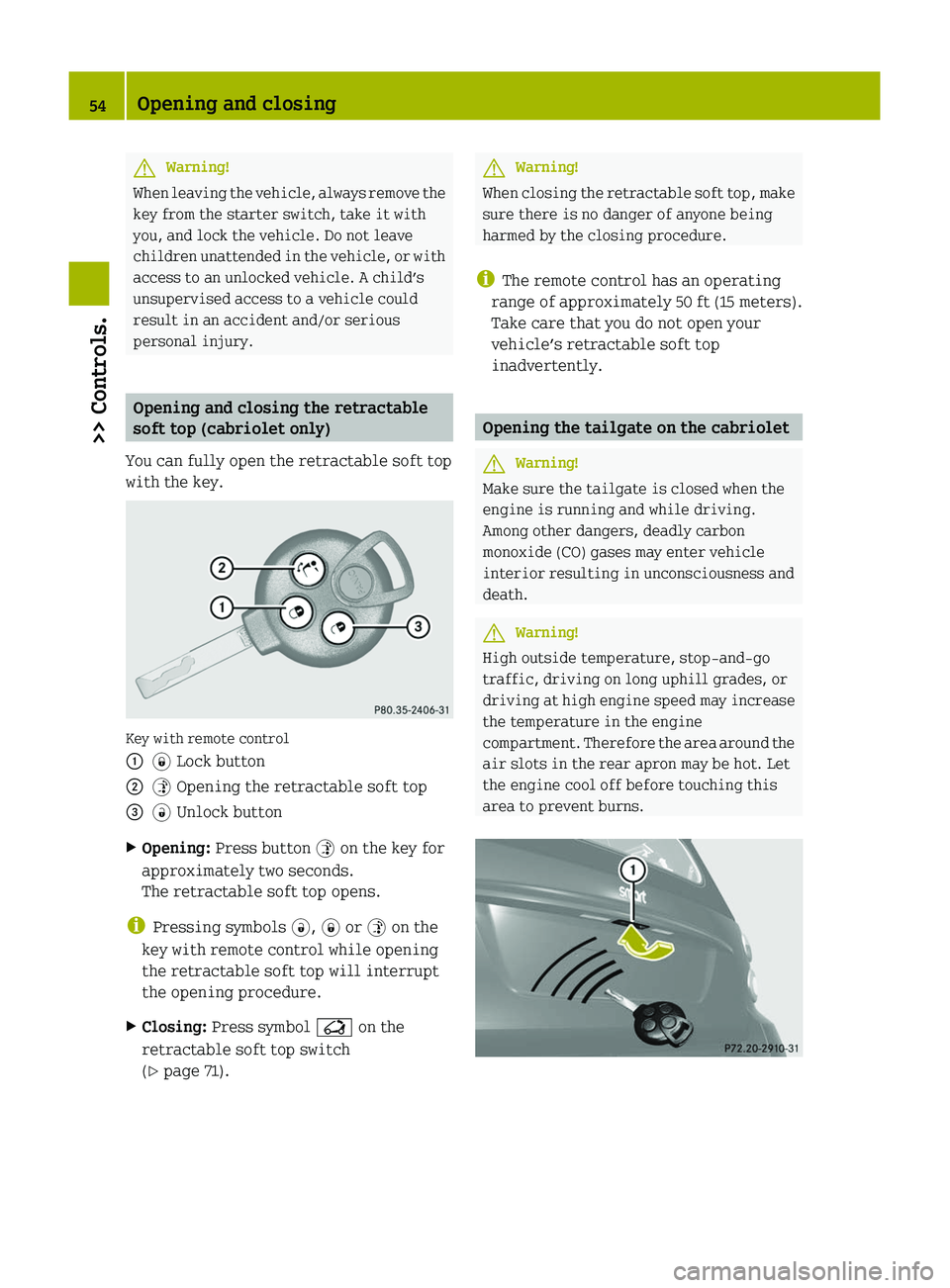
XPress button 0034 on the key twice.XPull the release handle in handle
recess 0046 of the tailgate.
The tailgate is unlocked.XSwivel the tailgate downwards to open.
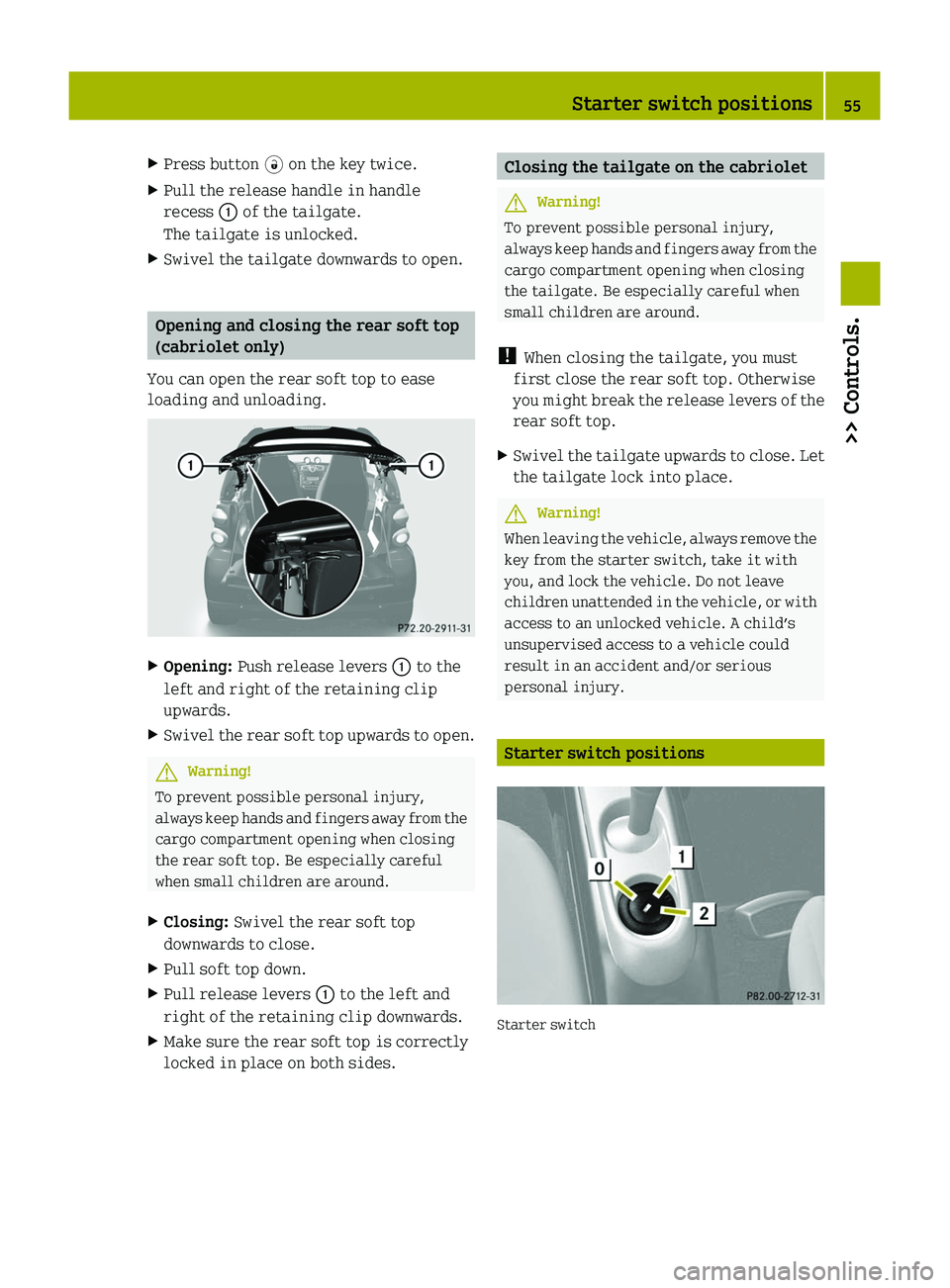
Opening and closing the rear soft top
(cabriolet only)
You can open the rear soft top to ease
loading and unloading.
XOpening: Push release levers 0046 to the
left and right of the retaining clip
upwards.XSwivel the rear soft top upwards to open.GWarning!
To prevent possible personal injury,
always keep hands and fingers away from the
cargo compartment opening when closing
the rear soft top. Be especially careful
when small children are around.
XClosing: Swivel the rear soft top
downwards to close.XPull soft top down.XPull release levers 0046 to the left and
right of the retaining clip downwards.XMake sure the rear soft top is correctly
locked in place on both sides.Closing the tailgate on the cabrioletGWarning!
To prevent possible personal injury,
always keep hands and fingers away from the
cargo compartment opening when closing
the tailgate. Be especially careful when
small children are around.
! When closing the tailgate, you must
first close the rear soft top. Otherwise
you might break the release levers of the
rear soft top.
XSwivel the tailgate upwards to close. Let
the tailgate lock into place.GWarning!
When leaving the vehicle, always remove the
key from the starter switch, take it with
you, and lock the vehicle. Do not leave
children unattended in the vehicle, or with
access to an unlocked vehicle. A child’s
unsupervised access to a vehicle could
result in an accident and/or serious
personal injury.
Starter switch positions
Starter switch
Starter switch positions55>> Controls.451_AKB; 3; 22, en-USd2ureepe,Version: 2.11.8.12009-07-27T09:36:34+02:00 - Seite 55Z