weight SMART FORTWO COUPE 2010 User Guide
[x] Cancel search | Manufacturer: SMART, Model Year: 2010, Model line: FORTWO COUPE, Model: SMART FORTWO COUPE 2010Pages: 216, PDF Size: 9.7 MB
Page 40 of 216
iIf the seat, including the trim cover and
cushion, needs to be serviced in any way,
take the vehicle to an authorized smart
center. Only seat accessories approved
by smart may be used.
Both driver and the passenger should
always use the 007F 007B indicator
lamp as an indication of whether or not
the passenger is properly positioned
( Y page 40).GWarning!
If the 007F 007B indicator lamp
illuminates when an adult or someone
larger than a small individual is in the
passenger seat, have the passenger re-
position himself or herself in the seat
until the 007F 007B indicator lamp
goes out.
In the event of a collision, the air bag
control unit will not allow passenger front
air bag deployment when the OCS has
classified the passenger seat occupant as
being up to or less than the weight of a
typical 12‑month‑old child in a standard
child restraint, or if the passenger seat is
sensed as being empty.
When the OCS senses that the passenger seat
occupant is classified as being up to or
less than the weight of a typical
12‑month‑old child in a standard child
restraint, the 007F 007B indicator
lamp will illuminate when the ignition is
switched on and remain illuminated,
indicating that the passenger front air bag
is deactivated.
When the OCS senses that the passenger seat
is classified as being empty, the
007F 007B indicator lamp will
illuminate and remains illuminated.
When the OCS senses that the passenger seat
occupant is classified as being heavier
than the weight of a typical 12‑month‑old
child seated in a standard child restraint
or as being a small individual (such as a
young teenager or a small adult), the
007F 007B indicator lamp will
illuminate for approximately 4 seconds
when the ignition is switched on and then,
depending on occupant weight sensor
readings from the seat, remains
illuminated or goes out.
When the 007F 007B indicator lamp is
illuminated, the passenger front air bag is
deactivated.
When the 007F 007B indicator lamp is
out and the passenger seat is occupied by
an adult or someone larger than a small
individual, the passenger front air bag is
activated.
When the OCS senses that the passenger seat
occupant is classified as an adult or
someone larger than a small individual, the
007F 007B indicator lamp will
illuminate for approximately 4 seconds
when the ignition is switched on and then
goes out, indicating that the passenger
front air bag is activated.
If the 007F 007B indicator lamp is
illuminated, the passenger front air bag is
deactivated and will not be deployed.
If the 007F 007B indicator lamp is not
illuminated, the passenger front air bag is
activated and will be deployed
R in the event of certain frontal impacts
R if impact exceeds a preset deployment
threshold
R independently of the head-thorax air
bags
If the passenger front air bag is deployed,
the rate of inflation will be influenced by
R the rate of vehicle deceleration and a
fastened or unfastened seat belt as
assessed by the air bag control unit
R the passenger’s weight category as
identified by the OCS38Occupant safety>> Safety.
451_AKB; 3; 22, en-USd2ureepe,Version: 2.11.8.12009-07-27T09:36:34+02:00 - Seite 38
Page 41 of 216
GWarning!
Children 12 years old and under must be
seated and properly secured in an
appropriate infant or child restraint
recommended for the size and weight of the
child.
The infant or child restraint must be
properly secured with the vehicle’s seat
belt, fully in accordance with the child
seat manufacturer’s instructions.
Children can be killed or seriously injured
by an inflating air bag. Note the following
important information:
R Your vehicle is equipped with air bag
technology designed to turn off the
passenger front air bag in your vehicle
when the system senses the weight of a
typical 12‑month‑old child or less along
with the weight of a standard
appropriate child restraint on the
passenger seat.
R A child in a rear-facing child restraint
on the passenger seat will be seriously
injured or even killed if the passenger
front air bag inflates in a collision
which could occur under some
circumstances, even with the air bag
technology installed in your vehicle.
R If you install a rear-facing child
restraint on the passenger seat, make
sure the 007F 007B indicator lamp
is illuminated, indicating that the
passenger front air bag is deactivated.
Should the 007F 007B indicator
lamp not illuminate or go out while the
restraint is installed, please check
installation.
Periodically check the 007F 007B
indicator lamp while driving to make
sure the 007F 007B indicator lamp
is illuminated.
If the 007F 007B indicator lamp
goes out or remains out, do not transport
a child on the passenger seat until the
system has been repaired.
A child in a rear-facing child restraint
on the passenger seat may be seriously
injured or even killed if the passenger
front air bag inflates.
R If you place a child in a forward-facing
child restraint on the passenger seat,
move the seat as far back as possible, use
the proper child restraint recommended
for the age, size and weight of the child
by the seat manufacturer, and secure
child restraint with the vehicle’s seat
belt according to the child seat
manufacturer’s instructions. For
children larger than the typical
12‑month‑old child, the passenger front
air bag may or may not be activated.
i Deployment of the driver front air bag
does not mean that the passenger front
air bag also should have deployed.
The Occupant Classification System
( Y page 37) may have determined
R that the seat was empty or occupied by the
weight up to or less than that of a typical
12‑month‑old child seated in a standard
child restraint — both instances where
the system suppresses deployment of the
passenger front air bag even though the
impact met the criteria and was of
sufficient severity to deploy the driver
front air bag
R that the seat was occupied by a small
individual (such as a young teenager or
a small adult) or a child weighing more
than the weight of a typical 12‑month‑old
child in a standard child restraint —
instances where the system may suppress
deployment of the passenger front air
bag even though the impact met the
criteria and was of sufficient severity
to deploy the driver front air bagOccupant safety39>> Safety.451_AKB; 3; 22, en-USd2ureepe,Version: 2.11.8.12009-07-27T09:36:34+02:00 - Seite 39Z
Page 42 of 216
Passenger front air bag off indicator
lamp
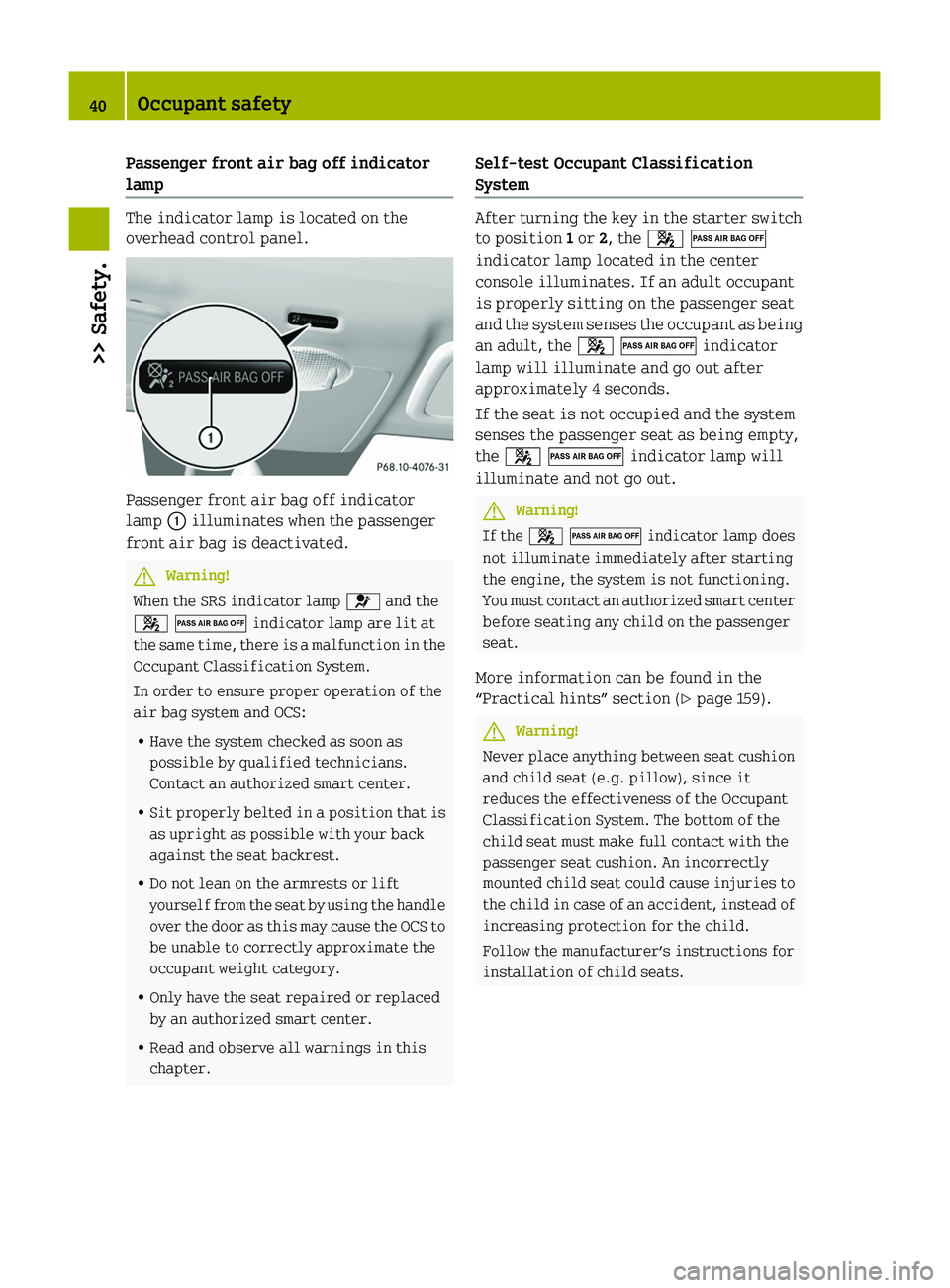
The indicator lamp is located on the
overhead control panel.
Passenger front air bag off indicator
lamp 0046 illuminates when the passenger
front air bag is deactivated.
GWarning!
When the SRS indicator lamp 0081 and the
007F 007B indicator lamp are lit at
the same time, there is a malfunction in the
Occupant Classification System.
In order to ensure proper operation of the
air bag system and OCS:
R Have the system checked as soon as
possible by qualified technicians.
Contact an authorized smart center.
R Sit properly belted in a position that is
as upright as possible with your back
against the seat backrest.
R Do not lean on the armrests or lift
yourself from the seat by using the handle
over the door as this may cause the OCS to
be unable to correctly approximate the
occupant weight category.
R Only have the seat repaired or replaced
by an authorized smart center.
R Read and observe all warnings in this
chapter.
Self-test Occupant Classification
System
After turning the key in the starter switch
to position 1 or 2, the 007F 007B
indicator lamp located in the center
console illuminates. If an adult occupant
is properly sitting on the passenger seat
and the system senses the occupant as being
an adult, the 007F 007B indicator
lamp will illuminate and go out after
approximately 4 seconds.
If the seat is not occupied and the system
senses the passenger seat as being empty,
the 007F 007B indicator lamp will
illuminate and not go out.
GWarning!
If the 007F 007B indicator lamp does
not illuminate immediately after starting
the engine, the system is not functioning.
You must contact an authorized smart center
before seating any child on the passenger
seat.
More information can be found in the
“Practical hints” section ( Y page 159).
GWarning!
Never place anything between seat cushion
and child seat (e.g. pillow), since it
reduces the effectiveness of the Occupant
Classification System. The bottom of the
child seat must make full contact with the
passenger seat cushion. An incorrectly
mounted child seat could cause injuries to
the child in case of an accident, instead of
increasing protection for the child.
Follow the manufacturer’s instructions for
installation of child seats.
40Occupant safety>> Safety.
451_AKB; 3; 22, en-USd2ureepe,Version: 2.11.8.12009-07-27T09:36:34+02:00 - Seite 40
Page 44 of 216
instruction manual provided with the
restraint.
When using any infant restraint, toddler
restraint, or booster seat be sure to
carefully read and follow all
manufacturer’s instructions for
installation and use.
Please read and observe warning labels
affixed to the inside of the vehicle and to
infant or child restraints.GWarning!
Children 12 years old and under must be
seated and properly secured in an
appropriately sized infant restraint,
toddler restraint, or booster seat
recommended for the size and weight of the
child.
The infant or child restraint must be
properly secured with the vehicle’s seat
belt fully in accordance with the child seat
manufacturer’s instructions.
Occupants, especially children, should
never place their bodies or lean their
heads in the area of the door where the
head-thorax air bag inflates. This could
result in serious injuries or death should
the head-thorax air bag be triggered.
Always sit as upright as possible, properly
use the seat belt and use an appropriately
sized infant restraint, toddler restraint,
or booster seat recommended for the size
and weight of the child.
Children can be killed or seriously injured
by an inflating air bag. Note the following
important information when circumstances
require you to place a child in the
passenger seat:
R Your vehicle is equipped with air bag
technology designed to turn off the
passenger front air bag in your vehicle
when the Occupant Classification System
senses the weight of a typical
12‑month‑old child or less along with the
weight of an appropriate child restraint
on the passenger seat.
R A child in a rear-facing child restraint
on the passenger seat may be seriously
injured or even killed if the passenger
front air bag inflates in a collision.
R If you install a rear-facing child
restraint on the passenger seat, make
sure the 007F 007B indicator lamp
is illuminated, indicating that the
passenger front air bag is deactivated.
Should the 007F 007B indicator
lamp not illuminate or go out while the
restraint is installed, please check
installation. Periodically check the
007F 007B indicator lamp while
driving to make sure the
007F 007B indicator lamp is
illuminated. If the 007F 007B
indicator lamp goes out or remains out,
do not transport a child on the passenger
seat until the system has been repaired.
A child in a rear-facing child restraint
on the passenger seat may be seriously
injured or even killed if the passenger
front air bag inflates.
R If you place a child in a forward-facing
child restraint on the passenger seat,
move the seat as far back as possible, use
a proper child restraint recommended
for the age, size and weight of the child,
and secure child restraint with the
vehicle’s seat belt according to the child
seat manufacturer’s instructions. For
children larger than the typical
12‑month‑old child, the passenger front
air bag may or may not be activated.GWarning!
Infants and small children should never
share a seat belt with another occupant.
During an accident, they could be crushed
between the occupant and seat belt.
A child’s risk of serious or fatal injuries
is significantly increased if the child
42Occupant safety>> Safety.
451_AKB; 3; 22, en-USd2ureepe,Version: 2.11.8.12009-07-27T09:36:34+02:00 - Seite 42
Page 55 of 216
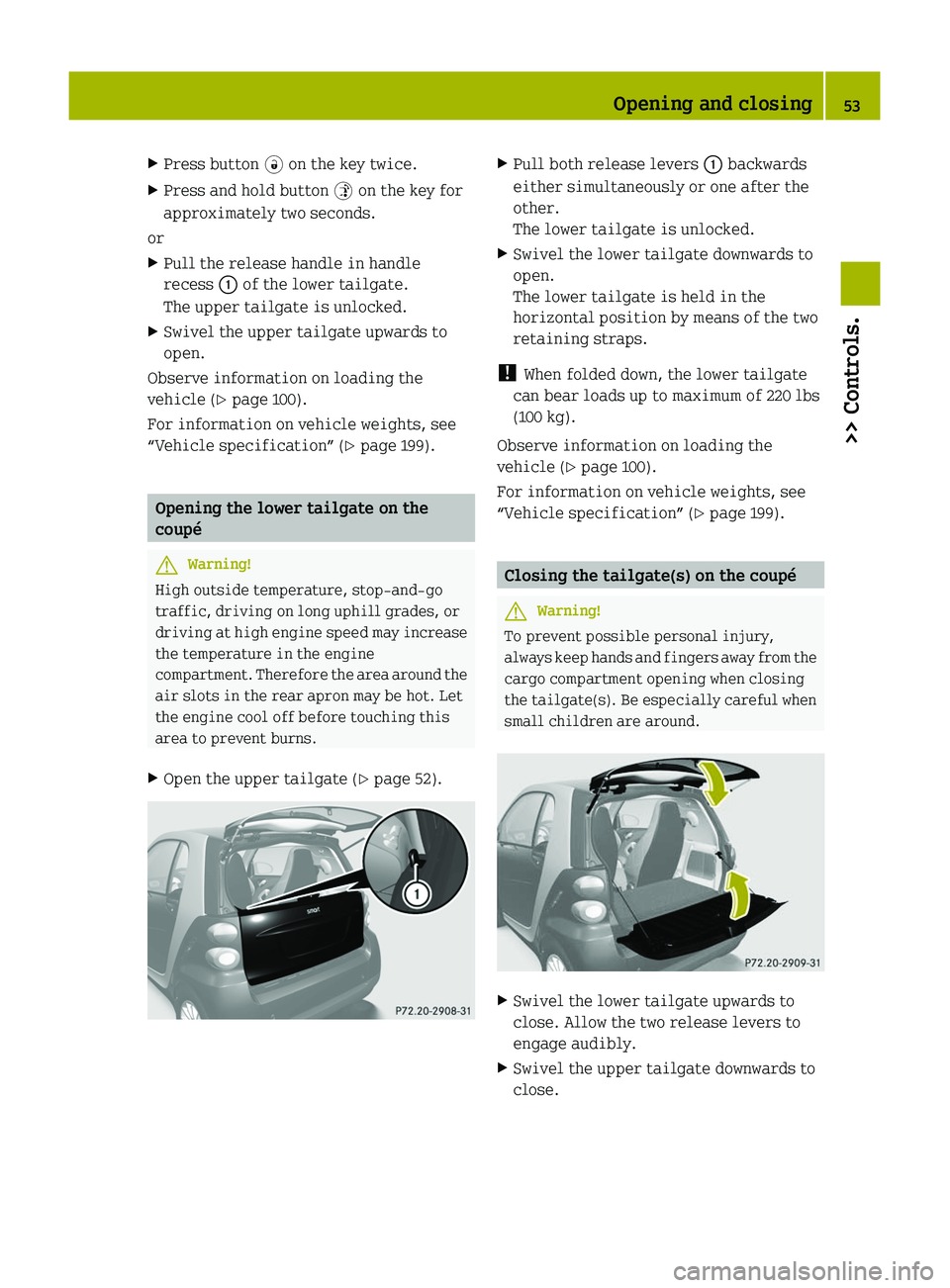
XPress button 0034 on the key twice.XPress and hold button 0035 on the key for
approximately two seconds.
or
XPull the release handle in handle
recess 0046 of the lower tailgate.
The upper tailgate is unlocked.XSwivel the upper tailgate upwards to
open.
Observe information on loading the
vehicle ( Y page 100).
For information on vehicle weights, see
“Vehicle specification” ( Y page 199).
Opening the lower tailgate on the
coupé
GWarning!
High outside temperature, stop-and-go
traffic, driving on long uphill grades, or
driving at high engine speed may increase
the temperature in the engine
compartment. Therefore the area around the
air slots in the rear apron may be hot. Let
the engine cool off before touching this
area to prevent burns.
XOpen the upper tailgate ( Y page 52).XPull both release levers 0046 backwards
either simultaneously or one after the
other.
The lower tailgate is unlocked.XSwivel the lower tailgate downwards to
open.
The lower tailgate is held in the
horizontal position by means of the two
retaining straps.
! When folded down, the lower tailgate
can bear loads up to maximum of 220 lbs
(100 kg).
Observe information on loading the
vehicle ( Y page 100).
For information on vehicle weights, see
“Vehicle specification” ( Y page 199).
Closing the tailgate(s) on the coupé
GWarning!
To prevent possible personal injury,
always keep hands and fingers away from the
cargo compartment opening when closing
the tailgate(s). Be especially careful when
small children are around.
XSwivel the lower tailgate upwards to
close. Allow the two release levers to
engage audibly.XSwivel the upper tailgate downwards to
close.Opening and closing53>> Controls.451_AKB; 3; 22, en-USd2ureepe,Version: 2.11.8.12009-07-27T09:36:34+02:00 - Seite 53Z
Page 58 of 216
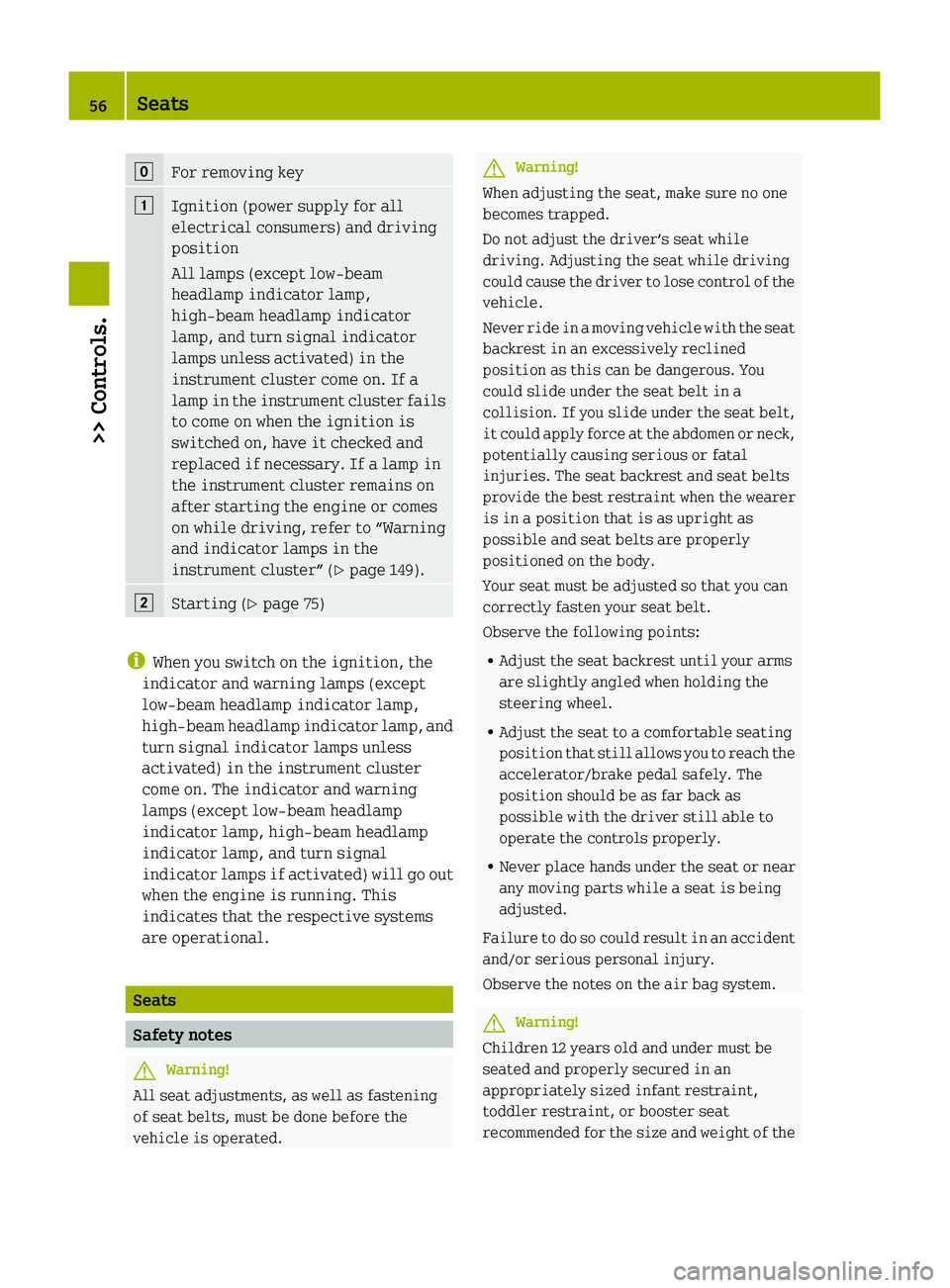
005DFor removing key004AIgnition (power supply for all
electrical consumers) and driving
position
All lamps (except low‑beam
headlamp indicator lamp,
high‑beam headlamp indicator
lamp, and turn signal indicator
lamps unless activated) in the
instrument cluster come on. If a
lamp in the instrument cluster fails
to come on when the ignition is
switched on, have it checked and
replaced if necessary. If a lamp in
the instrument cluster remains on
after starting the engine or comes
on while driving, refer to “Warning
and indicator lamps in the
instrument cluster” ( Y page 149).004BStarting ( Y page 75)
i
When you switch on the ignition, the
indicator and warning lamps (except
low‑beam headlamp indicator lamp,
high‑beam headlamp indicator lamp, and
turn signal indicator lamps unless
activated) in the instrument cluster
come on. The indicator and warning
lamps (except low‑beam headlamp
indicator lamp, high‑beam headlamp
indicator lamp, and turn signal
indicator lamps if activated) will go out
when the engine is running. This
indicates that the respective systems
are operational.
Seats
Safety notes
GWarning!
All seat adjustments, as well as fastening
of seat belts, must be done before the
vehicle is operated.
GWarning!
When adjusting the seat, make sure no one
becomes trapped.
Do not adjust the driver’s seat while
driving. Adjusting the seat while driving
could cause the driver to lose control of the
vehicle.
Never ride in a moving vehicle with the seat
backrest in an excessively reclined
position as this can be dangerous. You
could slide under the seat belt in a
collision. If you slide under the seat belt,
it could apply force at the abdomen or neck,
potentially causing serious or fatal
injuries. The seat backrest and seat belts
provide the best restraint when the wearer
is in a position that is as upright as
possible and seat belts are properly
positioned on the body.
Your seat must be adjusted so that you can
correctly fasten your seat belt.
Observe the following points:
R Adjust the seat backrest until your arms
are slightly angled when holding the
steering wheel.
R Adjust the seat to a comfortable seating
position that still allows you to reach the
accelerator/brake pedal safely. The
position should be as far back as
possible with the driver still able to
operate the controls properly.
R Never place hands under the seat or near
any moving parts while a seat is being
adjusted.
Failure to do so could result in an accident
and/or serious personal injury.
Observe the notes on the air bag system.
GWarning!
Children 12 years old and under must be
seated and properly secured in an
appropriately sized infant restraint,
toddler restraint, or booster seat
recommended for the size and weight of the
56Seats>> Controls.
451_AKB; 3; 22, en-USd2ureepe,Version: 2.11.8.12009-07-27T09:36:34+02:00 - Seite 56
Page 63 of 216
protect you if you are properly wearing
your seat belt.GWarning!
Children 12 years old and under must be
seated and properly secured in an
appropriately sized infant restraint,
toddler restraint, or booster seat
recommended for the size and weight of the
child. For additional information, see
“Children in the vehicle”.
A child’s risk of serious or fatal injuries
is significantly increased if the child
restraints are not properly secured in the
vehicle and/or the child is not properly
secured in the child restraint.
GWarning!
Never let more people ride in the vehicle
than there are seat belts available. Make
sure everyone riding in the vehicle is
correctly restrained with a separate seat
belt. Never use a seat belt for more than one
person at a time.
GWarning!
Never ride in a moving vehicle with the seat
backrest in an excessively reclined
position as this can be dangerous. You
could slide under the seat belt in a
collision. If you slide under it, the belt
would apply force at the abdomen or neck,
causing serious or even fatal injuries. The
seat backrest and seat belt provide the best
restraint when the wearer is in a position
that is as upright as possible and the belt
is properly positioned on the body.
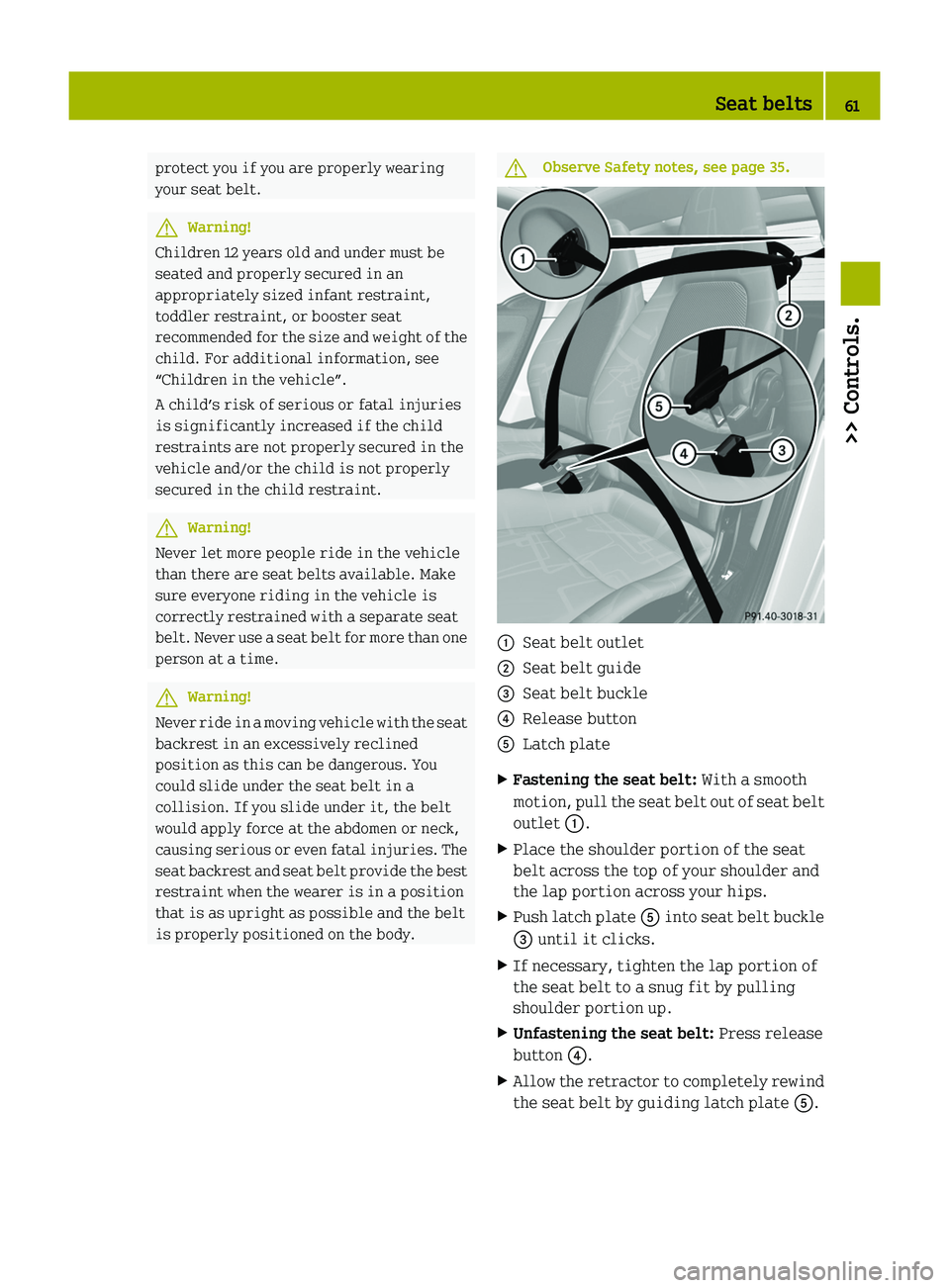
GObserve Safety notes, see page 35.0046Seat belt outlet0047Seat belt guide008ASeat belt buckle0088Release button0086Latch plateXFastening the seat belt: With a smooth
motion, pull the seat belt out of seat belt
outlet 0046.XPlace the shoulder portion of the seat
belt across the top of your shoulder and
the lap portion across your hips.XPush latch plate 0086 into seat belt buckle
008A until it clicks.XIf necessary, tighten the lap portion of
the seat belt to a snug fit by pulling
shoulder portion up.XUnfastening the seat belt: Press release
button 0088.XAllow the retractor to completely rewind
the seat belt by guiding latch plate 0086.Seat belts61>> Controls.451_AKB; 3; 22, en-USd2ureepe,Version: 2.11.8.12009-07-27T09:36:34+02:00 - Seite 61Z
Page 71 of 216
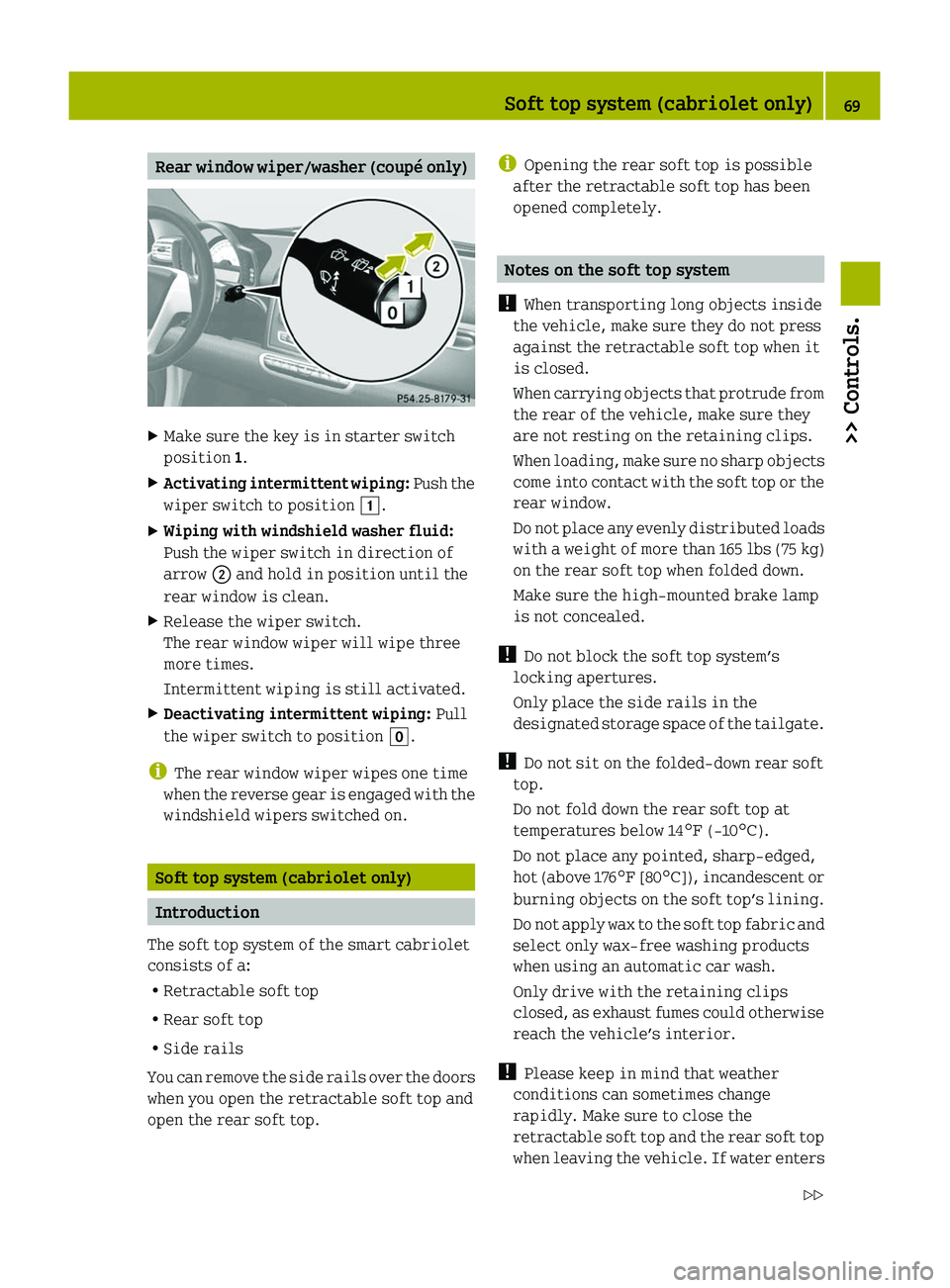
Rear window wiper/washer (coupé only)XMake sure the key is in starter switch
position 1.XActivating intermittent wiping: Push the
wiper switch to position 004A.XWiping with windshield washer fluid:
Push the wiper switch in direction of
arrow 0047 and hold in position until the
rear window is clean.XRelease the wiper switch.
The rear window wiper will wipe three
more times.
Intermittent wiping is still activated.XDeactivating intermittent wiping: Pull
the wiper switch to position 005D.
i
The rear window wiper wipes one time
when the reverse gear is engaged with the
windshield wipers switched on.
Soft top system (cabriolet only)
Introduction
The soft top system of the smart cabriolet
consists of a:
R Retractable soft top
R Rear soft top
R Side rails
You can remove the side rails over the doors
when you open the retractable soft top and
open the rear soft top.
i Opening the rear soft top is possible
after the retractable soft top has been
opened completely.
Notes on the soft top system
! When transporting long objects inside
the vehicle, make sure they do not press
against the retractable soft top when it
is closed.
When carrying objects that protrude from
the rear of the vehicle, make sure they
are not resting on the retaining clips.
When loading, make sure no sharp objects
come into contact with the soft top or the
rear window.
Do not place any evenly distributed loads
with a weight of more than 165 lbs (75 kg)
on the rear soft top when folded down.
Make sure the high-mounted brake lamp
is not concealed.
! Do not block the soft top system’s
locking apertures.
Only place the side rails in the
designated storage space of the tailgate.
! Do not sit on the folded-down rear soft
top.
Do not fold down the rear soft top at
temperatures below 14 ¦ (-10 ¥).
Do not place any pointed, sharp-edged,
hot (above 176 ¦ [80 ¥]), incandescent or
burning objects on the soft top’s lining.
Do not apply wax to the soft top fabric and
select only wax-free washing products
when using an automatic car wash.
Only drive with the retaining clips
closed, as exhaust fumes could otherwise
reach the vehicle’s interior.
! Please keep in mind that weather
conditions can sometimes change
rapidly. Make sure to close the
retractable soft top and the rear soft top
when leaving the vehicle. If water enters
Soft top system (cabriolet only)69>> Controls.451_AKB; 3; 22, en-USd2ureepe,Version: 2.11.8.12009-07-27T09:36:34+02:00 - Seite 69Z
Page 99 of 216
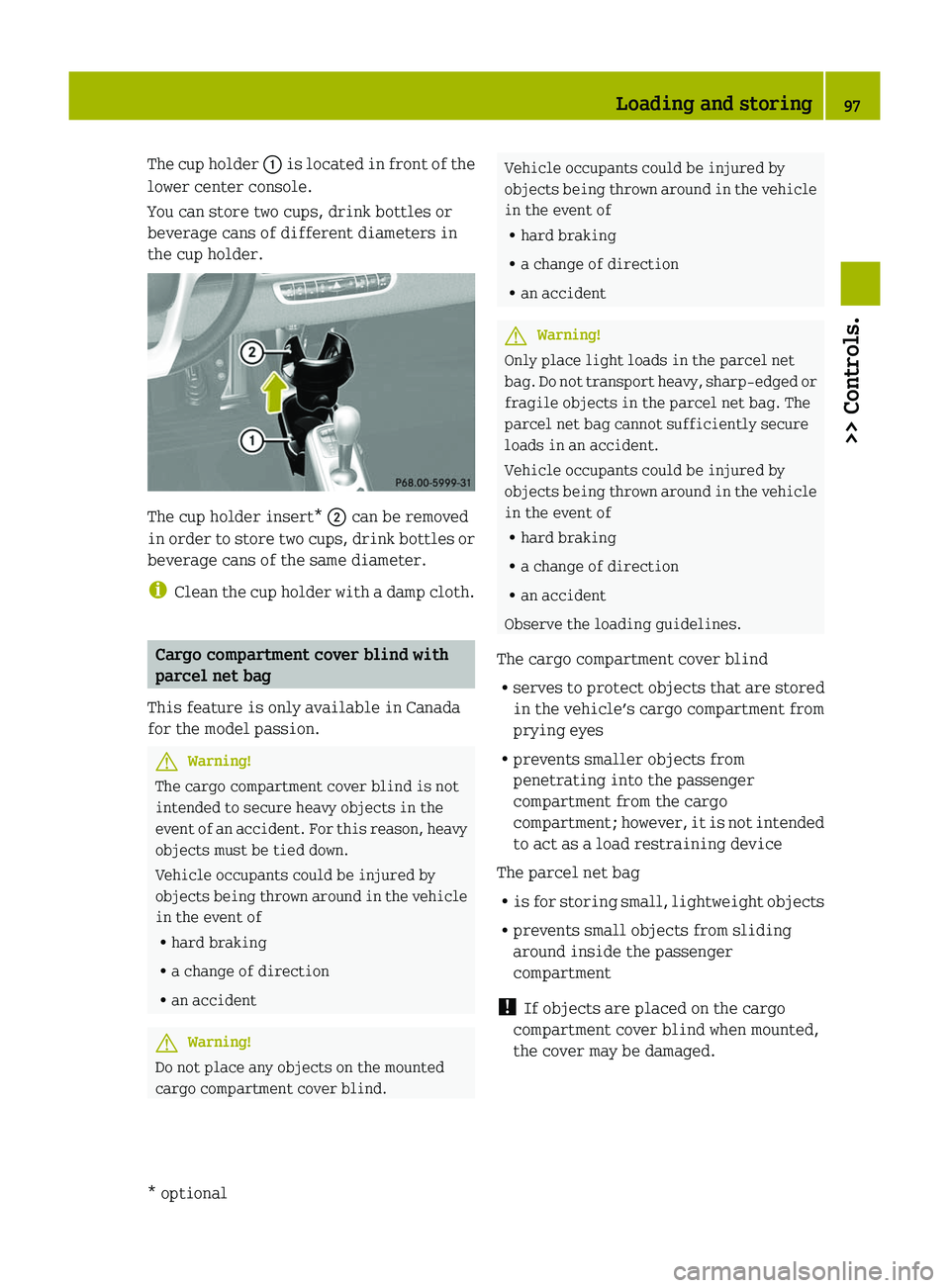
The cup holder 0046 is located in front of the
lower center console.
You can store two cups, drink bottles or
beverage cans of different diameters in
the cup holder.
The cup holder insert* 0047 can be removed
in order to store two cups, drink bottles or
beverage cans of the same diameter.
i Clean the cup holder with a damp cloth.
Cargo compartment cover blind with
parcel net bag
This feature is only available in Canada
for the model passion.
GWarning!
The cargo compartment cover blind is not
intended to secure heavy objects in the
event of an accident. For this reason, heavy
objects must be tied down.
Vehicle occupants could be injured by
objects being thrown around in the vehicle
in the event of
R hard braking
R a change of direction
R an accident
GWarning!
Do not place any objects on the mounted
cargo compartment cover blind.
Vehicle occupants could be injured by
objects being thrown around in the vehicle
in the event of
R hard braking
R a change of direction
R an accidentGWarning!
Only place light loads in the parcel net
bag. Do not transport heavy, sharp-edged or
fragile objects in the parcel net bag. The
parcel net bag cannot sufficiently secure
loads in an accident.
Vehicle occupants could be injured by
objects being thrown around in the vehicle
in the event of
R hard braking
R a change of direction
R an accident
Observe the loading guidelines.
The cargo compartment cover blind
R serves to protect objects that are stored
in the vehicle’s cargo compartment from
prying eyes
R prevents smaller objects from
penetrating into the passenger
compartment from the cargo
compartment; however, it is not intended
to act as a load restraining device
The parcel net bag
R is for storing small, lightweight objects
R prevents small objects from sliding
around inside the passenger
compartment
! If objects are placed on the cargo
compartment cover blind when mounted,
the cover may be damaged.
Loading and storing97>> Controls.* optional451_AKB; 3; 22, en-USd2ureepe,Version: 2.11.8.12009-07-27T09:36:34+02:00 - Seite 97Z
Page 102 of 216
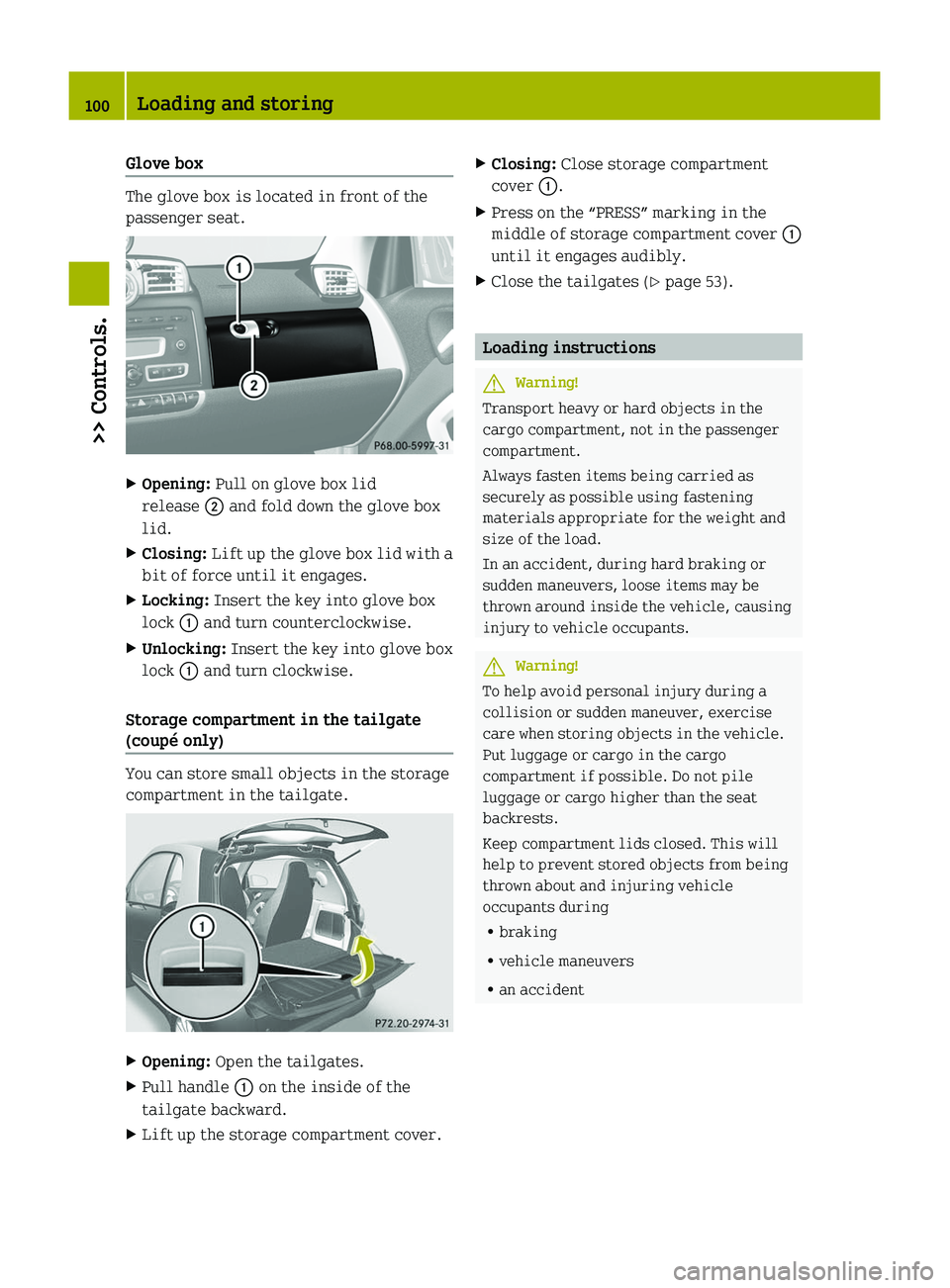
Glove box
The glove box is located in front of the
passenger seat.
XOpening: Pull on glove box lid
release 0047 and fold down the glove box
lid.XClosing: Lift up the glove box lid with a
bit of force until it engages.XLocking: Insert the key into glove box
lock 0046 and turn counterclockwise.XUnlocking: Insert the key into glove box
lock 0046 and turn clockwise.
Storage compartment in the tailgate
(coupé only)
You can store small objects in the storage
compartment in the tailgate.
XOpening: Open the tailgates.XPull handle 0046 on the inside of the
tailgate backward.XLift up the storage compartment cover.XClosing: Close storage compartment
cover 0046.XPress on the “PRESS” marking in the
middle of storage compartment cover 0046
until it engages audibly.XClose the tailgates ( Y page 53).
Loading instructions
GWarning!
Transport heavy or hard objects in the
cargo compartment, not in the passenger
compartment.
Always fasten items being carried as
securely as possible using fastening
materials appropriate for the weight and
size of the load.
In an accident, during hard braking or
sudden maneuvers, loose items may be
thrown around inside the vehicle, causing
injury to vehicle occupants.
GWarning!
To help avoid personal injury during a
collision or sudden maneuver, exercise
care when storing objects in the vehicle.
Put luggage or cargo in the cargo
compartment if possible. Do not pile
luggage or cargo higher than the seat
backrests.
Keep compartment lids closed. This will
help to prevent stored objects from being
thrown about and injuring vehicle
occupants during
R braking
R vehicle maneuvers
R an accident
100Loading and storing>> Controls.
451_AKB; 3; 22, en-USd2ureepe,Version: 2.11.8.12009-07-27T09:36:34+02:00 - Seite 100