tow SMART FORTWO COUPE 2010 Owner's Manual
[x] Cancel search | Manufacturer: SMART, Model Year: 2010, Model line: FORTWO COUPE, Model: SMART FORTWO COUPE 2010Pages: 216, PDF Size: 9.7 MB
Page 139 of 216

RNever run the fuel tank empty.
R If the engine starts to misfire, bring the
vehicle to an immediate standstill
without endangering traffic.
R If the engine fails to start the first time,
you should not try to start it any more
than three times in succession.
R Do not try to start for more than four
seconds at a time.
Tires
GWarning!
If you feel a sudden significant vibration
or ride disturbance, or you suspect that
possible damage to your vehicle has
occurred, you should turn on the hazard
warning flashers, carefully slow down, and
drive with caution to an area which is a safe
distance from the road.
Inspect the tires and the vehicle underbody
for possible damage. If the vehicle or tires
appear unsafe, have the vehicle towed to the
nearest smart center or tire dealer for
repairs.
Treadwear indicators (TWI) are required by
law. These indicators are located in six
places on the tread circumference and
become visible at a tread depth of
approximately 1
/ 16 in (1.6 mm), at which
point the tire is considered worn and
should be replaced.
The treadwear indicator appears as a solid
band across the tread.
GWarning!
Although the applicable federal motor
vehicle safety laws consider a tire to be
worn when the treadwear indicators (TWI)
become visible at approximately 1
/ 16 in
(1.6 mm), we recommend that you do not allow
your tires to wear down to that level. As
tread depth approaches 1
/ 8 in (3 mm), the
adhesion properties on a wet road are
sharply reduced.
Depending upon the weather and/or road
surface (conditions), the tire traction
varies widely.
Specified tire inflation pressures must be
maintained. This applies particularly if
the tires are subject to high loads (e.g.
high speeds, heavy loads, high ambient
temperatures).GWarning!
Do not drive with a flat tire. A flat tire will
affect your ability to steer or brake and may
cause you to lose control of the vehicle.
Continued driving with a flat tire or
driving at high speed with a flat tire will
cause excessive heat build-up and possibly
a fire.
For more information, see “Tires and
wheels” ( Y page 114).
Hydroplaning
Depending on the depth of the water layer
on the road, hydroplaning may occur
resulting in a loss of control, even at low
speeds and with new tires. Reduce vehicle
speed, avoid track grooves in the road and
apply brakes cautiously when it is raining.
Tire traction
The safe speed on a wet, snow covered or icy
road is always lower than on a dry road.
You should pay particular attention to the
condition of the road whenever the outside
temperatures are close to the freezing
point.
GWarning!
If ice has formed on the road, tire traction
will be substantially reduced. Under such
weather conditions, drive, steer and brake
with extreme caution.
Driving instructions137>> Operation.451_AKB; 3; 22, en-USd2ureepe,Version: 2.11.8.12009-07-27T09:36:34+02:00 - Seite 137Z
Page 145 of 216
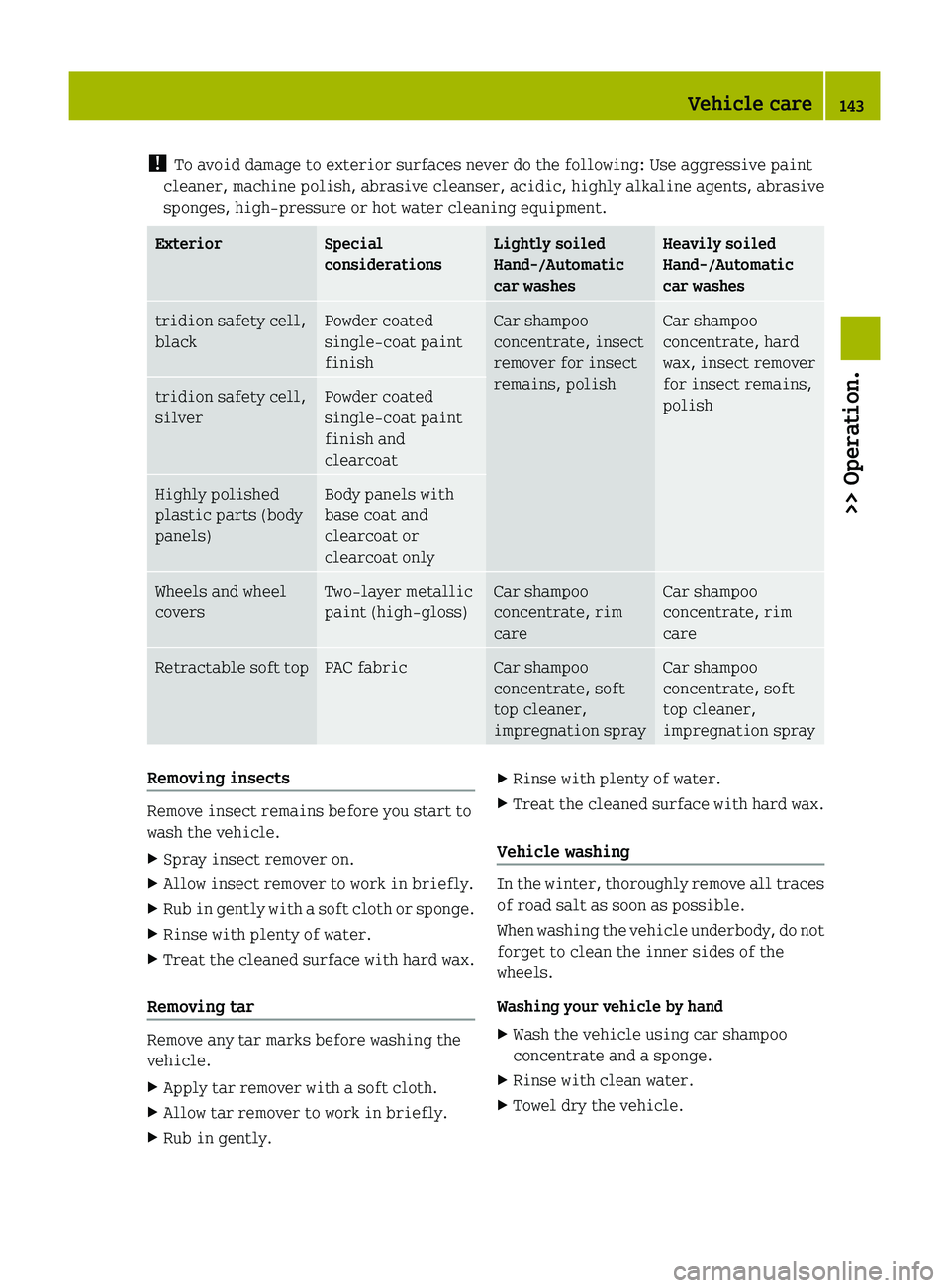
! To avoid damage to exterior surfaces never do the following: Use aggressive paint
cleaner, machine polish, abrasive cleanser, acidic, highly alkaline agents, abrasive
sponges, high-pressure or hot water cleaning equipment.ExteriorSpecial
considerationsLightly soiled
Hand-/Automatic
car washesHeavily soiled
Hand-/Automatic
car washestridion safety cell,
blackPowder coated
single-coat paint
finishCar shampoo
concentrate, insect
remover for insect
remains, polishCar shampoo
concentrate, hard
wax, insect remover
for insect remains,
polishtridion safety cell,
silverPowder coated
single-coat paint
finish and
clearcoatHighly polished
plastic parts (body
panels)Body panels with
base coat and
clearcoat or
clearcoat onlyWheels and wheel
coversTwo-layer metallic
paint (high-gloss)Car shampoo
concentrate, rim
careCar shampoo
concentrate, rim
careRetractable soft topPAC fabricCar shampoo
concentrate, soft
top cleaner,
impregnation sprayCar shampoo
concentrate, soft
top cleaner,
impregnation sprayRemoving insects
Remove insect remains before you start to
wash the vehicle.
XSpray insect remover on.XAllow insect remover to work in briefly.XRub in gently with a soft cloth or sponge.XRinse with plenty of water.XTreat the cleaned surface with hard wax.
Removing tar
Remove any tar marks before washing the
vehicle.
XApply tar remover with a soft cloth.XAllow tar remover to work in briefly.XRub in gently.XRinse with plenty of water.XTreat the cleaned surface with hard wax.
Vehicle washing
In the winter, thoroughly remove all traces
of road salt as soon as possible.
When washing the vehicle underbody, do not
forget to clean the inner sides of the
wheels.
Washing your vehicle by hand
XWash the vehicle using car shampoo
concentrate and a sponge.XRinse with clean water.XTowel dry the vehicle.Vehicle care143>> Operation.451_AKB; 3; 22, en-USd2ureepe,Version: 2.11.8.12009-07-27T09:36:34+02:00 - Seite 143Z
Page 149 of 216
>> Practical hints.Where will I find ...? ........................148
Display messages ............................. 148
What to do if ... ............................... 149
Unlocking/locking manually ...............162
Replacing transmitter battery ............163
Replacing bulbs .............................. 164
Replacing wiper blades .....................170
Flat tire ........................................ 172
Wheel change ................................... 177
Battery .......................................... 180
Jump starting .................................. 183
Towing ........................................... 185
Fuses ............................................. 188451_AKB; 3; 22, en-USd2ureepe,Version: 2.11.8.12009-07-27T09:36:34+02:00 - Seite 147
Page 169 of 216
Replacing bulbs for front lamps
Before you start to replace a bulb for a
front lamp, do the following first:XTurn the exterior lamp switch to position
0027 (Y page 62).XSwitch off the ignition.XOpen the service flap ( Y page 110).
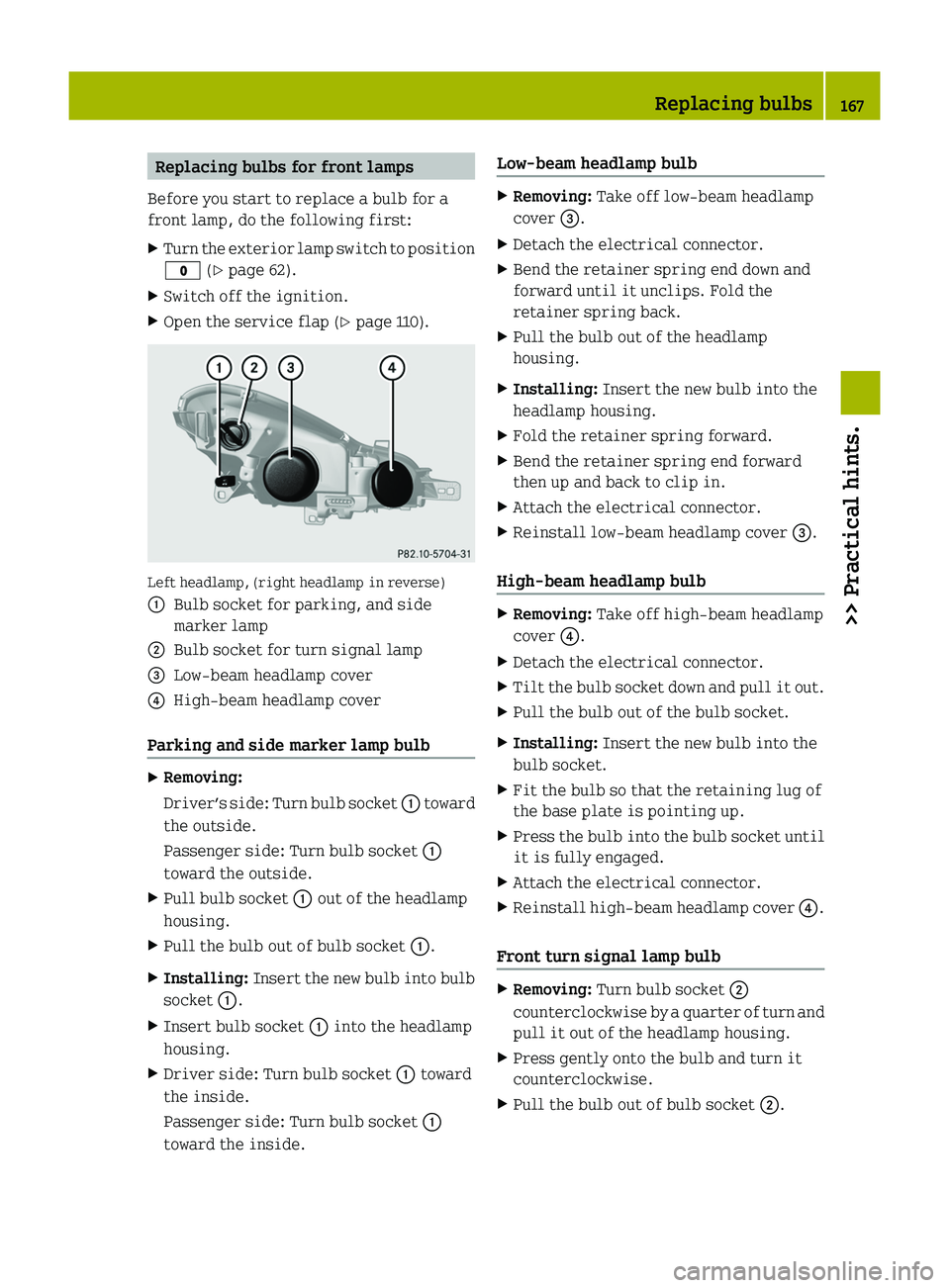
Left headlamp, (right headlamp in reverse)
0046Bulb socket for parking, and side
marker lamp0047Bulb socket for turn signal lamp008ALow‑beam headlamp cover0088High‑beam headlamp cover
Parking and side marker lamp bulb
XRemoving:
Driver’s side: Turn bulb socket 0046 toward
the outside.
Passenger side: Turn bulb socket 0046
toward the outside.XPull bulb socket 0046 out of the headlamp
housing.XPull the bulb out of bulb socket 0046.XInstalling: Insert the new bulb into bulb
socket 0046.XInsert bulb socket 0046 into the headlamp
housing.XDriver side: Turn bulb socket 0046 toward
the inside.
Passenger side: Turn bulb socket 0046
toward the inside.Low‑beam headlamp bulbXRemoving: Take off low‑beam headlamp
cover 008A.XDetach the electrical connector.XBend the retainer spring end down and
forward until it unclips. Fold the
retainer spring back.XPull the bulb out of the headlamp
housing.XInstalling: Insert the new bulb into the
headlamp housing.XFold the retainer spring forward.XBend the retainer spring end forward
then up and back to clip in.XAttach the electrical connector.XReinstall low‑beam headlamp cover 008A.
High‑beam headlamp bulb
XRemoving: Take off high‑beam headlamp
cover 0088.XDetach the electrical connector.XTilt the bulb socket down and pull it out.XPull the bulb out of the bulb socket.XInstalling: Insert the new bulb into the
bulb socket.XFit the bulb so that the retaining lug of
the base plate is pointing up.XPress the bulb into the bulb socket until
it is fully engaged.XAttach the electrical connector.XReinstall high‑beam headlamp cover 0088.
Front turn signal lamp bulb
XRemoving: Turn bulb socket 0047
counterclockwise by a quarter of turn and
pull it out of the headlamp housing.XPress gently onto the bulb and turn it
counterclockwise.XPull the bulb out of bulb socket 0047.Replacing bulbs167>> Practical hints.451_AKB; 3; 22, en-USd2ureepe,Version: 2.11.8.12009-07-27T09:36:34+02:00 - Seite 167Z
Page 173 of 216
To ensure proper visibility
R it is vital that you have wiper blades that
are in perfect shape
R clean the wiper blades regularly with a
cleaning agent
R remove any tough dirt stains with a
sponge or brush
Windshield wiper blades
! Do not pull on the wiper blade inserts.
They could tear.
Removing
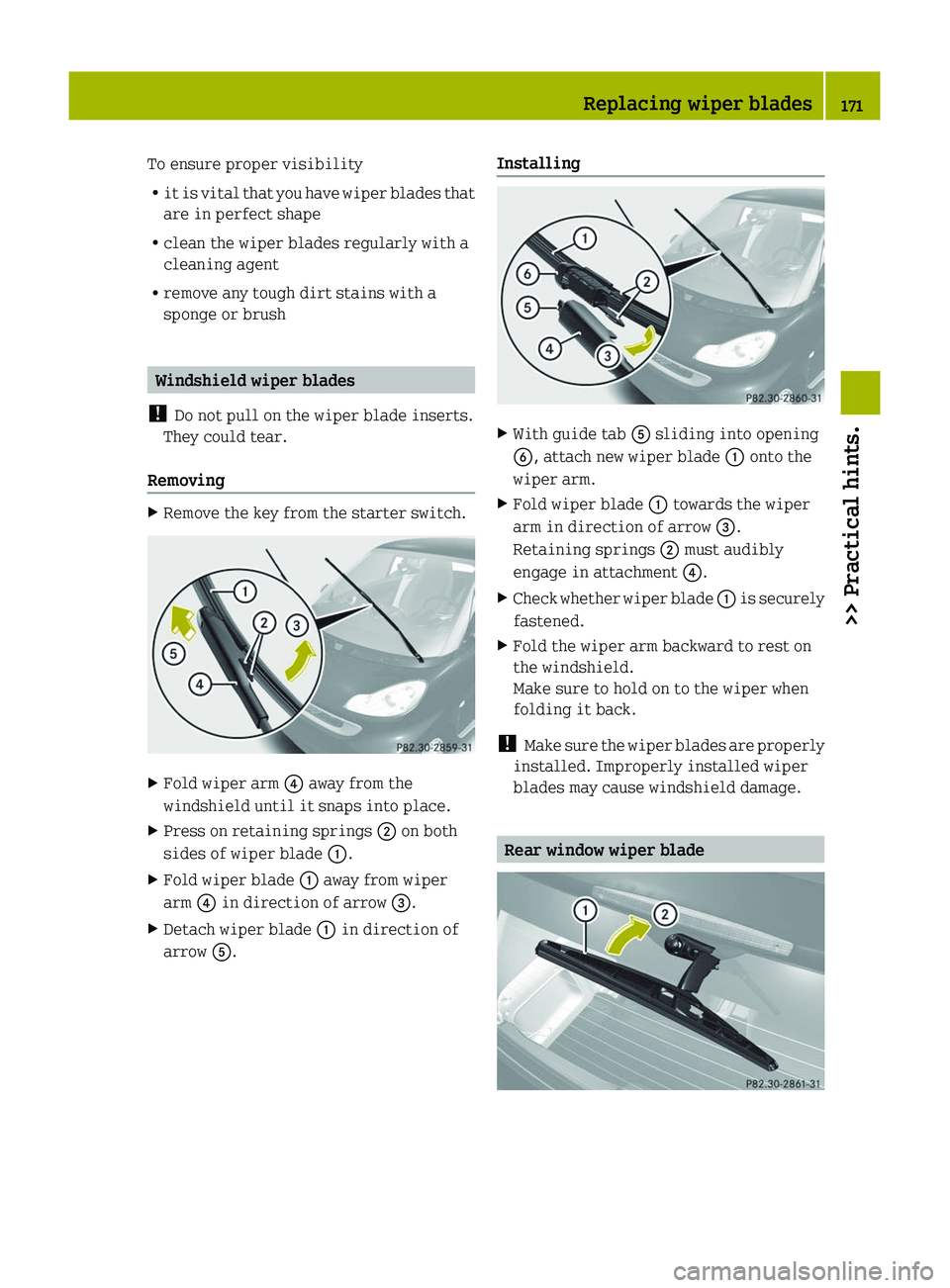
XRemove the key from the starter switch.XFold wiper arm 0088 away from the
windshield until it snaps into place.XPress on retaining springs 0047 on both
sides of wiper blade 0046.XFold wiper blade 0046 away from wiper
arm 0088 in direction of arrow 008A.XDetach wiper blade 0046 in direction of
arrow 0086.InstallingXWith guide tab 0086 sliding into opening
0087 , attach new wiper blade 0046 onto the
wiper arm.XFold wiper blade 0046 towards the wiper
arm in direction of arrow 008A.
Retaining springs 0047 must audibly
engage in attachment 0088.XCheck whether wiper blade 0046 is securely
fastened.XFold the wiper arm backward to rest on
the windshield.
Make sure to hold on to the wiper when
folding it back.
! Make sure the wiper blades are properly
installed. Improperly installed wiper
blades may cause windshield damage.
Rear window wiper blade
Replacing wiper blades171>> Practical hints.451_AKB; 3; 22, en-USd2ureepe,Version: 2.11.8.12009-07-27T09:36:34+02:00 - Seite 171Z
Page 185 of 216
Reinstalling the batteryXReinstall the charged battery. Follow the
previously described steps in reverse
order.
! The battery, its filler caps and the
ventilation hose must always be securely
installed when the vehicle is in
operation.
Reconnecting the battery
! Always connect the battery in the order
described below. Otherwise the
vehicle’s electronics can be damaged.
XTurn off all electrical accessories.XRemove the key from the starter switch.
! Never invert the terminal connections!
XConnect the battery positive lead and
fasten cover 0088 (Y page 182).XConnect battery negative lead 008A
( Y page 182).
i
After battery power (e.g. due to
reconnection) was interrupted, you will
have to set the clock ( Y page 86).
i Have the battery’s charge status and
acid level checked at the start of the cold
season at a smart center.
Jump starting
GWarning!
Failure to follow these directions will
cause damage to the electronic components,
and can lead to a battery explosion and
severe injury or death.
Never lean over batteries while connecting
or jump starting, you might get injured.
Battery fluid contains sulfuric acid. Do not
allow this fluid to come in contact with
eyes, skin or clothing. In case it does,
immediately flush affected area with
water, and seek medical help if necessary.
A battery will also produce hydrogen gas,
which is flammable and very explosive.
Keep flames or sparks away from battery,
avoid improper connection of jumper
cables, smoking, etc.
Attempting to jump start a frozen battery
can result in it exploding, causing
personal injury.
Read all instructions before proceeding.
! Do not tow‑start vehicle. You could
otherwise seriously damage the
transmission which is not covered by the
smart Limited Warranty.
! Avoid repeated and lengthy starting
attempts.
Do not attempt to start the engine using
a battery quick charge unit.
If the engine does not run after several
unsuccessful starting attempts, have it
checked at the nearest authorized smart
center.
Excessive unburned fuel generated by
repeated failed starting attempts may
damage the catalytic converter and may
present a fire risk.
Make sure the jumper cables do not have
loose or missing insulation.
Make sure the cable clamps do not touch
any other metal part while the other end
is still attached to a battery.
If the battery is discharged, the engine can
be started with jumper cables and the fully
charged battery of another vehicle or an
equivalent starter pack. Observe the
following:
R Access to the battery is not possible on
all vehicles. If you cannot access the
battery in your vehicle provide jumpJump starting183>> Practical hints.451_AKB; 3; 22, en-USd2ureepe,Version: 2.11.8.12009-07-27T09:36:34+02:00 - Seite 183Z
Page 187 of 216
Position 0086 represents the charged battery
of another vehicle or an equivalent starter
pack.
! Never invert the terminal connections!XConnect positive terminal 0046 of charged
battery 0086 with positive terminal 0047 of
discharged battery 0087 with a jumper
cable. Clamp the jumper cable to
positive terminal 0046 of charged battery
0086 first.XStart the engine of the vehicle with
charged battery 0086 and run at idle speed.XConnect negative terminal 008A of charged
battery 0086 with negative terminal 0088 of
discharged battery 0087 with a jumper
cable. Clamp the jumper cable to
negative terminal 008A of charged battery
0086 first.XStart the engine of the vehicle with
discharged battery 0087 and run at idle
speed. You can now switch on the
electrical consumers. Do not switch on
the headlamps under any circumstances.XRemove the jumper cables from negative
terminals 008A and 0088 first.XRemove the jumper cables from positive
terminals 0046 and 0047.
You can now switch on the headlamps.XRemount the positive terminal cover.XHave the battery checked at the nearest
authorized smart center.
Towing
About towing
This section offers information on towing
methods for breakdown situations,
emergency towing, and flat towing smart
vehicles.
Recommended towing method -
Breakdown situation
smart recommends that the vehicle be
transported with all wheels off the ground
using a flatbed carrier truck or
appropriate wheel lift/dolly equipment.XSwitch off the tow‑away protection* and
interior motion sensor* ( Y page 48).
!
To prevent damage during transport, do
not tie down the vehicle by its chassis or
suspension parts — use only wheel straps
to position and hold down the vehicle.
Improper tie down on a flatbed carrier
truck or trailer can damage suspension
parts and body panels.
Emergency towing
When circumstances do not permit the
recommended towing method, the vehicle
may be towed with all wheels on the ground
using a strap or tow bar connected to
another vehicle. Only tow the vehicle as far
as necessary to have the vehicle moved to a
safe location where the recommended
towing method can be employed.
GWarning!
If circumstances require towing the
vehicle with all wheels on the ground,
always tow with a tow bar if:
R the engine will not run
R there is a malfunction in the brake
system
R there is a malfunction in the power
supply or in the vehicle’s electrical
system
A tow bar is necessary to adequately control
the towed vehicle.
Prior to towing the vehicle with all wheels
on the ground, make sure the gear selector
lever is in neutral position N and the
ignition is switched off.
Towing185>> Practical hints.* optional451_AKB; 3; 22, en-USd2ureepe,Version: 2.11.8.12009-07-27T09:36:34+02:00 - Seite 185Z
Page 188 of 216
GWarning!
With the engine not running, there is no
power assistance for the brake and
steering* systems. In this case, it is
important to keep in mind that a
considerably higher degree of effort is
necessary to brake and steer the vehicle.
Adapt your driving accordingly.
! Do not tow the vehicle with the front
axle raised. Doing so may cause serious
damage to the brake system which is not
covered by the smart Limited Warranty.
! Before towing the vehicle observe the
following instructions:
R Do not tow with sling-type equipment
attached to suspension parts. This may
cause damage to the radiator and other
supports if towing on a bumpy road.
R Towing the vehicle should only be done
using the properly installed towing
eye bolt. Never attach a tow cable, tow
rope, or tow rod to the vehicle chassis,
frame, or suspension parts.
! Make sure the ignition is switched off
while towing the vehicle. Doing
otherwise may result in
R the ESP ®
being activated. Active
braking action through the ESP ®
may
seriously damage the brake system
which is not covered by the smart
Limited Warranty.
R a discharged battery.
! Make sure the gear selector lever is in
neutral position N while towing the
vehicle. Doing otherwise may result in
significant transmission damage.
! Towing the vehicle with a luggage
rack* mounted is not permissible. The
vehicle must not be towed by the luggage
rack*.
i If the battery is disconnected or
discharged, the gear selector lever will
remain locked in park position P.
Contact an authorized smart center for
assistance or call Roadside Assistance.
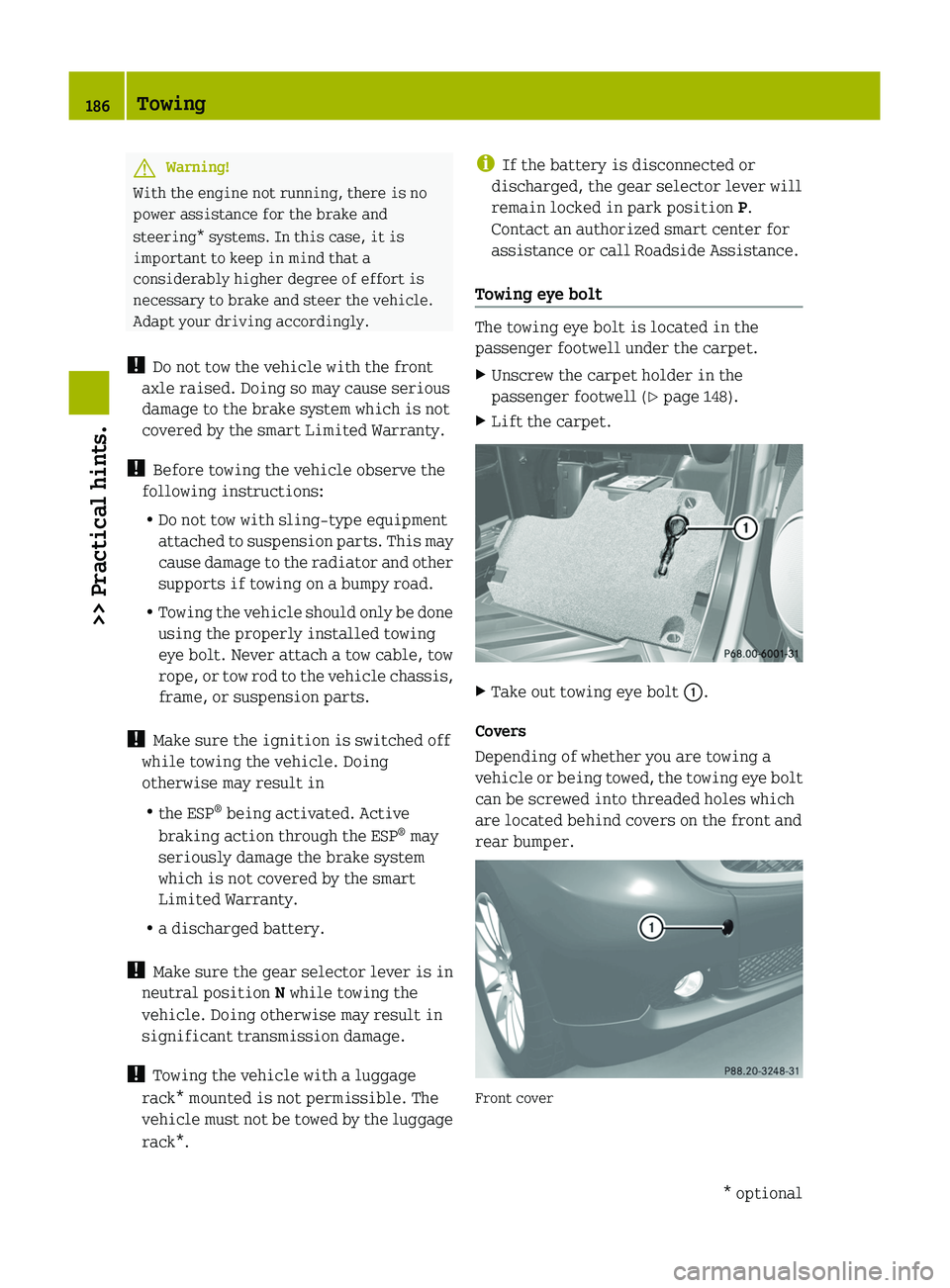
Towing eye bolt
The towing eye bolt is located in the
passenger footwell under the carpet.
XUnscrew the carpet holder in the
passenger footwell ( Y page 148).XLift the carpet.XTake out towing eye bolt 0046.
Covers
Depending of whether you are towing a
vehicle or being towed, the towing eye bolt
can be screwed into threaded holes which
are located behind covers on the front and
rear bumper.
Front cover
186Towing>> Practical hints.* optional451_AKB; 3; 22, en-USd2ureepe,Version: 2.11.8.12009-07-27T09:36:34+02:00 - Seite 186
Page 189 of 216

XRemove cover 0046 using a suitable object
to reveal the threaded hole for the towing
eye bolt.GWarning!
High outside temperature, stop-and-go
traffic, driving on long uphill grades, or
driving at high engine speed may increase
the temperature in the engine
compartment. Therefore the area around the
air slots in the rear apron may be hot. Let
the engine cool off before touching this
area to prevent burns.
Rear cover
XRemove cover 0047 using a suitable object
to reveal the threaded hole for the towing
eye bolt.
Installing towing eye bolt
XScrew towing eye bolt in clockwise to its
stop and tighten with a suitable object.GWarning!
For safety reasons, recovery or lashing
down of the vehicle by means of the towing
eye is not allowed. Failure to observe this
could result in the towing eye being ripped
out of its mounting and people being
injured.
Towing the vehicle
XEngage the parking brake.XConnect the strap or tow bar to the towing
eye.XSwitch on the ignition.XDepress the brake pedal and keep it
pressed.XMove the gear selector lever to neutral
position N.XRelease the brake pedal.
i
With the gear selector lever in neutral
position N, the key cannot be turned fully
to starter switch position 0. Therefore
turn the key in the starter switch as far
left as it will go when switching off the
ignition.
XSwitch off the ignition.XLeave the key in the starter switch.XSwitch on the hazard warning flasher.XRelease the parking brake.
Flat towing
Flat towing is when all wheels of the
vehicle are on the ground during the tow.
For vehicles that will be flat towed over
long distances observe the following
recommendations:
XPreparing the vehicle: Contact an
authorized smart center for information
on recommended tow bar equipment and
installing a matching on/off switch on
the battery terminal.XBefore towing: Make sure the ignition is
switched on.XEngage the parking brake.XDepress the brake pedal and keep it
pressed.XMove the gear selector lever to neutral
position N.XRelease the brake pedal.
i
With the gear selector lever in neutral
position N, the key cannot be turned fully
to starter switch position 0. Therefore
turn the key in the starter switch as far
Towing187>> Practical hints.451_AKB; 3; 22, en-USd2ureepe,Version: 2.11.8.12009-07-27T09:36:34+02:00 - Seite 187Z
Page 190 of 216

left as it will go when switching off the
ignition.XSwitch off the ignition.XLeave the key in the starter switch.XWait approximately 30 seconds until the
multifunction display in the instrument
cluster is completely blank.XTurn the battery off using the previously
installed battery switch.XRelease the parking brake.XDuring towing: Make sure the gear
selector lever remains in neutral
position N with the ignition switched
off.XAfter towing: Engage the parking brake.XTurn the battery on using the previously
installed battery switch.XMove the gear selector lever to park
position P.XRemove the key from the starter switch.XLock the doors.
!
Do not flat tow the vehicle with the front
axle raised. Doing so may cause serious
damage to the brake system which is not
covered by the smart Limited Warranty.
! Failure to follow the recommendations
for flat towing can cause damage to your
vehicle:
R Not following the battery disconnect
procedure in the proper sequence may
result in data loss in the vehicle’s
control units.
R Not disconnecting the battery and
leaving the key in starter switch
position 1 (ignition on) may result in
- the vehicle locking. The vehicle will
lock if the wheels are turning at
vehicle speeds of approximately
8 mph (14 km/h) or more.
- the ESP ®
being activated. Active
braking action through the ESP ®
may
seriously damage the brake system
which is not covered by the smart
Limited Warranty.
R Not moving the gear selector lever to
neutral position N may result in
significant transmission damage.
R in a discharged battery.
Fuses
The electrical fuses in your vehicle serve
to switch off malfunctioning power
circuits.
If a fuse is blown, the components and
systems secured by that fuse will stop
operating.
GWarning!
Only use fuses approved by smart with the
specified amperage for the system in
question and do not attempt to repair or
bridge a blown fuse this may cause an
overload leading to a fire, and/or cause
damage to electrical components and/or
systems. Contact a smart center if you
encounter any electrical problems.
! A blown fuse must be replaced by an
appropriate spare fuse (recognizable by
its color or the fuse rating given on the
fuse) of the amperage recommended in
the fuse chart. Any smart center will be
glad to advise you on this subject.
If a newly inserted fuse blows again, have
the cause determined and rectified at an
authorized smart center.
Before replacing fuses:
R Engage the parking brake.
R Make sure the gear selector lever is in
park position P.
R Turn off all electrical accessories.
188Fuses>> Practical hints.
451_AKB; 3; 22, en-USd2ureepe,Version: 2.11.8.12009-07-27T09:36:34+02:00 - Seite 188