flat tire SMART FORTWO COUPE 2010 Owner's Guide
[x] Cancel search | Manufacturer: SMART, Model Year: 2010, Model line: FORTWO COUPE, Model: SMART FORTWO COUPE 2010Pages: 216, PDF Size: 9.7 MB
Page 177 of 216
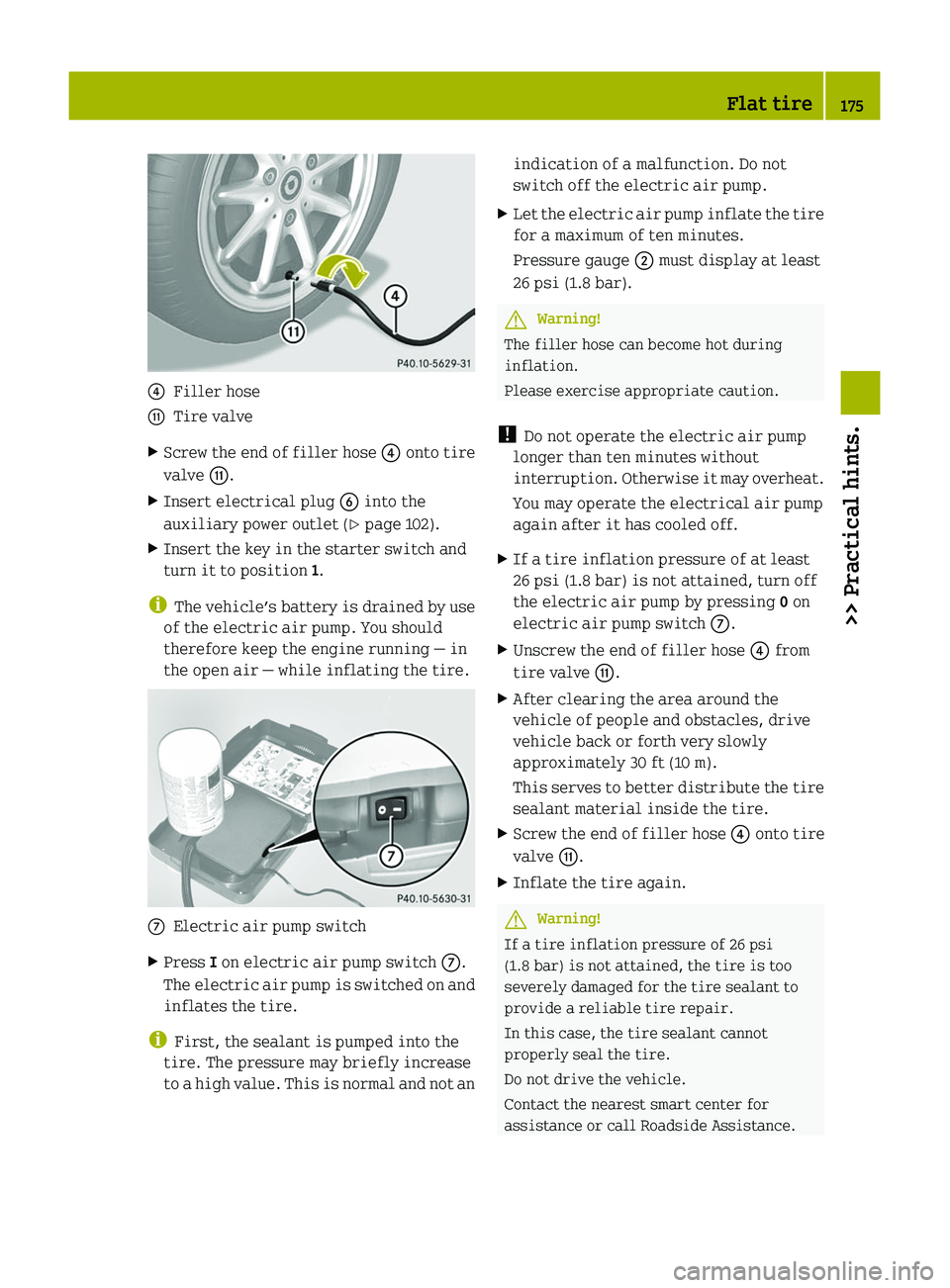
0088Filler hose0072Tire valveXScrew the end of filler hose 0088 onto tire
valve 0072.XInsert electrical plug 0087 into the
auxiliary power outlet ( Y page 102).XInsert the key in the starter switch and
turn it to position 1.
i
The vehicle’s battery is drained by use
of the electric air pump. You should
therefore keep the engine running — in
the open air — while inflating the tire.
006EElectric air pump switchXPress I on electric air pump switch 006E.
The electric air pump is switched on and
inflates the tire.
i First, the sealant is pumped into the
tire. The pressure may briefly increase
to a high value. This is normal and not an
indication of a malfunction. Do not
switch off the electric air pump.XLet the electric air pump inflate the tire
for a maximum of ten minutes.
Pressure gauge 0047 must display at least
26 psi (1.8 bar).GWarning!
The filler hose can become hot during
inflation.
Please exercise appropriate caution.
! Do not operate the electric air pump
longer than ten minutes without
interruption. Otherwise it may overheat.
You may operate the electrical air pump
again after it has cooled off.
XIf a tire inflation pressure of at least
26 psi (1.8 bar) is not attained, turn off
the electric air pump by pressing 0 on
electric air pump switch 006E.XUnscrew the end of filler hose 0088 from
tire valve 0072.XAfter clearing the area around the
vehicle of people and obstacles, drive
vehicle back or forth very slowly
approximately 30 ft (10 m).
This serves to better distribute the tire
sealant material inside the tire.XScrew the end of filler hose 0088 onto tire
valve 0072.XInflate the tire again.GWarning!
If a tire inflation pressure of 26 psi
(1.8 bar) is not attained, the tire is too
severely damaged for the tire sealant to
provide a reliable tire repair.
In this case, the tire sealant cannot
properly seal the tire.
Do not drive the vehicle.
Contact the nearest smart center for
assistance or call Roadside Assistance.
Flat tire175>> Practical hints.451_AKB; 3; 22, en-USd2ureepe,Version: 2.11.8.12009-07-27T09:36:34+02:00 - Seite 175Z
Page 178 of 216
XAfter attaining a tire inflation pressure
of at least 26 psi (1.8 bar), press 0 on
electric air pump switch 006E.
The electric air pump is switched off.XTurn the key in the starter switch to
position 0.XUnscrew the end of filler hose 0088 from
tire valve 0072.GWarning!
The filler hose may still be hot.
Please exercise appropriate caution.
XPlug filler hose with the stopper.XTire sealant container 0070 remains
screwed onto flange 0071.XPlace the tire repair kit securely in the
vehicle.XDrive off immediately.
The tire sealant will distribute itself
evenly inside the tire.GWarning!
Do not exceed vehicle speed of 50 mph
(80 km/h). A tire sealant repair is not
designed to operate at higher speeds.
The sticker must be attached on the
instrument cluster where it will be easily
seen by the driver.
Vehicle handling characteristics of a tire
sealant repaired tire may change. Adapt
your driving accordingly.
XAfter driving for about 1.8 miles (3 km)
or ten minutes, take all of the
appropriate safety precautions and then
take the tire repair kit from the vehicle.XScrew the end of filler hose 0088 onto tire
valve 0072.XCheck the tire inflation pressure using
pressure gauge 0047.GWarning!
If tire inflation pressure has fallen below
20 psi (1.3 bar) do not continue to drive the
vehicle.
Park your vehicle safely away from the
roadway and contact the nearest smart
center or call Roadside Assistance.
Have the damaged tire replaced.
XIf the tire inflation pressure is at least
20 psi (1.3 bar), inflate or deflate the
tire to correct tire inflation pressure
(see Tire and Loading Information
placard located on the driver’s door
B‑pillar).
R To increase the tire inflation
pressure: Switch on the electric air
pump.
R To decrease the tire inflation
pressure: Open vent screw 008A. Recheck
the tire inflation pressure with the
electric air pump’s pressure gauge.XAfter checking the tire inflation
pressure, unscrew the end of filler
hose 0088 from tire valve 0072.XPlug filler hose with the stopper.XPlace the tire repair kit securely in the
vehicle.XScrew the valve cap onto the tire valve.
! The manufacturer is unable to
guarantee that all tire punctures can be
repaired with the tire repair kit, in
particular cuts or perforations larger
than approximately 0.16 in (4 mm) or away
from the tire’s tread. The manufacturer
is not liable for damage sustained
through improper use of the tire repair
kit.
GWarning!
Follow recommended tire inflation
pressures.
Do not underinflate tires. Underinflated
tires wear excessively and/or unevenly,
176Flat tire>> Practical hints.
451_AKB; 3; 22, en-USd2ureepe,Version: 2.11.8.12009-07-27T09:36:34+02:00 - Seite 176
Page 179 of 216
adversely affect handling and fuel
economy, and are more likely to fail from
being overheated.
Do not overinflate tires. Overinflated
tires can adversely affect handling and
ride comfort, wear unevenly, increase
stopping distance, and result in sudden
deflation (blowout) because they are more
likely to become punctured or damaged by
road debris, potholes etc.
Do not overload the tires by exceeding the
specified load limit as indicated on the
Tire and Loading Information placard on
the driver’s door B‑pillar. Overloading the
tires can overheat them, possibly causing
a blowout. Overloading the tires can also
result in handling or steering problems, or
brake failure.XDrive to the nearest authorized smart
center, to have the damaged tire
replaced.XContact an authorized smart center as
soon as possible to obtain a new filler
hose and a new tire sealant container.XBring used tire sealant materials to an
authorized smart center for proper
disposal.XReplace your tire sealant container
every 4 years. Replacement containers
are available at any authorized smart
center.GWarning!
After changing a tire, contact a smart
center to make sure the bolts holding the
wheel to the car are tight enough.
Otherwise, the wheels could come off. Each
bolt should be tightened to a torque of
81 lb‑ft (110 Nm).
Wheel change
Preparing the vehicle
XPark the vehicle on a hard, flat surface
when possible.XTurn on the hazard warning flasher.XTurn the steering wheel so that the front
wheels are in a straight-ahead position.XEngage the parking brake.XMove the gear selector lever to park
position P.XTurn off the engine.XHave any passenger exit the vehicle at a
safe distance from the roadway.
Removing the wheel
GWarning!
When jacking up the vehicle, only use a
suitable jack. Observe the manufacturer’s
safety instructions.
The jack must be designed for jacking up
this vehicle at the jack take-up brackets
built into both sides of the vehicle.
The jack is intended only for lifting the
vehicle briefly for wheel changes. It is not
suited for performing maintenance work
under the vehicle. To help avoid personal
injury, use the jack only to lift the vehicle
during a wheel change.
Never get beneath the vehicle while it is
supported by the jack. Keep hands and feet
away from the area under the lifted vehicle.
Always lower the vehicle onto sufficient
capacity jackstands before working under
the vehicle.
Always firmly engage the parking brake and
block the wheels with wheel chocks or other
sizeable objects before raising the
vehicle with the jack. Do not release the
parking brake while the vehicle is raised.
Make sure the ground on which the vehicle
is standing and where you place the jack is
Wheel change177>> Practical hints.451_AKB; 3; 22, en-USd2ureepe,Version: 2.11.8.12009-07-27T09:36:34+02:00 - Seite 177Z
Page 205 of 216
Moreover, tires and rims not approved by
smart may, under load, exhibit
dimensional variations and different
tire deformation characteristics that
could cause them to come into contact
with the vehicle body or axle parts.
Damage to the tires or the vehicle may be
the result.
i Further information on tires and rims
is available at any authorized smart
center. A placard with the recommended
tire inflation pressure is located on the
driver’s door B‑pillar.
The tire inflation pressure should be
checked regularly and should only be
adjusted on cold tires. Follow tire
manufacturer’s maintenance
recommendation included with vehicle.
Mobility
Your vehicle is equipped with a tire repair
kit ( Y page 172). In case of a flat tire, it
enables you to drive to the nearest
authorized smart center on the sealed tire.
If the tire is damaged too severely for the
tire sealant to provide a reliable tire
repair:
XContact the nearest smart center.
or
XCall Roadside Assistance.Rims and tires203>> Technical data.451_AKB; 3; 22, en-USd2ureepe,Version: 2.11.8.12009-07-27T09:36:34+02:00 - Seite 203Z