fuel SMART FORTWO COUPE 2010 Owner's Guide
[x] Cancel search | Manufacturer: SMART, Model Year: 2010, Model line: FORTWO COUPE, Model: SMART FORTWO COUPE 2010Pages: 216, PDF Size: 9.7 MB
Page 160 of 216

Tire Pressure Monitoring System (TPMS)* ProblemPossible causes/consequences and 0050 Solutions0077The
combination
low tire
pressure/TPMS
malfunction
telltale
illuminates
continuously.The TPMS detects a loss of pressure in at least one tire.XCarefully bring the vehicle to a halt, avoiding abrupt
steering and braking maneuvers. Observe the traffic
situation around you.XCheck and correct tire inflation pressure as required
( Y page 116).
If the tire inflation pressure in the respective tire(s) has
(have) been corrected, the combination low tire pressure/TPMS
malfunction telltale goes out after a few minutes of driving.
See also “Restarting the TPMS” ( Y page 119).
0077The
combination
low tire
pressure/TPMS
malfunction
telltale flashes
60 seconds and
then stays
illuminated.There is a malfunction in the TPMS.XHave the TPMS checked at an authorized smart center.
After the malfunction has been remedied the combination low
tire pressure/TPMS malfunction telltale goes out after a few
minutes of driving.
GWarning!
Each tire should be checked monthly when cold and inflated to the inflation pressure
recommended by the vehicle manufacturer on the Tire and Loading Information placard. If
your vehicle has tires of a different size than the size indicated on the Tire and Loading
Information placard, you should determine the proper tire inflation pressure for those
tires.
As an added safety feature, your vehicle has been equipped with a tire pressure monitoring
system (TPMS) that illuminates a low tire pressure telltale when one or more of your tires
is significantly underinflated.
Accordingly, when the low tire pressure telltale illuminates, you should stop and check your
tires as soon as possible, and inflate them to the proper pressure. Driving on a significantly
underinflated tire causes the tire to overheat and can lead to tire failure.
Underinflation also reduces fuel efficiency and tire tread life, and may affect the vehicle’s
handling and stopping ability. Please note that the TPMS is not a substitute for proper tire
maintenance, and it is the driver’s responsibility to maintain correct tire pressure, even
if underinflation has not reached the level to trigger illumination of the TPMS low tire
pressure telltale.
Your vehicle has also been equipped with a TPMS malfunction indicator to indicate when
the system is not operating properly. The TPMS malfunction indicator is combined with the
low tire pressure telltale. When the system detects a malfunction, the telltale will flash for
approximately 1 minute and then remain continuously illuminated.
158What to do if ...>> Practical hints.* optional451_AKB; 3; 22, en-USd2ureepe,Version: 2.11.8.12009-07-27T09:36:34+02:00 - Seite 158
Page 164 of 216
Unlocking/locking manually
Unlocking the vehicle
You can unlock the driver’s door and the
fuel filler flap by unlocking the driver’s
door using the key. The lock cylinder is
fitted with a cap.
XPress button 0034 on the key.
The anti-theft warning system* is
disarmed.
i If the transmitter battery in the key is
discharged, the anti-theft warning
system* can no longer be disarmed with
button 0034 on the key. For replacing the
transmitter battery ( Y page 163).
Unlocking the vehicle with the key and
opening a door or the tailgate will
trigger the anti-theft warning system*
( Y page 47).
To cancel the alarm:
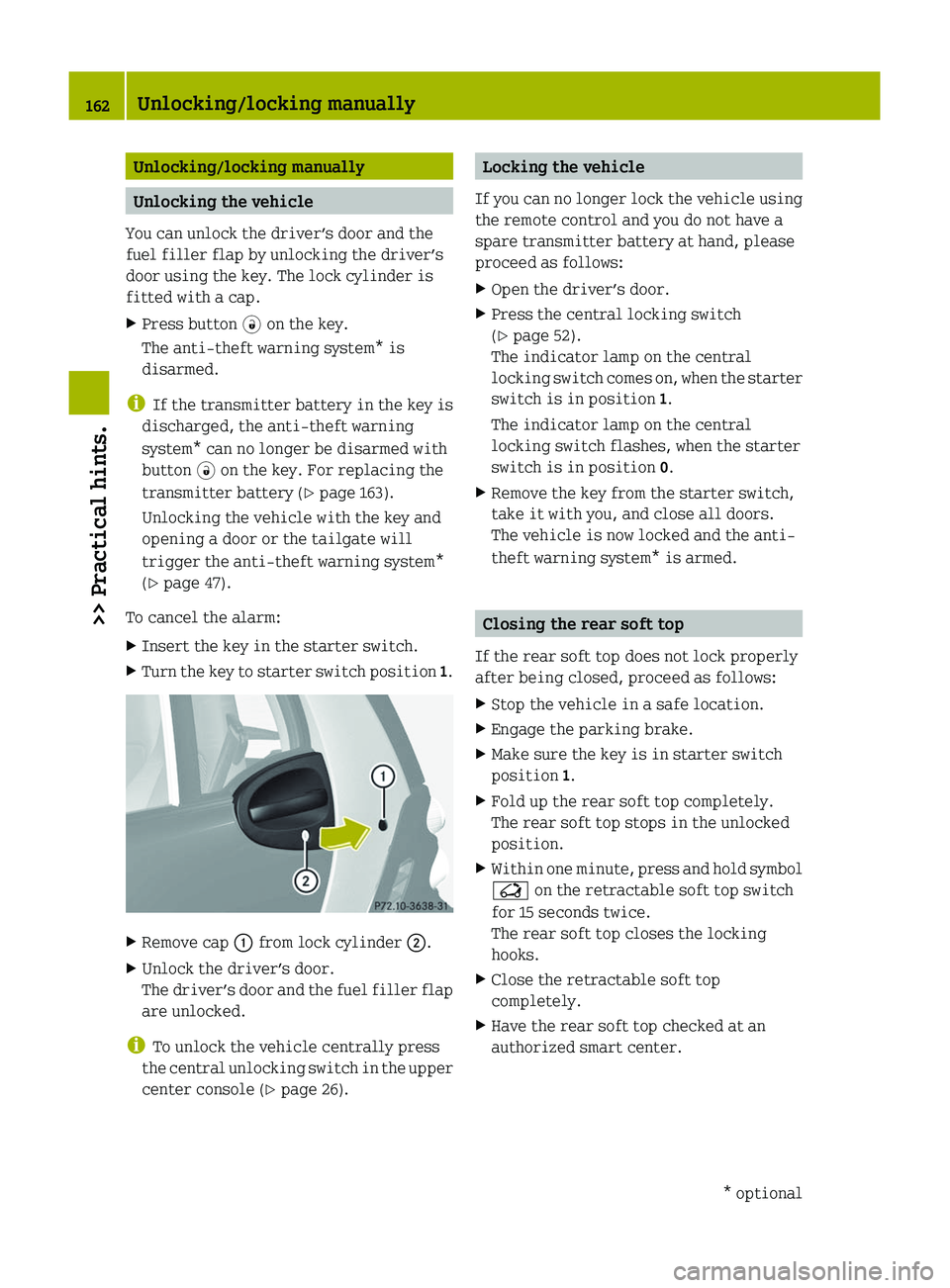
XInsert the key in the starter switch.XTurn the key to starter switch position 1.XRemove cap 0046 from lock cylinder 0047.XUnlock the driver’s door.
The driver’s door and the fuel filler flap
are unlocked.
i To unlock the vehicle centrally press
the central unlocking switch in the upper
center console ( Y page 26).
Locking the vehicle
If you can no longer lock the vehicle using
the remote control and you do not have a
spare transmitter battery at hand, please
proceed as follows:XOpen the driver’s door.XPress the central locking switch
( Y page 52).
The indicator lamp on the central
locking switch comes on, when the starter
switch is in position 1.
The indicator lamp on the central
locking switch flashes, when the starter
switch is in position 0.XRemove the key from the starter switch,
take it with you, and close all doors.
The vehicle is now locked and the anti-
theft warning system* is armed.
Closing the rear soft top
If the rear soft top does not lock properly
after being closed, proceed as follows:
XStop the vehicle in a safe location.XEngage the parking brake.XMake sure the key is in starter switch
position 1.XFold up the rear soft top completely.
The rear soft top stops in the unlocked
position.XWithin one minute, press and hold symbol
0055 on the retractable soft top switch
for 15 seconds twice.
The rear soft top closes the locking
hooks.XClose the retractable soft top
completely.XHave the rear soft top checked at an
authorized smart center.162Unlocking/locking manually>> Practical hints.* optional451_AKB; 3; 22, en-USd2ureepe,Version: 2.11.8.12009-07-27T09:36:34+02:00 - Seite 162
Page 179 of 216
adversely affect handling and fuel
economy, and are more likely to fail from
being overheated.
Do not overinflate tires. Overinflated
tires can adversely affect handling and
ride comfort, wear unevenly, increase
stopping distance, and result in sudden
deflation (blowout) because they are more
likely to become punctured or damaged by
road debris, potholes etc.
Do not overload the tires by exceeding the
specified load limit as indicated on the
Tire and Loading Information placard on
the driver’s door B‑pillar. Overloading the
tires can overheat them, possibly causing
a blowout. Overloading the tires can also
result in handling or steering problems, or
brake failure.XDrive to the nearest authorized smart
center, to have the damaged tire
replaced.XContact an authorized smart center as
soon as possible to obtain a new filler
hose and a new tire sealant container.XBring used tire sealant materials to an
authorized smart center for proper
disposal.XReplace your tire sealant container
every 4 years. Replacement containers
are available at any authorized smart
center.GWarning!
After changing a tire, contact a smart
center to make sure the bolts holding the
wheel to the car are tight enough.
Otherwise, the wheels could come off. Each
bolt should be tightened to a torque of
81 lb‑ft (110 Nm).
Wheel change
Preparing the vehicle
XPark the vehicle on a hard, flat surface
when possible.XTurn on the hazard warning flasher.XTurn the steering wheel so that the front
wheels are in a straight-ahead position.XEngage the parking brake.XMove the gear selector lever to park
position P.XTurn off the engine.XHave any passenger exit the vehicle at a
safe distance from the roadway.
Removing the wheel
GWarning!
When jacking up the vehicle, only use a
suitable jack. Observe the manufacturer’s
safety instructions.
The jack must be designed for jacking up
this vehicle at the jack take-up brackets
built into both sides of the vehicle.
The jack is intended only for lifting the
vehicle briefly for wheel changes. It is not
suited for performing maintenance work
under the vehicle. To help avoid personal
injury, use the jack only to lift the vehicle
during a wheel change.
Never get beneath the vehicle while it is
supported by the jack. Keep hands and feet
away from the area under the lifted vehicle.
Always lower the vehicle onto sufficient
capacity jackstands before working under
the vehicle.
Always firmly engage the parking brake and
block the wheels with wheel chocks or other
sizeable objects before raising the
vehicle with the jack. Do not release the
parking brake while the vehicle is raised.
Make sure the ground on which the vehicle
is standing and where you place the jack is
Wheel change177>> Practical hints.451_AKB; 3; 22, en-USd2ureepe,Version: 2.11.8.12009-07-27T09:36:34+02:00 - Seite 177Z
Page 185 of 216
Reinstalling the batteryXReinstall the charged battery. Follow the
previously described steps in reverse
order.
! The battery, its filler caps and the
ventilation hose must always be securely
installed when the vehicle is in
operation.
Reconnecting the battery
! Always connect the battery in the order
described below. Otherwise the
vehicle’s electronics can be damaged.
XTurn off all electrical accessories.XRemove the key from the starter switch.
! Never invert the terminal connections!
XConnect the battery positive lead and
fasten cover 0088 (Y page 182).XConnect battery negative lead 008A
( Y page 182).
i
After battery power (e.g. due to
reconnection) was interrupted, you will
have to set the clock ( Y page 86).
i Have the battery’s charge status and
acid level checked at the start of the cold
season at a smart center.
Jump starting
GWarning!
Failure to follow these directions will
cause damage to the electronic components,
and can lead to a battery explosion and
severe injury or death.
Never lean over batteries while connecting
or jump starting, you might get injured.
Battery fluid contains sulfuric acid. Do not
allow this fluid to come in contact with
eyes, skin or clothing. In case it does,
immediately flush affected area with
water, and seek medical help if necessary.
A battery will also produce hydrogen gas,
which is flammable and very explosive.
Keep flames or sparks away from battery,
avoid improper connection of jumper
cables, smoking, etc.
Attempting to jump start a frozen battery
can result in it exploding, causing
personal injury.
Read all instructions before proceeding.
! Do not tow‑start vehicle. You could
otherwise seriously damage the
transmission which is not covered by the
smart Limited Warranty.
! Avoid repeated and lengthy starting
attempts.
Do not attempt to start the engine using
a battery quick charge unit.
If the engine does not run after several
unsuccessful starting attempts, have it
checked at the nearest authorized smart
center.
Excessive unburned fuel generated by
repeated failed starting attempts may
damage the catalytic converter and may
present a fire risk.
Make sure the jumper cables do not have
loose or missing insulation.
Make sure the cable clamps do not touch
any other metal part while the other end
is still attached to a battery.
If the battery is discharged, the engine can
be started with jumper cables and the fully
charged battery of another vehicle or an
equivalent starter pack. Observe the
following:
R Access to the battery is not possible on
all vehicles. If you cannot access the
battery in your vehicle provide jumpJump starting183>> Practical hints.451_AKB; 3; 22, en-USd2ureepe,Version: 2.11.8.12009-07-27T09:36:34+02:00 - Seite 183Z
Page 194 of 216
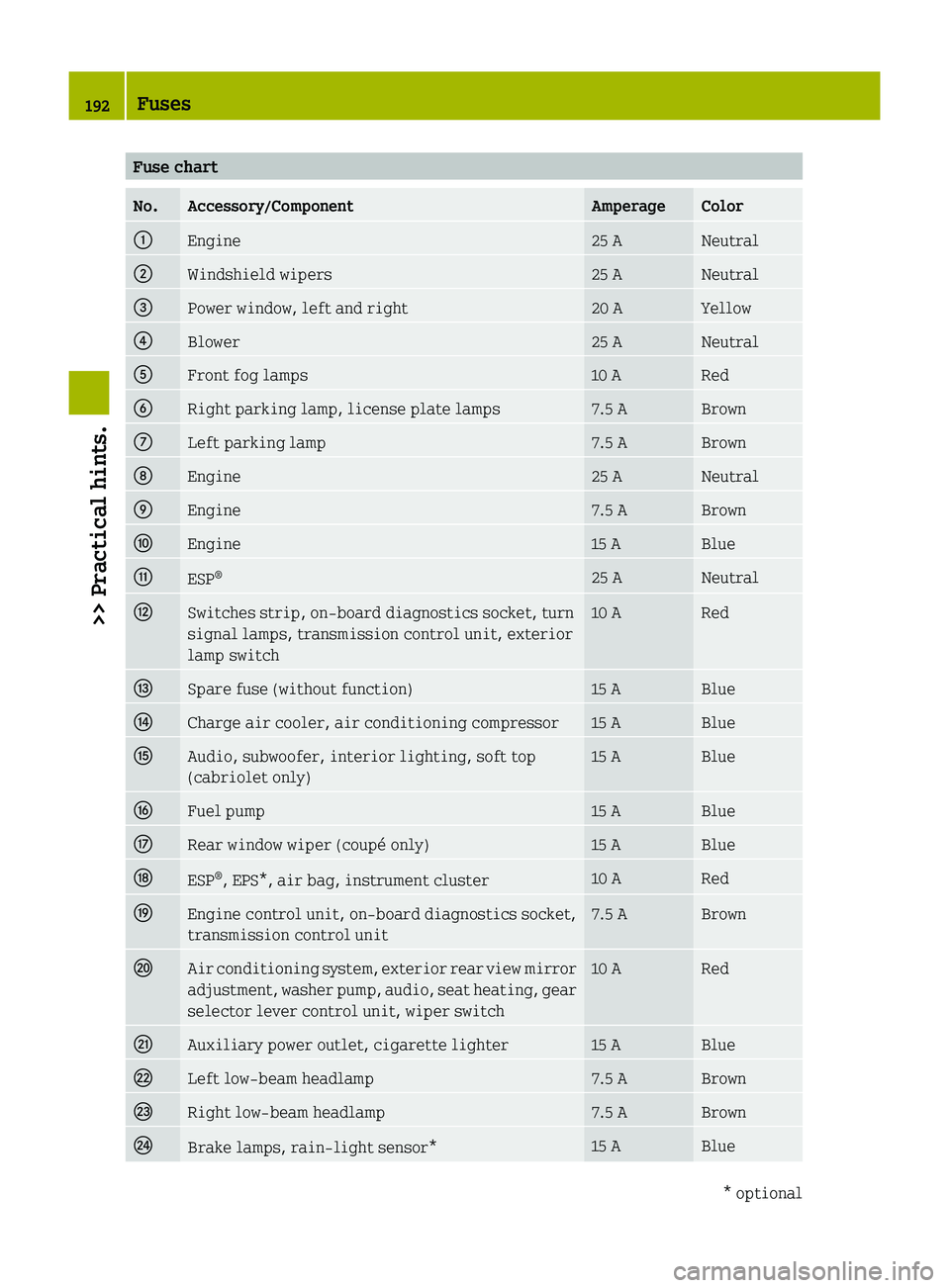
Fuse chart No.Accessory/ComponentAmperageColor0046Engine25 ANeutral0047Windshield wipers25 ANeutral008APower window, left and right20 AYellow0088Blower25 ANeutral0086Front fog lamps10 ARed0087Right parking lamp, license plate lamps7.5 ABrown006ELeft parking lamp7.5 ABrown006FEngine25 ANeutral0070Engine7.5 ABrown0071Engine15 ABlue0072ESP®25 ANeutral0073Switches strip, on-board diagnostics socket, turn
signal lamps, transmission control unit, exterior
lamp switch10 ARed0074Spare fuse (without function)15 ABlue0075Charge air cooler, air conditioning compressor15 ABlue0076Audio, subwoofer, interior lighting, soft top
(cabriolet only)15 ABlue0077Fuel pump15 ABlue0078Rear window wiper (coupé only)15 ABlue0079ESP ®
, EPS*, air bag, instrument cluster10 ARed007AEngine control unit, on-board diagnostics socket,
transmission control unit7.5 ABrown007BAir conditioning system, exterior rear view mirror
adjustment, washer pump, audio, seat heating, gear
selector lever control unit, wiper switch10 ARed007CAuxiliary power outlet, cigarette lighter15 ABlue007DLeft low‑beam headlamp7.5 ABrown007ERight low‑beam headlamp7.5 ABrown007FBrake lamps, rain-light sensor*15 ABlue192Fuses>> Practical hints.* optional451_AKB; 3; 22, en-USd2ureepe,Version: 2.11.8.12009-07-27T09:36:34+02:00 - Seite 192
Page 204 of 216
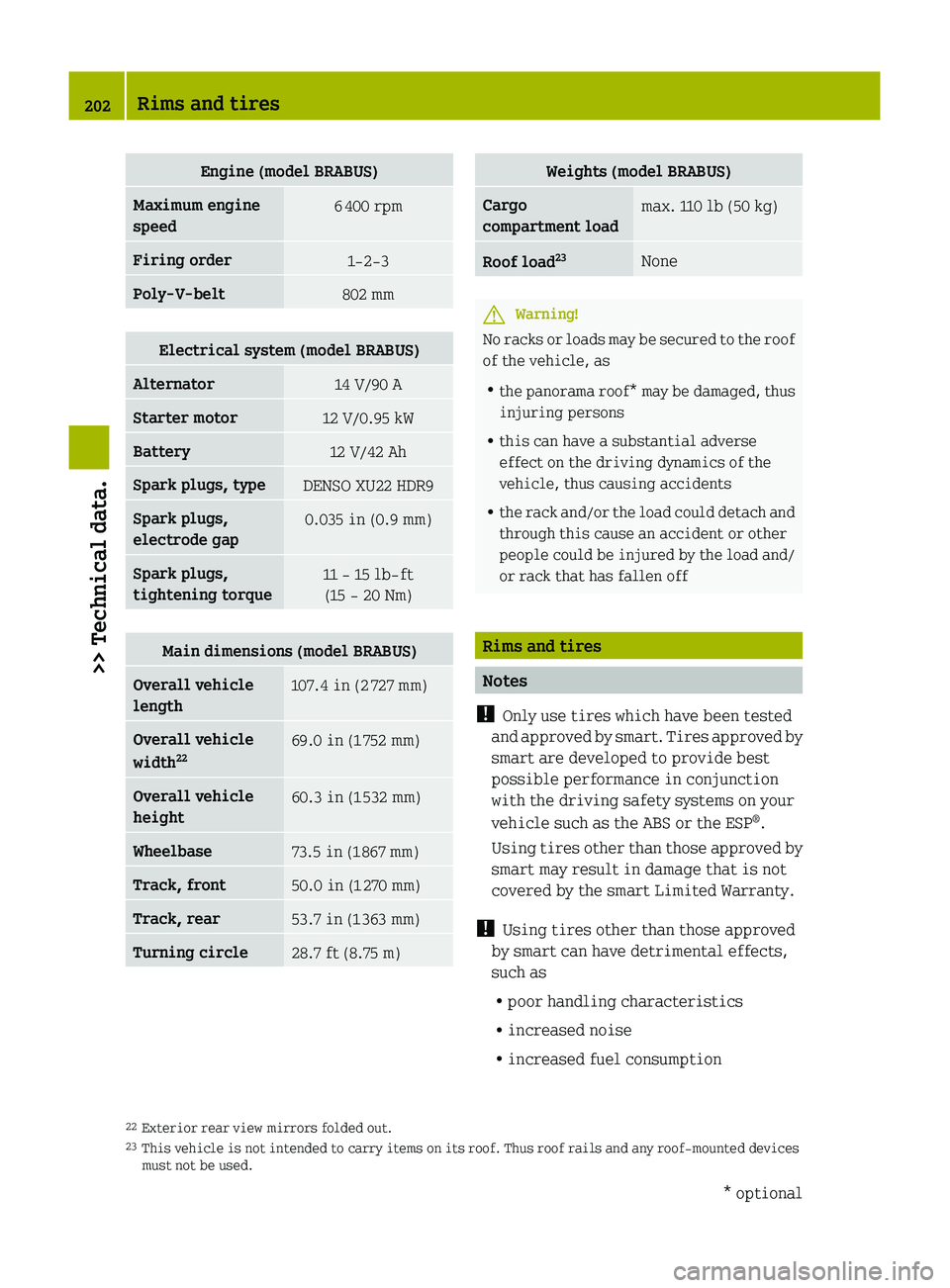
Engine (model BRABUS)Maximum engine
speed6 400 rpmFiring order1-2-3Poly‑V‑belt802 mmElectrical system (model BRABUS)Alternator14 V/90 AStarter motor12 V/0.95 kWBattery12 V/42 AhSpark plugs, typeDENSO XU22 HDR9Spark plugs,
electrode gap0.035 in (0.9 mm)Spark plugs,
tightening torque11 - 15 lb-ft (15 - 20 Nm)Main dimensions (model BRABUS)Overall vehicle
length107.4 in (2 727 mm)Overall vehicle
width 2269.0 in (1
752 mm)Overall vehicle
height60.3 in (1 532 mm)Wheelbase73.5 in (1 867 mm)Track, front50.0 in (1 270 mm)Track, rear53.7 in (1 363 mm)Turning circle28.7 ft (8.75 m)Weights (model BRABUS)Cargo
compartment loadmax. 110 lb (50 kg)Roof load 23NoneGWarning!
No racks or loads may be secured to the roof
of the vehicle, as
R the panorama roof* may be damaged, thus
injuring persons
R this can have a substantial adverse
effect on the driving dynamics of the
vehicle, thus causing accidents
R the rack and/or the load could detach and
through this cause an accident or other
people could be injured by the load and/
or rack that has fallen off
Rims and tires
Notes
! Only use tires which have been tested
and approved by smart. Tires approved by
smart are developed to provide best
possible performance in conjunction
with the driving safety systems on your
vehicle such as the ABS or the ESP ®
.
Using tires other than those approved by
smart may result in damage that is not
covered by the smart Limited Warranty.
! Using tires other than those approved
by smart can have detrimental effects,
such as
R poor handling characteristics
R increased noise
R increased fuel consumption
22Exterior rear view mirrors folded out.
23 This vehicle is not intended to carry items on its roof. Thus roof rails and any roof-mounted devices
must not be used.202Rims and tires>> Technical data.* optional451_AKB; 3; 22, en-USd2ureepe,Version: 2.11.8.12009-07-27T09:36:34+02:00 - Seite 202
Page 208 of 216
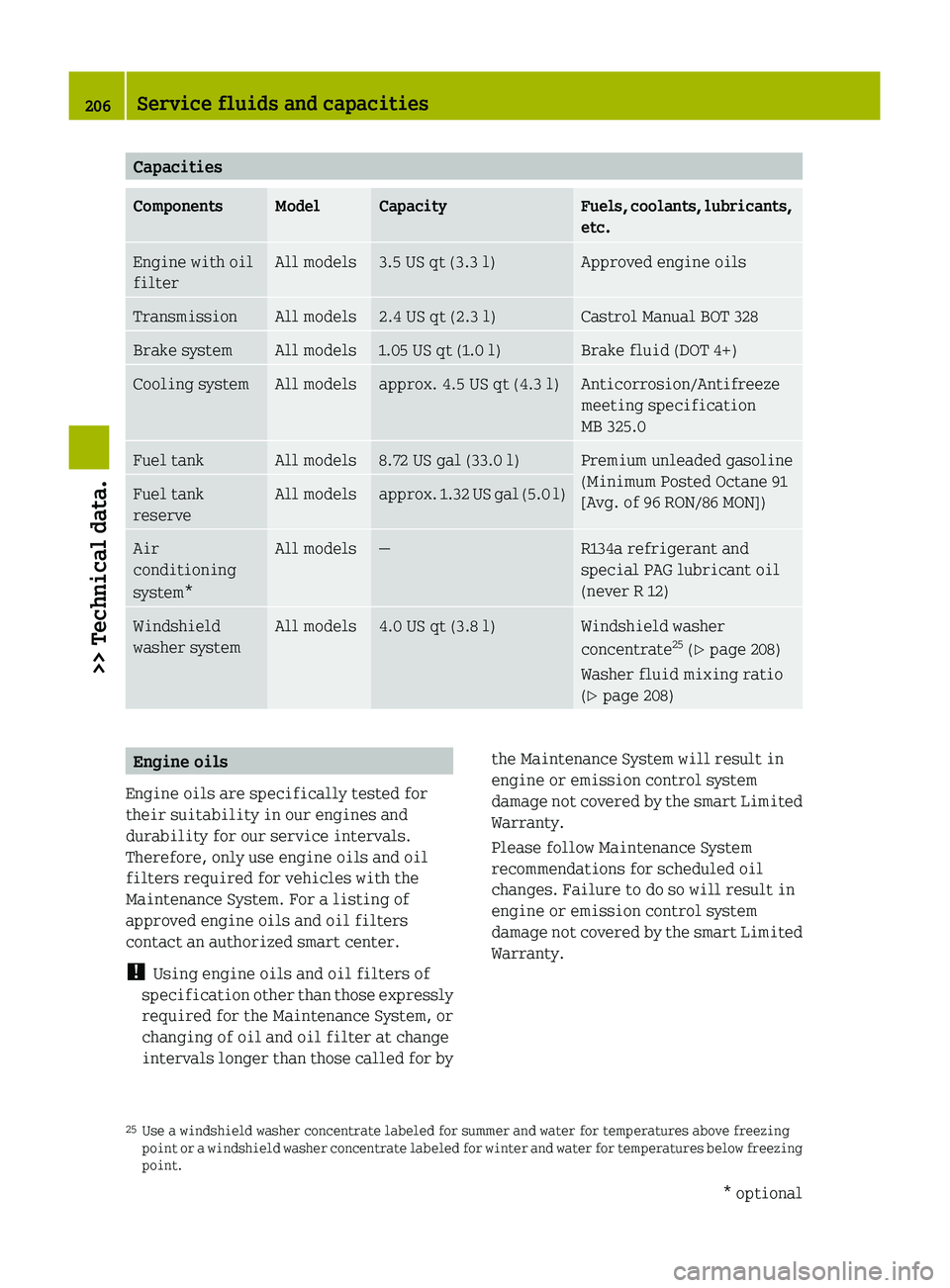
CapacitiesComponentsModelCapacityFuels, coolants, lubricants,
etc.Engine with oil
filterAll models3.5 US qt (3.3 l)Approved engine oilsTransmissionAll models2.4 US qt (2.3 l)Castrol Manual BOT 328Brake systemAll models1.05 US qt (1.0 l)Brake fluid (DOT 4+)Cooling systemAll modelsapprox. 4.5 US qt (4.3 l)Anticorrosion/Antifreeze
meeting specification
MB 325.0Fuel tankAll models8.72 US gal (33.0 l)Premium unleaded gasoline
(Minimum Posted Octane 91
[Avg. of 96 RON/86 MON])Fuel tank
reserveAll modelsapprox. 1.32 US gal (5.0 l)Air
conditioning
system*All models—R134a refrigerant and
special PAG lubricant oil
(never R 12)Windshield
washer systemAll models4.0 US qt (3.8 l)Windshield washer
concentrate 25
(Y page 208)
Washer fluid mixing ratio
( Y page 208)Engine oils
Engine oils are specifically tested for
their suitability in our engines and
durability for our service intervals.
Therefore, only use engine oils and oil
filters required for vehicles with the
Maintenance System. For a listing of
approved engine oils and oil filters
contact an authorized smart center.
! Using engine oils and oil filters of
specification other than those expressly
required for the Maintenance System, or
changing of oil and oil filter at change
intervals longer than those called for bythe Maintenance System will result in
engine or emission control system
damage not covered by the smart Limited
Warranty.
Please follow Maintenance System
recommendations for scheduled oil
changes. Failure to do so will result in
engine or emission control system
damage not covered by the smart Limited
Warranty.25 Use a windshield washer concentrate labeled for summer and water for temperatures above freezing
point or a windshield washer concentrate labeled for winter and water for temperatures below freezing
point.206Service fluids and capacities>> Technical data.* optional451_AKB; 3; 22, en-USd2ureepe,Version: 2.11.8.12009-07-27T09:36:34+02:00 - Seite 206
Page 209 of 216
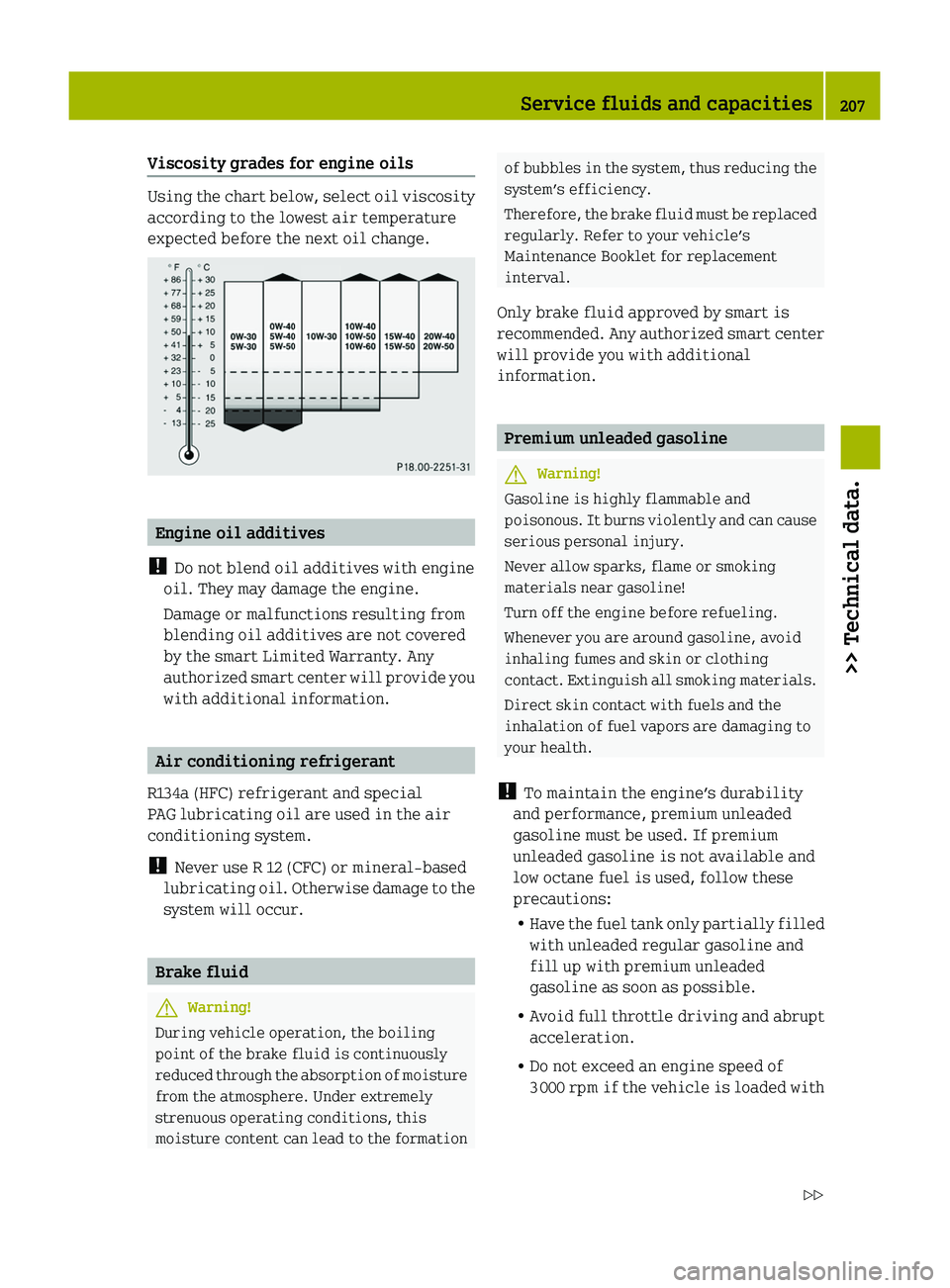
Viscosity grades for engine oils
Using the chart below, select oil viscosity
according to the lowest air temperature
expected before the next oil change.
Engine oil additives
! Do not blend oil additives with engine
oil. They may damage the engine.
Damage or malfunctions resulting from
blending oil additives are not covered
by the smart Limited Warranty. Any
authorized smart center will provide you
with additional information.
Air conditioning refrigerant
R134a (HFC) refrigerant and special
PAG lubricating oil are used in the air
conditioning system.
! Never use R 12 (CFC) or mineral-based
lubricating oil. Otherwise damage to the
system will occur.
Brake fluid
GWarning!
During vehicle operation, the boiling
point of the brake fluid is continuously
reduced through the absorption of moisture
from the atmosphere. Under extremely
strenuous operating conditions, this
moisture content can lead to the formation
of bubbles in the system, thus reducing the
system’s efficiency.
Therefore, the brake fluid must be replaced
regularly. Refer to your vehicle’s
Maintenance Booklet for replacement
interval.
Only brake fluid approved by smart is
recommended. Any authorized smart center
will provide you with additional
information.
Premium unleaded gasoline
GWarning!
Gasoline is highly flammable and
poisonous. It burns violently and can cause
serious personal injury.
Never allow sparks, flame or smoking
materials near gasoline!
Turn off the engine before refueling.
Whenever you are around gasoline, avoid
inhaling fumes and skin or clothing
contact. Extinguish all smoking materials.
Direct skin contact with fuels and the
inhalation of fuel vapors are damaging to
your health.
! To maintain the engine’s durability
and performance, premium unleaded
gasoline must be used. If premium
unleaded gasoline is not available and
low octane fuel is used, follow these
precautions:
R Have the fuel tank only partially filled
with unleaded regular gasoline and
fill up with premium unleaded
gasoline as soon as possible.
R Avoid full throttle driving and abrupt
acceleration.
R Do not exceed an engine speed of
3 000 rpm if the vehicle is loaded with
Service fluids and capacities207>> Technical data.451_AKB; 3; 22, en-USd2ureepe,Version: 2.11.8.12009-07-27T09:36:34+02:00 - Seite 207Z
Page 210 of 216
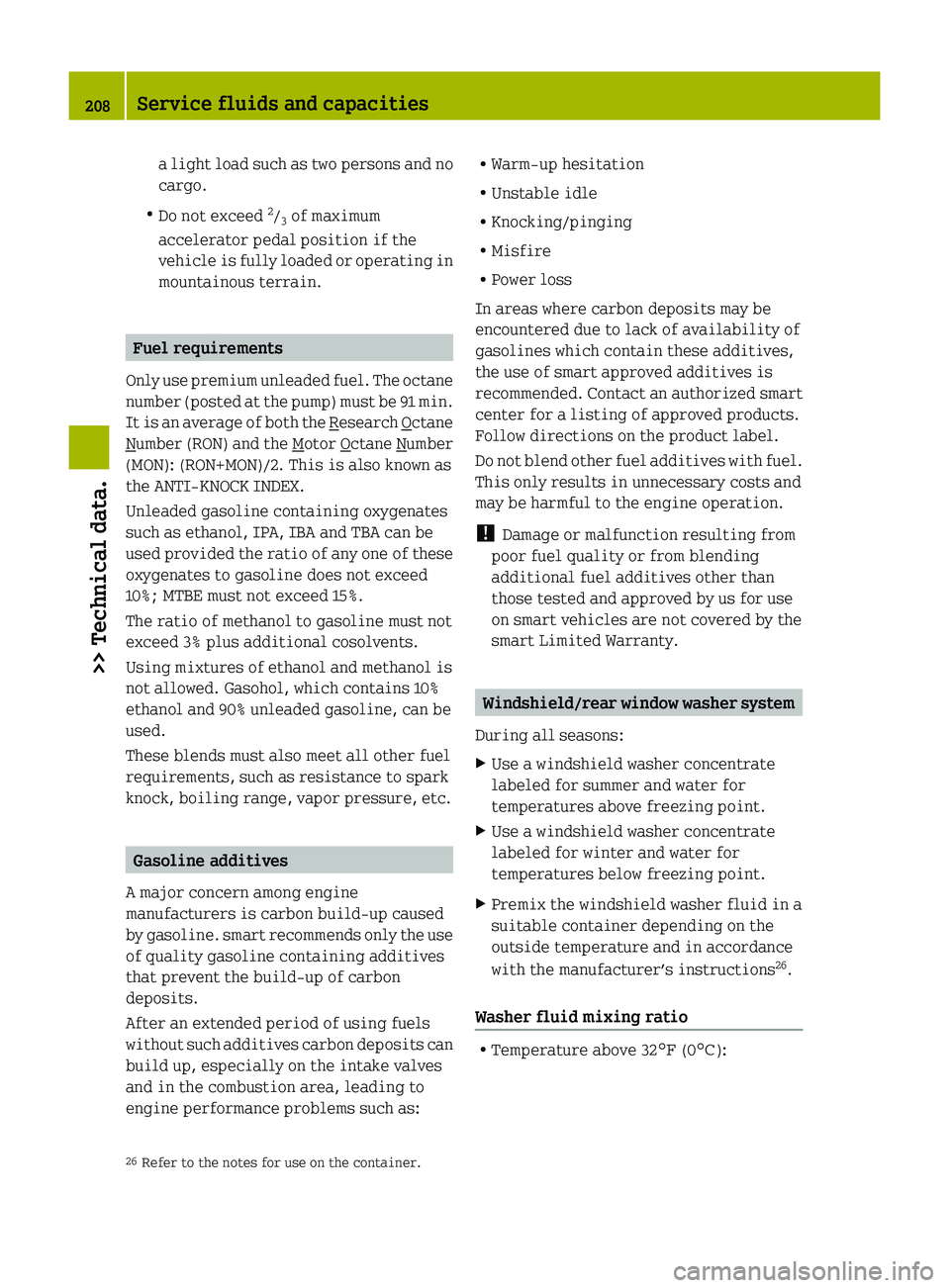
a light load such as two persons and no
cargo.
R Do not exceed 2
/ 3 of maximum
accelerator pedal position if the
vehicle is fully loaded or operating in
mountainous terrain.
Fuel requirements
Only use premium unleaded fuel. The octane
number (posted at the pump) must be 91 min.
It is an average of both the
R esearch Octane
N umber (RON) and the Motor Octane Number
(MON): (RON+MON)/2. This is also known as
the ANTI‑KNOCK INDEX.
Unleaded gasoline containing oxygenates
such as ethanol, IPA, IBA and TBA can be
used provided the ratio of any one of these
oxygenates to gasoline does not exceed
10%; MTBE must not exceed 15%.
The ratio of methanol to gasoline must not
exceed 3% plus additional cosolvents.
Using mixtures of ethanol and methanol is
not allowed. Gasohol, which contains 10%
ethanol and 90% unleaded gasoline, can be
used.
These blends must also meet all other fuel
requirements, such as resistance to spark
knock, boiling range, vapor pressure, etc.
Gasoline additives
A major concern among engine
manufacturers is carbon build-up caused
by gasoline. smart recommends only the use
of quality gasoline containing additives
that prevent the build-up of carbon
deposits.
After an extended period of using fuels
without such additives carbon deposits can
build up, especially on the intake valves
and in the combustion area, leading to
engine performance problems such as:
R Warm-up hesitation
R Unstable idle
R Knocking/pinging
R Misfire
R Power loss
In areas where carbon deposits may be
encountered due to lack of availability of
gasolines which contain these additives,
the use of smart approved additives is
recommended. Contact an authorized smart
center for a listing of approved products.
Follow directions on the product label.
Do not blend other fuel additives with fuel.
This only results in unnecessary costs and
may be harmful to the engine operation.
! Damage or malfunction resulting from
poor fuel quality or from blending
additional fuel additives other than
those tested and approved by us for use
on smart vehicles are not covered by the
smart Limited Warranty.
Windshield/rear window washer system
During all seasons:
XUse a windshield washer concentrate
labeled for summer and water for
temperatures above freezing point.XUse a windshield washer concentrate
labeled for winter and water for
temperatures below freezing point.XPremix the windshield washer fluid in a
suitable container depending on the
outside temperature and in accordance
with the manufacturer’s instructions 26
.
Washer fluid mixing ratio
R Temperature above 32 ¦ (0¥ ):
26
Refer to the notes for use on the container.208Service fluids and capacities>> Technical data.
451_AKB; 3; 22, en-USd2ureepe,Version: 2.11.8.12009-07-27T09:36:34+02:00 - Seite 208