engine SMART FORTWO COUPE 2010 Repair Manual
[x] Cancel search | Manufacturer: SMART, Model Year: 2010, Model line: FORTWO COUPE, Model: SMART FORTWO COUPE 2010Pages: 216, PDF Size: 9.7 MB
Page 158 of 216
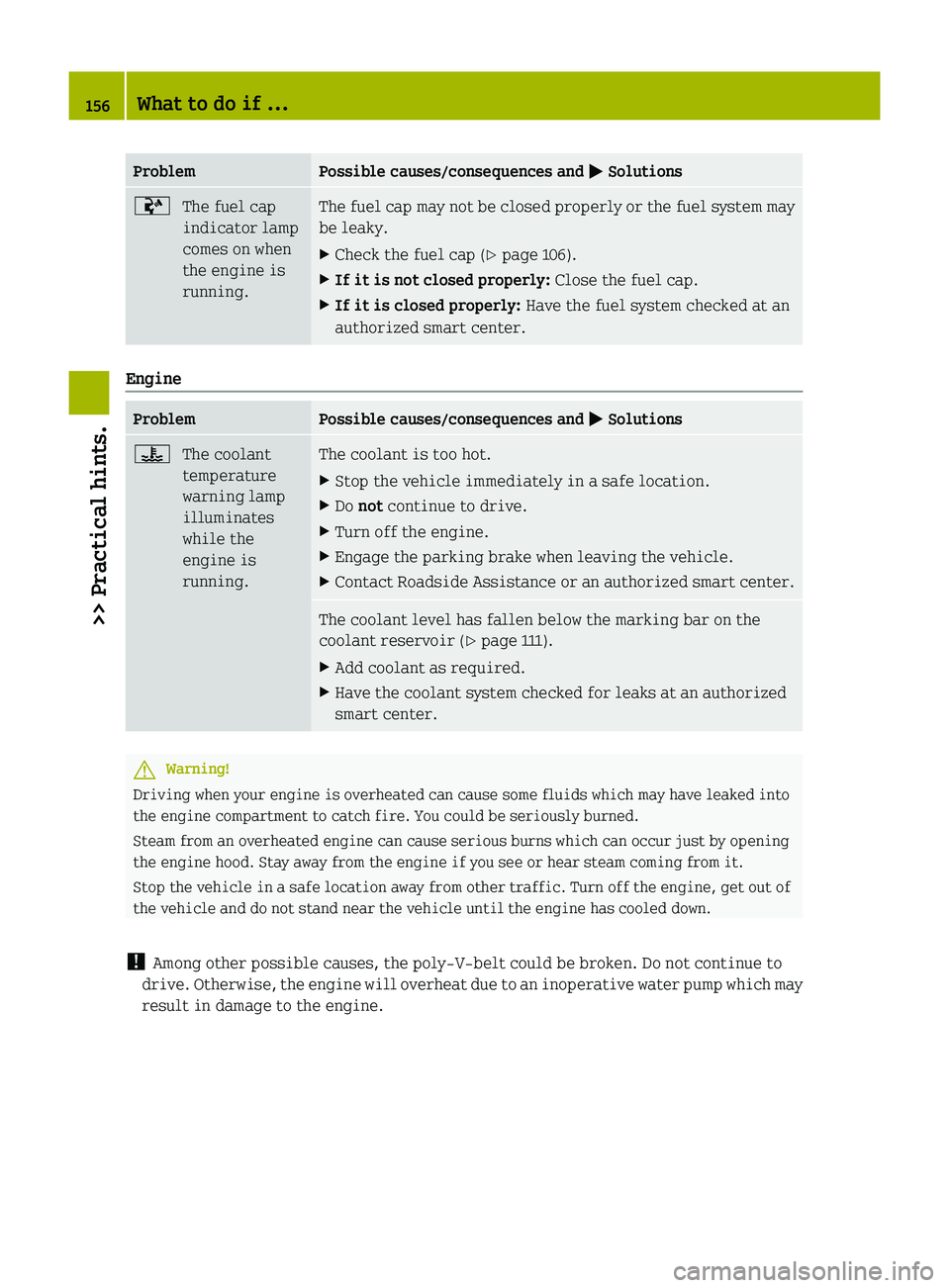
ProblemPossible causes/consequences and 0050 Solutions00ACThe fuel cap
indicator lamp
comes on when
the engine is
running.The fuel cap may not be closed properly or the fuel system may
be leaky.XCheck the fuel cap ( Y page 106).XIf it is not closed properly: Close the fuel cap.XIf it is closed properly: Have the fuel system checked at an
authorized smart center.
Engine
ProblemPossible causes/consequences and 0050 Solutions00AEThe coolant
temperature
warning lamp
illuminates
while the
engine is
running.The coolant is too hot.XStop the vehicle immediately in a safe location.XDo not continue to drive.XTurn off the engine.XEngage the parking brake when leaving the vehicle.XContact Roadside Assistance or an authorized smart center.The coolant level has fallen below the marking bar on the
coolant reservoir ( Y page 111).XAdd coolant as required.XHave the coolant system checked for leaks at an authorized
smart center.GWarning!
Driving when your engine is overheated can cause some fluids which may have leaked into
the engine compartment to catch fire. You could be seriously burned.
Steam from an overheated engine can cause serious burns which can occur just by opening
the engine hood. Stay away from the engine if you see or hear steam coming from it.
Stop the vehicle in a safe location away from other traffic. Turn off the engine, get out of
the vehicle and do not stand near the vehicle until the engine has cooled down.
! Among other possible causes, the poly-V-belt could be broken. Do not continue to
drive. Otherwise, the engine will overheat due to an inoperative water pump which may
result in damage to the engine.
156What to do if ...>> Practical hints.
451_AKB; 3; 22, en-USd2ureepe,Version: 2.11.8.12009-07-27T09:36:34+02:00 - Seite 156
Page 159 of 216
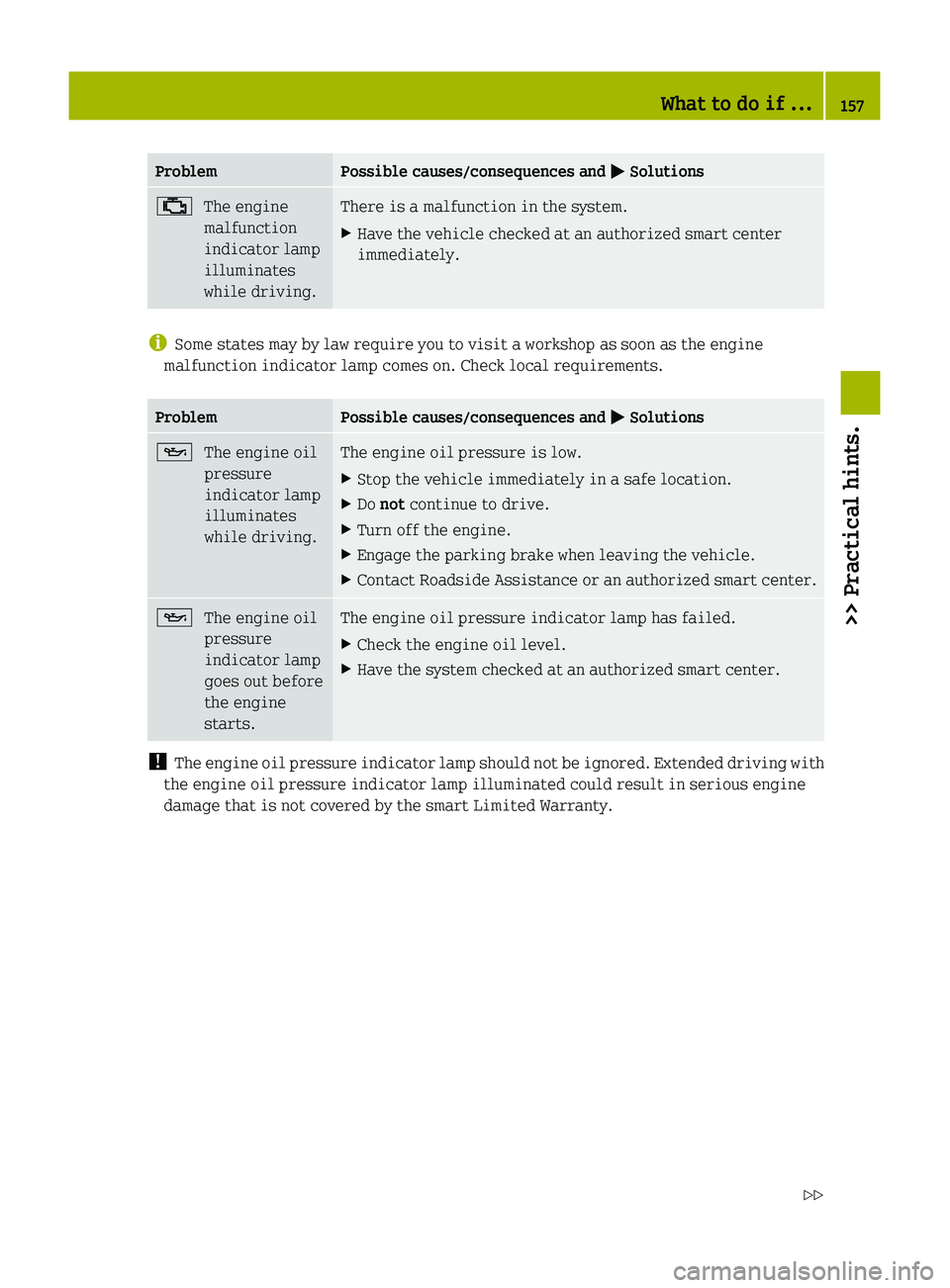
ProblemPossible causes/consequences and 0050 Solutions00BBThe engine
malfunction
indicator lamp
illuminates
while driving.There is a malfunction in the system.XHave the vehicle checked at an authorized smart center
immediately.
i Some states may by law require you to visit a workshop as soon as the engine
malfunction indicator lamp comes on. Check local requirements.
ProblemPossible causes/consequences and 0050 Solutions00B5The engine oil
pressure
indicator lamp
illuminates
while driving.The engine oil pressure is low.XStop the vehicle immediately in a safe location.XDo not continue to drive.XTurn off the engine.XEngage the parking brake when leaving the vehicle.XContact Roadside Assistance or an authorized smart center.00B5The engine oil
pressure
indicator lamp
goes out before
the engine
starts.The engine oil pressure indicator lamp has failed.XCheck the engine oil level.XHave the system checked at an authorized smart center.! The engine oil pressure indicator lamp should not be ignored. Extended driving with
the engine oil pressure indicator lamp illuminated could result in serious engine
damage that is not covered by the smart Limited Warranty.What to do if ...157>> Practical hints.451_AKB; 3; 22, en-USd2ureepe,Version: 2.11.8.12009-07-27T09:36:34+02:00 - Seite 157Z
Page 162 of 216
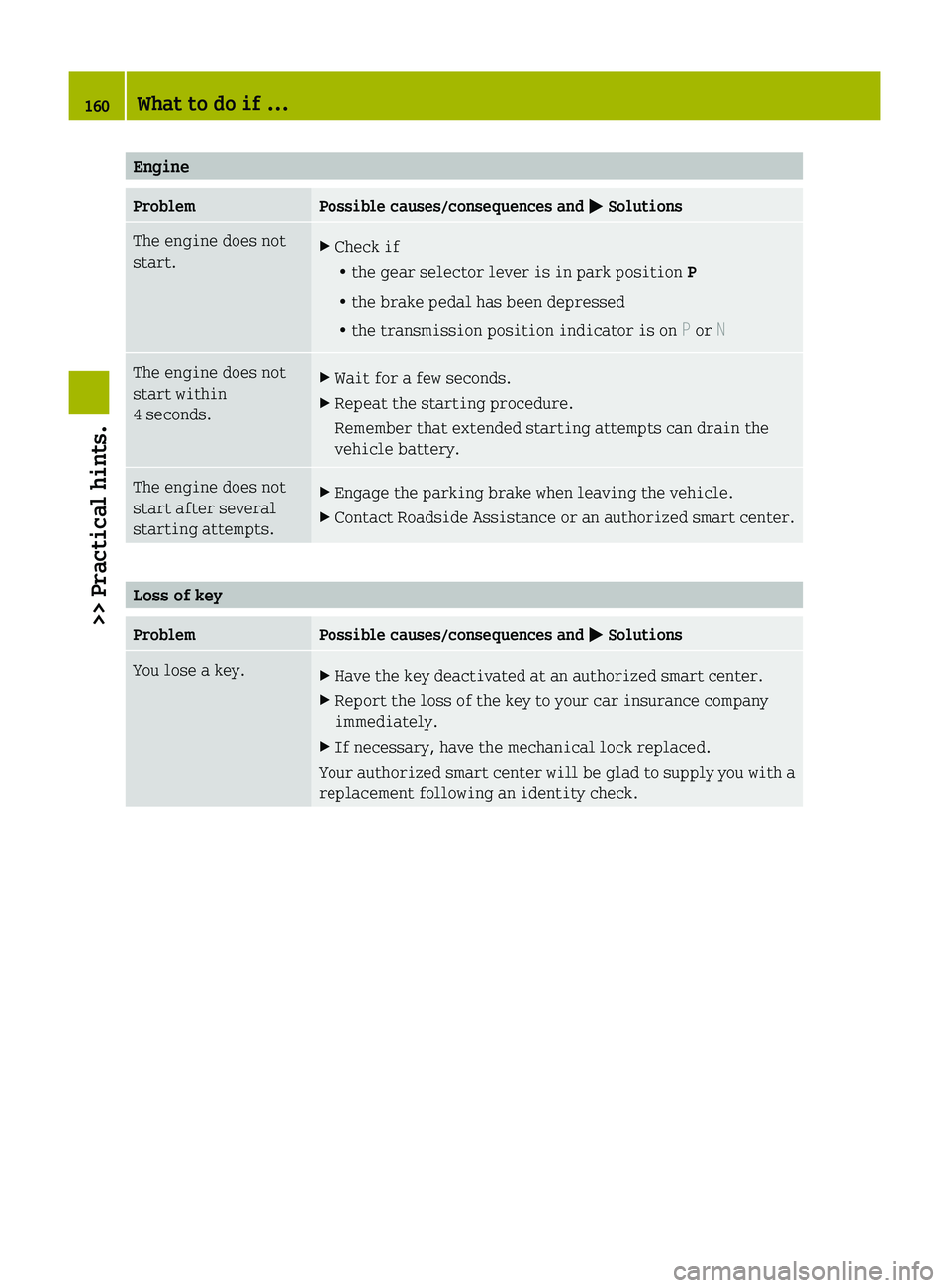
EngineProblemPossible causes/consequences and 0050 SolutionsThe engine does not
start.XCheck if
R the gear selector lever is in park position P
R the brake pedal has been depressed
R the transmission position indicator is on P or NThe engine does not
start within
4 seconds.XWait for a few seconds.XRepeat the starting procedure.
Remember that extended starting attempts can drain the
vehicle battery.The engine does not
start after several
starting attempts.XEngage the parking brake when leaving the vehicle.XContact Roadside Assistance or an authorized smart center.
Loss of key
ProblemPossible causes/consequences and 0050 SolutionsYou lose a key.XHave the key deactivated at an authorized smart center.XReport the loss of the key to your car insurance company
immediately.XIf necessary, have the mechanical lock replaced.
Your authorized smart center will be glad to supply you with a
replacement following an identity check.
160What to do if ...>> Practical hints.
451_AKB; 3; 22, en-USd2ureepe,Version: 2.11.8.12009-07-27T09:36:34+02:00 - Seite 160
Page 163 of 216
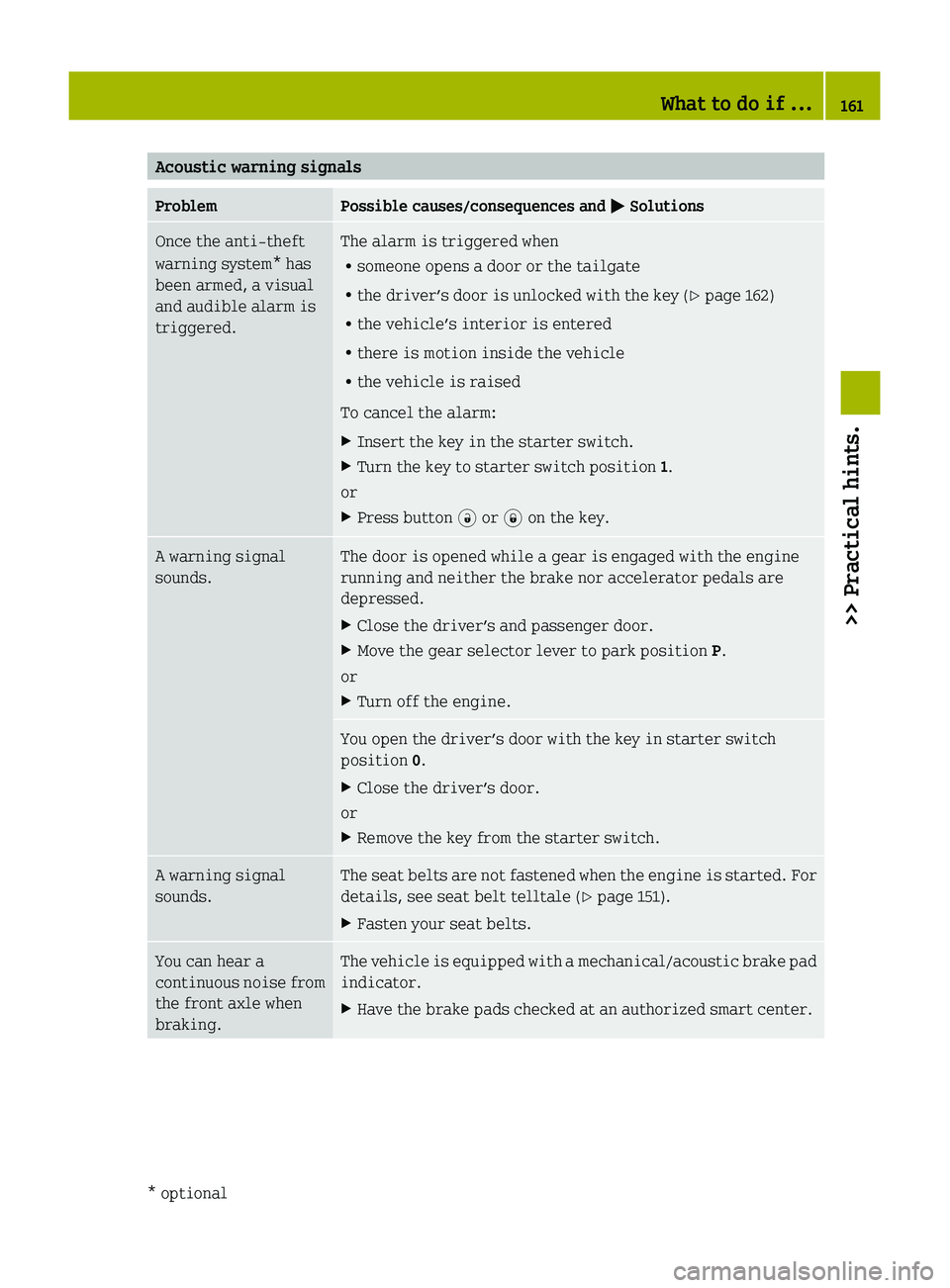
Acoustic warning signalsProblemPossible causes/consequences and 0050 SolutionsOnce the anti-theft
warning system* has
been armed, a visual
and audible alarm is
triggered.The alarm is triggered when
R someone opens a door or the tailgate
R the driver’s door is unlocked with the key ( Y page 162)
R the vehicle’s interior is entered
R there is motion inside the vehicle
R the vehicle is raised
To cancel the alarm:XInsert the key in the starter switch.XTurn the key to starter switch position 1.
or
XPress button 0034 or 0038 on the key.A warning signal
sounds.The door is opened while a gear is engaged with the engine
running and neither the brake nor accelerator pedals are
depressed.XClose the driver’s and passenger door.XMove the gear selector lever to park position P.
or
XTurn off the engine.You open the driver’s door with the key in starter switch
position 0.XClose the driver’s door.
or
XRemove the key from the starter switch.A warning signal
sounds.The seat belts are not fastened when the engine is started. For
details, see seat belt telltale ( Y page 151).XFasten your seat belts.You can hear a
continuous noise from
the front axle when
braking.The vehicle is equipped with a mechanical/acoustic brake pad
indicator.XHave the brake pads checked at an authorized smart center.What to do if ...161>> Practical hints.* optional451_AKB; 3; 22, en-USd2ureepe,Version: 2.11.8.12009-07-27T09:36:34+02:00 - Seite 161Z
Page 171 of 216
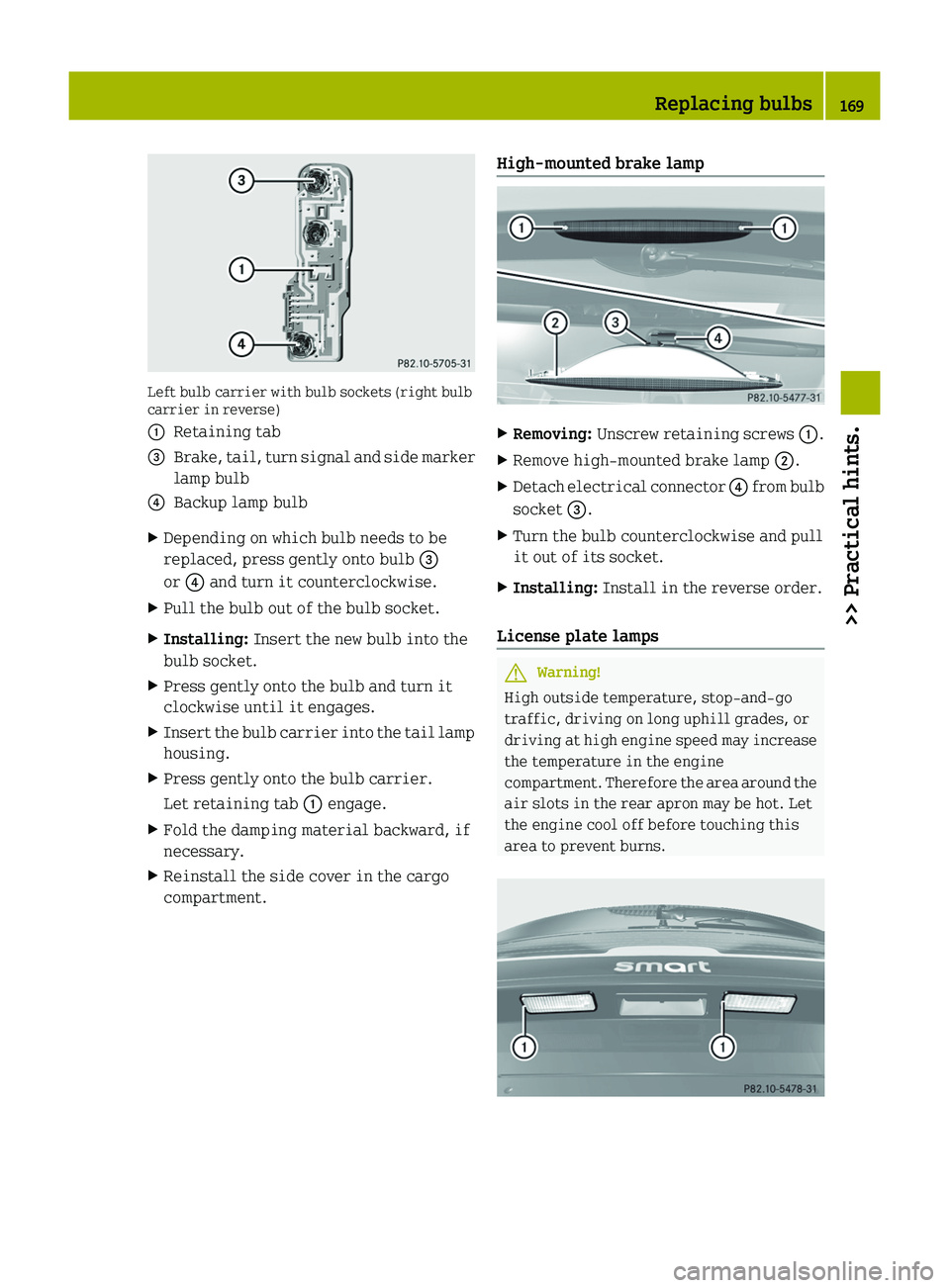
Left bulb carrier with bulb sockets (right bulb
carrier in reverse)
0046Retaining tab008ABrake, tail, turn signal and side marker
lamp bulb0088Backup lamp bulbXDepending on which bulb needs to be
replaced, press gently onto bulb 008A
or 0088 and turn it counterclockwise.XPull the bulb out of the bulb socket.XInstalling: Insert the new bulb into the
bulb socket.XPress gently onto the bulb and turn it
clockwise until it engages.XInsert the bulb carrier into the tail lamp
housing.XPress gently onto the bulb carrier.
Let retaining tab 0046 engage.XFold the damping material backward, if
necessary.XReinstall the side cover in the cargo
compartment.High-mounted brake lampXRemoving: Unscrew retaining screws 0046.XRemove high-mounted brake lamp 0047.XDetach electrical connector 0088 from bulb
socket 008A.XTurn the bulb counterclockwise and pull
it out of its socket.XInstalling: Install in the reverse order.
License plate lamps
GWarning!
High outside temperature, stop-and-go
traffic, driving on long uphill grades, or
driving at high engine speed may increase
the temperature in the engine
compartment. Therefore the area around the
air slots in the rear apron may be hot. Let
the engine cool off before touching this
area to prevent burns.
Replacing bulbs169>> Practical hints.451_AKB; 3; 22, en-USd2ureepe,Version: 2.11.8.12009-07-27T09:36:34+02:00 - Seite 169Z
Page 174 of 216
XRemoving: Fold the wiper arm away from
the rear window until you feel it engage.XFold wiper blade 0046 away from the wiper
arm in direction of arrow 0047 until it
disengages from its mounting.XDetach wiper blade 0046.XInstalling: Push the new wiper blade onto
the wiper arm until you feel it engage.XFold the wiper blade into a position
parallel to the wiper arm.XFold the wiper arm backward to rest on
the rear window.
Make sure to hold on to the wiper when
folding the wiper arm back.
! Make sure the wiper blade is properly
installed. An improperly installed
wiper blade may cause rear window
damage.
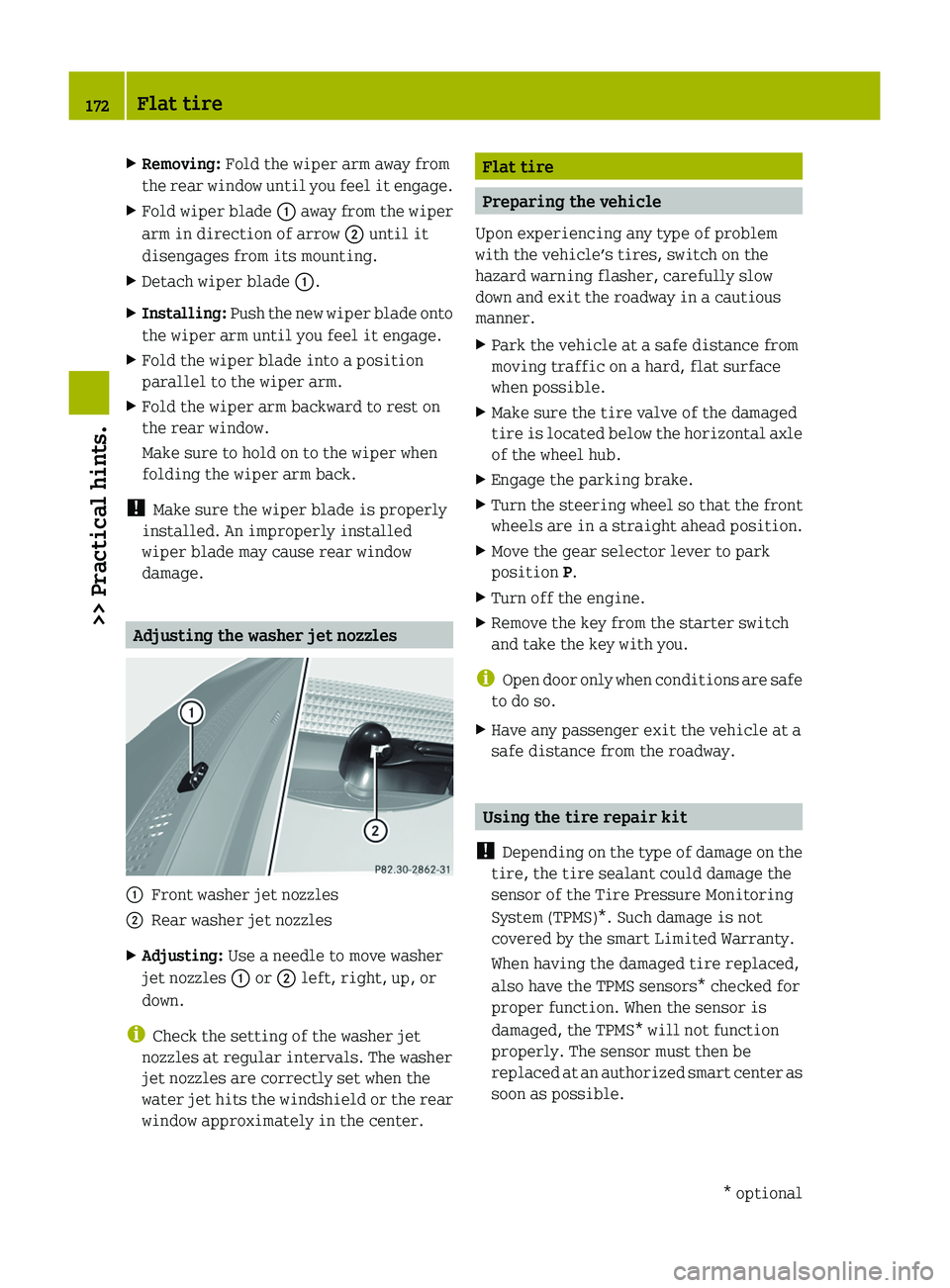
Adjusting the washer jet nozzles
0046Front washer jet nozzles0047Rear washer jet nozzlesXAdjusting: Use a needle to move washer
jet nozzles 0046 or 0047 left, right, up, or
down.
i Check the setting of the washer jet
nozzles at regular intervals. The washer
jet nozzles are correctly set when the
water jet hits the windshield or the rear
window approximately in the center.
Flat tire
Preparing the vehicle
Upon experiencing any type of problem
with the vehicle’s tires, switch on the
hazard warning flasher, carefully slow
down and exit the roadway in a cautious
manner.
XPark the vehicle at a safe distance from
moving traffic on a hard, flat surface
when possible.XMake sure the tire valve of the damaged
tire is located below the horizontal axle
of the wheel hub.XEngage the parking brake.XTurn the steering wheel so that the front
wheels are in a straight ahead position.XMove the gear selector lever to park
position P.XTurn off the engine.XRemove the key from the starter switch
and take the key with you.
i Open door only when conditions are safe
to do so.
XHave any passenger exit the vehicle at a
safe distance from the roadway.
Using the tire repair kit
! Depending on the type of damage on the
tire, the tire sealant could damage the
sensor of the Tire Pressure Monitoring
System (TPMS)*. Such damage is not
covered by the smart Limited Warranty.
When having the damaged tire replaced,
also have the TPMS sensors* checked for
proper function. When the sensor is
damaged, the TPMS* will not function
properly. The sensor must then be
replaced at an authorized smart center as
soon as possible.
172Flat tire>> Practical hints.* optional451_AKB; 3; 22, en-USd2ureepe,Version: 2.11.8.12009-07-27T09:36:34+02:00 - Seite 172
Page 177 of 216
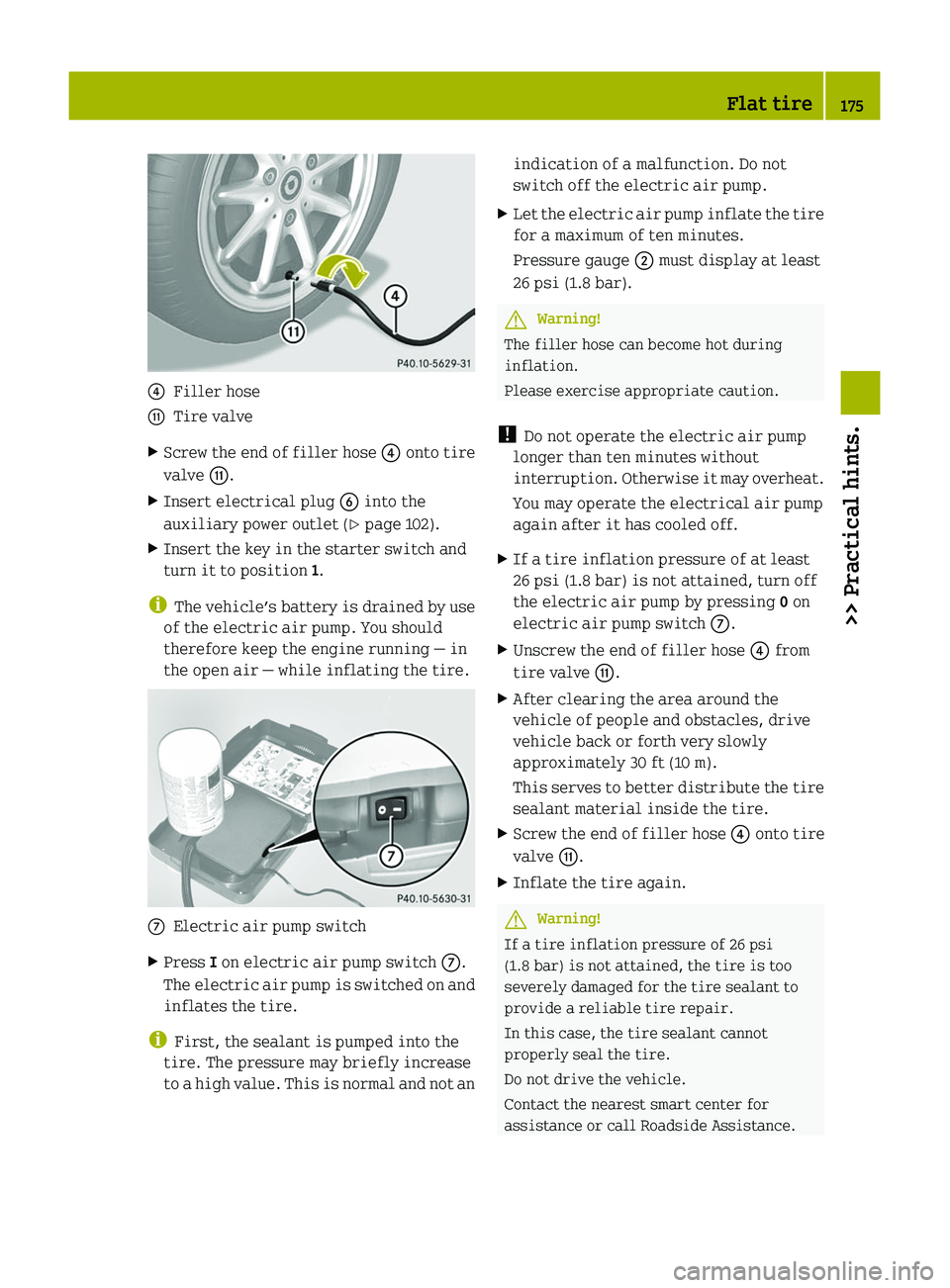
0088Filler hose0072Tire valveXScrew the end of filler hose 0088 onto tire
valve 0072.XInsert electrical plug 0087 into the
auxiliary power outlet ( Y page 102).XInsert the key in the starter switch and
turn it to position 1.
i
The vehicle’s battery is drained by use
of the electric air pump. You should
therefore keep the engine running — in
the open air — while inflating the tire.
006EElectric air pump switchXPress I on electric air pump switch 006E.
The electric air pump is switched on and
inflates the tire.
i First, the sealant is pumped into the
tire. The pressure may briefly increase
to a high value. This is normal and not an
indication of a malfunction. Do not
switch off the electric air pump.XLet the electric air pump inflate the tire
for a maximum of ten minutes.
Pressure gauge 0047 must display at least
26 psi (1.8 bar).GWarning!
The filler hose can become hot during
inflation.
Please exercise appropriate caution.
! Do not operate the electric air pump
longer than ten minutes without
interruption. Otherwise it may overheat.
You may operate the electrical air pump
again after it has cooled off.
XIf a tire inflation pressure of at least
26 psi (1.8 bar) is not attained, turn off
the electric air pump by pressing 0 on
electric air pump switch 006E.XUnscrew the end of filler hose 0088 from
tire valve 0072.XAfter clearing the area around the
vehicle of people and obstacles, drive
vehicle back or forth very slowly
approximately 30 ft (10 m).
This serves to better distribute the tire
sealant material inside the tire.XScrew the end of filler hose 0088 onto tire
valve 0072.XInflate the tire again.GWarning!
If a tire inflation pressure of 26 psi
(1.8 bar) is not attained, the tire is too
severely damaged for the tire sealant to
provide a reliable tire repair.
In this case, the tire sealant cannot
properly seal the tire.
Do not drive the vehicle.
Contact the nearest smart center for
assistance or call Roadside Assistance.
Flat tire175>> Practical hints.451_AKB; 3; 22, en-USd2ureepe,Version: 2.11.8.12009-07-27T09:36:34+02:00 - Seite 175Z
Page 179 of 216
adversely affect handling and fuel
economy, and are more likely to fail from
being overheated.
Do not overinflate tires. Overinflated
tires can adversely affect handling and
ride comfort, wear unevenly, increase
stopping distance, and result in sudden
deflation (blowout) because they are more
likely to become punctured or damaged by
road debris, potholes etc.
Do not overload the tires by exceeding the
specified load limit as indicated on the
Tire and Loading Information placard on
the driver’s door B‑pillar. Overloading the
tires can overheat them, possibly causing
a blowout. Overloading the tires can also
result in handling or steering problems, or
brake failure.XDrive to the nearest authorized smart
center, to have the damaged tire
replaced.XContact an authorized smart center as
soon as possible to obtain a new filler
hose and a new tire sealant container.XBring used tire sealant materials to an
authorized smart center for proper
disposal.XReplace your tire sealant container
every 4 years. Replacement containers
are available at any authorized smart
center.GWarning!
After changing a tire, contact a smart
center to make sure the bolts holding the
wheel to the car are tight enough.
Otherwise, the wheels could come off. Each
bolt should be tightened to a torque of
81 lb‑ft (110 Nm).
Wheel change
Preparing the vehicle
XPark the vehicle on a hard, flat surface
when possible.XTurn on the hazard warning flasher.XTurn the steering wheel so that the front
wheels are in a straight-ahead position.XEngage the parking brake.XMove the gear selector lever to park
position P.XTurn off the engine.XHave any passenger exit the vehicle at a
safe distance from the roadway.
Removing the wheel
GWarning!
When jacking up the vehicle, only use a
suitable jack. Observe the manufacturer’s
safety instructions.
The jack must be designed for jacking up
this vehicle at the jack take-up brackets
built into both sides of the vehicle.
The jack is intended only for lifting the
vehicle briefly for wheel changes. It is not
suited for performing maintenance work
under the vehicle. To help avoid personal
injury, use the jack only to lift the vehicle
during a wheel change.
Never get beneath the vehicle while it is
supported by the jack. Keep hands and feet
away from the area under the lifted vehicle.
Always lower the vehicle onto sufficient
capacity jackstands before working under
the vehicle.
Always firmly engage the parking brake and
block the wheels with wheel chocks or other
sizeable objects before raising the
vehicle with the jack. Do not release the
parking brake while the vehicle is raised.
Make sure the ground on which the vehicle
is standing and where you place the jack is
Wheel change177>> Practical hints.451_AKB; 3; 22, en-USd2ureepe,Version: 2.11.8.12009-07-27T09:36:34+02:00 - Seite 177Z
Page 180 of 216
solid, level and not slippery. If necessary,
use a large underlay. On slippery surfaces,
such as tiled floors, you should use a non-
slip underlay, for example a rubber mat.
Do not use wooden blocks or similar objects
to support the jack. Otherwise the jack may
not be able to achieve its load-bearing
capacity if it is not at its full height.
The jack must always be vertical when in
use. Always try to use the jack on level
surface. If you do not position the jack
correctly, the vehicle can fall off the jack
and seriously or fatally injure you or
others.
Never start the engine when the vehicle is
raised.
Also observe the notes on the jack.XMake sure to have a suitable jack 17
, wheel
wrench 17
and wheel chock 17
.
Contact an authorized smart center for
information on which jack and wheel
wrench are required.XPrepare the vehicle as described
( Y page 177).XMake sure the surface is level.
Prevent the vehicle from rolling away by
blocking wheels with wheel chocks or other
sizeable objects:
XPlace one wheel chock or other sizeable
object in front of and another wheel
chock or other sizeable object behind
the wheel that is diagonally opposite to
the wheel being changed.
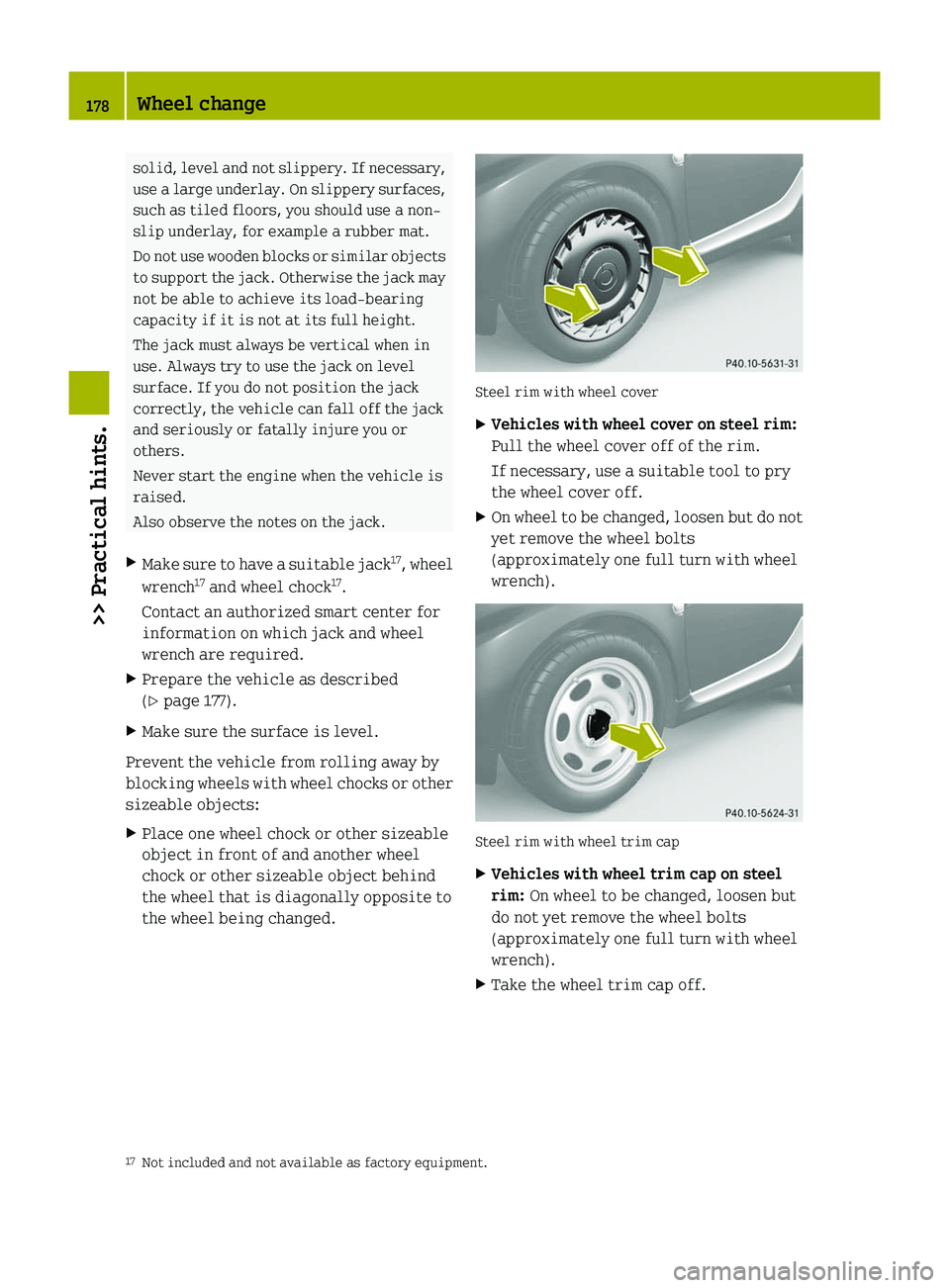
Steel rim with wheel cover
XVehicles with wheel cover on steel rim:
Pull the wheel cover off of the rim.
If necessary, use a suitable tool to pry
the wheel cover off.XOn wheel to be changed, loosen but do not
yet remove the wheel bolts
(approximately one full turn with wheel
wrench).
Steel rim with wheel trim cap
XVehicles with wheel trim cap on steel
rim: On wheel to be changed, loosen but
do not yet remove the wheel bolts
(approximately one full turn with wheel
wrench).XTake the wheel trim cap off.17 Not included and not available as factory equipment.178Wheel change>> Practical hints.
451_AKB; 3; 22, en-USd2ureepe,Version: 2.11.8.12009-07-27T09:36:34+02:00 - Seite 178
Page 183 of 216
GWarning!
Failure to follow these instructions can
result in severe injury or death.
Observe all safety instructions and
precautions when handling automotive
batteries.
Never lean over batteries while
connecting, you might get injured.
Battery fluid contains sulfuric acid. Do not
allow this fluid to come in contact with
eyes, skin or clothing. In case it does,
immediately flush affected area with water
and seek medical help if necessary.
A battery will also produce hydrogen gas,
which is flammable and explosive. Keep
flames or sparks away from battery, avoid
improper connection of jumper cables,
smoking, etc.
GWarning!
Do not place any metal objects on a battery.
You could otherwise cause a short circuit
and the battery’s highly flammable
chemicals could ignite.
Never allow any metal object to contact both
battery terminals or the positive terminal
and the vehicle body at the same time. This
might short circuit the battery and ignite
the highly flammable and explosive
hydrogen gas generated by the battery,
causing serious personal injury.
GWarning!
Keep flames or sparks away from battery,
avoid improper connection of jumper
cables, smoking, etc.
R When disconnecting the battery, always
disconnect the negative terminal first,
followed by positive terminal.
R When connecting the battery, always
connect the positive terminal first,
followed by the negative terminal.
R Do not loosen or disconnect the battery
terminal clips while the engine is
running or the key is in the starter
switch.
! Never loosen or detach battery terminal
clamps while the engine is running or the
key is in the starter switch. Otherwise
the alternator and other electronic
components could be severely damaged.
Have the battery checked regularly at an
authorized smart center.
Refer to Maintenance Booklet for
maintenance intervals or contact an
authorized smart center for further
information.
! Never invert the terminal connections!
Disconnecting, removing, charging,
reinstalling and reconnecting the
battery
Disconnecting the battery
i If the battery is disconnected or
discharged
R the key will not turn in the starter
switch
R the automatic transmission will
remain in park position P
For more information see “Jump
starting” ( Y page 183).
XEngage the parking brake.XMove the gear selector lever to park
position P.XTurn off all electrical accessories.XTurn off the engine.XOpen the passenger door.XMove the passenger seat to the rear as far
as possible.XUnscrew the carpet holder in the
passenger footwell ( Y page 148).XLift the carpet.Battery181>> Practical hints.451_AKB; 3; 22, en-USd2ureepe,Version: 2.11.8.12009-07-27T09:36:34+02:00 - Seite 181Z