coolant temperature SMART FORTWO COUPE 2010 Owners Manual
[x] Cancel search | Manufacturer: SMART, Model Year: 2010, Model line: FORTWO COUPE, Model: SMART FORTWO COUPE 2010Pages: 216, PDF Size: 9.7 MB
Page 7 of 216
C
CAC (Customer Assistance Center) ...... 16
California retail buyers and
lessees, important notice for ........... 14
Can holder see Cup holder
Can holder insert
see Cup holder insert
Cargo compartment cover blind ......... 97
Catalytic converter ....................... 136
CD player ..................................... 90
Center console
Lower part ............................... 27
Upper part ............................... 26
Central locking
Automatic ................................ 51
Certification label ....................... 198
Children in the vehicle ................... 41
Air bags .................................. 33
Indicator lamp, passenger front
air bag off ......................... 40, 159
Infant and child restraint
systems ................................... 41
OCS (Occupant Classification
System) .................................... 37
Safety notes .............................. 41
Tether anchorage points .............43
Child safety
see Children in the vehicle
Cigarette lighter .......................... 102
Climate control
see HVAC .................................. 91
Clock ........................................... 86
Cockpit ........................................ 21
Coin holder .................................. 99
Cold tire inflation pressure ........... 130
Combination switch ........................ 64
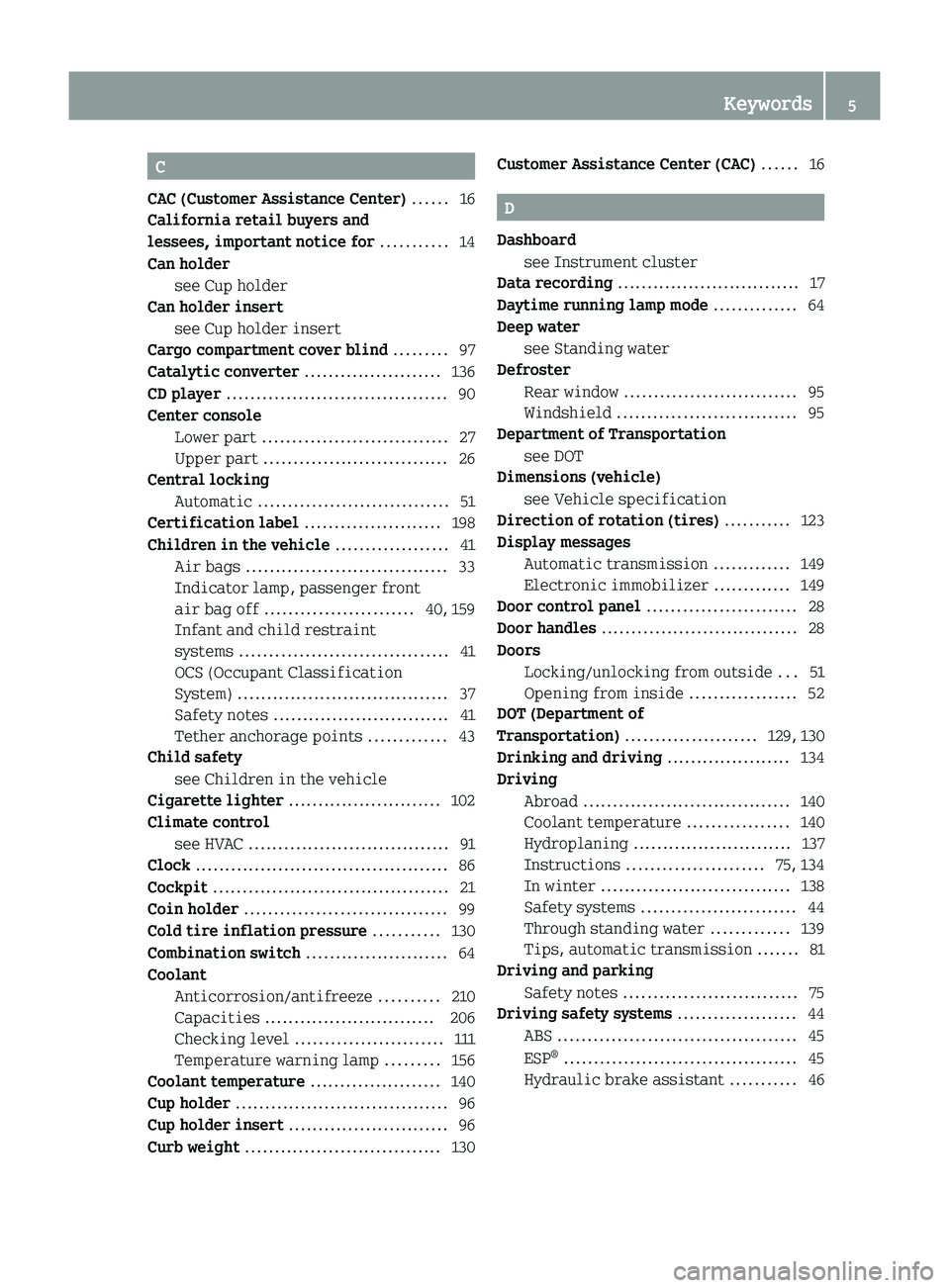
Coolant
Anticorrosion/antifreeze ..........210
Capacities ............................. 206
Checking level ......................... 111
Temperature warning lamp .........156
Coolant temperature ...................... 140
Cup holder .................................... 96
Cup holder insert ........................... 96
Curb weight ................................. 130Customer Assistance Center (CAC) ...... 16
D
Dashboard see Instrument cluster
Data recording ............................... 17
Daytime running lamp mode .............. 64
Deep water see Standing water
Defroster
Rear window ............................. 95
Windshield .............................. 95
Department of Transportation
see DOT
Dimensions (vehicle)
see Vehicle specification
Direction of rotation (tires) ........... 123
Display messages
Automatic transmission .............149
Electronic immobilizer .............149
Door control panel ......................... 28
Door handles ................................. 28
Doors
Locking/unlocking from outside ...51
Opening from inside ..................52
DOT (Department of
Transportation) ...................... 129, 130
Drinking and driving ..................... 134
Driving
Abroad ................................... 140
Coolant temperature .................140
Hydroplaning ........................... 137
Instructions ....................... 75, 134
In winter ................................ 138
Safety systems .......................... 44
Through standing water .............139
Tips, automatic transmission .......81
Driving and parking
Safety notes ............................. 75
Driving safety systems .................... 44
ABS ........................................ 45
ESP ®
....................................... 45
Hydraulic brake assistant ...........46
Keywords5451_AKB; 3; 22, en-USd2ureepe,Version: 2.11.8.12009-07-27T09:36:34+02:00 - Seite 5
Page 10 of 216
L
Labels ........................................ 198
Emission control information .....198
Lamps, exterior
Exterior lamp switch ..................62
Switching on/off ....................... 62
Lamps, indicator and warning
ABS ....................................... 149
Battery .................................. 154
Brakes ................................... 150
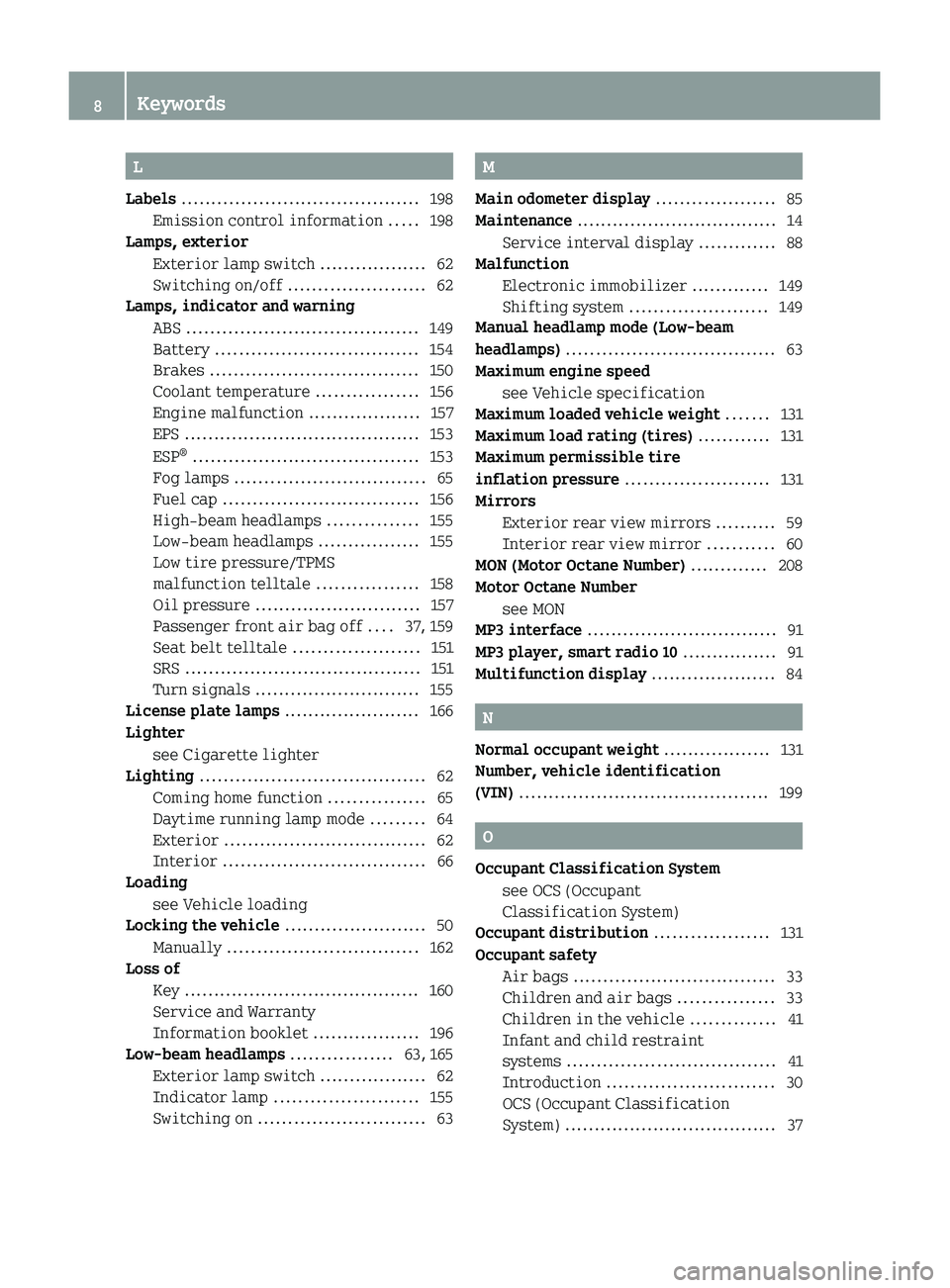
Coolant temperature .................156
Engine malfunction ...................157
EPS ........................................ 153
ESP ®
...................................... 153
Fog lamps ................................ 65
Fuel cap ................................. 156
High-beam headlamps ...............155
Low-beam headlamps .................155
Low tire pressure/TPMS
malfunction telltale .................158
Oil pressure ............................ 157
Passenger front air bag off ....37, 159
Seat belt telltale ..................... 151
SRS ........................................ 151
Turn signals ............................ 155
License plate lamps ....................... 166
Lighter see Cigarette lighter
Lighting ...................................... 62
Coming home function ................65
Daytime running lamp mode .........64
Exterior .................................. 62
Interior .................................. 66
Loading
see Vehicle loading
Locking the vehicle ........................ 50
Manually ................................ 162
Loss of
Key ........................................ 160
Service and Warranty
Information booklet ..................196
Low-beam headlamps ................. 63, 165
Exterior lamp switch ..................62
Indicator lamp ........................ 155
Switching on ............................ 63M
Main odometer display .................... 85
Maintenance .................................. 14
Service interval display .............88
Malfunction
Electronic immobilizer .............149
Shifting system ....................... 149
Manual headlamp mode (Low-beam
headlamps) ................................... 63
Maximum engine speed see Vehicle specification
Maximum loaded vehicle weight ....... 131
Maximum load rating (tires) ............ 131
Maximum permissible tire
inflation pressure ........................ 131
Mirrors
Exterior rear view mirrors ..........59
Interior rear view mirror ...........60
MON (Motor Octane Number) ............. 208
Motor Octane Number see MON
MP3 interface ................................ 91
MP3 player, smart radio 10 ................ 91
Multifunction display ..................... 84
N
Normal occupant weight .................. 131
Number, vehicle identification
(VIN) .......................................... 199
O
Occupant Classification System see OCS (Occupant
Classification System)
Occupant distribution ................... 131
Occupant safety
Air bags .................................. 33
Children and air bags ................33
Children in the vehicle ..............41
Infant and child restraint
systems ................................... 41
Introduction ............................ 30
OCS (Occupant Classification
System) .................................... 37
8Keywords451_AKB; 3; 22, en-USd2ureepe,Version: 2.11.8.12009-07-27T09:36:34+02:00 - Seite 8
Page 13 of 216
Technical data (dimensions)see Vehicle specification
Technical data (electrical system)
see Vehicle specification
Technical data (engine)
see Vehicle specification
Technical data (weights)
see Vehicle specification
Temperature
Coolant .................................. 140
Interior temperature .................93
Outside ................................... 86
Tether anchorage points
see Children in the vehicle
Tightening torque
Wheels ................................... 125
TIN (Tire Identification
Number) ................................. 129, 131
Tire and Loading Information
placard ....................................... 120
Tire and loading terminology .......... 130
Tire Identification Number see TIN
Tire inflation pressure
Checking ................................ 116
Important notes on ....................116
Placard on driver’s door B-
pillar .................................... 120
Tire labeling ............................... 125
Tire load rating ........................... 131
Tire ply composition and material
used ........................................... 132
Tire Pressure Monitoring System
(TPMS) ......................................... 117
Tire repair kit ....................... 148, 172
Tires .................................... 114, 202
Air pressure ............................ 115
Care and maintenance ...............123
Cleaning ................................ 124
Direction of rotation, spinning ..123
Driving instructions ................. 137
Flat tire ................................. 172
Important notes on tire
inflation pressure ....................116
Inflation pressure ...............116, 117
Information placard .................120
Inspection .............................. 123Labeling ................................ 125
Load rating ............................. 131
Ply composition and material
used ...................................... 132
Problems under-/overinflation ...116
Retreads ................................. 114
Rims and tires (technical data) ...202
Rotation ................................. 125
Service life ............................ 123
Sizes ..................................... 202
Snow chains ............................ 133
Speed rating ................ 127, 132, 138
Storing .................................. 124
Temperature ...................... 116, 125
Terminology ............................ 130
Tire Identification Number ..129, 131
Tire Pressure Monitoring
System (TPMS) .......................... 117
Traction ...................... 125, 132, 137
Tread ..................................... 132
Tread depth ....................... 123, 132
Treadwear indicators ..........123, 132
Vehicle maximum load on ...........132
Winter tires ...................... 132, 202
Tire speed rating .................... 127, 132
Top tether see Children in the vehicle
Total load limit ........................... 132
Tow-away alarm ............................. 48
Towing ........................................ 185
Traction ................................ 132, 137
Transmission see Automatic transmission
Transmission position indicator ...... 85
Transmitting power values .............. 196
Traveling abroad .......................... 140
Tread (tires) ................................ 132
Tread depth (tires) .................. 123, 132
Treadwear indicators (tires) ..... 123, 132
Trip odometer, resetting ................. 88
Turning off the engine .................... 79
Turn signal lamps ......................... 165
Turn signals ................................. 65
Indicator lamps ....................... 155Keywords11451_AKB; 3; 22, en-USd2ureepe,Version: 2.11.8.12009-07-27T09:36:34+02:00 - Seite 11
Page 25 of 216
FunctionPage0046Selecting display for
status indicator
87
Setting digital clock860047Left indicator lamp
display with:0065Low‑beam
headlamp indicator
lamp
63,
155
0063High‑beam
headlamp indicator
lamp
65,
155
0077Combination low
tire pressure/TPMS
malfunction
telltale*
158
0082Seat belt telltale1510081SRS indicator lamp151008A0026Left turn signal
indicator lamp65,
15500880067ESP ®
warning lamp15300860024Right turn signal
indicator lamp65,
1550087Speedometer006ERight indicator lamp
display with:0052EPS* warning lamp15300BBEngine malfunction
indicator lamp
157
00EBABS indicator lamp1490027Brake warning lamp150FunctionPage006FAdjusting instrument
cluster illumination
89
Setting digital clock860070Right center indicator
lamp display with:00B5Engine oil pressure
indicator lamp
157
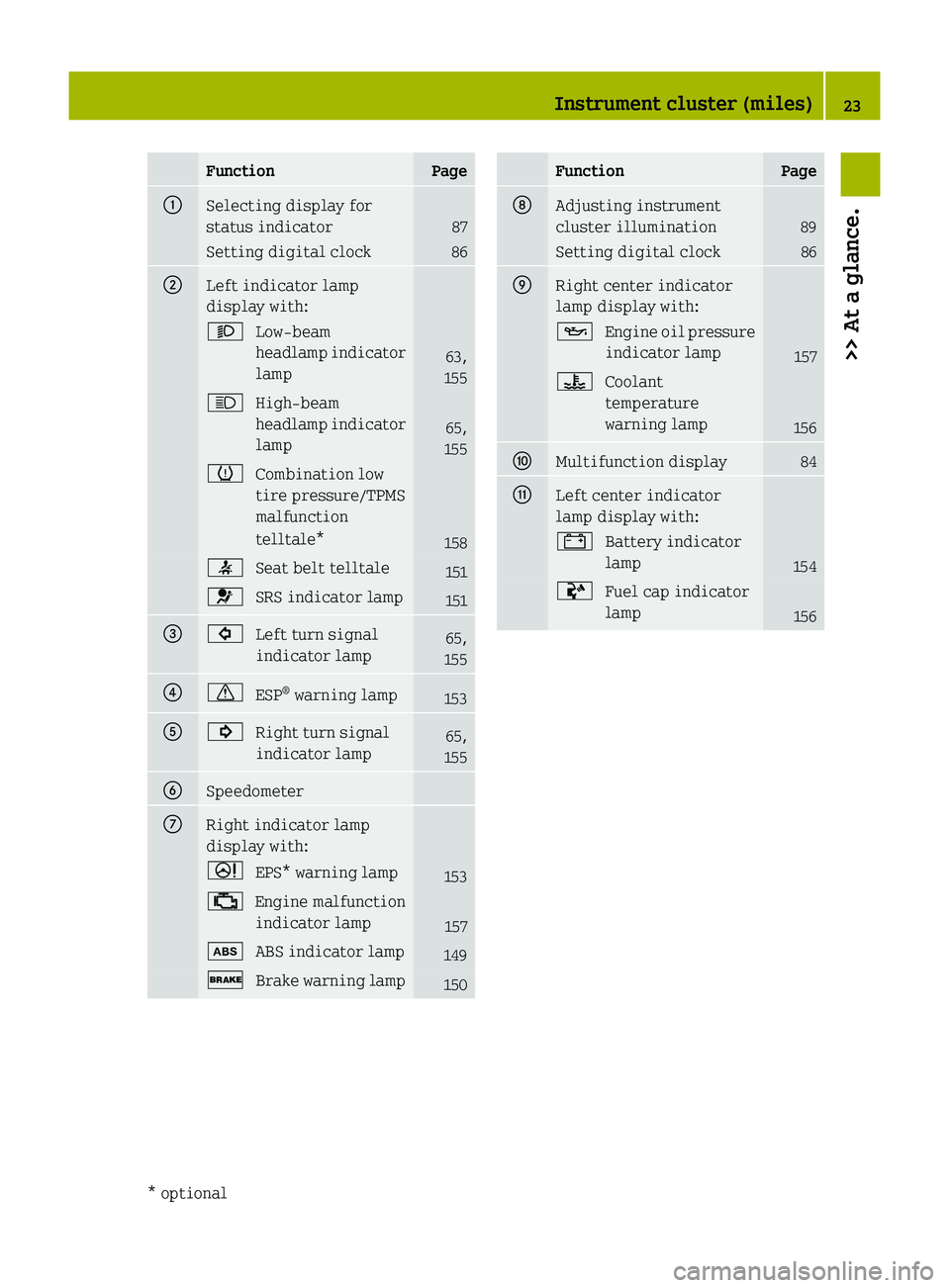
00AECoolant
temperature
warning lamp
156
0071Multifunction display840072Left center indicator
lamp display with:003FBattery indicator
lamp
154
00ACFuel cap indicator
lamp
156
Instrument cluster (miles)23>> At a glance.* optional451_AKB; 3; 22, en-USd2ureepe,Version: 2.11.8.12009-07-27T09:36:34+02:00 - Seite 23
Page 27 of 216
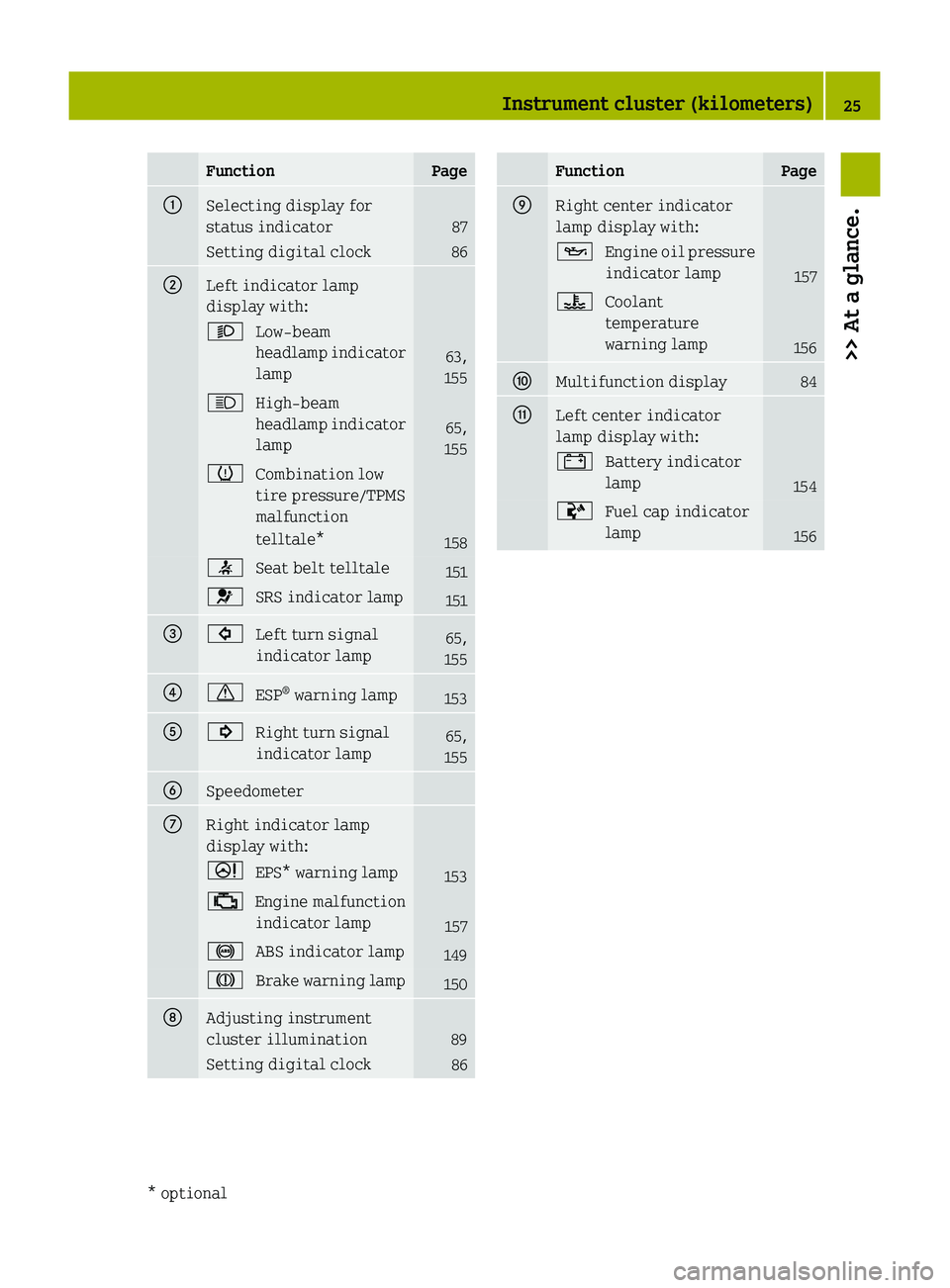
FunctionPage0046Selecting display for
status indicator
87
Setting digital clock860047Left indicator lamp
display with:0065Low‑beam
headlamp indicator
lamp
63,
155
0063High‑beam
headlamp indicator
lamp
65,
155
0077Combination low
tire pressure/TPMS
malfunction
telltale*
158
0082Seat belt telltale1510081SRS indicator lamp151008A0026Left turn signal
indicator lamp65,
15500880067ESP ®
warning lamp15300860024Right turn signal
indicator lamp65,
1550087Speedometer006ERight indicator lamp
display with:0052EPS* warning lamp15300BBEngine malfunction
indicator lamp
157
0031ABS indicator lamp149004DBrake warning lamp150006FAdjusting instrument
cluster illumination
89
Setting digital clock86FunctionPage0070Right center indicator
lamp display with:00B5Engine oil pressure
indicator lamp
157
00AECoolant
temperature
warning lamp
156
0071Multifunction display840072Left center indicator
lamp display with:003FBattery indicator
lamp
154
00ACFuel cap indicator
lamp
156
Instrument cluster (kilometers)25>> At a glance.* optional451_AKB; 3; 22, en-USd2ureepe,Version: 2.11.8.12009-07-27T09:36:34+02:00 - Seite 25
Page 95 of 216
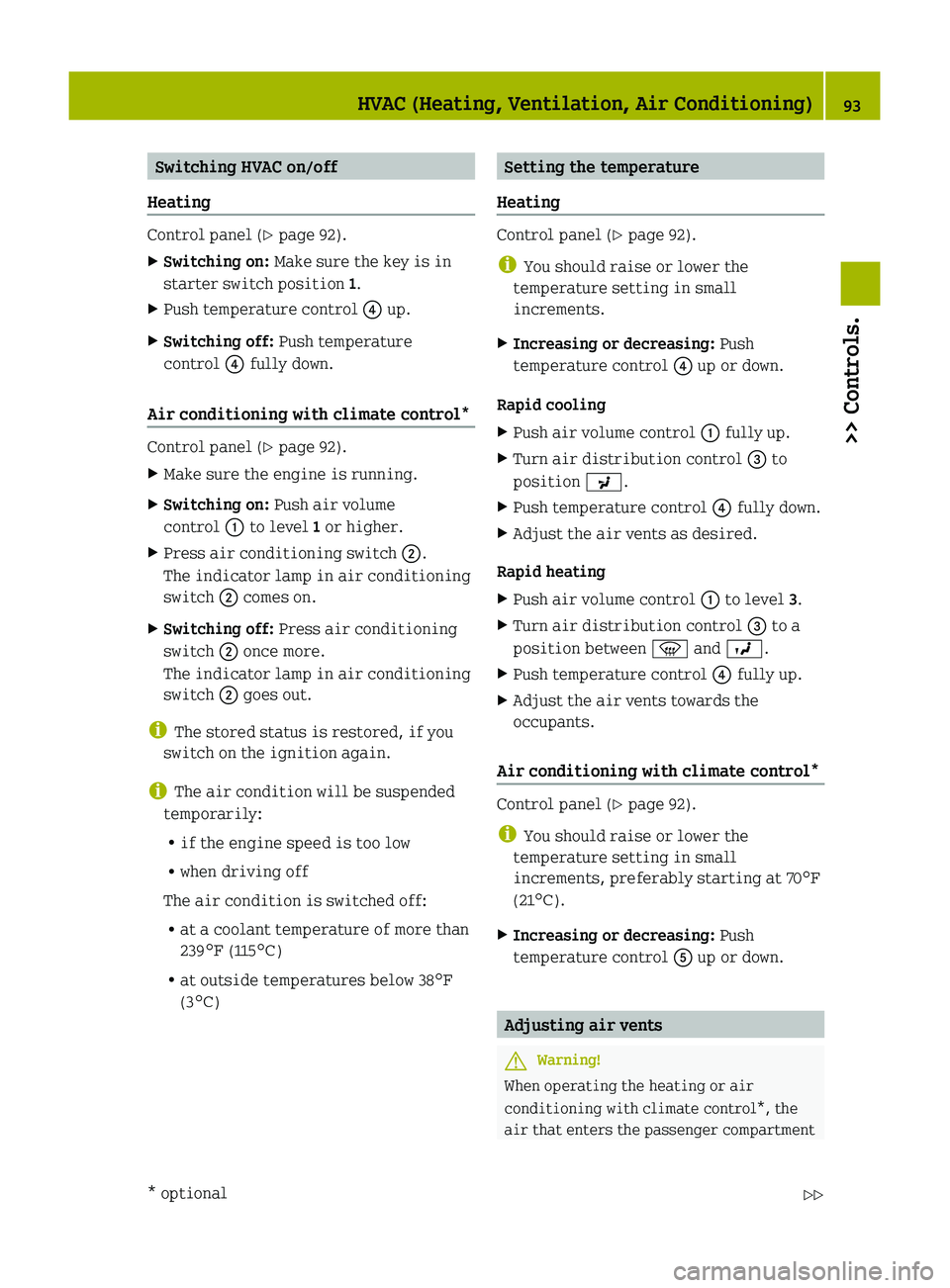
Switching HVAC on/off
Heating
Control panel ( Y page 92).
XSwitching on: Make sure the key is in
starter switch position 1.XPush temperature control 0088 up.XSwitching off: Push temperature
control 0088 fully down.
Air conditioning with climate control*
Control panel ( Y page 92).
XMake sure the engine is running.XSwitching on: Push air volume
control 0046 to level 1 or higher.XPress air conditioning switch 0047.
The indicator lamp in air conditioning
switch 0047 comes on.XSwitching off: Press air conditioning
switch 0047 once more.
The indicator lamp in air conditioning
switch 0047 goes out.
i
The stored status is restored, if you
switch on the ignition again.
i The air condition will be suspended
temporarily:
R if the engine speed is too low
R when driving off
The air condition is switched off:
R at a coolant temperature of more than
239 ¦ (115 ¥)
R at outside temperatures below 38 ¦
(3 ¥ )
Setting the temperature
Heating
Control panel ( Y page 92).
i You should raise or lower the
temperature setting in small
increments.
XIncreasing or decreasing: Push
temperature control 0088 up or down.
Rapid cooling
XPush air volume control 0046 fully up.XTurn air distribution control 008A to
position 009E.XPush temperature control 0088 fully down.XAdjust the air vents as desired.
Rapid heating
XPush air volume control 0046 to level 3.XTurn air distribution control 008A to a
position between 0087 and 009D .XPush temperature control 0088 fully up.XAdjust the air vents towards the
occupants.
Air conditioning with climate control*
Control panel ( Y page 92).
i You should raise or lower the
temperature setting in small
increments, preferably starting at 70 ¦
(21 ¥).
XIncreasing or decreasing: Push
temperature control 0086 up or down.
Adjusting air vents
GWarning!
When operating the heating or air
conditioning with climate control*, the
air that enters the passenger compartment
HVAC (Heating, Ventilation, Air Conditioning)93>> Controls.* optional451_AKB; 3; 22, en-USd2ureepe,Version: 2.11.8.12009-07-27T09:36:34+02:00 - Seite 93Z
Page 109 of 216
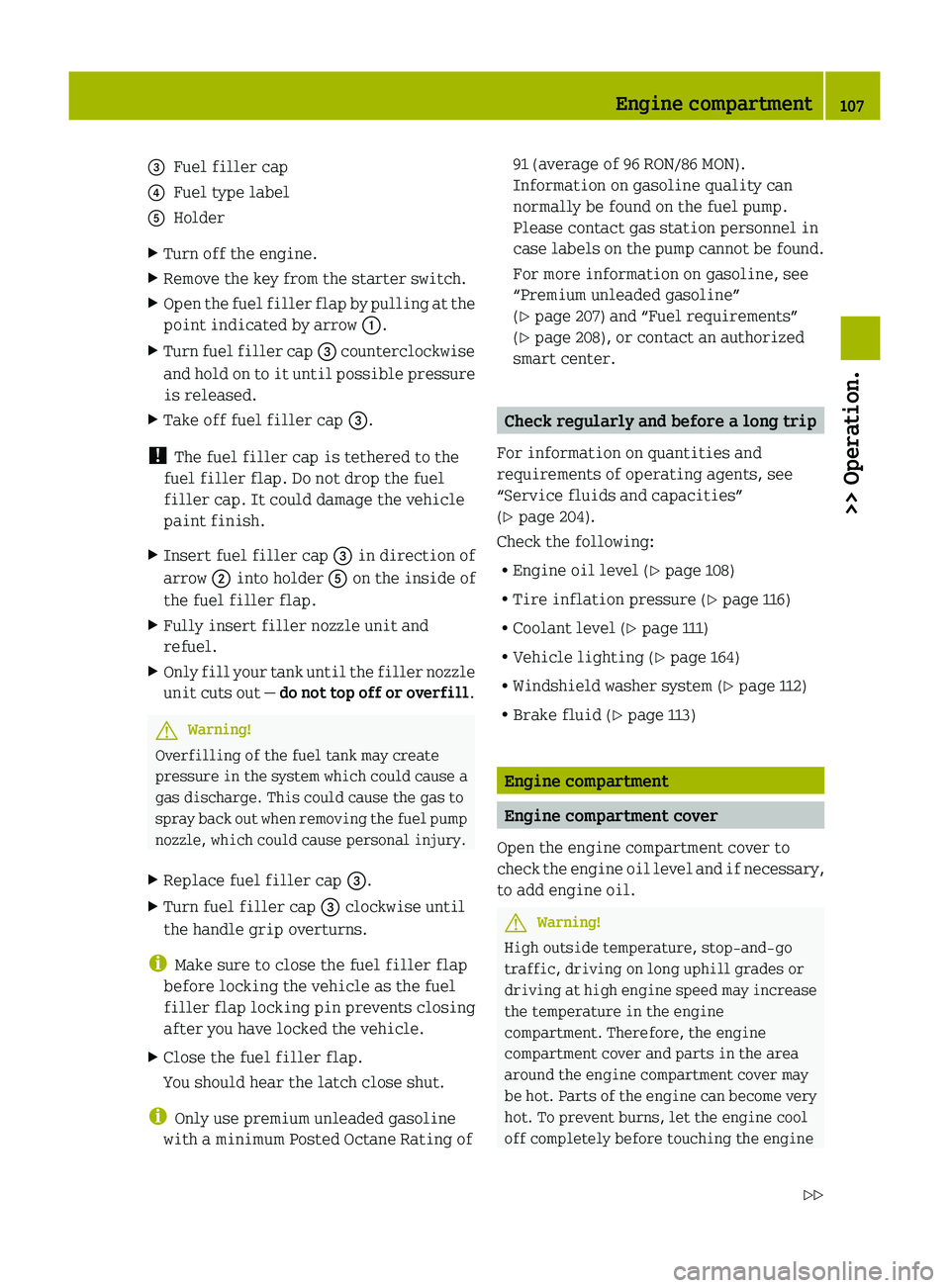
008AFuel filler cap0088Fuel type label0086HolderXTurn off the engine.XRemove the key from the starter switch.XOpen the fuel filler flap by pulling at the
point indicated by arrow 0046.XTurn fuel filler cap 008A counterclockwise
and hold on to it until possible pressure
is released.XTake off fuel filler cap 008A.
!
The fuel filler cap is tethered to the
fuel filler flap. Do not drop the fuel
filler cap. It could damage the vehicle
paint finish.
XInsert fuel filler cap 008A in direction of
arrow 0047 into holder 0086 on the inside of
the fuel filler flap.XFully insert filler nozzle unit and
refuel.XOnly fill your tank until the filler nozzle
unit cuts out — do not top off or overfill .GWarning!
Overfilling of the fuel tank may create
pressure in the system which could cause a
gas discharge. This could cause the gas to
spray back out when removing the fuel pump
nozzle, which could cause personal injury.
XReplace fuel filler cap 008A.XTurn fuel filler cap 008A clockwise until
the handle grip overturns.
i Make sure to close the fuel filler flap
before locking the vehicle as the fuel
filler flap locking pin prevents closing
after you have locked the vehicle.
XClose the fuel filler flap.
You should hear the latch close shut.
i Only use premium unleaded gasoline
with a minimum Posted Octane Rating of
91 (average of 96 RON/86 MON).
Information on gasoline quality can
normally be found on the fuel pump.
Please contact gas station personnel in
case labels on the pump cannot be found.
For more information on gasoline, see
“Premium unleaded gasoline”
( Y page 207) and “Fuel requirements”
( Y page 208), or contact an authorized
smart center.
Check regularly and before a long trip
For information on quantities and
requirements of operating agents, see
“Service fluids and capacities”
( Y page 204).
Check the following:
R Engine oil level ( Y page 108)
R Tire inflation pressure ( Y page 116)
R Coolant level ( Y page 111)
R Vehicle lighting ( Y page 164)
R Windshield washer system ( Y page 112)
R Brake fluid ( Y page 113)
Engine compartment
Engine compartment cover
Open the engine compartment cover to
check the engine oil level and if necessary,
to add engine oil.
GWarning!
High outside temperature, stop-and-go
traffic, driving on long uphill grades or
driving at high engine speed may increase
the temperature in the engine
compartment. Therefore, the engine
compartment cover and parts in the area
around the engine compartment cover may
be hot. Parts of the engine can become very
hot. To prevent burns, let the engine cool
off completely before touching the engine
Engine compartment107>> Operation.451_AKB; 3; 22, en-USd2ureepe,Version: 2.11.8.12009-07-27T09:36:34+02:00 - Seite 107Z
Page 110 of 216
compartment cover, parts in the area
around the engine compartment cover, and
parts of the engine.XTurn off the engine.XEngage the parking brake.XOpen the tailgate.GWarning!
Exercise extreme caution if you see flames
or smoke coming from the engine
compartment. Move away from the vehicle
and call the fire department.
If the coolant temperature warning lamp
indicates that the engine is overheated, do
not attempt to open the engine compartment
cover. Move away from the vehicle and wait
until the engine has cooled before opening
the engine compartment.
GWarning!
To help prevent personal injury, stay clear
of moving parts when the engine
compartment cover is open and the engine
is running.
GWarning!
The engine is equipped with a
transistorized ignition system that
utilizes high voltage. Do not touch any
components (ignition coils, spark plug
sockets, diagnostic socket) of the ignition
system
R while the engine is running
R while starting the engine
R if ignition is “on” and the engine is
turned manually
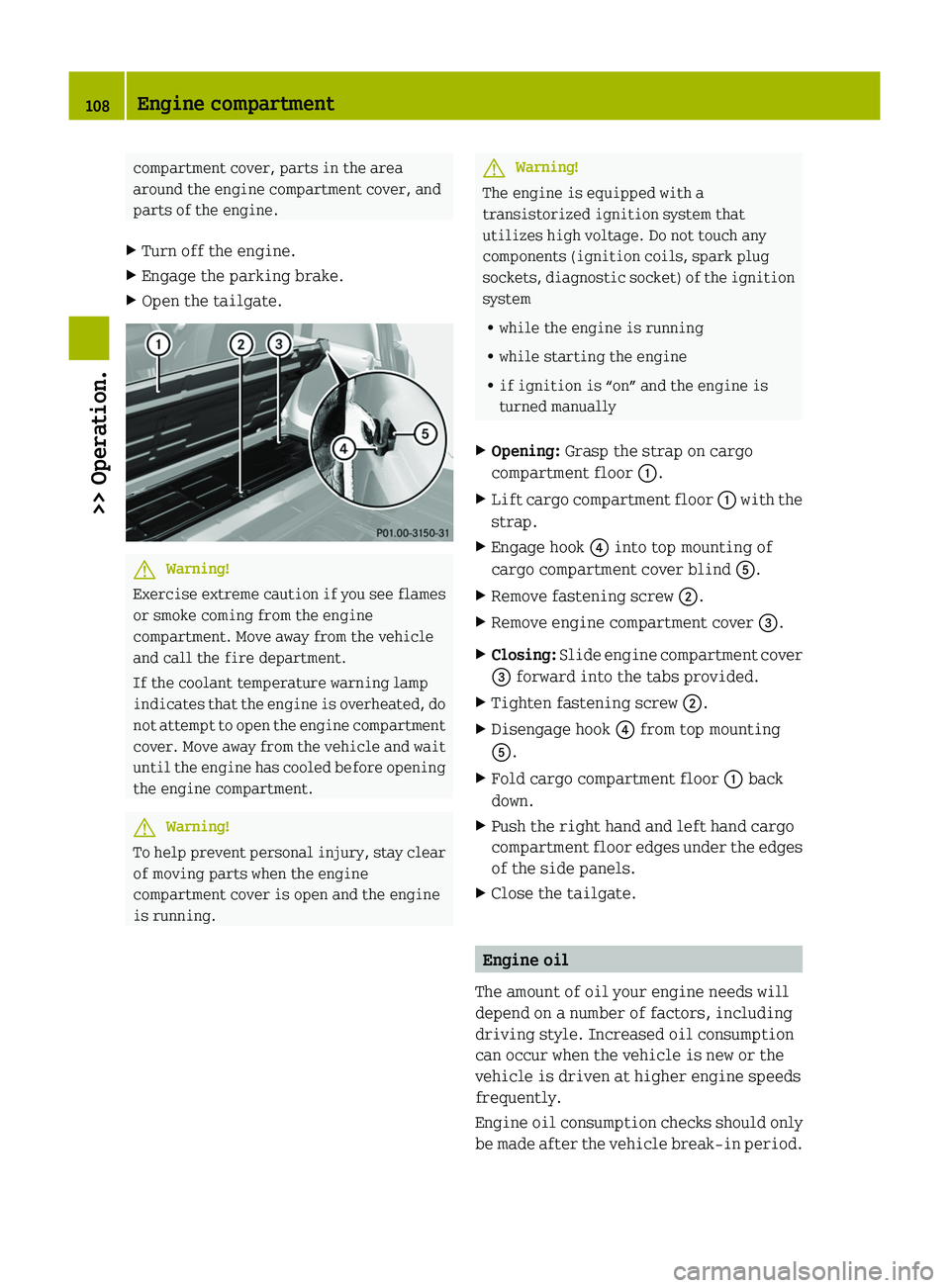
XOpening: Grasp the strap on cargo
compartment floor 0046.XLift cargo compartment floor 0046 with the
strap.XEngage hook 0088 into top mounting of
cargo compartment cover blind 0086.XRemove fastening screw 0047.XRemove engine compartment cover 008A.XClosing: Slide engine compartment cover
008A forward into the tabs provided.XTighten fastening screw 0047.XDisengage hook 0088 from top mounting
0086 .XFold cargo compartment floor 0046 back
down.XPush the right hand and left hand cargo
compartment floor edges under the edges
of the side panels.XClose the tailgate.
Engine oil
The amount of oil your engine needs will
depend on a number of factors, including
driving style. Increased oil consumption
can occur when the vehicle is new or the
vehicle is driven at higher engine speeds
frequently.
Engine oil consumption checks should only
be made after the vehicle break-in period.
108Engine compartment>> Operation.
451_AKB; 3; 22, en-USd2ureepe,Version: 2.11.8.12009-07-27T09:36:34+02:00 - Seite 108
Page 114 of 216
cooling system, or if the coolant
temperature warning lamp 00AE in the
instrument cluster indicates that the
coolant is overheated.
R Do not remove the pressure cap on coolant
reservoir if coolant temperature is
above 158 ¦ (70 ¥). Allow engine to cool
down before removing cap. The coolant
reservoir contains hot fluid and is under
pressure.
R Using a rag, slowly turn the cap
approximately 1
/ 2 turn to relieve excess
pressure. If opened immediately,
scalding hot fluid and steam will be
blown out under pressure.
The engine coolant is a mixture of water
and anticorrosion/antifreeze. To check the
coolant level the vehicle must be parked on
level ground and the engine must have
cooled down. For more information, see
“Coolants” ( Y page 209).
Checking coolant levelXRemove the service flap and insert it on
the front of the vehicle ( Y page 110).
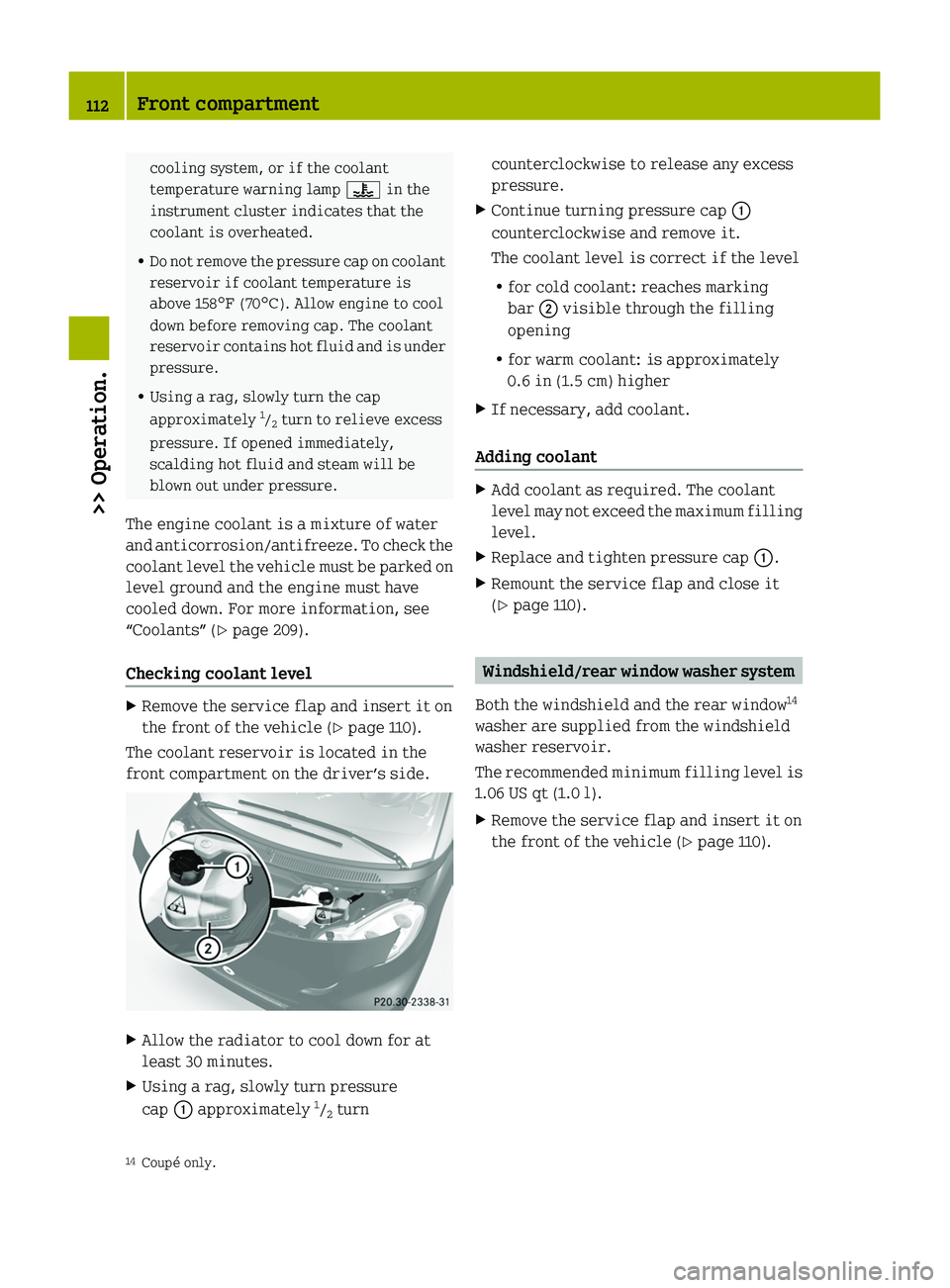
The coolant reservoir is located in the
front compartment on the driver’s side.
XAllow the radiator to cool down for at
least 30 minutes.XUsing a rag, slowly turn pressure
cap 0046 approximately 1
/ 2 turncounterclockwise to release any excess
pressure.XContinue turning pressure cap 0046
counterclockwise and remove it.
The coolant level is correct if the level
R for cold coolant: reaches marking
bar 0047 visible through the filling
opening
R for warm coolant: is approximately
0.6 in (1.5 cm) higherXIf necessary, add coolant.
Adding coolant
XAdd coolant as required. The coolant
level may not exceed the maximum filling
level.XReplace and tighten pressure cap 0046.XRemount the service flap and close it
( Y page 110).
Windshield/rear window washer system
Both the windshield and the rear window 14
washer are supplied from the windshield
washer reservoir.
The recommended minimum filling level is
1.06 US qt (1.0 l).
XRemove the service flap and insert it on
the front of the vehicle ( Y page 110).14
Coupé only.112Front compartment>> Operation.
451_AKB; 3; 22, en-USd2ureepe,Version: 2.11.8.12009-07-27T09:36:34+02:00 - Seite 112
Page 142 of 216
malfunction of the vehicle’s electronic
system, possibly resulting in an accident
and/or serious personal injury.
Radio transmitters, such as a mobile phone
or a citizens band unit should only be used
inside the vehicle if they are connected to
an antenna that is installed on the outside
of the vehicle.
Refer to the radio transmitter operation
instructions regarding use of an external
antenna.
Emission control
Certain engine systems serve to keep the
toxic components of the exhaust gases
within permissible legal limits.
These systems, of course, will function
properly only when maintained strictly
according to factory specifications.
Any adjustments to the engine should
therefore be carried out only by qualified
smart center authorized technicians.
Engine adjustments should not be altered
in any way. Moreover, the specified service
jobs must be carried out regularly
according to smart servicing
requirements. For details refer to the
Maintenance Booklet.
GWarning!
Inhalation of exhaust gas is hazardous to
your health. All exhaust gas contains
carbon monoxide (CO), and inhaling it can
cause unconsciousness and lead to death.
Do not run the engine in confined areas
(such as a garage) which are not properly
ventilated. If you think that exhaust gas
fumes are entering the vehicle while
driving, have the cause determined and
corrected immediately. If you must drive
under these conditions, drive only with at
least one window fully open at all times.
Coolant temperature
During severe operating conditions and
stop-and-go city traffic, the coolant
temperature may rise.
! Excessive coolant temperature causes
the red coolant temperature warning
lamp 00AE in the instrument cluster
comes on.
The engine should not be operated with
the red coolant temperature warning
lamp illuminated. Doing so may cause
serious engine damage which is not
covered by the smart Limited Warranty.
For more information on coolant
temperature warning lamp ( Y page 156).GWarning!
Driving when your engine is overheated can
cause some fluids which may have leaked
into the engine compartment to catch fire.
You could be seriously burned.
Steam from an overheated engine can cause
serious burns which can occur just by
opening the engine hood. Stay away from the
engine if you see or hear steam coming from
it.
Stop the vehicle in a safe location away
from other traffic. Turn off the engine, get
out of the vehicle and do not stand near the
vehicle until the engine has cooled down.
Driving abroad
Abroad, there is an extensive smart service
network at your disposal. If you plan to
drive into areas which are not listed in the
index of your smart center directory, you
should request pertinent information from
an authorized smart center.
Symmetrical low beams
i If you drive in countries where
vehicles drive on the other side of the
140Driving abroad>> Operation.
451_AKB; 3; 22, en-USd2ureepe,Version: 2.11.8.12009-07-27T09:36:34+02:00 - Seite 140