fuel cap SMART FORTWO COUPE 2010 Owners Manual
[x] Cancel search | Manufacturer: SMART, Model Year: 2010, Model line: FORTWO COUPE, Model: SMART FORTWO COUPE 2010Pages: 216, PDF Size: 9.7 MB
Page 8 of 216
E
Electrical system
Improper work on or
modifications ........................... 15
Power outlet ............................ 102
Electrical system (Technical data)
see Vehicle specification
Electronic immobilizer .................. 47
Display message ...................... 149
Electronic Power Steering
see EPS
Electronic Stability Program
see ESP ®
Emergency, in case of
Hazard warning flasher ..........47, 66
Roadside Assistance ..................14
Emergency operation (limp-home
mode) .......................................... 83
Emergency Tensioning Device see ETD
Emission control .......................... 140
Information label .....................198
System warranties ......................13
Engine
Break-in recommendations .........106
Compartment ........................... 107
Compartment cover ...................107
Electronics ............................. 196
Malfunction indicator lamp ........157
Number .................................. 199
Starting .................................. 75
Turning off .............................. 79
Engine (Technical data)
see Vehicle specification
Engine coolant
see Coolant
Engine oil
Adding ................................... 109
Additives ............................... 207
Checking level ......................... 109
Consumption ........................... 108
Oil dipstick ............................ 109
EPS (Electronic Power Steering)
Warning lamp .......................... 153
ESP ®
(Electronic Stability Program) .. 45
Warning lamp .......................... 153ETD (Emergency Tensioning Device) ... 33
Safety guidelines ......................35
Exterior lamp switch ...................... 62
Exterior lighting
Overview ................................ 165
Exterior rear view mirrors .............. 59
Exterior view of vehicle .................. 20
F
First-aid kit ............................... 148
Flat tire ..................................... 172
Fluids
Brake fluid ............................. 206
Capacities ............................. 206
Engine coolant ........................ 206
Engine oil .............................. 206
Transmission fluid ..................206
Fog lamps ............................... 65, 165
Front air bags see Air bags
Front compartment ........................ 110
Front lamps
Overview ................................ 165
Fuel ........................................... 136
Additives ............................... 208
Capacity, fuel tank ...................206
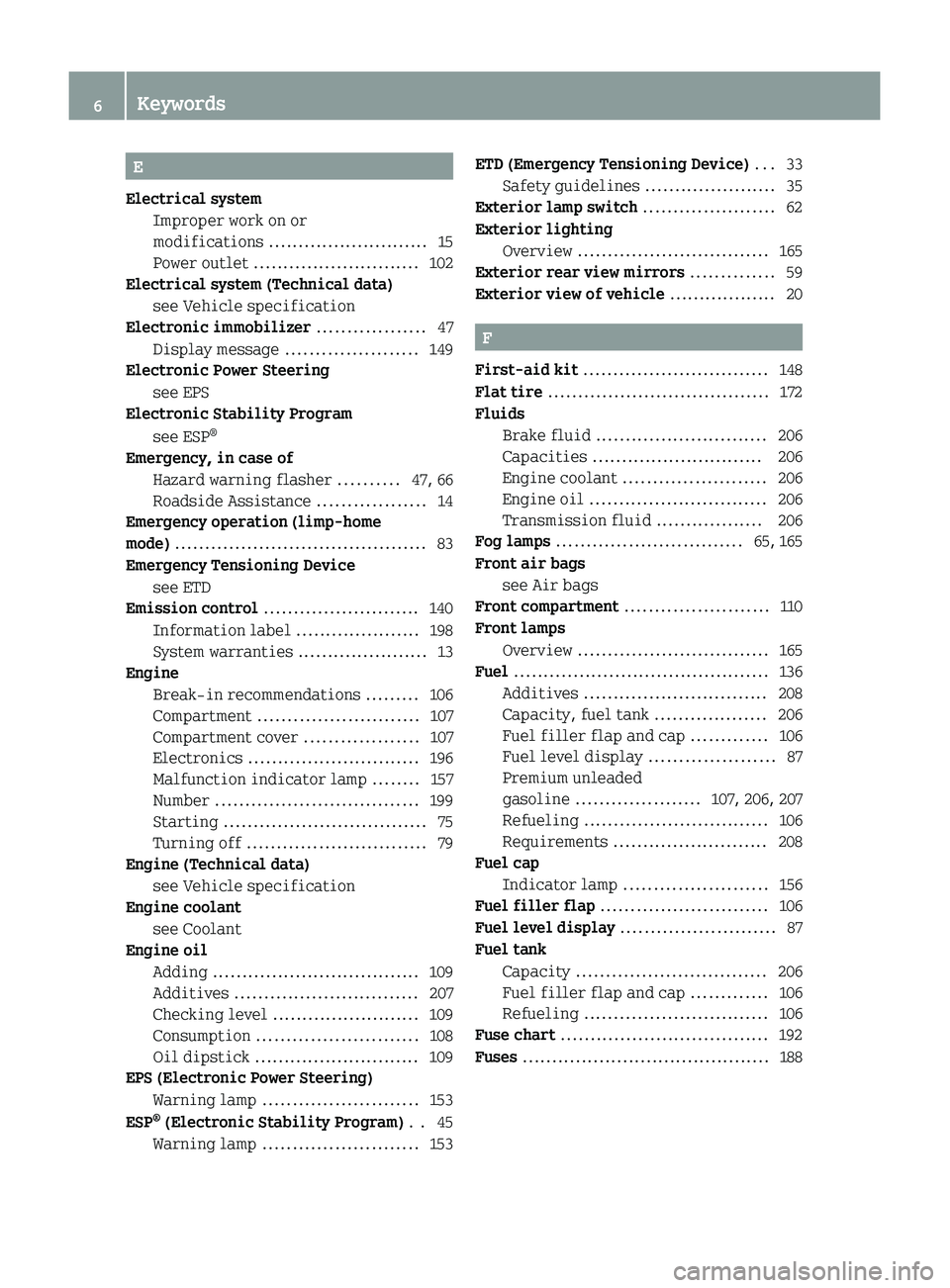
Fuel filler flap and cap .............106
Fuel level display .....................87
Premium unleaded
gasoline ..................... 107, 206, 207
Refueling ............................... 106
Requirements .......................... 208
Fuel cap
Indicator lamp ........................ 156
Fuel filler flap ............................ 106
Fuel level display .......................... 87
Fuel tank
Capacity ................................ 206
Fuel filler flap and cap .............106
Refueling ............................... 106
Fuse chart ................................... 192
Fuses .......................................... 188
6Keywords451_AKB; 3; 22, en-USd2ureepe,Version: 2.11.8.12009-07-27T09:36:34+02:00 - Seite 6
Page 10 of 216
L
Labels ........................................ 198
Emission control information .....198
Lamps, exterior
Exterior lamp switch ..................62
Switching on/off ....................... 62
Lamps, indicator and warning
ABS ....................................... 149
Battery .................................. 154
Brakes ................................... 150
Coolant temperature .................156
Engine malfunction ...................157
EPS ........................................ 153
ESP ®
...................................... 153
Fog lamps ................................ 65
Fuel cap ................................. 156
High-beam headlamps ...............155
Low-beam headlamps .................155
Low tire pressure/TPMS
malfunction telltale .................158
Oil pressure ............................ 157
Passenger front air bag off ....37, 159
Seat belt telltale ..................... 151
SRS ........................................ 151
Turn signals ............................ 155
License plate lamps ....................... 166
Lighter see Cigarette lighter
Lighting ...................................... 62
Coming home function ................65
Daytime running lamp mode .........64
Exterior .................................. 62
Interior .................................. 66
Loading
see Vehicle loading
Locking the vehicle ........................ 50
Manually ................................ 162
Loss of
Key ........................................ 160
Service and Warranty
Information booklet ..................196
Low-beam headlamps ................. 63, 165
Exterior lamp switch ..................62
Indicator lamp ........................ 155
Switching on ............................ 63M
Main odometer display .................... 85
Maintenance .................................. 14
Service interval display .............88
Malfunction
Electronic immobilizer .............149
Shifting system ....................... 149
Manual headlamp mode (Low-beam
headlamps) ................................... 63
Maximum engine speed see Vehicle specification
Maximum loaded vehicle weight ....... 131
Maximum load rating (tires) ............ 131
Maximum permissible tire
inflation pressure ........................ 131
Mirrors
Exterior rear view mirrors ..........59
Interior rear view mirror ...........60
MON (Motor Octane Number) ............. 208
Motor Octane Number see MON
MP3 interface ................................ 91
MP3 player, smart radio 10 ................ 91
Multifunction display ..................... 84
N
Normal occupant weight .................. 131
Number, vehicle identification
(VIN) .......................................... 199
O
Occupant Classification System see OCS (Occupant
Classification System)
Occupant distribution ................... 131
Occupant safety
Air bags .................................. 33
Children and air bags ................33
Children in the vehicle ..............41
Infant and child restraint
systems ................................... 41
Introduction ............................ 30
OCS (Occupant Classification
System) .................................... 37
8Keywords451_AKB; 3; 22, en-USd2ureepe,Version: 2.11.8.12009-07-27T09:36:34+02:00 - Seite 8
Page 12 of 216
S
Safety
Driving safety systems ...............44
Occupant safety ......................... 30
Reporting defects ......................16
Safety belts
see Seat belts
Seat belt force limiter .................... 33
Seat belts ..................................... 31
Children in the vehicle ..............41
Fastening ................................ 60
Proper use of ............................ 31
Safety guidelines ......................35
Safety notes .............................. 31
Telltale .................................. 151
Seating capacity ........................... 121
Seats ........................................... 56
Adjustment ............................... 57
Armrest ................................... 57
Heating ................................... 58
Passenger seat .......................... 58
Self-test
OCS (Occupant Classification
System) ................................... 40
SRS ......................................... 30
Service
see Maintenance
Service, parts .............................. 196
Service and warranty
Booklet .................................. 196
Service flap ................................. 110
Service interval display .................. 88
Service life (tires) ....................... 123
Side marker lamps ......................... 165
Sidewall (tires) ............................ 131
Side windows
Operation ................................ 74
Signs and labels ........................... 198
smart radio 10 ............................... 91
smart radio 9 ................................ 90
smart sound package ....................... 91
Snow chains ................................. 133
Snow tires see Winter tires
Soft top system .............................. 69
Cleaning the soft top fabric .......145Locking rear soft top manually ....162
Mounting the side rails ..............73
Opening and closing the rear
soft top ............................... 55, 71
Opening and closing the
retractable soft top ...............54, 70
Removing the side rails ..............72
Storing the side rails ................73
Sound package ............................... 91
SRS (Supplemental Restraint System)
Indicator lamp ......................... 151
Standing water, driving through ...... 139
Starter switch positions .................. 55
Starting the engine ........................ 75
Steering wheel gearshift control ...... 26
Storage compartments ..................... 99
in the tailgate ........................ 100
Storing tires ............................... 124
Sun screen ................................... 102
Sun visors ................................... 101
T
Tailgate
Closing ............................... 53, 55
Opening .............................. 52, 54
Tail lamps ................................... 166
Technical data
Air conditioning refrigerant .....207
Brake fluid ............................. 207
Coolant .................................. 209
Engine oil additives ................ 207
Engine oils ............................. 206
Fuel requirements ....................208
Gasoline additives ...................208
Identification labels ................198
Premium unleaded gasoline ........207
Rims and tires ......................... 202
Service fluids and capacities ....204
Vehicle specification (model
BRABUS) ................................. 201
Vehicle specification (model
passion) ................................. 200
Vehicle specification (model
pure) ..................................... 199
Windshield/rear window washer
system ............................. 206, 208
10Keywords451_AKB; 3; 22, en-USd2ureepe,Version: 2.11.8.12009-07-27T09:36:34+02:00 - Seite 10
Page 25 of 216
FunctionPage0046Selecting display for
status indicator
87
Setting digital clock860047Left indicator lamp
display with:0065Low‑beam
headlamp indicator
lamp
63,
155
0063High‑beam
headlamp indicator
lamp
65,
155
0077Combination low
tire pressure/TPMS
malfunction
telltale*
158
0082Seat belt telltale1510081SRS indicator lamp151008A0026Left turn signal
indicator lamp65,
15500880067ESP ®
warning lamp15300860024Right turn signal
indicator lamp65,
1550087Speedometer006ERight indicator lamp
display with:0052EPS* warning lamp15300BBEngine malfunction
indicator lamp
157
00EBABS indicator lamp1490027Brake warning lamp150FunctionPage006FAdjusting instrument
cluster illumination
89
Setting digital clock860070Right center indicator
lamp display with:00B5Engine oil pressure
indicator lamp
157
00AECoolant
temperature
warning lamp
156
0071Multifunction display840072Left center indicator
lamp display with:003FBattery indicator
lamp
154
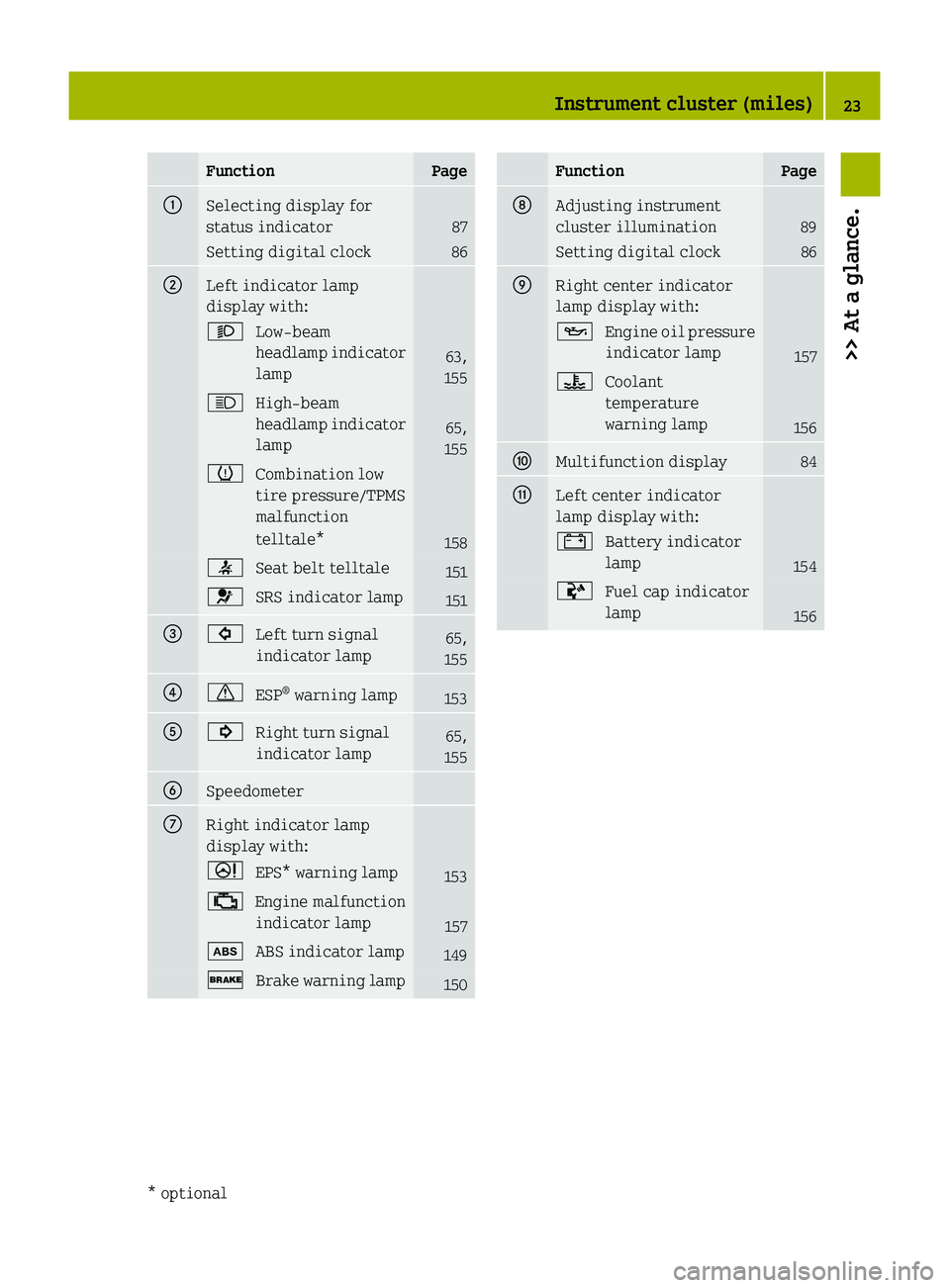
00ACFuel cap indicator
lamp
156
Instrument cluster (miles)23>> At a glance.* optional451_AKB; 3; 22, en-USd2ureepe,Version: 2.11.8.12009-07-27T09:36:34+02:00 - Seite 23
Page 27 of 216
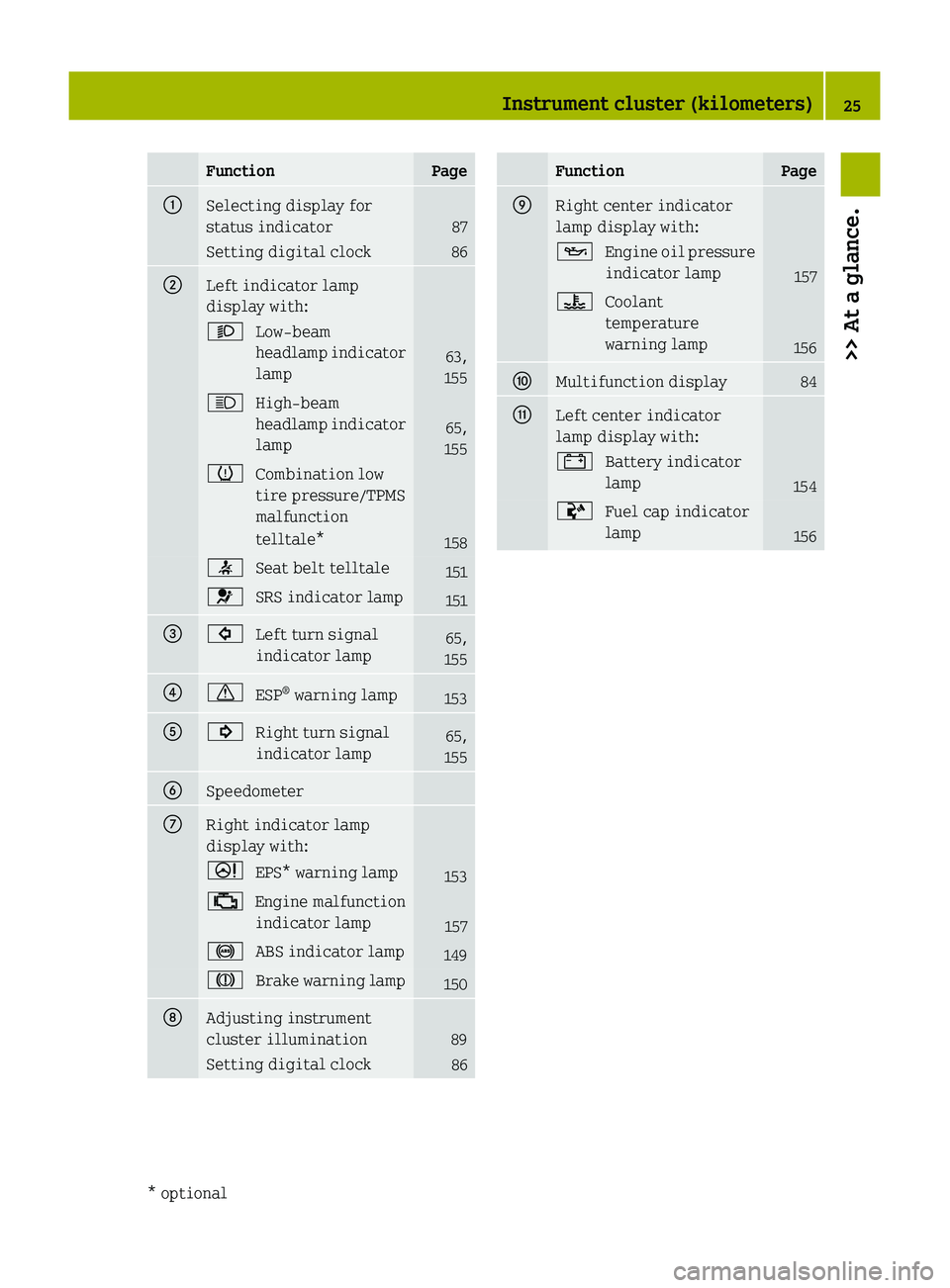
FunctionPage0046Selecting display for
status indicator
87
Setting digital clock860047Left indicator lamp
display with:0065Low‑beam
headlamp indicator
lamp
63,
155
0063High‑beam
headlamp indicator
lamp
65,
155
0077Combination low
tire pressure/TPMS
malfunction
telltale*
158
0082Seat belt telltale1510081SRS indicator lamp151008A0026Left turn signal
indicator lamp65,
15500880067ESP ®
warning lamp15300860024Right turn signal
indicator lamp65,
1550087Speedometer006ERight indicator lamp
display with:0052EPS* warning lamp15300BBEngine malfunction
indicator lamp
157
0031ABS indicator lamp149004DBrake warning lamp150006FAdjusting instrument
cluster illumination
89
Setting digital clock86FunctionPage0070Right center indicator
lamp display with:00B5Engine oil pressure
indicator lamp
157
00AECoolant
temperature
warning lamp
156
0071Multifunction display840072Left center indicator
lamp display with:003FBattery indicator
lamp
154
00ACFuel cap indicator
lamp
156
Instrument cluster (kilometers)25>> At a glance.* optional451_AKB; 3; 22, en-USd2ureepe,Version: 2.11.8.12009-07-27T09:36:34+02:00 - Seite 25
Page 108 of 216
The first 1000 miles (1500 km)
In the Operation section you will find
detailed information on operating,
maintaining and caring for your vehicle.
The more cautiously you treat your vehicle
during the break-in period, the more
satisfied you will be with its performance
later on.
R Drive your vehicle during the first
1 000 miles (1 500 km) at varying but
moderate vehicle and engine speeds.
R During this period, avoid heavy loads
(full throttle driving) and excessive
engine speeds (no more than 2
/ 3 of
maximum rpm in each gear).
R Shift gears in a timely manner.
R Do not attempt to slow the vehicle down
by shifting to a lower gear.
R Avoid accelerating by kickdown.
After 1 000 miles (1 500 km), you may
gradually increase vehicle and engine
speeds to the permissible maximum.
All of the above instructions also apply
when driving the first 1 000 miles (1 500 km)
after the engine has been replaced.
i Always obey applicable speed limits.
At the gas station
Refueling
GWarning!
Gasoline is highly flammable and
poisonous. It burns violently and can cause
serious personal injury.
Never allow sparks, flame or smoking
materials near gasoline!
Turn off the engine before refueling.
Whenever you are around gasoline, avoid
inhaling fumes and skin or clothing
contact. Extinguish all smoking materials.
Direct skin contact with fuels and the
inhalation of fuel vapors are damaging to
your health.
! Do not put diesel fuel in vehicles with
gasoline engines. Do not mix gasoline
with diesel fuel. Even small quantities
of diesel fuel will damage the injection
system. Damage caused by adding diesel
fuel will not be covered by the smart
Limited Warranty.
If diesel fuel has mixed with gasoline,
do not start the engine. Otherwise the
catalytic converter will be irreparably
damaged.
Contact an authorized smart center or
Roadside Assistance immediately and
have the vehicle towed.
! Damage resulting from mixing gasoline
with diesel fuel is not covered by the
smart Limited Warranty.
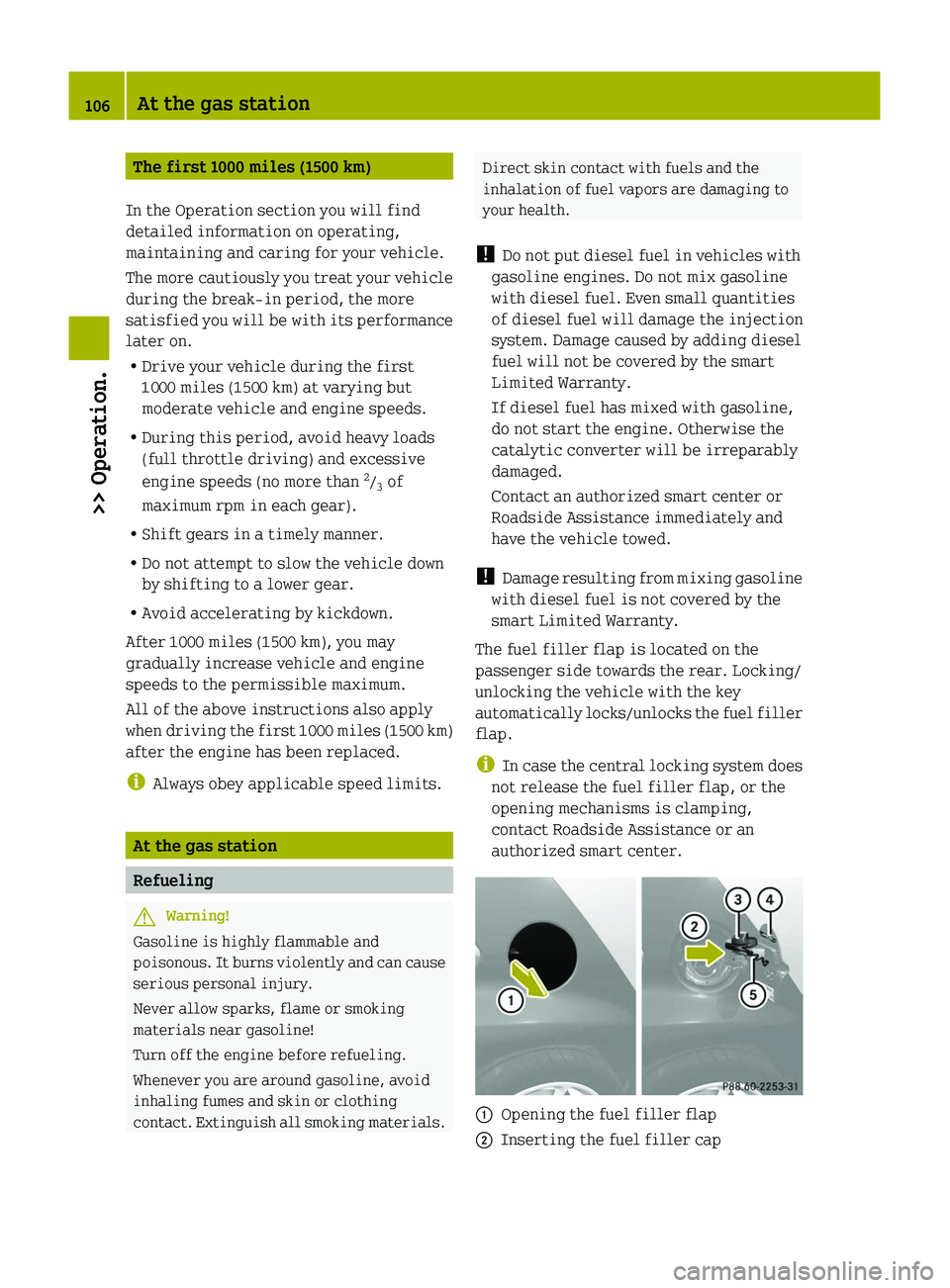
The fuel filler flap is located on the
passenger side towards the rear. Locking/
unlocking the vehicle with the key
automatically locks/unlocks the fuel filler
flap.
i In case the central locking system does
not release the fuel filler flap, or the
opening mechanisms is clamping,
contact Roadside Assistance or an
authorized smart center.0046Opening the fuel filler flap0047Inserting the fuel filler cap106At the gas station>> Operation.
451_AKB; 3; 22, en-USd2ureepe,Version: 2.11.8.12009-07-27T09:36:34+02:00 - Seite 106
Page 109 of 216
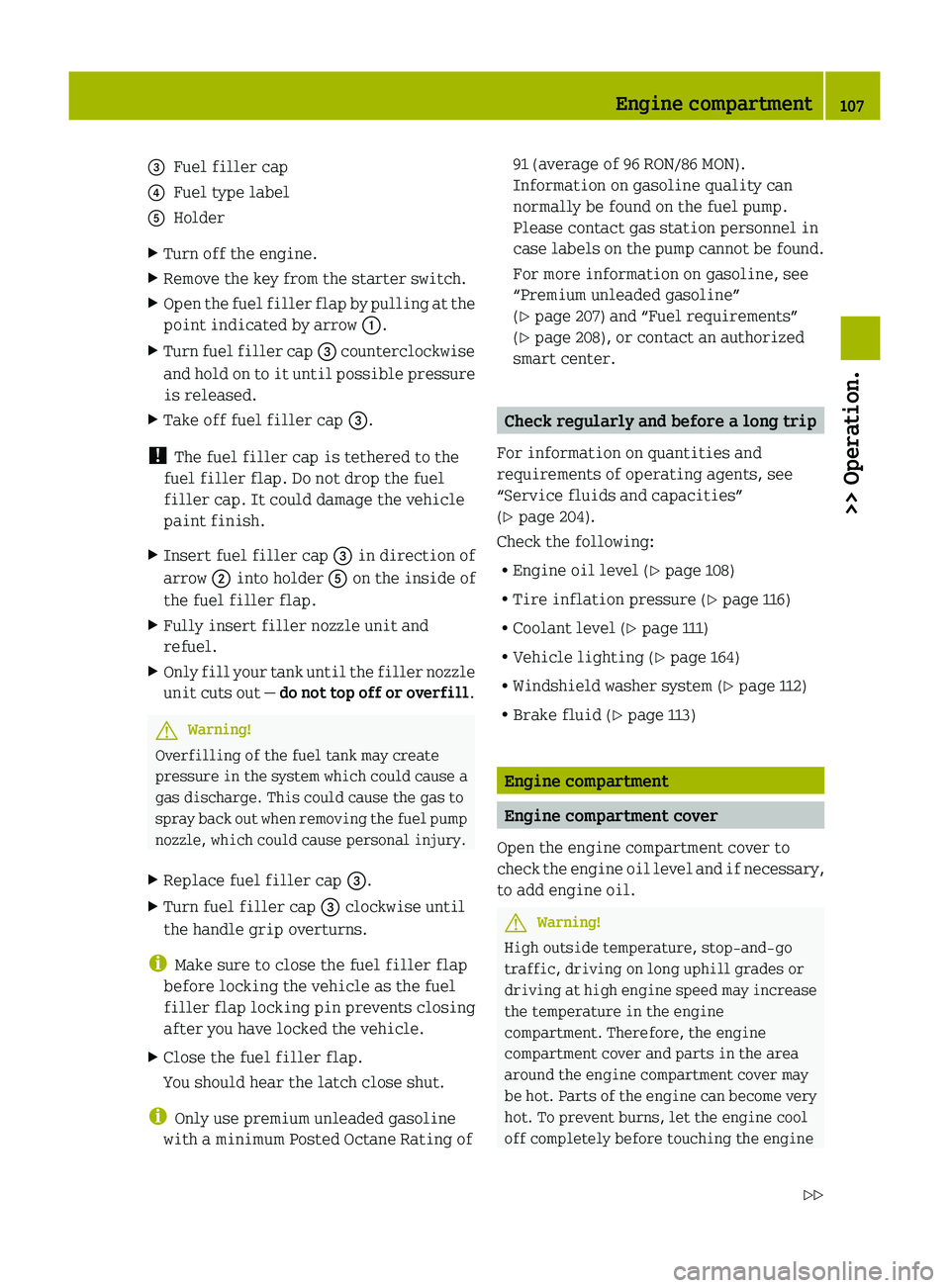
008AFuel filler cap0088Fuel type label0086HolderXTurn off the engine.XRemove the key from the starter switch.XOpen the fuel filler flap by pulling at the
point indicated by arrow 0046.XTurn fuel filler cap 008A counterclockwise
and hold on to it until possible pressure
is released.XTake off fuel filler cap 008A.
!
The fuel filler cap is tethered to the
fuel filler flap. Do not drop the fuel
filler cap. It could damage the vehicle
paint finish.
XInsert fuel filler cap 008A in direction of
arrow 0047 into holder 0086 on the inside of
the fuel filler flap.XFully insert filler nozzle unit and
refuel.XOnly fill your tank until the filler nozzle
unit cuts out — do not top off or overfill .GWarning!
Overfilling of the fuel tank may create
pressure in the system which could cause a
gas discharge. This could cause the gas to
spray back out when removing the fuel pump
nozzle, which could cause personal injury.
XReplace fuel filler cap 008A.XTurn fuel filler cap 008A clockwise until
the handle grip overturns.
i Make sure to close the fuel filler flap
before locking the vehicle as the fuel
filler flap locking pin prevents closing
after you have locked the vehicle.
XClose the fuel filler flap.
You should hear the latch close shut.
i Only use premium unleaded gasoline
with a minimum Posted Octane Rating of
91 (average of 96 RON/86 MON).
Information on gasoline quality can
normally be found on the fuel pump.
Please contact gas station personnel in
case labels on the pump cannot be found.
For more information on gasoline, see
“Premium unleaded gasoline”
( Y page 207) and “Fuel requirements”
( Y page 208), or contact an authorized
smart center.
Check regularly and before a long trip
For information on quantities and
requirements of operating agents, see
“Service fluids and capacities”
( Y page 204).
Check the following:
R Engine oil level ( Y page 108)
R Tire inflation pressure ( Y page 116)
R Coolant level ( Y page 111)
R Vehicle lighting ( Y page 164)
R Windshield washer system ( Y page 112)
R Brake fluid ( Y page 113)
Engine compartment
Engine compartment cover
Open the engine compartment cover to
check the engine oil level and if necessary,
to add engine oil.
GWarning!
High outside temperature, stop-and-go
traffic, driving on long uphill grades or
driving at high engine speed may increase
the temperature in the engine
compartment. Therefore, the engine
compartment cover and parts in the area
around the engine compartment cover may
be hot. Parts of the engine can become very
hot. To prevent burns, let the engine cool
off completely before touching the engine
Engine compartment107>> Operation.451_AKB; 3; 22, en-USd2ureepe,Version: 2.11.8.12009-07-27T09:36:34+02:00 - Seite 107Z
Page 122 of 216
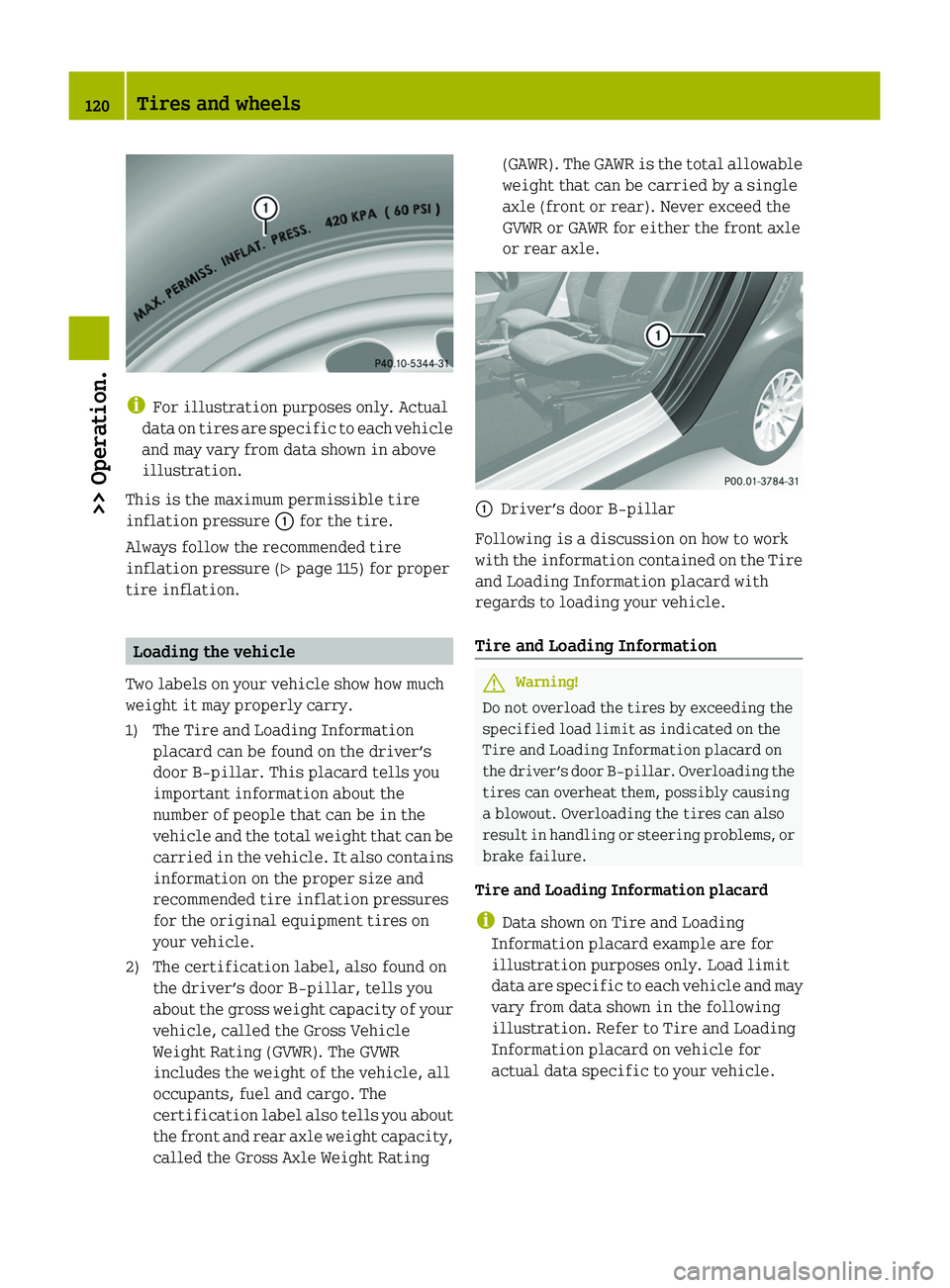
iFor illustration purposes only. Actual
data on tires are specific to each vehicle
and may vary from data shown in above
illustration.
This is the maximum permissible tire
inflation pressure 0046 for the tire.
Always follow the recommended tire
inflation pressure ( Y page 115) for proper
tire inflation.
Loading the vehicle
Two labels on your vehicle show how much
weight it may properly carry.
1)The Tire and Loading Information
placard can be found on the driver’s
door B‑pillar. This placard tells you
important information about the
number of people that can be in the
vehicle and the total weight that can be
carried in the vehicle. It also contains
information on the proper size and
recommended tire inflation pressures
for the original equipment tires on
your vehicle.2)The certification label, also found on
the driver’s door B‑pillar, tells you
about the gross weight capacity of your
vehicle, called the Gross Vehicle
Weight Rating (GVWR). The GVWR
includes the weight of the vehicle, all
occupants, fuel and cargo. The
certification label also tells you about
the front and rear axle weight capacity,
called the Gross Axle Weight Rating(GAWR). The GAWR is the total allowable
weight that can be carried by a single
axle (front or rear). Never exceed the
GVWR or GAWR for either the front axle
or rear axle.0046Driver’s door B‑pillar
Following is a discussion on how to work
with the information contained on the Tire
and Loading Information placard with
regards to loading your vehicle.
Tire and Loading Information
GWarning!
Do not overload the tires by exceeding the
specified load limit as indicated on the
Tire and Loading Information placard on
the driver’s door B‑pillar. Overloading the
tires can overheat them, possibly causing
a blowout. Overloading the tires can also
result in handling or steering problems, or
brake failure.
Tire and Loading Information placard
i Data shown on Tire and Loading
Information placard example are for
illustration purposes only. Load limit
data are specific to each vehicle and may
vary from data shown in the following
illustration. Refer to Tire and Loading
Information placard on vehicle for
actual data specific to your vehicle.
120Tires and wheels>> Operation.
451_AKB; 3; 22, en-USd2ureepe,Version: 2.11.8.12009-07-27T09:36:34+02:00 - Seite 120
Page 132 of 216
Tire ply material
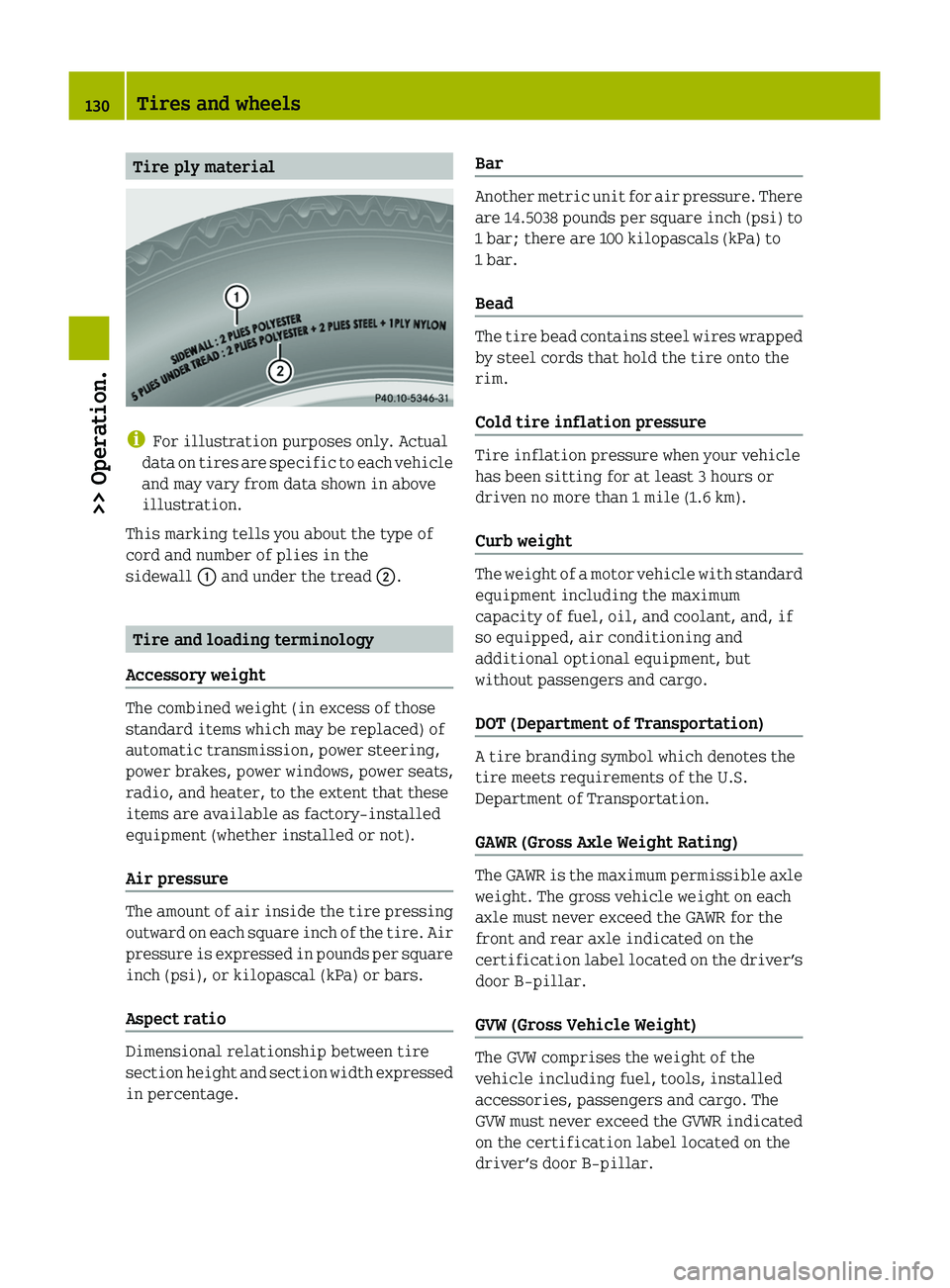
iFor illustration purposes only. Actual
data on tires are specific to each vehicle
and may vary from data shown in above
illustration.
This marking tells you about the type of
cord and number of plies in the
sidewall 0046 and under the tread 0047.
Tire and loading terminology
Accessory weight
The combined weight (in excess of those
standard items which may be replaced) of
automatic transmission, power steering,
power brakes, power windows, power seats,
radio, and heater, to the extent that these
items are available as factory-installed
equipment (whether installed or not).
Air pressure
The amount of air inside the tire pressing
outward on each square inch of the tire. Air
pressure is expressed in pounds per square
inch (psi), or kilopascal (kPa) or bars.
Aspect ratio
Dimensional relationship between tire
section height and section width expressed
in percentage.
Bar
Another metric unit for air pressure. There
are 14.5038 pounds per square inch (psi) to
1 bar; there are 100 kilopascals (kPa) to
1 bar.
Bead
The tire bead contains steel wires wrapped
by steel cords that hold the tire onto the
rim.
Cold tire inflation pressure
Tire inflation pressure when your vehicle
has been sitting for at least 3 hours or
driven no more than 1 mile (1.6 km).
Curb weight
The weight of a motor vehicle with standard
equipment including the maximum
capacity of fuel, oil, and coolant, and, if
so equipped, air conditioning and
additional optional equipment, but
without passengers and cargo.
DOT (Department of Transportation)
A tire branding symbol which denotes the
tire meets requirements of the U.S.
Department of Transportation.
GAWR (Gross Axle Weight Rating)
The GAWR is the maximum permissible axle
weight. The gross vehicle weight on each
axle must never exceed the GAWR for the
front and rear axle indicated on the
certification label located on the driver’s
door B‑pillar.
GVW (Gross Vehicle Weight)
The GVW comprises the weight of the
vehicle including fuel, tools, installed
accessories, passengers and cargo. The
GVW must never exceed the GVWR indicated
on the certification label located on the
driver’s door B‑pillar.
130Tires and wheels>> Operation.
451_AKB; 3; 22, en-USd2ureepe,Version: 2.11.8.12009-07-27T09:36:34+02:00 - Seite 130
Page 158 of 216
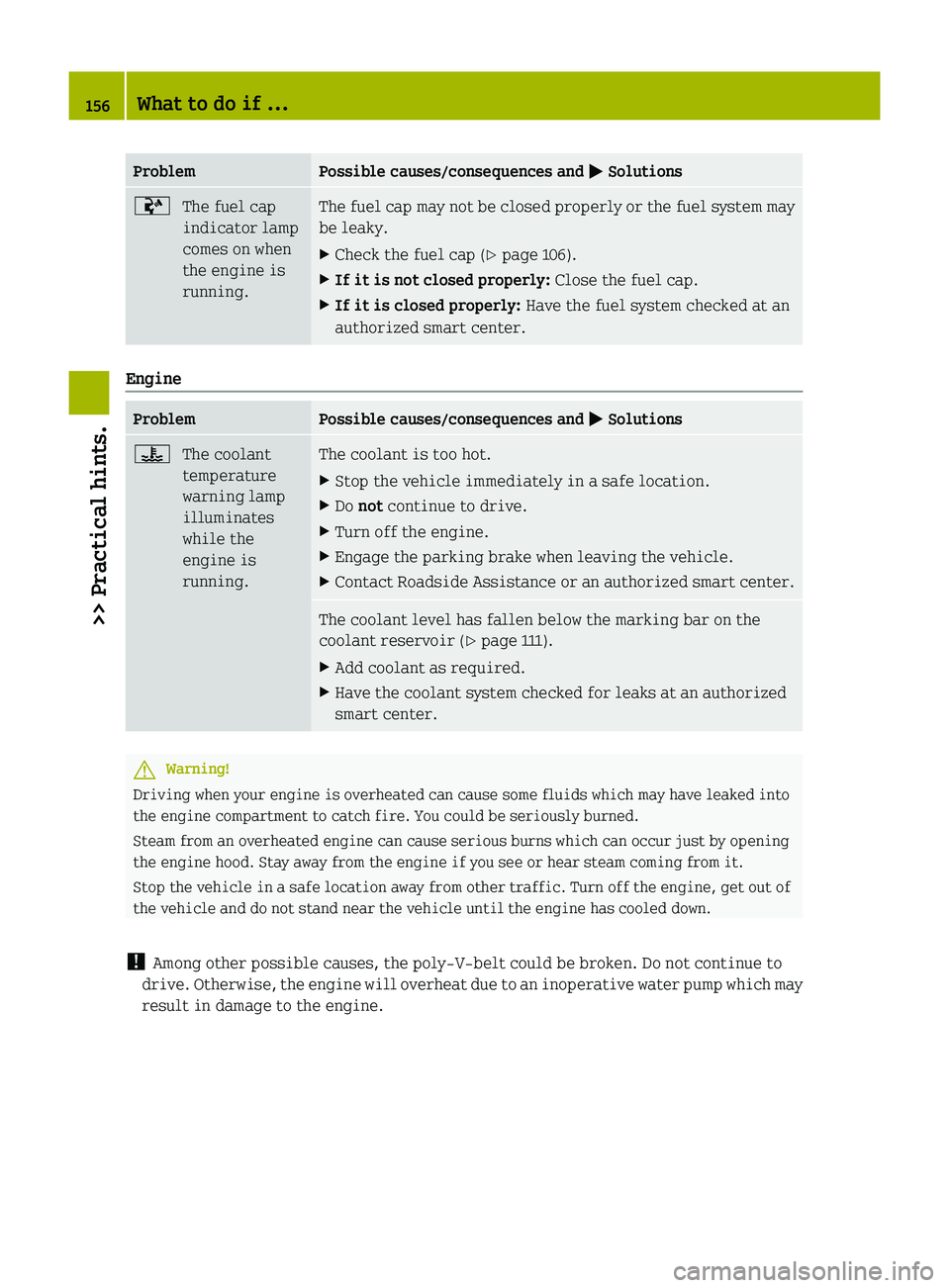
ProblemPossible causes/consequences and 0050 Solutions00ACThe fuel cap
indicator lamp
comes on when
the engine is
running.The fuel cap may not be closed properly or the fuel system may
be leaky.XCheck the fuel cap ( Y page 106).XIf it is not closed properly: Close the fuel cap.XIf it is closed properly: Have the fuel system checked at an
authorized smart center.
Engine
ProblemPossible causes/consequences and 0050 Solutions00AEThe coolant
temperature
warning lamp
illuminates
while the
engine is
running.The coolant is too hot.XStop the vehicle immediately in a safe location.XDo not continue to drive.XTurn off the engine.XEngage the parking brake when leaving the vehicle.XContact Roadside Assistance or an authorized smart center.The coolant level has fallen below the marking bar on the
coolant reservoir ( Y page 111).XAdd coolant as required.XHave the coolant system checked for leaks at an authorized
smart center.GWarning!
Driving when your engine is overheated can cause some fluids which may have leaked into
the engine compartment to catch fire. You could be seriously burned.
Steam from an overheated engine can cause serious burns which can occur just by opening
the engine hood. Stay away from the engine if you see or hear steam coming from it.
Stop the vehicle in a safe location away from other traffic. Turn off the engine, get out of
the vehicle and do not stand near the vehicle until the engine has cooled down.
! Among other possible causes, the poly-V-belt could be broken. Do not continue to
drive. Otherwise, the engine will overheat due to an inoperative water pump which may
result in damage to the engine.
156What to do if ...>> Practical hints.
451_AKB; 3; 22, en-USd2ureepe,Version: 2.11.8.12009-07-27T09:36:34+02:00 - Seite 156