fuel pressure SMART FORTWO COUPE 2010 Owners Manual
[x] Cancel search | Manufacturer: SMART, Model Year: 2010, Model line: FORTWO COUPE, Model: SMART FORTWO COUPE 2010Pages: 216, PDF Size: 9.7 MB
Page 9 of 216
G
Gasoline see Fuel
GAWR (Gross Axle Weight Rating) ...... 130
Gear selector lever ......................... 79
Transmission positions ..............80
Generator
see Alternator
Global locking/unlocking ................ 51
Glove box .................................... 100
Gross Axle Weight Rating see GAWR
Gross Vehicle Weight
see GVW
Gross Vehicle Weight Rating
see GVWR
GVW (Gross Vehicle Weight) ............. 130
GVWR (Gross Vehicle Weight Rating) .. 131
H
Halogen headlamps see Headlamps
Hazard warning flasher .................... 66
Headlamps
Automatic headlamp mode ............63
Daytime running lamp mode .........64
High-beam flasher .....................65
High-beam headlamps ................. 65
Low-beam headlamps ..................63
Switch ..................................... 62
Head-thorax air bags ...................... 36
Heated exterior rear view mirrors ..... 60
Heated seats .................................. 58
Heating
see HVAC .................................. 91
Height adjustment
Seats ...................................... 57
High-beam flasher ......................... 65
High-beam headlamps ................ 65, 165
Indicator lamp ........................ 155
High-mounted brake lamp ............... 166
Hill-start assist system .................. 81
HVAC (Heating, Ventilation, Air
Conditioning) ............................... 91
Air distribution ....................... 94
Air recirculation ...................... 96
Air vents ................................. 93
Air volume ............................... 95
Defrosting ............................... 95
Rear window defroster ................95
Temperature ............................. 93
Hydraulic brake assistant ................ 46
Hydroplaning ............................... 137
I
Identification labels .................... 198
Identification number, vehicle
(VIN) .......................................... 199
Infant and child restraint systems see Children in the vehicle
Inflation pressure
see Tires, Inflation pressure
Inside door handle ......................... 52
Instrument cluster ..................... 22, 24
Lamps, indicator and warning .....149
Instrument panel
see Instrument cluster
Instruments and controls
see Cockpit
Interior motion sensor .................... 48
Interior rear view mirror ................ 60
Interior storage spaces see Storage compartments
Intermittent wiping
Rear window wiper .....................69
Windshield wipers .....................68
J
Jump-starting .............................. 183
K
Key ............................................. 50
Loss of ................................... 160
Replacing the transmitter
battery ................................... 163
Kilopascal (air pressure unit) ......... 131
Keywords7451_AKB; 3; 22, en-USd2ureepe,Version: 2.11.8.12009-07-27T09:36:34+02:00 - Seite 7
Page 10 of 216
L
Labels ........................................ 198
Emission control information .....198
Lamps, exterior
Exterior lamp switch ..................62
Switching on/off ....................... 62
Lamps, indicator and warning
ABS ....................................... 149
Battery .................................. 154
Brakes ................................... 150
Coolant temperature .................156
Engine malfunction ...................157
EPS ........................................ 153
ESP ®
...................................... 153
Fog lamps ................................ 65
Fuel cap ................................. 156
High-beam headlamps ...............155
Low-beam headlamps .................155
Low tire pressure/TPMS
malfunction telltale .................158
Oil pressure ............................ 157
Passenger front air bag off ....37, 159
Seat belt telltale ..................... 151
SRS ........................................ 151
Turn signals ............................ 155
License plate lamps ....................... 166
Lighter see Cigarette lighter
Lighting ...................................... 62
Coming home function ................65
Daytime running lamp mode .........64
Exterior .................................. 62
Interior .................................. 66
Loading
see Vehicle loading
Locking the vehicle ........................ 50
Manually ................................ 162
Loss of
Key ........................................ 160
Service and Warranty
Information booklet ..................196
Low-beam headlamps ................. 63, 165
Exterior lamp switch ..................62
Indicator lamp ........................ 155
Switching on ............................ 63M
Main odometer display .................... 85
Maintenance .................................. 14
Service interval display .............88
Malfunction
Electronic immobilizer .............149
Shifting system ....................... 149
Manual headlamp mode (Low-beam
headlamps) ................................... 63
Maximum engine speed see Vehicle specification
Maximum loaded vehicle weight ....... 131
Maximum load rating (tires) ............ 131
Maximum permissible tire
inflation pressure ........................ 131
Mirrors
Exterior rear view mirrors ..........59
Interior rear view mirror ...........60
MON (Motor Octane Number) ............. 208
Motor Octane Number see MON
MP3 interface ................................ 91
MP3 player, smart radio 10 ................ 91
Multifunction display ..................... 84
N
Normal occupant weight .................. 131
Number, vehicle identification
(VIN) .......................................... 199
O
Occupant Classification System see OCS (Occupant
Classification System)
Occupant distribution ................... 131
Occupant safety
Air bags .................................. 33
Children and air bags ................33
Children in the vehicle ..............41
Infant and child restraint
systems ................................... 41
Introduction ............................ 30
OCS (Occupant Classification
System) .................................... 37
8Keywords451_AKB; 3; 22, en-USd2ureepe,Version: 2.11.8.12009-07-27T09:36:34+02:00 - Seite 8
Page 11 of 216
Passenger front air bag off
indicator lamp .......................... 37
Seat belts ............................ 31, 35
SRS indicator lamp, malfunction .. 151
OCS (Occupant Classification
System) ........................................ 37
Self-test ................................. 40
Oil
see Engine oil
Oil level
see Engine oil, Checking level
On-board Diagnostics Socket (OBD) ... 197
Operating safety ............................ 15
Outside temperature display ............ 86
Overhead control panel ................... 28
P
Paintwork care ............................. 144
Panic alarm .................................. 44
Parcel net ..................................... 97
Parking ........................................ 77
Parking brake ................................ 77
Parking lamps .............................. 165
Parts service ............................... 196
PASS AIR BAG OFF indicator lamp see Passenger front air bag off
indicator lamp
Passenger front air bag ................... 37
Passenger front air bag off
indicator lamp .................... 28, 37, 159
Passenger safety see Occupant safety
Passenger seat ............................... 58
Pedals ........................................ 134
Power assistance .......................... 134
Power outlet ................................ 102
Power washer ............................... 144
Practical hints
Battery .................................. 180
Display messages .....................148
Flat tire ................................. 172
Fuses ..................................... 188
Jump starting .......................... 183
Replacing bulbs ....................... 164
Replacing transmitter battery ....163
Replacing wiper blades .............170
Towing ................................... 185
Unlocking/locking manually .......162
Warning and indicator
lamps ............................... 149, 159
What to do if ........................... 149
Where will I find...? .................148
Premium unleaded gasoline ............ 208
Problems with your vehicle .............. 16
Product information ....................... 13
Production options weight .............. 131
PSI (air pressure unit) ................... 131
R
Radio .......................................... 90
Radio transmitters ........................ 139
Rain-light sensor .......................... 68
Rear lamps
Overview ................................ 166
Rear window defroster ..................... 95
Rear window wiper/washer ............... 69
Replacing wiper blade ..............170
Recommended tire inflation
pressure ................................ 115, 131
Refrigerant, air conditioning ......... 207
Refueling .................................... 106
Remote control see Key
Replacing bulbs ............................ 164
Reporting safety defects .................. 16
Research Octane Number see RON
Reserve fuel indicator .................... 88
Restraint systems see Occupant safety
Rims ..................................... 131, 202
Roadside Assistance ....................... 14
RON (Research Octane Number) ......... 208
Roof see Soft top system
Keywords9451_AKB; 3; 22, en-USd2ureepe,Version: 2.11.8.12009-07-27T09:36:34+02:00 - Seite 9
Page 22 of 216
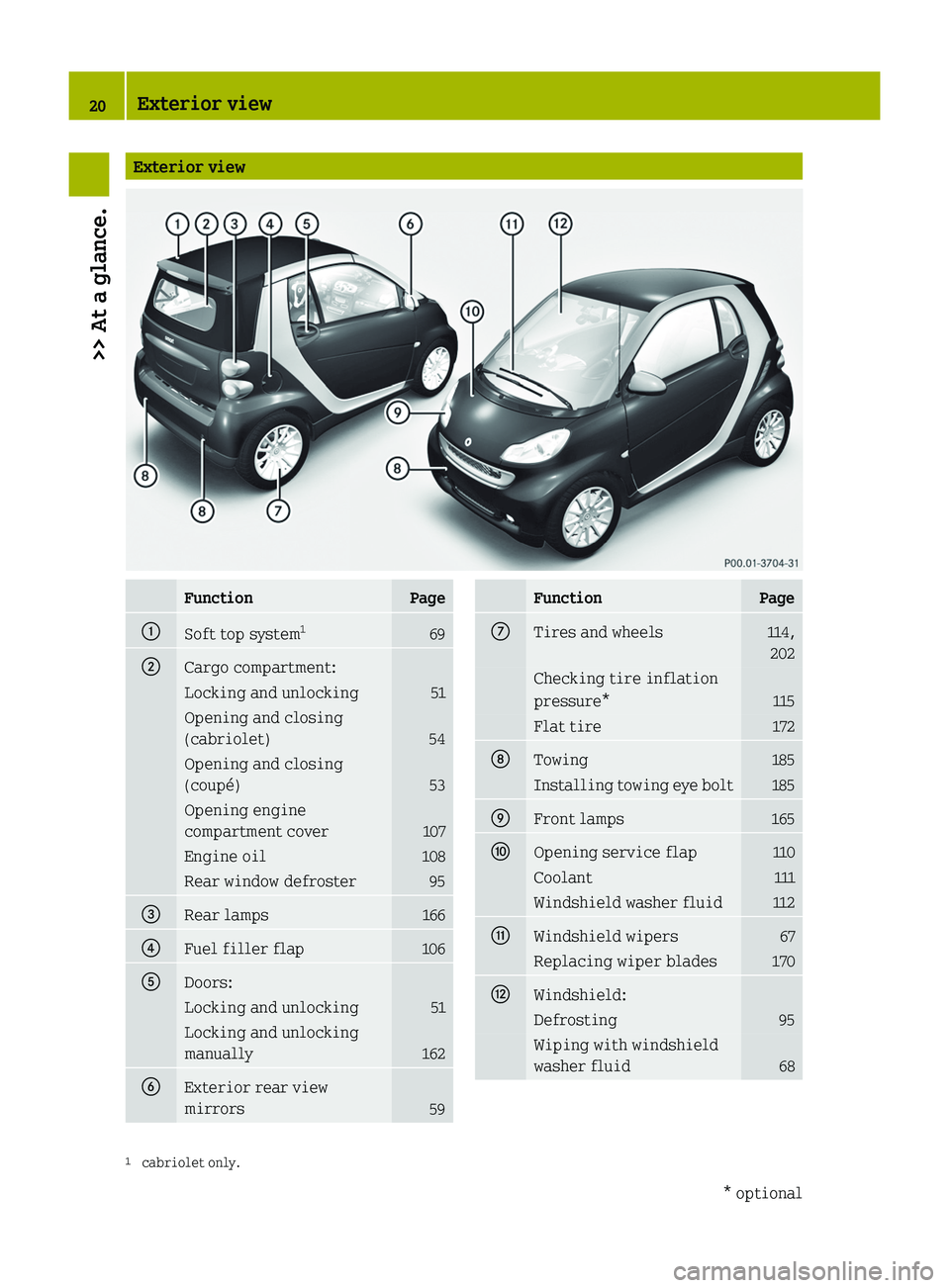
Exterior viewFunctionPage0046Soft top system1690047Cargo compartment:Locking and unlocking51Opening and closing
(cabriolet)
54
Opening and closing
(coupé)
53
Opening engine
compartment cover
107
Engine oil108Rear window defroster95008ARear lamps1660088Fuel filler flap1060086Doors:Locking and unlocking51Locking and unlocking
manually
162
0087Exterior rear view
mirrors
59
FunctionPage006ETires and wheels114, 202Checking tire inflation
pressure*
115
Flat tire172006FTowing185Installing towing eye bolt1850070Front lamps1650071Opening service flap110Coolant111Windshield washer fluid1120072Windshield wipers67Replacing wiper blades1700073Windshield:Defrosting95Wiping with windshield
washer fluid
681 cabriolet only.20Exterior view>> At a glance.* optional451_AKB; 3; 22, en-USd2ureepe,Version: 2.11.8.12009-07-27T09:36:34+02:00 - Seite 20
Page 25 of 216
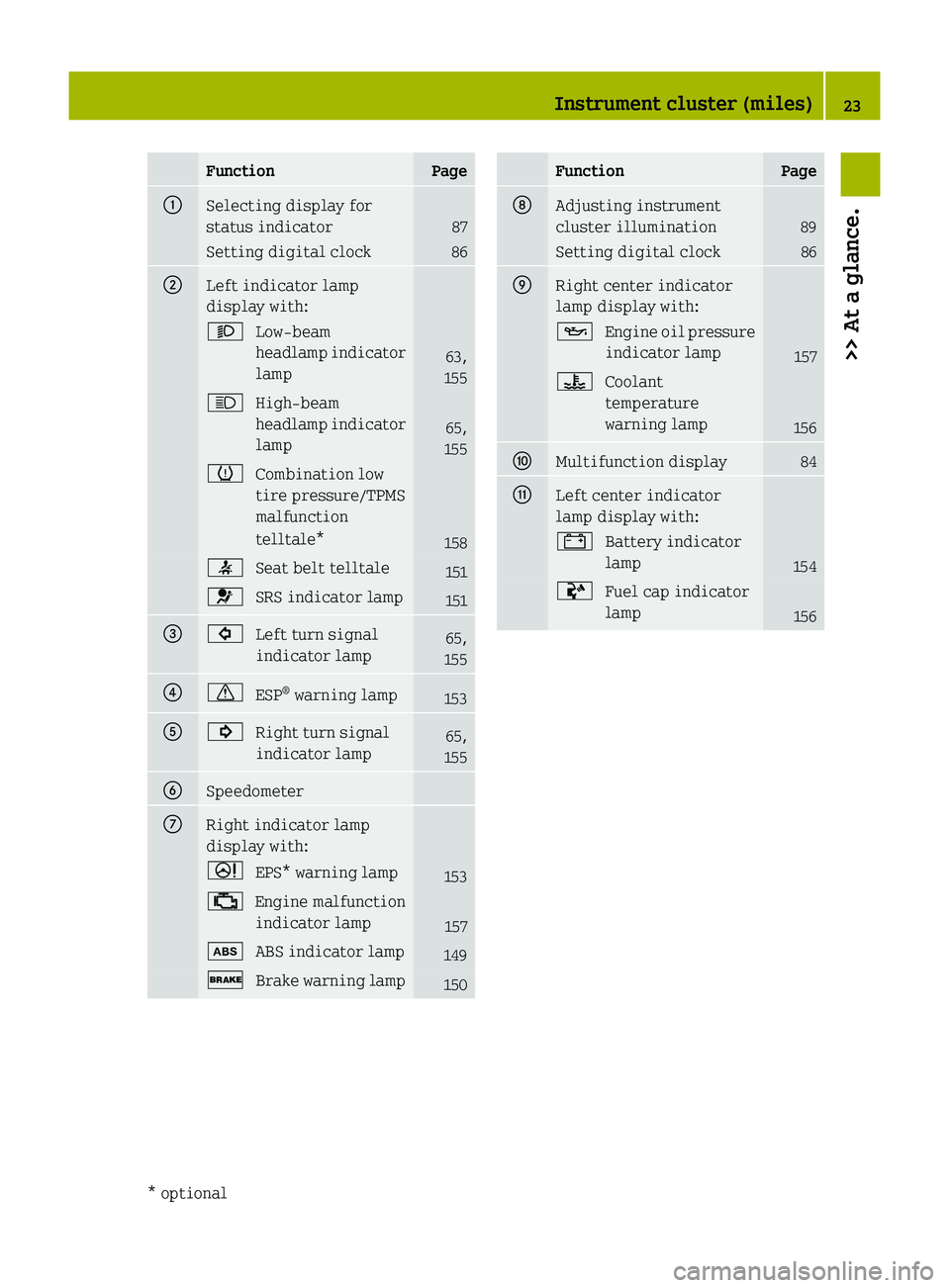
FunctionPage0046Selecting display for
status indicator
87
Setting digital clock860047Left indicator lamp
display with:0065Low‑beam
headlamp indicator
lamp
63,
155
0063High‑beam
headlamp indicator
lamp
65,
155
0077Combination low
tire pressure/TPMS
malfunction
telltale*
158
0082Seat belt telltale1510081SRS indicator lamp151008A0026Left turn signal
indicator lamp65,
15500880067ESP ®
warning lamp15300860024Right turn signal
indicator lamp65,
1550087Speedometer006ERight indicator lamp
display with:0052EPS* warning lamp15300BBEngine malfunction
indicator lamp
157
00EBABS indicator lamp1490027Brake warning lamp150FunctionPage006FAdjusting instrument
cluster illumination
89
Setting digital clock860070Right center indicator
lamp display with:00B5Engine oil pressure
indicator lamp
157
00AECoolant
temperature
warning lamp
156
0071Multifunction display840072Left center indicator
lamp display with:003FBattery indicator
lamp
154
00ACFuel cap indicator
lamp
156
Instrument cluster (miles)23>> At a glance.* optional451_AKB; 3; 22, en-USd2ureepe,Version: 2.11.8.12009-07-27T09:36:34+02:00 - Seite 23
Page 27 of 216
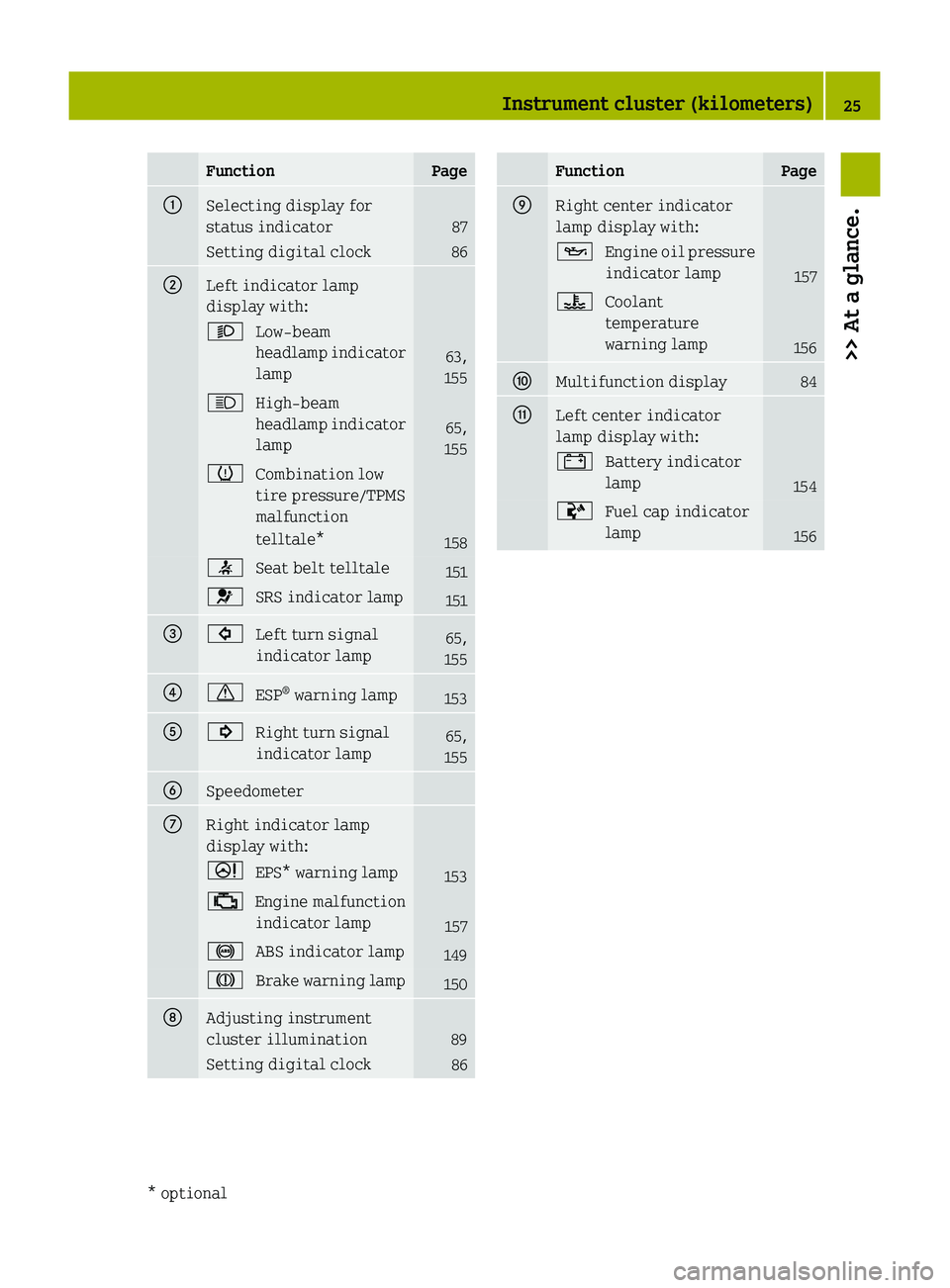
FunctionPage0046Selecting display for
status indicator
87
Setting digital clock860047Left indicator lamp
display with:0065Low‑beam
headlamp indicator
lamp
63,
155
0063High‑beam
headlamp indicator
lamp
65,
155
0077Combination low
tire pressure/TPMS
malfunction
telltale*
158
0082Seat belt telltale1510081SRS indicator lamp151008A0026Left turn signal
indicator lamp65,
15500880067ESP ®
warning lamp15300860024Right turn signal
indicator lamp65,
1550087Speedometer006ERight indicator lamp
display with:0052EPS* warning lamp15300BBEngine malfunction
indicator lamp
157
0031ABS indicator lamp149004DBrake warning lamp150006FAdjusting instrument
cluster illumination
89
Setting digital clock86FunctionPage0070Right center indicator
lamp display with:00B5Engine oil pressure
indicator lamp
157
00AECoolant
temperature
warning lamp
156
0071Multifunction display840072Left center indicator
lamp display with:003FBattery indicator
lamp
154
00ACFuel cap indicator
lamp
156
Instrument cluster (kilometers)25>> At a glance.* optional451_AKB; 3; 22, en-USd2ureepe,Version: 2.11.8.12009-07-27T09:36:34+02:00 - Seite 25
Page 109 of 216
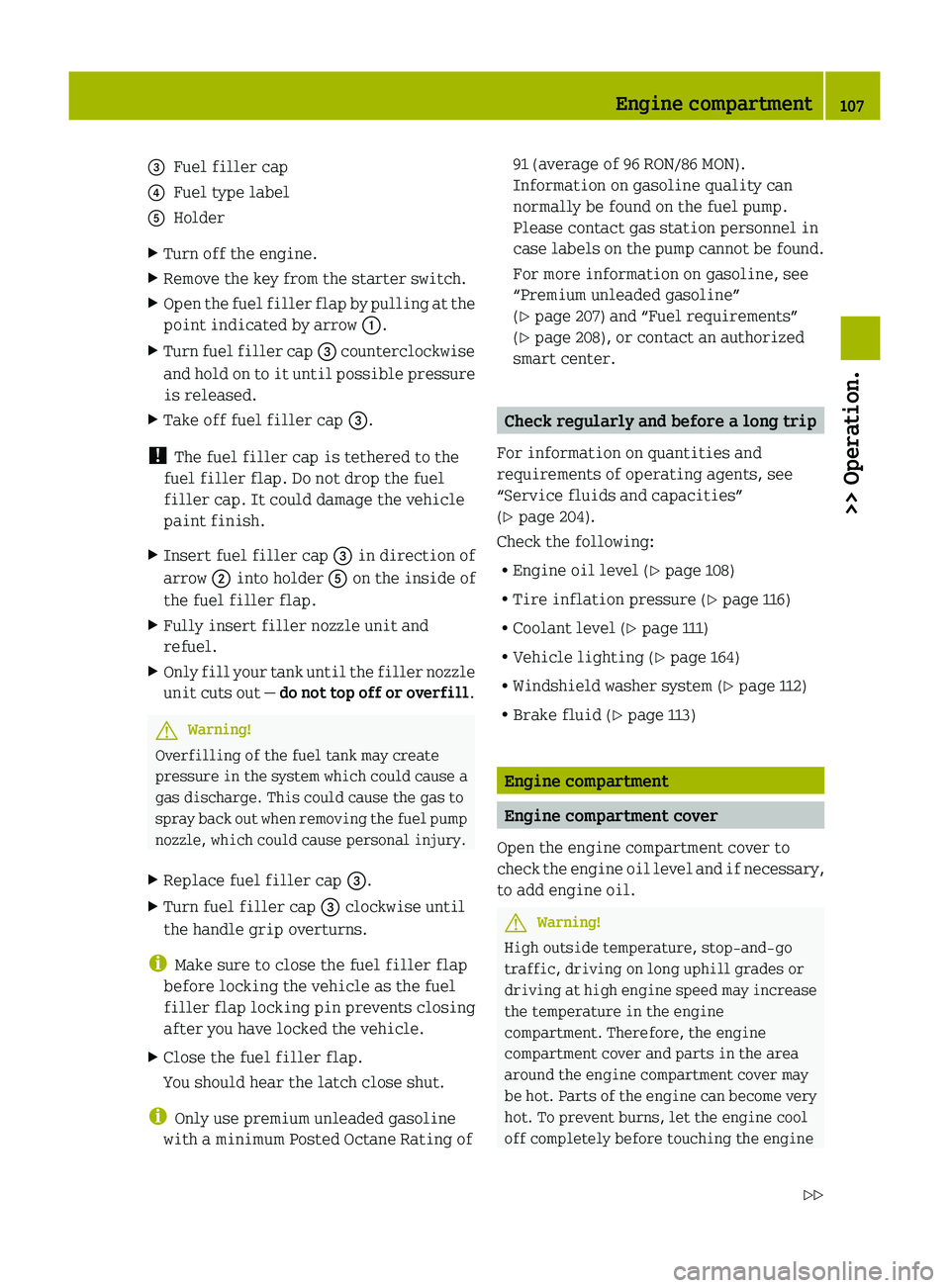
008AFuel filler cap0088Fuel type label0086HolderXTurn off the engine.XRemove the key from the starter switch.XOpen the fuel filler flap by pulling at the
point indicated by arrow 0046.XTurn fuel filler cap 008A counterclockwise
and hold on to it until possible pressure
is released.XTake off fuel filler cap 008A.
!
The fuel filler cap is tethered to the
fuel filler flap. Do not drop the fuel
filler cap. It could damage the vehicle
paint finish.
XInsert fuel filler cap 008A in direction of
arrow 0047 into holder 0086 on the inside of
the fuel filler flap.XFully insert filler nozzle unit and
refuel.XOnly fill your tank until the filler nozzle
unit cuts out — do not top off or overfill .GWarning!
Overfilling of the fuel tank may create
pressure in the system which could cause a
gas discharge. This could cause the gas to
spray back out when removing the fuel pump
nozzle, which could cause personal injury.
XReplace fuel filler cap 008A.XTurn fuel filler cap 008A clockwise until
the handle grip overturns.
i Make sure to close the fuel filler flap
before locking the vehicle as the fuel
filler flap locking pin prevents closing
after you have locked the vehicle.
XClose the fuel filler flap.
You should hear the latch close shut.
i Only use premium unleaded gasoline
with a minimum Posted Octane Rating of
91 (average of 96 RON/86 MON).
Information on gasoline quality can
normally be found on the fuel pump.
Please contact gas station personnel in
case labels on the pump cannot be found.
For more information on gasoline, see
“Premium unleaded gasoline”
( Y page 207) and “Fuel requirements”
( Y page 208), or contact an authorized
smart center.
Check regularly and before a long trip
For information on quantities and
requirements of operating agents, see
“Service fluids and capacities”
( Y page 204).
Check the following:
R Engine oil level ( Y page 108)
R Tire inflation pressure ( Y page 116)
R Coolant level ( Y page 111)
R Vehicle lighting ( Y page 164)
R Windshield washer system ( Y page 112)
R Brake fluid ( Y page 113)
Engine compartment
Engine compartment cover
Open the engine compartment cover to
check the engine oil level and if necessary,
to add engine oil.
GWarning!
High outside temperature, stop-and-go
traffic, driving on long uphill grades or
driving at high engine speed may increase
the temperature in the engine
compartment. Therefore, the engine
compartment cover and parts in the area
around the engine compartment cover may
be hot. Parts of the engine can become very
hot. To prevent burns, let the engine cool
off completely before touching the engine
Engine compartment107>> Operation.451_AKB; 3; 22, en-USd2ureepe,Version: 2.11.8.12009-07-27T09:36:34+02:00 - Seite 107Z
Page 117 of 216
tire pressure loss and damage to the tire
beads.
R If vehicle is heavily loaded, check tire
inflation pressure and correct as
required.
R Do not allow your tires to wear down too
far. Adhesion properties on wet roads are
sharply reduced at tread depths of less
than 1
/ 8 in (3 mm).
Recommended tire inflation pressure
GWarning!
Follow recommended tire inflation
pressures.
Do not underinflate tires. Underinflated
tires wear excessively and/or unevenly,
adversely affect handling and fuel
economy, and are more likely to fail from
being overheated.
Do not overinflate tires. Overinflated
tires can adversely affect handling and
ride comfort, wear unevenly, increase
stopping distance, and result in sudden
deflation (blowout) because they are more
likely to become punctured or damaged by
road debris, potholes etc.
Do not overload the tires by exceeding the
specified load limit as indicated on the
Tire and Loading Information placard on
the driver’s door B‑pillar. Overloading the
tires can overheat them, possibly causing
a blowout. Overloading the tires can also
result in handling or steering problems, or
brake failure.
Your vehicle is equipped with the Tire and
Loading Information placard located on
the driver’s door B‑pillar ( Y page 120).
The tire inflation pressure should be
checked regularly. Only adjust the tire
inflation pressure on cold tires. The tires
can be considered cold if the vehicle has
been parked for at least 3 hours or driven
less than 1 mile (1.6 km). Depending on the
ambient temperature, the driving speed
and the tire load, the tire temperature
changes. When the tire temperature
changes by 18 ¦ (10 ¥), the tire inflation
pressure will change by approximately
1.5 psi (0.1 bar). Keep this in mind when
checking tire inflation pressure on warm
tires and adjust the tire pressure only if
the tire inflation pressure is too low for
the current operating conditions. If you
check the tire inflation pressure when the
tires are warm, the reading will be higher
than the cold reading. This is normal. Do
not let air out to match the specified cold
tire inflation pressure. Otherwise, the
tire will be underinflated.
Follow recommended cold tire inflation
pressures listed on Tire and Loading
Information placard on the driver’s door
B‑pillar.
Keeping the tires properly inflated
provides the best handling, tread life and
riding comfort.
In addition to the Tire and Loading
Information placard on the driver’s door
B‑pillar, also consult the tire inflation
pressure label (if available) on the inside
of the filler flap for any additional
information pertaining to special driving
situations. For more information, see
“Important notes on tire inflation
pressure” ( Y page 116).
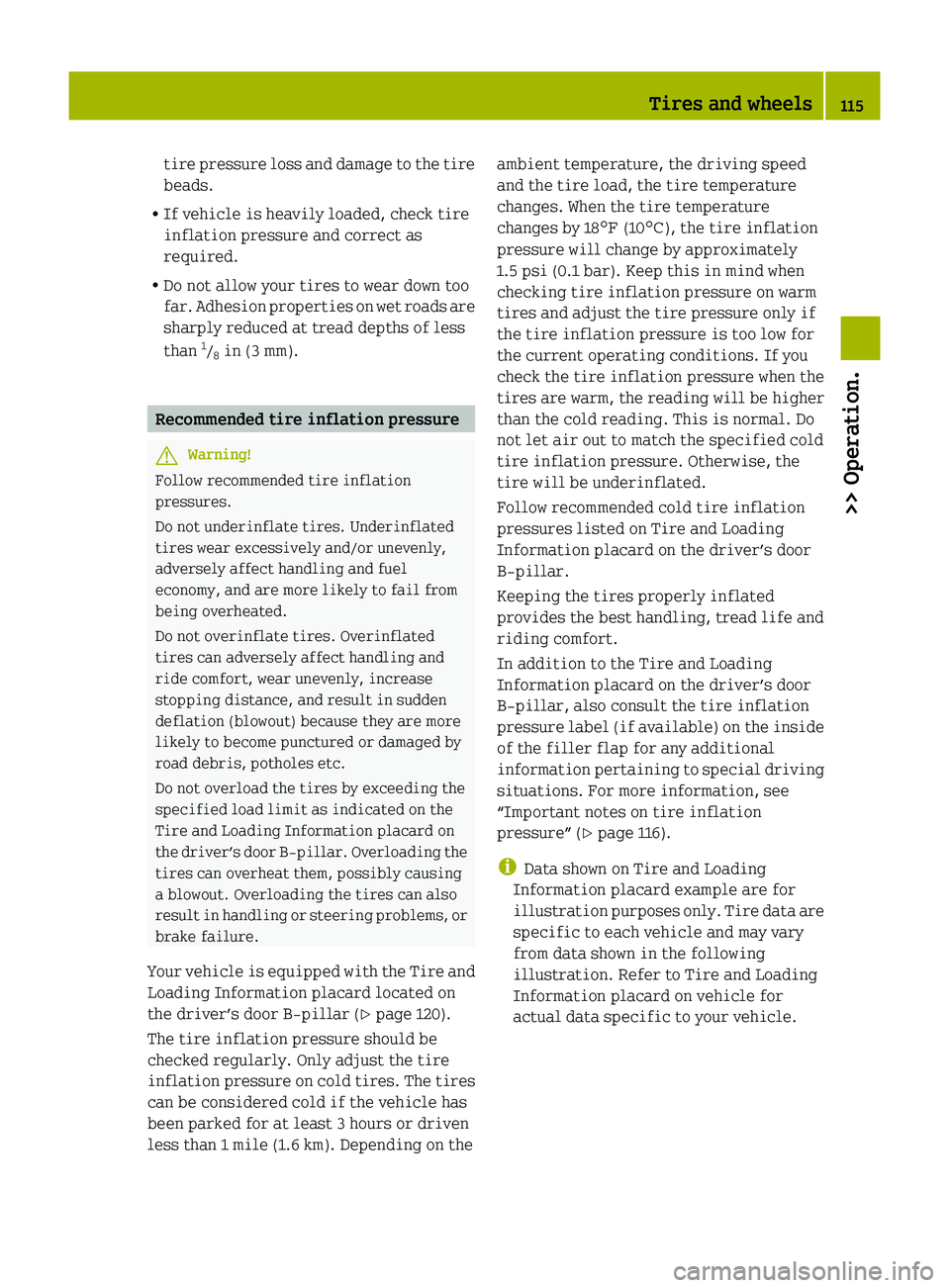
i Data shown on Tire and Loading
Information placard example are for
illustration purposes only. Tire data are
specific to each vehicle and may vary
from data shown in the following
illustration. Refer to Tire and Loading
Information placard on vehicle for
actual data specific to your vehicle.Tires and wheels115>> Operation.451_AKB; 3; 22, en-USd2ureepe,Version: 2.11.8.12009-07-27T09:36:34+02:00 - Seite 115Z
Page 118 of 216
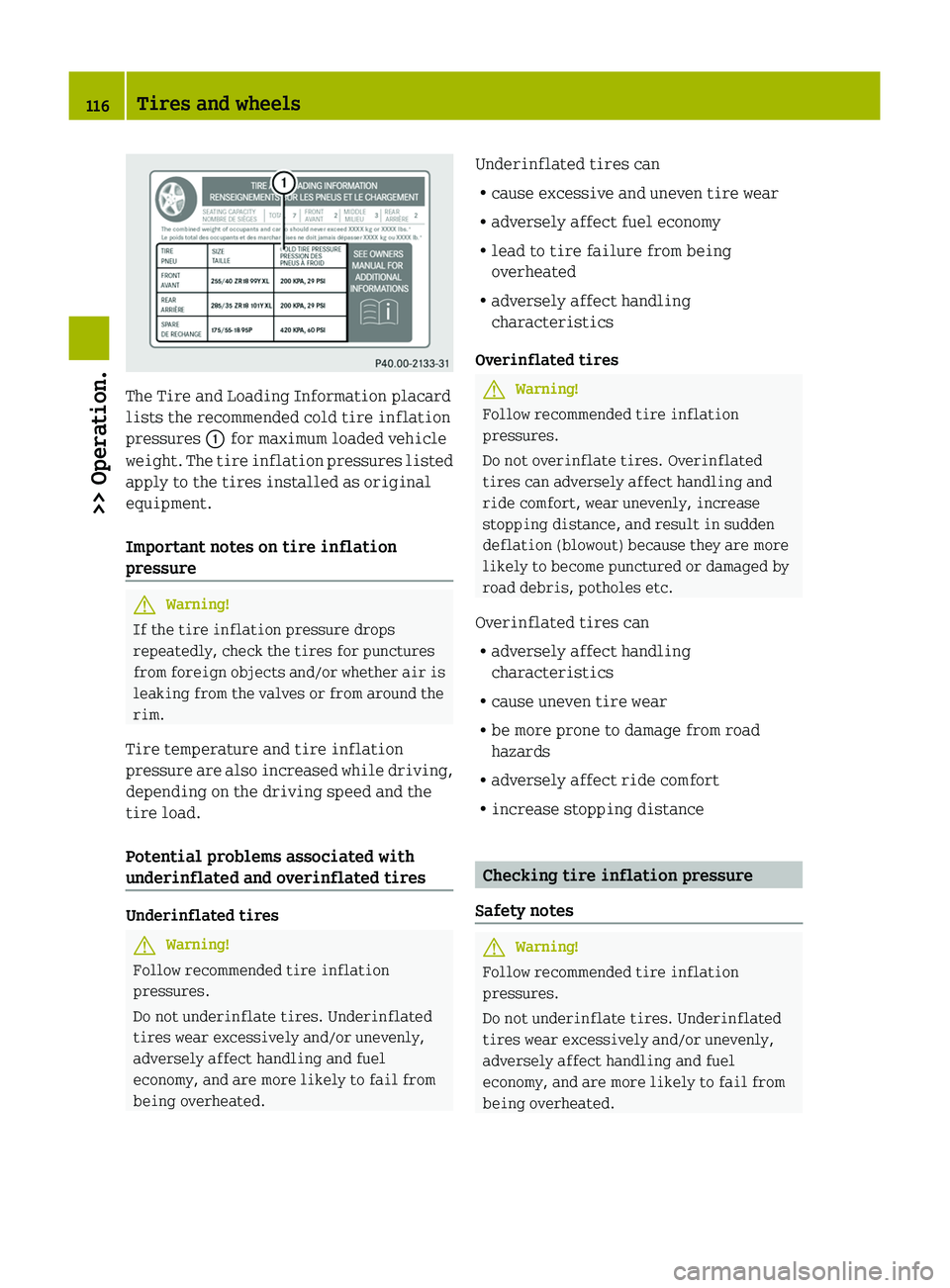
The Tire and Loading Information placard
lists the recommended cold tire inflation
pressures 0046 for maximum loaded vehicle
weight. The tire inflation pressures listed
apply to the tires installed as original
equipment.
Important notes on tire inflation
pressure
GWarning!
If the tire inflation pressure drops
repeatedly, check the tires for punctures
from foreign objects and/or whether air is
leaking from the valves or from around the
rim.
Tire temperature and tire inflation
pressure are also increased while driving,
depending on the driving speed and the
tire load.
Potential problems associated with
underinflated and overinflated tires
Underinflated tires
GWarning!
Follow recommended tire inflation
pressures.
Do not underinflate tires. Underinflated
tires wear excessively and/or unevenly,
adversely affect handling and fuel
economy, and are more likely to fail from
being overheated.
Underinflated tires can
R cause excessive and uneven tire wear
R adversely affect fuel economy
R lead to tire failure from being
overheated
R adversely affect handling
characteristics
Overinflated tiresGWarning!
Follow recommended tire inflation
pressures.
Do not overinflate tires. Overinflated
tires can adversely affect handling and
ride comfort, wear unevenly, increase
stopping distance, and result in sudden
deflation (blowout) because they are more
likely to become punctured or damaged by
road debris, potholes etc.
Overinflated tires can
R adversely affect handling
characteristics
R cause uneven tire wear
R be more prone to damage from road
hazards
R adversely affect ride comfort
R increase stopping distance
Checking tire inflation pressure
Safety notes
GWarning!
Follow recommended tire inflation
pressures.
Do not underinflate tires. Underinflated
tires wear excessively and/or unevenly,
adversely affect handling and fuel
economy, and are more likely to fail from
being overheated.
116Tires and wheels>> Operation.
451_AKB; 3; 22, en-USd2ureepe,Version: 2.11.8.12009-07-27T09:36:34+02:00 - Seite 116
Page 120 of 216
placard. If your vehicle has tires of a
different size than the size indicated on
the Tire and Loading Information placard,
you should determine the proper tire
inflation pressure for those tires.
As an added safety feature, your vehicle has
been equipped with a tire pressure
monitoring system (TPMS) that illuminates
a low tire pressure telltale when one or
more of your tires is significantly
underinflated.
Accordingly, when the low tire pressure
telltale illuminates, you should stop and
check your tires as soon as possible, and
inflate them to the proper pressure.
Driving on a significantly underinflated
tire causes the tire to overheat and can lead
to tire failure.
Underinflation also reduces fuel
efficiency and tire tread life, and may
affect the vehicle’s handling and stopping
ability. Please note that the TPMS is not a
substitute for proper tire maintenance,
and it is the driver’s responsibility to
maintain correct tire pressure, even if
underinflation has not reached the level to
trigger illumination of the TPMS low tire
pressure telltale.
Your vehicle has also been equipped with a
TPMS malfunction indicator to indicate
when the system is not operating properly.
The TPMS malfunction indicator is
combined with the low tire pressure
telltale. When the system detects a
malfunction, the telltale will flash for
approximately 1 minute and then remain
continuously illuminated.
This sequence will continue upon
subsequent vehicle start-ups as long as the
malfunction exists. When the malfunction
indicator is illuminated, the system may
not be able to detect or signal low tire
pressure as intended.
TPMS malfunctions may occur for a variety
of reasons, including the installation of
incompatible replacement or alternatetires or wheels on the vehicle that prevent
the TPMS from functioning properly. Always
check the TPMS malfunction telltale after
replacing one or more tires or wheels on
your vehicle to ensure that the replacement
or alternate tires and wheels allow the
TPMS to continue to function properly.
i If a condition causing the TPMS to
malfunction develops, it may take up to
10 minutes for the system to signal a
malfunction using the TPMS telltale
flashing and illumination sequence.
The telltale extinguishes after a few
minutes driving if the malfunction has
been corrected.
i Operating radio transmission
equipment (e.g. wireless headsets, two-
way radios) in or near the vehicle could
cause the TPMS to malfunction.
i USA only:
This device complies with Part 15 of the
FCC Rules. Operation is subject to the
following two conditions:
1. This device may not cause harmful interference, and
2. this device must accept any interference received, including
interference that may cause
undesired operation.
Any unauthorized modification to this
device could void the user’s authority to
operate the equipment.
i Canada only:
This device complies with RSS‑210 of
Industry Canada. Operation is subject to
the following two conditions:
1. This device may not cause interference, and
2. this device must accept any interference received, including118Tires and wheels>> Operation.
451_AKB; 3; 22, en-USd2ureepe,Version: 2.11.8.12009-07-27T09:36:34+02:00 - Seite 118