steering SMART FORTWO COUPE 2010 Owners Manual
[x] Cancel search | Manufacturer: SMART, Model Year: 2010, Model line: FORTWO COUPE, Model: SMART FORTWO COUPE 2010Pages: 216, PDF Size: 9.7 MB
Page 8 of 216
E
Electrical system
Improper work on or
modifications ........................... 15
Power outlet ............................ 102
Electrical system (Technical data)
see Vehicle specification
Electronic immobilizer .................. 47
Display message ...................... 149
Electronic Power Steering
see EPS
Electronic Stability Program
see ESP ®
Emergency, in case of
Hazard warning flasher ..........47, 66
Roadside Assistance ..................14
Emergency operation (limp-home
mode) .......................................... 83
Emergency Tensioning Device see ETD
Emission control .......................... 140
Information label .....................198
System warranties ......................13
Engine
Break-in recommendations .........106
Compartment ........................... 107
Compartment cover ...................107
Electronics ............................. 196
Malfunction indicator lamp ........157
Number .................................. 199
Starting .................................. 75
Turning off .............................. 79
Engine (Technical data)
see Vehicle specification
Engine coolant
see Coolant
Engine oil
Adding ................................... 109
Additives ............................... 207
Checking level ......................... 109
Consumption ........................... 108
Oil dipstick ............................ 109
EPS (Electronic Power Steering)
Warning lamp .......................... 153
ESP ®
(Electronic Stability Program) .. 45
Warning lamp .......................... 153ETD (Emergency Tensioning Device) ... 33
Safety guidelines ......................35
Exterior lamp switch ...................... 62
Exterior lighting
Overview ................................ 165
Exterior rear view mirrors .............. 59
Exterior view of vehicle .................. 20
F
First-aid kit ............................... 148
Flat tire ..................................... 172
Fluids
Brake fluid ............................. 206
Capacities ............................. 206
Engine coolant ........................ 206
Engine oil .............................. 206
Transmission fluid ..................206
Fog lamps ............................... 65, 165
Front air bags see Air bags
Front compartment ........................ 110
Front lamps
Overview ................................ 165
Fuel ........................................... 136
Additives ............................... 208
Capacity, fuel tank ...................206
Fuel filler flap and cap .............106
Fuel level display .....................87
Premium unleaded
gasoline ..................... 107, 206, 207
Refueling ............................... 106
Requirements .......................... 208
Fuel cap
Indicator lamp ........................ 156
Fuel filler flap ............................ 106
Fuel level display .......................... 87
Fuel tank
Capacity ................................ 206
Fuel filler flap and cap .............106
Refueling ............................... 106
Fuse chart ................................... 192
Fuses .......................................... 188
6Keywords451_AKB; 3; 22, en-USd2ureepe,Version: 2.11.8.12009-07-27T09:36:34+02:00 - Seite 6
Page 12 of 216
S
Safety
Driving safety systems ...............44
Occupant safety ......................... 30
Reporting defects ......................16
Safety belts
see Seat belts
Seat belt force limiter .................... 33
Seat belts ..................................... 31
Children in the vehicle ..............41
Fastening ................................ 60
Proper use of ............................ 31
Safety guidelines ......................35
Safety notes .............................. 31
Telltale .................................. 151
Seating capacity ........................... 121
Seats ........................................... 56
Adjustment ............................... 57
Armrest ................................... 57
Heating ................................... 58
Passenger seat .......................... 58
Self-test
OCS (Occupant Classification
System) ................................... 40
SRS ......................................... 30
Service
see Maintenance
Service, parts .............................. 196
Service and warranty
Booklet .................................. 196
Service flap ................................. 110
Service interval display .................. 88
Service life (tires) ....................... 123
Side marker lamps ......................... 165
Sidewall (tires) ............................ 131
Side windows
Operation ................................ 74
Signs and labels ........................... 198
smart radio 10 ............................... 91
smart radio 9 ................................ 90
smart sound package ....................... 91
Snow chains ................................. 133
Snow tires see Winter tires
Soft top system .............................. 69
Cleaning the soft top fabric .......145Locking rear soft top manually ....162
Mounting the side rails ..............73
Opening and closing the rear
soft top ............................... 55, 71
Opening and closing the
retractable soft top ...............54, 70
Removing the side rails ..............72
Storing the side rails ................73
Sound package ............................... 91
SRS (Supplemental Restraint System)
Indicator lamp ......................... 151
Standing water, driving through ...... 139
Starter switch positions .................. 55
Starting the engine ........................ 75
Steering wheel gearshift control ...... 26
Storage compartments ..................... 99
in the tailgate ........................ 100
Storing tires ............................... 124
Sun screen ................................... 102
Sun visors ................................... 101
T
Tailgate
Closing ............................... 53, 55
Opening .............................. 52, 54
Tail lamps ................................... 166
Technical data
Air conditioning refrigerant .....207
Brake fluid ............................. 207
Coolant .................................. 209
Engine oil additives ................ 207
Engine oils ............................. 206
Fuel requirements ....................208
Gasoline additives ...................208
Identification labels ................198
Premium unleaded gasoline ........207
Rims and tires ......................... 202
Service fluids and capacities ....204
Vehicle specification (model
BRABUS) ................................. 201
Vehicle specification (model
passion) ................................. 200
Vehicle specification (model
pure) ..................................... 199
Windshield/rear window washer
system ............................. 206, 208
10Keywords451_AKB; 3; 22, en-USd2ureepe,Version: 2.11.8.12009-07-27T09:36:34+02:00 - Seite 10
Page 21 of 216
>> At a glance.Exterior view ................................... 20
Cockpit ........................................... 21
Instrument cluster (miles) ..................22
Instrument cluster (kilometers) ...........24
Steering wheel gearshift control ..........26
Upper center console .........................26
Lower center console .........................27
Overhead control panel ......................28
Door control panel ............................ 28451_AKB; 3; 22, en-USd2ureepe,Version: 2.11.8.12009-07-27T09:36:34+02:00 - Seite 19
Page 23 of 216
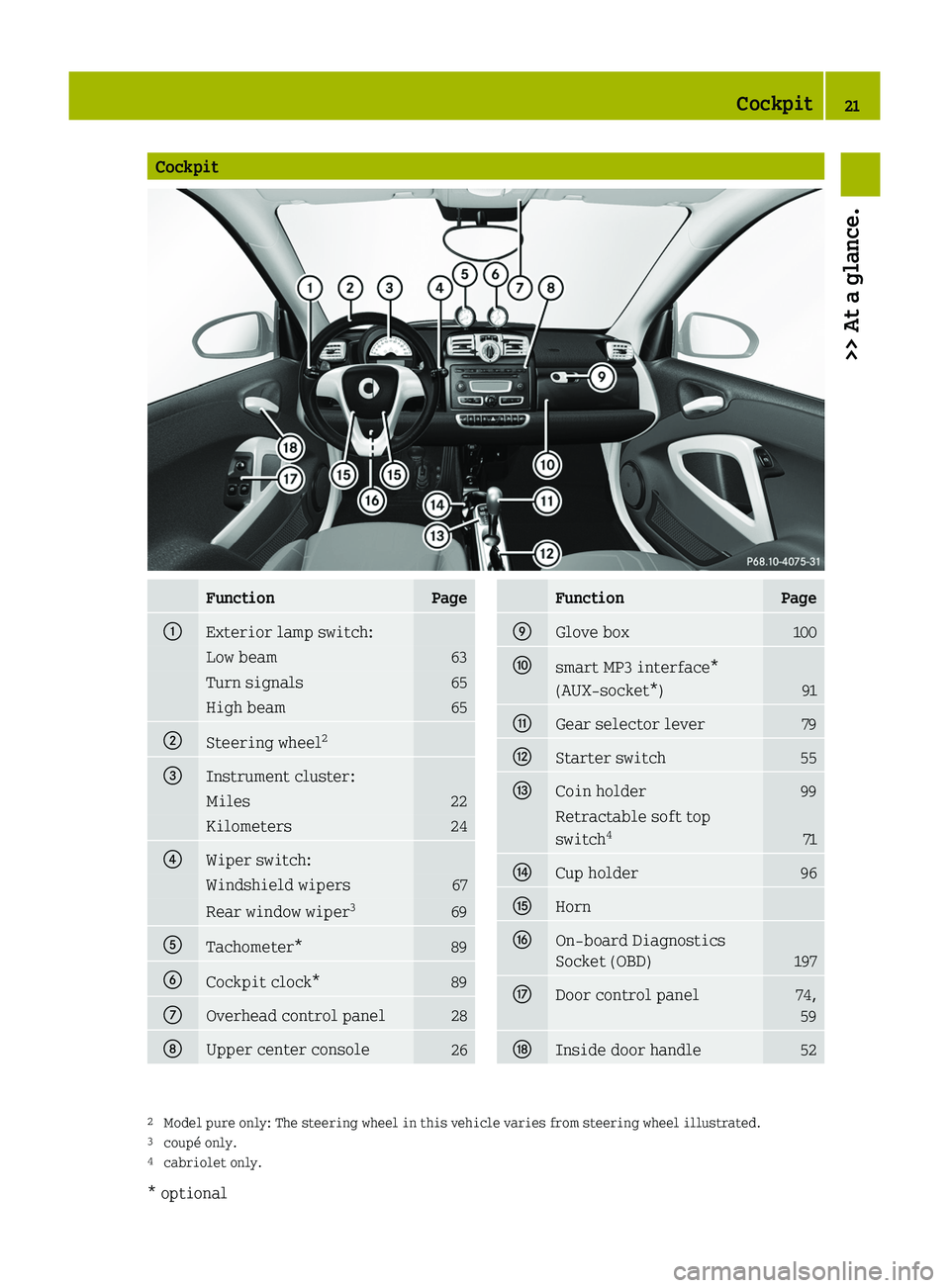
CockpitFunctionPage0046Exterior lamp switch:Low beam63Turn signals65High beam650047Steering wheel2008AInstrument cluster:Miles22Kilometers240088Wiper switch:Windshield wipers67Rear window wiper 3690086Tachometer*890087Cockpit clock*89006EOverhead control panel28006FUpper center console26FunctionPage0070Glove box1000071smart MP3 interface*
(AUX-socket*)
91
0072Gear selector lever790073Starter switch550074Coin holder99Retractable soft top
switch 4
71
0075Cup holder960076Horn0077On-board Diagnostics
Socket (OBD)
197
0078Door control panel74, 590079Inside door handle522 Model pure only: The steering wheel in this vehicle varies from steering wheel illustrated.
3 coupé only.
4 cabriolet only.Cockpit21>> At a glance.* optional451_AKB; 3; 22, en-USd2ureepe,Version: 2.11.8.12009-07-27T09:36:34+02:00 - Seite 21
Page 28 of 216
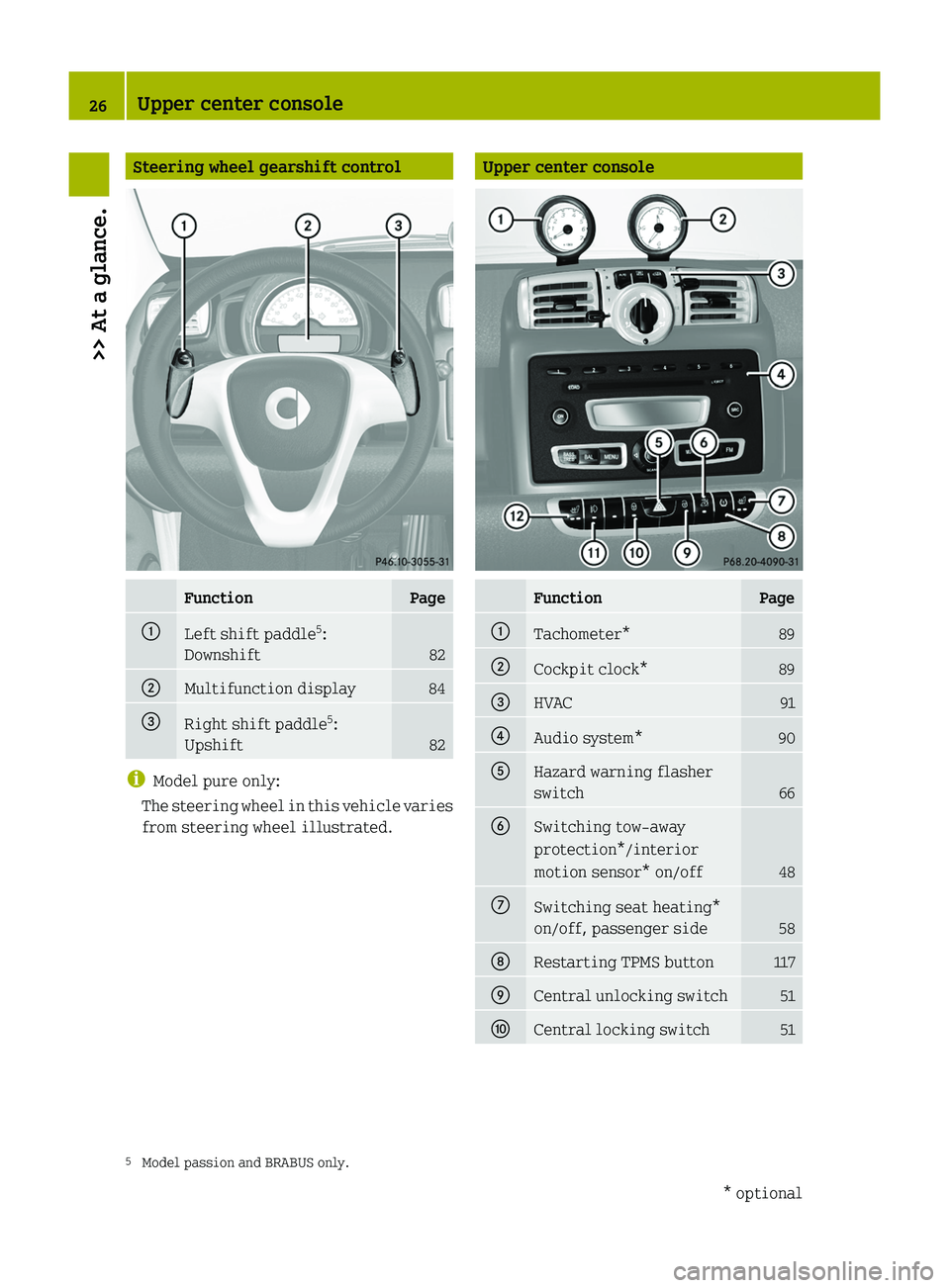
Steering wheel gearshift controlFunctionPage0046Left shift paddle5
:
Downshift
82
0047Multifunction display84008ARight shift paddle 5
:
Upshift
82
i Model pure only:
The steering wheel in this vehicle varies
from steering wheel illustrated.
Upper center consoleFunctionPage0046Tachometer*890047Cockpit clock*89008AHVAC910088Audio system*900086Hazard warning flasher
switch
66
0087Switching tow-away
protection*/interior
motion sensor* on/off
48
006ESwitching seat heating*
on/off, passenger side
58
006FRestarting TPMS button1170070Central unlocking switch510071Central locking switch515 Model passion and BRABUS only.26Upper center console>> At a glance.* optional451_AKB; 3; 22, en-USd2ureepe,Version: 2.11.8.12009-07-27T09:36:34+02:00 - Seite 26
Page 36 of 216
have any breathing difficulty but cannot
get out of the vehicle after the air bag
inflates, then get fresh air by opening a
window or door.GWarning!
To reduce the risk of injury when the front
air bags inflate, it is very important for
the driver and passenger to always be in a
properly seated position and to wear their
respective seat belt.
For maximum protection in the event of a
collision always be in normal seated
position with your back against the
backrest. Fasten your seat belt and ensure
it is properly positioned on your body.
Since the air bag inflates with
considerable speed and force, a proper
seating and hands on steering wheel
position will help to keep you at a safe
distance from the air bag.
Occupants who are unbelted, out of position
or too close to the air bag can be seriously
injured or killed by an air bag as it
inflates extremely quickly and with great
force:
R Sit properly belted in a position that is
as upright as possible with your back
against the seat backrest.
R Adjust the driver’s seat as far as possible
rearward, still permitting proper
operation of vehicle controls. The
distance from the center of the driver’s
breastbone to the center of the air bag
cover on the steering wheel must be at
least 10 inches (25 cm) or more. You should
be able to accomplish this by
adjustments to the seat. If you have any
problems, please contact an authorized
smart center.
R Do not lean your head or chest close to the
steering wheel or dashboard.
R Keep hands on the outside of the steering
wheel rim. Placing hands and arms inside
the rim can increase the risk and
potential severity of hand/arm injury
when the driver’s front air bag inflates.
R Adjust the passenger seat as far as
possible rearward from the dashboard
when the seat is occupied.
R Occupants, especially children, should
always sit as upright as possible,
properly use the seat belts and use an
appropriately sized infant restraint,
toddler restraint, or booster seat
recommended for the size and weight of
the child.
Failure to follow these instructions can
result in severe injuries to you or other
occupants.
If you sell your vehicle, it is important that
you make the buyer aware of this safety
information. Be sure to give the buyer this
Operator’s Manual.
i Air bags are designed to deploy only in
certain frontal impacts (front air bags),
and in side impacts (head-thorax air
bags) which exceed preset thresholds.
Only during these events will they
provide their supplemental protection.
The driver and passenger should always
wear their seat belts. Otherwise it is not
possible for air bags to provide their
supplemental protection.
In case of other types of impacts and
impacts below air bag deployment
thresholds, air bags will not deploy. The
driver and passenger will then be
protected to the extent possible by a
properly fastened seat belt. A properly
fastened seat belt is also needed to
provide the best possible protection in
a rollover.
We caution you not to rely on the presence
of the air bags in order to avoid wearing
your seat belt.34Occupant safety>> Safety.
451_AKB; 3; 22, en-USd2ureepe,Version: 2.11.8.12009-07-27T09:36:34+02:00 - Seite 34
Page 37 of 216
It is important to your safety and that of
your passenger that you replace deployed
air bags and repair any malfunctioning
air bags to make sure the vehicle will
continue to provide supplemental crash
protection for occupants.
Safety guidelines for the seat belt,
Emergency Tensioning Devices (ETDs)
and air bag GWarning!
R Damaged seat belts or seat belts that were
highly stressed in an accident must be
replaced and their anchoring points
must also be checked. Only use seat belts
installed or supplied by an authorized
smart center.
R Air bags and Emergency Tensioning
Devices (ETDs) contain Perchlorate
material, which may require special
handling and regard for the environment.
Check with your local government’s
disposal guidelines. California
residents, see http://www.dtsc.ca.gov/
HazardousWaste/Perchlorate/index.cfm .
R Given the considerable deployment
speed, required inflation volume, and
the textile structure of the air bags,
there is the possibility of abrasions or
other, potentially more serious injuries
resulting from air bag deployment.
R Air bags and Emergency Tensioning
Devices (ETDs) are designed to function
on a one-time-only basis. An air bag or
ETD that has deployed must be replaced.
R Do not pass seat belts over sharp edges.
They could tear.
R Do not make any modification that could
change the effectiveness of the seat
belts.
R No modifications of any kind may be made
to any components or wiring of the SRS.
This includes changing or removing any
component or part of the SRS, the
installation of additional trim
material, badges, etc. over the steering
wheel hub, passenger front air bag cover,
outboard sides of the seat backrests, and
installation of additional electrical/
electronic equipment on or near SRS
components and wiring. Keep area
between air bags and occupants free from
objects (e.g. packages, purses,
umbrellas, etc.).
R Do not bleach or dye seat belts as this may
severely weaken them. In a crash they may
not be able to provide adequate
protection.
R Do not hang hangers on the coat hooks or
handles over the door. These items may
turn into projectiles and cause head and
other injuries when the head-thorax air
bag is deployed.
R Air bag system components will be hot
after an air bag has inflated. Do not
touch.
R Never place your feet on the instrument
panel, dashboard, or on the seat. Always
keep both feet on the floor in front of the
seat.
R In addition, improper repair work on the
SRS creates a risk of rendering the SRS
inoperative or causing unintended air
bag deployment. Work on the SRS must
therefore only be performed by qualified
technicians. Contact an authorized smart
center.
R For your protection and the protection of
others, when scrapping the air bag unit
or Emergency Tensioning Devices (ETDs),
our safety instructions must be followed.
These instructions are available from
any authorized smart center.
How the air bag operates
The air bag is inflated in a matter of
milliseconds. If the air bag is triggered,
Occupant safety35>> Safety.451_AKB; 3; 22, en-USd2ureepe,Version: 2.11.8.12009-07-27T09:36:34+02:00 - Seite 35Z
Page 39 of 216
Driver front air bag/passenger front air
bag
The front air bags are designed to reduce
the potential of injury in certain frontal
impacts.
Driver front air bag and passenger front
air bag are deployed
R at the start of an accident with high
vehicle deceleration in the longitudinal
direction
R independently of other air bags in the
vehicle being deployed
R never in the event of a rollover, unless
high vehicle deceleration in the
longitudinal direction is detected
i The front air bags in this vehicle have
been designed to inflate in two stages.
This allows the air bag to have different
rates of inflation that are based on the
rate of relevant vehicle deceleration
and a fastened or unfastened seat belt as
assessed by the air bag control unit.
On the passenger side, the front air bag
deployment is additionally influenced
by the passenger’s weight category as
identified by the Occupant
Classification System (OCS)
( Y page 37).
The lighter the passenger side occupant,
the higher the vehicle deceleration rate
required for the second stage inflation
of the air bag.
The air bags will not deploy in impacts
which do not exceed the system’s
deployment thresholds. In such instances,
the seat belts are designed to protect you.
The passenger air bag will only be
deployed if
R the system, based on OCS weight sensor
readings, senses that the passenger seat
is occupied and the 007F 007B
indicator lamp is not lit ( Y page 40)
R the impact exceeds a preset deployment
threshold
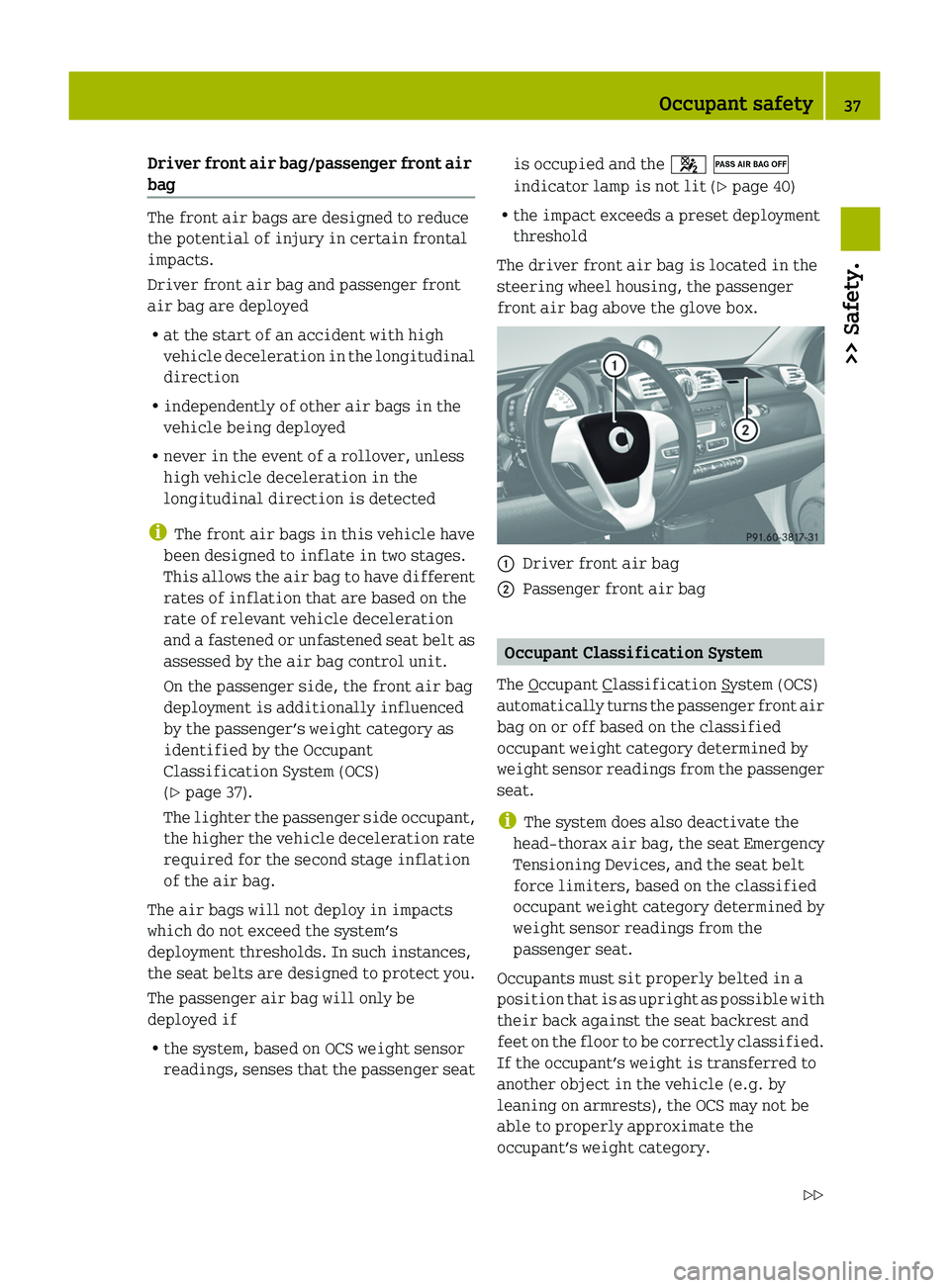
The driver front air bag is located in the
steering wheel housing, the passenger
front air bag above the glove box.0046Driver front air bag0047Passenger front air bag
Occupant Classification System
The
Occupant Classification System (OCS)
automatically turns the passenger front air
bag on or off based on the classified
occupant weight category determined by
weight sensor readings from the passenger
seat.
i The system does also deactivate the
head-thorax air bag, the seat Emergency
Tensioning Devices, and the seat belt
force limiters, based on the classified
occupant weight category determined by
weight sensor readings from the
passenger seat.
Occupants must sit properly belted in a
position that is as upright as possible with
their back against the seat backrest and
feet on the floor to be correctly classified.
If the occupant’s weight is transferred to
another object in the vehicle (e.g. by
leaning on armrests), the OCS may not be
able to properly approximate the
occupant’s weight category.
Occupant safety37>> Safety.451_AKB; 3; 22, en-USd2ureepe,Version: 2.11.8.12009-07-27T09:36:34+02:00 - Seite 37Z
Page 47 of 216
Antilock Brake System (ABS)GWarning!
Do not pump the brake pedal. Use firm,
steady brake pedal pressure instead.
Pumping the brake pedal defeats the
purpose of the ABS and significantly
reduces braking effectiveness.
The
Antilock Brake System (ABS) regulates
the brake pressure so that the wheels do not
lock during braking. This allows you to
maintain the ability to steer your vehicle.
On slippery road surfaces, the ABS will
respond even to light brake pressure.
The ABS indicator lamp in the instrument
cluster ( Y page 22) comes on when you
switch on the ignition. It goes out when the
engine is running.
Braking
At the instant one of the wheels is about to
lock up, a slight pulsation can be felt in
the brake pedal, indicating that the ABS is
regulating the brake pressure.
XKeep firm and steady pressure on the
brake pedal while experiencing the
pulsation.
Continuous, steady brake pedal pressure
yields the advantages provided by the ABS,
namely braking power and the ability to
steer the vehicle.
A pulsating brake pedal can be an
indication of hazardous road conditions
and functions as a reminder to take extra
care while driving.
Emergency brake maneuver
XKeep continuous full pressure on the
brake pedal.GWarning!
When the ABS is malfunctioning, the
hydraulic brake assistant and the ESP ®
are
also switched off.
When the ABS is malfunctioning, the wheels
may lock during hard braking, reducing
steering capability and extending the
braking distance.GWarning!
The ABS cannot prevent the natural laws of
physics from acting on the vehicle, nor can
it increase braking or steering efficiency
beyond that afforded by the condition of the
vehicle brakes and tires or the traction
afforded. The ABS cannot prevent
accidents, including those resulting from
excessive speed in turns, following
another vehicle too closely, or
hydroplaning. Only a safe, attentive, and
skillful driver can prevent accidents. The
capabilities of an ABS equipped vehicle
must never be exploited in a reckless or
dangerous manner which could jeopardize
the user’s safety or the safety of others.
Electronic Stability Program (ESP ®
)
Your vehicle is equipped with the
Electronic Stability Program (ESP ®
). The
ESP ®
is operational as soon as the engine
is running and it monitors the vehicle’s
traction (force of adhesive friction
between the tires and the road surface) and
handling.
The ESP ®
recognizes when a wheel is
spinning or if the vehicle starts to skid.
By applying brakes to the appropriate
wheel and by limiting the engine output,
the ESP ®
works to stabilize the vehicle. The
ESP ®
is especially useful while driving off
and on wet or slippery road surfaces. The
ESP ®
also stabilizes the vehicle during
braking and steering maneuvers.
The ESP ®
warning lamp 0067 in the
instrument cluster flashes when the ESP ®
is
engaged.
The ESP ®
warning lamp 0067 in the
instrument cluster comes on when you
Driving safety systems45>> Safety.451_AKB; 3; 22, en-USd2ureepe,Version: 2.11.8.12009-07-27T09:36:34+02:00 - Seite 45Z
Page 58 of 216
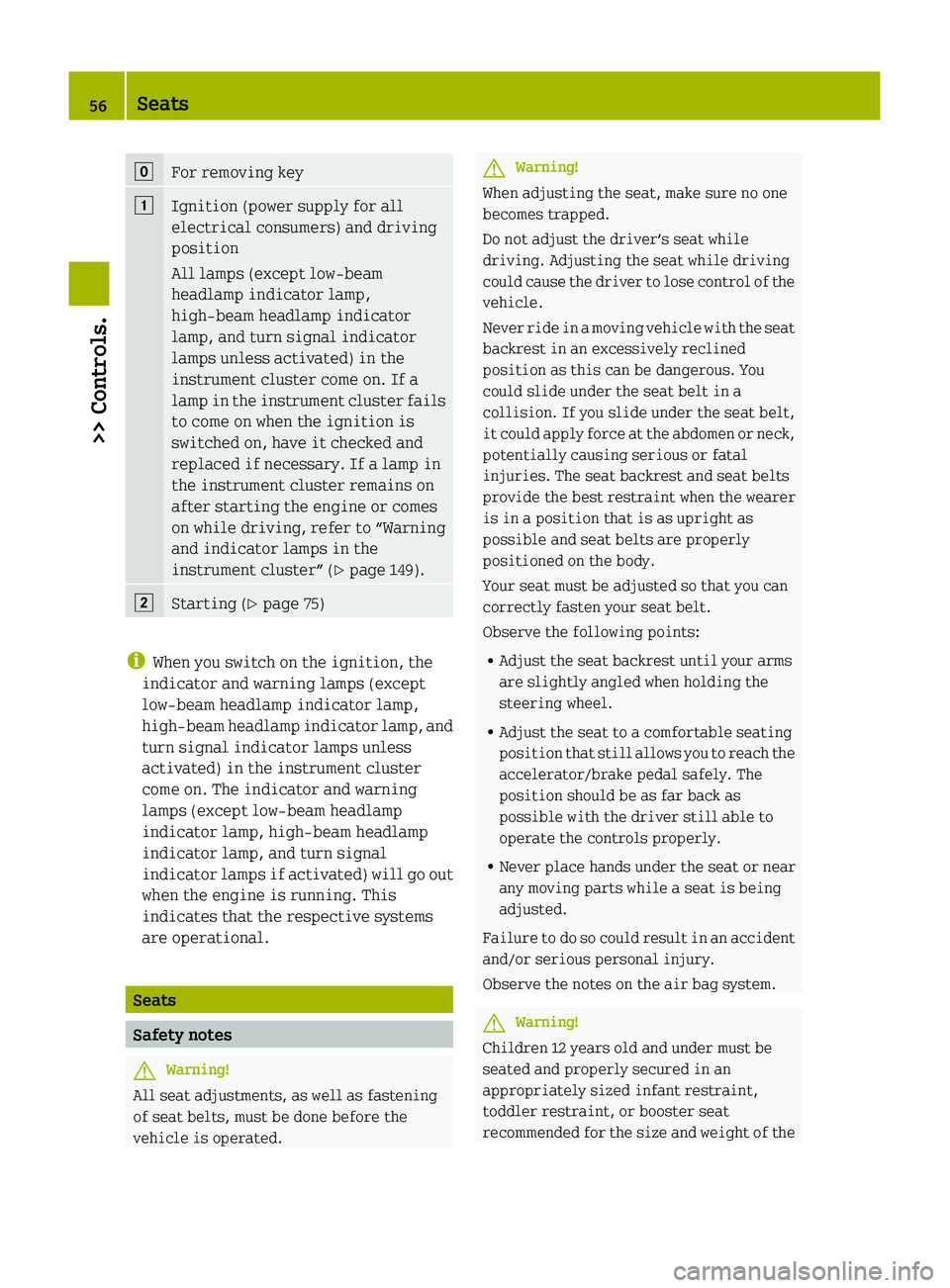
005DFor removing key004AIgnition (power supply for all
electrical consumers) and driving
position
All lamps (except low‑beam
headlamp indicator lamp,
high‑beam headlamp indicator
lamp, and turn signal indicator
lamps unless activated) in the
instrument cluster come on. If a
lamp in the instrument cluster fails
to come on when the ignition is
switched on, have it checked and
replaced if necessary. If a lamp in
the instrument cluster remains on
after starting the engine or comes
on while driving, refer to “Warning
and indicator lamps in the
instrument cluster” ( Y page 149).004BStarting ( Y page 75)
i
When you switch on the ignition, the
indicator and warning lamps (except
low‑beam headlamp indicator lamp,
high‑beam headlamp indicator lamp, and
turn signal indicator lamps unless
activated) in the instrument cluster
come on. The indicator and warning
lamps (except low‑beam headlamp
indicator lamp, high‑beam headlamp
indicator lamp, and turn signal
indicator lamps if activated) will go out
when the engine is running. This
indicates that the respective systems
are operational.
Seats
Safety notes
GWarning!
All seat adjustments, as well as fastening
of seat belts, must be done before the
vehicle is operated.
GWarning!
When adjusting the seat, make sure no one
becomes trapped.
Do not adjust the driver’s seat while
driving. Adjusting the seat while driving
could cause the driver to lose control of the
vehicle.
Never ride in a moving vehicle with the seat
backrest in an excessively reclined
position as this can be dangerous. You
could slide under the seat belt in a
collision. If you slide under the seat belt,
it could apply force at the abdomen or neck,
potentially causing serious or fatal
injuries. The seat backrest and seat belts
provide the best restraint when the wearer
is in a position that is as upright as
possible and seat belts are properly
positioned on the body.
Your seat must be adjusted so that you can
correctly fasten your seat belt.
Observe the following points:
R Adjust the seat backrest until your arms
are slightly angled when holding the
steering wheel.
R Adjust the seat to a comfortable seating
position that still allows you to reach the
accelerator/brake pedal safely. The
position should be as far back as
possible with the driver still able to
operate the controls properly.
R Never place hands under the seat or near
any moving parts while a seat is being
adjusted.
Failure to do so could result in an accident
and/or serious personal injury.
Observe the notes on the air bag system.
GWarning!
Children 12 years old and under must be
seated and properly secured in an
appropriately sized infant restraint,
toddler restraint, or booster seat
recommended for the size and weight of the
56Seats>> Controls.
451_AKB; 3; 22, en-USd2ureepe,Version: 2.11.8.12009-07-27T09:36:34+02:00 - Seite 56