ECU SMART FORTWO COUPE 2011 User Guide
[x] Cancel search | Manufacturer: SMART, Model Year: 2011, Model line: FORTWO COUPE, Model: SMART FORTWO COUPE 2011Pages: 228, PDF Size: 11.48 MB
Page 64 of 228
Exterior rear view mirror heating
This feature is only available on the model
passion and BRABUS and in conjunction
with power exterior rear view mirrors.
After switching on the rear window
defroster, the exterior rear view mirrors
will be heated automatically. This
prevents icing up the exterior rear view
mirrors and also creates a clear view when
the exterior rear view mirrors have fogged
up.
If the rear window defroster is
automatically deactivated after
approximately 10 minutes of operation, the
exterior rear view mirror heating also
deactivates.
XMake sure the key is in starter switch
position 1.XSwitching on: Switch on the rear window
defroster ( Y page 107).
The exterior rear view mirror heating is
switched on.XSwitching off: Switch off the rear window
defroster ( Y page 107).
The exterior rear view mirror heating is
switched off.
i The exterior rear view mirror heating
also switches off if the key is turned to
starter switch position 0.
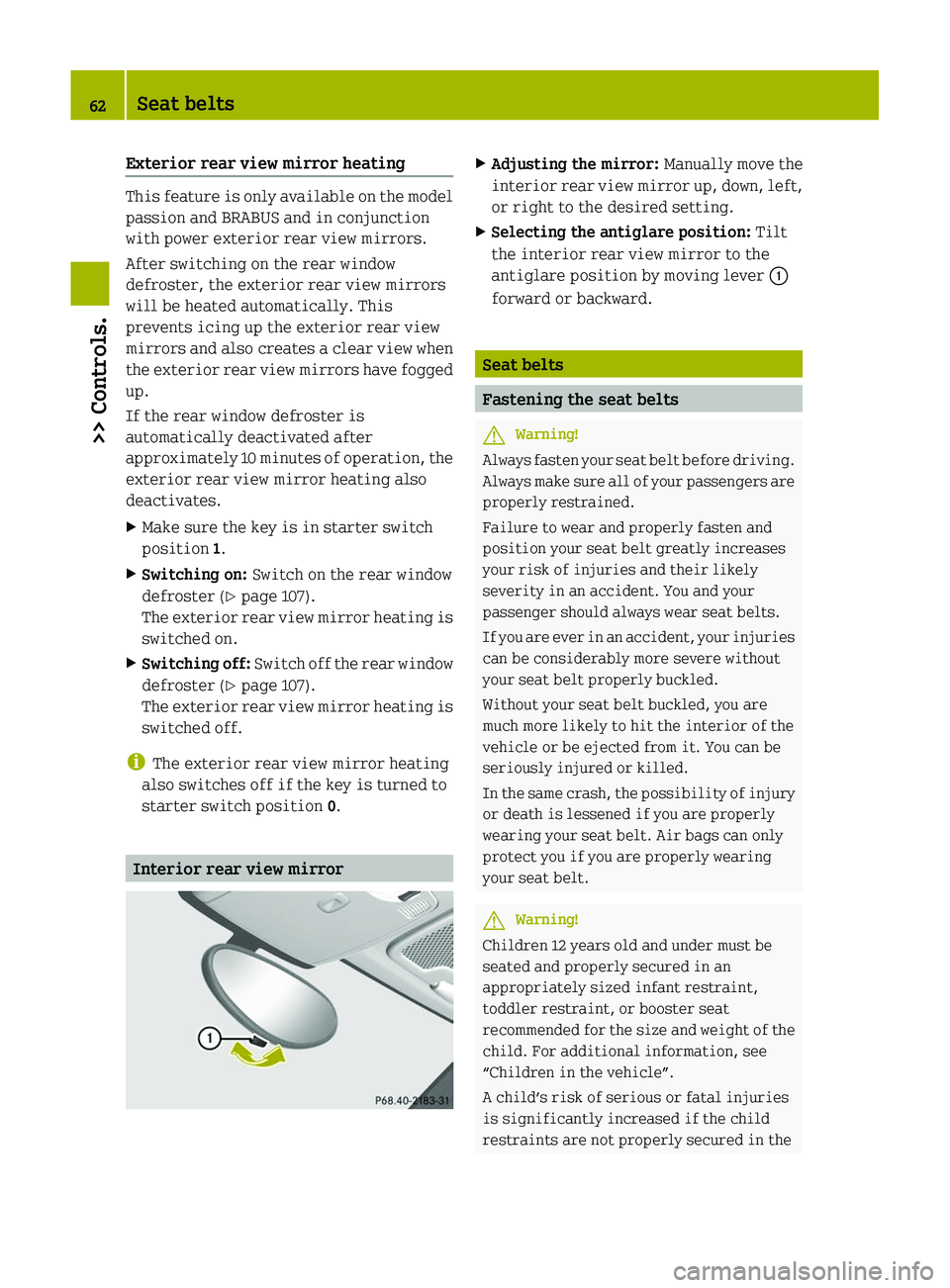
Interior rear view mirror
XAdjusting the mirror: Manually move the
interior rear view mirror up, down, left,
or right to the desired setting.XSelecting the antiglare position: Tilt
the interior rear view mirror to the
antiglare position by moving lever 0046
forward or backward.
Seat belts
Fastening the seat belts
GWarning!
Always fasten your seat belt before driving.
Always make sure all of your passengers are
properly restrained.
Failure to wear and properly fasten and
position your seat belt greatly increases
your risk of injuries and their likely
severity in an accident. You and your
passenger should always wear seat belts.
If you are ever in an accident, your injuries
can be considerably more severe without
your seat belt properly buckled.
Without your seat belt buckled, you are
much more likely to hit the interior of the
vehicle or be ejected from it. You can be
seriously injured or killed.
In the same crash, the possibility of injury
or death is lessened if you are properly
wearing your seat belt. Air bags can only
protect you if you are properly wearing
your seat belt.
GWarning!
Children 12 years old and under must be
seated and properly secured in an
appropriately sized infant restraint,
toddler restraint, or booster seat
recommended for the size and weight of the
child. For additional information, see
“Children in the vehicle”.
A child’s risk of serious or fatal injuries
is significantly increased if the child
restraints are not properly secured in the
62Seat belts>> Controls.
BA 451 USA, CA Edition A 2011; 1; 4, en-UShereepeVersion: 3.0.3.62010-05-11T15:12:26+02:00 - Seite 62
Page 65 of 228
vehicle and/or the child is not properly
secured in the child restraint.
GWarning!
Never let more people ride in the vehicle
than there are seat belts available. Make
sure everyone riding in the vehicle is
correctly restrained with a separate seat
belt. Never use a seat belt for more than one
person at a time.
GWarning!
Never ride in a moving vehicle with the seat
backrest in an excessively reclined
position as this can be dangerous. You
could slide under the seat belt in a
collision. If you slide under it, the belt
would apply force at the abdomen or neck,
causing serious or even fatal injuries. The
seat backrest and seat belt provide the best
restraint when the wearer is in a position
that is as upright as possible and the belt
is properly positioned on the body.
GWarning!
Observe ”Safety notes“ (Y page 35).
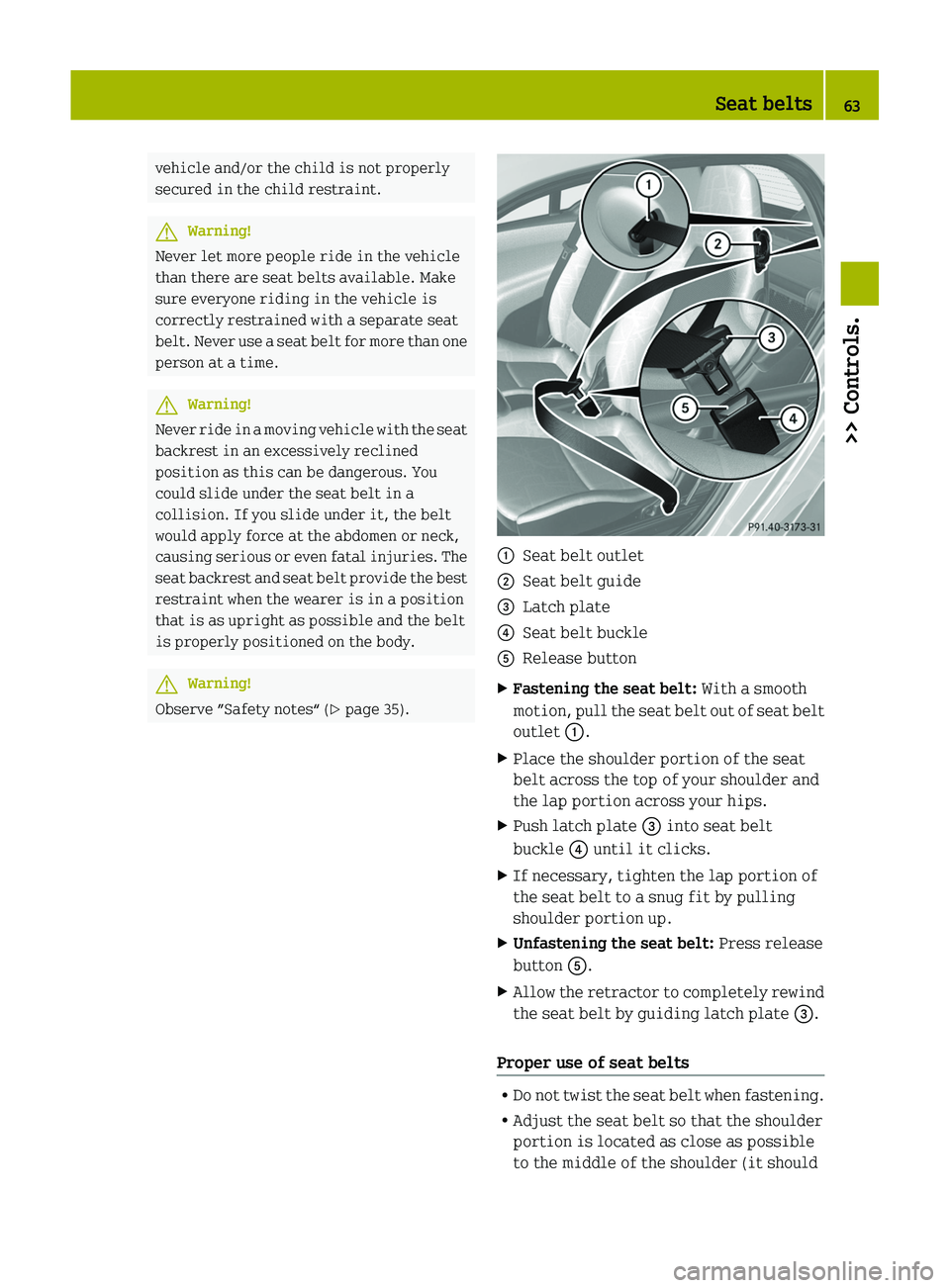
\000FSeat belt outlet\000GSeat belt guide\000
Page 66 of 228
not touch the neck). Never pass the
shoulder portion of the seat belt under
your arm.
RPosition the lap belt as low as possible
on your hips (over hip joint) and not
across the abdomen.
RPlace the seat backrest in a position that
is as upright as possible.
RNever use a seat belt for more than one
person at a time.
RDo not fasten a seat belt around a person
and another object at the same time. When
using a seat belt to secure infant or
toddler restraints or children in booster
seats, always follow the child seat
manufacturer’s instructions.
RCheck your seat belt during travel to
make sure it is properly positioned.
RMake sure the seat belt is always fitted
snugly. Take special care to maintain a
snug fit when wearing loose clothing.
GWarning!
Do not pass seat belts over sharp edges.
They could tear.
Do not allow the seat belt to get caught in
the door or in the seat adjustment
mechanism. This could damage the seat
belt.
Never attempt to make modifications to
seat belts. This could impair the
effectiveness of the seat belts.
Do not bleach or dye seat belts as this may
severely weaken them. In a crash they may
not be able to provide adequate protection.
Damaged seat belts or seat belts that were
highly stressed in an accident must be
replaced. Contact an authorized smart
center.
Correct driver seat adjustment
GWarning!
Observe ”Safety notes“ (Y page 58).
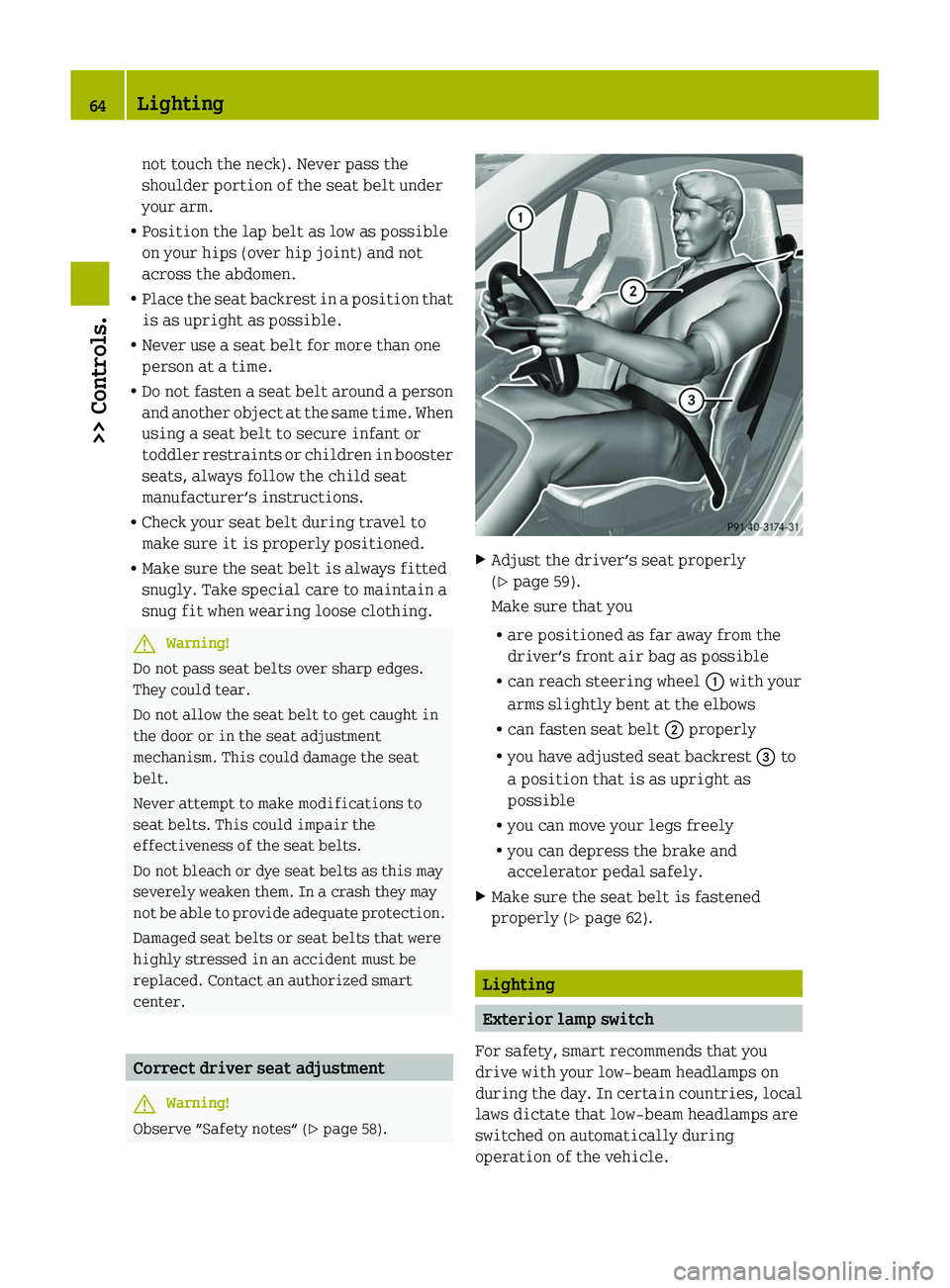
XAdjust the driver’s seat properly
(Y page 59).
Make sure that you
Rare positioned as far away from the
driver’s front air bag as possible
Rcan reach steering wheel \000F with your
arms slightly bent at the elbows
Rcan fasten seat belt \000G properly
Ryou have adjusted seat backrest \000
Page 82 of 228
RKeep right foot on the brake pedal.
R Engage the parking brake.
R Move the gear selector lever to park
position P.
R Slowly release the brake pedal.
R When parked on an incline, always turn
the front wheels towards the curb.
R Turn the key to starter switch position 0
and remove the key from the starter
switch.
R Take the key with you and lock the vehicle
when leaving.GWarning!
With the engine not running, there is no
power assistance for the brake and
steering* systems. In this case, it is
important to keep in mind that a
considerably higher degree of effort is
necessary to brake and steer the vehicle.
Adapt your driving accordingly.
XProperly stop and park the vehicle.XDepress the brake pedal.XEngage the parking brake ( Y page 80).
When the ignition is switched on or the
engine is running, the brake warning
lamp 0027 (USA only) or 004D (Canada
only) in the instrument cluster comes on.XRelease the brake pedal.
Parking brake
The parking brake serves to secure the
vehicle against rolling away when it is
stationary or parked.
GWarning!
Engaging the parking brake while the
vehicle is in motion can cause the rear
wheels to lock up. You could lose control of
the vehicle and cause an accident. In
addition, the vehicle’s brake lights do not
light up when the parking brake is engaged.
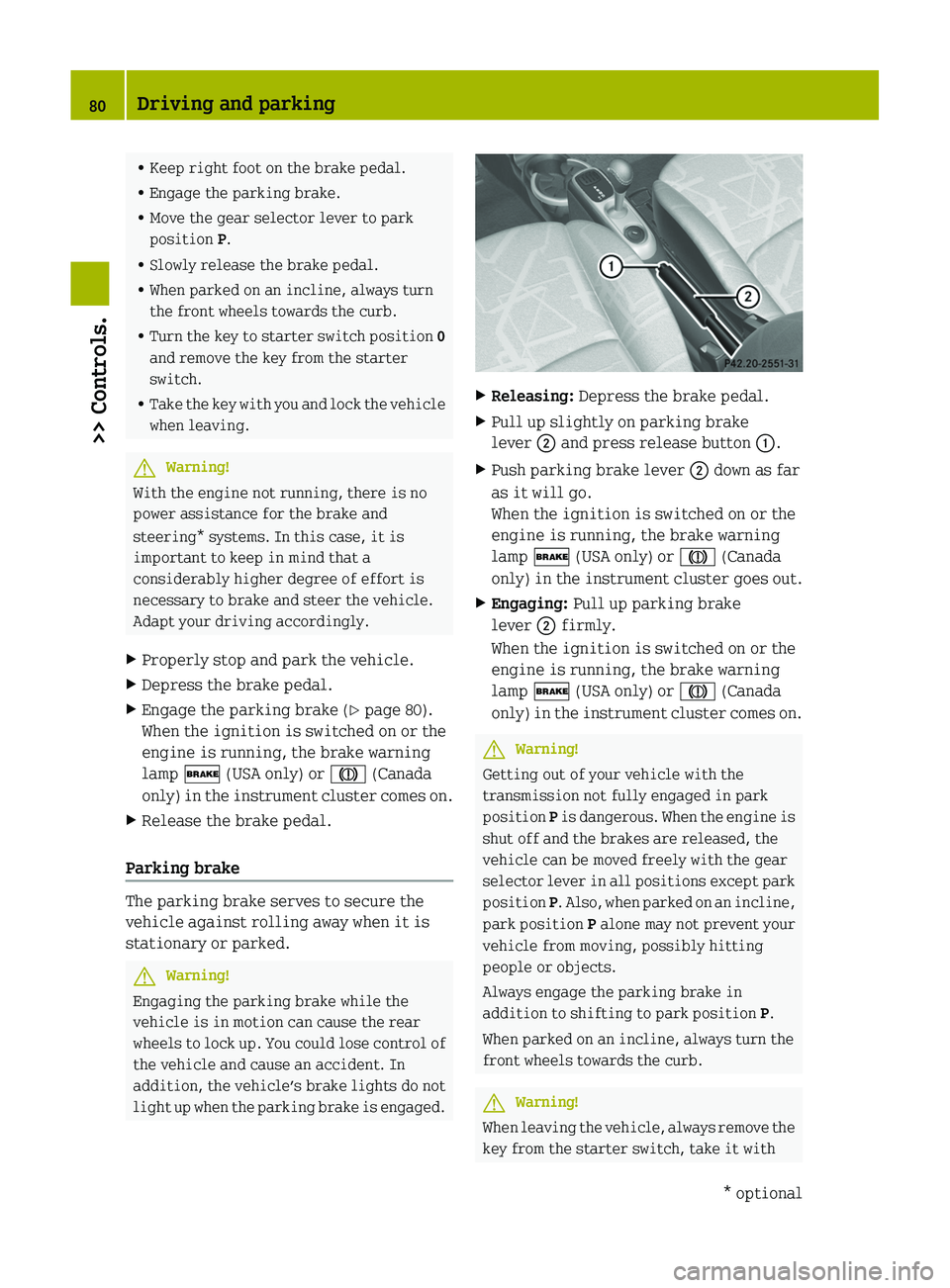
XReleasing: Depress the brake pedal.XPull up slightly on parking brake
lever 0047 and press release button 0046.XPush parking brake lever 0047 down as far
as it will go.
When the ignition is switched on or the
engine is running, the brake warning
lamp 0027 (USA only) or 004D (Canada
only) in the instrument cluster goes out.XEngaging: Pull up parking brake
lever 0047 firmly.
When the ignition is switched on or the
engine is running, the brake warning
lamp 0027 (USA only) or 004D (Canada
only) in the instrument cluster comes on.GWarning!
Getting out of your vehicle with the
transmission not fully engaged in park
position P is dangerous. When the engine is
shut off and the brakes are released, the
vehicle can be moved freely with the gear
selector lever in all positions except park
position P. Also, when parked on an incline,
park position P alone may not prevent your
vehicle from moving, possibly hitting
people or objects.
Always engage the parking brake in
addition to shifting to park position P.
When parked on an incline, always turn the
front wheels towards the curb.
GWarning!
When leaving the vehicle, always remove the
key from the starter switch, take it with
80Driving and parking>> Controls.* optionalBA 451 USA, CA Edition A 2011; 1; 4, en-UShereepeVersion: 3.0.3.62010-05-11T15:12:26+02:00 - Seite 80
Page 85 of 228
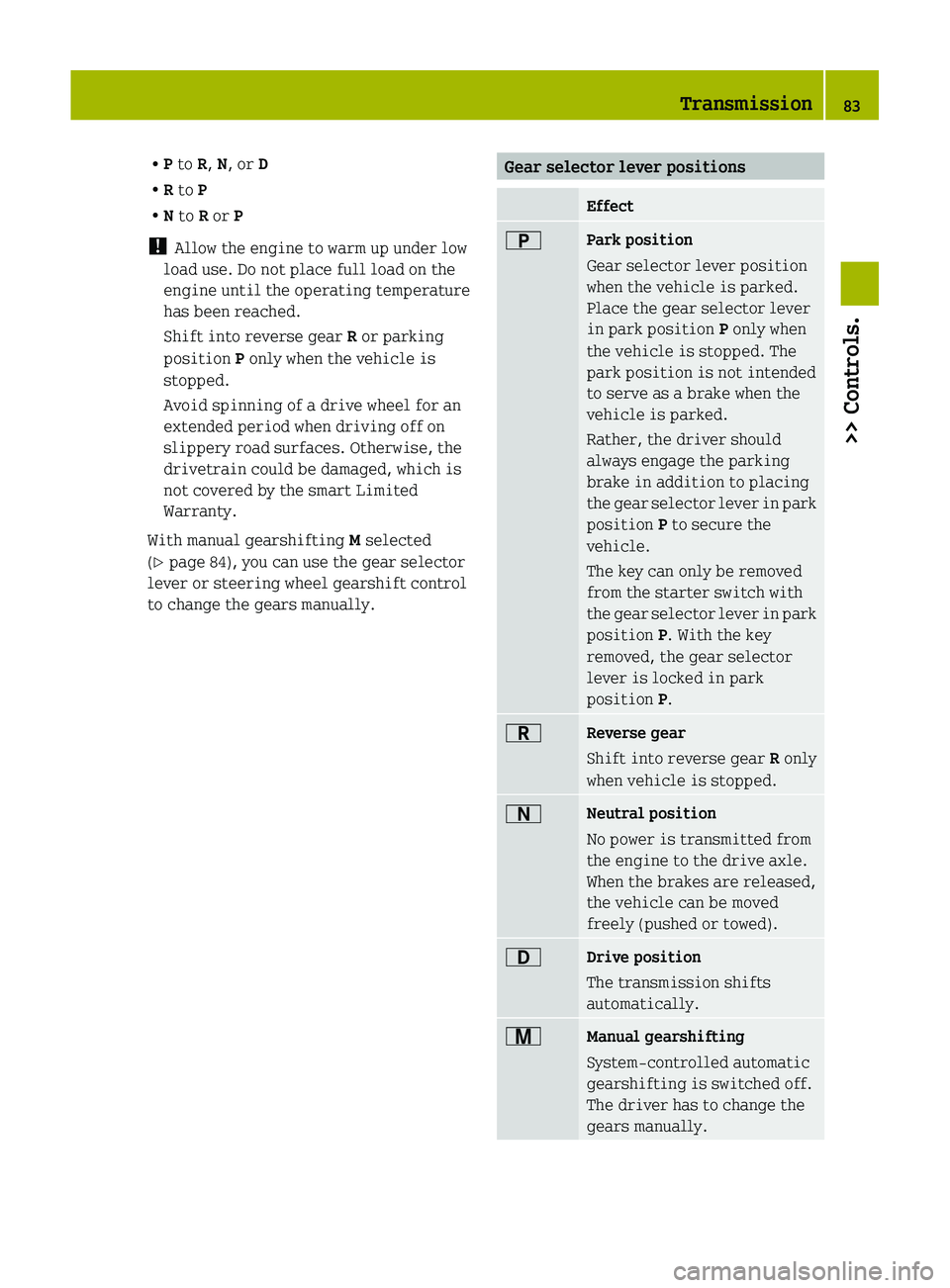
RP to R, N , or D
R R to P
R N to R or P
! Allow the engine to warm up under low
load use. Do not place full load on the
engine until the operating temperature
has been reached.
Shift into reverse gear R or parking
position P only when the vehicle is
stopped.
Avoid spinning of a drive wheel for an
extended period when driving off on
slippery road surfaces. Otherwise, the
drivetrain could be damaged, which is
not covered by the smart Limited
Warranty.
With manual gearshifting M selected
( Y page 84), you can use the gear selector
lever or steering wheel gearshift control
to change the gears manually.Gear selector lever positionsEffect0045Park position
Gear selector lever position
when the vehicle is parked.
Place the gear selector lever
in park position P only when
the vehicle is stopped. The
park position is not intended
to serve as a brake when the
vehicle is parked.
Rather, the driver should
always engage the parking
brake in addition to placing
the gear selector lever in park
position P to secure the
vehicle.
The key can only be removed
from the starter switch with
the gear selector lever in park
position P. With the key
removed, the gear selector
lever is locked in park
position P.0046Reverse gear
Shift into reverse gear R only
when vehicle is stopped.0044Neutral position
No power is transmitted from
the engine to the drive axle.
When the brakes are released,
the vehicle can be moved
freely (pushed or towed).003ADrive position
The transmission shifts
automatically.009CManual gearshifting
System-controlled automatic
gearshifting is switched off.
The driver has to change the
gears manually.Transmission83>> Controls.BA 451 USA, CA Edition A 2011; 1; 4, en-UShereepeVersion: 3.0.3.62010-05-11T15:12:26+02:00 - Seite 83Z
Page 110 of 228
Air recirculation mode*
Switch to air recirculation mode 12
to
prevent unpleasant odors from entering the
vehicle from the outside (e.g. before
driving through a tunnel). This setting cuts
off the intake of outside air and
recirculates the air in the passenger
compartment.GWarning!
When the air recirculation mode is
switched on, windows can fog on the inside
immediately. Fogged windows impair
visibility, endangering you and others. If
the windows begin to fog on the inside,
switching off the air recirculation mode
immediately should clear interior window
fogging. If interior window fogging
persists, make sure the air conditioning is
switched on, turn air distribution control
0087 to position 0087 and increase the air
volume using air volume control 0046.
Control panel ( Y page 104).
XSwitching on: Press air recirculation
switch 0088.
The indicator lamp in air recirculation
switch 0088 comes on.XSwitching off: Press air recirculation
switch 0088 once more.
The indicator lamp in air recirculation
switch 0088 goes out.
Loading and storing
Cup holder
GWarning!
In order to help prevent spilling liquids
on vehicle occupants and/or vehicle
equipment, only use containers that fit
into the cup holder. Use lids on open
containers and do not fill containers to a
height where the contents, especially hot
liquids, could spill during braking,
vehicle maneuvers, or an accident. Liquids
spilled on vehicle occupants may cause
serious personal injury. Liquids spilled
on vehicle equipment may cause damage not
covered by the smart Limited Warranty.
Keep in mind that objects placed in a cup
holder may come loose during braking,
vehicle maneuvers, or an accident and be
thrown around in the vehicle interior.
Objects thrown around in the vehicle
interior may cause an accident and/or
serious personal injury.
The cup holder can be used to safely store
sealed drink bottles, containers with a lid,
or beverage cans.
! Do not use the cup holder as an ashtray.
Otherwise it could be damaged.
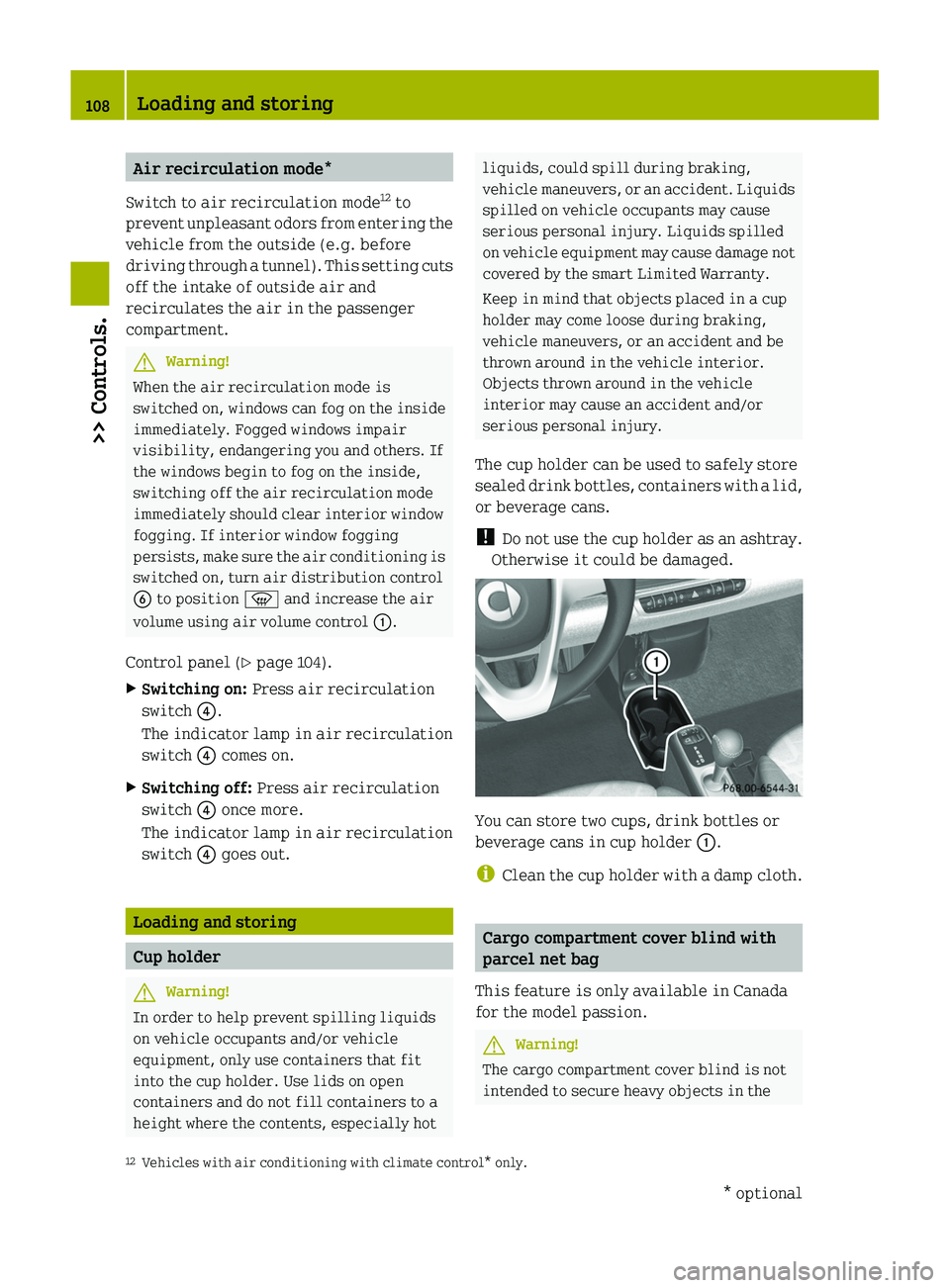
You can store two cups, drink bottles or
beverage cans in cup holder 0046.
i Clean the cup holder with a damp cloth.
Cargo compartment cover blind with
parcel net bag
This feature is only available in Canada
for the model passion.
GWarning!
The cargo compartment cover blind is not
intended to secure heavy objects in the
12 Vehicles with air conditioning with climate control* only.108Loading and storing>> Controls.* optionalBA 451 USA, CA Edition A 2011; 1; 4, en-UShereepeVersion: 3.0.3.62010-05-11T15:12:26+02:00 - Seite 108
Page 111 of 228
event of an accident. For this reason, heavy
objects must be tied down.
Vehicle occupants could be injured by
objects being thrown around in the vehicle
in the event of
Rhard braking
Ra change of direction
Ran accident
GWarning!
Do not place any objects on the mounted
cargo compartment cover blind.
Vehicle occupants could be injured by
objects being thrown around in the vehicle
in the event of
Rhard braking
Ra change of direction
Ran accident
GWarning!
Only place light loads in the parcel net
bag. Do not transport heavy, sharp-edged or
fragile objects in the parcel net bag. The
parcel net bag cannot sufficiently secure
loads in an accident.
Vehicle occupants could be injured by
objects being thrown around in the vehicle
in the event of
Rhard braking
Ra change of direction
Ran accident
Observe the loading guidelines.
The cargo compartment cover blind
Rserves to protect objects that are stored
in the vehicle’s cargo compartment from
prying eyes
Rprevents smaller objects from
penetrating into the passenger
compartment from the cargo
compartment; however, it is not intended
to act as a load restraining device
The parcel net bag
Ris for storing small, lightweight objects
Rprevents small objects from sliding
around inside the passenger
compartment
! If objects are placed on the cargo
compartment cover blind when mounted,
the cover may be damaged.
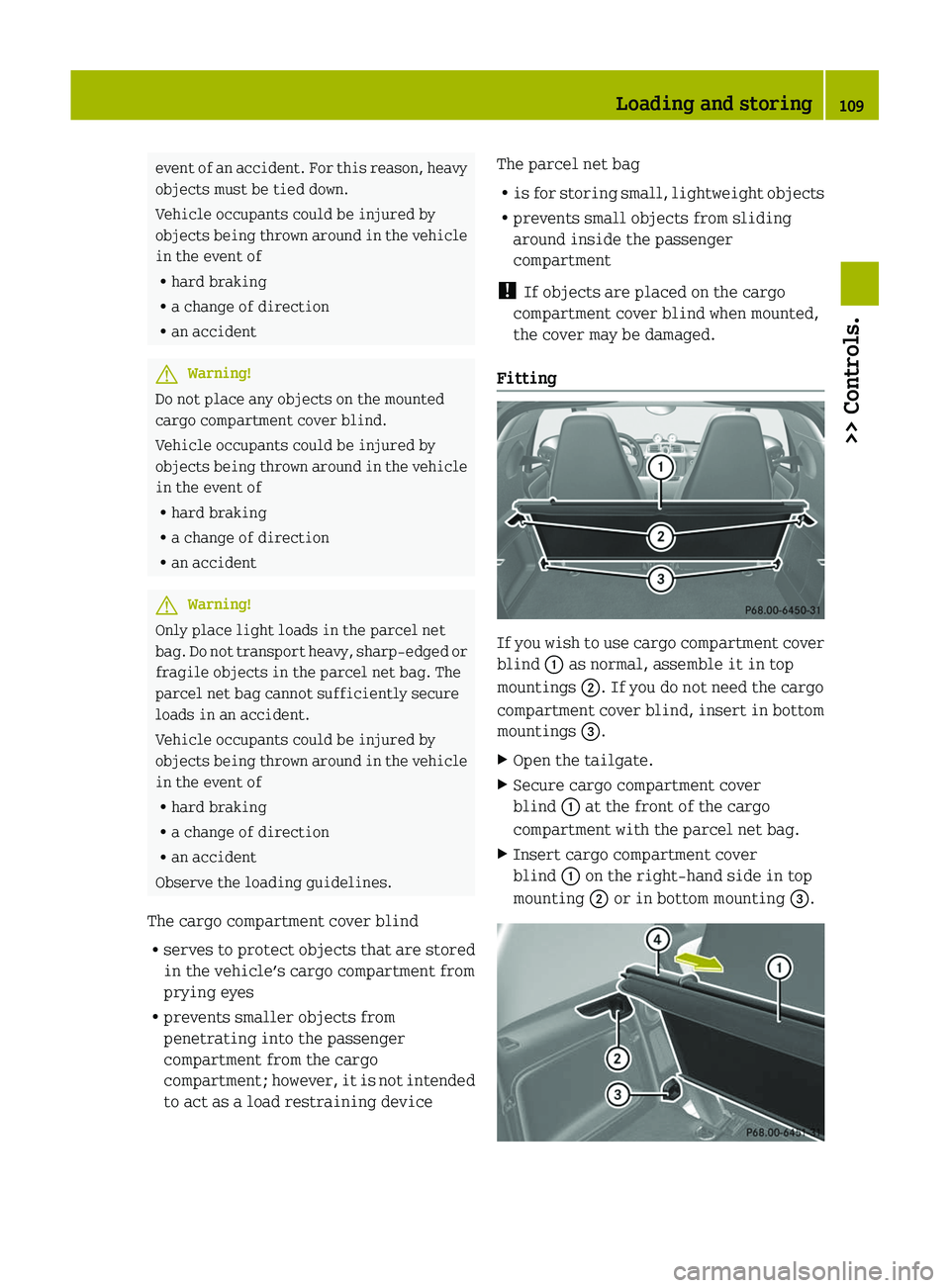
Fitting
If you wish to use cargo compartment cover
blind \000F as normal, assemble it in top
mountings \000G. If you do not need the cargo
compartment cover blind, insert in bottom
mountings \000
Page 115 of 228
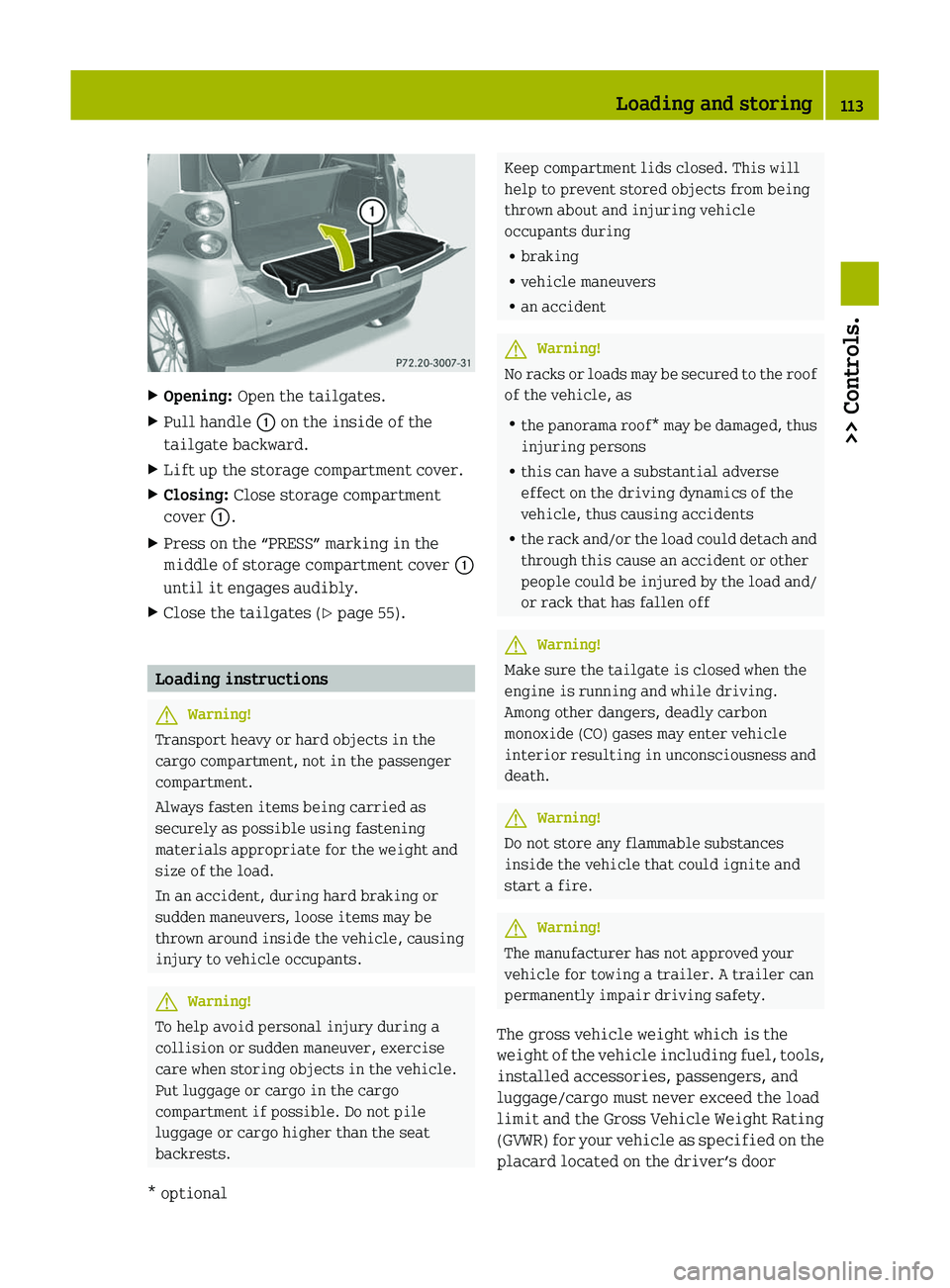
XOpening: Open the tailgates.XPull handle \000F on the inside of the
tailgate backward.
XLift up the storage compartment cover.XClosing: Close storage compartment
cover \000F.
XPress on the “PRESS” marking in the
middle of storage compartment cover \000F
until it engages audibly.
XClose the tailgates (Y page 55).
Loading instructions
GWarning!
Transport heavy or hard objects in the
cargo compartment, not in the passenger
compartment.
Always fasten items being carried as
securely as possible using fastening
materials appropriate for the weight and
size of the load.
In an accident, during hard braking or
sudden maneuvers, loose items may be
thrown around inside the vehicle, causing
injury to vehicle occupants.
GWarning!
To help avoid personal injury during a
collision or sudden maneuver, exercise
care when storing objects in the vehicle.
Put luggage or cargo in the cargo
compartment if possible. Do not pile
luggage or cargo higher than the seat
backrests.
Keep compartment lids closed. This will
help to prevent stored objects from being
thrown about and injuring vehicle
occupants during
Rbraking
Rvehicle maneuvers
Ran accident
GWarning!
No racks or loads may be secured to the roof
of the vehicle, as
Rthe panorama roof* may be damaged, thus
injuring persons
Rthis can have a substantial adverse
effect on the driving dynamics of the
vehicle, thus causing accidents
Rthe rack and/or the load could detach and
through this cause an accident or other
people could be injured by the load and/
or rack that has fallen off
GWarning!
Make sure the tailgate is closed when the
engine is running and while driving.
Among other dangers, deadly carbon
monoxide (CO) gases may enter vehicle
interior resulting in unconsciousness and
death.
GWarning!
Do not store any flammable substances
inside the vehicle that could ignite and
start a fire.
GWarning!
The manufacturer has not approved your
vehicle for towing a trailer. A trailer can
permanently impair driving safety.
The gross vehicle weight which is the
weight of the vehicle including fuel, tools,
installed accessories, passengers, and
luggage/cargo must never exceed the load
limit and the Gross Vehicle Weight Rating
(GVWR) for your vehicle as specified on the
placard located on the driver’s door
Loading and storing113>> Controls.* optionalBA 451 USA, CA Edition A 2011; 1; 4, en-UShereepeVersion: 3.0.3.62010-05-11T15:12:26+02:00 - Seite 113Z
Page 116 of 228
B‑pillar (Y page 214). In addition, the load
must be distributed in such a way so that
the weight on each axle never exceeds the
Gross Axle Weight Rating (GAWR) for the
front and rear axle. The GVWR and GAWR for
your vehicle are indicated on the
certification label which can be found on
the driver’s door B‑pillar.
For more information, see “Loading the
vehicle” (Y page 132).
The handling characteristics of a fully
loaded vehicle depend greatly on the load
distribution. It is therefore recommended
to load the vehicle with the heaviest items
being placed towards the front of the
vehicle.
Please pay attention to and comply with the
following instructions when loading the
vehicle and transporting cargo:
RAlways place items being carried
against seat backrests, and fasten them
as securely as possible.
RThe heaviest portion of the cargo should
always be kept as low as possible against
seat backrests.
RDo not stack loads higher than the top
edge of the head restraints.
RMake sure no luggage/cargo items can get
above or next to the driver’s and/or
passenger seat into the passenger
compartment.
RMake sure luggage/cargo is properly
secured.
RAlways use, if so equipped, cargo net*
when transporting cargo.
Useful features
Sun visors
The sun visors protect you from sun glare
while driving.
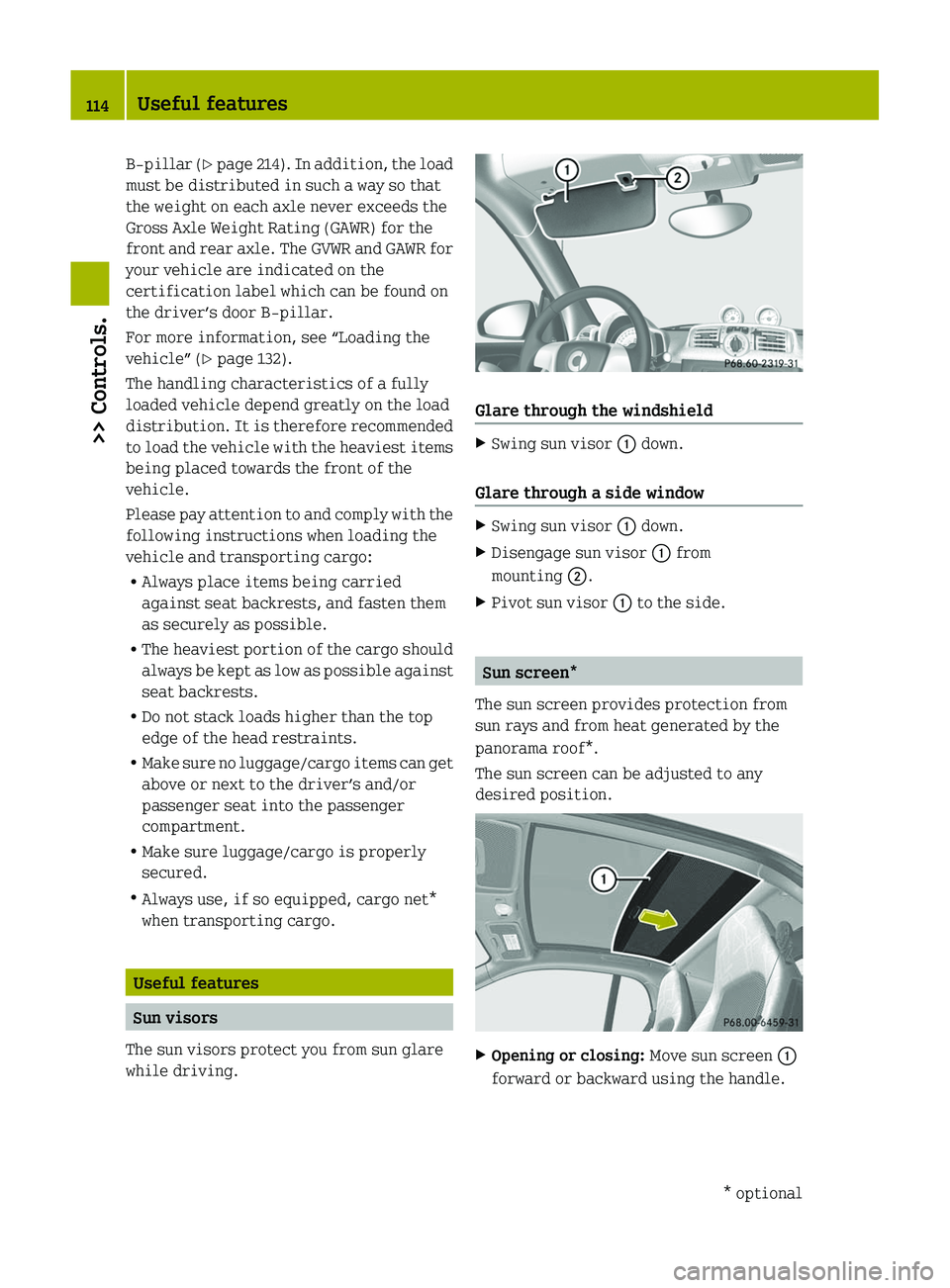
Glare through the windshield
XSwing sun visor \000F down.
Glare through a side window
XSwing sun visor \000F down.XDisengage sun visor \000F from
mounting \000G.
XPivot sun visor \000F to the side.
Sun screen*
The sun screen provides protection from
sun rays and from heat generated by the
panorama roof*.
The sun screen can be adjusted to any
desired position.
XOpening or closing: Move sun screen \000F
forward or backward using the handle.
114Useful features>> Controls.* optionalBA 451 USA, CA Edition A 2011; 1; 4, en-UShereepeVersion: 3.0.3.62010-05-11T15:12:26+02:00 - Seite 114
Page 154 of 228
the air intake, causing severe internal
engine damage.
Any such damage is not covered by the smart
Limited Warranty.
Passenger compartment
GWarning!
Always fasten items being carried as
securely as possible.
In an accident, during hard braking or
sudden maneuvers, loose items thrown
around inside the vehicle may injure
vehicle occupants.
The cargo compartment is the preferred
place to carry objects.
Control and operation of radio
transmitters
Radio and telephone
GWarning!
Please do not forget that your primary
responsibility is to drive the vehicle
safely. Only operate the radio or
telephone 16
if road, weather and traffic
conditions permit.
Bear in mind that at a speed of just 30 mph
(approximately 50 km/h), your vehicle is
covering a distance of 44 feet
(approximately 14 m) every second.
Telephones and two-way radios
GWarning!
Never operate radio transmitters equipped
with a built-in or attached antenna (i.e.
without being connected to an external
antenna) from inside the vehicle while the
engine is running. Doing so could lead to a
malfunction of the vehicle’s electronic
system, possibly resulting in an accident
and/or serious personal injury.
Radio transmitters, such as a mobile phone
or a citizens band unit should only be used
inside the vehicle if they are connected to
an antenna that is installed on the outside
of the vehicle.
Refer to the radio transmitter operation
instructions regarding use of an external
antenna.
Emission control
Certain engine systems serve to keep the
toxic components of the exhaust gases
within permissible legal limits.
These systems, of course, will function
properly only when maintained strictly
according to factory specifications.
Any adjustments to the engine should
therefore be carried out only by qualified
smart center authorized technicians.
Engine adjustments should not be altered
in any way. Moreover, the specified service
jobs must be carried out regularly
according to smart servicing
requirements. For details refer to the
Maintenance Booklet.
GWarning!
Inhalation of exhaust gas is hazardous to
your health. All exhaust gas contains
carbon monoxide (CO), and inhaling it can
cause unconsciousness and lead to death.
Do not run the engine in confined areas
(such as a garage) which are not properly
ventilated. If you think that exhaust gas
fumes are entering the vehicle while
driving, have the cause determined and
corrected immediately. If you must drive
under these conditions, drive only with at
least one window fully open at all times.
16 Observe all legal requirements.152Driving instructions>> Operation.
BA 451 USA, CA Edition A 2011; 1; 4, en-UShereepeVersion: 3.0.3.62010-05-11T15:12:26+02:00 - Seite 152