fuel pressure SMART FORTWO COUPE 2011 User Guide
[x] Cancel search | Manufacturer: SMART, Model Year: 2011, Model line: FORTWO COUPE, Model: SMART FORTWO COUPE 2011Pages: 228, PDF Size: 11.48 MB
Page 134 of 228
Always follow the recommended tire
inflation pressure ( Y page 127) for proper
tire inflation.
Loading the vehicle
Two labels on your vehicle show how much
weight it may properly carry.
1)The Tire and Loading Information
placard can be found on the driver’s
door B‑pillar. This placard tells you
important information about the
number of people that can be in the
vehicle and the total weight that can be
carried in the vehicle. It also contains
information on the proper size and
recommended tire inflation pressures
for the original equipment tires on
your vehicle.2)The certification label, also found on
the driver’s door B‑pillar, tells you
about the gross weight capacity of your
vehicle, called the Gross Vehicle
Weight Rating (GVWR). The GVWR
includes the weight of the vehicle, all
occupants, fuel and cargo. The
certification label also tells you about
the front and rear axle weight capacity,
called the Gross Axle Weight Rating
(GAWR). The GAWR is the total allowable
weight that can be carried by a single
axle (front or rear). Never exceed the
GVWR or GAWR for either the front axle
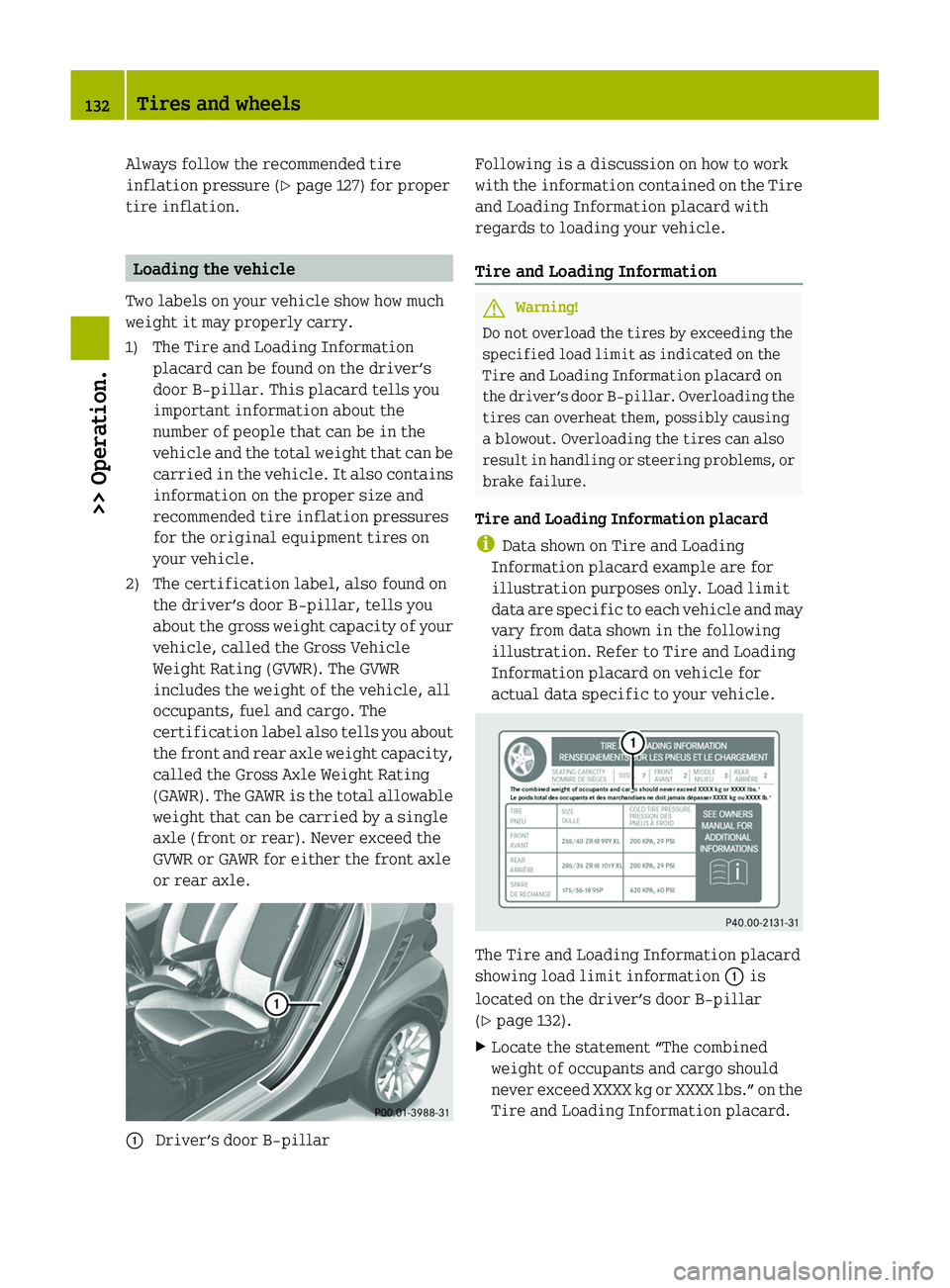
or rear axle.0046 Driver’s door B‑pillarFollowing is a discussion on how to work
with the information contained on the Tire
and Loading Information placard with
regards to loading your vehicle.
Tire and Loading InformationGWarning!
Do not overload the tires by exceeding the
specified load limit as indicated on the
Tire and Loading Information placard on
the driver’s door B‑pillar. Overloading the
tires can overheat them, possibly causing
a blowout. Overloading the tires can also
result in handling or steering problems, or
brake failure.
Tire and Loading Information placard
i Data shown on Tire and Loading
Information placard example are for
illustration purposes only. Load limit
data are specific to each vehicle and may
vary from data shown in the following
illustration. Refer to Tire and Loading
Information placard on vehicle for
actual data specific to your vehicle.
The Tire and Loading Information placard
showing load limit information 0046 is
located on the driver’s door B‑pillar
( Y page 132).
XLocate the statement “The combined
weight of occupants and cargo should
never exceed XXXX kg or XXXX lbs.” on the
Tire and Loading Information placard.132Tires and wheels>> Operation.
BA 451 USA, CA Edition A 2011; 1; 4, en-UShereepeVersion: 3.0.3.62010-05-11T15:12:26+02:00 - Seite 132
Page 138 of 228
Check the tire inflation pressure at least
once a month. For more information on
checking tire inflation pressure, see
“Recommended tire inflation pressure”
( Y page 127).
Tire inspection
Every time you check the tire inflation
pressure, you should also inspect your
tires for the following
R excessive treadwear ( Y page 136)
R cord or fabric showing through the tire’s
rubber
R bumps, bulges, cuts, cracks or splits in
the tread or side of the tire
Replace the tire if you find any of the above
conditions.
Life of tire
GWarning!
Tires should be replaced after 6 years,
regardless of the remaining tread.
The service life of a tire is dependent upon
varying factors including but not limited
to
R driving style
R tire inflation pressure
R distance driven
Tread depth
GWarning!
Although the applicable federal motor
vehicle safety laws consider a tire to be
worn when the treadwear indicators (TWI)
become visible at approximately 1
/ 16 in
(1.6 mm), we recommend that you do not allow
your tires to wear down to that level. As
tread depth approaches 1
/ 8 in (3 mm), the
adhesion properties on a wet road are
sharply reduced.
Depending upon the weather and/or road
surface (conditions), the tire traction
varies widely.
Do not allow your tires to wear down too far.
Adhesion properties on wet roads are
sharply reduced at tread depths of less
than 1
/ 8 in (3 mm).
Treadwear indicators (TWI) are required by
law. These indicators are located in six
places on the tread circumference and
become visible at a tread depth of
approximately 1
/ 16 in (1.6 mm), at which
point the tire is considered worn and
should be replaced.
Recommended minimum tire tread depth:
Summer tires 1
/ 8 in (3 mm)
Winter tires 1
/ 6 in (4 mm)
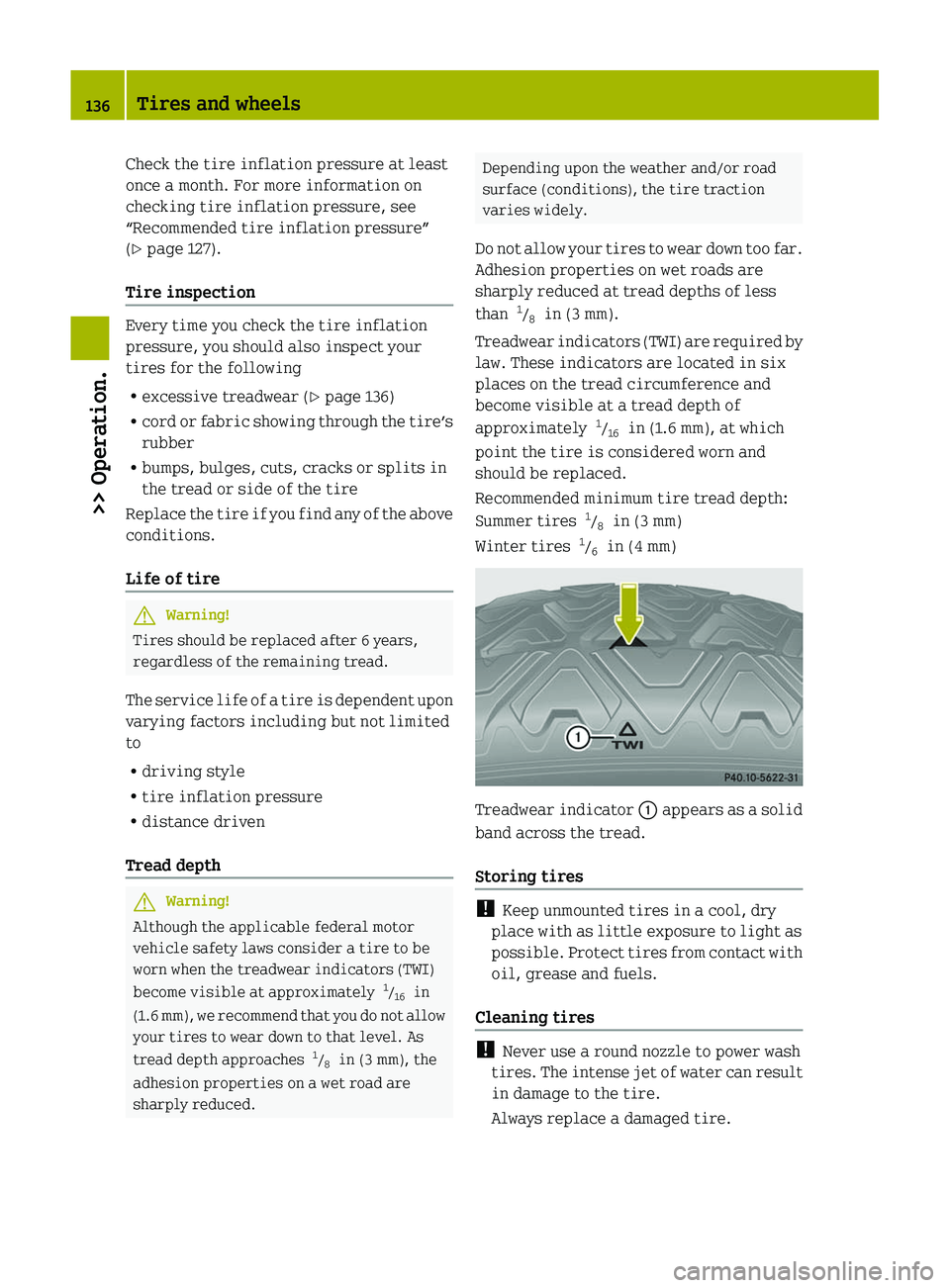
Treadwear indicator
0046 appears as a solid
band across the tread.
Storing tires
! Keep unmounted tires in a cool, dry
place with as little exposure to light as
possible. Protect tires from contact with
oil, grease and fuels.
Cleaning tires
! Never use a round nozzle to power wash
tires. The intense jet of water can result
in damage to the tire.
Always replace a damaged tire.
136Tires and wheels>> Operation.
BA 451 USA, CA Edition A 2011; 1; 4, en-UShereepeVersion: 3.0.3.62010-05-11T15:12:26+02:00 - Seite 136
Page 145 of 228
Bar
Another metric unit for air pressure. There
are 14.5038 pounds per square inch (psi) to
1 bar; there are 100 kilopascals (kPa) to
1 bar.
Bead
The tire bead contains steel wires wrapped
by steel cords that hold the tire onto the
rim.
Cold tire inflation pressure
Tire inflation pressure when your vehicle
has been sitting for at least 3 hours or
driven no more than 1 mile (1.6 km).
Curb weight
The weight of a motor vehicle with standard
equipment including the maximum
capacity of fuel, oil, and coolant, and, if
so equipped, air conditioning and
additional optional equipment, but
without passengers and cargo.
DOT (Department of Transportation)
A tire branding symbol which denotes the
tire meets requirements of the U.S.
Department of Transportation.
GAWR (Gross Axle Weight Rating)
The GAWR is the maximum permissible axle
weight. The gross vehicle weight on each
axle must never exceed the GAWR for the
front and rear axle indicated on the
certification label located on the driver’s
door B‑pillar.
GVW (Gross Vehicle Weight)
The GVW comprises the weight of the
vehicle including fuel, tools, installed
accessories, passengers and cargo. The
GVW must never exceed the GVWR indicated
on the certification label located on the
driver’s door B‑pillar.
GVWR (Gross Vehicle Weight Rating)
This is the maximum permissible vehicle
weight of the fully loaded vehicle (weight
of the vehicle including all options,
passengers, fuel, and cargo. It is indicated
on certification label located on the
driver’s door B‑pillar.
Kilopascal (kPa)
The metric unit for air pressure. There are
6.9 kPa to 1 psi; another metric unit for air
pressure is bars. There are
100 kilopascals (kPa) to 1 bar.
Maximum load rating
The maximum load in kilograms and pounds
that can be carried by the tire.
Maximum loaded vehicle weight
The sum of curb weight, accessory weight,
total load limit and production options
weight.
Maximum permissible tire inflation
pressure
This number is the greatest amount of air
pressure that should ever be put in the tire.
Normal occupant weight
The number of occupants the vehicle is
designed to seat, multiplied by
68 kilograms (150 lbs).
Occupant distribution
The distribution of occupants in a vehicle
at their designated seating positions.
Production options weight
The combined weight of those installed
regular production options weighing over
5 lbs (2.3 kilograms) in excess of those
standard items which they replace, not
previously considered in curb weight or
Tires and wheels143>> Operation.BA 451 USA, CA Edition A 2011; 1; 4, en-UShereepeVersion: 3.0.3.62010-05-11T15:12:26+02:00 - Seite 143Z
Page 150 of 228
parking. The heat generated serves to dry
the brakes.GWarning!
Make sure not to endanger any other road
users when carrying out these braking
maneuvers.
Limited braking effect on salted roads
Remember that the effect of the brakes can
be limited on salted road surfaces. A layer
of salt can form on brake discs and brake
pads, considerably reducing the friction
between the brake disc and the brake pad.
The effect is most noticeable after long
trips without braking, e.g. on the highway,
and after the vehicle has been parked for
several hours.
GWarning!
The accumulation of salt on brake discs and
brake pads reduces braking effectiveness
and increases the distance necessary to
come to a complete standstill. This could
potentially cause an accident and/or
personal injury.
To avoid this risk, you should
R brake carefully every now and then on
salted roads in order to remove any layer
of salt on the brake disc and brake pad,
but do so without endangering any other
road users
R keep a good safe distance from the
vehicle in front and drive carefully
R press the brake carefully at the end of the
trip and again when beginning the next
trip in order to remove any salt residues
from the brake disc
New brake pads
Only install brake pads recommended by
smart.
GWarning!
If other than recommended brake pads are
installed, or other than recommended brake
fluid is used, the braking properties of the
vehicle can be degraded to an extent that
safe braking is substantially impaired.
This could result in an accident.GWarning!
New brake pads will not achieve their
optimal braking effect until after several
hundred miles (kilometers). This means
that you must compensate for the reduced
braking effect by pressing harder on the
brake pedal and adapt your driving style
accordingly. The same applies after brake
pads or brake discs have been changed.
Drive sensibly - save fuel
Fuel consumption, to a great extent,
depends on driving habits and operating
conditions.
To save fuel you should:
R Shift gears in a timely manner.
R Avoid frequent acceleration and
deceleration.
R Keep tires at the recommended inflation
pressures.
R Remove carriers* when not in use.
R Remove unnecessary loads.
R Allow engine to warm up under low load
use.
R Have all maintenance work performed at
the intervals specified in the
Maintenance Booklet and as required by
the Maintenance System. Contact an
authorized smart center.
Fuel consumption is also increased by
driving in cold weather, in stop-and-go
traffic, on short trips, and in hilly areas.
Catalytic converter
Your smart is equipped with monolithic-
type catalytic converter, an important
element in conjunction with the oxygen
148Driving instructions>> Operation.* optionalBA 451 USA, CA Edition A 2011; 1; 4, en-UShereepeVersion: 3.0.3.62010-05-11T15:12:26+02:00 - Seite 148
Page 165 of 228
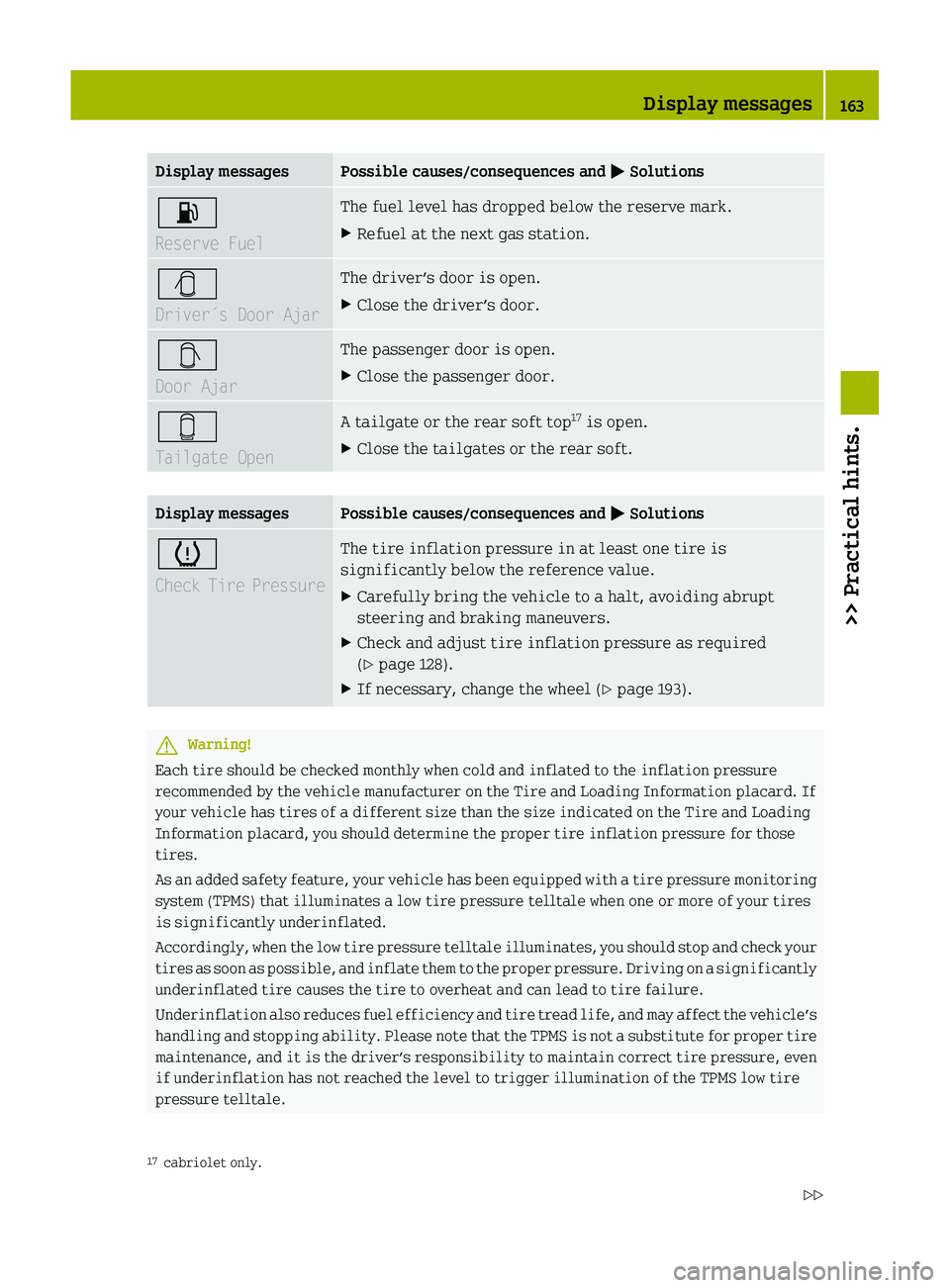
Display messagesPossible causes/consequences and 0050 Solutions00B6
Reserve FuelThe fuel level has dropped below the reserve mark.XRefuel at the next gas station.00DC
Driver´s Door AjarThe driver’s door is open.XClose the driver’s door.00DD
Door AjarThe passenger door is open.XClose the passenger door.00DB
Tailgate OpenA tailgate or the rear soft top 17
is open.XClose the tailgates or the rear soft.Display messagesPossible causes/consequences and 0050 Solutions0077
Check Tire PressureThe tire inflation pressure in at least one tire is
significantly below the reference value.XCarefully bring the vehicle to a halt, avoiding abrupt
steering and braking maneuvers.XCheck and adjust tire inflation pressure as required
( Y page 128).XIf necessary, change the wheel ( Y page 193).GWarning!
Each tire should be checked monthly when cold and inflated to the inflation pressure
recommended by the vehicle manufacturer on the Tire and Loading Information placard. If
your vehicle has tires of a different size than the size indicated on the Tire and Loading
Information placard, you should determine the proper tire inflation pressure for those
tires.
As an added safety feature, your vehicle has been equipped with a tire pressure monitoring
system (TPMS) that illuminates a low tire pressure telltale when one or more of your tires
is significantly underinflated.
Accordingly, when the low tire pressure telltale illuminates, you should stop and check your
tires as soon as possible, and inflate them to the proper pressure. Driving on a significantly
underinflated tire causes the tire to overheat and can lead to tire failure.
Underinflation also reduces fuel efficiency and tire tread life, and may affect the vehicle’s
handling and stopping ability. Please note that the TPMS is not a substitute for proper tire
maintenance, and it is the driver’s responsibility to maintain correct tire pressure, even
if underinflation has not reached the level to trigger illumination of the TPMS low tire
pressure telltale.
17 cabriolet only.Display messages163>> Practical hints.BA 451 USA, CA Edition A 2011; 1; 4, en-UShereepeVersion: 3.0.3.62010-05-11T15:12:26+02:00 - Seite 163Z
Page 176 of 228
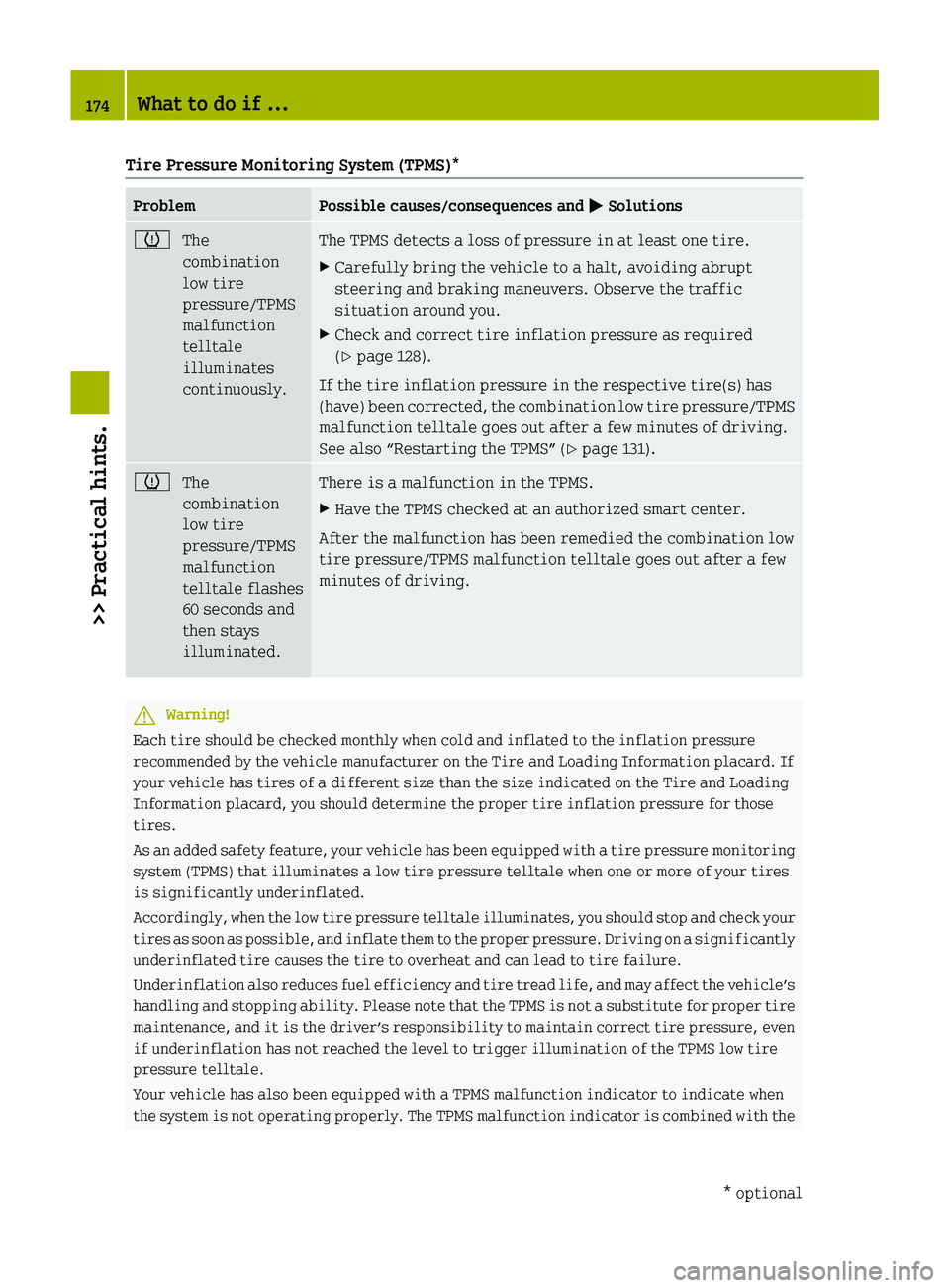
Tire Pressure Monitoring System (TPMS)* ProblemPossible causes/consequences and 0050 Solutions0077The
combination
low tire
pressure/TPMS
malfunction
telltale
illuminates
continuously.The TPMS detects a loss of pressure in at least one tire.XCarefully bring the vehicle to a halt, avoiding abrupt
steering and braking maneuvers. Observe the traffic
situation around you.XCheck and correct tire inflation pressure as required
( Y page 128).
If the tire inflation pressure in the respective tire(s) has
(have) been corrected, the combination low tire pressure/TPMS
malfunction telltale goes out after a few minutes of driving.
See also “Restarting the TPMS” ( Y page 131).
0077The
combination
low tire
pressure/TPMS
malfunction
telltale flashes
60 seconds and
then stays
illuminated.There is a malfunction in the TPMS.XHave the TPMS checked at an authorized smart center.
After the malfunction has been remedied the combination low
tire pressure/TPMS malfunction telltale goes out after a few
minutes of driving.
GWarning!
Each tire should be checked monthly when cold and inflated to the inflation pressure
recommended by the vehicle manufacturer on the Tire and Loading Information placard. If
your vehicle has tires of a different size than the size indicated on the Tire and Loading
Information placard, you should determine the proper tire inflation pressure for those
tires.
As an added safety feature, your vehicle has been equipped with a tire pressure monitoring
system (TPMS) that illuminates a low tire pressure telltale when one or more of your tires
is significantly underinflated.
Accordingly, when the low tire pressure telltale illuminates, you should stop and check your
tires as soon as possible, and inflate them to the proper pressure. Driving on a significantly
underinflated tire causes the tire to overheat and can lead to tire failure.
Underinflation also reduces fuel efficiency and tire tread life, and may affect the vehicle’s
handling and stopping ability. Please note that the TPMS is not a substitute for proper tire
maintenance, and it is the driver’s responsibility to maintain correct tire pressure, even
if underinflation has not reached the level to trigger illumination of the TPMS low tire
pressure telltale.
Your vehicle has also been equipped with a TPMS malfunction indicator to indicate when
the system is not operating properly. The TPMS malfunction indicator is combined with the
174What to do if ...>> Practical hints.* optionalBA 451 USA, CA Edition A 2011; 1; 4, en-UShereepeVersion: 3.0.3.62010-05-11T15:12:26+02:00 - Seite 174
Page 194 of 228
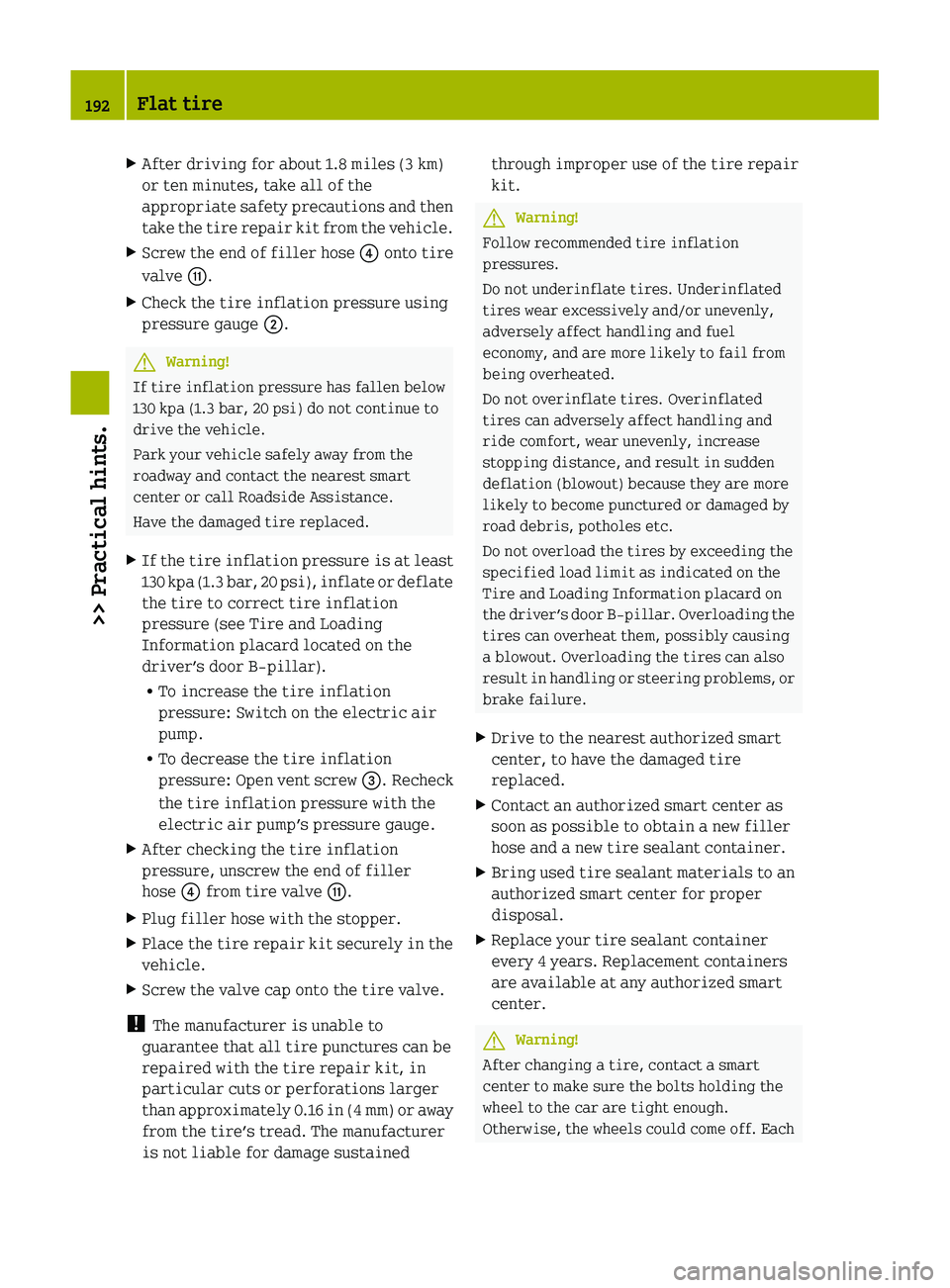
XAfter driving for about 1.8 miles (3 km)
or ten minutes, take all of the
appropriate safety precautions and then
take the tire repair kit from the vehicle.XScrew the end of filler hose 0088 onto tire
valve 0072.XCheck the tire inflation pressure using
pressure gauge 0047.GWarning!
If tire inflation pressure has fallen below
130 kpa (1.3 bar, 20 psi) do not continue to
drive the vehicle.
Park your vehicle safely away from the
roadway and contact the nearest smart
center or call Roadside Assistance.
Have the damaged tire replaced.
XIf the tire inflation pressure is at least
130 kpa (1.3 bar, 20 psi), inflate or deflate
the tire to correct tire inflation
pressure (see Tire and Loading
Information placard located on the
driver’s door B‑pillar).
R To increase the tire inflation
pressure: Switch on the electric air
pump.
R To decrease the tire inflation
pressure: Open vent screw 008A. Recheck
the tire inflation pressure with the
electric air pump’s pressure gauge.XAfter checking the tire inflation
pressure, unscrew the end of filler
hose 0088 from tire valve 0072.XPlug filler hose with the stopper.XPlace the tire repair kit securely in the
vehicle.XScrew the valve cap onto the tire valve.
! The manufacturer is unable to
guarantee that all tire punctures can be
repaired with the tire repair kit, in
particular cuts or perforations larger
than approximately 0.16 in (4 mm) or away
from the tire’s tread. The manufacturer
is not liable for damage sustained
through improper use of the tire repair
kit.GWarning!
Follow recommended tire inflation
pressures.
Do not underinflate tires. Underinflated
tires wear excessively and/or unevenly,
adversely affect handling and fuel
economy, and are more likely to fail from
being overheated.
Do not overinflate tires. Overinflated
tires can adversely affect handling and
ride comfort, wear unevenly, increase
stopping distance, and result in sudden
deflation (blowout) because they are more
likely to become punctured or damaged by
road debris, potholes etc.
Do not overload the tires by exceeding the
specified load limit as indicated on the
Tire and Loading Information placard on
the driver’s door B‑pillar. Overloading the
tires can overheat them, possibly causing
a blowout. Overloading the tires can also
result in handling or steering problems, or
brake failure.
XDrive to the nearest authorized smart
center, to have the damaged tire
replaced.XContact an authorized smart center as
soon as possible to obtain a new filler
hose and a new tire sealant container.XBring used tire sealant materials to an
authorized smart center for proper
disposal.XReplace your tire sealant container
every 4 years. Replacement containers
are available at any authorized smart
center.GWarning!
After changing a tire, contact a smart
center to make sure the bolts holding the
wheel to the car are tight enough.
Otherwise, the wheels could come off. Each
192Flat tire>> Practical hints.
BA 451 USA, CA Edition A 2011; 1; 4, en-UShereepeVersion: 3.0.3.62010-05-11T15:12:26+02:00 - Seite 192
Page 219 of 228
Rims and tires
Notes
! Only use tires which have been tested
and approved by smart. Tires approved by
smart are developed to provide best
possible performance in conjunction
with the driving safety systems on your
vehicle such as the ABS or the ESP ®
.
Using tires other than those approved by
smart may result in damage that is not
covered by the smart Limited Warranty.
! Using tires other than those approved
by smart can have detrimental effects,
such as
R poor handling characteristics
R increased noise
R increased fuel consumption
Moreover, tires and rims not approved by
smart may, under load, exhibit
dimensional variations and different
tire deformation characteristics that
could cause them to come into contact
with the vehicle body or axle parts.
Damage to the tires or the vehicle may be
the result.
i Further information on tires and rims
is available at any authorized smart
center. A placard with the recommended
tire inflation pressure is located on the
driver’s door B‑pillar.
The tire inflation pressure should be
checked regularly and should only be
adjusted on cold tires. Follow tire
manufacturer’s maintenance
recommendation included with vehicle.
Mobility
Your vehicle is equipped with a tire repair
kit ( Y page 188). In case of a flat tire, it
enables you to drive to the nearest
authorized smart center on the sealed tire.
If the tire is damaged too severely for the
tire sealant to provide a reliable tire
repair:XContact the nearest smart center.
or
XCall Roadside Assistance.Rims and tires217>> Technical data.BA 451 USA, CA Edition A 2011; 1; 4, en-UShereepeVersion: 3.0.3.62010-05-11T15:12:26+02:00 - Seite 217Z
Page 224 of 228
Fuel requirements
Only use premium unleaded fuel. The octane
number (posted at the pump) must be 91 min.
It is an average of both the Research Octane
N umber (RON) and the Motor Octane Number
(MON): (RON+MON)/2. This is also known as
the ANTI‑KNOCK INDEX.
Unleaded gasoline containing oxygenates
such as ethanol, IPA, IBA and TBA can be
used provided the ratio of any one of these
oxygenates to gasoline does not exceed
10%; MTBE must not exceed 15%.
The ratio of methanol to gasoline must not
exceed 3% plus additional cosolvents.
Using mixtures of ethanol and methanol is
not allowed. Gasohol, which contains 10%
ethanol and 90% unleaded gasoline, can be
used.
These blends must also meet all other fuel
requirements, such as resistance to spark
knock, boiling range, vapor pressure, etc.
Gasoline additives
A major concern among engine
manufacturers is carbon build-up caused
by gasoline. smart recommends only the use
of quality gasoline containing additives
that prevent the build-up of carbon
deposits.
After an extended period of using fuels
without such additives carbon deposits can
build up, especially on the intake valves
and in the combustion area, leading to
engine performance problems such as:
R Warm-up hesitation
R Unstable idle
R Knocking/pinging
R Misfire
R Power loss
In areas where carbon deposits may be
encountered due to lack of availability of
gasolines which contain these additives,
the use of smart approved additives is
recommended. Contact an authorized smart
center for a listing of approved products.
Follow directions on the product label.
Do not blend other fuel additives with fuel.
This only results in unnecessary costs and
may be harmful to the engine operation.
! Damage or malfunction resulting from
poor fuel quality or from blending
additional fuel additives other than
those tested and approved by us for use
on smart vehicles are not covered by the
smart Limited Warranty.
Windshield/rear window washer system
During all seasons:
XUse a windshield washer concentrate
labeled for summer and water for
temperatures above freezing point.XUse a windshield washer concentrate
labeled for winter and water for
temperatures below freezing point.XPremix the windshield washer fluid in a
suitable container depending on the
outside temperature and in accordance
with the manufacturer’s instructions 28
.
Washer fluid mixing ratio
R Temperature above 32 ¦ (0¥ ):
1 part windshield washer concentrate
labeled for summer to 100 parts water
R Temperature of 14 ¦ (-10 ¥):
1 part windshield washer concentrate
labeled for winter to 2 parts water
R Temperature of -4 ¦ (-20 ¥):
1 part windshield washer concentrate
labeled for winter to 1 part water
GWarning!
Windshield washer concentrate is highly
flammable. Fire, naked flames and smoking
28 Refer to the notes for use on the container.222Service fluids and capacities>> Technical data.
BA 451 USA, CA Edition A 2011; 1; 4, en-UShereepeVersion: 3.0.3.62010-05-11T15:12:26+02:00 - Seite 222