key battery SMART FORTWO COUPE 2011 User Guide
[x] Cancel search | Manufacturer: SMART, Model Year: 2011, Model line: FORTWO COUPE, Model: SMART FORTWO COUPE 2011Pages: 228, PDF Size: 11.48 MB
Page 181 of 228
Replacing transmitter battery
Notes
The remote control’s transmitter battery is
almost spent when the turn signals flash
rapidly nine times in a row when locking
the vehicle.
iIf you do not replace the transmitter
battery, after about 100 more times you
will no longer be able to lock or unlock
the vehicle using the remote control.
XReplace the transmitter battery.
or
XHave the transmitter battery replaced at
an smart center.
GWarning!
Batteries contain poisonous and corrosive
substances. Therefore keep the batteries
out of reach of children.
If a battery is swallowed, seek medical help
immediately.
Batteries contain materials that can harm
the environment if disposed of improperly.
Recycling of batteries is the preferred
method of disposal. Many states/provinces
require sellers of batteries to accept old
batteries for recycling.
Replacing battery
Replacement battery: CR 2016 button cell
! Replace the remote control’s
transmitter battery every two years at
the latest. Otherwise there is a danger of
leakage. The remote control could be
damaged.
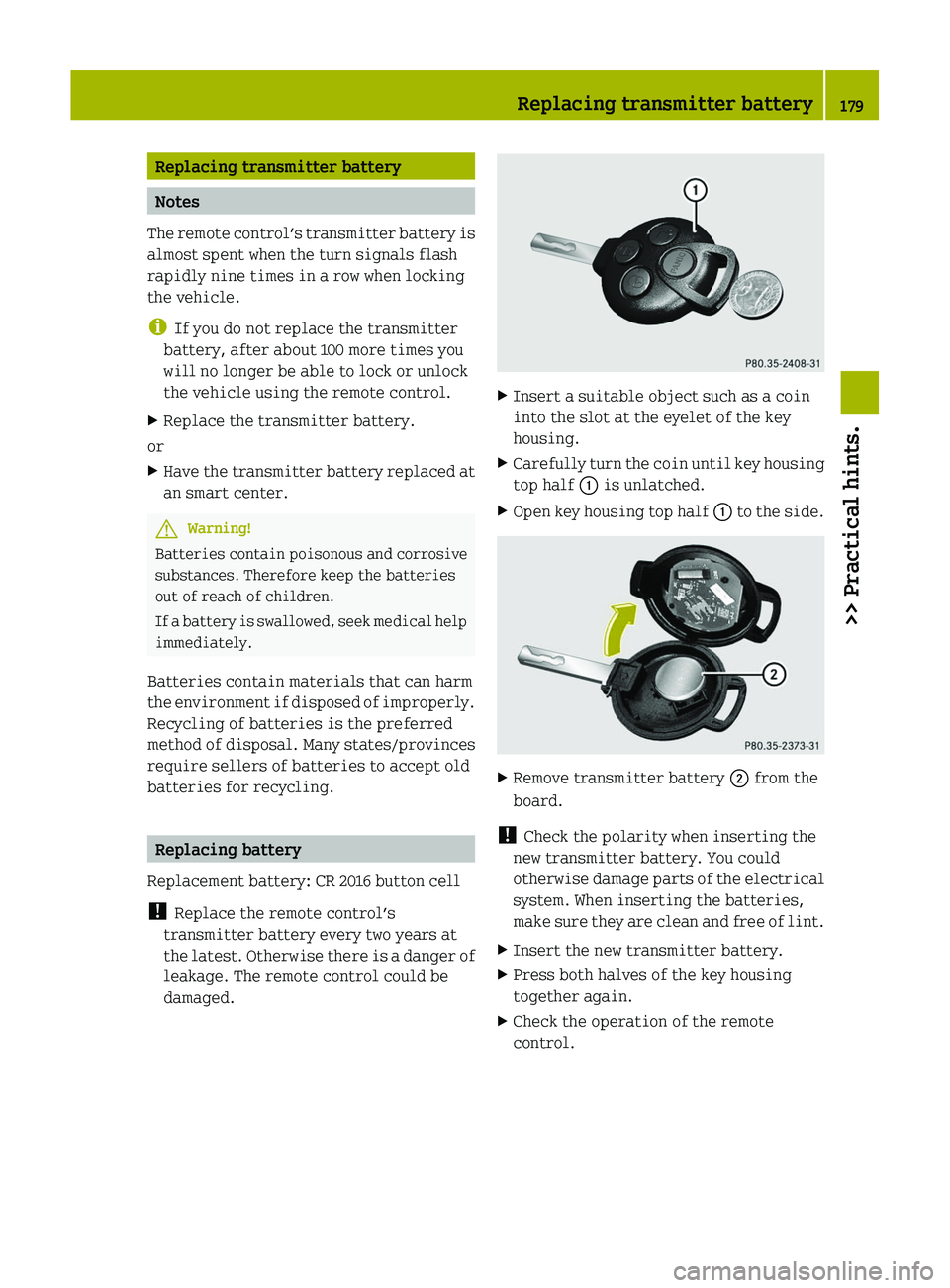
XInsert a suitable object such as a coin
into the slot at the eyelet of the key
housing.
XCarefully turn the coin until key housing
top half \000F is unlatched.
XOpen key housing top half \000F to the side.XRemove transmitter battery \000G from the
board.
! Check the polarity when inserting the
new transmitter battery. You could
otherwise damage parts of the electrical
system. When inserting the batteries,
make sure they are clean and free of lint.
XInsert the new transmitter battery.XPress both halves of the key housing
together again.
XCheck the operation of the remote
control.
Replacing transmitter battery179>> Practical hints.BA 451 USA, CA Edition A 2011; 1; 4, en-UShereepeVersion: 3.0.3.62010-05-11T15:12:26+02:00 - Seite 179Z
Page 198 of 228
authorized smart center about steps you
need to observe.
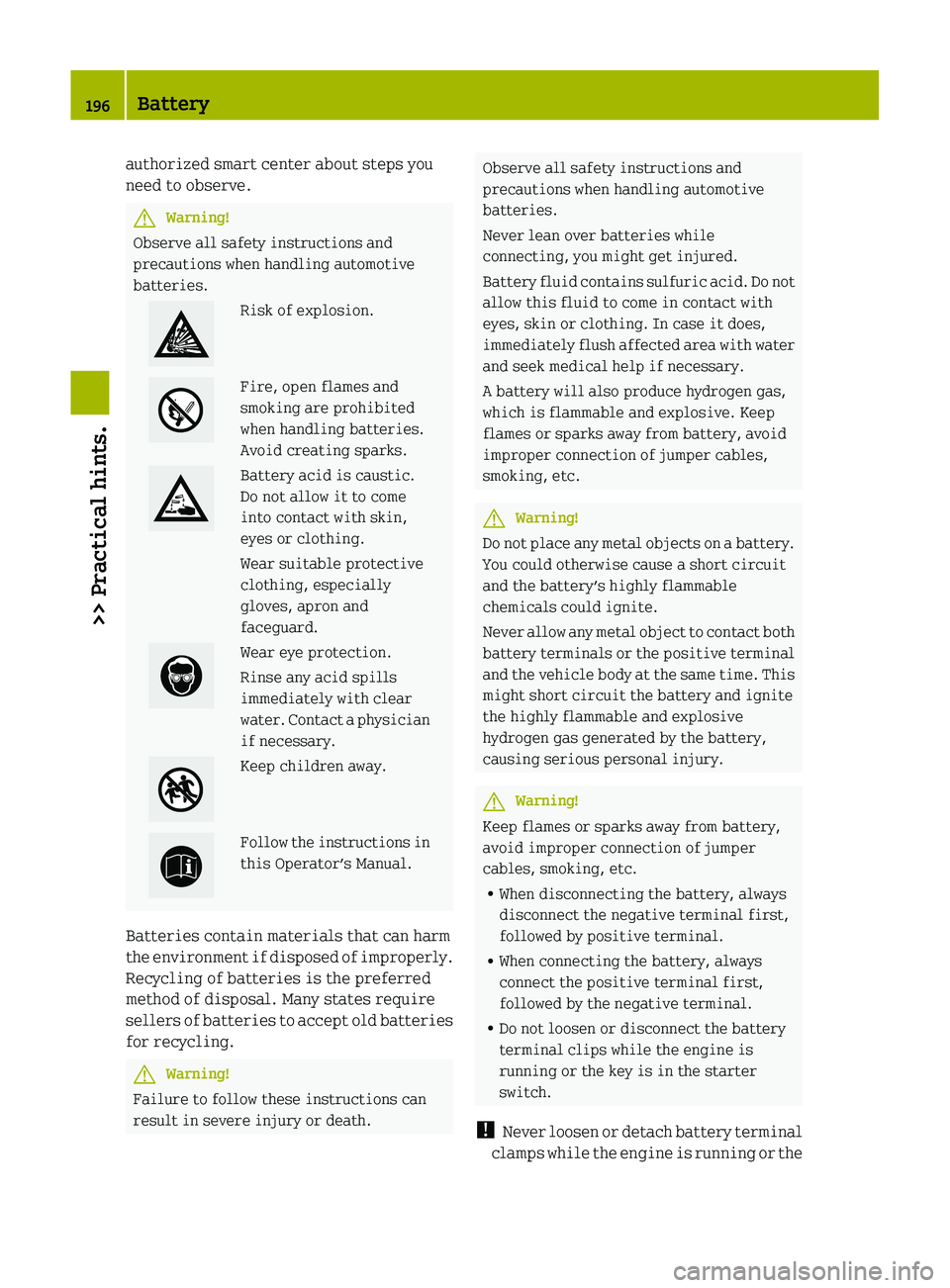
GWarning!
Observe all safety instructions and
precautions when handling automotive
batteries.
Risk of explosion.Fire, open flames and
smoking are prohibited
when handling batteries.
Avoid creating sparks.
Battery acid is caustic.
Do not allow it to come
into contact with skin,
eyes or clothing.
Wear suitable protective
clothing, especially
gloves, apron and
faceguard.
Wear eye protection.
Rinse any acid spills
immediately with clear
water. Contact a physician
if necessary.
Keep children away.Follow the instructions in
this Operator’s Manual.
Batteries contain materials that can harm
the environment if disposed of improperly.
Recycling of batteries is the preferred
method of disposal. Many states require
sellers of batteries to accept old batteries
for recycling.
GWarning!
Failure to follow these instructions can
result in severe injury or death.
Observe all safety instructions and
precautions when handling automotive
batteries.
Never lean over batteries while
connecting, you might get injured.
Battery fluid contains sulfuric acid. Do not
allow this fluid to come in contact with
eyes, skin or clothing. In case it does,
immediately flush affected area with water
and seek medical help if necessary.
A battery will also produce hydrogen gas,
which is flammable and explosive. Keep
flames or sparks away from battery, avoid
improper connection of jumper cables,
smoking, etc.
GWarning!
Do not place any metal objects on a battery.
You could otherwise cause a short circuit
and the battery’s highly flammable
chemicals could ignite.
Never allow any metal object to contact both
battery terminals or the positive terminal
and the vehicle body at the same time. This
might short circuit the battery and ignite
the highly flammable and explosive
hydrogen gas generated by the battery,
causing serious personal injury.
GWarning!
Keep flames or sparks away from battery,
avoid improper connection of jumper
cables, smoking, etc.
RWhen disconnecting the battery, always
disconnect the negative terminal first,
followed by positive terminal.
RWhen connecting the battery, always
connect the positive terminal first,
followed by the negative terminal.
RDo not loosen or disconnect the battery
terminal clips while the engine is
running or the key is in the starter
switch.
! Never loosen or detach battery terminal
clamps while the engine is running or the
196Battery>> Practical hints.
BA 451 USA, CA Edition A 2011; 1; 4, en-UShereepeVersion: 3.0.3.62010-05-11T15:12:26+02:00 - Seite 196
Page 199 of 228
key is in the starter switch. Otherwise
the alternator and other electronic
components could be severely damaged.
Have the battery checked regularly at an
authorized smart center.
Refer to Maintenance Booklet for
maintenance intervals or contact an
authorized smart center for further
information.
! Never invert the terminal connections!
Disconnecting, removing, charging,
reinstalling and reconnecting the
battery
Disconnecting the battery
iIf the battery is disconnected or
discharged
Rthe key will not turn in the starter
switch
Rthe automatic transmission will
remain in park position P
For more information see “Jump
starting” (Y page 198).
XEngage the parking brake.XMove the gear selector lever to park
position P.
XTurn off all electrical accessories.XTurn off the engine.XOpen the passenger door.XMove the passenger seat to the rear as far
as possible.
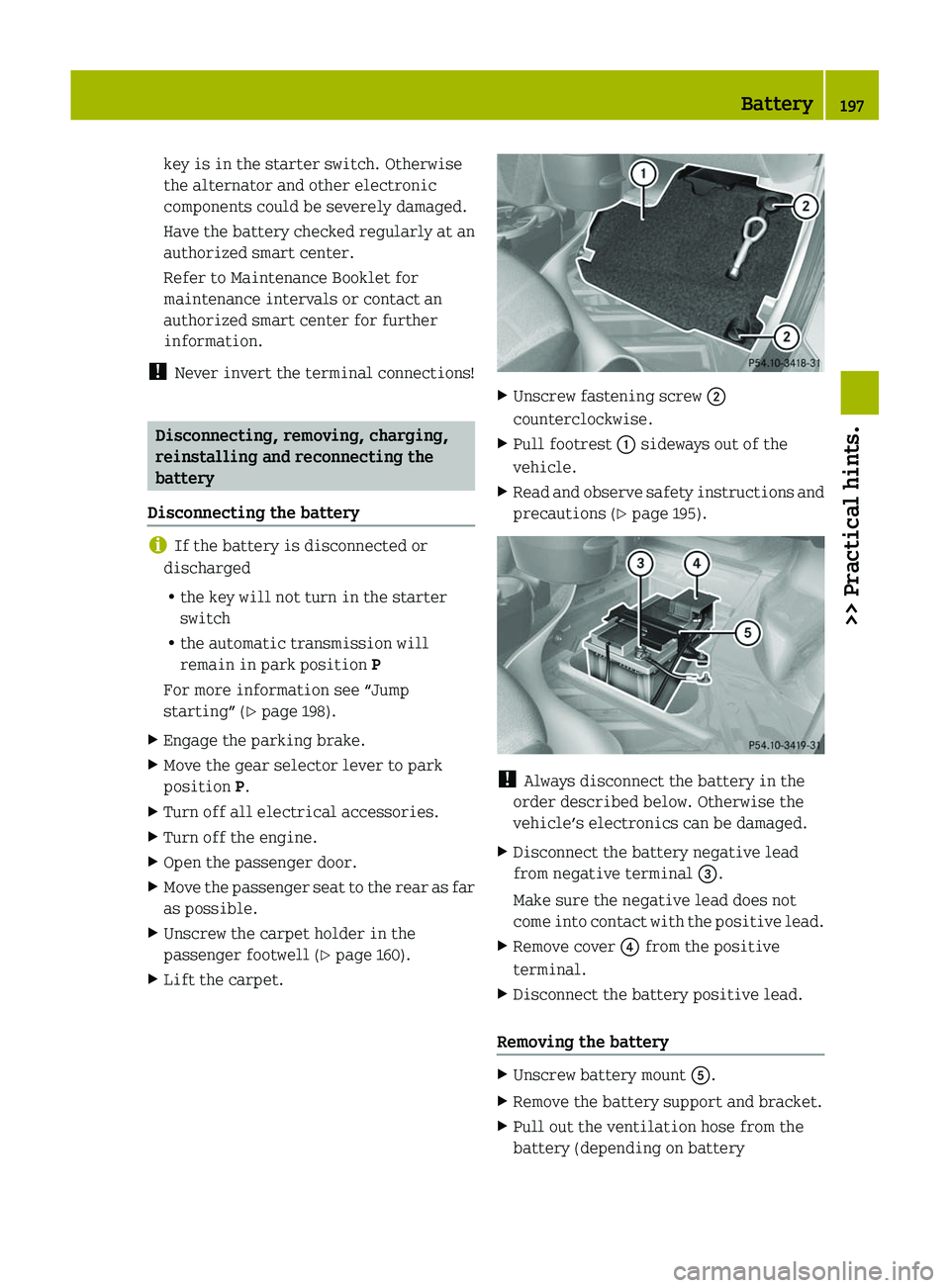
XUnscrew the carpet holder in the
passenger footwell (Y page 160).
XLift the carpet.XUnscrew fastening screw \000G
counterclockwise.
XPull footrest \000F sideways out of the
vehicle.
XRead and observe safety instructions and
precautions (Y page 195).
! Always disconnect the battery in the
order described below. Otherwise the
vehicle’s electronics can be damaged.
XDisconnect the battery negative lead
from negative terminal \000
Page 200 of 228
arrangement in your vehicle model, the
ventilation hose is located either on the
left or right side of the battery).XRemove the battery.
Charging the battery
GWarning!
Avoid creating sparks when charging the
battery as escaping gases are flammable.
Keep open flames away from the battery and
do not smoke.
Do not touch the battery terminal with metal
objects and do not remove the battery
charger’s terminal clamps until the battery
charger has been switched off and no
further gas is being discharged by the
batteries.
Only charge the battery in a well ventilated
area.
There is a risk of acid burns during the
charging procedure due to the gases which
escape from the battery. Do not lean over
the battery when it is being charged.
GWarning!
Never charge a battery while still installed
in the vehicle. Gases may escape during
charging and cause explosions that may
result in paint damage, corrosion or
personal injury.
XCharge battery in accordance with the
instructions of the battery charger
manufacturer.
! Only use chargers of a correct and
suitable voltage.
! Never attempt to recharge a frozen
battery. Have the battery checked at a
smart center. The battery housing could
be damaged.
Reinstalling the batteryXReinstall the charged battery. Follow the
previously described steps in reverse
order.
! The battery, its filler caps and the
ventilation hose must always be securely
installed when the vehicle is in
operation.
Reconnecting the battery
! Always connect the battery in the order
described below. Otherwise the
vehicle’s electronics can be damaged.
XTurn off all electrical accessories.XRemove the key from the starter switch.
! Never invert the terminal connections!
XConnect the battery positive lead and
fasten cover 0088 (Y page 197).XConnect battery negative lead 008A
( Y page 197).
i
After battery power (e.g. due to
reconnection) was interrupted, you will
have to set the clock ( Y page 89).
i Have the battery’s charge status and
acid level checked at the start of the cold
season at a smart center.
Jump starting
Notes
GWarning!
Failure to follow these directions will
cause damage to the electronic components,
and can lead to a battery explosion and
severe injury or death.
Never lean over batteries while connecting
or jump starting, you might get injured.
Battery fluid contains sulfuric acid. Do not
allow this fluid to come in contact with
eyes, skin or clothing. In case it does,
198Jump starting>> Practical hints.
BA 451 USA, CA Edition A 2011; 1; 4, en-UShereepeVersion: 3.0.3.62010-05-11T15:12:26+02:00 - Seite 198
Page 205 of 228
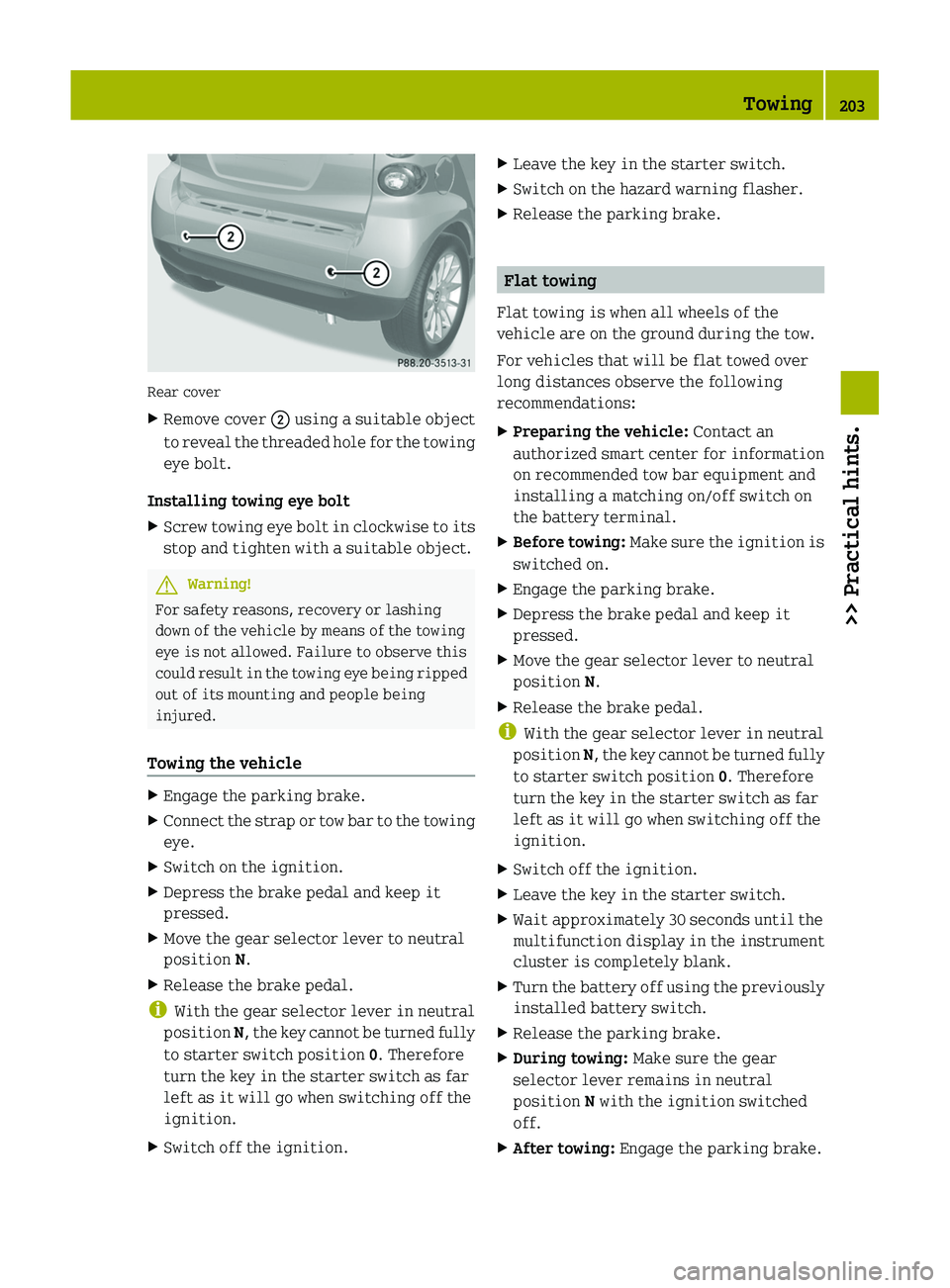
Rear cover
XRemove cover \000G using a suitable object
to reveal the threaded hole for the towing
eye bolt.
Installing towing eye bolt
XScrew towing eye bolt in clockwise to its
stop and tighten with a suitable object.
GWarning!
For safety reasons, recovery or lashing
down of the vehicle by means of the towing
eye is not allowed. Failure to observe this
could result in the towing eye being ripped
out of its mounting and people being
injured.
Towing the vehicle
XEngage the parking brake.XConnect the strap or tow bar to the towing
eye.
XSwitch on the ignition.XDepress the brake pedal and keep it
pressed.
XMove the gear selector lever to neutral
position N.
XRelease the brake pedal.
iWith the gear selector lever in neutral
position N, the key cannot be turned fully
to starter switch position 0. Therefore
turn the key in the starter switch as far
left as it will go when switching off the
ignition.
XSwitch off the ignition.XLeave the key in the starter switch.XSwitch on the hazard warning flasher.XRelease the parking brake.
Flat towing
Flat towing is when all wheels of the
vehicle are on the ground during the tow.
For vehicles that will be flat towed over
long distances observe the following
recommendations:
XPreparing the vehicle: Contact an
authorized smart center for information
on recommended tow bar equipment and
installing a matching on/off switch on
the battery terminal.
XBefore towing: Make sure the ignition is
switched on.
XEngage the parking brake.XDepress the brake pedal and keep it
pressed.
XMove the gear selector lever to neutral
position N.
XRelease the brake pedal.
iWith the gear selector lever in neutral
position N, the key cannot be turned fully
to starter switch position 0. Therefore
turn the key in the starter switch as far
left as it will go when switching off the
ignition.
XSwitch off the ignition.XLeave the key in the starter switch.XWait approximately 30 seconds until the
multifunction display in the instrument
cluster is completely blank.
XTurn the battery off using the previously
installed battery switch.
XRelease the parking brake.XDuring towing: Make sure the gear
selector lever remains in neutral
position N with the ignition switched
off.
XAfter towing: Engage the parking brake.Towing203>> Practical hints.BA 451 USA, CA Edition A 2011; 1; 4, en-UShereepeVersion: 3.0.3.62010-05-11T15:12:26+02:00 - Seite 203Z
Page 206 of 228
XTurn the battery on using the previously
installed battery switch.
XMove the gear selector lever to park
position P.
XRemove the key from the starter switch.XLock the doors.
! Do not flat tow the vehicle with the front
axle raised. Doing so may cause serious
damage to the brake system which is not
covered by the smart Limited Warranty.
! Failure to follow the recommendations
for flat towing can cause damage to your
vehicle:
RNot following the battery disconnect
procedure in the proper sequence may
result in data loss in the vehicle’s
control units.
RNot disconnecting the battery and
leaving the key in starter switch
position 1 (ignition on) may result in
-the vehicle locking. The vehicle will
lock if the wheels are turning at
vehicle speeds of approximately
8 mph (14 km/h) or more.
-the ESP® being activated. Active
braking action through the ESP® may
seriously damage the brake system
which is not covered by the smart
Limited Warranty.
RNot moving the gear selector lever to
neutral position N may result in
significant transmission damage.
Rin a discharged battery.
Fuses
The electrical fuses in your vehicle serve
to switch off malfunctioning power
circuits.
If a fuse is blown, the components and
systems secured by that fuse will stop
operating.
GWarning!
Only use fuses approved by smart with the
specified amperage for the system in
question and do not attempt to repair or
bridge a blown fuse this may cause an
overload leading to a fire, and/or cause
damage to electrical components and/or
systems. Contact a smart center if you
encounter any electrical problems.
! A blown fuse must be replaced by an
appropriate spare fuse (recognizable by
its color or the fuse rating given on the
fuse) of the amperage recommended in
the fuse chart. Any smart center will be
glad to advise you on this subject.
If a newly inserted fuse blows again, have
the cause determined and rectified at an
authorized smart center.
Before replacing fuses:
REngage the parking brake.
RMake sure the gear selector lever is in
park position P.
RTurn off all electrical accessories.
RTurn off the engine.
RRemove the key from the starter switch.
Replacing a fuse
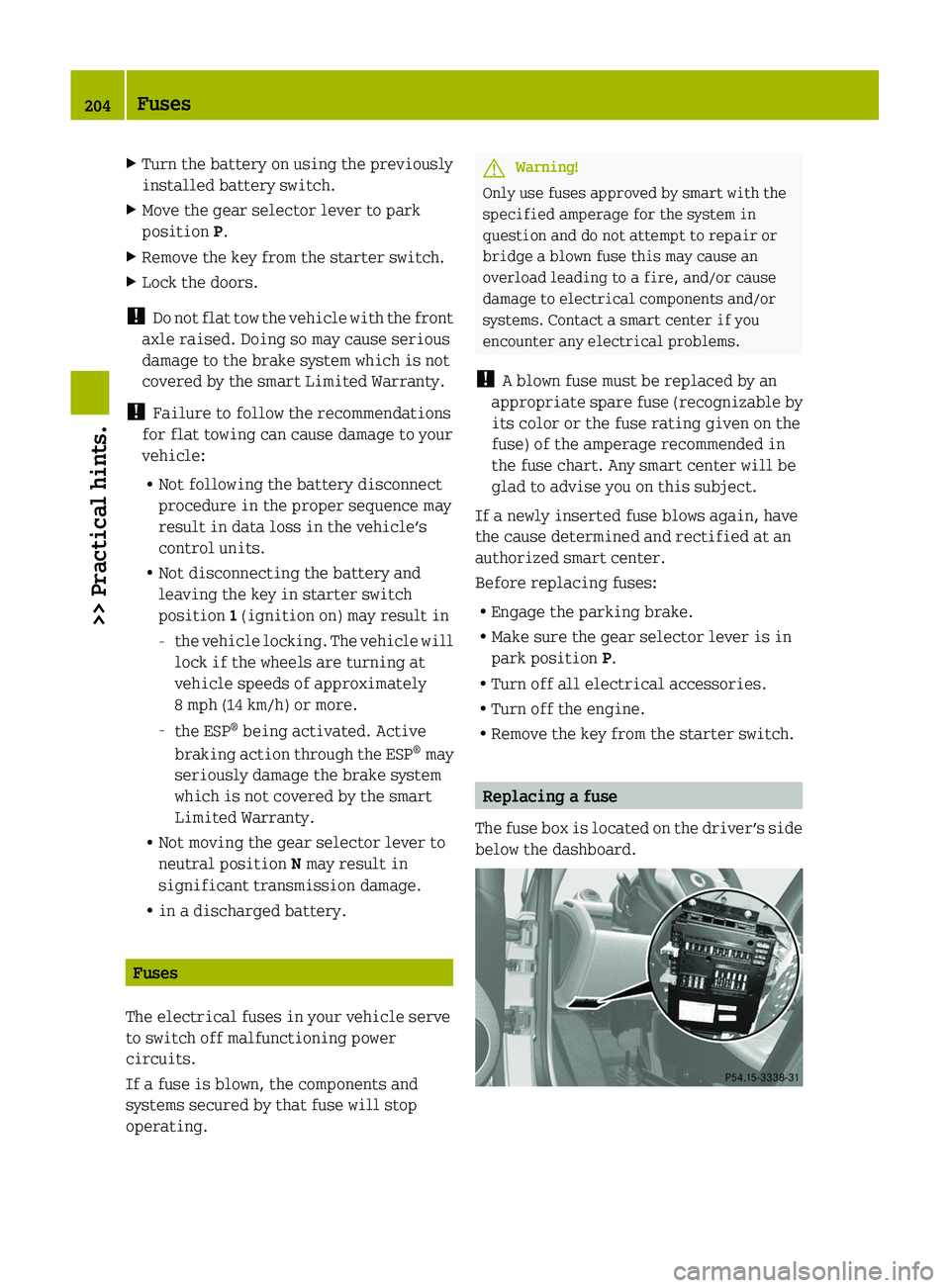
The fuse box is located on the driver’s side
below the dashboard.
204Fuses>> Practical hints.
BA 451 USA, CA Edition A 2011; 1; 4, en-UShereepeVersion: 3.0.3.62010-05-11T15:12:26+02:00 - Seite 204