belt SMART FORTWO COUPE 2011 Owner's Manual
[x] Cancel search | Manufacturer: SMART, Model Year: 2011, Model line: FORTWO COUPE, Model: SMART FORTWO COUPE 2011Pages: 228, PDF Size: 11.48 MB
Page 60 of 228

005DFor removing key004AIgnition (power supply for all
electrical consumers) and driving
position
All lamps (except low‑beam
headlamp indicator lamp,
high‑beam headlamp indicator
lamp, and turn signal indicator
lamps unless activated) in the
instrument cluster come on. If a
lamp in the instrument cluster fails
to come on when the ignition is
switched on, have it checked and
replaced if necessary. If a lamp in
the instrument cluster remains on
after starting the engine or comes
on while driving, refer to “Warning
and indicator lamps in the
instrument cluster” ( Y page 164).004BStarting ( Y page 78)
i
When you switch on the ignition, the
indicator and warning lamps (except
low‑beam headlamp indicator lamp,
high‑beam headlamp indicator lamp, and
turn signal indicator lamps unless
activated) in the instrument cluster
come on. The indicator and warning
lamps (except low‑beam headlamp
indicator lamp, high‑beam headlamp
indicator lamp, and turn signal
indicator lamps if activated) will go out
when the engine is running. This
indicates that the respective systems
are operational.
Seats
Safety notes
GWarning!
All seat adjustments, as well as fastening
of seat belts, must be done before the
vehicle is operated.
GWarning!
When adjusting the seat, make sure no one
becomes trapped.
Do not adjust the driver’s seat while
driving. Adjusting the seat while driving
could cause the driver to lose control of the
vehicle.
Never ride in a moving vehicle with the seat
backrest in an excessively reclined
position as this can be dangerous. You
could slide under the seat belt in a
collision. If you slide under the seat belt,
it could apply force at the abdomen or neck,
potentially causing serious or fatal
injuries. The seat backrest and seat belts
provide the best restraint when the wearer
is in a position that is as upright as
possible and seat belts are properly
positioned on the body.
Your seat must be adjusted so that you can
correctly fasten your seat belt.
Observe the following points:
R Adjust the seat backrest until your arms
are slightly angled when holding the
steering wheel.
R Adjust the seat to a comfortable seating
position that still allows you to reach the
accelerator/brake pedal safely. The
position should be as far back as
possible with the driver still able to
operate the controls properly.
R Never place hands under the seat or near
any moving parts while a seat is being
adjusted.
Failure to do so could result in an accident
and/or serious personal injury.
Observe the notes on the air bag system.
GWarning!
Children 12 years old and under must be
seated and properly secured in an
appropriately sized infant restraint,
toddler restraint, or booster seat
recommended for the size and weight of the
58Seats>> Controls.
BA 451 USA, CA Edition A 2011; 1; 4, en-UShereepeVersion: 3.0.3.62010-05-11T15:12:26+02:00 - Seite 58
Page 61 of 228
child. For additional information, see
“Children in the vehicle”.
A child’s risk of serious or fatal injuries
is significantly increased if the child
restraints are not properly secured in the
vehicle and/or the child is not properly
secured in the child restraint.
GWarning!
Contact an authorized smart center if the
seats have become damaged.
The seat is an integral part of the vehicle’s
safety system in the same way as seat belts
and air bags. Damage to the seats may
reduce their ability to protect the
occupants in an accident.
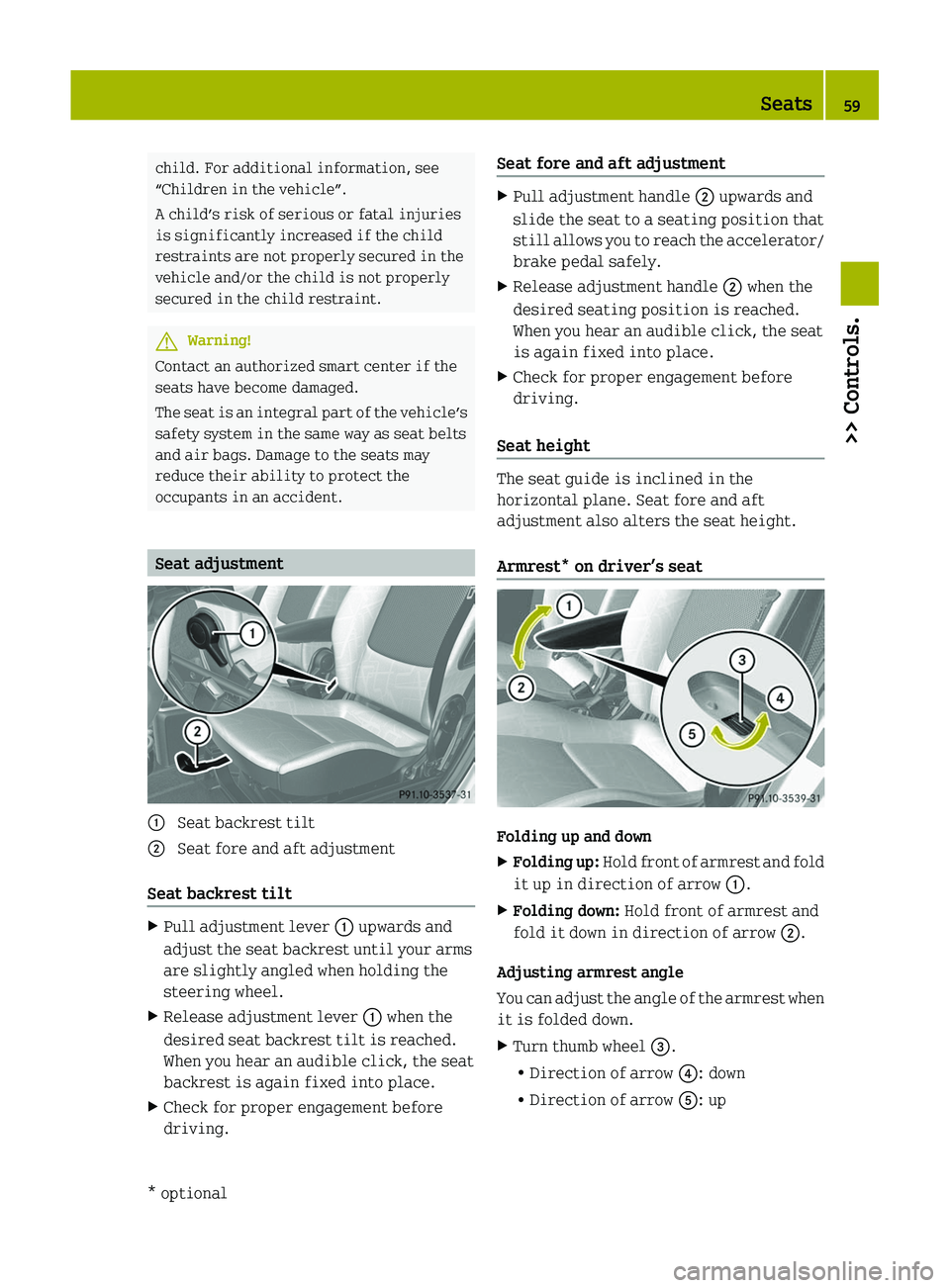
Seat adjustment
\000F Seat backrest tilt\000G Seat fore and aft adjustment
Seat backrest tilt
XPull adjustment lever \000F upwards and
adjust the seat backrest until your arms
are slightly angled when holding the
steering wheel.
XRelease adjustment lever \000F when the
desired seat backrest tilt is reached.
When you hear an audible click, the seat
backrest is again fixed into place.
XCheck for proper engagement before
driving.
Seat fore and aft adjustmentXPull adjustment handle \000G upwards and
slide the seat to a seating position that
still allows you to reach the accelerator/
brake pedal safely.
XRelease adjustment handle \000G when the
desired seating position is reached.
When you hear an audible click, the seat
is again fixed into place.
XCheck for proper engagement before
driving.
Seat height
The seat guide is inclined in the
horizontal plane. Seat fore and aft
adjustment also alters the seat height.
Armrest* on driver’s seat
Folding up and down
XFolding up: Hold front of armrest and fold
it up in direction of arrow \000F.
XFolding down: Hold front of armrest and
fold it down in direction of arrow \000G.
Adjusting armrest angle
You can adjust the angle of the armrest when
it is folded down.
XTurn thumb wheel \000
Page 62 of 228
Passenger seat
You can expand the cargo compartment by
folding down the passenger seat.
Observe the loading instructions
(Y page 113).
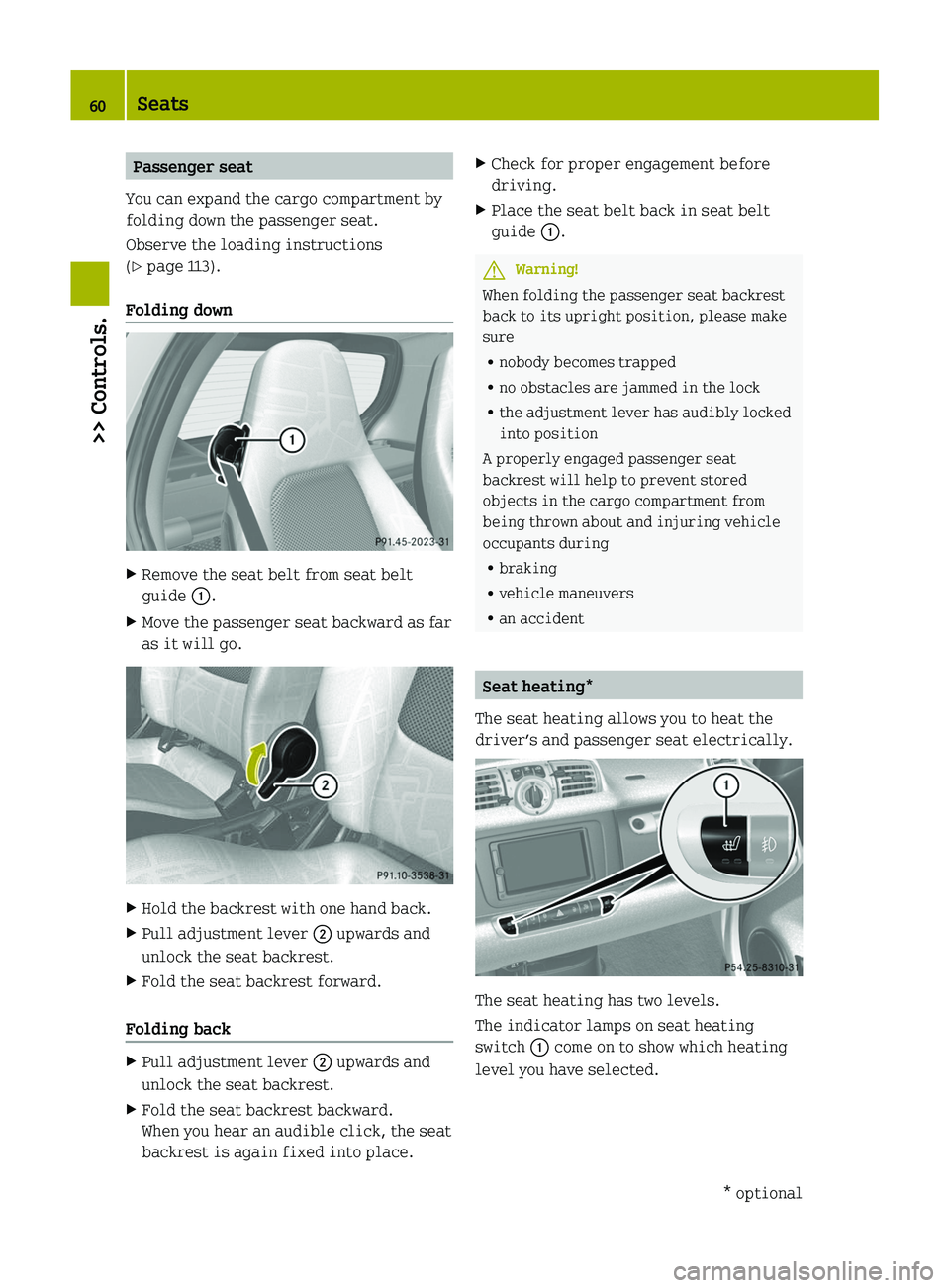
Folding down
XRemove the seat belt from seat belt
guide \000F.
XMove the passenger seat backward as far
as it will go.
XHold the backrest with one hand back.XPull adjustment lever \000G upwards and
unlock the seat backrest.
XFold the seat backrest forward.
Folding back
XPull adjustment lever \000G upwards and
unlock the seat backrest.
XFold the seat backrest backward.
When you hear an audible click, the seat
backrest is again fixed into place.
XCheck for proper engagement before
driving.
XPlace the seat belt back in seat belt
guide \000F.
GWarning!
When folding the passenger seat backrest
back to its upright position, please make
sure
Rnobody becomes trapped
Rno obstacles are jammed in the lock
Rthe adjustment lever has audibly locked
into position
A properly engaged passenger seat
backrest will help to prevent stored
objects in the cargo compartment from
being thrown about and injuring vehicle
occupants during
Rbraking
Rvehicle maneuvers
Ran accident
Seat heating*
The seat heating allows you to heat the
driver’s and passenger seat electrically.
The seat heating has two levels.
The indicator lamps on seat heating
switch \000F come on to show which heating
level you have selected.
60Seats>> Controls.* optionalBA 451 USA, CA Edition A 2011; 1; 4, en-UShereepeVersion: 3.0.3.62010-05-11T15:12:26+02:00 - Seite 60
Page 64 of 228
Exterior rear view mirror heating
This feature is only available on the model
passion and BRABUS and in conjunction
with power exterior rear view mirrors.
After switching on the rear window
defroster, the exterior rear view mirrors
will be heated automatically. This
prevents icing up the exterior rear view
mirrors and also creates a clear view when
the exterior rear view mirrors have fogged
up.
If the rear window defroster is
automatically deactivated after
approximately 10 minutes of operation, the
exterior rear view mirror heating also
deactivates.
XMake sure the key is in starter switch
position 1.XSwitching on: Switch on the rear window
defroster ( Y page 107).
The exterior rear view mirror heating is
switched on.XSwitching off: Switch off the rear window
defroster ( Y page 107).
The exterior rear view mirror heating is
switched off.
i The exterior rear view mirror heating
also switches off if the key is turned to
starter switch position 0.
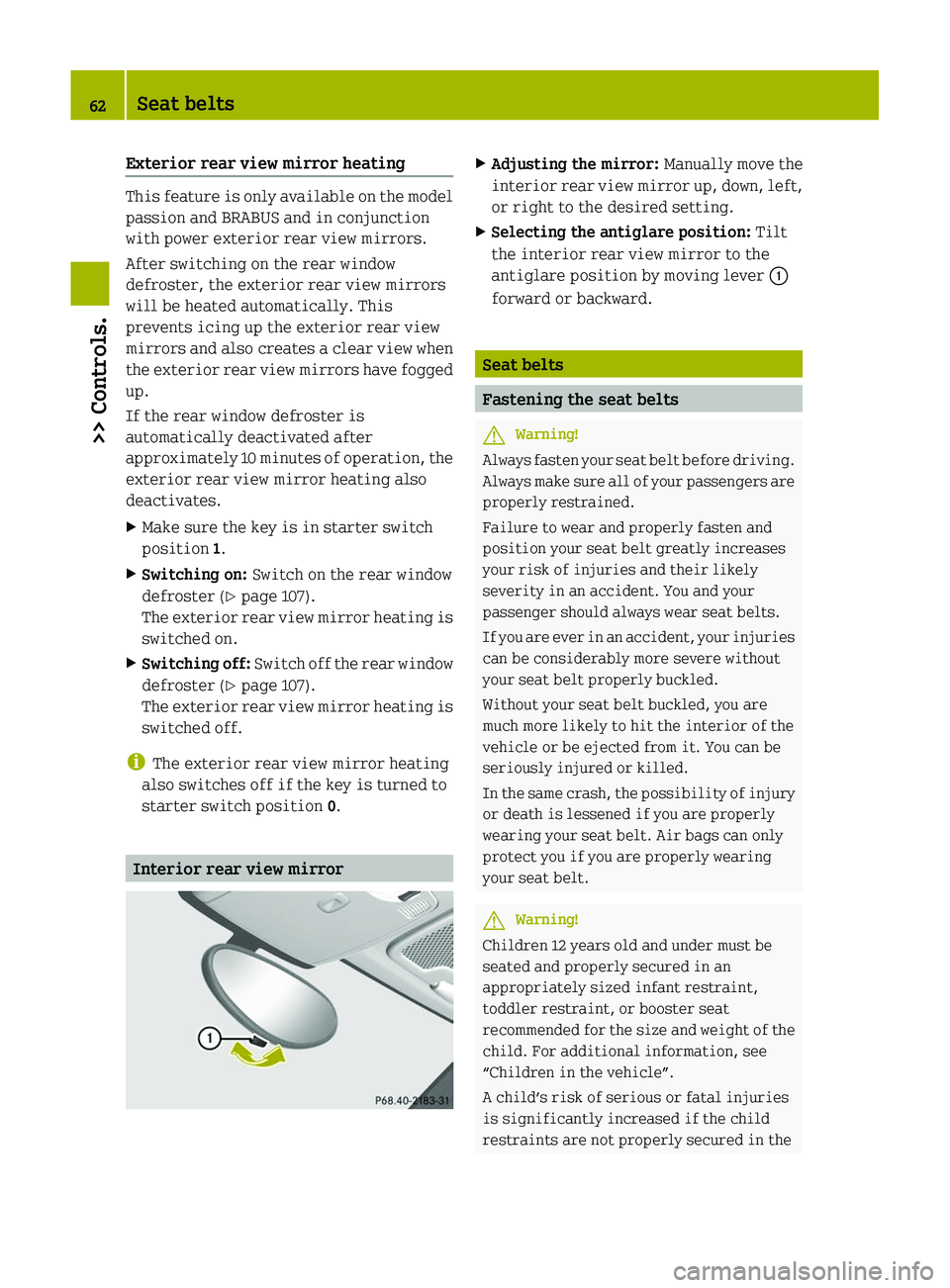
Interior rear view mirror
XAdjusting the mirror: Manually move the
interior rear view mirror up, down, left,
or right to the desired setting.XSelecting the antiglare position: Tilt
the interior rear view mirror to the
antiglare position by moving lever 0046
forward or backward.
Seat belts
Fastening the seat belts
GWarning!
Always fasten your seat belt before driving.
Always make sure all of your passengers are
properly restrained.
Failure to wear and properly fasten and
position your seat belt greatly increases
your risk of injuries and their likely
severity in an accident. You and your
passenger should always wear seat belts.
If you are ever in an accident, your injuries
can be considerably more severe without
your seat belt properly buckled.
Without your seat belt buckled, you are
much more likely to hit the interior of the
vehicle or be ejected from it. You can be
seriously injured or killed.
In the same crash, the possibility of injury
or death is lessened if you are properly
wearing your seat belt. Air bags can only
protect you if you are properly wearing
your seat belt.
GWarning!
Children 12 years old and under must be
seated and properly secured in an
appropriately sized infant restraint,
toddler restraint, or booster seat
recommended for the size and weight of the
child. For additional information, see
“Children in the vehicle”.
A child’s risk of serious or fatal injuries
is significantly increased if the child
restraints are not properly secured in the
62Seat belts>> Controls.
BA 451 USA, CA Edition A 2011; 1; 4, en-UShereepeVersion: 3.0.3.62010-05-11T15:12:26+02:00 - Seite 62
Page 65 of 228
vehicle and/or the child is not properly
secured in the child restraint.
GWarning!
Never let more people ride in the vehicle
than there are seat belts available. Make
sure everyone riding in the vehicle is
correctly restrained with a separate seat
belt. Never use a seat belt for more than one
person at a time.
GWarning!
Never ride in a moving vehicle with the seat
backrest in an excessively reclined
position as this can be dangerous. You
could slide under the seat belt in a
collision. If you slide under it, the belt
would apply force at the abdomen or neck,
causing serious or even fatal injuries. The
seat backrest and seat belt provide the best
restraint when the wearer is in a position
that is as upright as possible and the belt
is properly positioned on the body.
GWarning!
Observe ”Safety notes“ (Y page 35).
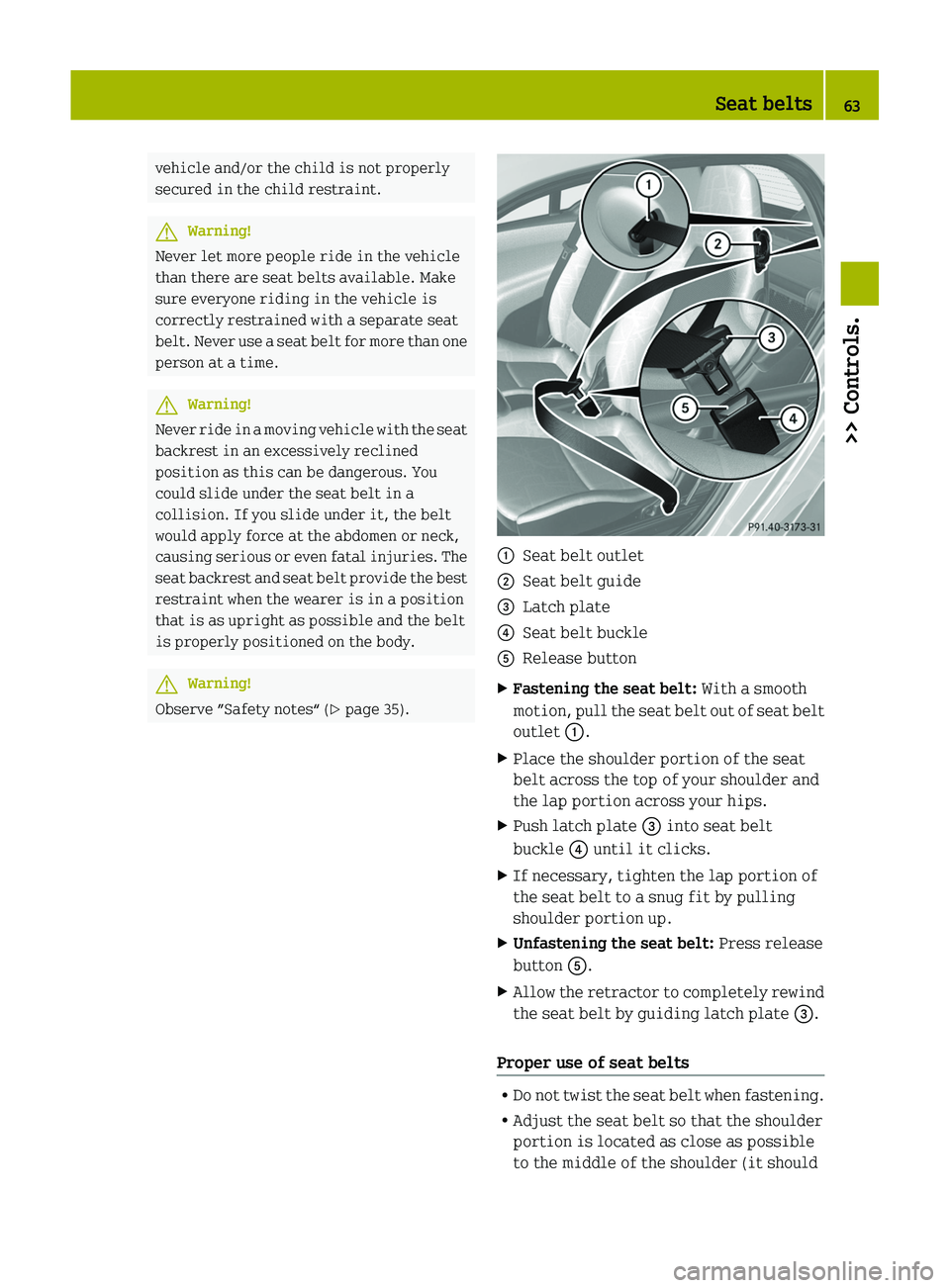
\000FSeat belt outlet\000GSeat belt guide\000
Page 66 of 228
not touch the neck). Never pass the
shoulder portion of the seat belt under
your arm.
RPosition the lap belt as low as possible
on your hips (over hip joint) and not
across the abdomen.
RPlace the seat backrest in a position that
is as upright as possible.
RNever use a seat belt for more than one
person at a time.
RDo not fasten a seat belt around a person
and another object at the same time. When
using a seat belt to secure infant or
toddler restraints or children in booster
seats, always follow the child seat
manufacturer’s instructions.
RCheck your seat belt during travel to
make sure it is properly positioned.
RMake sure the seat belt is always fitted
snugly. Take special care to maintain a
snug fit when wearing loose clothing.
GWarning!
Do not pass seat belts over sharp edges.
They could tear.
Do not allow the seat belt to get caught in
the door or in the seat adjustment
mechanism. This could damage the seat
belt.
Never attempt to make modifications to
seat belts. This could impair the
effectiveness of the seat belts.
Do not bleach or dye seat belts as this may
severely weaken them. In a crash they may
not be able to provide adequate protection.
Damaged seat belts or seat belts that were
highly stressed in an accident must be
replaced. Contact an authorized smart
center.
Correct driver seat adjustment
GWarning!
Observe ”Safety notes“ (Y page 58).
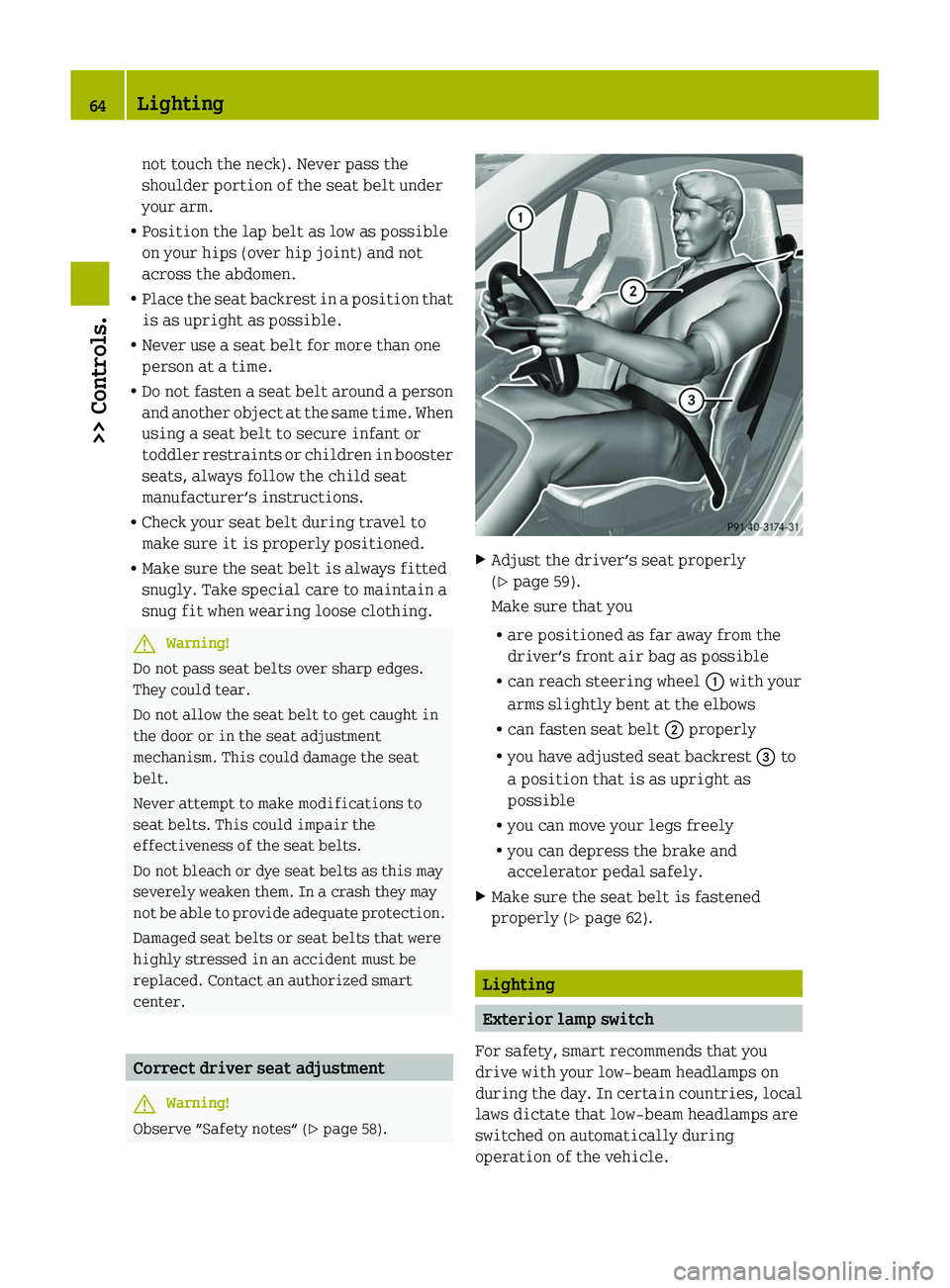
XAdjust the driver’s seat properly
(Y page 59).
Make sure that you
Rare positioned as far away from the
driver’s front air bag as possible
Rcan reach steering wheel \000F with your
arms slightly bent at the elbows
Rcan fasten seat belt \000G properly
Ryou have adjusted seat backrest \000
Page 74 of 228
Rretractable soft top
R rear soft top
R side rails
You can remove the side rails over the doors
when you open the retractable soft top and
open the rear soft top.
i Opening the rear soft top is possible
after the retractable soft top has been
opened completely.
Notes on the soft top system
! When transporting long objects inside
the vehicle, make sure they do not press
against the retractable soft top when it
is closed.
When carrying objects that protrude from
the rear of the vehicle, make sure they
are not resting on the retaining clips.
When loading, make sure no sharp objects
come into contact with the soft top or the
rear window.
Do not place any evenly distributed loads
with a weight of more than 165 lbs (75 kg)
on the rear soft top when folded down.
Make sure the high-mounted brake lamp
is not concealed.
! Do not block the soft top system’s
locking apertures.
Only place the side rails in the
designated storage space of the tailgate.
! Do not sit on the folded-down rear soft
top.
Do not fold down the rear soft top at
temperatures below 14 ¦ (-10 ¥).
Do not place any pointed, sharp-edged,
hot (above 176 ¦ [80 ¥]), incandescent or
burning objects on the soft top’s lining.
Do not apply wax to the soft top fabric and
select only wax-free washing products
when using an automatic car wash.
Only drive with the retaining clips
closed, as exhaust fumes could otherwise
reach the vehicle’s interior.
! Please keep in mind that weather
conditions can sometimes change
rapidly. Make sure to close the
retractable soft top and the rear soft top
when leaving the vehicle. If water enters
the vehicle interior, vehicle
electronics could be damaged which is
not covered by the smart Limited
Warranty.
Opening and closing the retractable
soft top
You can open and close the retractable soft
top when the vehicle is either stationary
or in motion.
GWarning!
Never operate the retractable soft top if
there is the possibility of anyone being
harmed by the opening or closing
procedure.
GWarning!
The retractable soft top is made out of
fabric. In the event of an accident, the
fabric may tear. This may result in an
opening in the roof.
In a vehicle rollover, occupants not
wearing their seat belts or not wearing
them properly may be thrown out of the
opening. Such an opening also presents a
potential for injury for occupants wearing
their seat belts properly as entire body
parts or portions of them may protrude from
the passenger compartment.
GWarning!
When leaving the vehicle, always remove the
key from the starter switch, take it with
you, and lock the vehicle. Do not leave
children unattended in the vehicle, or with
access to an unlocked vehicle. A child’s
72Soft top system (cabriolet only)>> Controls.
BA 451 USA, CA Edition A 2011; 1; 4, en-UShereepeVersion: 3.0.3.62010-05-11T15:12:26+02:00 - Seite 72
Page 141 of 228
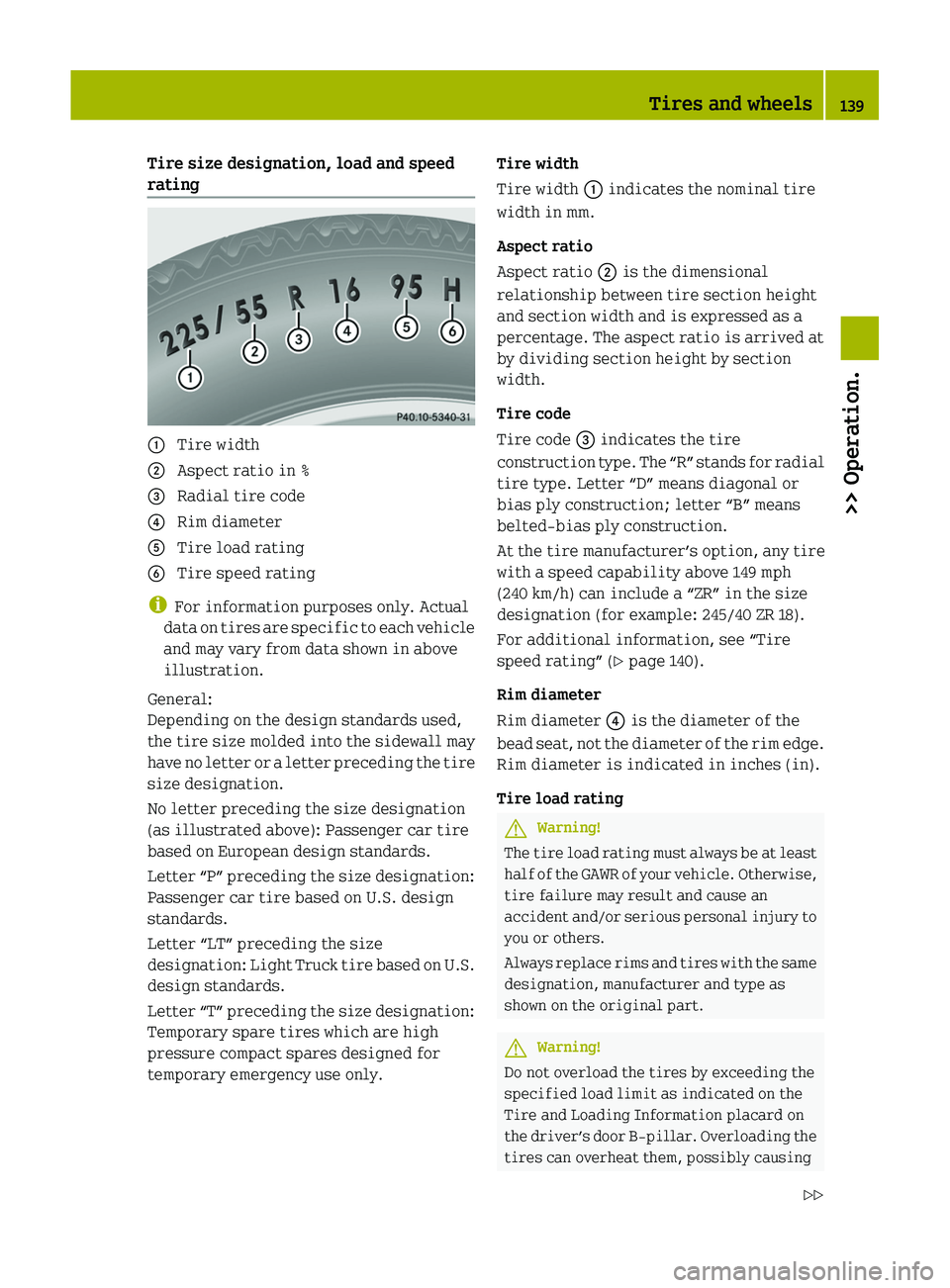
Tire size designation, load and speed
rating0046 Tire width0047 Aspect ratio in %008A Radial tire code0088 Rim diameter0086 Tire load rating0087 Tire speed rating
i
For information purposes only. Actual
data on tires are specific to each vehicle
and may vary from data shown in above
illustration.
General:
Depending on the design standards used,
the tire size molded into the sidewall may
have no letter or a letter preceding the tire
size designation.
No letter preceding the size designation
(as illustrated above): Passenger car tire
based on European design standards.
Letter “P” preceding the size designation:
Passenger car tire based on U.S. design
standards.
Letter “LT” preceding the size
designation: Light Truck tire based on U.S.
design standards.
Letter “T” preceding the size designation:
Temporary spare tires which are high
pressure compact spares designed for
temporary emergency use only.
Tire width
Tire width 0046 indicates the nominal tire
width in mm.
Aspect ratio
Aspect ratio 0047 is the dimensional
relationship between tire section height
and section width and is expressed as a
percentage. The aspect ratio is arrived at
by dividing section height by section
width.
Tire code
Tire code 008A indicates the tire
construction type. The “R” stands for radial
tire type. Letter “D” means diagonal or
bias ply construction; letter “B” means
belted-bias ply construction.
At the tire manufacturer’s option, any tire
with a speed capability above 149 mph
(240 km/h) can include a “ZR” in the size
designation (for example: 245/40 ZR 18).
For additional information, see “Tire
speed rating” ( Y page 140).
Rim diameter
Rim diameter 0088 is the diameter of the
bead seat, not the diameter of the rim edge.
Rim diameter is indicated in inches (in).
Tire load ratingGWarning!
The tire load rating must always be at least
half of the GAWR of your vehicle. Otherwise,
tire failure may result and cause an
accident and/or serious personal injury to
you or others.
Always replace rims and tires with the same
designation, manufacturer and type as
shown on the original part.
GWarning!
Do not overload the tires by exceeding the
specified load limit as indicated on the
Tire and Loading Information placard on
the driver’s door B‑pillar. Overloading the
tires can overheat them, possibly causing
Tires and wheels139>> Operation.BA 451 USA, CA Edition A 2011; 1; 4, en-UShereepeVersion: 3.0.3.62010-05-11T15:12:26+02:00 - Seite 139Z
Page 163 of 228
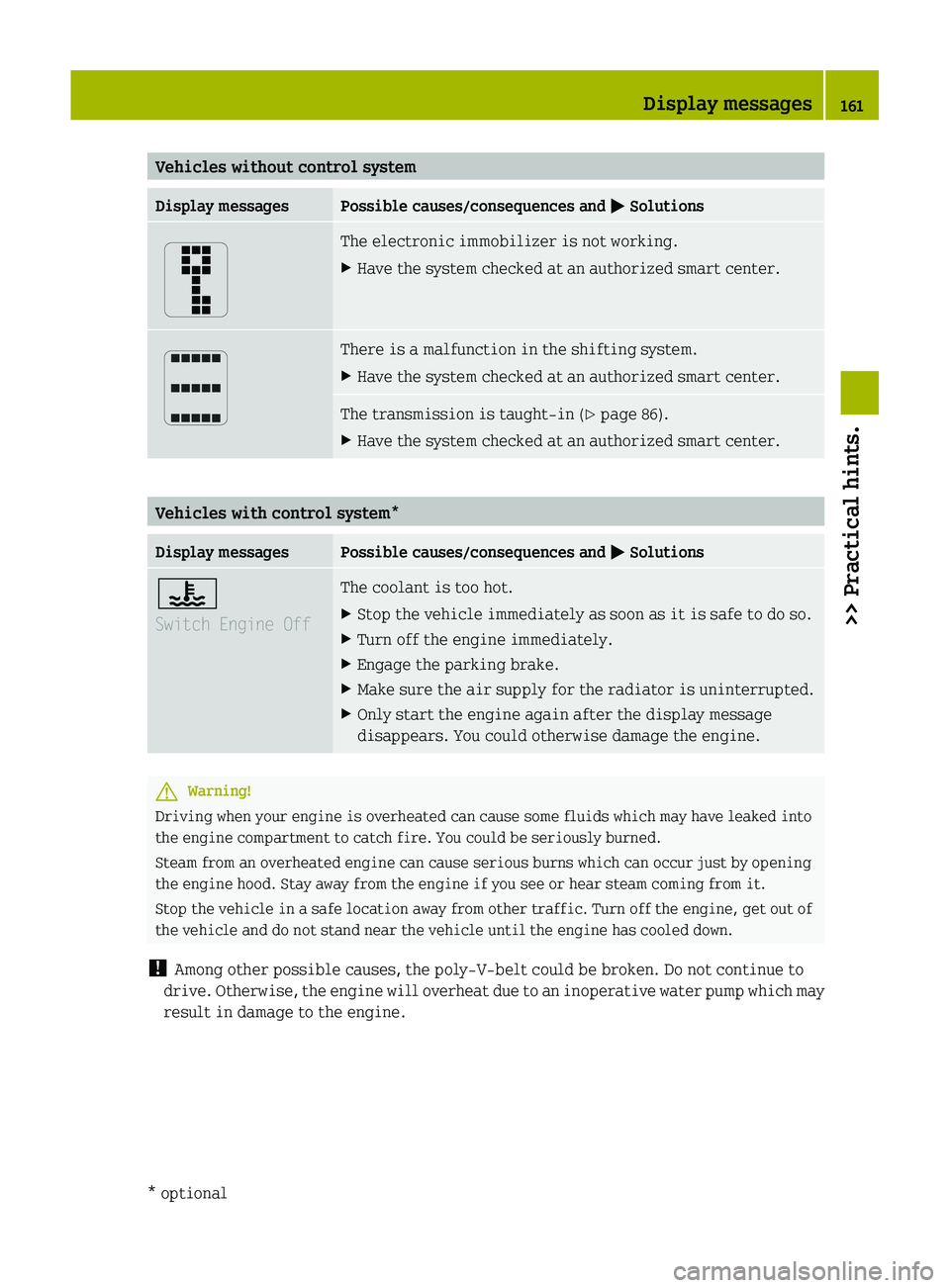
Vehicles without control systemDisplay messagesPossible causes/consequences and 0050 SolutionsThe electronic immobilizer is not working. XHave the system checked at an authorized smart center.There is a malfunction in the shifting system. XHave the system checked at an authorized smart center.The transmission is taught-in ( Y page 86).XHave the system checked at an authorized smart center.
Vehicles with control system*
Display messagesPossible causes/consequences and 0050 Solutions00AE
Switch Engine OffThe coolant is too hot.XStop the vehicle immediately as soon as it is safe to do so.XTurn off the engine immediately.XEngage the parking brake.XMake sure the air supply for the radiator is uninterrupted.XOnly start the engine again after the display message
disappears. You could otherwise damage the engine.GWarning!
Driving when your engine is overheated can cause some fluids which may have leaked into
the engine compartment to catch fire. You could be seriously burned.
Steam from an overheated engine can cause serious burns which can occur just by opening
the engine hood. Stay away from the engine if you see or hear steam coming from it.
Stop the vehicle in a safe location away from other traffic. Turn off the engine, get out of
the vehicle and do not stand near the vehicle until the engine has cooled down.
! Among other possible causes, the poly-V-belt could be broken. Do not continue to
drive. Otherwise, the engine will overheat due to an inoperative water pump which may
result in damage to the engine.
Display messages161>> Practical hints.* optionalBA 451 USA, CA Edition A 2011; 1; 4, en-UShereepeVersion: 3.0.3.62010-05-11T15:12:26+02:00 - Seite 161Z
Page 164 of 228
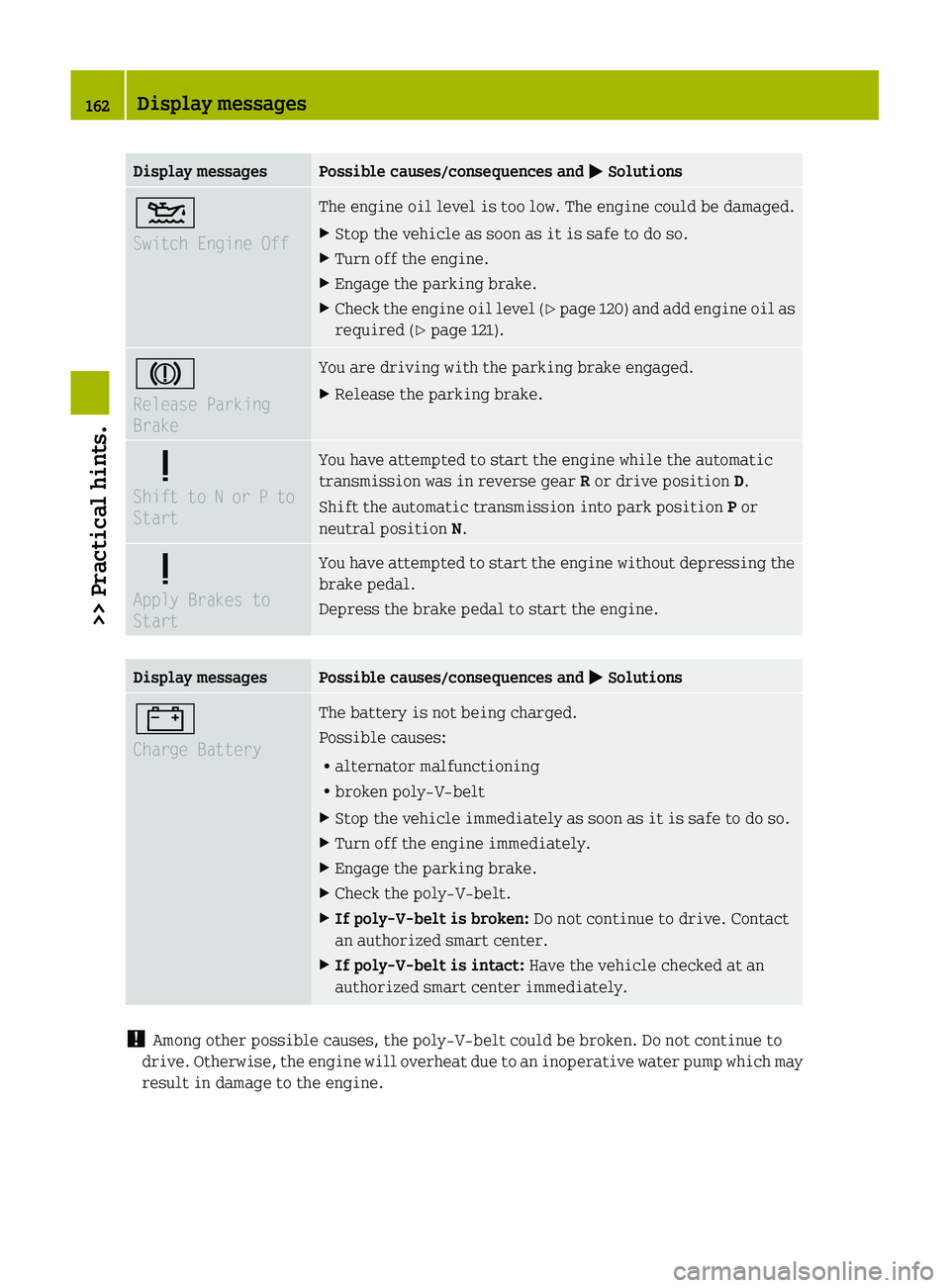
Display messagesPossible causes/consequences and 0050 Solutions00B4
Switch Engine OffThe engine oil level is too low. The engine could be damaged.XStop the vehicle as soon as it is safe to do so.XTurn off the engine.XEngage the parking brake.XCheck the engine oil level (Y page 120) and add engine oil as
required ( Y page 121).004D
Release Parking
BrakeYou are driving with the parking brake engaged.XRelease the parking brake.0077
Shift to N or P to
StartYou have attempted to start the engine while the automatic
transmission was in reverse gear R or drive position D.
Shift the automatic transmission into park position P or
neutral position N.0077
Apply Brakes to
StartYou have attempted to start the engine without depressing the
brake pedal.
Depress the brake pedal to start the engine.Display messagesPossible causes/consequences and 0050 Solutions003F
Charge BatteryThe battery is not being charged.
Possible causes:
R alternator malfunctioning
R broken poly-V-beltXStop the vehicle immediately as soon as it is safe to do so.XTurn off the engine immediately.XEngage the parking brake.XCheck the poly-V-belt.XIf poly-V-belt is broken: Do not continue to drive. Contact
an authorized smart center.XIf poly-V-belt is intact: Have the vehicle checked at an
authorized smart center immediately.
! Among other possible causes, the poly-V-belt could be broken. Do not continue to
drive. Otherwise, the engine will overheat due to an inoperative water pump which may
result in damage to the engine.
162Display messages>> Practical hints.
BA 451 USA, CA Edition A 2011; 1; 4, en-UShereepeVersion: 3.0.3.62010-05-11T15:12:26+02:00 - Seite 162