flat tire SMART FORTWO COUPE 2011 Owner's Guide
[x] Cancel search | Manufacturer: SMART, Model Year: 2011, Model line: FORTWO COUPE, Model: SMART FORTWO COUPE 2011Pages: 228, PDF Size: 11.48 MB
Page 193 of 228
therefore keep the engine running — in
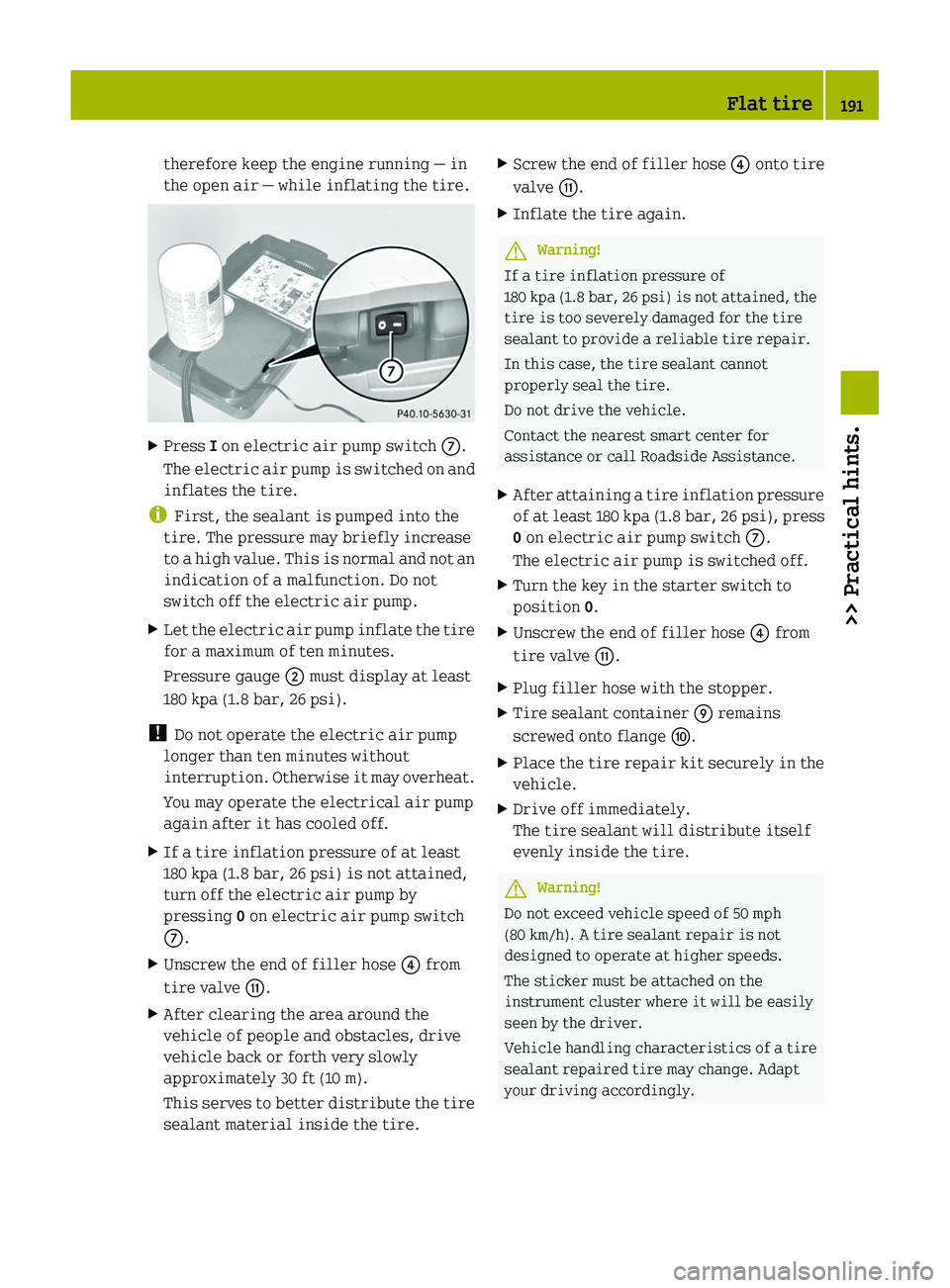
the open air — while inflating the tire.XPress I on electric air pump switch 006E.
The electric air pump is switched on and
inflates the tire.
i First, the sealant is pumped into the
tire. The pressure may briefly increase
to a high value. This is normal and not an
indication of a malfunction. Do not
switch off the electric air pump.
XLet the electric air pump inflate the tire
for a maximum of ten minutes.
Pressure gauge 0047 must display at least
180 kpa (1.8 bar, 26 psi).
! Do not operate the electric air pump
longer than ten minutes without
interruption. Otherwise it may overheat.
You may operate the electrical air pump
again after it has cooled off.
XIf a tire inflation pressure of at least
180 kpa (1.8 bar, 26 psi) is not attained,
turn off the electric air pump by
pressing 0 on electric air pump switch
006E .XUnscrew the end of filler hose 0088 from
tire valve 0072.XAfter clearing the area around the
vehicle of people and obstacles, drive
vehicle back or forth very slowly
approximately 30 ft (10 m).
This serves to better distribute the tire
sealant material inside the tire.XScrew the end of filler hose 0088 onto tire
valve 0072.XInflate the tire again.GWarning!
If a tire inflation pressure of
180 kpa (1.8 bar, 26 psi) is not attained, the
tire is too severely damaged for the tire
sealant to provide a reliable tire repair.
In this case, the tire sealant cannot
properly seal the tire.
Do not drive the vehicle.
Contact the nearest smart center for
assistance or call Roadside Assistance.
XAfter attaining a tire inflation pressure
of at least 180 kpa (1.8 bar, 26 psi) , press
0 on electric air pump switch 006E.
The electric air pump is switched off.XTurn the key in the starter switch to
position 0.XUnscrew the end of filler hose 0088 from
tire valve 0072.XPlug filler hose with the stopper.XTire sealant container 0070 remains
screwed onto flange 0071.XPlace the tire repair kit securely in the
vehicle.XDrive off immediately.
The tire sealant will distribute itself
evenly inside the tire.GWarning!
Do not exceed vehicle speed of 50 mph
(80 km/h). A tire sealant repair is not
designed to operate at higher speeds.
The sticker must be attached on the
instrument cluster where it will be easily
seen by the driver.
Vehicle handling characteristics of a tire
sealant repaired tire may change. Adapt
your driving accordingly.
Flat tire191>> Practical hints.BA 451 USA, CA Edition A 2011; 1; 4, en-UShereepeVersion: 3.0.3.62010-05-11T15:12:26+02:00 - Seite 191Z
Page 194 of 228
XAfter driving for about 1.8 miles (3 km)
or ten minutes, take all of the
appropriate safety precautions and then
take the tire repair kit from the vehicle.XScrew the end of filler hose 0088 onto tire
valve 0072.XCheck the tire inflation pressure using
pressure gauge 0047.GWarning!
If tire inflation pressure has fallen below
130 kpa (1.3 bar, 20 psi) do not continue to
drive the vehicle.
Park your vehicle safely away from the
roadway and contact the nearest smart
center or call Roadside Assistance.
Have the damaged tire replaced.
XIf the tire inflation pressure is at least
130 kpa (1.3 bar, 20 psi), inflate or deflate
the tire to correct tire inflation
pressure (see Tire and Loading
Information placard located on the
driver’s door B‑pillar).
R To increase the tire inflation
pressure: Switch on the electric air
pump.
R To decrease the tire inflation
pressure: Open vent screw 008A. Recheck
the tire inflation pressure with the
electric air pump’s pressure gauge.XAfter checking the tire inflation
pressure, unscrew the end of filler
hose 0088 from tire valve 0072.XPlug filler hose with the stopper.XPlace the tire repair kit securely in the
vehicle.XScrew the valve cap onto the tire valve.
! The manufacturer is unable to
guarantee that all tire punctures can be
repaired with the tire repair kit, in
particular cuts or perforations larger
than approximately 0.16 in (4 mm) or away
from the tire’s tread. The manufacturer
is not liable for damage sustained
through improper use of the tire repair
kit.GWarning!
Follow recommended tire inflation
pressures.
Do not underinflate tires. Underinflated
tires wear excessively and/or unevenly,
adversely affect handling and fuel
economy, and are more likely to fail from
being overheated.
Do not overinflate tires. Overinflated
tires can adversely affect handling and
ride comfort, wear unevenly, increase
stopping distance, and result in sudden
deflation (blowout) because they are more
likely to become punctured or damaged by
road debris, potholes etc.
Do not overload the tires by exceeding the
specified load limit as indicated on the
Tire and Loading Information placard on
the driver’s door B‑pillar. Overloading the
tires can overheat them, possibly causing
a blowout. Overloading the tires can also
result in handling or steering problems, or
brake failure.
XDrive to the nearest authorized smart
center, to have the damaged tire
replaced.XContact an authorized smart center as
soon as possible to obtain a new filler
hose and a new tire sealant container.XBring used tire sealant materials to an
authorized smart center for proper
disposal.XReplace your tire sealant container
every 4 years. Replacement containers
are available at any authorized smart
center.GWarning!
After changing a tire, contact a smart
center to make sure the bolts holding the
wheel to the car are tight enough.
Otherwise, the wheels could come off. Each
192Flat tire>> Practical hints.
BA 451 USA, CA Edition A 2011; 1; 4, en-UShereepeVersion: 3.0.3.62010-05-11T15:12:26+02:00 - Seite 192
Page 197 of 228
to come off. This could cause an accident.
Be sure to use the correct wheel bolts.
GWarning!
Only use genuine smart wheel bolts. Other
wheel bolts may come loose.
Do not tighten the wheel bolts when the
vehicle is raised. Otherwise the vehicle
could fall off the jack.
XClean contact surfaces of wheel and wheel
hub.
! To avoid paint damage, place wheel flat
against hub and hold it there while
installing first wheel bolt.
XGuide the wheel onto the wheel hub and
push it on.
XInsert two wheel bolts and tighten them
slightly.
XVehicles with wheel trim cap on steel
rim: Attach the wheel trim cap so that it
is held by the two wheel bolts.
XInstall last wheel bolt and tighten it
slightly.
XLower the vehicle until the vehicle is
resting fully on its own weight.
XRemove the jack.XTighten the wheel bolts. Observe a
tightening torque of 80 lb-ft (110 Nm).
GWarning!
Have the tightening torque checked after
changing a wheel. The wheels could come
loose if they are not tightened to a torque
of 80 lb-ft (110 Nm).
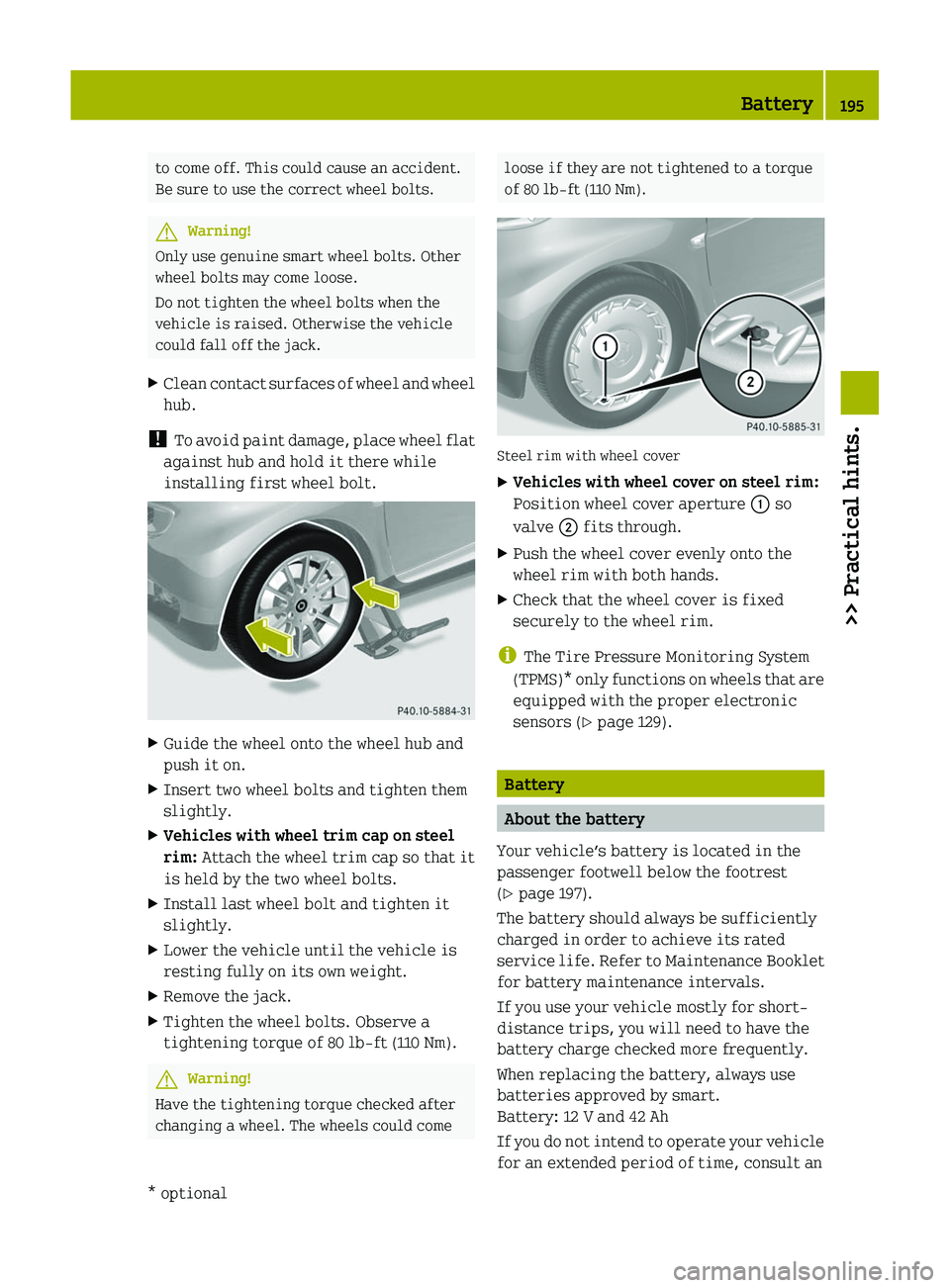
Steel rim with wheel cover
XVehicles with wheel cover on steel rim:
Position wheel cover aperture \000F so
valve \000G fits through.
XPush the wheel cover evenly onto the
wheel rim with both hands.
XCheck that the wheel cover is fixed
securely to the wheel rim.
iThe Tire Pressure Monitoring System
(TPMS)* only functions on wheels that are
equipped with the proper electronic
sensors (Y page 129).
Battery
About the battery
Your vehicle’s battery is located in the
passenger footwell below the footrest
(Y page 197).
The battery should always be sufficiently
charged in order to achieve its rated
service life. Refer to Maintenance Booklet
for battery maintenance intervals.
If you use your vehicle mostly for short-
distance trips, you will need to have the
battery charge checked more frequently.
When replacing the battery, always use
batteries approved by smart.
Battery: 12 V and 42 Ah
If you do not intend to operate your vehicle
for an extended period of time, consult an
Battery195>> Practical hints.* optionalBA 451 USA, CA Edition A 2011; 1; 4, en-UShereepeVersion: 3.0.3.62010-05-11T15:12:26+02:00 - Seite 195Z
Page 219 of 228
Rims and tires
Notes
! Only use tires which have been tested
and approved by smart. Tires approved by
smart are developed to provide best
possible performance in conjunction
with the driving safety systems on your
vehicle such as the ABS or the ESP ®
.
Using tires other than those approved by
smart may result in damage that is not
covered by the smart Limited Warranty.
! Using tires other than those approved
by smart can have detrimental effects,
such as
R poor handling characteristics
R increased noise
R increased fuel consumption
Moreover, tires and rims not approved by
smart may, under load, exhibit
dimensional variations and different
tire deformation characteristics that
could cause them to come into contact
with the vehicle body or axle parts.
Damage to the tires or the vehicle may be
the result.
i Further information on tires and rims
is available at any authorized smart
center. A placard with the recommended
tire inflation pressure is located on the
driver’s door B‑pillar.
The tire inflation pressure should be
checked regularly and should only be
adjusted on cold tires. Follow tire
manufacturer’s maintenance
recommendation included with vehicle.
Mobility
Your vehicle is equipped with a tire repair
kit ( Y page 188). In case of a flat tire, it
enables you to drive to the nearest
authorized smart center on the sealed tire.
If the tire is damaged too severely for the
tire sealant to provide a reliable tire
repair:XContact the nearest smart center.
or
XCall Roadside Assistance.Rims and tires217>> Technical data.BA 451 USA, CA Edition A 2011; 1; 4, en-UShereepeVersion: 3.0.3.62010-05-11T15:12:26+02:00 - Seite 217Z