lock SMART FORTWO COUPE 2011 Workshop Manual
[x] Cancel search | Manufacturer: SMART, Model Year: 2011, Model line: FORTWO COUPE, Model: SMART FORTWO COUPE 2011Pages: 228, PDF Size: 11.48 MB
Page 167 of 228

BrakeProblemPossible causes/consequences and 0050 Solutions00EB (USA only)
0031 (Canada only)
The ABS indicator
lamp illuminates
while the engine is
running. There is a malfunction in the ABS system.XHave the ABS system checked at an authorized smart center
immediately.00EB (USA only)
0031 (Canada only)
The ABS indicator
lamp illuminates
together with the
brake warning lamp
while the engine is
running.The ABS system fails.XStop the vehicle immediately in a safe location.XDo not continue to drive.XTurn off the engine.XEngage the parking brake when leaving the vehicle.XContact Roadside Assistance or an authorized smart center.GWarning!
When the ABS system is malfunctioning, the wheels may lock during hard braking, reducing
steering capability and extending the braking distance.
When the ABS is switched off due to a malfunction, the ESP ®
is also switched off. The basic
driving and braking functions are still available.
The risk of your vehicle skidding is then increased in certain situations. You should
therefore always adapt your speed and driving style to the prevailing road and weather
conditions.
What to do if ...165>> Practical hints.BA 451 USA, CA Edition A 2011; 1; 4, en-UShereepeVersion: 3.0.3.62010-05-11T15:12:26+02:00 - Seite 165Z
Page 178 of 228
GWarning!
If the 007F 007B indicator lamp does not illuminate or remains out with the weight of
a typical 12‑month‑old child in a standard child restraint or less on the passenger seat, do
not transport a child on the passenger seat until the system has been repaired.
Engine
ProblemPossible causes/consequences and 0050 SolutionsThe engine does not
start.XCheck if
R the gear selector lever is in park position P
R the brake pedal has been depressed
R the transmission position indicator is on P or NThe engine does not
start within
4 seconds.XWait for a few seconds.XRepeat the starting procedure.
Remember that extended starting attempts can drain the
vehicle battery.The engine does not
start after several
starting attempts.XEngage the parking brake when leaving the vehicle.XContact Roadside Assistance or an authorized smart center.
Loss of key
ProblemPossible causes/consequences and 0050 SolutionsYou lose a key.XHave the key deactivated at an authorized smart center.XReport the loss of the key to your car insurance company
immediately.XIf necessary, have the mechanical lock replaced.
Your authorized smart center will be glad to supply you with a
replacement following an identity check.
176What to do if ...>> Practical hints.
BA 451 USA, CA Edition A 2011; 1; 4, en-UShereepeVersion: 3.0.3.62010-05-11T15:12:26+02:00 - Seite 176
Page 179 of 228
Acoustic warning signalsProblemPossible causes/consequences and 0050 SolutionsOnce the anti-theft
warning system* has
been armed, a visual
and audible alarm is
triggered.The alarm is triggered when
R someone opens a door or the tailgate
R the driver’s door is unlocked with the key ( Y page 178)
R the vehicle’s interior is entered
R there is motion inside the vehicle
R the vehicle is raised
To cancel the alarm:XInsert the key in the starter switch.XTurn the key to starter switch position 1.
or
XPress button 0034 or 0038 on the key.A warning signal
sounds.The door is opened while a gear is engaged with the engine
running and neither the brake nor accelerator pedals are
depressed. XClose the driver’s and passenger door.XMove the gear selector lever to park position P.
or
XTurn off the engine.You open the driver’s door with the key in starter switch
position 0.XClose the driver’s door.
or
XRemove the key from the starter switch.A warning signal
sounds.The seat belts are not fastened when the engine is started. For
details, see seat belt telltale ( Y page 167).XFasten your seat belts.You can hear a
continuous noise from
the front axle when
braking.The vehicle is equipped with a mechanical/acoustic brake pad
indicator. XHave the brake pads checked at an authorized smart center.What to do if ...177>> Practical hints.* optionalBA 451 USA, CA Edition A 2011; 1; 4, en-UShereepeVersion: 3.0.3.62010-05-11T15:12:26+02:00 - Seite 177Z
Page 180 of 228
Unlocking/locking manually
Unlocking the vehicle
You can unlock the driver’s door and the
fuel filler flap by unlocking the driver’s
door using the key. The lock cylinder is
fitted with a cap.
XPress button \0004 on the key.
The anti-theft warning system* is
disarmed.
iIf the transmitter battery in the key is
discharged, the anti-theft warning
system* can no longer be disarmed with
button \0004 on the key. For replacing the
transmitter battery (Y page 179).
Unlocking the vehicle with the key and
opening a door or the tailgate will
trigger the anti-theft warning system*
(Y page 48).
To cancel the alarm:
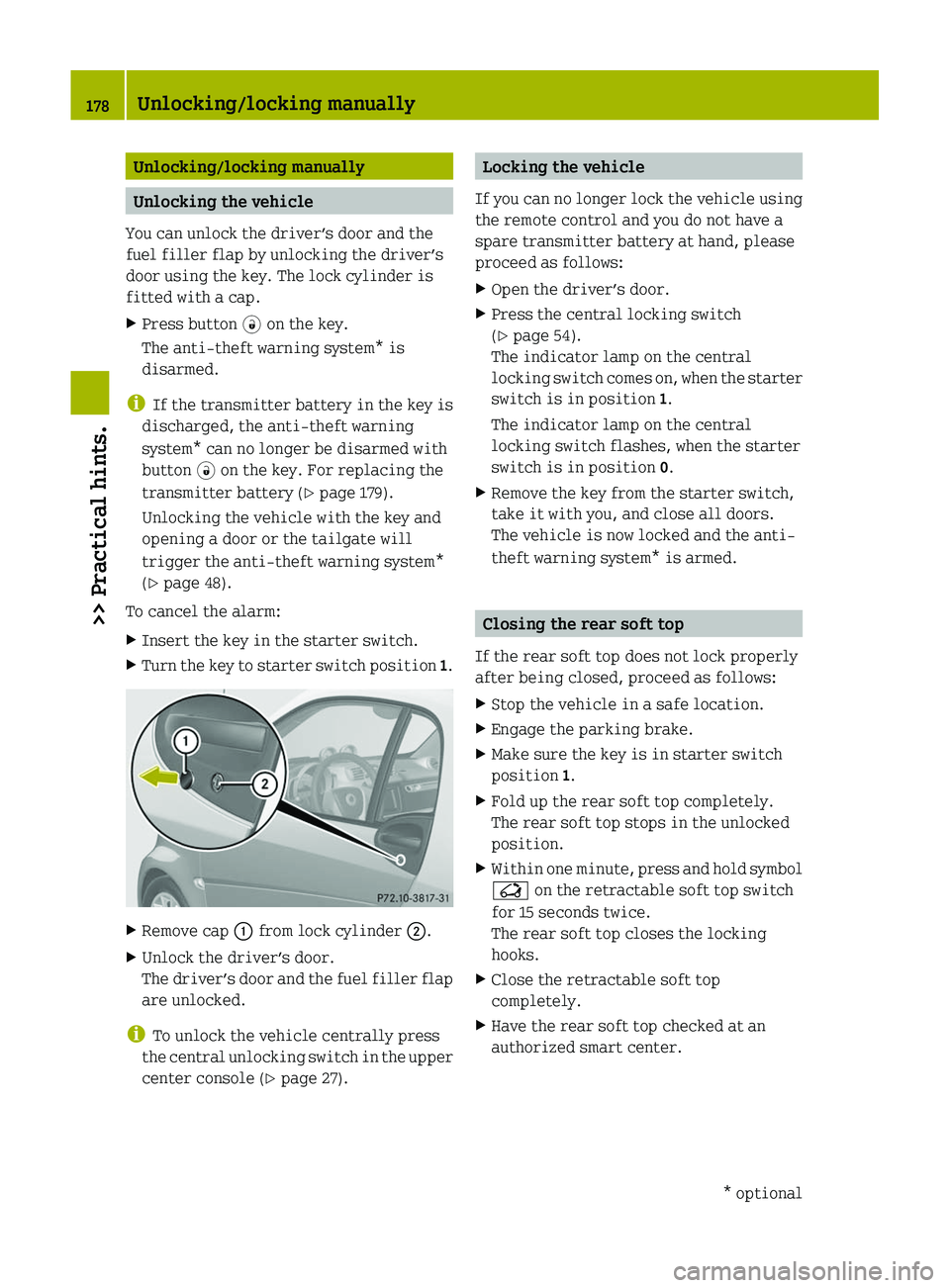
XInsert the key in the starter switch.XTurn the key to starter switch position 1.XRemove cap \000F from lock cylinder \000G.XUnlock the driver’s door.
The driver’s door and the fuel filler flap
are unlocked.
iTo unlock the vehicle centrally press
the central unlocking switch in the upper
center console (Y page 27).
Locking the vehicle
If you can no longer lock the vehicle using
the remote control and you do not have a
spare transmitter battery at hand, please
proceed as follows:
XOpen the driver’s door.XPress the central locking switch
(Y page 54).
The indicator lamp on the central
locking switch comes on, when the starter
switch is in position 1.
The indicator lamp on the central
locking switch flashes, when the starter
switch is in position 0.
XRemove the key from the starter switch,
take it with you, and close all doors.
The vehicle is now locked and the anti-
theft warning system* is armed.
Closing the rear soft top
If the rear soft top does not lock properly
after being closed, proceed as follows:
XStop the vehicle in a safe location.XEngage the parking brake.XMake sure the key is in starter switch
position 1.
XFold up the rear soft top completely.
The rear soft top stops in the unlocked
position.
XWithin one minute, press and hold symbol
\000U on the retractable soft top switch
for 15 seconds twice.
The rear soft top closes the locking
hooks.
XClose the retractable soft top
completely.
XHave the rear soft top checked at an
authorized smart center.
178Unlocking/locking manually>> Practical hints.* optionalBA 451 USA, CA Edition A 2011; 1; 4, en-UShereepeVersion: 3.0.3.62010-05-11T15:12:26+02:00 - Seite 178
Page 181 of 228
Replacing transmitter battery
Notes
The remote control’s transmitter battery is
almost spent when the turn signals flash
rapidly nine times in a row when locking
the vehicle.
iIf you do not replace the transmitter
battery, after about 100 more times you
will no longer be able to lock or unlock
the vehicle using the remote control.
XReplace the transmitter battery.
or
XHave the transmitter battery replaced at
an smart center.
GWarning!
Batteries contain poisonous and corrosive
substances. Therefore keep the batteries
out of reach of children.
If a battery is swallowed, seek medical help
immediately.
Batteries contain materials that can harm
the environment if disposed of improperly.
Recycling of batteries is the preferred
method of disposal. Many states/provinces
require sellers of batteries to accept old
batteries for recycling.
Replacing battery
Replacement battery: CR 2016 button cell
! Replace the remote control’s
transmitter battery every two years at
the latest. Otherwise there is a danger of
leakage. The remote control could be
damaged.
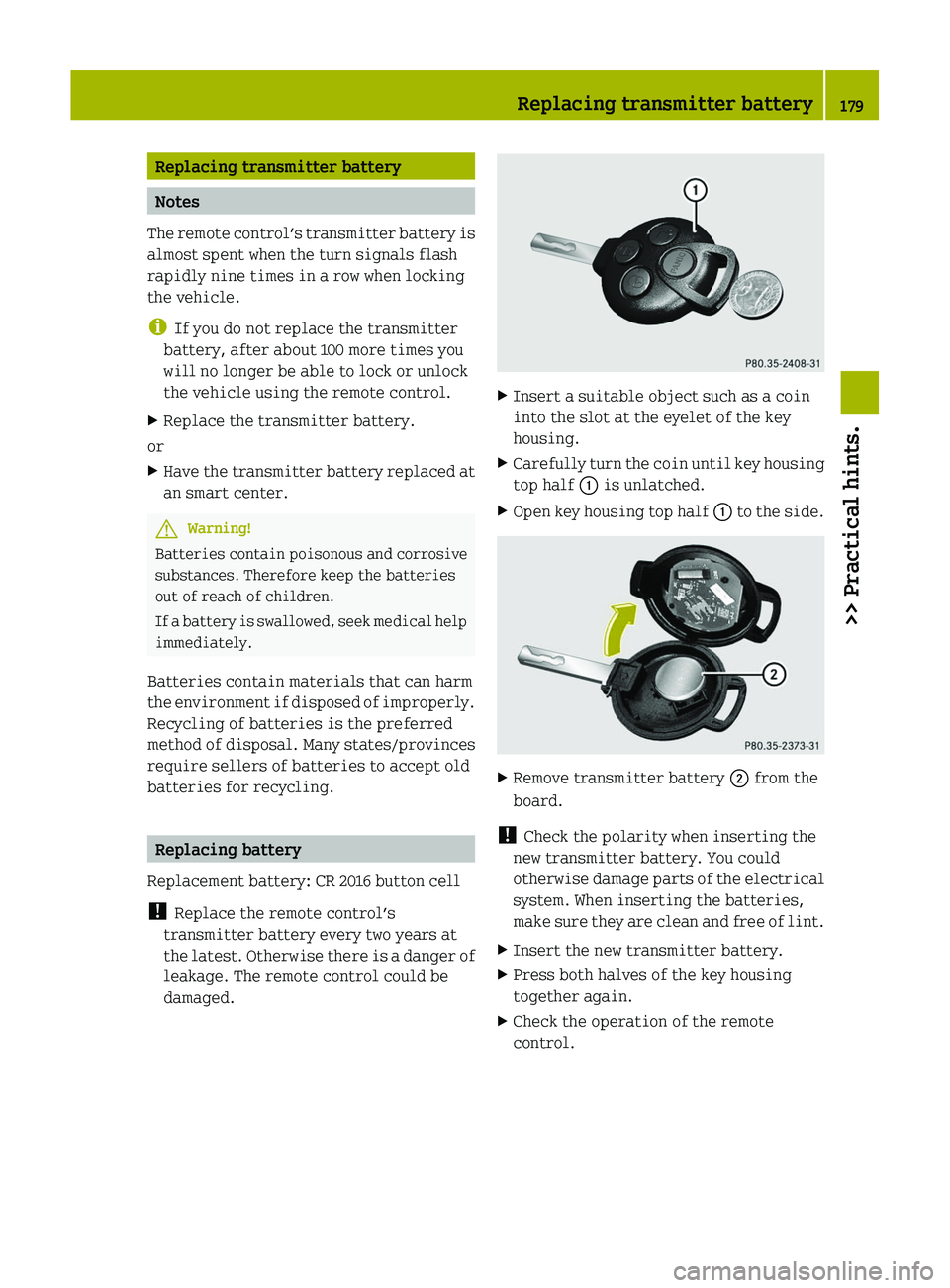
XInsert a suitable object such as a coin
into the slot at the eyelet of the key
housing.
XCarefully turn the coin until key housing
top half \000F is unlatched.
XOpen key housing top half \000F to the side.XRemove transmitter battery \000G from the
board.
! Check the polarity when inserting the
new transmitter battery. You could
otherwise damage parts of the electrical
system. When inserting the batteries,
make sure they are clean and free of lint.
XInsert the new transmitter battery.XPress both halves of the key housing
together again.
XCheck the operation of the remote
control.
Replacing transmitter battery179>> Practical hints.BA 451 USA, CA Edition A 2011; 1; 4, en-UShereepeVersion: 3.0.3.62010-05-11T15:12:26+02:00 - Seite 179Z
Page 186 of 228
The arrow on bulb socket \000F must be in
line with the line on the headlamp
housing.
XTurn bulb socket \000F clockwise by a
quarter of turn.
Side turn signal lamp bulb
XRemoving: Open the door on the
corresponding side.
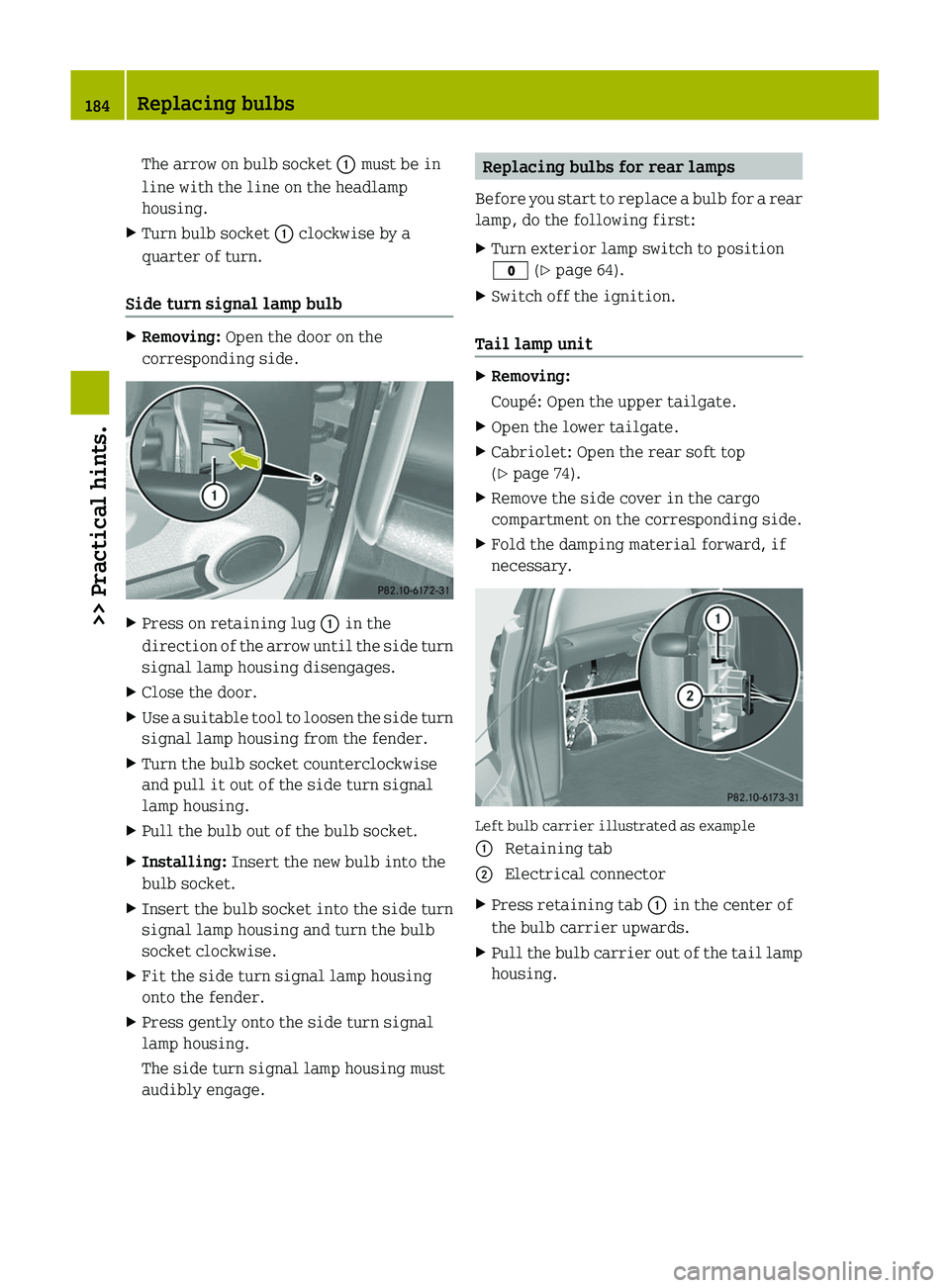
XPress on retaining lug \000F in the
direction of the arrow until the side turn
signal lamp housing disengages.
XClose the door.XUse a suitable tool to loosen the side turn
signal lamp housing from the fender.
XTurn the bulb socket counterclockwise
and pull it out of the side turn signal
lamp housing.
XPull the bulb out of the bulb socket.XInstalling: Insert the new bulb into the
bulb socket.
XInsert the bulb socket into the side turn
signal lamp housing and turn the bulb
socket clockwise.
XFit the side turn signal lamp housing
onto the fender.
XPress gently onto the side turn signal
lamp housing.
The side turn signal lamp housing must
audibly engage.
Replacing bulbs for rear lamps
Before you start to replace a bulb for a rear
lamp, do the following first:
XTurn exterior lamp switch to position
\000' (Y page 64).
XSwitch off the ignition.
Tail lamp unit
XRemoving:
Coupé: Open the upper tailgate.
XOpen the lower tailgate.XCabriolet: Open the rear soft top
(Y page 74).
XRemove the side cover in the cargo
compartment on the corresponding side.
XFold the damping material forward, if
necessary.
Left bulb carrier illustrated as example
\000F Retaining tab\000G Electrical connectorXPress retaining tab \000F in the center of
the bulb carrier upwards.
XPull the bulb carrier out of the tail lamp
housing.
184Replacing bulbs>> Practical hints.
BA 451 USA, CA Edition A 2011; 1; 4, en-UShereepeVersion: 3.0.3.62010-05-11T15:12:26+02:00 - Seite 184
Page 195 of 228
bolt should be tightened to a torque of
81 lb‑ft (110 Nm).
Wheel change
Preparing the vehicle
XPark the vehicle on a hard, flat surface
when possible.XTurn on the hazard warning flasher.XTurn the steering wheel so that the front
wheels are in a straight-ahead position.XEngage the parking brake.XMove the gear selector lever to park
position P.XTurn off the engine.XHave any passenger exit the vehicle at a
safe distance from the roadway.
Removing the wheel
GWarning!
When jacking up the vehicle, only use a
suitable jack. Observe the manufacturer’s
safety instructions.
The jack must be designed for jacking up
this vehicle at the jack take-up brackets
built into both sides of the vehicle.
The jack is intended only for lifting the
vehicle briefly for wheel changes. It is not
suited for performing maintenance work
under the vehicle. To help avoid personal
injury, use the jack only to lift the vehicle
during a wheel change.
Never get beneath the vehicle while it is
supported by the jack. Keep hands and feet
away from the area under the lifted vehicle.
Always lower the vehicle onto sufficient
capacity jackstands before working under
the vehicle.
Always firmly engage the parking brake and
block the wheels with wheel chocks or other
sizeable objects before raising the
vehicle with the jack. Do not release the
parking brake while the vehicle is raised.
Make sure the ground on which the vehicle
is standing and where you place the jack is
solid, level and not slippery. If necessary,
use a large underlay. On slippery surfaces,
such as tiled floors, you should use a non-
slip underlay, for example a rubber mat.
Do not use wooden blocks or similar objects
to support the jack. Otherwise the jack may
not be able to achieve its load-bearing
capacity if it is not at its full height.
The jack must always be vertical when in
use. Always try to use the jack on level
surface. If you do not position the jack
correctly, the vehicle can fall off the jack
and seriously or fatally injure you or
others.
Never start the engine when the vehicle is
raised.
Also observe the notes on the jack.XMake sure to have a suitable jack 18
, wheel
wrench 18
and wheel chock 18
.
Contact an authorized smart center for
information on which jack and wheel
wrench are required.XPrepare the vehicle as described
( Y page 193).XMake sure the surface is level.
Prevent the vehicle from rolling away by
blocking wheels with wheel chocks or other
sizeable objects:
XPlace one wheel chock or other sizeable
object in front of and another wheel
chock or other sizeable object behind
the wheel that is diagonally opposite to
the wheel being changed.18 Not included and not available as factory equipment.Wheel change193>> Practical hints.BA 451 USA, CA Edition A 2011; 1; 4, en-UShereepeVersion: 3.0.3.62010-05-11T15:12:26+02:00 - Seite 193Z
Page 199 of 228
key is in the starter switch. Otherwise
the alternator and other electronic
components could be severely damaged.
Have the battery checked regularly at an
authorized smart center.
Refer to Maintenance Booklet for
maintenance intervals or contact an
authorized smart center for further
information.
! Never invert the terminal connections!
Disconnecting, removing, charging,
reinstalling and reconnecting the
battery
Disconnecting the battery
iIf the battery is disconnected or
discharged
Rthe key will not turn in the starter
switch
Rthe automatic transmission will
remain in park position P
For more information see “Jump
starting” (Y page 198).
XEngage the parking brake.XMove the gear selector lever to park
position P.
XTurn off all electrical accessories.XTurn off the engine.XOpen the passenger door.XMove the passenger seat to the rear as far
as possible.
XUnscrew the carpet holder in the
passenger footwell (Y page 160).
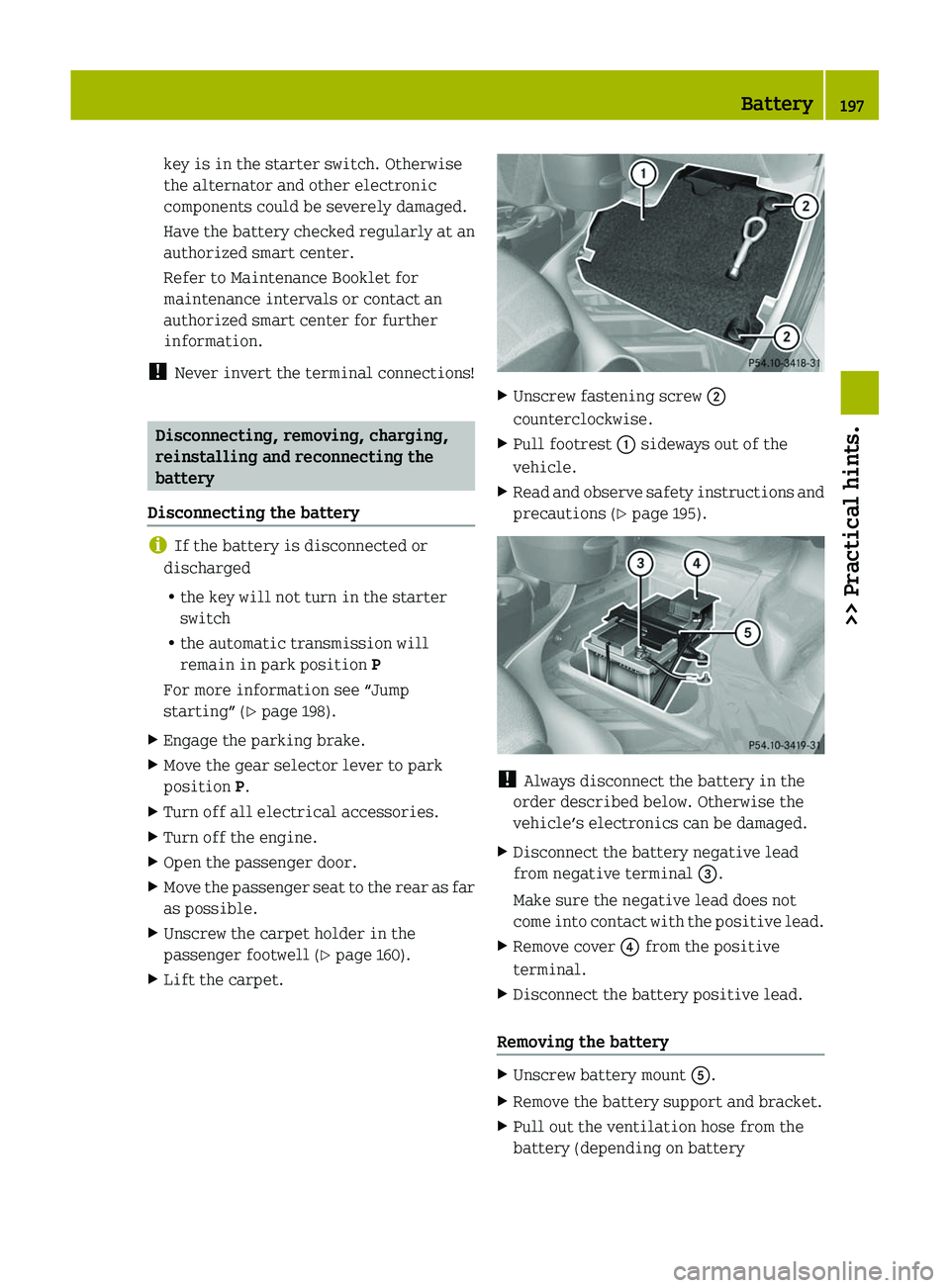
XLift the carpet.XUnscrew fastening screw \000G
counterclockwise.
XPull footrest \000F sideways out of the
vehicle.
XRead and observe safety instructions and
precautions (Y page 195).
! Always disconnect the battery in the
order described below. Otherwise the
vehicle’s electronics can be damaged.
XDisconnect the battery negative lead
from negative terminal \000
Page 200 of 228
arrangement in your vehicle model, the
ventilation hose is located either on the
left or right side of the battery).XRemove the battery.
Charging the battery
GWarning!
Avoid creating sparks when charging the
battery as escaping gases are flammable.
Keep open flames away from the battery and
do not smoke.
Do not touch the battery terminal with metal
objects and do not remove the battery
charger’s terminal clamps until the battery
charger has been switched off and no
further gas is being discharged by the
batteries.
Only charge the battery in a well ventilated
area.
There is a risk of acid burns during the
charging procedure due to the gases which
escape from the battery. Do not lean over
the battery when it is being charged.
GWarning!
Never charge a battery while still installed
in the vehicle. Gases may escape during
charging and cause explosions that may
result in paint damage, corrosion or
personal injury.
XCharge battery in accordance with the
instructions of the battery charger
manufacturer.
! Only use chargers of a correct and
suitable voltage.
! Never attempt to recharge a frozen
battery. Have the battery checked at a
smart center. The battery housing could
be damaged.
Reinstalling the batteryXReinstall the charged battery. Follow the
previously described steps in reverse
order.
! The battery, its filler caps and the
ventilation hose must always be securely
installed when the vehicle is in
operation.
Reconnecting the battery
! Always connect the battery in the order
described below. Otherwise the
vehicle’s electronics can be damaged.
XTurn off all electrical accessories.XRemove the key from the starter switch.
! Never invert the terminal connections!
XConnect the battery positive lead and
fasten cover 0088 (Y page 197).XConnect battery negative lead 008A
( Y page 197).
i
After battery power (e.g. due to
reconnection) was interrupted, you will
have to set the clock ( Y page 89).
i Have the battery’s charge status and
acid level checked at the start of the cold
season at a smart center.
Jump starting
Notes
GWarning!
Failure to follow these directions will
cause damage to the electronic components,
and can lead to a battery explosion and
severe injury or death.
Never lean over batteries while connecting
or jump starting, you might get injured.
Battery fluid contains sulfuric acid. Do not
allow this fluid to come in contact with
eyes, skin or clothing. In case it does,
198Jump starting>> Practical hints.
BA 451 USA, CA Edition A 2011; 1; 4, en-UShereepeVersion: 3.0.3.62010-05-11T15:12:26+02:00 - Seite 198
Page 204 of 228
cause damage to the radiator and other
supports if towing on a bumpy road.
RTowing the vehicle should only be done
using the properly installed towing
eye bolt. Never attach a tow cable, tow
rope, or tow rod to the vehicle chassis,
frame, or suspension parts.
! Make sure the ignition is switched off
while towing the vehicle. Doing
otherwise may result in
Rthe ESP® being activated. Active
braking action through the ESP® may
seriously damage the brake system
which is not covered by the smart
Limited Warranty.
Ra discharged battery.
! Make sure the gear selector lever is in
neutral position N while towing the
vehicle. Doing otherwise may result in
significant transmission damage.
! Towing the vehicle with a luggage
rack* mounted is not permissible. The
vehicle must not be towed by the luggage
rack*.
iIf the battery is disconnected or
discharged, the gear selector lever will
remain locked in park position P.
Contact an authorized smart center for
assistance or call Roadside Assistance.
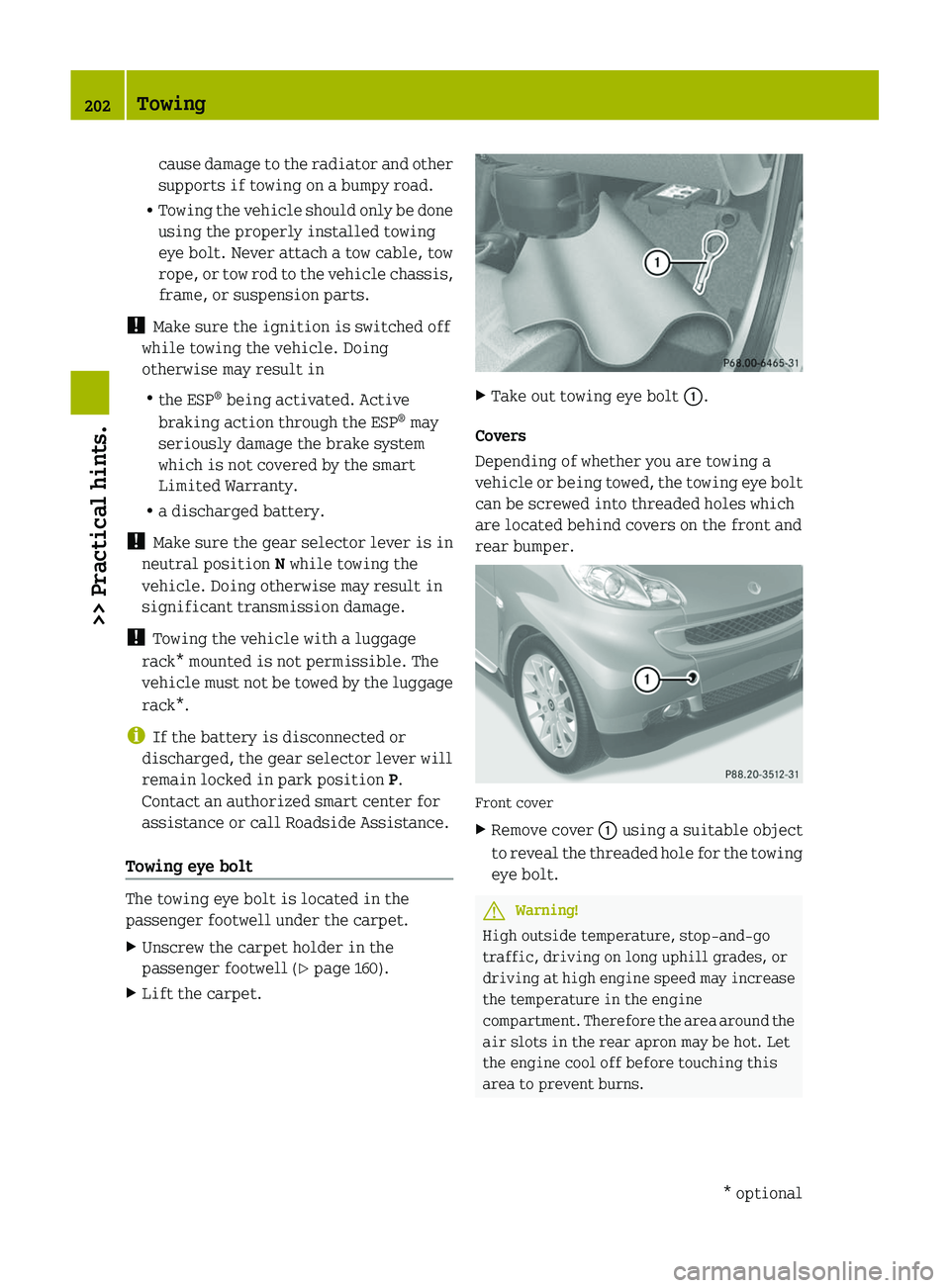
Towing eye bolt
The towing eye bolt is located in the
passenger footwell under the carpet.
XUnscrew the carpet holder in the
passenger footwell (Y page 160).
XLift the carpet.XTake out towing eye bolt \000F.
Covers
Depending of whether you are towing a
vehicle or being towed, the towing eye bolt
can be screwed into threaded holes which
are located behind covers on the front and
rear bumper.
Front cover
XRemove cover \000F using a suitable object
to reveal the threaded hole for the towing
eye bolt.
GWarning!
High outside temperature, stop-and-go
traffic, driving on long uphill grades, or
driving at high engine speed may increase
the temperature in the engine
compartment. Therefore the area around the
air slots in the rear apron may be hot. Let
the engine cool off before touching this
area to prevent burns.
202Towing>> Practical hints.* optionalBA 451 USA, CA Edition A 2011; 1; 4, en-UShereepeVersion: 3.0.3.62010-05-11T15:12:26+02:00 - Seite 202