wheel SMART FORTWO COUPE 2011 Workshop Manual
[x] Cancel search | Manufacturer: SMART, Model Year: 2011, Model line: FORTWO COUPE, Model: SMART FORTWO COUPE 2011Pages: 228, PDF Size: 11.48 MB
Page 159 of 228
rubber parts. The distance should be at
least 3.9 in (10 cm) and the water
temperature must not exceed 140 ¦
(60 ¥). Follow the instructions provided
by the power washer manufacturer on
maintaining a distance between the
vehicle and the nozzle of the power
washer.
Always keep the jet of water moving
across the surface.
Wheel cover* XWash the wheel cover with shampoo and a
soft brush or in the car wash.
Decorative foils
! Decorative foils are permanently
adhered to the painted parts of the
vehicle and cannot be removed.
! Do not expose the foils to solvents,
gasoline or diesel.
i When cleaning with a power washer, note
the following guideline values:
R Water temperature max. 176 ¦ (80 ¥)
R Minimum distance 11.8 in (30 cm)
R Jet of water strike at a right angle
Paintwork care
The frequency with which you care for your
paintwork is dependent on
R how much the vehicle is used
R where you normally park the vehicle (e.g.
in a garage or under a tree)
R the season
R weather and environmental influences
Rectifying paintwork damage
You can use a touch-up paint pen to repair
minimal stone chip damage and scratches.
Recommended touch-up paint pens can be
obtained in a smart center.
i For any major paintwork damage, please
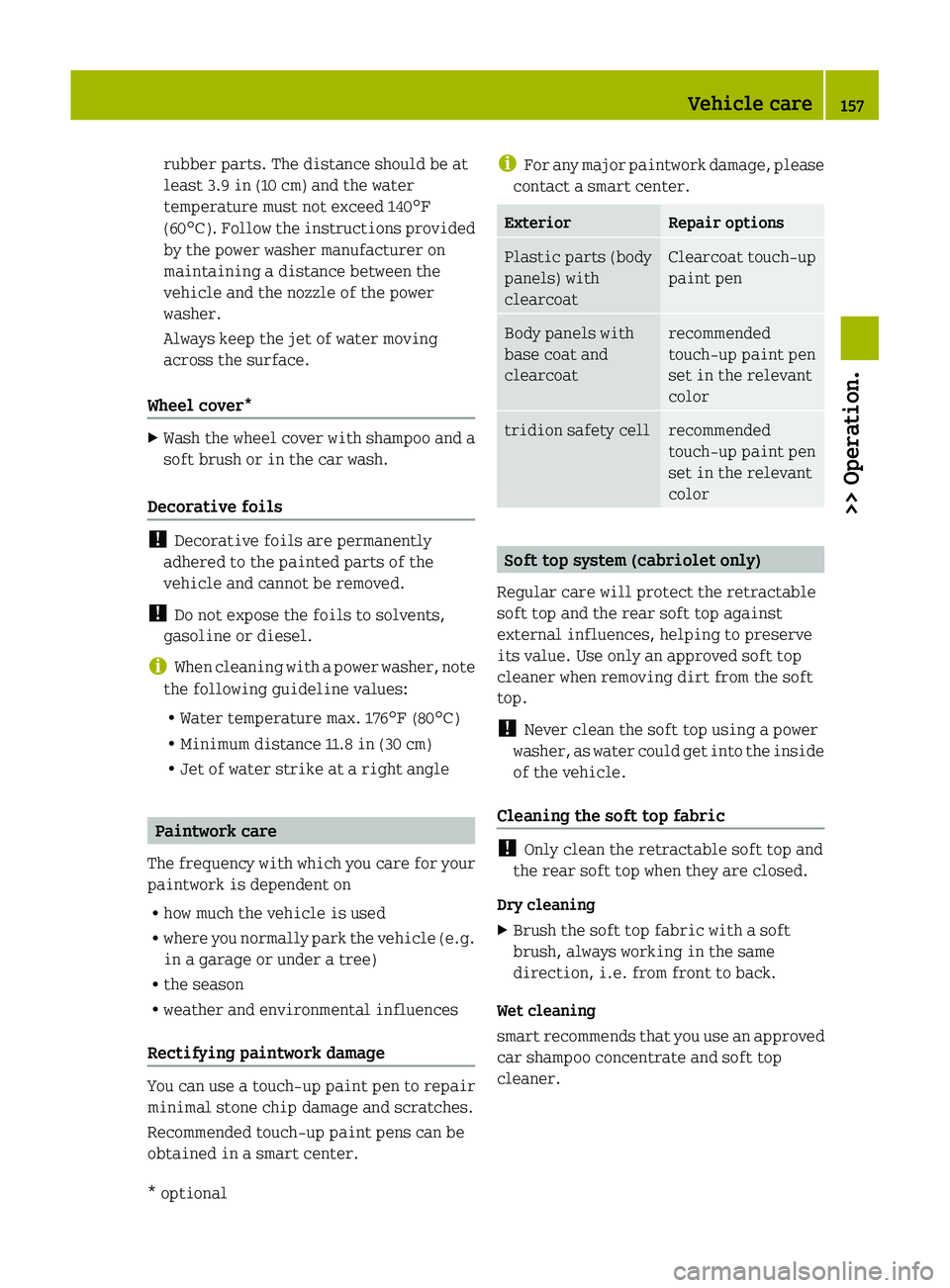
contact a smart center.ExteriorRepair optionsPlastic parts (body
panels) with
clearcoatClearcoat touch-up
paint penBody panels with
base coat and
clearcoatrecommended
touch-up paint pen
set in the relevant
colortridion safety cellrecommended
touch-up paint pen
set in the relevant
color
Soft top system (cabriolet only)
Regular care will protect the retractable
soft top and the rear soft top against
external influences, helping to preserve
its value. Use only an approved soft top
cleaner when removing dirt from the soft
top.
! Never clean the soft top using a power
washer, as water could get into the inside
of the vehicle.
Cleaning the soft top fabric
! Only clean the retractable soft top and
the rear soft top when they are closed.
Dry cleaning
XBrush the soft top fabric with a soft
brush, always working in the same
direction, i.e. from front to back.
Wet cleaning
smart recommends that you use an approved
car shampoo concentrate and soft top
cleaner.
Vehicle care157>> Operation.* optionalBA 451 USA, CA Edition A 2011; 1; 4, en-UShereepeVersion: 3.0.3.62010-05-11T15:12:26+02:00 - Seite 157Z
Page 161 of 228
>> Practical hints.Where will I find ... ..........................160
Display messages .............................160
What to do if ... ...............................164
Unlocking/locking manually ...............178
Replacing transmitter battery ............179
Replacing bulbs ..............................180
Replacing wiper blades .....................186
Flat tire ........................................188
Wheel change ..................................193
Battery ..........................................195
Jump starting ..................................198
Towing ..........................................201
Fuses ............................................204
BA 451 USA, CA Edition A 2011; 1; 4, en-UShereepeVersion: 3.0.3.62010-05-11T15:12:26+02:00 - Seite 159
Page 165 of 228
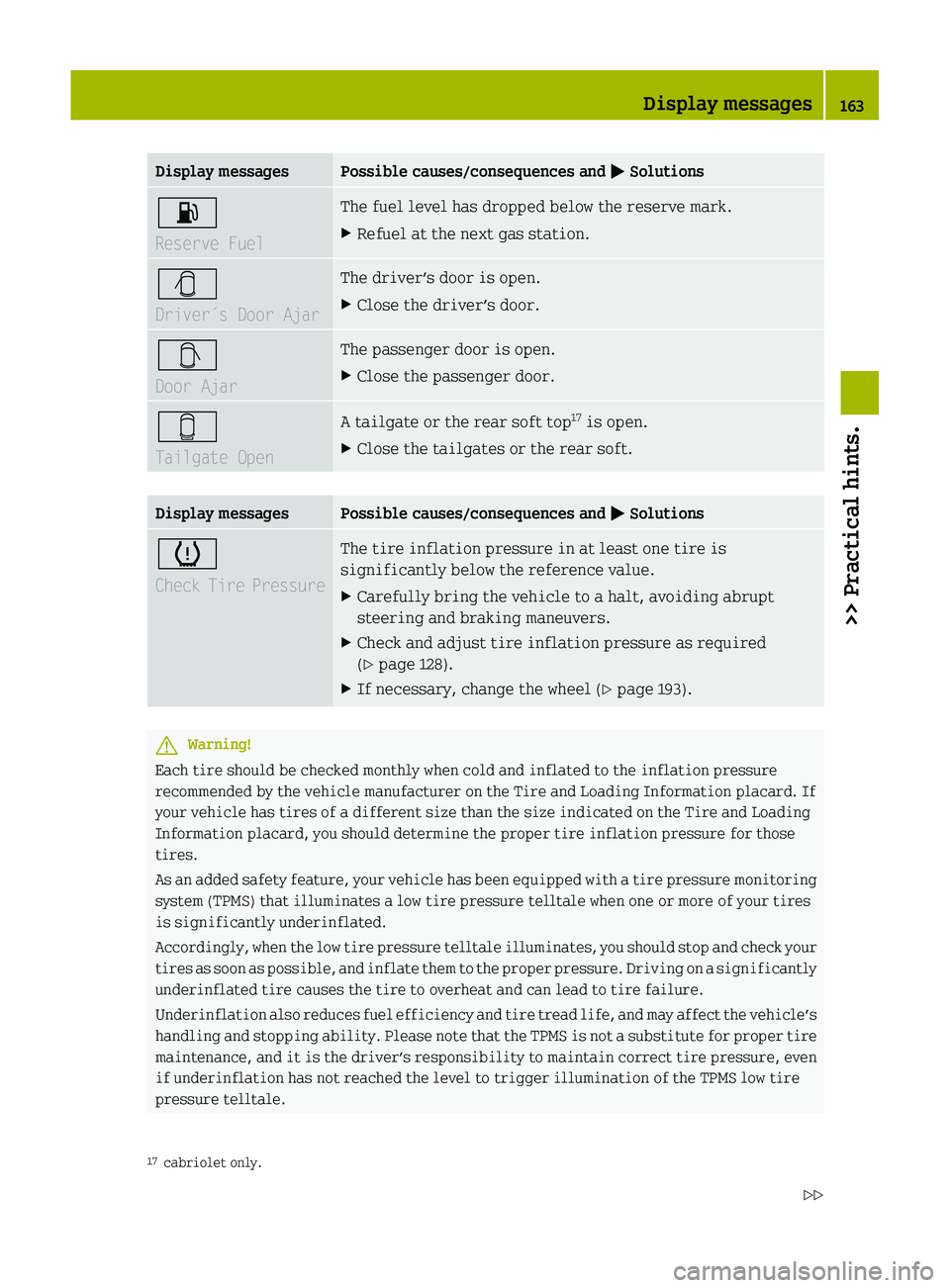
Display messagesPossible causes/consequences and 0050 Solutions00B6
Reserve FuelThe fuel level has dropped below the reserve mark.XRefuel at the next gas station.00DC
Driver´s Door AjarThe driver’s door is open.XClose the driver’s door.00DD
Door AjarThe passenger door is open.XClose the passenger door.00DB
Tailgate OpenA tailgate or the rear soft top 17
is open.XClose the tailgates or the rear soft.Display messagesPossible causes/consequences and 0050 Solutions0077
Check Tire PressureThe tire inflation pressure in at least one tire is
significantly below the reference value.XCarefully bring the vehicle to a halt, avoiding abrupt
steering and braking maneuvers.XCheck and adjust tire inflation pressure as required
( Y page 128).XIf necessary, change the wheel ( Y page 193).GWarning!
Each tire should be checked monthly when cold and inflated to the inflation pressure
recommended by the vehicle manufacturer on the Tire and Loading Information placard. If
your vehicle has tires of a different size than the size indicated on the Tire and Loading
Information placard, you should determine the proper tire inflation pressure for those
tires.
As an added safety feature, your vehicle has been equipped with a tire pressure monitoring
system (TPMS) that illuminates a low tire pressure telltale when one or more of your tires
is significantly underinflated.
Accordingly, when the low tire pressure telltale illuminates, you should stop and check your
tires as soon as possible, and inflate them to the proper pressure. Driving on a significantly
underinflated tire causes the tire to overheat and can lead to tire failure.
Underinflation also reduces fuel efficiency and tire tread life, and may affect the vehicle’s
handling and stopping ability. Please note that the TPMS is not a substitute for proper tire
maintenance, and it is the driver’s responsibility to maintain correct tire pressure, even
if underinflation has not reached the level to trigger illumination of the TPMS low tire
pressure telltale.
17 cabriolet only.Display messages163>> Practical hints.BA 451 USA, CA Edition A 2011; 1; 4, en-UShereepeVersion: 3.0.3.62010-05-11T15:12:26+02:00 - Seite 163Z
Page 166 of 228
Your vehicle has also been equipped with a TPMS malfunction indicator to indicate when
the system is not operating properly. The TPMS malfunction indicator is combined with the
low tire pressure telltale. When the system detects a malfunction, the telltale will flash for
approximately 1 minute and then remain continuously illuminated.
This sequence will continue upon subsequent vehicle start-ups as long as the malfunction
exists. When the malfunction indicator is illuminated, the system may not be able to detect
or signal low tire pressure as intended.
TPMS malfunctions may occur for a variety of reasons, including the installation of
incompatible replacement or alternate tires or wheels on the vehicle that prevent the TPMS
from functioning properly. Always check the TPMS malfunction telltale after replacing one
or more tires or wheels on your vehicle to ensure that the replacement or alternate tires
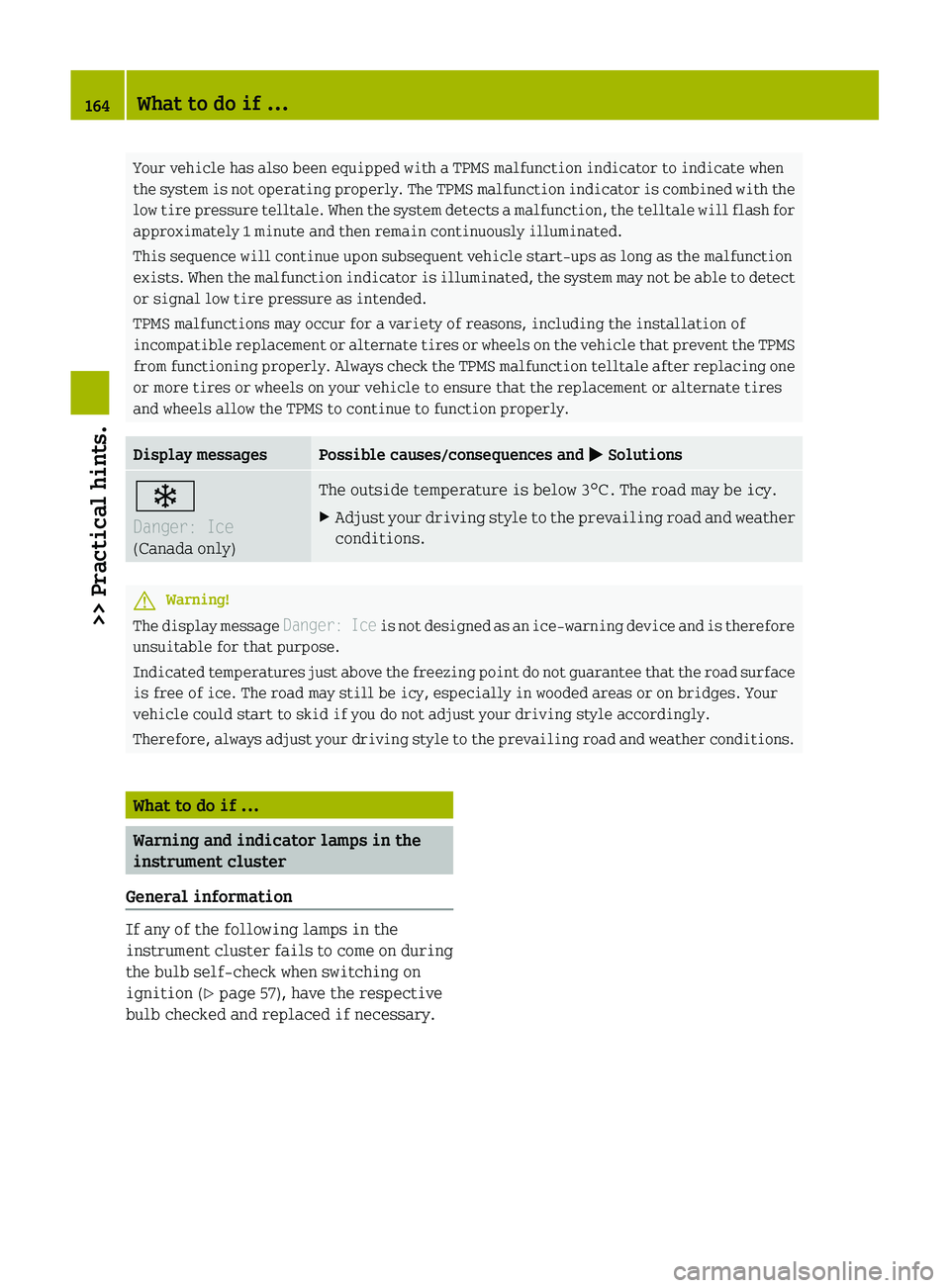
and wheels allow the TPMS to continue to function properly.Display messagesPossible causes/consequences and 0050 Solutions0048
Danger: Ice
(Canada only)The outside temperature is below 3 ¥. The road may be icy.XAdjust your driving style to the prevailing road and weather
conditions.GWarning!
The display message Danger: Ice is not designed as an ice-warning device and is therefore
unsuitable for that purpose.
Indicated temperatures just above the freezing point do not guarantee that the road surface
is free of ice. The road may still be icy, especially in wooded areas or on bridges. Your
vehicle could start to skid if you do not adjust your driving style accordingly.
Therefore, always adjust your driving style to the prevailing road and weather conditions.
What to do if ...
Warning and indicator lamps in the
instrument cluster
General information
If any of the following lamps in the
instrument cluster fails to come on during
the bulb self-check when switching on
ignition ( Y page 57), have the respective
bulb checked and replaced if necessary.
164What to do if ...>> Practical hints.
BA 451 USA, CA Edition A 2011; 1; 4, en-UShereepeVersion: 3.0.3.62010-05-11T15:12:26+02:00 - Seite 164
Page 167 of 228

BrakeProblemPossible causes/consequences and 0050 Solutions00EB (USA only)
0031 (Canada only)
The ABS indicator
lamp illuminates
while the engine is
running. There is a malfunction in the ABS system.XHave the ABS system checked at an authorized smart center
immediately.00EB (USA only)
0031 (Canada only)
The ABS indicator
lamp illuminates
together with the
brake warning lamp
while the engine is
running.The ABS system fails.XStop the vehicle immediately in a safe location.XDo not continue to drive.XTurn off the engine.XEngage the parking brake when leaving the vehicle.XContact Roadside Assistance or an authorized smart center.GWarning!
When the ABS system is malfunctioning, the wheels may lock during hard braking, reducing
steering capability and extending the braking distance.
When the ABS is switched off due to a malfunction, the ESP ®
is also switched off. The basic
driving and braking functions are still available.
The risk of your vehicle skidding is then increased in certain situations. You should
therefore always adapt your speed and driving style to the prevailing road and weather
conditions.
What to do if ...165>> Practical hints.BA 451 USA, CA Edition A 2011; 1; 4, en-UShereepeVersion: 3.0.3.62010-05-11T15:12:26+02:00 - Seite 165Z
Page 177 of 228
low tire pressure telltale. When the system detects a malfunction, the telltale will flash for
approximately 1 minute and then remain continuously illuminated.
This sequence will continue upon subsequent vehicle start-ups as long as the malfunction
exists. When the malfunction indicator is illuminated, the system may not be able to detect
or signal low tire pressure as intended.
TPMS malfunctions may occur for a variety of reasons, including the installation of
incompatible replacement or alternate tires or wheels on the vehicle that prevent the TPMS
from functioning properly. Always check the TPMS malfunction telltale after replacing one
or more tires or wheels on your vehicle to ensure that the replacement or alternate tires
and wheels allow the TPMS to continue to function properly.
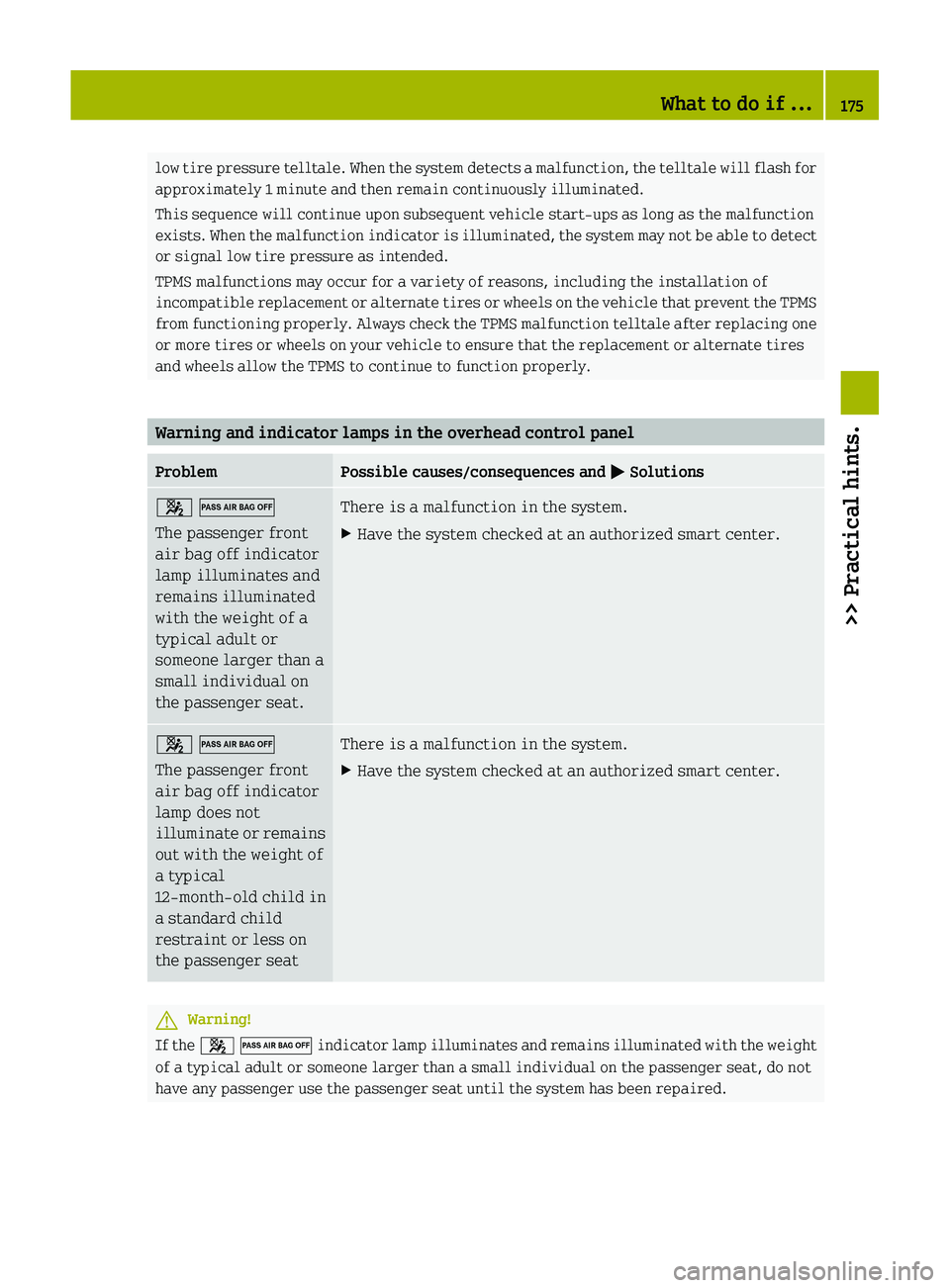
Warning and indicator lamps in the overhead control panel
ProblemPossible causes/consequences and 0050 Solutions007F 007B
The passenger front
air bag off indicator
lamp illuminates and
remains illuminated
with the weight of a
typical adult or
someone larger than a
small individual on
the passenger seat.There is a malfunction in the system.XHave the system checked at an authorized smart center.007F 007B
The passenger front
air bag off indicator
lamp does not
illuminate or remains
out with the weight of
a typical
12‑month‑old child in
a standard child
restraint or less on
the passenger seatThere is a malfunction in the system.XHave the system checked at an authorized smart center.GWarning!
If the 007F 007B indicator lamp illuminates and remains illuminated with the weight
of a typical adult or someone larger than a small individual on the passenger seat, do not
have any passenger use the passenger seat until the system has been repaired.
What to do if ...175>> Practical hints.BA 451 USA, CA Edition A 2011; 1; 4, en-UShereepeVersion: 3.0.3.62010-05-11T15:12:26+02:00 - Seite 175Z
Page 190 of 228
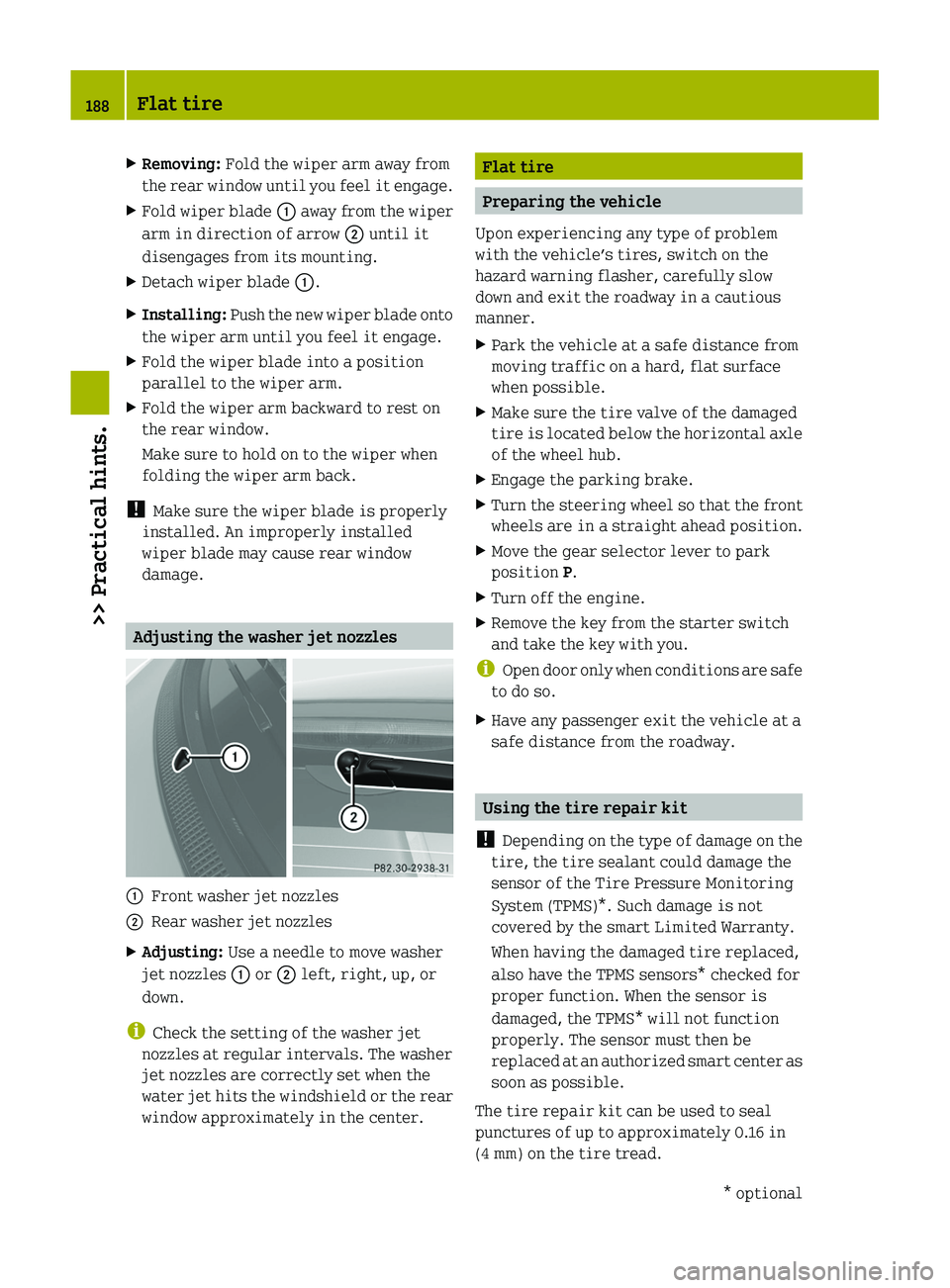
XRemoving: Fold the wiper arm away from
the rear window until you feel it engage.
XFold wiper blade \000F away from the wiper
arm in direction of arrow \000G until it
disengages from its mounting.
XDetach wiper blade \000F.XInstalling: Push the new wiper blade onto
the wiper arm until you feel it engage.
XFold the wiper blade into a position
parallel to the wiper arm.
XFold the wiper arm backward to rest on
the rear window.
Make sure to hold on to the wiper when
folding the wiper arm back.
! Make sure the wiper blade is properly
installed. An improperly installed
wiper blade may cause rear window
damage.
Adjusting the washer jet nozzles
\000FFront washer jet nozzles\000GRear washer jet nozzlesXAdjusting: Use a needle to move washer
jet nozzles \000F or \000G left, right, up, or
down.
iCheck the setting of the washer jet
nozzles at regular intervals. The washer
jet nozzles are correctly set when the
water jet hits the windshield or the rear
window approximately in the center.
Flat tire
Preparing the vehicle
Upon experiencing any type of problem
with the vehicle’s tires, switch on the
hazard warning flasher, carefully slow
down and exit the roadway in a cautious
manner.
XPark the vehicle at a safe distance from
moving traffic on a hard, flat surface
when possible.
XMake sure the tire valve of the damaged
tire is located below the horizontal axle
of the wheel hub.
XEngage the parking brake.XTurn the steering wheel so that the front
wheels are in a straight ahead position.
XMove the gear selector lever to park
position P.
XTurn off the engine.XRemove the key from the starter switch
and take the key with you.
iOpen door only when conditions are safe
to do so.
XHave any passenger exit the vehicle at a
safe distance from the roadway.
Using the tire repair kit
! Depending on the type of damage on the
tire, the tire sealant could damage the
sensor of the Tire Pressure Monitoring
System (TPMS)*. Such damage is not
covered by the smart Limited Warranty.
When having the damaged tire replaced,
also have the TPMS sensors* checked for
proper function. When the sensor is
damaged, the TPMS* will not function
properly. The sensor must then be
replaced at an authorized smart center as
soon as possible.
The tire repair kit can be used to seal
punctures of up to approximately 0.16 in
(4 mm) on the tire tread.
188Flat tire>> Practical hints.* optionalBA 451 USA, CA Edition A 2011; 1; 4, en-UShereepeVersion: 3.0.3.62010-05-11T15:12:26+02:00 - Seite 188
Page 191 of 228
The tire repair kit enables you to drive on
the sealed tire to the nearest authorized
smart center.XYou should have the sealed tire replaced
at an authorized smart center.GWarning!
Take care not to allow the contents of the
tire sealant to come in contact with hair,
eyes or clothing. The tire sealant is
harmful if inhaled, swallowed or absorbed
through the skin - causes skin, eye and
respiratory irritation. Wear gloves while
using this product if they are available.
Any contact with eyes or skin should be
flushed immediately with plenty of water.
If clothing comes in contact with the tire
sealant, change clothing as soon as
possible.
In case of allergic reaction or rash, consult
a physician immediately.
Notes
R Small tire punctures, particularly those
in the tread, can be sealed with the tire
sealant.
R The tire sealant can be used in ambient
temperatures from ‑4 ¦ (‑20 ¥) to
104 ¦ (+40 ¥).
R Do not remove any foreign objects such as
nails or screws that have penetrated the
tire.
R Do not use the tire sealant if the tire has
been damaged by being driven when
insufficiently inflated (e.g. bumps,
cuts, cracks etc. on the tire).
R Allow escaped tire sealant to dry, then
peel it off.
R Immediately wash all painted surfaces
that came into contact with the tire
sealant using a damp cloth.
R Avoid skin and eye contact with the tire
sealant.
R Do not swallow the tire sealant.
RAllow the tire sealant that is inside the
damaged tire to dry and dispose of
together with the tire.
R Do not use the tire sealant after the
expiration date has elapsed (see top of
container).
Instead, have it replaced at an
authorized smart center.GWarning!
The tire sealant is a limited repair device.
The tire sealant cannot be used for cuts or
punctures larger than approximately
0.16 in (4 mm) and tire damage caused by
driving with extremely low tire inflation
pressure, or on a flat tire, or a damaged
wheel.
Do not drive the vehicle under such
circumstances.
If you are unsure of the condition of the tire
or have any question whatsoever about its
suitability for driving contact the nearest
smart center for assistance or call
Roadside Assistance.
GWarning!
Please review the instructions below for
using the tire repair kit. If you are not
confident that you can competently follow
the instructions for using this kit, do not
use the kit, but instead call for Roadside
Assistance.
GWarning!
Keep the tire sealant out of reach of
children. If swallowed, rinse mouth
immediately with plenty of water and drink
plenty of water.
Do not induce vomiting!
Consult a physician immediately.
Keep away from open flame, heat source or
sparks. Do not smoke.
Flat tire189>> Practical hints.BA 451 USA, CA Edition A 2011; 1; 4, en-UShereepeVersion: 3.0.3.62010-05-11T15:12:26+02:00 - Seite 189Z
Page 194 of 228
XAfter driving for about 1.8 miles (3 km)
or ten minutes, take all of the
appropriate safety precautions and then
take the tire repair kit from the vehicle.XScrew the end of filler hose 0088 onto tire
valve 0072.XCheck the tire inflation pressure using
pressure gauge 0047.GWarning!
If tire inflation pressure has fallen below
130 kpa (1.3 bar, 20 psi) do not continue to
drive the vehicle.
Park your vehicle safely away from the
roadway and contact the nearest smart
center or call Roadside Assistance.
Have the damaged tire replaced.
XIf the tire inflation pressure is at least
130 kpa (1.3 bar, 20 psi), inflate or deflate
the tire to correct tire inflation
pressure (see Tire and Loading
Information placard located on the
driver’s door B‑pillar).
R To increase the tire inflation
pressure: Switch on the electric air
pump.
R To decrease the tire inflation
pressure: Open vent screw 008A. Recheck
the tire inflation pressure with the
electric air pump’s pressure gauge.XAfter checking the tire inflation
pressure, unscrew the end of filler
hose 0088 from tire valve 0072.XPlug filler hose with the stopper.XPlace the tire repair kit securely in the
vehicle.XScrew the valve cap onto the tire valve.
! The manufacturer is unable to
guarantee that all tire punctures can be
repaired with the tire repair kit, in
particular cuts or perforations larger
than approximately 0.16 in (4 mm) or away
from the tire’s tread. The manufacturer
is not liable for damage sustained
through improper use of the tire repair
kit.GWarning!
Follow recommended tire inflation
pressures.
Do not underinflate tires. Underinflated
tires wear excessively and/or unevenly,
adversely affect handling and fuel
economy, and are more likely to fail from
being overheated.
Do not overinflate tires. Overinflated
tires can adversely affect handling and
ride comfort, wear unevenly, increase
stopping distance, and result in sudden
deflation (blowout) because they are more
likely to become punctured or damaged by
road debris, potholes etc.
Do not overload the tires by exceeding the
specified load limit as indicated on the
Tire and Loading Information placard on
the driver’s door B‑pillar. Overloading the
tires can overheat them, possibly causing
a blowout. Overloading the tires can also
result in handling or steering problems, or
brake failure.
XDrive to the nearest authorized smart
center, to have the damaged tire
replaced.XContact an authorized smart center as
soon as possible to obtain a new filler
hose and a new tire sealant container.XBring used tire sealant materials to an
authorized smart center for proper
disposal.XReplace your tire sealant container
every 4 years. Replacement containers
are available at any authorized smart
center.GWarning!
After changing a tire, contact a smart
center to make sure the bolts holding the
wheel to the car are tight enough.
Otherwise, the wheels could come off. Each
192Flat tire>> Practical hints.
BA 451 USA, CA Edition A 2011; 1; 4, en-UShereepeVersion: 3.0.3.62010-05-11T15:12:26+02:00 - Seite 192
Page 195 of 228
bolt should be tightened to a torque of
81 lb‑ft (110 Nm).
Wheel change
Preparing the vehicle
XPark the vehicle on a hard, flat surface
when possible.XTurn on the hazard warning flasher.XTurn the steering wheel so that the front
wheels are in a straight-ahead position.XEngage the parking brake.XMove the gear selector lever to park
position P.XTurn off the engine.XHave any passenger exit the vehicle at a
safe distance from the roadway.
Removing the wheel
GWarning!
When jacking up the vehicle, only use a
suitable jack. Observe the manufacturer’s
safety instructions.
The jack must be designed for jacking up
this vehicle at the jack take-up brackets
built into both sides of the vehicle.
The jack is intended only for lifting the
vehicle briefly for wheel changes. It is not
suited for performing maintenance work
under the vehicle. To help avoid personal
injury, use the jack only to lift the vehicle
during a wheel change.
Never get beneath the vehicle while it is
supported by the jack. Keep hands and feet
away from the area under the lifted vehicle.
Always lower the vehicle onto sufficient
capacity jackstands before working under
the vehicle.
Always firmly engage the parking brake and
block the wheels with wheel chocks or other
sizeable objects before raising the
vehicle with the jack. Do not release the
parking brake while the vehicle is raised.
Make sure the ground on which the vehicle
is standing and where you place the jack is
solid, level and not slippery. If necessary,
use a large underlay. On slippery surfaces,
such as tiled floors, you should use a non-
slip underlay, for example a rubber mat.
Do not use wooden blocks or similar objects
to support the jack. Otherwise the jack may
not be able to achieve its load-bearing
capacity if it is not at its full height.
The jack must always be vertical when in
use. Always try to use the jack on level
surface. If you do not position the jack
correctly, the vehicle can fall off the jack
and seriously or fatally injure you or
others.
Never start the engine when the vehicle is
raised.
Also observe the notes on the jack.XMake sure to have a suitable jack 18
, wheel
wrench 18
and wheel chock 18
.
Contact an authorized smart center for
information on which jack and wheel
wrench are required.XPrepare the vehicle as described
( Y page 193).XMake sure the surface is level.
Prevent the vehicle from rolling away by
blocking wheels with wheel chocks or other
sizeable objects:
XPlace one wheel chock or other sizeable
object in front of and another wheel
chock or other sizeable object behind
the wheel that is diagonally opposite to
the wheel being changed.18 Not included and not available as factory equipment.Wheel change193>> Practical hints.BA 451 USA, CA Edition A 2011; 1; 4, en-UShereepeVersion: 3.0.3.62010-05-11T15:12:26+02:00 - Seite 193Z