coolant temperature SMART FORTWO COUPE 2011 Owners Manual
[x] Cancel search | Manufacturer: SMART, Model Year: 2011, Model line: FORTWO COUPE, Model: SMART FORTWO COUPE 2011Pages: 228, PDF Size: 11.48 MB
Page 7 of 228
C
CAC (Customer Assistance Center) ...... 16
California retail buyers and
lessees, important notice for ........... 14
Can holder see Cup holder
Cargo compartment cover blind ........ 108
Catalytic converter ....................... 148
CD player ..................................... 99
Center console ............................... 27
Central locking Automatic ................................ 53
Certification label ....................... 214
Children in the vehicle ................... 42
Air bags .................................. 33
Indicator lamp, passenger front
air bag off .......................... 41, 175
Infant and child restraint
systems ................................... 43
OCS (Occupant Classification
System) ................................... 39
Safety notes ............................. 42
Tether anchorage points .............44
Child safety
see Children in the vehicle
Cigarette lighter .......................... 115
Climate control see HVAC ................................ 103
Clock ........................................... 89
Cockpit ........................................ 21
Coin holder .................................. 111
Cold tire inflation pressure ........... 143
Combination switch ........................ 67
Control system Consumption menu .....................96
Control lever ............................ 93
Introduction ............................ 93
Menus and submenus ...................95
Messages menu .......................... 97
Multifunction display ................93
Odometer menu .......................... 95
Reset menu ............................... 96
Settings menu ........................... 97
Start menu ............................... 96
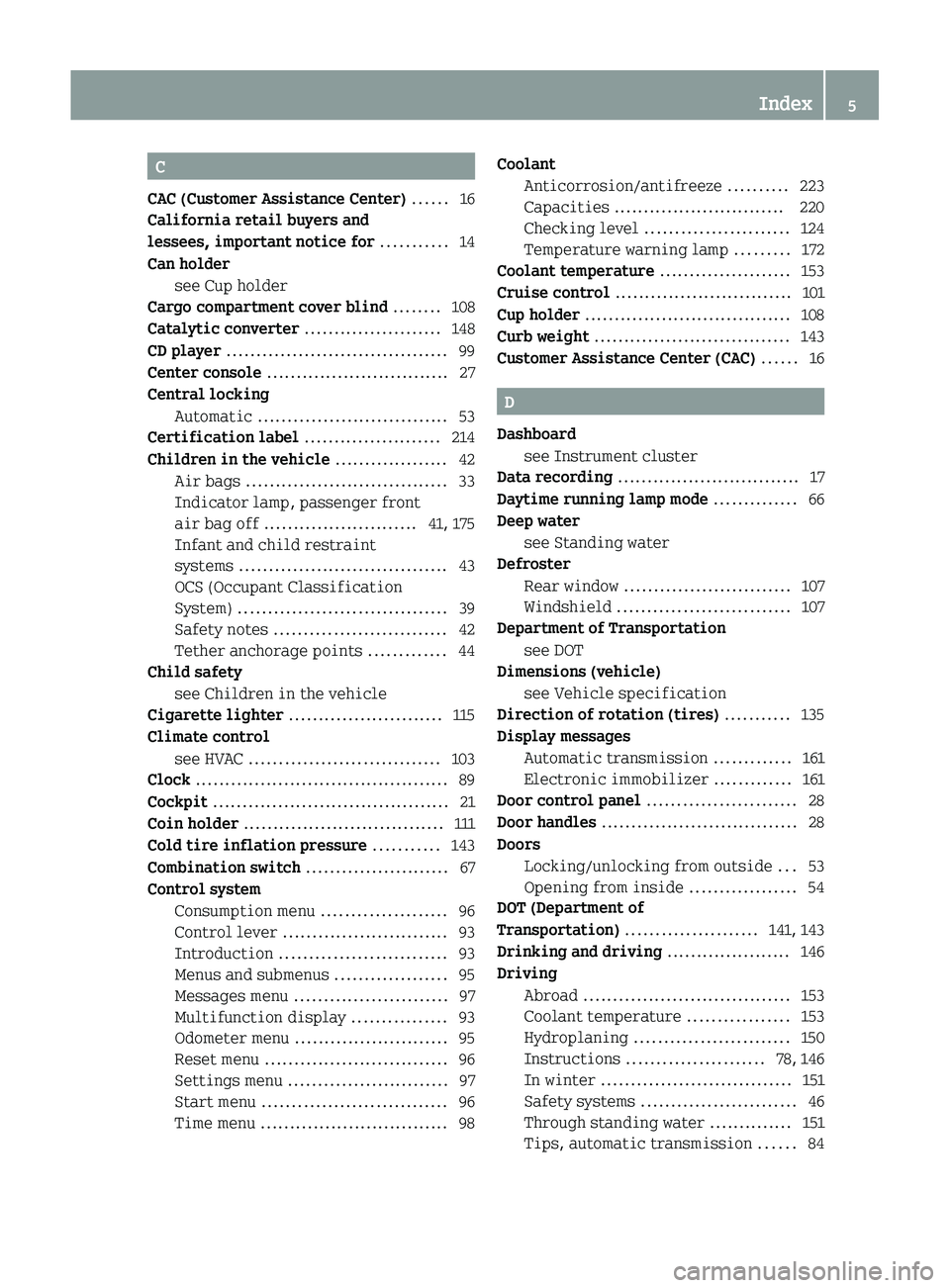
Time menu ................................ 98Coolant
Anticorrosion/antifreeze ..........223
Capacities ............................. 220
Checking level ........................ 124
Temperature warning lamp .........172
Coolant temperature ...................... 153
Cruise control .............................. 101
Cup holder ................................... 108
Curb weight ................................. 143
Customer Assistance Center (CAC) ...... 16
D
Dashboard see Instrument cluster
Data recording ............................... 17
Daytime running lamp mode .............. 66
Deep water see Standing water
Defroster
Rear window ............................ 107
Windshield ............................. 107
Department of Transportation
see DOT
Dimensions (vehicle)
see Vehicle specification
Direction of rotation (tires) ........... 135
Display messages Automatic transmission .............161
Electronic immobilizer .............161
Door control panel ......................... 28
Door handles ................................. 28
Doors Locking/unlocking from outside ...53
Opening from inside ..................54
DOT (Department of
Transportation) ...................... 141, 143
Drinking and driving ..................... 146
Driving Abroad ................................... 153
Coolant temperature .................153
Hydroplaning .......................... 150
Instructions ....................... 78, 146
In winter ................................ 151
Safety systems .......................... 46
Through standing water .............. 151
Tips, automatic transmission ......84
Index5BA 451 USA, CA Edition A 2011; 1; 4, en-UShereepeVersion: 3.0.3.62010-05-11T15:12:26+02:00 - Seite 5
Page 10 of 228
L
Labels ........................................ 213
Emission control information .....213
Lamps, exterior
Exterior lamp switch ..................64
Switching on/off ....................... 64
Lamps, indicator and warning
ABS ....................................... 165
Battery ................................... 170
Brakes ................................... 166
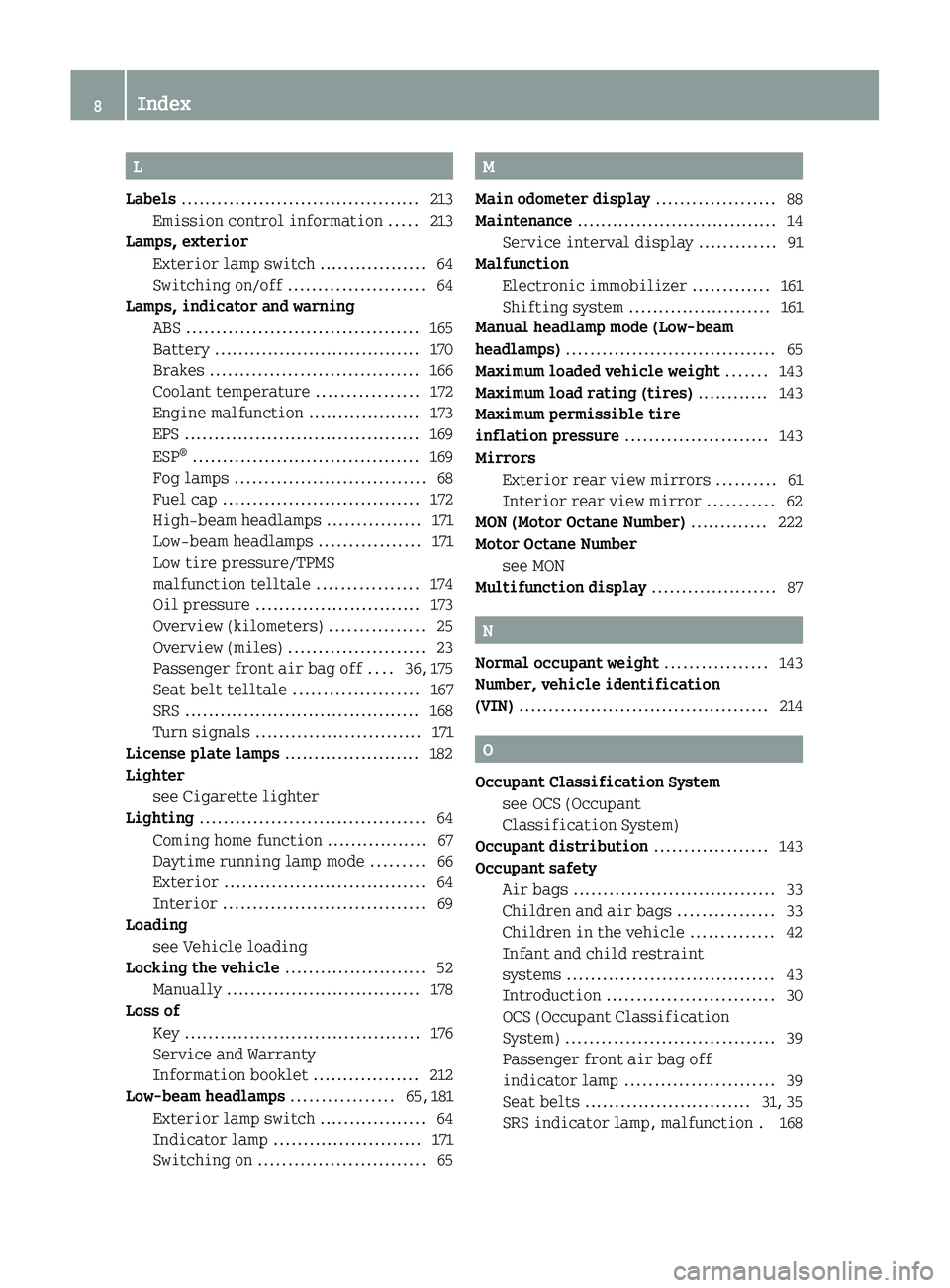
Coolant temperature .................172
Engine malfunction ................... 173
EPS ........................................ 169
ESP ®
...................................... 169
Fog lamps ................................ 68
Fuel cap ................................. 172
High-beam headlamps ................171
Low-beam headlamps .................171
Low tire pressure/TPMS
malfunction telltale .................174
Oil pressure ............................ 173
Overview (kilometers) ................25
Overview (miles) ....................... 23
Passenger front air bag off ....36, 175
Seat belt telltale ..................... 167
SRS ........................................ 168
Turn signals ............................ 171
License plate lamps ....................... 182
Lighter see Cigarette lighter
Lighting ...................................... 64
Coming home function ................. 67
Daytime running lamp mode .........66
Exterior .................................. 64
Interior .................................. 69
Loading
see Vehicle loading
Locking the vehicle ........................ 52
Manually ................................. 178
Loss of
Key ........................................ 176
Service and Warranty
Information booklet ..................212
Low-beam headlamps ................. 65, 181
Exterior lamp switch ..................64
Indicator lamp ......................... 171
Switching on ............................ 65M
Main odometer display .................... 88
Maintenance .................................. 14
Service interval display .............91
Malfunction
Electronic immobilizer .............161
Shifting system ........................ 161
Manual headlamp mode (Low-beam
headlamps) ................................... 65
Maximum loaded vehicle weight ....... 143
Maximum load rating (tires) ............ 143
Maximum permissible tire
inflation pressure ........................ 143
Mirrors Exterior rear view mirrors ..........61
Interior rear view mirror ...........62
MON (Motor Octane Number) ............. 222
Motor Octane Number see MON
Multifunction display ..................... 87
N
Normal occupant weight ................. 143
Number, vehicle identification
(VIN) .......................................... 214
O
Occupant Classification System see OCS (Occupant
Classification System)
Occupant distribution ................... 143
Occupant safety Air bags .................................. 33
Children and air bags ................33
Children in the vehicle ..............42
Infant and child restraint
systems ................................... 43
Introduction ............................ 30
OCS (Occupant Classification
System) ................................... 39
Passenger front air bag off
indicator lamp ......................... 39
Seat belts ............................ 31, 35
SRS indicator lamp, malfunction . 168
8IndexBA 451 USA, CA Edition A 2011; 1; 4, en-UShereepeVersion: 3.0.3.62010-05-11T15:12:26+02:00 - Seite 8
Page 13 of 228
Technical data (dimensions)see Vehicle specification
Technical data (weights)
see Vehicle specification
Temperature
Coolant .................................. 153
Interior temperature ................105
Outside ................................... 89
Tether anchorage points
see Children in the vehicle
Thorax-pelvis side air bags ............. 38
Tightening torque Wheels ................................... 138
TIN (Tire Identification
Number) ................................. 141, 144
Tire and Loading Information
placard ....................................... 132
Tire and loading terminology .......... 142
Tire Identification Number see TIN
Tire inflation pressure
Checking ................................ 128
Important notes on ....................128
Placard on driver’s door B-
pillar .................................... 132
Tire labeling ............................... 138
Tire load rating ........................... 144
Tire ply composition and material
used ........................................... 144
Tire Pressure Monitoring System
(TPMS) ........................................ 129
Tire repair kit ....................... 160, 188
Tires .................................... 126, 217
Air pressure ............................ 127
Care and maintenance ................ 135
Cleaning ................................ 136
Direction of rotation, spinning ..135
Driving instructions ................149
Flat tire ................................. 188
Important notes on tire
inflation pressure .................... 128
Inflation pressure ..............128, 129
Information placard .................132
Inspection .............................. 136
Labeling ................................ 138
Load rating ............................. 144Ply composition and material
used ...................................... 144
Problems under-/overinflation ...128
Retreads ................................. 126
Rims and tires (technical data) ...217
Rotation ................................. 138
Service life ............................ 136
Sizes ..................................... 217
Snow chains ............................ 145
Speed rating ................ 140, 144, 150
Storing .................................. 136
Temperature ...................... 128, 137
Terminology ............................ 142
Tire Identification Number ..141, 144
Tire Pressure Monitoring
System (TPMS) .......................... 129
Traction ...................... 137, 144, 150
Tread ..................................... 144
Tread depth ....................... 136, 145
Treadwear indicators ..........136, 144
Vehicle maximum load on ...........145
Wheel change ........................... 193
Winter tires ...................... 145, 217
Tire speed rating .................... 140, 144
Top tether see Children in the vehicle
Total load limit ........................... 144
Tow-away alarm ............................. 49
Towing ....................................... 201
Traction ................................ 144, 150
Transmission see Automatic transmission
Transmission position indicator ...... 88
Transmitting power values .............. 212
Traveling abroad .......................... 153
Tread (tires) ................................ 144
Tread depth (tires) .................. 136, 145
Treadwear indicators (tires) ..... 136, 144
Trip odometer, resetting ................. 91
Turning off the engine .................... 81
Turn signal lamps .......................... 181
Turn signals .................................. 67
Indicator lamps ....................... 171Index11BA 451 USA, CA Edition A 2011; 1; 4, en-UShereepeVersion: 3.0.3.62010-05-11T15:12:26+02:00 - Seite 11
Page 25 of 228
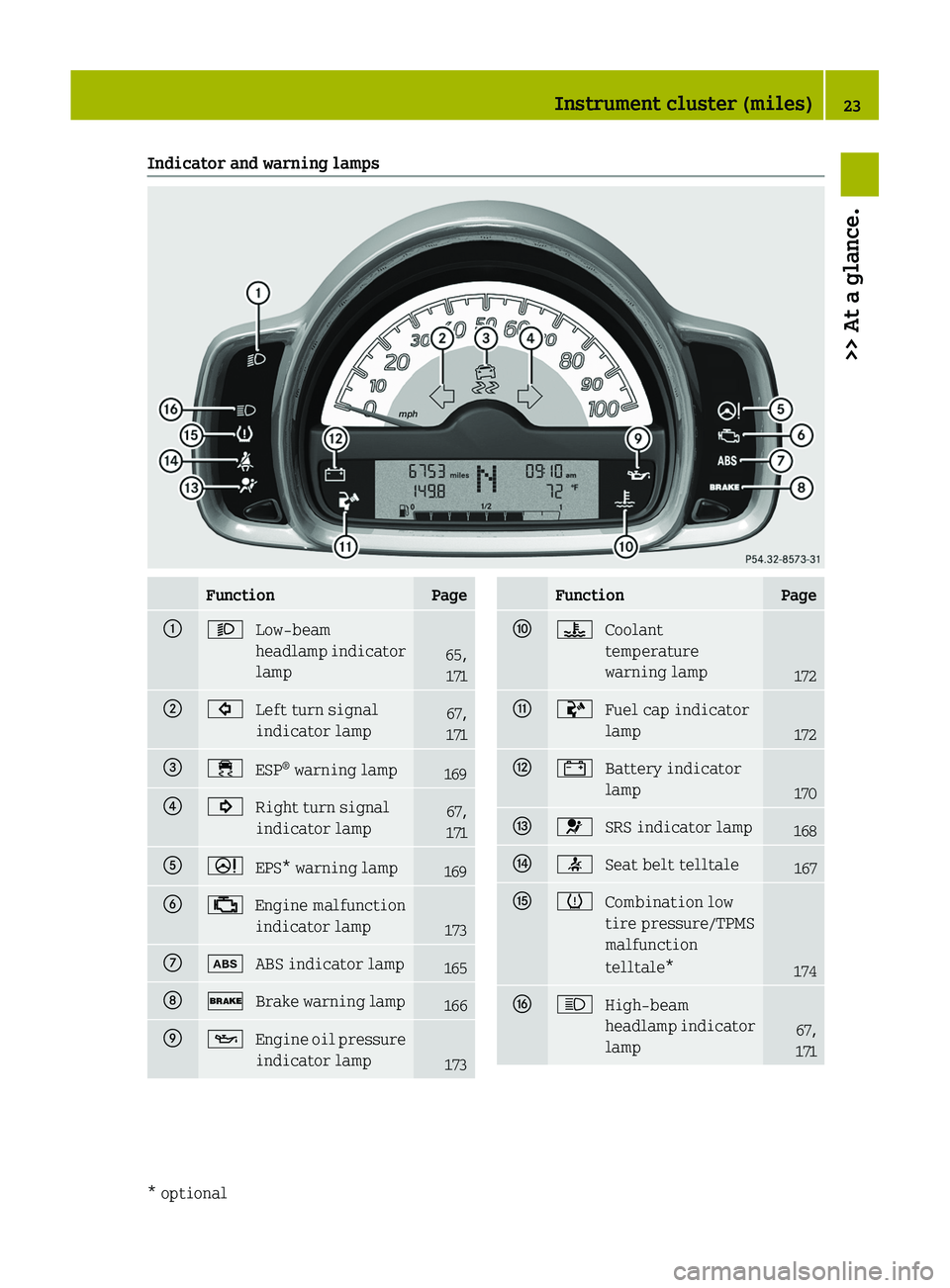
Indicator and warning lampsFunctionPage00460065Low‑beam
headlamp indicator
lamp
65, 171
00470026Left turn signal
indicator lamp67, 171008A00F2ESP ®
warning lamp16900880024Right turn signal
indicator lamp67, 17100860052EPS* warning lamp169008700BBEngine malfunction
indicator lamp
173
006E00EBABS indicator lamp165006F0027Brake warning lamp166007000B5Engine oil pressure
indicator lamp
173
FunctionPage007100AECoolant
temperature
warning lamp
172
007200ACFuel cap indicator
lamp
172
0073003FBattery indicator
lamp
170
00740081SRS indicator lamp16800750082Seat belt telltale16700760077Combination low
tire pressure/TPMS
malfunction
telltale*
174
00770063High‑beam
headlamp indicator
lamp
67, 171
Instrument cluster (miles)23>> At a glance.* optionalBA 451 USA, CA Edition A 2011; 1; 4, en-UShereepeVersion: 3.0.3.62010-05-11T15:12:26+02:00 - Seite 23
Page 27 of 228
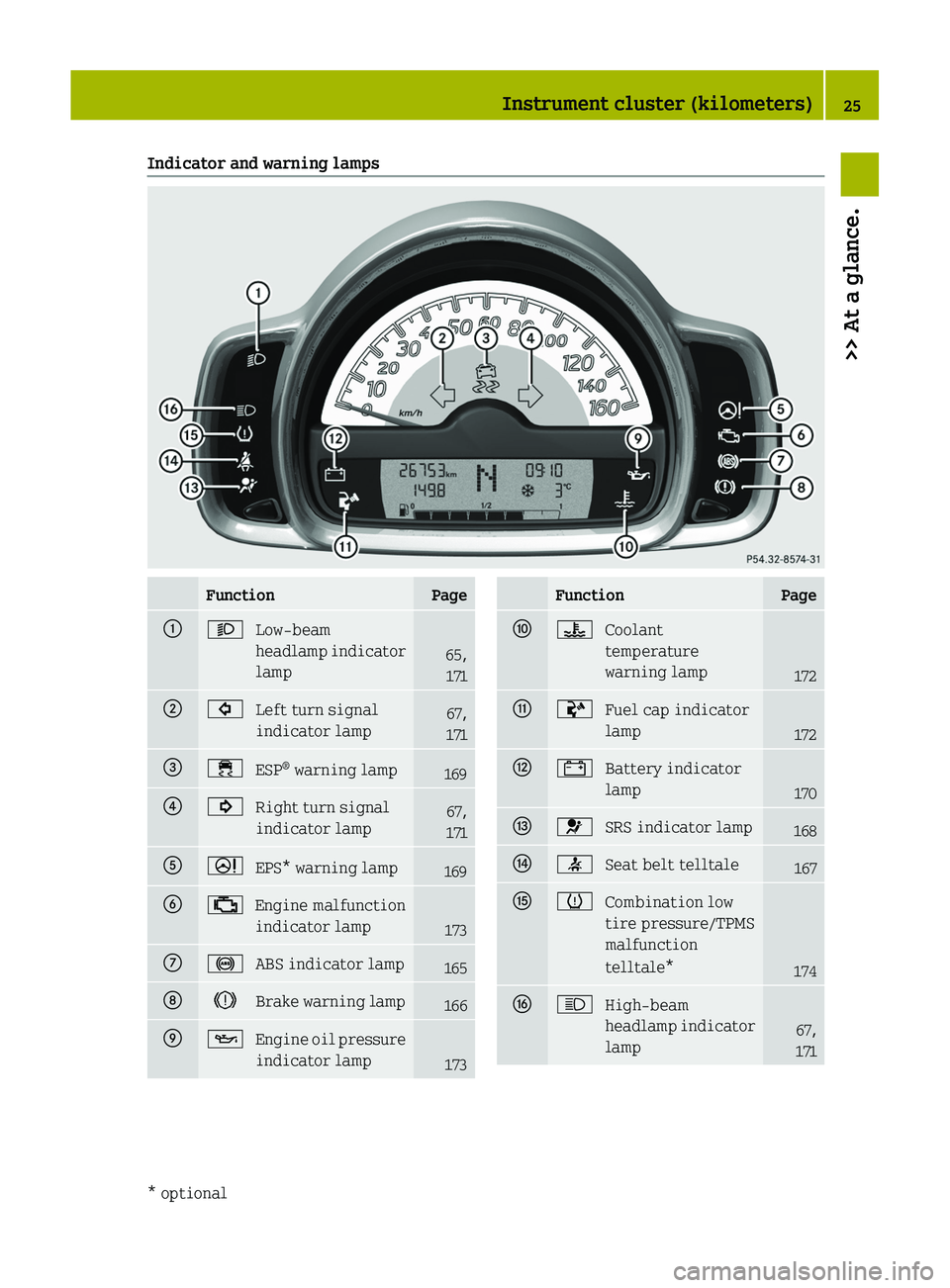
Indicator and warning lampsFunctionPage00460065Low‑beam
headlamp indicator
lamp
65, 171
00470026Left turn signal
indicator lamp67, 171008A00F2ESP ®
warning lamp16900880024Right turn signal
indicator lamp67, 17100860052EPS* warning lamp169008700BBEngine malfunction
indicator lamp
173
006E0031ABS indicator lamp165006F0052Brake warning lamp166007000B5Engine oil pressure
indicator lamp
173
FunctionPage007100AECoolant
temperature
warning lamp
172
007200ACFuel cap indicator
lamp
172
0073003FBattery indicator
lamp
170
00740081SRS indicator lamp16800750082Seat belt telltale16700760077Combination low
tire pressure/TPMS
malfunction
telltale*
174
00770063High‑beam
headlamp indicator
lamp
67, 171
Instrument cluster (kilometers)25>> At a glance.* optionalBA 451 USA, CA Edition A 2011; 1; 4, en-UShereepeVersion: 3.0.3.62010-05-11T15:12:26+02:00 - Seite 25
Page 107 of 228
Air conditioning with climate control*
Control panel (Y page 104).
XMake sure the engine is running.XSwitching on: Push air volume
control 0046 to level 1 or higher.XPress air conditioning switch 0047.
The indicator lamp in air conditioning
switch 0047 comes on.XSwitching off: Press air conditioning
switch 0047 once more.
The indicator lamp in air conditioning
switch 0047 goes out.
i
The stored status is restored, if you
switch on the ignition again.
i The air condition will be suspended
temporarily:
R if the engine speed is too low
R when driving off
The air condition is switched off:
R at a coolant temperature of more than
239 ¦ (115 ¥)
R at outside temperatures below 38 ¦
(3 ¥ )
Setting the temperature
Heating
Control panel ( Y page 104).
i You should raise or lower the
temperature setting in small
increments.
XIncreasing or decreasing: Push
temperature control 0088 up or down.
Rapid cooling
XPush air volume control 0046 fully up.XTurn air distribution control 008A to
position 009E.XPush temperature control 0088 fully down.XAdjust the air vents as desired.
Rapid heating
XPush air volume control 0046 to level 3.XTurn air distribution control 008A to a
position between 0087 and 009D .XPush temperature control 0088 fully up.XAdjust the air vents towards the
occupants.
Air conditioning with climate control*
Control panel ( Y page 104).
i You should raise or lower the
temperature setting in small
increments, preferably starting at
70 ¦ (21 ¥).
XIncreasing or decreasing: Push
temperature control 0086 up or down.
Adjusting air vents
GWarning!
When operating the heating or air
conditioning with climate control*, the
air that enters the passenger compartment
through the air vents can be very hot or very
cold (depending on the set temperature).
This may cause burns or frostbite on
unprotected skin in the immediate area of
the air vents. Always keep sufficient
distance between unprotected parts of the
body and the air vents. If necessary, use the
air distribution control to direct the air
to air vents in the vehicle interior that are
not in the immediate area of unprotected
skin.
To make sure the heating or air
conditioning with climate control* works
properly, please observe the following:
R Keep the air intake grill free from
deposits, e.g. ice or snow, to ensure that
HVAC (Heating, Ventilation, Air Conditioning)105>> Controls.* optionalBA 451 USA, CA Edition A 2011; 1; 4, en-UShereepeVersion: 3.0.3.62010-05-11T15:12:26+02:00 - Seite 105Z
Page 121 of 228
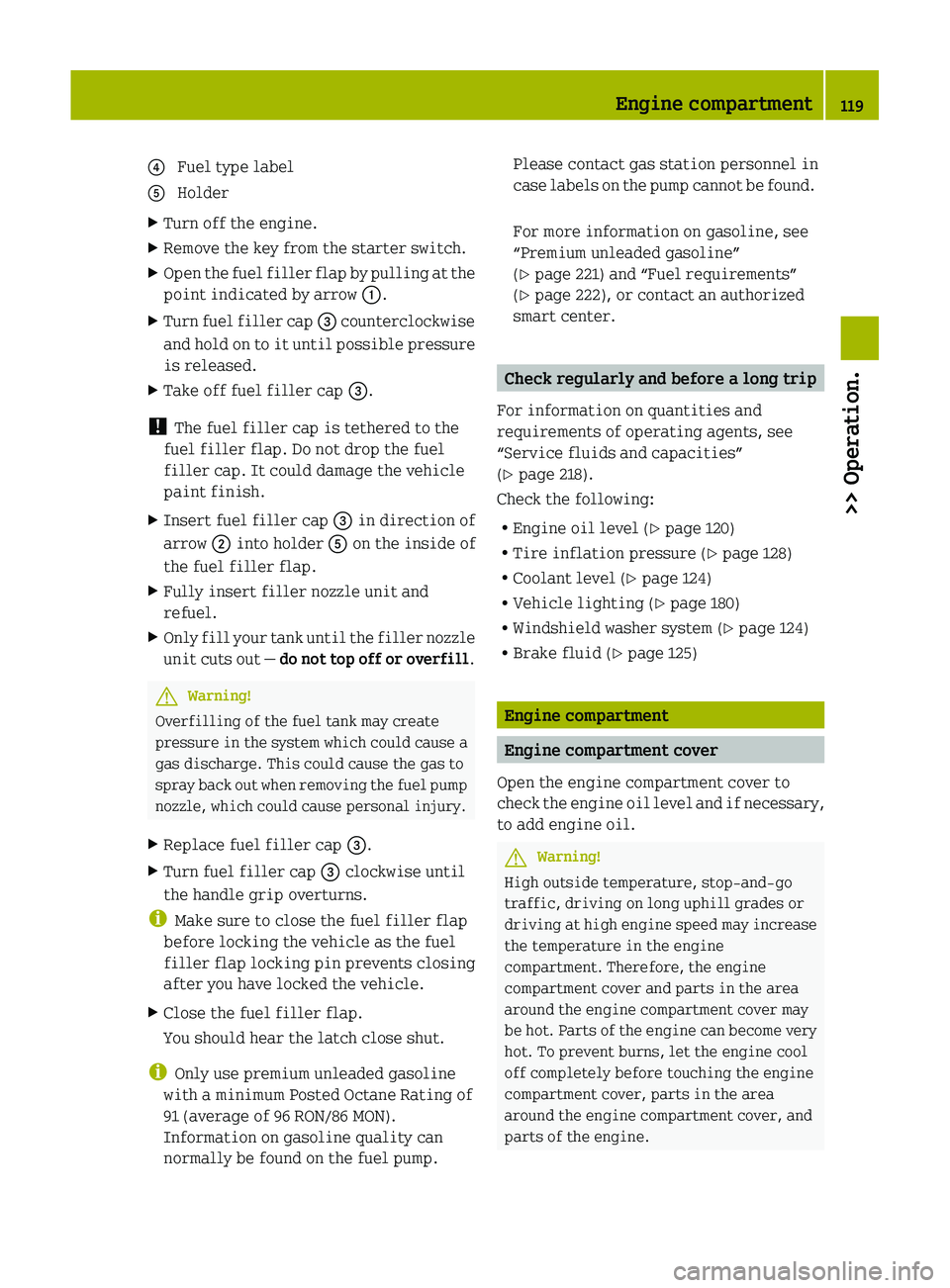
0088 Fuel type label0086 HolderXTurn off the engine.XRemove the key from the starter switch.XOpen the fuel filler flap by pulling at the
point indicated by arrow 0046.XTurn fuel filler cap 008A counterclockwise
and hold on to it until possible pressure
is released.XTake off fuel filler cap 008A.
!
The fuel filler cap is tethered to the
fuel filler flap. Do not drop the fuel
filler cap. It could damage the vehicle
paint finish.
XInsert fuel filler cap 008A in direction of
arrow 0047 into holder 0086 on the inside of
the fuel filler flap.XFully insert filler nozzle unit and
refuel.XOnly fill your tank until the filler nozzle
unit cuts out — do not top off or overfill .GWarning!
Overfilling of the fuel tank may create
pressure in the system which could cause a
gas discharge. This could cause the gas to
spray back out when removing the fuel pump
nozzle, which could cause personal injury.
XReplace fuel filler cap 008A.XTurn fuel filler cap 008A clockwise until
the handle grip overturns.
i Make sure to close the fuel filler flap
before locking the vehicle as the fuel
filler flap locking pin prevents closing
after you have locked the vehicle.
XClose the fuel filler flap.
You should hear the latch close shut.
i Only use premium unleaded gasoline
with a minimum Posted Octane Rating of
91 (average of 96 RON/86 MON).
Information on gasoline quality can
normally be found on the fuel pump.
Please contact gas station personnel in
case labels on the pump cannot be found.
For more information on gasoline, see
“Premium unleaded gasoline”
( Y page 221) and “Fuel requirements”
( Y page 222), or contact an authorized
smart center.
Check regularly and before a long trip
For information on quantities and
requirements of operating agents, see
“Service fluids and capacities”
( Y page 218).
Check the following:
R Engine oil level ( Y page 120)
R Tire inflation pressure ( Y page 128)
R Coolant level ( Y page 124)
R Vehicle lighting ( Y page 180)
R Windshield washer system ( Y page 124)
R Brake fluid ( Y page 125)
Engine compartment
Engine compartment cover
Open the engine compartment cover to
check the engine oil level and if necessary,
to add engine oil.
GWarning!
High outside temperature, stop-and-go
traffic, driving on long uphill grades or
driving at high engine speed may increase
the temperature in the engine
compartment. Therefore, the engine
compartment cover and parts in the area
around the engine compartment cover may
be hot. Parts of the engine can become very
hot. To prevent burns, let the engine cool
off completely before touching the engine
compartment cover, parts in the area
around the engine compartment cover, and
parts of the engine.
Engine compartment119>> Operation.BA 451 USA, CA Edition A 2011; 1; 4, en-UShereepeVersion: 3.0.3.62010-05-11T15:12:26+02:00 - Seite 119Z
Page 122 of 228
XTurn off the engine.XEngage the parking brake.XOpen the tailgate.GWarning!
Exercise extreme caution if you see flames
or smoke coming from the engine
compartment. Move away from the vehicle
and call the fire department.
If the coolant temperature warning lamp
indicates that the engine is overheated, do
not attempt to open the engine compartment
cover. Move away from the vehicle and wait
until the engine has cooled before opening
the engine compartment.
GWarning!
To help prevent personal injury, stay clear
of moving parts when the engine
compartment cover is open and the engine
is running.
GWarning!
The engine is equipped with a
transistorized ignition system that
utilizes high voltage. Do not touch any
components (ignition coils, spark plug
sockets, diagnostic socket) of the ignition
system
Rwhile the engine is running
Rwhile starting the engine
Rif ignition is “on” and the engine is
turned manually
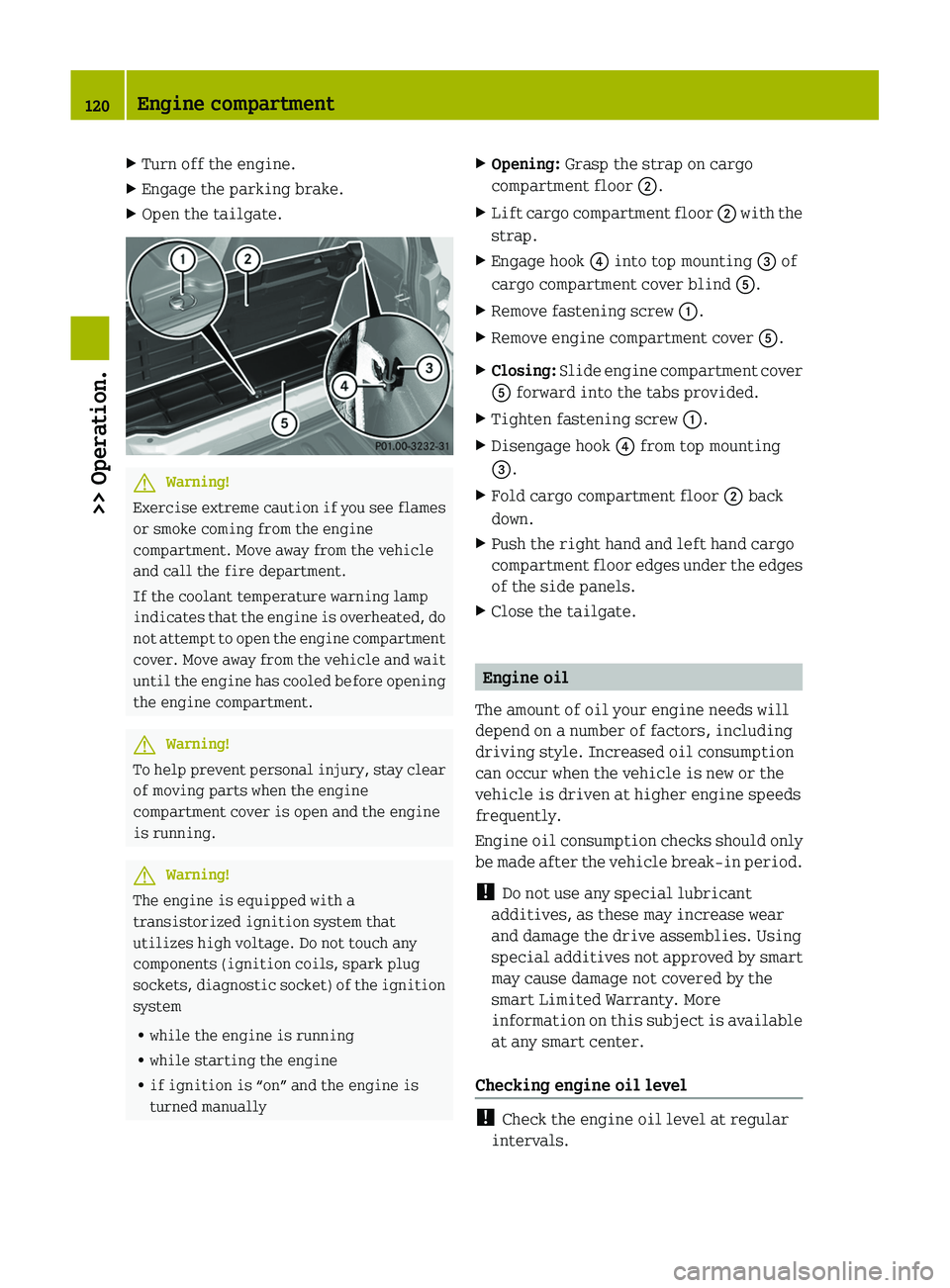
XOpening: Grasp the strap on cargo
compartment floor \000G.
XLift cargo compartment floor \000G with the
strap.
XEngage hook \000
Page 126 of 228
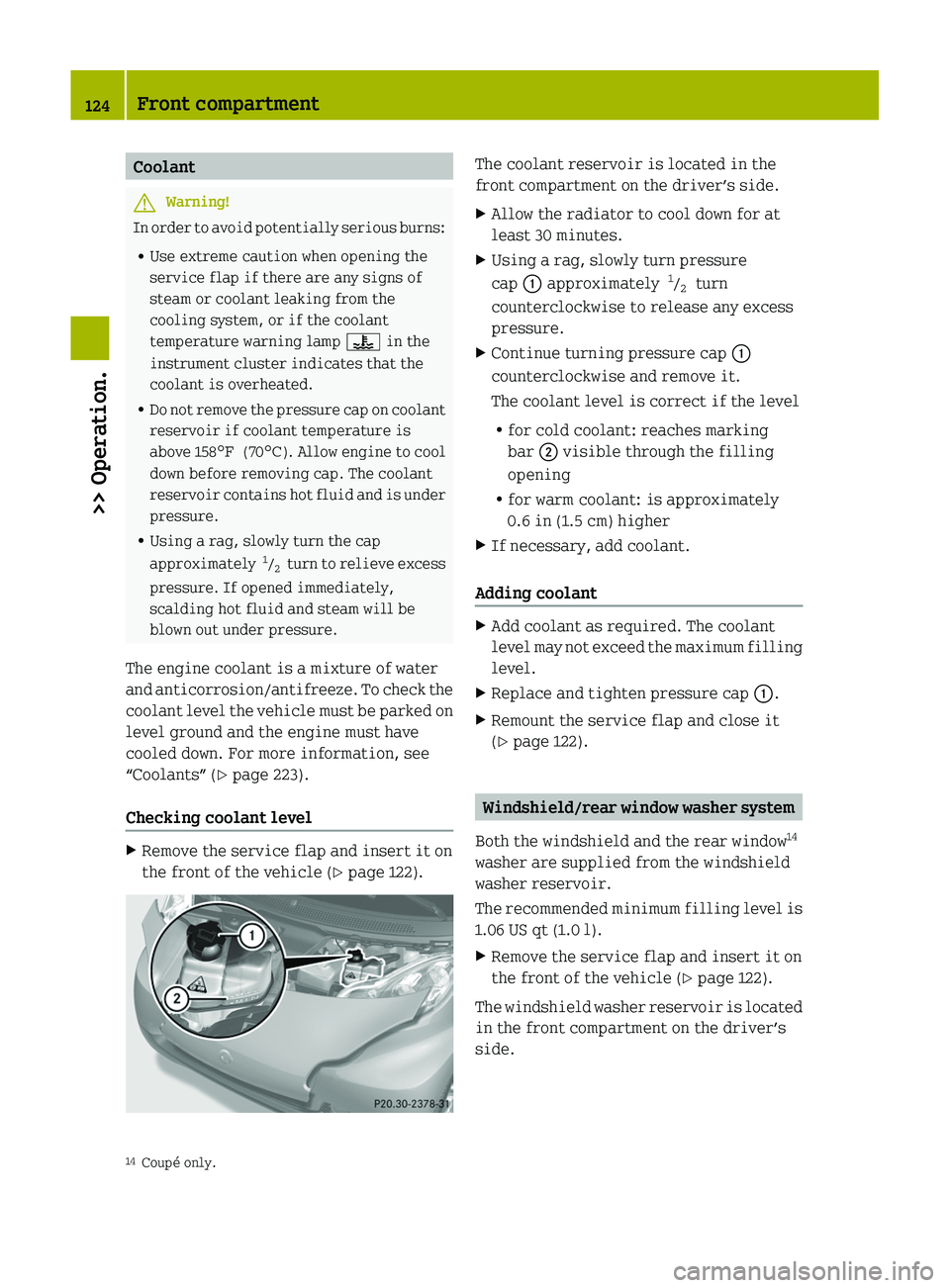
CoolantGWarning!
In order to avoid potentially serious burns:
RUse extreme caution when opening the
service flap if there are any signs of
steam or coolant leaking from the
cooling system, or if the coolant
temperature warning lamp \000
Page 155 of 228
Coolant temperature
During severe operating conditions and
stop-and-go city traffic, the coolant
temperature may rise.
! Excessive coolant temperature causes
the red coolant temperature warning
lamp 00AE in the instrument cluster
comes on.
The engine should not be operated with
the red coolant temperature warning
lamp illuminated. Doing so may cause
serious engine damage which is not
covered by the smart Limited Warranty.
For more information on coolant
temperature warning lamp ( Y page 172).GWarning!
Driving when your engine is overheated can
cause some fluids which may have leaked
into the engine compartment to catch fire.
You could be seriously burned.
Steam from an overheated engine can cause
serious burns which can occur just by
opening the engine hood. Stay away from the
engine if you see or hear steam coming from
it.
Stop the vehicle in a safe location away
from other traffic. Turn off the engine, get
out of the vehicle and do not stand near the
vehicle until the engine has cooled down.
Driving abroad
Abroad, there is an extensive smart service
network at your disposal. If you plan to
drive into areas which are not listed in the
index of your smart center directory, you
should request pertinent information from
an authorized smart center.
Symmetrical low beams
i If you drive in countries where
vehicles drive on the other side of the
road than the country in which the
vehicle is registered, you must have the
headlamps modified for symmetrical low
beams. Relevant information can be
obtained at any authorized smart center.
Vehicle care
Care tips
Regular and proper care will help to
maintain the value of your vehicle. The
best way to protect your vehicle from
harmful environmental influences is to
wash it and use protective treatments
regularly.
smart recommends that you care for the
paintwork at least twice a year (e.g. in the
spring and autumn).
GWarning!
Many cleaning products can be hazardous.
Some are poisonous, others are flammable.
Always follow the instructions on the
particular container. Always open your
vehicle’s doors or windows when cleaning
the inside.
Never use fluids or solvents that are not
designed for cleaning your vehicle.
Always lock away cleaning products and
keep them out of reach of children.
! Follow the care tips. Wash your vehicle
preferably by hand.
While in operation or even while parked,
your vehicle is subjected to varying
external influences, which left unchecked
can attack the paint as well as the vehicle
underbody and lead to permanent damage.
Such damage is caused not only by extreme
and varying climatic conditions, but also
by:
R Air pollution
R Road salt
R Tar
R Gravel and stone chipping
Vehicle care153>> Operation.BA 451 USA, CA Edition A 2011; 1; 4, en-UShereepeVersion: 3.0.3.62010-05-11T15:12:26+02:00 - Seite 153Z