ABS SMART FORTWO COUPE 2012 User Guide
[x] Cancel search | Manufacturer: SMART, Model Year: 2012, Model line: FORTWO COUPE, Model: SMART FORTWO COUPE 2012Pages: 228, PDF Size: 12.76 MB
Page 80 of 228
G
WARNING
When closing the windows, make sure there
is no danger of anyone being harmed by the
closing procedure.
The closing of the side windows can be
immediately stopped by releasing the
switch.
When leaving the vehicle, always remove the
key from the starter switch, take it with
you, and lock the vehicle. Do not leave
children unattended in the vehicle, or with
access to an unlocked vehicle. A child’s
unsupervised access to a vehicle could
result in an accident and/or serious
personal injury.
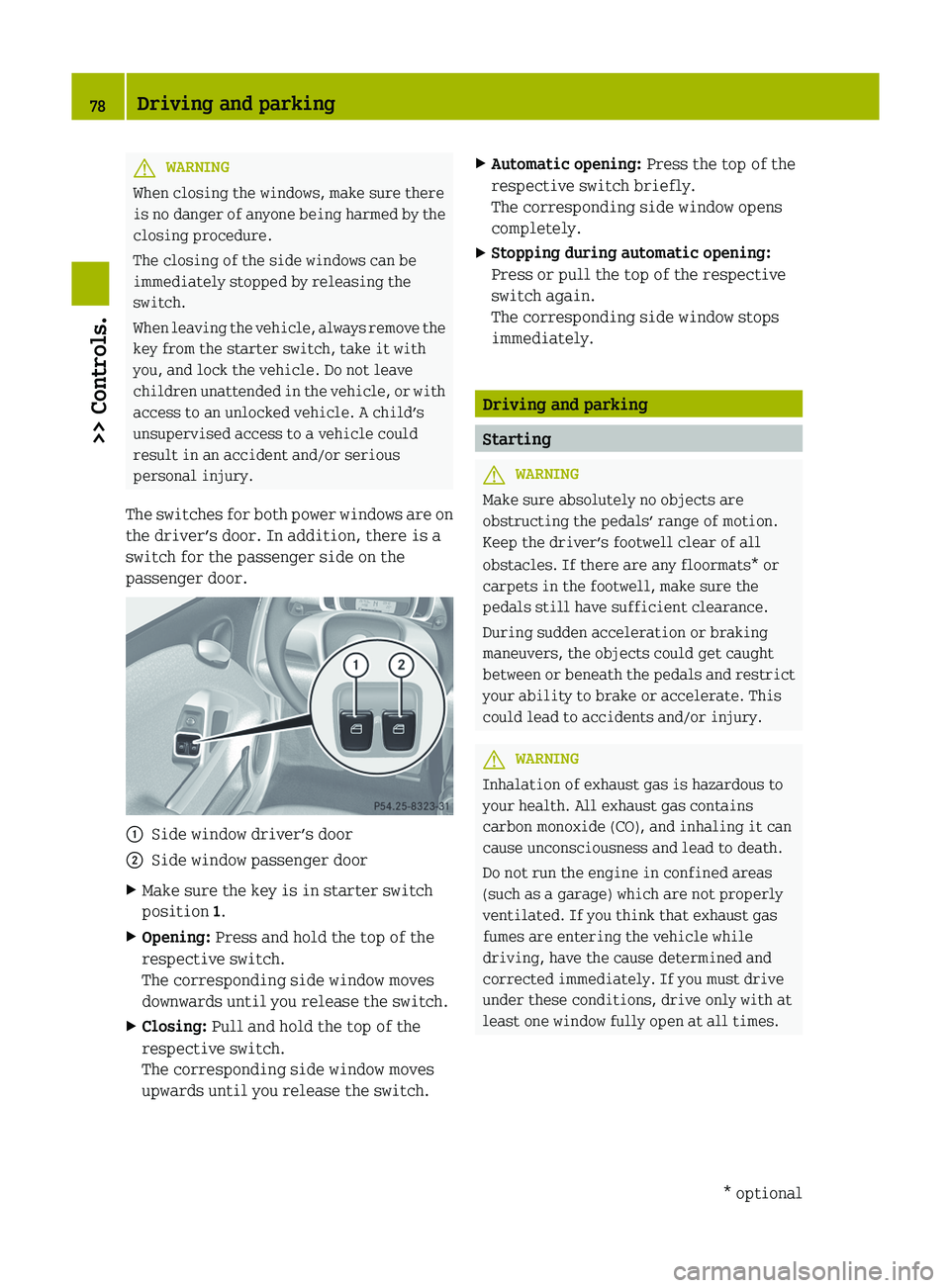
The switches for both power windows are on
the driver’s door. In addition, there is a
switch for the passenger side on the
passenger door. :
Side window driver’s door
; Side window passenger door
X Make sure the key is in starter switch
position 1.
X Opening: Press and hold the top of the
respective switch.
The corresponding side window moves
downwards until you release the switch.
X Closing: Pull and hold the top of the
respective switch.
The corresponding side window moves
upwards until you release the switch. X
Automatic opening: Press the top of the
respective switch briefly.
The corresponding side window opens
completely.
X Stopping during automatic opening:
Press or pull the top of the respective
switch again.
The corresponding side window stops
immediately. Driving and parking
Starting
G
WARNING
Make sure absolutely no objects are
obstructing the pedals’ range of motion.
Keep the driver’s footwell clear of all
obstacles. If there are any floormats*
or
carpets in the footwell, make sure the
pedals still have sufficient clearance.
During sudden acceleration or braking
maneuvers, the objects could get caught
between or beneath the pedals and restrict
your ability to brake or accelerate. This
could lead to accidents and/or injury. G
WARNING
Inhalation of exhaust gas is hazardous to
your health. All exhaust gas contains
carbon monoxide (CO), and inhaling it can
cause unconsciousness and lead to death.
Do not run the engine in confined areas
(such as a garage) which are not properly
ventilated. If you think that exhaust gas
fumes are entering the vehicle while
driving, have the cause determined and
corrected immediately. If you must drive
under these conditions, drive only with at
least one window fully open at all times. 78
Driving and parking
>> Controls.
* optional
Page 81 of 228
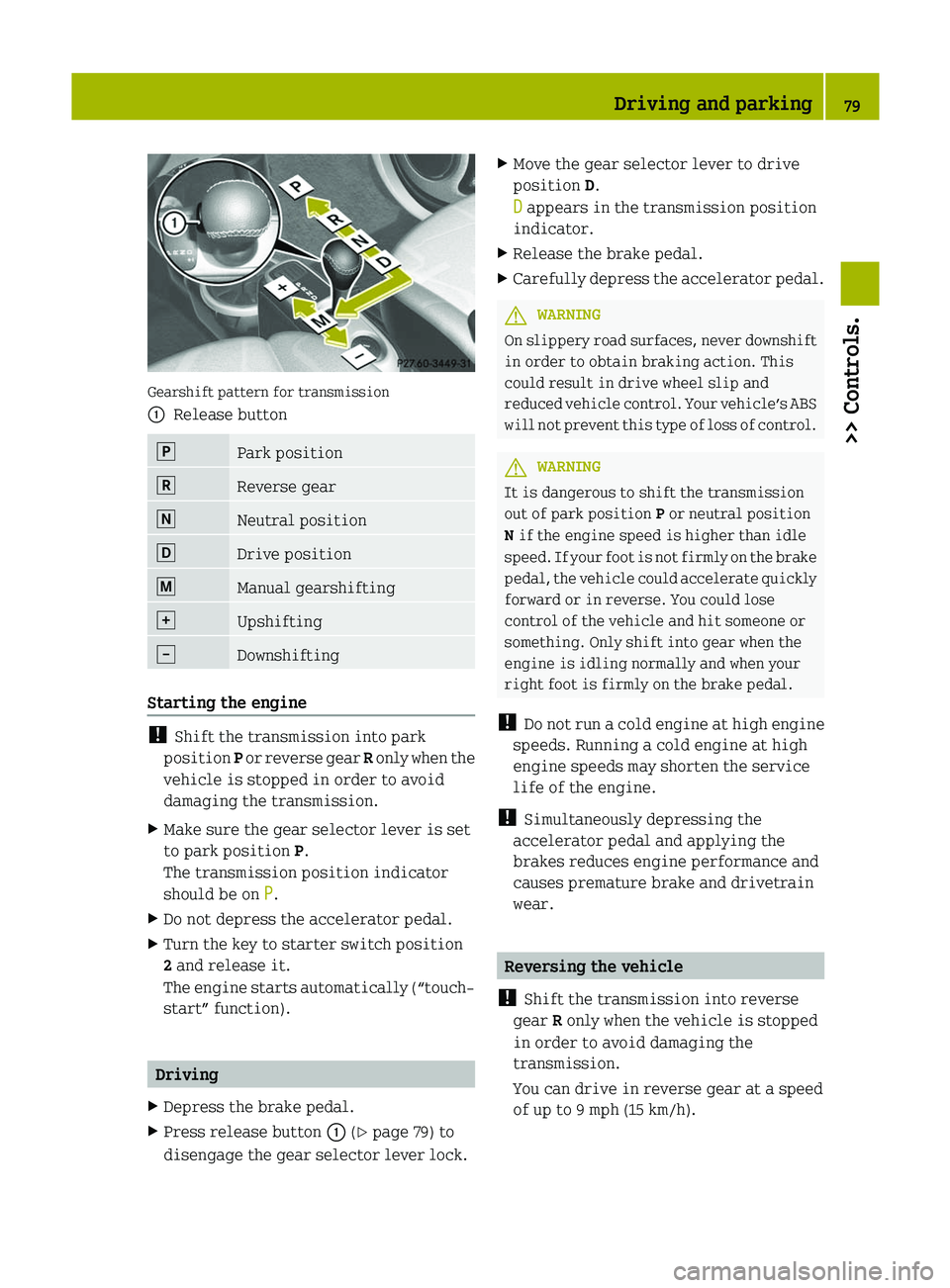
Gearshift pattern for transmission
:
Release button j
Park position
k
Reverse gear
i
Neutral position
h
Drive position
p
Manual gearshifting
q
Upshifting
±
Downshifting
Starting the engine
!
Shift the transmission into park
position P
or reverse gear R only when the
vehicle is stopped in order to avoid
damaging the transmission.
X Make sure the gear selector lever is set
to park position P.
The transmission position indicator
should be on P.
X Do not depress the accelerator pedal.
X Turn the key to starter switch position
2 and release it.
The
engine starts automatically (“touch-
start” function). Driving
X Depress the brake pedal.
X Press release button : (Y page 79) to
disengage the gear selector lever lock. X
Move the gear selector lever to drive
position D.
D appears in the transmission position
indicator.
X Release the brake pedal.
X Carefully depress the accelerator pedal. G
WARNING
On slippery road surfaces, never downshift
in order to obtain braking action. This
could result in drive wheel slip and
reduced
vehicle control. Your vehicle’s ABS
will not prevent this type of loss of control. G
WARNING
It is dangerous to shift the transmission
out of park position P or neutral position
N if the engine speed is higher than idle
speed.
If your foot is not firmly on the brake
pedal, the vehicle could accelerate quickly
forward or in reverse. You could lose
control of the vehicle and hit someone or
something. Only shift into gear when the
engine is idling normally and when your
right foot is firmly on the brake pedal.
! Do not run a cold engine at high engine
speeds. Running a cold engine at high
engine speeds may shorten the service
life of the engine.
! Simultaneously depressing the
accelerator pedal and applying the
brakes reduces engine performance and
causes premature brake and drivetrain
wear. Reversing the vehicle
! Shift the transmission into reverse
gear R only when the vehicle is stopped
in order to avoid damaging the
transmission.
You can drive in reverse gear at a speed
of up to 9 mph (15 km/h). Driving and parking
79
>> Controls. Z
Page 83 of 228
lamp $ (USA only) or J (Canada
only)
in the instrument cluster comes on. G
WARNING
Getting out of your vehicle with the
transmission not fully engaged in park
position P
is dangerous. When the engine is
shut off and the brakes are released, the
vehicle can be moved freely with the gear
selector lever in all positions except park
position P. Also, when parked on an incline,
park position P alone may not prevent your
vehicle from moving, possibly hitting
people or objects.
Always engage the parking brake in
addition to shifting to park position P.
When parked on an incline, always turn the
front wheels towards the curb. G
WARNING
When leaving the vehicle, always remove the
key from the starter switch, take it with
you, and lock the vehicle. Do not leave
children
unattended in the vehicle, or with
access to an unlocked vehicle. Children
could release the parking brake and/or
move the gear selector lever from park
position P, either of which could result in
an accident and/or serious personal
injury.
Brake pedal The brake pedal has two brake circuits
independent
of each other. A brake servo is
used during braking (when the engine is
running) to increase pedal force. G
WARNING
Make sure absolutely no objects are
obstructing the pedals’ range of motion.
Keep the driver’s footwell clear of all
obstacles. If there are any floormats*
or
carpets in the footwell, make sure the
pedals still have sufficient clearance.
During sudden acceleration or braking
maneuvers, the objects could get caught between or beneath the pedals and restrict
your ability to brake or accelerate. This
could lead to accidents and/or injury.
G
WARNING
Considerably more effort will be required
to apply the brakes if
R the brake servo has failed
R a brake circuit has failed
R the engine is switched off, e.g. for
towing the vehicle
The braking distance is likewise greater.
Make sure the engine is running whenever
the vehicle is rolling. Have the brake
system repaired at an authorized smart
center, if there is a fault in the brake
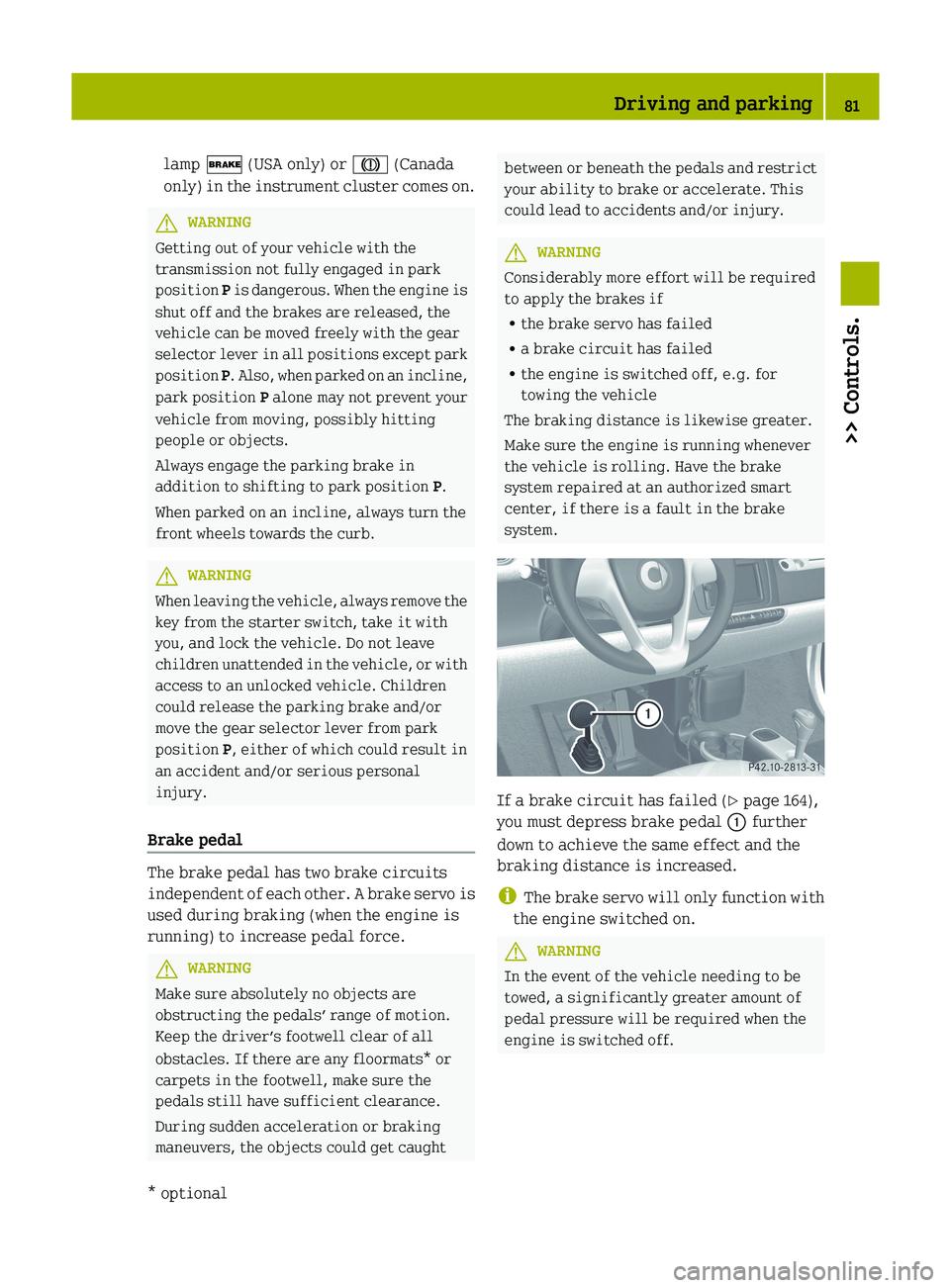
system. If a brake circuit has failed (
Y page 164),
you must depress brake pedal : further
down to achieve the same effect and the
braking distance is increased.
i The
brake servo will only function with
the engine switched on. G
WARNING
In the event of the vehicle needing to be
towed, a significantly greater amount of
pedal pressure will be required when the
engine is switched off. Driving and parking
81
>> Controls.
* optional Z
Page 84 of 228

Turning off the engine
G
WARNING
Do not turn off the engine before the
vehicle has come to a complete stop. With
the engine not running, there is no power
assistance for the brake and steering*
systems. In this case, it is important to
keep in mind that a considerably higher
degree of effort is necessary to brake and
steer the vehicle.
X Depress the brake pedal.
X Press the release button (Y page 79) to
disengage the gear selector lever lock.
X Move the gear selector lever to park
position P.
The transmission position indicator
should be on P
! Always engage the parking brake in
addition to shifting to park position P.
X Release the brake pedal.
X Turn the key to starter switch position
0.
X Remove the key from the starter switch.
The electronic immobilizer is
activated. Transmission
Introduction
Your vehicle is equipped with a 5‑speed
automated transmission with manual or
automatic mode. For information on
driving with the transmission see also
“Starting” ( Y page 78).G
WARNING
Make sure absolutely no objects are
obstructing the pedals’ range of motion.
Keep the driver’s footwell clear of all
obstacles. If there are any floormats*
or
carpets in the footwell, make sure the
pedals still have sufficient clearance. During sudden acceleration or braking
maneuvers, the objects could get caught
between
or beneath the pedals and restrict
your ability to brake or accelerate. This
could lead to accidents and/or injury. Gear selector lever
Gearshift pattern for transmission
:
Release button j
Park position
k
Reverse gear
i
Neutral position
h
Drive position
p
Manual gearshifting
q
Upshifting
±
Downshifting
The current gear selector lever position
appears in the transmission position
indicator. When manual gearshifting M is
selected, the currently selected gear
appears ( Y page 88). G
WARNING
It is dangerous to shift the transmission
out of park position P or neutral position
N if the engine speed is higher than idle
speed.
If your foot is not firmly on the brake
pedal, the vehicle could accelerate quickly
forward or in reverse. You could lose 82
Transmission
>> Controls.
* optional
Page 87 of 228
!
Allow the engine to warm up under low
load use. Do not place full load on the
engine until the operating temperature
has been reached.
Shift into reverse gear R or parking
position P only when the vehicle is
stopped.
Avoid spinning of a drive wheel for an
extended period when driving off on
slippery road surfaces. Otherwise, the
drivetrain could be damaged, which is
not covered by the smart Limited
Warranty. Activating manual gearshifting
X
Move the gear selector lever to drive
position D (Y page 82).
X Pull one of the shift paddles (Y page 85)
towards you.
or
X Move the gear selector lever to manual
gearshifting M (Y page 82).
System-controlled automatic
gearshifting is switched off.
You
can upshift or downshift through the
gears in succession.
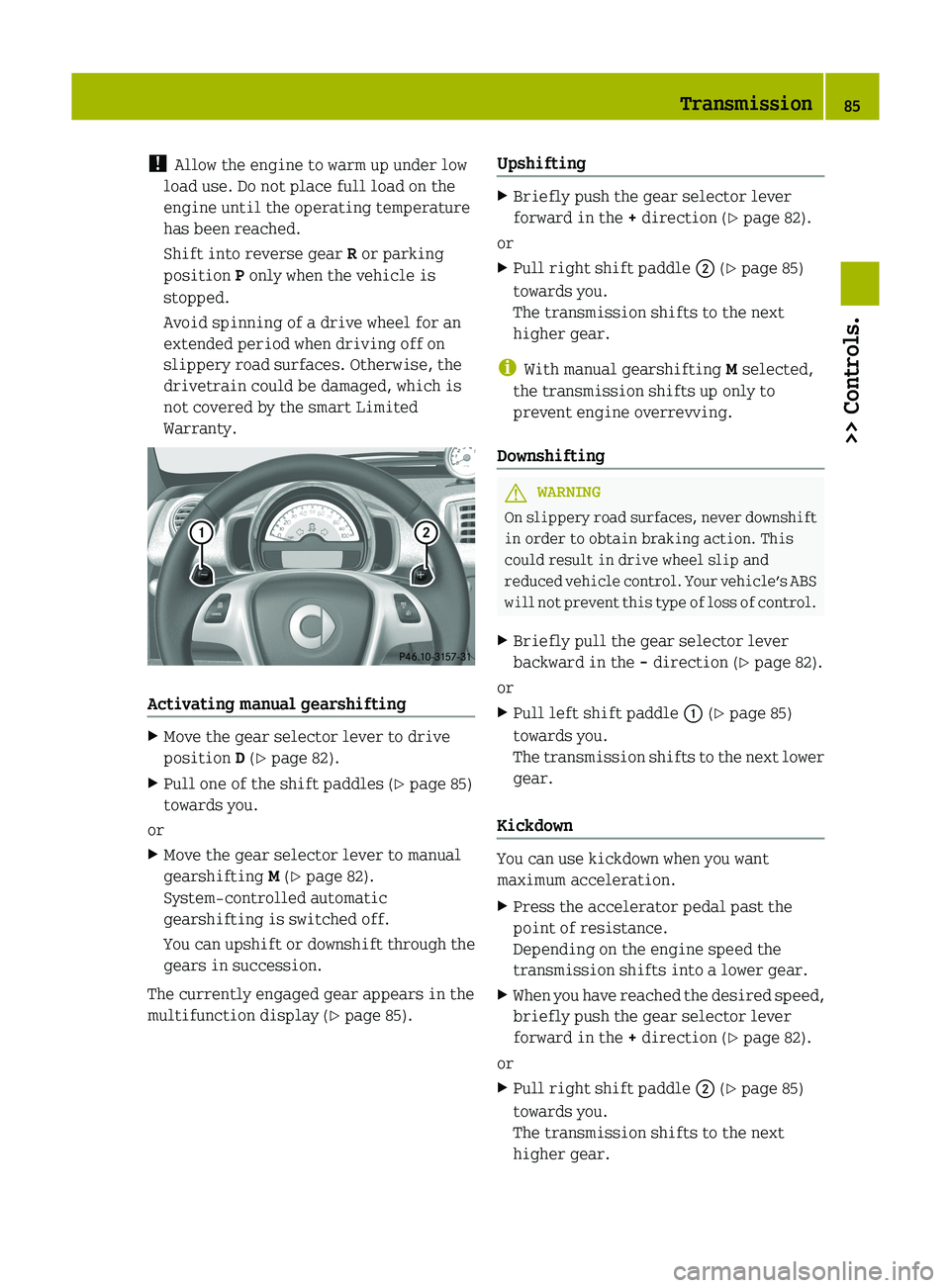
The currently engaged gear appears in the
multifunction display ( Y page 85).Upshifting X
Briefly push the gear selector lever
forward in the + direction (Y page 82).
or
X Pull right shift paddle ; (Y page 85)
towards you.
The transmission shifts to the next
higher gear.
i With manual gearshifting M selected,
the transmission shifts up only to
prevent engine overrevving.
Downshifting G
WARNING
On slippery road surfaces, never downshift
in order to obtain braking action. This
could result in drive wheel slip and
reduced
vehicle control. Your vehicle’s ABS
will not prevent this type of loss of control.
X Briefly pull the gear selector lever
backward in the - direction (Y page 82).
or
X Pull left shift paddle : (Y page 85)
towards you.
The
transmission shifts to the next lower
gear.
Kickdown You can use kickdown when you want
maximum acceleration.
X
Press the accelerator pedal past the
point of resistance.
Depending on the engine speed the
transmission shifts into a lower gear.
X When you have reached the desired speed,
briefly push the gear selector lever
forward in the + direction (Y page 82).
or
X Pull right shift paddle ; (Y page 85)
towards you.
The transmission shifts to the next
higher gear. Transmission
85
>> Controls. Z
Page 120 of 228

X
Engage the parking brake.
X Move the gear selector lever to park
position P.
X Switch off the ignition.
X Open the tailgate. G
WARNING
Exercise extreme caution if you see flames
or smoke coming from the engine
compartment. Move away from the vehicle
and call the fire department.
If the coolant temperature warning lamp
indicates
that the engine is overheated, do
not attempt to open the engine compartment
cover. Move away from the vehicle and wait
until the engine has cooled before opening
the engine compartment. G
WARNING
To help prevent personal injury, stay clear
of moving parts when the engine
compartment cover is open and the engine
is running. G
WARNING
The engine is equipped with a
transistorized ignition system that
utilizes high voltage. Do not touch any
components (ignition coils, spark plug
sockets,
diagnostic socket) of the ignition
system
R while the engine is running
R while starting the engine
R if ignition is “on” and the engine is
turned manually X
Opening: Grasp the strap on cargo
compartment floor ;.
X Lift cargo compartment floor ;
with the
strap.
X Engage hook ? into top mounting = of
cargo compartment cover blind A.
X Remove fastening screw :.
X Remove engine compartment cover A.
X Closing:
Slide engine compartment cover
A forward into the tabs provided.
X Tighten fastening screw :.
X Disengage hook ? from top mounting
=.
X Fold cargo compartment floor ; back
down.
X Push the right hand and left hand cargo
compartment
floor edges under the edges
of the side panels.
X Close the tailgate. Engine oil
The amount of oil your engine needs will
depend on a number of factors, including
driving style. Increased oil consumption
can occur when the vehicle is new or the
vehicle is driven at higher engine speeds
frequently.
Engine
oil consumption checks should only
be made after the vehicle break-in period.
! Do not use any special lubricant
additives, as these may increase wear
and damage the drive assemblies. Using
special additives not approved by smart
may cause damage not covered by the
smart Limited Warranty. More
information on this subject is available
at any smart center.
Checking engine oil level !
Check the engine oil level at regular
intervals. 118
Engine compartment
>> Operation.
Page 123 of 228
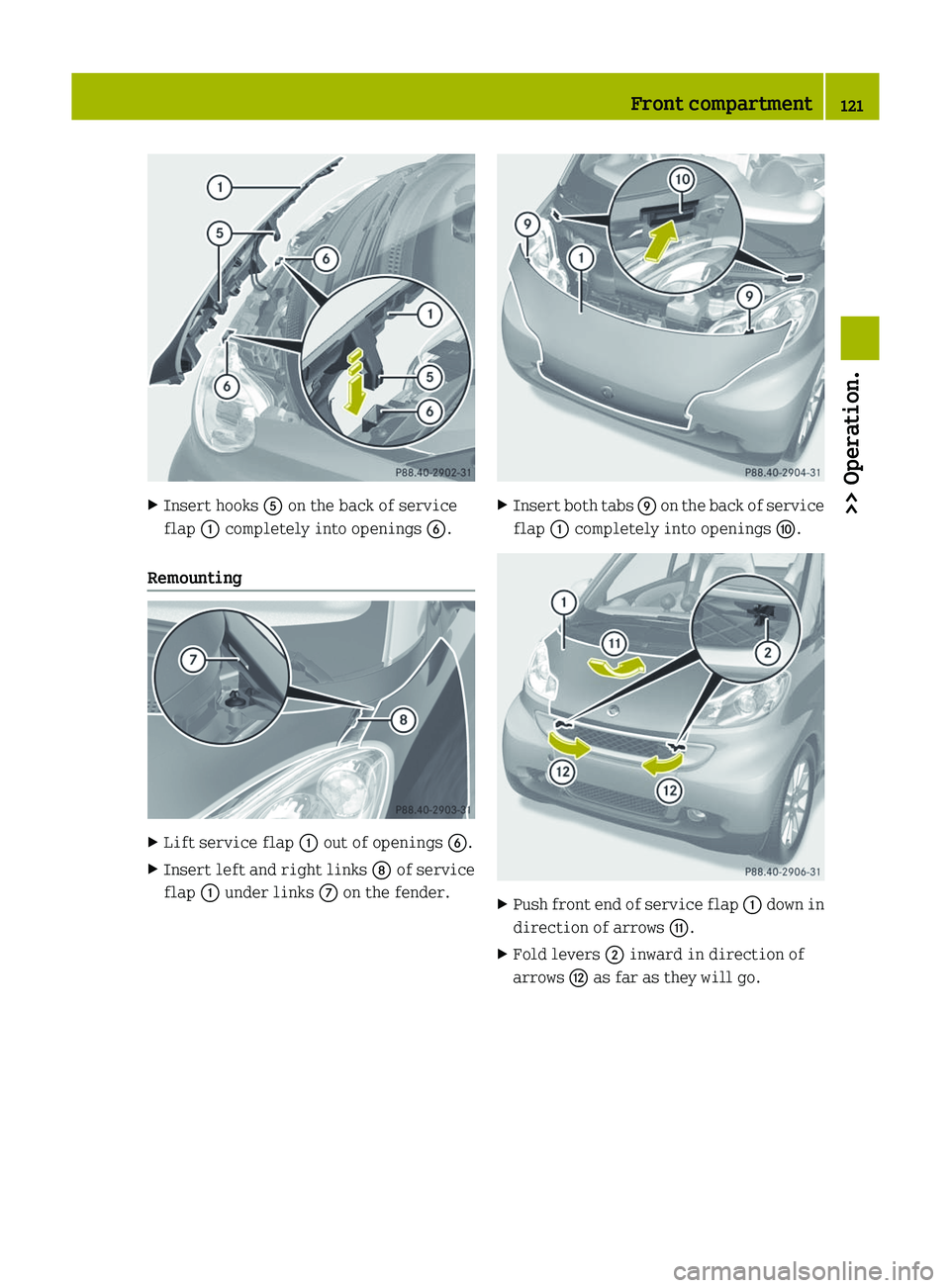
X
Insert hooks A on the back of service
flap : completely into openings B.
Remounting X
Lift service flap : out of openings B.
X Insert left and right links D of service
flap : under links C on the fender. X
Insert both tabs E on the back of service
flap : completely into openings F. X
Push front end of service flap :
down in
direction of arrows G.
X Fold levers ; inward in direction of
arrows H as far as they will go. Front compartment
121
>> Operation. Z
Page 125 of 228
G
WARNING
Windshield washer concentrate is highly
flammable. Fire, naked flames and smoking
are prohibited when windshield washer
concentrate is being handled.
X Use a windshield washer concentrate
labeled for summer and water for
temperatures above freezing point.
X Use a windshield washer concentrate
labeled for winter and water for
temperatures below freezing point.
! Always use a windshield washer
concentrate labeled for winter where
temperatures may fall below freezing
point. Failure to do so could result in
damage to the washer system/reservoir.
X Premix the windshield washer fluid in a
suitable container.
Observe mixing ratios depending on the
outside temperature
(Y page 222).
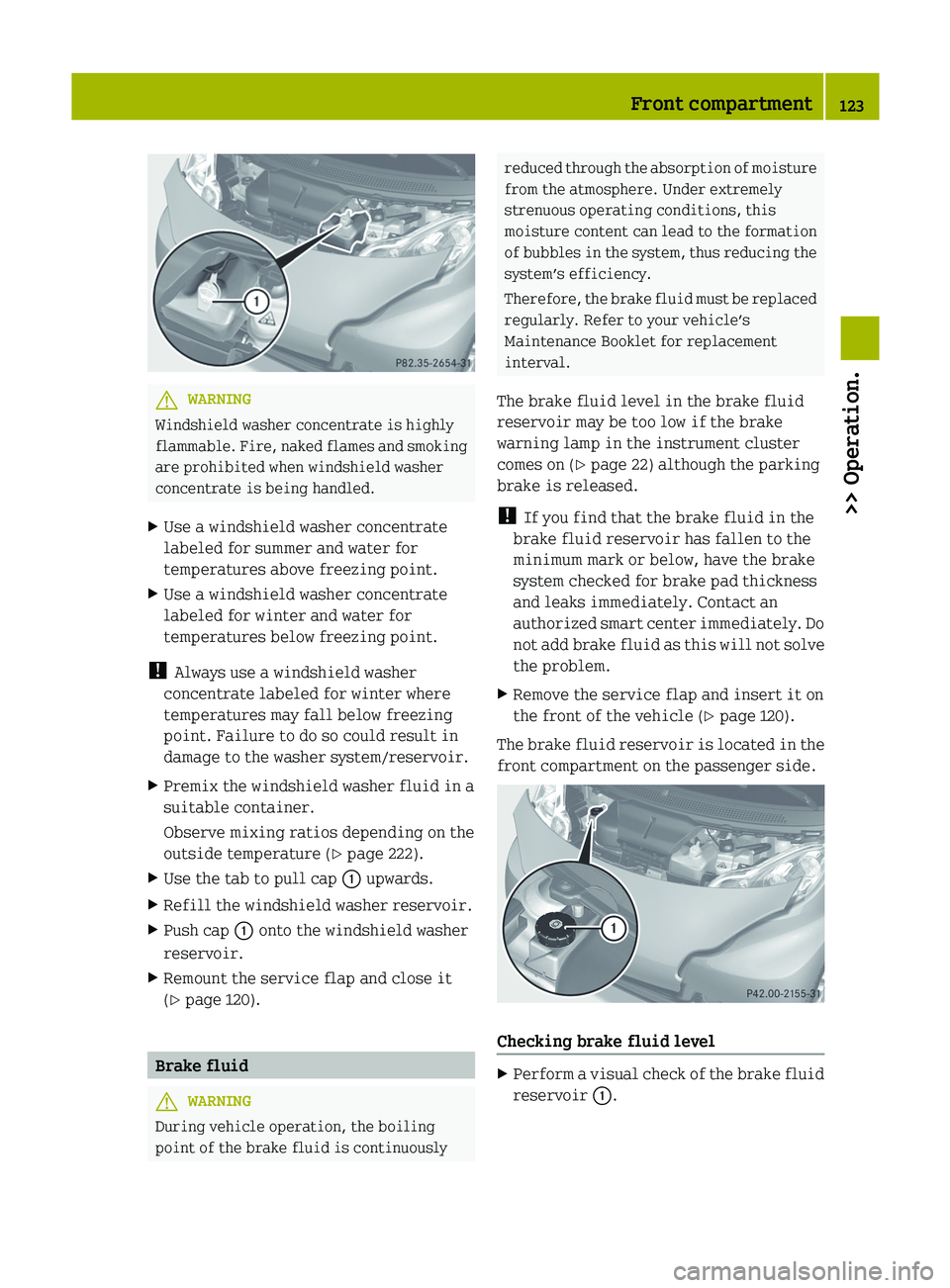
X Use the tab to pull cap : upwards.
X Refill the windshield washer reservoir.
X Push cap : onto the windshield washer
reservoir.
X Remount the service flap and close it
(Y page 120). Brake fluid
G
WARNING
During vehicle operation, the boiling
point of the brake fluid is continuously reduced through the absorption of moisture
from the atmosphere. Under extremely
strenuous operating conditions, this
moisture content can lead to the formation
of
bubbles in the system, thus reducing the
system’s efficiency.
Therefore, the brake fluid must be replaced
regularly. Refer to your vehicle’s
Maintenance Booklet for replacement
interval.
The brake fluid level in the brake fluid
reservoir may be too low if the brake
warning lamp in the instrument cluster
comes on (Y page 22) although the parking
brake is released.
! If you find that the brake fluid in the
brake fluid reservoir has fallen to the
minimum mark or below, have the brake
system checked for brake pad thickness
and leaks immediately. Contact an
authorized smart center immediately. Do
not add brake fluid as this will not solve
the problem.
X Remove the service flap and insert it on
the front of the vehicle ( Y page 120).
The brake fluid reservoir is located in the
front compartment on the passenger side. Checking brake fluid level
X
Perform a visual check of the brake fluid
reservoir :. Front compartment
123
>> Operation. Z
Page 140 of 228
symbol in the service description.
Example: 245/40 ZR18 97Y.
In this example, “97Y” is the service
description. The letter “Y” designates
the speed rating and the speed
capability of the tire is limited to
186 mph (300 km/h).
R Any tire with a speed capability above
186
mph (300 km/h) must include a “ZR” in
the size designation AND the service
description must be placed in
parenthesis. Example:
275/40 ZR 18 (99Y). The “(Y)” speed rating
in parenthesis designates the maximum
speed capability of the tire as being
above 186 mph (300 km/h). Consult the tire
manufacturer for the actual maximum
permissible speed of the tire.
All-season and winter tires Index Speed rating
Q M+S
15 up to 100 mph (160 km/h)
T M+S
15 up to 118 mph (190 km/h)
H M+S
15 up to 130 mph (210 km/h)
V M+S
15 up to 149 mph (240 km/h)
i
Not
all M+S rated tires provide special
winter performance. Make sure the tires
you use show M+S and the mountain/
snowflake marking i on the tire
sidewall. These tires meet specific snow
traction performance requirements of
the Rubber Manufacturers Association
(RMA) and the Rubber Association of
Canada (RAC) and have been designed
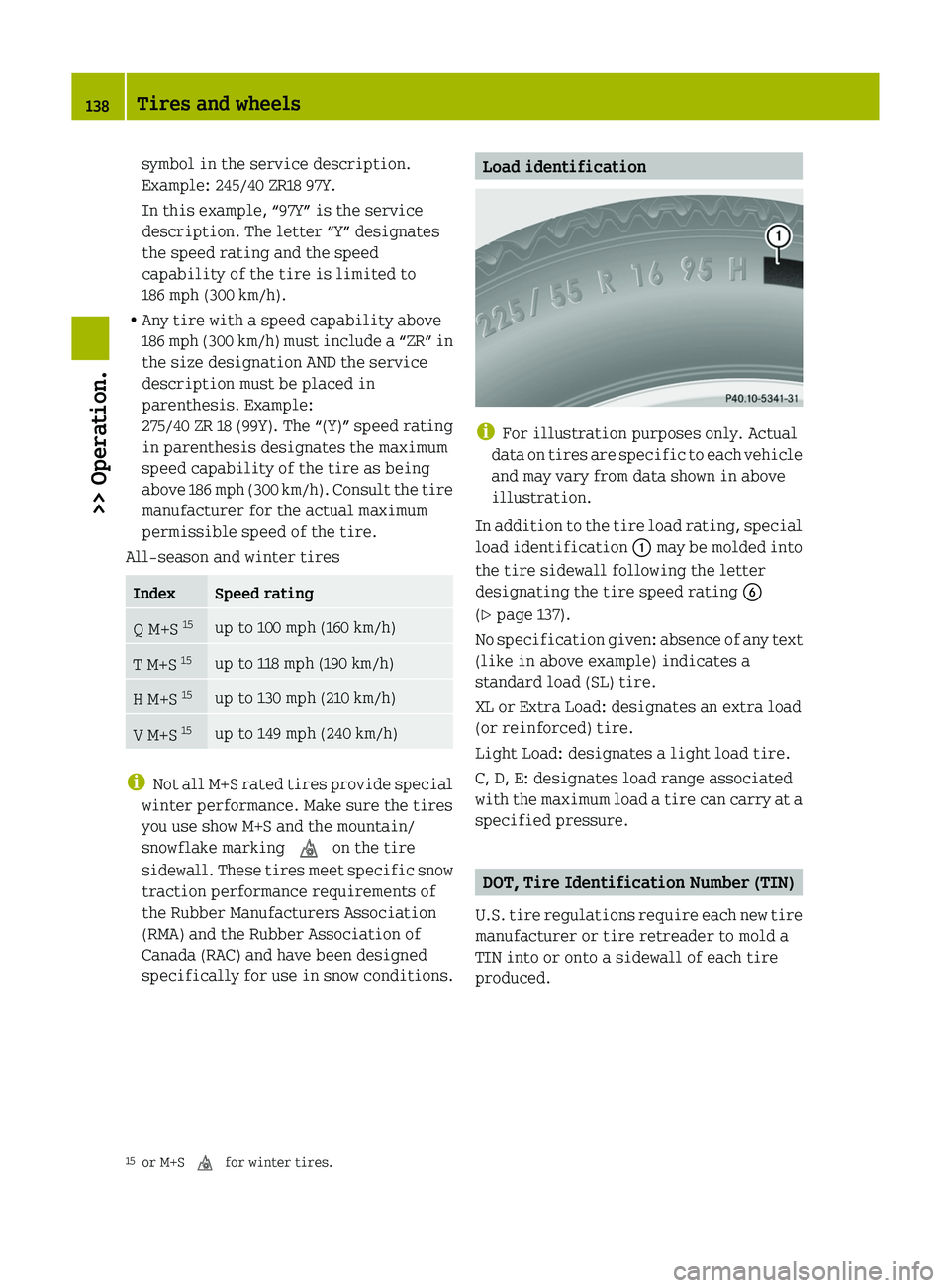
specifically for use in snow conditions. Load identification
i
For illustration purposes only. Actual
data
on tires are specific to each vehicle
and may vary from data shown in above
illustration.
In addition to the tire load rating, special
load identification : may be molded into
the tire sidewall following the letter
designating the tire speed rating B
(Y page 137).
No specification given: absence of any text
(like in above example) indicates a
standard load (SL) tire.
XL or Extra Load: designates an extra load
(or reinforced) tire.
Light Load: designates a light load tire.
C, D, E: designates load range associated
with the maximum load a tire can carry at a
specified pressure. DOT, Tire Identification Number (TIN)
U.S.
tire regulations require each new tire
manufacturer or tire retreader to mold a
TIN into or onto a sidewall of each tire
produced.
15 or M+S i for winter tires.138
Tires and wheels
>> Operation.
Page 144 of 228
Treadwear indicators
Narrow bands, sometimes called “wear
bars” that show across the tread of a tire
when
only 1
/ 16 in (1.6 mm) of tread remains.
Uniform Tire Quality Grading Standards A tire information system that provides
consumers with ratings for a tire’s
traction, temperature and treadwear.
Ratings are determined by tire
manufacturers using U.S. government
testing
procedures. The ratings are molded
into the sidewall of the tire.
Vehicle maximum load on the tire Load on an individual tire that is
determined by distributing to each axle
its share of the maximum loaded vehicle
weight and dividing it by two.
Winter driving
Before the onset of winter, have your
vehicle winterized at an authorized smart
center.
This service includes:
R Check of anticorrosion and antifreeze
concentration.
R Addition of washer concentrate to the
water of the windshield/rear window.
Use a windshield washer concentrate
labeled for winter which is formulated
for temperatures below freezing point
(Y page 222).
R Battery
test. Battery capacity drops with
decreasing ambient temperature. A well
charged battery helps to make sure the
engine can be started, even at low
ambient temperatures.
R Tire change. Winter tires
G
WARNING
Winter tires with a tread depth of less
than 1
/ 6 in (4 mm) must be replaced. They
are no longer suitable for winter
operation.
Always use winter tires at temperatures
below 45 ¦ (7¥) and whenever wintry road
conditions
prevail. Not all M+S rated tires
provide special winter performance. Make
sure the tires you use show the mountain/
snowflake marking i on the tire
sidewall. These tires meet specific snow
traction performance requirements of the
Rubber Manufacturers Association (RMA)
and the Rubber Association of Canada (RAC)
and have been designed specifically for
use in snow conditions. Use of winter tires
is the only way to achieve the maximum
effectiveness of the ABS and ESP ®
in winter
operation.
For safe handling, make sure all mounted
winter tires are of the same make and have
the same tread design.
For information on winter tires for your
vehicle model, see the "Technical data"
section (Y page 217).
Always observe the speed rating of the
winter tires installed on your vehicle. If
the maximum speed for which your tires are
rated is below the speed rating of your
vehicle, you must place a notice to this
effect where it will be seen by the driver.
Such notices are available at your tire
dealer or any authorized smart center. Snow chains*
! Remember
that snow chains must always
be compatible with the tire sizes of a
vehicle. Snow chains that are approved
by smart are only permitted for the
following tire size:
175/55 R15 on the rear axle. 142
Winter driving
>> Operation.
* optional