brakes SMART FORTWO COUPE 2012 User Guide
[x] Cancel search | Manufacturer: SMART, Model Year: 2012, Model line: FORTWO COUPE, Model: SMART FORTWO COUPE 2012Pages: 228, PDF Size: 12.76 MB
Page 129 of 228
stopping distance, and result in sudden
deflation (blowout) because they are more
likely to become punctured or damaged by
road debris, potholes etc.
Do not overload the tires by exceeding the
specified load limit as indicated on the
Tire and Loading Information placard on
the
driver’s door B‑pillar. Overloading the
tires can overheat them, possibly causing
a blowout. Overloading the tires can also
result in handling or steering problems, or
brake failure.
Check the tire inflation pressure at least
once a month.
Check and adjust the tire inflation
pressure when the tires are cold
(Y page 125).
Checking tire inflation pressure
manually Follow the steps below to achieve correct
tire inflation pressure:
X
Remove the cap from the valve on one tire.
X Firmly press a tire gauge onto the valve.
X Read the tire inflation pressure on tire
gauge and check against the
recommended tire inflation pressure on
the Tire and Loading Information
placard on the driver’s door B‑pillar
(Y page 130). If necessary, add air to
achieve the recommended tire inflation
pressure.
X If you have overfilled the tire, release
tire inflation pressure by pushing the
metal
stem of the valve with e.g. a tip of
a pen. Then recheck the tire inflation
pressure with the tire gauge.
X Install the valve cap.
X Repeat this procedure for each tire.
Tire Pressure Monitoring System (TPMS)* Your vehicle may be equipped with a Tire
Pressure
Monitoring System (TPMS). It monitors the tire inflation pressure in
all
four tires. A warning is issued to alert
you to a decrease in pressure in one or more
of the tires.
The Tire Pressure Monitoring System
(TPMS) is equipped with a combination low
tire pressure/TPMS malfunction telltale in
the instrument cluster. Depending on how
the telltale illuminates, it indicates a low
tire pressure condition or a malfunction in
the TPMS system itself:
R If the telltale illuminates continuously,
one or more of your tires is significantly
underinflated. There is no malfunction
in the TPMS.
R If the telltale flashes for 60 seconds and
then stays illuminated, the TPMS system
itself is not operating properly.
The TPMS only functions on wheels that are
equipped with the proper electronic
sensors. G
WARNING
The TPMS does not indicate a warning for
wrongly selected inflation pressures.
Always adjust tire inflation pressure
according to the Tire and Loading
Information placard on the driver’s door
B‑pillar.
The
TPMS is not able to issue a warning due
to a sudden dramatic loss of pressure (e.g.
tire blowout caused by a foreign object). In
this case bring the vehicle to a halt by
carefully applying the brakes and avoiding
abrupt steering maneuvers. G
WARNING
Each tire should be checked monthly when
cold
and inflated to the inflation pressure
recommended by the vehicle manufacturer
on the Tire and Loading Information
placard. If your vehicle has tires of a
different size than the size indicated on
the Tire and Loading Information placard,
you should determine the proper tire
inflation pressure for those tires. Tires and wheels
127
>> Operation.
* optional Z
Page 141 of 228
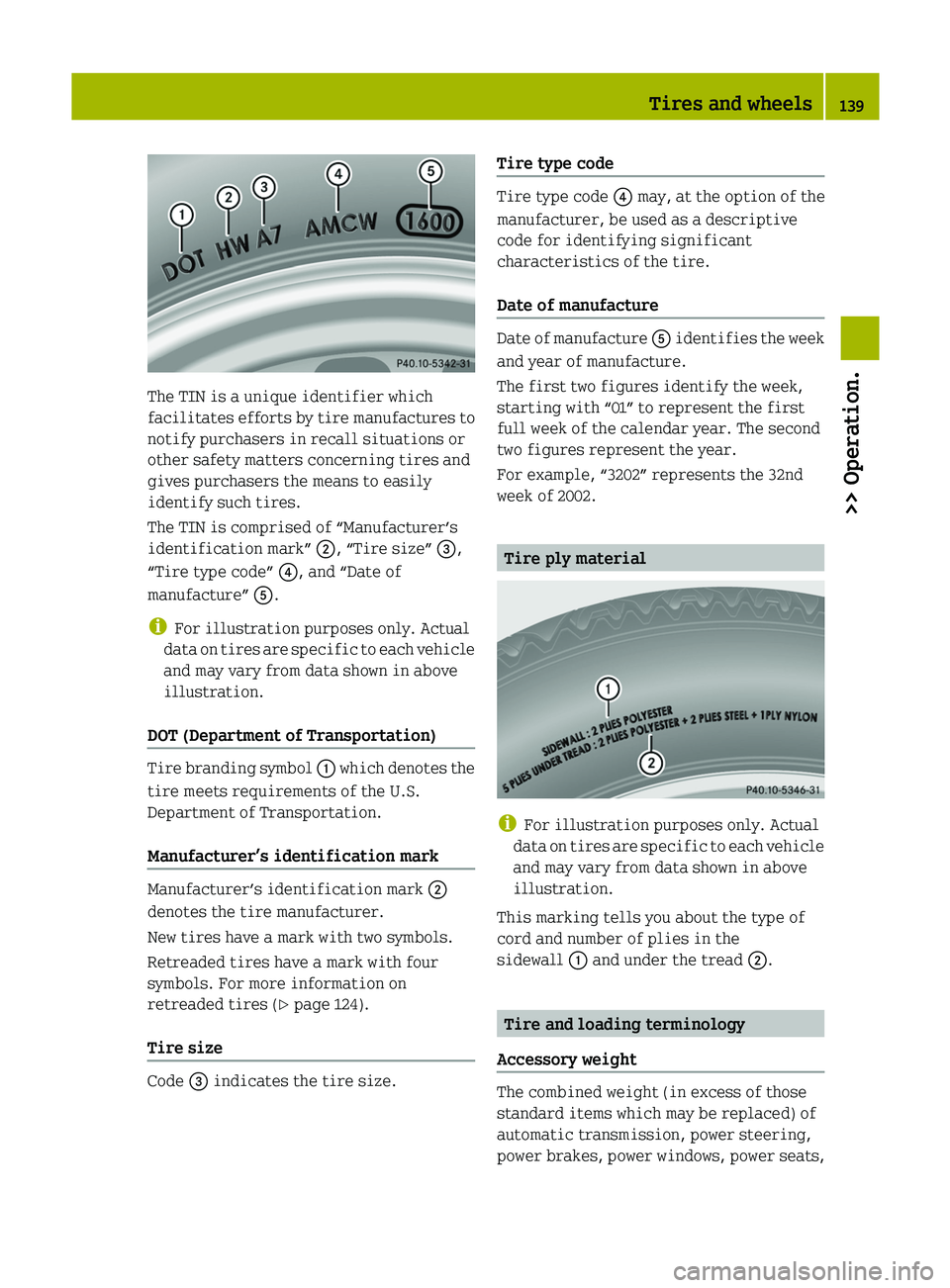
The TIN is a unique identifier which
facilitates
efforts by tire manufactures to
notify purchasers in recall situations or
other safety matters concerning tires and
gives purchasers the means to easily
identify such tires.
The TIN is comprised of “Manufacturer’s
identification mark” ;, “Tire size” =,
“Tire type code” ?, and “Date of
manufacture” A.
i For illustration purposes only. Actual
data on tires are specific to each vehicle
and may vary from data shown in above
illustration.
DOT (Department of Transportation) Tire branding symbol
:
which denotes the
tire meets requirements of the U.S.
Department of Transportation.
Manufacturer’s identification mark Manufacturer’s identification mark
;
denotes the tire manufacturer.
New tires have a mark with two symbols.
Retreaded tires have a mark with four
symbols. For more information on
retreaded tires ( Y page 124).
Tire size Code = indicates the tire size. Tire type code Tire type code
? may, at the option of the
manufacturer, be used as a descriptive
code for identifying significant
characteristics of the tire.
Date of manufacture Date of manufacture
A
identifies the week
and year of manufacture.
The first two figures identify the week,
starting with “01” to represent the first
full week of the calendar year. The second
two figures represent the year.
For example, “3202” represents the 32nd
week of 2002. Tire ply material
i
For illustration purposes only. Actual
data
on tires are specific to each vehicle
and may vary from data shown in above
illustration.
This marking tells you about the type of
cord and number of plies in the
sidewall : and under the tread ;. Tire and loading terminology
Accessory weight The combined weight (in excess of those
standard items which may be replaced) of
automatic transmission, power steering,
power brakes, power windows, power seats, Tires and wheels
139
>> Operation. Z
Page 143 of 228
Normal occupant weight
The number of occupants the vehicle is
designed to seat, multiplied by
68 kilograms (150 lbs).
Occupant distribution
The distribution of occupants in a vehicle
at their designated seating positions.
Production options weight
The combined weight of those installed
regular production options weighing over
5 lbs (2.3 kilograms) in excess of those
standard items which they replace, not
previously considered in curb weight or
accessory weight, including heavy duty
brakes,
ride levelers, roof rack, heavy duty
battery, and special trim.
PSI (Pounds per square inch) A standard unit of measure for air
pressure.
Recommended tire inflation pressure
The recommended tire inflation pressure
for
normal driving conditions is listed on
the Tire and Loading Information placard
located on driver’s door B‑pillar and
provides best handling, tread life and
riding comfort.
Rim A metal support for a tire or a tire and tube
assembly upon which the tire beads are
seated.
Sidewall
The portion of a tire between the tread and
the bead. TIN (Tire Identification Number) Unique identifier which facilitates
efforts by tire manufacturers to notify
purchasers in recall situations or other
safety matters concerning tires and gives
purchasers the means to easily identify
such tires. The TIN is comprised of
“Manufacturer’s identification mark”,
“Tire size”, “Tire type code” and “Date of
manufacture”.
Tire load rating
Numerical code associated with the
maximum load a tire can support.
Tire ply composition and material used
This indicates the number of plies or the
number of layers of rubber-coated fabric
in the tire tread and sidewall. Tire
manufacturers also must indicate the ply
materials in the tire and sidewall, which
include
steel, nylon, polyester, and others.
Tire speed rating Part of tire designation; indicates the
speed range for which a tire is approved.
Total load limit
Rated cargo and luggage load plus
68 kilograms (150 lbs) times the vehicle’s
designated seating capacity.
Traction
Force exerted by the vehicle on the road via
the tires. The amount of grip provided.
Tread
The portion of a tire that comes into
contact with the road. Tires and wheels
141
>> Operation. Z
Page 146 of 228
important to keep in mind that a
considerably higher degree of effort is
necessary to brake and steer the vehicle.
Adapt your driving accordingly.
Brakes
G
WARNING
Make sure not to endanger any other road
users when carrying out braking
maneuvers.
Refer to the description of the hydraulic
brake assistant
(Y page 48).
! Because the ESP ®
operates
automatically, the engine must be turned
off (ignition switched off) when the
parking brake is being tested on a brake
test dynamometer. Active braking action
through the ESP ®
may otherwise seriously
damage the brake system which is not
covered by the smart Limited Warranty.
Brake pad wear or a leak in the brake system
may be the reason for low brake fluid level
in the brake fluid reservoir.
The brake fluid level in the brake fluid
reservoir may be too low if the brake
warning lamp in the instrument cluster
comes on (Y page 22) although the parking
brake is released.
Have the brake system inspected
immediately. Contact an authorized smart
center.
All checks and service work on the brake
system should be carried out by qualified
technicians only. Contact an authorized
smart center.
Only install brake pads and use brake fluid
recommended by smart.
Inclines !
When driving down long and steep
grades,
relieve the load on the brakes by
shifting into a lower gear to use the engine’s braking power. This helps
prevent overheating of the brakes and
reduces brake pad wear.
When
using the engine’s braking power, a
drive wheel may not spin for an extended
period of time, e.g. on slippery road
surfaces. This may cause serious damage
to the drive- train which is not covered
by the smart Limited Warranty.
High and low stresses G
WARNING
Resting your foot on the brake pedal will
cause excessive and premature wear of the
brake pads.
It can also result in the brakes
overheating, thereby significantly
reducing their effectiveness and your
ability to stop the vehicle in sufficient
time to avoid an accident.
After
hard braking, it is advisable to drive
on for some time, rather than immediately
park, so that the air stream will cool down
the brakes faster.
If your brake system is normally only
subjected to moderate loads, you should
occasionally test the effectiveness of the
brakes by applying above-normal braking
pressure at higher speeds. This will also
enhance the grip of the brake pads. G
WARNING
Make sure not to endanger any other road
users when carrying out these braking
maneuvers.
Wet road surface G
WARNING
After driving in heavy rain for some time
without applying the brakes or through
water
deep enough to wet brake components,
the first braking action may be somewhat
reduced and increased pedal pressure may
be necessary to obtain expected braking 144
Driving instructions
>> Operation.
Page 147 of 228
effect. Maintain a safe distance from
vehicles in front.
To
help prevent brake disc corrosion after
driving on wet road surfaces (particularly
salted roads), it is advisable to brake the
vehicle with considerable force prior to
parking. The heat generated serves to dry
the brakes. G
WARNING
Make sure not to endanger any other road
users when carrying out these braking
maneuvers.
Limited braking effect on salted roads Remember that the effect of the brakes can
be
limited on salted road surfaces. A layer
of salt can form on brake discs and brake
pads, considerably reducing the friction
between the brake disc and the brake pad.
The effect is most noticeable after long
trips without braking, e.g. on the highway,
and after the vehicle has been parked for
several hours. G
WARNING
The accumulation of salt on brake discs and
brake pads reduces braking effectiveness
and increases the distance necessary to
come to a complete standstill. This could
potentially cause an accident and/or
personal injury.
To avoid this risk, you should
R brake carefully every now and then on
salted
roads in order to remove any layer
of salt on the brake disc and brake pad,
but do so without endangering any other
road users
R keep a good safe distance from the
vehicle in front and drive carefully
R press the brake carefully at the end of the
trip and again when beginning the next
trip in order to remove any salt residues
from the brake disc New brake pads Only install brake pads recommended by
smart.
G
WARNING
If other than recommended brake pads are
installed,
or other than recommended brake
fluid is used, the braking properties of the
vehicle can be degraded to an extent that
safe braking is substantially impaired.
This could result in an accident. G
WARNING
New brake pads will not achieve their
optimal braking effect until after several
hundred miles (kilometers). This means
that you must compensate for the reduced
braking effect by pressing harder on the
brake pedal and adapt your driving style
accordingly. The same applies after brake
pads or brake discs have been changed. Drive sensibly - save fuel
Fuel consumption, to a great extent,
depends on driving habits and operating
conditions.
To save fuel you should:
R Shift gears in a timely manner.
R Avoid frequent acceleration and
deceleration.
R Keep
tires at the recommended inflation
pressures.
R Remove carriers* when not in use.
R Remove unnecessary loads.
R Allow engine to warm up under low load
use.
R Have all maintenance work performed at
the intervals specified in the
Maintenance Booklet and as required by
the Maintenance System. Contact an
authorized smart center.
Fuel consumption is also increased by
driving in cold weather, in stop-and-go
traffic, on short trips, and in hilly areas. Driving instructions
145
>> Operation.
* optional Z
Page 149 of 228

Depending upon the weather and/or road
surface (conditions), the tire traction
varies widely.
Specified
tire inflation pressures must be
maintained. This applies particularly if
the tires are subject to high loads (e.g.
high speeds, heavy loads, high ambient
temperatures). G
WARNING
Do not drive with a flat tire. A flat tire will
affect
your ability to steer or brake and may
cause you to lose control of the vehicle.
Continued driving with a flat tire or
driving at high speed with a flat tire will
cause excessive heat build-up and possibly
a fire.
For more information, see “Tires and
wheels” (Y page 124). Hydroplaning
Depending on the depth of the water layer
on the road, hydroplaning may occur
resulting in a loss of control, even at low
speeds and with new tires. Reduce vehicle
speed, avoid track grooves in the road and
apply
brakes cautiously when it is raining. Tire traction
The
safe speed on a wet, snow covered or icy
road is always lower than on a dry road.
You should pay particular attention to the
condition of the road whenever the outside
temperatures are close to the freezing
point. G
WARNING
If ice has formed on the road, tire traction
will be substantially reduced. Under such
weather
conditions, drive, steer and brake
with extreme caution.
smart recommends winter tires
(Y page 142) with a minimum tread depth of approximately
1
/ 6 in (4 mm) on all four
wheels for the winter season to ensure
normal
balanced handling characteristics.
On packed snow, they can reduce your
stopping distance compared to summer
tires.
Stopping distance, however, is still
considerably greater than when the road is
not covered with snow or ice. Exercise
appropriate caution.
! Avoid spinning of a drive wheel for an
extended period when driving off on
slippery road surfaces. Otherwise, the
drivetrain could be damaged, which is
not covered by the smart Limited
Warranty. Tire speed rating
Regardless of the tire speed rating, local
speed
limits should be obeyed. Use prudent
driving speeds appropriate to prevailing
conditions. G
WARNING
Even when permitted by law, never operate
a vehicle at speeds greater than the
maximum speed rating of the tires.
Exceeding the maximum speed for which
tires are rated can lead to sudden tire
failure,
causing loss of vehicle control and
possibly resulting in an accident and/or
personal injury and possible death, for you
and for others.
An electronic speed limiter prevents your
vehicle from exceeding a speed of 90 mph
(145 km/h).
The factory equipped tires on your vehicle
may have a tire speed rating above the
maximum speed permitted by the
electronic speed limiter.
Make sure your tires have the required tire
speed rating as specified for your vehicle
in the “Technical data section” Driving instructions
147
>> Operation. Z
Page 153 of 228
Such damage is caused not only by extreme
and varying climatic conditions, but also
by:
R
Air pollution
R Road salt
R Tar
R Gravel and stone chipping
To avoid paint damage, you should
immediately remove:
R Insects
R Bird droppings
R Tree sap, etc.
R Grease and oil
R Brake fluid
R Coolant
R Fuel
R Tar spots
! Failure to remove such dirt
immediately can cause damage to the
paint or the soft top fabric*
.
Environmental influences are not
covered by the smart Limited Warranty.
Frequent washing reduces and/or
eliminates the aggressiveness and potency
of the above adverse influences.
More frequent washings are necessary to
deal with unfavorable conditions:
R near the ocean
R in industrial areas (smoke, exhaust
emissions)
R during winter operation
You should check your vehicle from time to
time for stone chipping or other damage.
Any damage should be repaired as soon as
possible to prevent corrosion.
In doing so, do not neglect the underbody
of the vehicle. A prerequisite for a
thorough check is a washing of the
underbody followed by a thorough
inspection. Damaged areas need to be re-
undercoated.
Your vehicle has been treated at the factory
with a wax-base rustproofing in the body cavities which will last for the lifetime of
the vehicle. Post-production treatment is
neither necessary nor recommended by
smart because of the possibility of
incompatibility
between materials used in
the production process and others applied
later.
We have selected vehicle-care products
and compiled recommendations which are
specially matched to our vehicles and
which always reflect the latest technology.
You can obtain smart approved vehicle-
care products at an authorized smart
center.
Scratches, corrosive deposits, corrosion
or damage due to negligent or incorrect
care cannot always be removed or repaired
with the vehicle-care products
recommended here. In such cases it is best
to seek aid at an authorized smart center.
The following topics deal with the cleaning
and care of your vehicle and give important
“how-to” information as well as references
to smart approved vehicle-care products. Vehicle care
Contact an authorized smart center for
recommended and approved care products.
i Advice on caring for the soft top
system, see (Y page 154). G
WARNING
After washing the vehicle, the brakes may
still be wet and thus their functionality
impaired. Therefore, when you start off,
brake lightly several times without
endangering traffic. Vehicle care
151
>> Operation.
* optional Z
Page 162 of 228
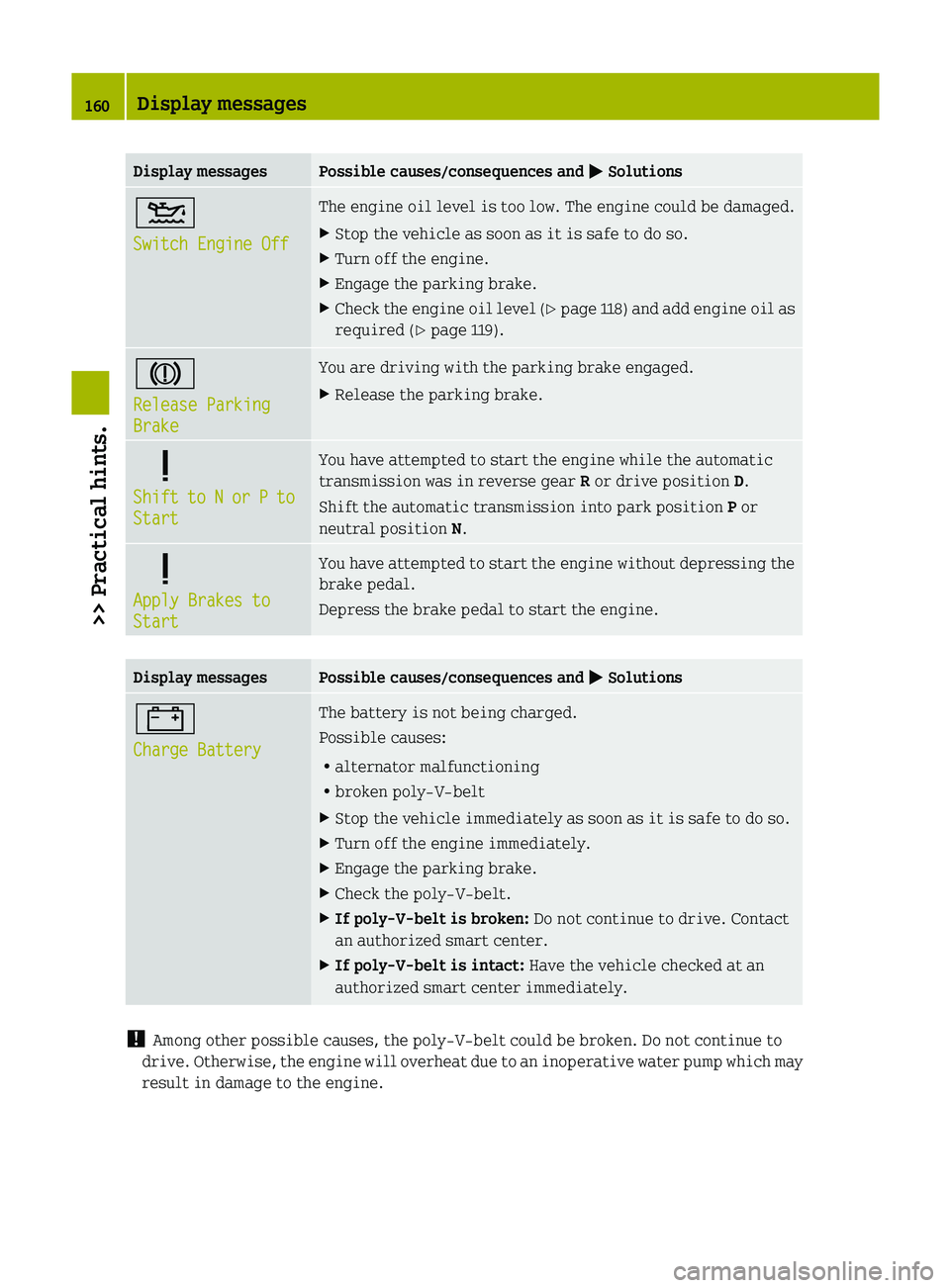
Display messages Possible causes/consequences and
M Solutions4
Switch Engine Off The engine oil level is too low. The engine could be damaged.
X
Stop the vehicle as soon as it is safe to do so.
X Turn off the engine.
X Engage the parking brake.
X Check the engine oil level (Y page 118) and add engine oil as
required (Y page 119). J
Release Parking
Brake You are driving with the parking brake engaged.
X
Release the parking brake. 5
Shift
to N or P to
Start You have attempted to start the engine while the automatic
transmission was in reverse gear
R or drive position D.
Shift the automatic transmission into park position P or
neutral position N.5
Apply Brakes to
Start You have attempted to start the engine without depressing the
brake pedal.
Depress the brake pedal to start the engine.
Display messages Possible causes/consequences and
M Solutions#
Charge Battery The battery is not being charged.
Possible causes:
R
alternator malfunctioning
R broken poly-V-belt
X Stop the vehicle immediately as soon as it is safe to do so.
X Turn off the engine immediately.
X Engage the parking brake.
X Check the poly-V-belt.
X If poly-V-belt is broken: Do not continue to drive. Contact
an authorized smart center.
X If poly-V-belt is intact: Have the vehicle checked at an
authorized smart center immediately. !
Among other possible causes, the poly-V-belt could be broken. Do not continue to
drive.
Otherwise, the engine will overheat due to an inoperative water pump which may
result in damage to the engine. 160
Display messages
>> Practical hints.